Int. J. Electrochem. Sci., 12 (2017) 1680 – 1689, doi: 10.20964/2017.03.38
International Journal of
ELECTROCHEMICAL
SCIENCE
www.electrochemsci.org
Short Communication
Investigation of Electrochemical Property and Crystal Structure
of
Schiff Base Cobalt(III) Complex
Liyan You, Hui Jiang, Xianwu Dong and Chaohong Ma*
Department of Chemistry, College of Arts and Science, Jilin Agricultural Science and Technology University, No.77 Hanlin Rd, Jilin Economic and Technological Development Zone, Jilin, 132101, P.R China
*
Email: [email protected]
Received: 19 November 2016 / Accepted: 4 January 2017 / Published: 12 February 2017
A Co(III) complex (CoL)Cl·4H2O was successfully synthesized with a new Schiff base L. Structure
analysis reveals that mononuclear cationic complex unit (CoL)+ with approximate octahedral geometry of central Co (III) ion existed in the as-prepared cobalt complex. The diameter of cobalt complex nanoparticles after the deposition on glass substrate was found to be around 63nm. In the cyclic voltammetry curves of cobalt(III) complex, two reversible redox waves ascribed to the consecutive redox processes of Co (III)/Co (II) and Co (II)/Co (I) pairs were found, suggeating the successful formation of CoIII complex.
Keywords: Cobalt(III) complex; Schiff base; Electrochemical property; Crystal structure; FT-IR
1. INTRODUCTION
3d-Metal complexes, typically synthesized with Schiff base ligands, have attracted enormous attention owing to the remarkable magnetic, catalytic and biological properties. Among the large number of 3d metal ions, Cobalt with the valence state of +3 is of great importance with unusual magnetic and catalytic properties [1-9].
direct use of Co(III) salts as homogeneous catalysts in order to improve the reaction rate [11, 12]. Although the study in Co(III) catalyst is still in initial stage, several Co(III) catalytic systems have already been developed [13-16].
In order to achieve repeated use, supported catalysts which are synthesized via surface functionalization and incorporation of metal complex onto the surface of supports are highly demand [8, 17-23]. Polymer especially chloromethyl polystyrene has opened up new opportunities for the synthesis of supported catalysts [24-27]. Recently, the catalytic activity of massive metal complex such as transition metals coordinated with N, O-containing ligands for various catalytic organic reactions has received a lot of attention and research. However, less attention has been paid to the catalytic activity of polymer that incorporating N, O-donor ligands up to now.
In this study, cobalt (III) complex composed of Schiff base ligand (L) was successfully prepared. The crystallographic structure and electrochemical character of as-prepared cobalt (III) complex was investigated by X-ray diffraction (XRD) and cyclic voltammetry (CV). Then nano-sized cobalt (III) complex was deposited on glass substrate, and the obtained sample was characterized with UV-Vis spectroscopy (UV-Vis) and scanning electron microscopy (SEM).
2. EXPERIMENTS 2.1. Chemicals
Chloromethylated polystyrene, sulfides and alkenes were purchased from Sigma-Aldrich. Cobalt (II) chloride hexahydrate, triethylenetetramine, 2-hydroxyacetophenone and 30% H2O2 were
supplied by Merck. All reagents and solvents were used as received without subsequent purification.
2.2. Characterizations
1
2.3. Synthesis of Schiff base ligand (L)
Schiff base ligand (L) was prepared according to the method reported by Islam et al. [28] with some modification. 20 mL of N,N′-bis-(2-aminoethyl)ethylenediamine methanol solution (10 mmol) was added to 20 mL of 2-hydroxyacetophenone methanol solution (20 mmol) and the mixture was refluxed in a water bath for 4 h. Then the resulted dark yellow solution was poured into crushed ice in order to achieve the yellow precipitate. Finally, the achieved solid was rinsed thoroughly with water and then dried. The following related characterizations indicated the successful synthesis of Schiff base ligand (L). C22H30N4O2 (3.99 g, 88%): calcd. C 69.13, H 7.78, N 14.45 (%); found C 69.08, H
7.81, N 14.42 (%). Mass spectrum (EI): m/z 382 (M+ = L+). 1H NMR (CDCl3, ppm): δ = 16.12 (s, 2 H,
phenolic OH), 7.52–6.88 (m, 8 H), 3.67–3.73 (m, 4 H), 2.75 (t, 4 H), 2.60 (t, 4 H), 2.32 (s, 6 H, methyl), 2.23(s, 2H, amine). 13C NMR (CDCl3, ppm): δ = 163.4, 160.3, 131.1, 130.5, 123.1, 120.7,
116.5, 49.7, 46.6, 43.3, 14.1.
2.4. Synthesis of cobalt(III) complex (CoL)Cl 4H2O
A solution of NEt3 in ethanol (2 mmol) was added slowly to a yellow solution of Schiff base
ligand in 30 mL of ethanol (1 mmol). Then a solution of CoCl2·6H2O in ethanol (1 mmol) was added
dropwise to the mixture solution under magnetic stirring. The obtained homogeneous solution was refluxed for 2 h. After cooling down to room temperature naturally, the reaction solution was kept unperturbed in order to evaporate the solvent slowly. Pink single crystal was obtained from mother liquor by filtration after several weeks.
2.5. Synthesis of polymer attached cobalt complex
2 g of chloromethylated polystyrene with the Cl concentration of 5.5 mmol/g and 5.5 mmol of Schiff base ligand (L) were added into 100 mL of DMF in a round bottom flask (250 mL) under stirring, and the obtained mixture was treated with stirring at 100 °C. After 24 h, the reaction solution was filtered. The obtained Schiff base-functionalized polymer was rinsed thoroughly with DMF and dried in vacuum oven for 12 h. 2 g of Schiff base-functionalized polymer was dispersed into 50 mL of ethanol for 30 min. Subsequently, an ethanolic solution of CoCl26H2O (1% w/v) was added to the
above solution and the mixture was heated to 70 °C for 6 h. The reaction solution was treated with filtration and the obtained solid was rinsed with ethanol. The resulted polymer impregnated with metal complex was named as PS-TETA-Co 3.
3. RESULTS AND DISCUSSION
[image:4.596.109.488.293.514.2] [image:4.596.110.487.295.514.2]
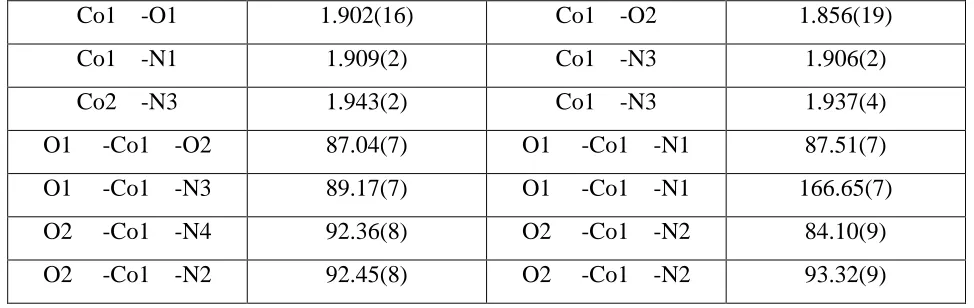
geometries, which might resulted from the structural constraints caused by the coordinated polydentate ligand. It was found that the cisoid and transoid angles between nitrogen atoms of imine and Co(III) ion was in the range of 82.97(8)-96.46°(9) and 175.45(8)-178.04°(8), respectively, indicating that the nitrogen atoms of imine bind with each other in trans fashion. The trans angle (175.45-178.04°) is close to the angle in ideal octahedral geometry (180°). The bond distances of Co-N and Co-O range from 1.876 to 1.9488 Å, which consistent with other similar cobalt (III) Schiff base complexes. The Co–N and Co–O bond distancesranging from 1.876 to 1.9488˚A agree well with similar other Schiffbase complexes of cobalt(III) [29-31].Table 1 showed the collected crystallographic data and structure refinement parameters. The obtained bond lengths and angles after refinement were shown in Table 2.
Table 1. Crystal data and details of the structure determination.
Formula C22H28CoN4O2,4(H2O),Cl
Formula weight 546.93
Space group P−1 (no. 2)
a (Å) 10.0667 (12)
b (Å) 10.2854 (13)
c (Å) 13.0365 (18)
α (°) 70.811 (2)
β (°) 70.878 (2)
γ (°) 72.789 (2)
V (Å3) 1197(3)
Z 2
D (calc) (g/cm3) 1.51
μ(Mo Kα) (/mm) 0.868
F(0 0 0) 571
Crystal size (mm) 0.04 × 0.08 × 0.10
Table 2. Some selected bond lengths (Å) and bond angles (º) of complex (CoL)Cl· 4H2O.
Co1 -O1 1.902(16) Co1 -O2 1.856(19)
Co1 -N1 1.909(2) Co1 -N3 1.906(2)
Co2 -N3 1.943(2) Co1 -N3 1.937(4)
[image:4.596.55.542.566.720.2]
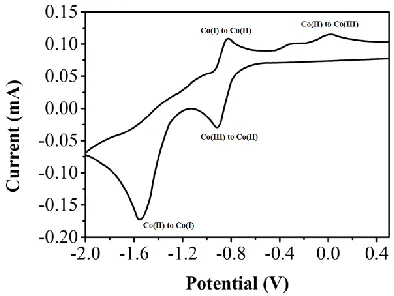
Cyclic voltammetry (CV) curves were achieved to investigate the electrochemical character of Co (III) complex. Specific experimental parameters were as follows: tetrabutylammonium perchlorate dissolved in DMF solution (0.05 M) as electrolyte, 100 mV/s as scanning rate and -2 to 0.5 V (vs. Ag/AgCl) as potential range. As can be seen from the obtained cyclic voltammetry (CV) curves for Co(III) complex (Fig. 1), two pairs of reversible redox waves could be found, which belonged to the consecutive redox processes of Co(II)/Co(I) and Co(III)/Co(II) pairs. As to the first pair of redox wave which was ascribed to the redox process of Co (III)/Co (II), the peak potentials were 0.132 V (Epa1)
and -0.879 V (Epc1), respectively, and thus the gap between anodic and cathodic peak (ΔEp1) was
1.011 V. The proportional of cathodic peak current to anodic peak current (ipc1/ipa1) was calculated to
be 1.412. Similarly, the second pair of redox wave which was ascribed to the redox process of Co (II)/Co (I), the peak potentials were -0.799 V (Epa2) and -1.541 V (Epc2), respectively, and thus the
gap between anodic and cathodic peak (ΔEp2) was 0.742 V.
Figure 1. Cyclic voltammogram of (CoL)Cl 4H2O complex. Condition: scan rate: 50 mV/s;
electrolyte: 0.05 M DMF.
Figure 2. UV-vis absorption spectra of L and (CoL)Cl·4H2O.
The proportional of cathodic peak current to anodic peak current (ipc2/ipa2) was calculated to
[image:5.596.200.397.295.443.2] [image:5.596.180.419.514.691.2]
redox waves were found to be ascribed to the consecutive redox processes of Co (III)/Co (II) and Co (II)/Co (I) pairs, affirming the successful formation of CoIII complex [33-37].
UV-vis absorption spectra of L and (CoL)Cl·4H2O were measured by dissolving samples in
0.05 mM CH2Cl2 solution and the results were given in Fig. 2. As can be seen from the UV-vis
absorption spectrum of L, three absorption peaks were observed at 242, 303 and 366 nm, respectively. The absorption spectrum of (CoL)Cl·4H2O was different from that of L. Firstly, the absorption peak at
366 nm was found to be absent in (CoL)Cl·4H2O. Secondly, the absorption peak at 242 nm exhibited a
shift to 248 nm and 269 nm for (CoL)Cl·4H2O. In addition, a new obscure absorption peak at 453 nm
was found in the absorption spectrum of (CoL)Cl·4H2O, which could be ascribed to the d-d transition
of Co(III) ion. The intense band around 453 nm corresponded to ligand-to-metal charge transfer (LMCT) transitions [38].The Co(III) complex with 3d6 electronic configuration belonged to 4T1g(F) → 4T1g(P) d-d transition of six coordinated Co(III) ion [39]. Co (III) ion was verified to be in
octahedral geometry as indicated by the spin-allowed d-d bands. In addition, the d-d electronic transition was caused by the splitting of 3d levels in coordination compounds. All the results herein were similar to the spectral signature of transition state metal complexes. These absorptions also present in thespectrum of the cobalt complex but shifted which indicates thecoordination behavior of the polymer anchored Schiff base ligandto the metal ion. Polymer anchored cobalt complex shows an addi-tional band at 625–700 nm which can be assigned to d→d transition [40].
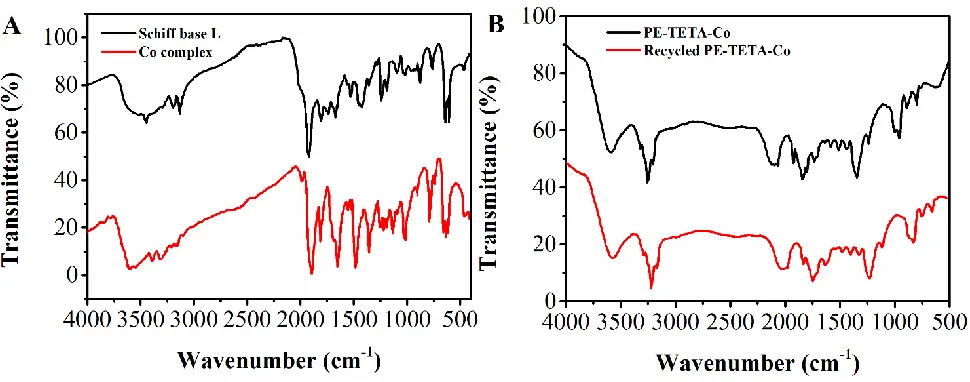
Figure 3. (A) FT-IR spectra of Schiff base L and cobalt complex (CoL)Cl·4H2O. (B) FT-IR spectra of
polymer, polymer supported Schiff base ligand and polymer supported cobalt complex.
Fig. 3A showed the FT-IR spectra of Schiff base ligand (L) and cobalt complex (CoL)Cl·4H2O.
[image:6.596.52.537.394.585.2]
ligand L (1280 cm−1), demonstrating the coordination of metal through phenolic oxygen. The peak observed at 1493 cm−1 for L corresponds to N-H (secondary amine) bending vibration. However, this peak was absent in (CoL)Cl·4H2O, indicating the absence of N-H (secondary amine) bond in cobalt
complex. Moreover, the bands at 3465 and 1540 cm−1 was resulted from the υ(OH) stretching of lattice water molecule in the cobalt complex.
FT-IR spectra of polymer, polymer supported Schiff base ligand and polymer supported cobalt complex was investigated and the results were shown in Fig. 3B. Owing to the low concentration of complex, the intensity of polymer supported metal complex was weak. As shown form the FTIR spectrum of polymer supported metal complex, a band at 1660 cm−1 ascribed to C=N bond of polymeric support was observed. In addition, a sharp peak at 1263 cm−1 ascribed to CCl bond of -CH2Cl group in polymer weaken after the load of Schiff base on polymer support. The two
phenomenons mentioned above confirmed the successful loading of Schiff base (L) on polymer matrix. The N-H (secondary amine) bending vibration (1487 cm−1) observed in L was found to be absent in the polymer supported Schiff base ligand, indicating that the attachment of Schiff base (L) to polymer was carried out via secondary amine ‘N’ atom. The frequency of phenolic (C-O) stretching in polymer anchored ligand was observed at 1366 cm−1. The bands ascribed to C=N and phenolic (C-O) was found to shift to lower and higher frequency region after complexation, respectively.
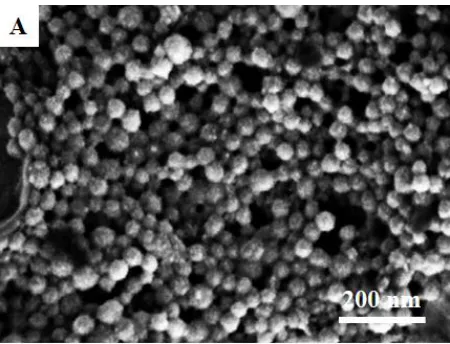
The morphology feature of nano-sized (CoL)Cl· 4H2O complex was investigated by SEM after
the deposition of complex on glass substrate and the results were shown in Fig.4 . The cobalt complex molecules could be dispersed uniformly into nanoparticles after the deposition on glass substrate. The diameter of nano-sized (CoL)Cl·4H2O complex was found to be around 63nm. The aggregation of
[image:7.596.186.411.456.628.2]nano-sized particles still existed as indicated from SEM images.
Figure 4. SEM top view image of nano-sized (CoL)Cl·4H2O complex.
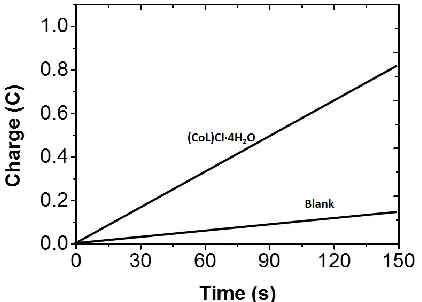
versus Ag/AgCl, the maximum charge was only 47 mC in 2 min of electrolysis in the absence of complex 1 (Fig. 5).
Figure 5. Charge buildup of 0.25 M phosphate buffer and (CoL)Cl·4H2O complex at pH 7.0.
4. CONCLUSIONS
Nano size (CoL)Cl·4H2O complex was successfully prepared with the employment of a new
Schiff base ligand (L). Cyclic voltammograms curves of CoL)Cl·4H2O complex demonstrated the
quasi-reversible redox process of Co(III)/Co(II) and Co(II)/Co(I) pairs. Co (III) ion was verified to be in octahedral geometry as indicated by the UV-vis absorption spectrum. FTIR spectrum of polymer supported cobalt complex indicated that Schiff base (L) was attached to polymer via secondary amine ‘N’ atom. The diameter of as-prepared nano-sized (CoL)Cl·4H2O complex was found to be around
63 nm.
ACKNOWLEDGEMENT
This work was supported by Foundation of Jilin Educational Committee([2015]377); Science and Technology Development Funds of Jilin city(20156431); The Doctoral Scientific Research Foundation of Jilin Agricultural Science And Technology University ([2012]302) and Youth Foundation of Jilin Agricultural Science And Technology University ([2014]209).
References
1. R. Sabatini, B. Lindley, T. McCormick, T. Lazarides, W. Brennessel, D. McCamant and R. Eisenberg, J Phys Chem B, 120 (2016) 527.
2. M. Yin, S. Ma, C. Wu and Y. Fan, RSC Advances, 5 (2015) 1852.
3. Y. Liu, W. Ren, C. Liu, S. Fu, M. Wang, K. He, R. Li, R. Zhang and X. Lu, Macromolecules, 47 (2014) 7775.
4. B. Sun, T. Yoshino, S. Matsunaga and M. Kanai, Advanced Synthesis & Catalysis, 356 (2014) 1491.
[image:8.596.197.408.113.264.2]
Japan, 86 (2013) 983.
7. L. Zhou, L. Fu and S. Zhan, J. Mol. Catal. A: Chem., 404 (2015) 227.
8. B. Sun, T. Yoshino, S. Matsunaga and M. Kanai, Advanced Synthesis & Catalysis, 356 (2014) 1381.
9. Y. Zhang, L. Fu, L. Zhou, S. Zhan and W. Li, Synthetic Metals, 212 (2016) 69. 10.A. Jayaseeli, A. Ramdass and S. Rajagopal, Polyhedron, 100 (2015) 59. 11.V. Sharma, S. Jain and B. Sain, J. Mol. Catal. A: Chem., 227 (2005) 47.
12.T. Punniyamurthy, S. Velusamy and J. Iqbal, Chemical Reviews, 105 (2005) 2329.
13.R. Chakrabarty, P. Sarmah, B. Saha, S. Chakravorty and B.K. Das, Inorganic Chemistry, 48 (2009) 6371.
14.P. Hinsinger, Plant and Soil, 237 (2001) 173.
15.P. Sarmah, R. Chakrabarty, P. Phukan and B. Das, J. Mol. Catal. A: Chem., 268 (2007) 36. 16.B. Sadeghi, B. Mirjalili and M. Hashemi, Tetrahedron Letters, 49 (2008) 2575.
17.M. Villamil, Q. Liang and Z. Zhuang, Cell Biochemistry and Biophysics, 67 (2013) 111. 18.M. Lotz, D. Spielvogel and B. Pugin, Chimica Oggi-Chemistry Today, 30 (2012) 5.
19.J. Awrejcewicz, Y. Lind, I. Gubaidullin and K. Koledina, Theoretical and Applied Mechanics Letters, 2 (2012) 043003.
20.J. Beatty and C. Stephenson, Accounts of Chemical Research, 48 (2015) 1474. 21.E. Shul’ts and G. Tolstikov, Russian Chemical Bulletin, 62 (2013) 605.
22.L. Chen, W. Xu, B. Huang, J. Ma, L. Wang, J. Xi, K. Harms, L. Gong and E. Meggers, Journal of the American Chemical Society, 135 (2013) 10598.
23.H. Huo, C. Fu, K. Harms and E. Meggers, Journal of the American Chemical Society, 136 (2014) 2990.
24.M. Bakherad and S. Jajarmi, J. Mol. Catal. A: Chem., 370 (2013) 152.
25.M. Tavassoli, A. Landarani-Isfahani, M. Moghadam, S. Tangestaninejad, V. Mirkhani and I. Mohammadpoor-Baltork, Applied Catalysis A: General, 503 (2015) 186.
26.B. O’Driscoll, R. Kelly, M. Shaw, P. Mokarian-Tabari, G. Liontos, K. Ntetsikas, A. Avgeropoulos, N. Petkov and M. Morris, European Polymer Journal, 49 (2013) 3445.
27.M. Bakherad, B. Bahramian and S. Jajarmi, Journal of Organometallic Chemistry, 749 (2014) 405. 28.S. Islam, A. Roy, S. Dalapati, R. Saha, P. Mondal, K. Ghosh, S. Chatterjee, K. Sarkar, N. Guchhait
and P. Mitra, J. Mol. Catal. A: Chem., 380 (2013) 94.
29.C. Floriani, M. Fiallo, A. Chiesi-Villa and C. Guastini, Journal of the Chemical Society, Dalton Transactions, (1987) 1367.
30.H. Liu, Case Study: Covering Index, Oracle Database Performance and Scalability, John Wiley & Sons, Inc.2011, pp. 531.
31.S. Sasi, M.R.P. Kurup and E. Suresh, Journal of Chemical Crystallography, 37 (2007) 31. 32.J. Liu, J. Cao, W. Deng and B. Chen, Journal of Chemical Crystallography, 41 (2011) 806. 33.K. Gr nwald, M. Volpe, P. Cias, G. Gescheidt and N. M sch-Zanetti, Inorganic Chemistry, 50
(2011) 7478.
34.F. Bustamante, J. Metello, F. de Castro, C. Pinheiro, M. Pereira and M. Lanznaster, Inorganic Chemistry, 52 (2013) 1167.
35.J. Cao, K. Shang, W. Deng and J. Liu, Inorganic Chemistry Communications, 29 (2013) 183. 36.M. Habibi, E. Shojaee, Y. Yamane and T. Suzuki, Journal of Inorganic and Organometallic
Polymers and Materials, 22 (2012) 190.
37.F. Hwang, H. Chen, P. Chen, C. Liu, Y. Chi, C. Shu, F. Wu, P. Chou, S. Peng and G. Lee, Inorganic Chemistry, 44 (2005) 1344.
38.D. Sarma, K. Ramanujachary, S. Lofland, T. Magdaleno and S. Natarajan, Inorganic Chemistry, 48 (2009) 11660.
40.S. Islam, M. Mobarok, P. Mondal, A. Roy, N. Salam, D. Hossain and S. Mondal, Transition Metal Chemistry, 37 (2012) 97.