Kingdom of Tonga
European Community
Joint
Annual Report 2008
r .,
I
! "
1.
EXECUTIVE SUMMARY1.1.
IntroductionArticle 5, Annex IV of the Cotonou Agreement requires that the National Authorising Officer and Head of Delegation shall annually undertake an operational review of the indicative programme to ensure that operations are kept in line with the objectives of the Agreement and to take account of any changes in the economic situation, priorities and objectives of the relevant country. This joint annual report for 2008 fulfils this reporting requirement and serves as a basis to carry out the Annual Operational Review in 2009.
The overall National Indicative Programme (NIP) for the Kingdom of Tonga from 10th EDF was increased by 16% in comparison to the previous gth EDF and that is a good indication of the overall successful cooperation with the EC.
With the signature of the 10th EDF CSP/NIP, the Government of Tonga agreed to apply EDF support nationwide after more than three decades of focusing in the Island Group of Vava'u. As of January 2008 the Minister of Finance and National Planning took over the NAO office and the overall management of the EC programmes in Tonga in line with efforts for increased donor coordination.
The completion of the major programme under the gth EDF, Vava'u Social Sector Support Programme (VSSSP) was noted to be very satisfactory and implementation of a number of other programmes financed under the gth EDF and ST ABEX was either on-going or started procurement.
Both the Government of Tonga and the EC Delegation recognize that effective and efficient communication networking amongst the Key Stakeholders is important for ensuring the successful implementations of all the EC programmes in Tonga.
The year 2008 for Tonga was marked by a period of consolidation in terms of economic development while at the same time the government took some decisive steps towards necessary political reforms. While the energy price increases during 2008 had adverse impacts for the Tongan economy, growth remained still positive, mainly due to a strong increase of tourism and continuing, although slightly decreasing remittances.
1.2.
Update of the political, economic and social situation
Update on the political situation
Although Tonga had quickly restored law and order after the riots of 16 November 2006, the State of Emergency continued throughout the years of 2007 and 2008 but its scope was significantly reduced. The results of Tonga's 2008 General Elections were decided by less than half of the people who are registered to vote when 32,000 Tongans turned out to vote on 24 April 2008. Pro-democracy candidates won six out of nine parliamentary seats on offer in the elections; however, three of them were still facing charges over the November 2006 riots.
The Government, being conscious of the challenges of a substantial agenda of reforms, covering political and constitutional issues, the public service as well as economic and fiscal changes, embarked on the elaboration of what could be seen as a road map to reforms. Just before his Coronation in August 2008, the King assented the legislation passed by the Legislative Assembly
r
r··,_
' '
L
to form a Constitutional and Electoral Commission to review the progress on political reform and to work towards full democratic reform by 2010.
In November, Tonga's former chief justice Gordon Ward has been appointed chairman of the Political Reform Commission. Members of the Commission consist of one candidate each from the Peoples' and Nobles Representatives with two nominated from the Judicial Services Commission. The Commission plans to begin public consultations and hearing petitions on democratic reform in early 2009.
The situation of Human Rights in Tonga was subject to a Universal Periodic Review at the UN Human Rights Commission in May 2008. Tonga is party to only two core Human Rights treaties: ICERD and CRC and its reports are long overdue. The Tongan government responded that this is not because of lack of will, but due to technical and capacity constraints and the reporting regime is seen as a disincentive to the ratification of other international HR instruments. However the review might be a catalyst for consideration of the remaining HR instruments, especially in view of the political and constitutional reforms underway.
During 2008 no progress has been made regarding ratification of the core UN human rights convention such as the International Covenant on Civil and Political Rights, the International Covenant on Economic, Social and Cultural Rights and the Convention against Torture and Other Cruel, Inhuman or Degrading Treatment or Punishment. No progress can be reported either towards the ratification of CEDAW.
Update on the economic situation
The composition of Tonga's economy has not changed significantly in the last five years. The Agriculture, Forestry and Fishing industry remains the highest contributor to economic activity at 25% of GOP, followed by Commerce, Hotels and Restaurants (17%); Government Administration and Community Services (13%), Finance and Business services (12%), Construction (10%), Transport and Communication (8.6%). Remittances, from both temporary and long-term emigrants, continue to give strong support to Tonga's economy.
Tonga's economy1 has shown some resilience in the face of internal and external shocks. The Ministry of Finance and National Planning now estimates that the Tongan economy will grow by 0.4 % in 2008/09 with construction, transport and services providing the impetus. This is a downward revision from the 3% forecast at the time of the 2008/09 Budget. A number of tourism and agricultural initiatives are in the pipeline in order to address growing demand. These initiatives allowed Tonga to tap into its unused economic potential and also bring some much needed diversity into the Tongan economy.
This should also help to address the problem of a narrow economic base and reliance on a few key exports that has been a constraint in expanding the Tongan economy. This economic growth is underpinned by strong remittances, increasing foreign aid and recovery in private investments. These favourable economic developments are expected to help the government to maintain a balanced budget for 2008/09 financial year. The main features of the 2008/09 budget include:
l
• an inclusive process with the ministries setting their own revenue and expenditure targets;
• increased government revenue due to economic growth and improved revenue compliance;
Ref: Statement by the Hon. Minister of Finance and National Planning, October 2008 at the Board of Governors Annual Meeting, International Monetary Fund in Washington DC
:f_ -,
• Government maintains its prudent fiscal stance of recent years;
• Health and Education see increases in their budget allocation of around TOP 3 million each.
For the first time in a number of years the Government is able to significantly increase its capital expenditure and improve the country's infrastructure (road maintenance, border security and customs compliance equipment, etc.).
The impact of the global financial crisis has encouraged the whole Nation to wisely use its resources as means of immediate objective. The government has removed customs duty from a number of imported goods (meat and poultry, fuel) and services in July 2008 in a bid to assist the public in the light of the rising food and oil prices at the time. As a consequence of the high world commodity prices, import payments continued to rise and inflation has risen, reaching 10.6 % in the year to January 2008, after averaging 5.8% in 2007.
The effective coordination of the foreign aids remains a priority for the Government. The Government continued with its public and economic reform to enhance the productivity at both the public and the private sectors. The Government also committed in 2008 to conclude the final preparation of rebuilding the Nuku'alofa Central Business District. This project is anticipated to create a new dimension of business and economic development in Tonga in the next 3 to 5 years.
Update on the poverty and social situation
Despite the non-existence of absolute poverty in Tonga, the investments of the Tonga Government on Education and Health sectors remain a priority. The Government offers free basic education and subsidies to the operation of the non-government High Schools in Tonga. One of the biggest challenges schools faced in 2007 and 2008 was a shortage of teachers in both primary and secondary schools in Tonga. The Government aims to address this problem with an intake of more than 50 teachers and a plan to monitor areas where students are performing poorly. The South Pacific Board of Examinations had reviewed the literacy level and found that reading and mathematics had the lowest scores. The costs of health services are also heavily subsidized by the Government. Thus Tonga continues to have the best HOI and MDG attainment rates in the Pacific.
The context of poverty in Tonga is associated with the i) limited employment opportunities; ii) lack of access to basic services and iii) lack of Government responsive to the needs of the people. The establishment of the new Ministry of Training, Employment, Youth and Sports is anticipated to improve the overall employment opportunities in Tonga.
A new work scheme with New Zealand and now Australia provide employment for Tongans working in New Zealand and Australia through the overview of the Ministry of Labour, Commerce and Industry. The interventions of the EU - Vava'u Social Sector Support Programme have improved dramatically the access to education and health services from building and remodelling new schools, classrooms, staff quarters, roads, health clinics and the procurements of necessity medical equipment for the Hospital and the Rural Health Clinics in Vava'u.
Update on the environmental situation
The environmental policy guideline in Goal 7 of the National Strategic Development Plan 8 indicated the commitment of Tonga to ensure the environmental sustainability and disaster risk reduction. This is underpinned by several projects that the Government of Tonga committed to, including the completion of a multi-million project for developing a land fill and waste management area at Tapuhia, funded by AusAID. Tonga has completed and implemented waste management legislations and it is anticipated that the agreement to focus the 101h EDF on
i'""-;
renewable energy will contribute significantly to the reduction of imports of diesoline for power generation.
2.
OVERVIEW OF PAST AND ONGOING CO-OPERATION2.1. Reporting on the financial performance of EDF resources
Focal area 1 Renewable Ene
Non focal areas
- TCF, incl. NSA Indicative allocation 10th EDF (M€) 5.0 0.9 5.9 0.9 6.8 Commitments planned in 2008 * (M€) (add in brackets planned share of SBS) 5.0
0.9
5.9
Commitments Realised/ realised in planned(%) 2008 (M€) (add in (add in brackets brackets ratio effective realised/ share of SBS) planned 0
0 0
0 0
0
0
Disbursements realised in 2008 (M€)
0
0
0
0
Implementation of the 1oth EDF has not yet started due to on-going discussions on different options for project implementation regarding scope and modalities. A pre-identification study early 2008 by a consultant for Renewable Energy has outlined options to which the government could not fully agree. Consequently it was decided that a fully fledged feasibility study will be conducted covering the preferred option of the Government as well as alternative projects as pre-identified by the consultant of the above mentioned study. Preparations for this feasibility study are under way in coordination with other donors active in Renewable Energy in Tonga.
For the non-focal areas, preparations are also underway to have a financing decision in 2009. 2.2. Projects and programmes in the focal and non focal areas
The Government of Tonga managed to de-commit and allocate the remaining funds from previous EDFs before the sunset clause applied to i) Stabex (€2,504,000), ii). Tonga -Sustainable urban and environment management - Capacity building and environmental protection (€2,014,000) and iii). Vava'u Social Sector Support Programme (€500,000) to make a total de-committed budget of €5,018,000.
In terms of financial performances, the Government of Tonga is satisfied with the progress of the overall fund control and management.
f '
{
L
gth EDF- A Envelope (Focal Area, VSSSP)- €3.5 million: The completion of the Vava'u Social Support Programme in 2008 is a milestone for the development of health and education sectors in Tonga. The investments on health services catered for more than 10,000 people. This included renovating completely existing quarters and building new staff quarters, supplying of medical equipment to the Hospital and the 4 Rural Health Centers. The establishment of a new Health Clinic and several trainings by the Tonga Red Cross, Family Planning and the Non-Government Organizations underpinned the promotion of the good health at the Island Group of Vava'u. The complete renovations and building of more than 50 classrooms and 15 staff quarters have impacted dramatically the education services in both the Government and Church Schools in Vava'u. Following the internal evaluation to the Vsssp, it was indicated that the new education and health environment has huge impacts on the performance of the pupils and the health workers.
91h EDF- A Envelope (Non-Focal Areas, TCF) - €0.5 million: The appointment of theTA to
the NAO was effective from the 51h of August 2008 for 2 years. The T A to the NAO is based in the Ministry of Finance and National Planning and it is noted the sound coordination of the EC National and Regional programmes in Tonga. The "Reconciliation and Civic Education" programme has convened several district workshops and the positive impacts of this programme in the process of reconciliation and political reform is well noted.
91h EDF - B Envelope, Natural Disaster Preparedness - €1. 11 million: The Pacific Island
Countries agreed that this regional project be implemented by the South Pacific Geosciences Commission (SOPAC). The project would ensure water quality and availability in Nuku'alofa and rural communities during the events of natural disasters. In 2008 the Project Manager tendered out the upgrading of the Mataki'eua water supply for the whole of Nuku'alofa. The project is progressing very satisfactorily.
Previous EDFs, FLEX 2006- Sustainable urban and Environmental Management gth EDF-2.014 million: This project started towards the end of 2008 with the preparation of tender dossiers for conducting topographical survey as part of the assistance for the rebuilding of Great Nuku'alofa and the recruitment of a long-tem TA to assist the Ministry of Lands, Survey, Natural Resources and Environment on Town Planning. The topographical survey and urban planning services are expected to commence in 2009.
Previous EDF Stabex - €2.504 million: The Start up Programme Estimate was effective from the 111h of September 2008. The programme is focused specifically on enhancing agricultural and livestock development in Tonga with attentions on export commodities and intensification and diversification, post harvest handling, processing and market infrastructure development, livestock development initiatives and agro-processing and added value products development. The Stabex Coordination Unit was also established in 2008 and all the Stabex Budget is already committed from approving the final Programme Estimate 2 towards the end of 2008.
);> Other cooperation
The NAO Office acknowledges the importance to ensure the positive impacts of the regional and intra-ACP programmes to the Pacific Island Countries. In 2008, an EU Working Committee was established by the NAO with a clear mandate to coordinate all the EU projects outside the NIP. This is to enhance the complementary of the NIP and the Rl P and lntra-ACP projects. Again, it is noted the alignment of these programmes with the objectives of the National Strategic Development Plan 8.
a) The NAO Office opted to enhance proactive participations of Tonga on the formulation and preparation of regional and intra-ACP programmes;
b) The Government of Tonga submitted the FLEX statistics for 2007; however Tonga was found not eligible under FLEX application year 2007;
c) The EIB interventions are progressing well and according to the Tonga Development Bank, this soft loan packages have been very instrumental for the income generating projects in the agriculture and trade sectors;
e) Tonga is looking for more opportunities to exploit other Community interventions including the European Instrument for Democracy and Human Rights, the Instrument for Stability, Fishery Agreements etc. and again, the closer working of the NAO Office, the Ministry of Foreign Affairs and the Tonga High Commissioner in London with the EC will enhance the active participation of Tonga on the above financial opportunity from the EU.
);> Policy Coherence for Development (PCF)
Tonga on its development policy cohere the Millennium Goals. The focusing of the previous NIP, VSSSP on social sector have substantiated the objective in the millennium goal for basic education to be achieved by 2015 and for every children in Tonga to complete formal primary education by this year. The programme also substantiates health services to reducing child mortality and improving maternal health (Goal4). The awareness programmes from VSSSP also assist reducing the spread of HIV/Aids in Tonga (Goal 5).
It is anticipated that the interventions in Renewable Energy under EDF 1 0 will contribute to the aim of combating climate change. Again, this programme is anticipated to enhance clean and health environment and will eventually contribute to the Millennium Goals 7 and 8.
The Government of Tonga seriously took the importance of effectively coordinating all the aid programmes to ensure their positive impacts on the economic and social development in Tonga. This involved capacity building and the establishment of project coordination committees to enhance information exchange between the aid donors.
);> Dialogue in country with the national Parliaments, local authorities and NSAs
Under the 91h EDF, Non-State Actors were and continue to be involved in the implementation of various activities under the programmes in the focal and non-focal area. Whenever feasible, the EC-Delegation consults with the Civil Society Forum of Tonga and its affiliated NSA-organisation on progress in implementation of the various programmes, the Joint Annual Report, programming of future interventions and other funding opportunities outside the EDF. In view of the planned intervention in support of NSA under the 1 01h EDF, consultations continued with other donors such as NZ-Aid and AusAID in order to streamline and coordinate the various approaches.
);> Aid effectiveness
Australia (AUD $ 15.7 million in 2007/2008) and New Zealand are the major players in political and economic terms as well as the biggest donors in Tonga, followed by the EU. The USA and China also play an important role, as well as the ADS, World Bank and Japan. Aligned to SDP 8, donors' support focuses on infrastructure development, construction of health facilities, rural area water projects, solid waste management, good governance/Public Sector Reform, etc. Australia and New Zealand have both a High Commission post in Tonga. No Member State is represented in the country. For more details see Donor Matrix in Annex.
Aid Coordination is centralised in the Aid Management Division of the Ministry of Finance & Planning with special focus laid on coordination of missions to Tonga. Following the shift of the
' ,
'
l,
l
f .
t
NAO's office to the Ministry of Finance and Planning, the EC's aid is now better embedded in the donor coordination efforts of the Government of Tonga.
The EC Delegation in Suva is in regular and frequent dialogue with the Government of Tonga and other donors present in the country through visits by EC officials and meetings with leaders at international fora. Donors also regularly brief each other on political, economic and cooperation matters in quarterly telecommunications.
3.
CONCLUSIONSIn conclusion, we note with gratitude the tireless efforts of the Head of Delegation and the National Authorising Officer and the other Key Stakeholders in assuring the sound implementation of the EC Programmes in Tonga during the year 2008.
Signatures :
The National Authorising Officer
Hon. '0. Afu'alo Matoto
Minister for Finance & National Planning and National Authorising Officer
The Head of Delegation
.<JJr4rl~
Wiepke Van Der Goot Head of Delegation
EC Delegation for the Pacific
'RITVA
SAllMEN
Charn,;,
~ . -:"'t "-< rt" . ·" , e.:i . -:·.ANNEX 2 - Annexes to the JAR
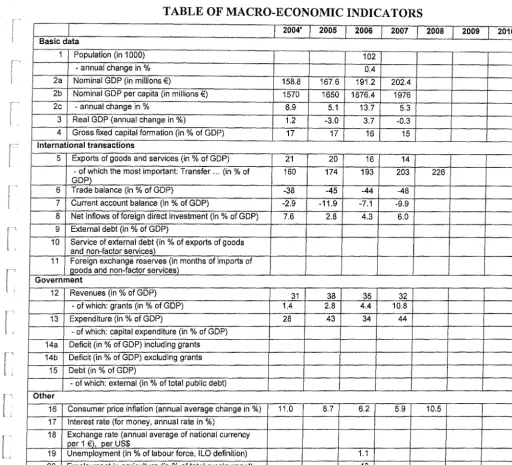
TABLE OF MACRO-ECONOMIC INDICATORS
2004' 2005 2006 2007 2008 2009 2010
Basic data
1 Population (in 1 000) 102
- annual change in % 0.4
2a Nominal GOP (in millions €) 158.8 167.6 191.2 202.4
2b Nominal GOP per capita (in millions €) 1570 1650 1876.4 1976
2c - annual change in % 6.9 5.1 13.7 5.3
3 Real GOP (annual change in%) 1.2 -3.0 3.7 -0.3
4 Gross fixed capital formation (in %of GOP) 17 17 16 15
International transactions
5 Exports of goods and services (in % of GOP) 21 20 16 14
- of which the most important: Transfer ... (in % of 160 174 193 203 226
GOP)
6 Trade balance (in% of GOP) -38 -45 -44 -48
7 Current account balance (in % of GOP) -2.9 -11.9 -7.1 -9.9
8 Net inflows of foreign direct investment (in % of GOP) 7.6 2.8 4.3 6.0
9 Extemal debt (in % of GOP)
10 Service of external debt (in %of exports of goods
and non-factor services)
11 Foreign exchange reserves (in months of imports of
goods and non-factor services)
Government
12 Revenues (in % of GOP) 31 38 35 32
-of which: grants (in% of GOP) 1.4 2.8 4.4 10.8
13 Expenditure (in % of GOP) 28 43 34 44
- of which: capital expenditure (in % of GOP)
14a Deficit (in % of GOP) including grants
14b Deficit (in % of GOP) excluding grants
15 Debt (in % of GOP)
- of which: external (in % of total public debt)
Other
16 Consumer price inflation (annual average change in %) 11.0 8.7 6.2 5.9 10.5
17 Interest rate (for money, annual rate in%)
18 Exchange rate (annual average of national currency
per 1 €)~ per US$
19 Unemployment (in % of labour force, ILO definition) 1.1
20 Employment in agriculture (in % of total employment) 48
'.
MONITORING COUNTRY PERFORMANCE
Key indicators 1990 2005 2006 2007 2008 lnterm. 2015
(Census Targets goals
2006)
1. Proportion of population below 1 $/day in 50%1990
ppp value
2. Prevalence of underweight children 50% 1990
value
3. Urider 5 child mortality 3/1000 1/3 1990
value
4. HIV prevalence rate of women aged 15-24 Halt/
reverse rate
5. Proportion of births attended by skilled 100%
health personnel
6. Proportion of 1 year old children 100%
immunised against measles
7. Net enrolment ratio in primary education 97.9% 100%
8. Ratio of girls to boys in primary and 1:1.01 1:1
secondary education
9. Primary school completion rate >75%
10. Proportion of population with sustainable 98.5% 50% 1990
access to an improved water source, % of total17,462 households
11. Fixed lines and mobile telephone per 8,977 &
1 000 inhabitants, # of households 12,736
12. Formal cost required for business start up2
13. Time required for business start up'0
2932 3027 3006
14. Real GOP per capita and annual change, 1172.8 1210.8 1202.4
€'000, (%) (-3%) (3%) (-1%)
15. Access of rural population to an all
season road3
16. Household electrification rate• (%of total 89.4%
households)
Source: www.doingbusiness.org
There are two main approaches to measuring this indicator: (a) household surveys that include information about access to transport, and (b) mapping data to determine how many people live within the specified catchments of the road network. A possible source of information for DEL, alternative to Govt, would be the WB (limited to 31 IDA countries).
The indicator is estimated using national household surveys and Core Welfare Indicators Questionnaire (CWIQ) surveys. For DEL the source would be the WB's Economic Research Group report, available for 50-55 countries.
Page 110
COMMITTED AND PLANNED AID PROGRAMMES (TONGA)- 2008/09 FY
Item NZAid AusAid Subtotal ADB WB EU UNDP Japan China CFTC Total
1 Governance and Civil Society
1.1 Tonga Police Development 1.06 0.98 2.04 0.00 0.00 0.00 0.00 0.00 0.00 0.00
Programme 2.04 i
Civil society institutional
•
1.2 strengthening and 0.38 1.09 1.48 0.00 0.00 0.00 0.12 0.00 0.29 0.00
programme fund 1.89
1.2. 1 National Centre for
0.12 0.00 0.12 0.00 0.00 0.00 0.00 0.00 0.00 0.00
Women and Children 0.12
1.3 Public sector reform (audit, 0.41 1.44 1.85 0.00 0.00 0.00 0.00 0.00 0.29 0.11
procurement, tax, customs) 2.44
1.4 Judicial Support 0.24 0.36 0.60 0.00 0.00 0.00 0.00 0.00 0.00 0.07 0.66 1.5 Anti-Corruption Commission 0.00 0.39 0.39 0.00 0.00 0.00 0.00 0.00 0.00 0.00 0.39
1.6 Political Governance 0.00 0.33 0.33 0.00 0.00 0.00 0.00 0.00 0.00 0.00
Program 0.33
1.7 Policy & Program 0.00 0.26 0.26 0.00 0.00 0.00 0.05 0.00 0.00 0.00
Development 0.32
1.8 Short-term training awards 0.24 0.00 0.24 0.00 0.00 0.00 0.00 0.00 0.00 0.00 0.24 ERP - Education
1.9 Reconciliation Programme 0.00 0.00 0.00 0.00 0.00 0.05 0.00 0.00 0.00 0.00
(PMO) 0.05
1.10 TCF (TA to the NAO) 0.00 0.00 0.00 0.00 0.00 0.06 0.00 0.00 0.00 0.00 0.06 1.11 Legal assistance 0.00 0.00 0.00 0.00 0.00 0.00 0.00 0.00 0.00 0.16 0.16 Sub-total 2.44 4.86 7.30 0.00 0.00 0.12 0.18 0.00 0.58 0.33 8.70
2 Broad-based growth and sustainable livelihoods
2.1 - - - -Tourism - ""--·---0.29 0.00 0.29 0.00 0.00 0.00 0.00 0.00 0.00 0.00 0.29
Item NZAid AusAid Subtotal ADB WB EU UNDP Japan China CFTC Total
2.2 Support vocational training sector through Ministry of Training, Employment,
Youth and Sport and in- 0.47 0.00 0.47 0.00 0.00 0.00 0.00 0.00 0.00 0.00
country training
programmes (TVET, ICT,
ICA) 0.47
2.3 Business Recovery (post 16/11) 0.06 0.65 0.71 0.00 0.00 0.00 0.00 0.00 0.00 0.00 0.71
2.4 NEDC 0.00 0.00 0.00 0.00 0.00 0.00 0.00 0.00 0.00 0.00 0.00
2.5 Private Sector Development 0.00 0.00 0.00 0.19 0.00 0.00 0.00 0.00 0.00 0.06 0.24
2.6 ~riculture (STABEX) 0.00 0.00 0.00 0.00 0.00 0.72 0.00 0.00 0.00 0.00 0.72
Sub-total 0.82 0.65 1.48 0.19 0.00 0.72 0.00 0.00 0.00 0.06 2.44
3 Health
3.1 Health Sector Program 0.00 1.34 1.34 0.00 0.00 0.00 0.00 0.00 0.00 0.00 1.34
3.2 Medical Treatment Scheme 0.21 0.00 0.21 0.00 0.00 0.00 0.00 0.00 0.00 0.00 0.21
Sub-total 0.21 1.34 1.55 0.00 0.00 0.00 0.00 0.00 0.00 0.00 1.55
4 Education
4.1 Tonga Education Support Programme 1.18 0.00 1.18 0.00 0.70 0.00 0.00 0.00 0.00 0.00
1.88
4.2 Bi-lateral Development 0.47 0.33 0.80 0.00 0.00 0.00 0.00 0.00 0.00 0.00
Scholarships 0.80
4.3 Regional Development 0.59 0.94 1.53 0.00 0.00 0.00 0.00 0.00 0.00 0.00
Scholarships 1.53
4.4 Nuiataputopu High School 1.35 0.00 1.35 0.00 0.00 0.00 0.00 0.00 0.00 0.00
(re-construction)· 1.36
Sub-total 3.59 1.26 4.86 0.00 0.70 0.00 0.00 0.00 0.00 0.00 5.56
5 Infrastructure
5.1 Integrated Urban 0.00 0.00 0.00 1.99 0.00 0.40 0.00 0.00 0.00 0.00
Development Sector Project 2.39
5.2 Transport Sector 0.00 0.00 0.00 0.00 1.16 0.00 0.00 0.00 1.75 0.00
Consolidation Project . . L ... - - - · 2.92
Item NZAid AusAid Subtotal ADB WB EU UNDP Japan China CFTC Total Strengthened service
5.3 delivery to outer islands - 0.59 0.00 0.59 0.00 0.00 0.00 0.00 0.00 0.00 0.00
'Eua Runway 0.59.
5.4 Solid Waste Management 0.00 1.31 1.31 0.00 0.00 0.00 0.00 0.00 0.00 0.00 1.31 5.6 Ha'apai Electrification 0.00 0.05 0.05 0.00 0.00 0.00 0.00 0.00 0.00 0.00 0.05
5.7 Pacific Regional 0.00 0.39 0.39 0.00 0.00 0.00 0.00 0.00 0.00 0.00
Infrastructure Facility 0.00
Sub-total 0.59 1.76 2.34 1.99 1.16 0.40 0.00 0.00 1.75 0.00 7.26
6 Renewable Energy
6.1 Feasibility Study (FS) - 1Oth 0.00 0.00 0.00 0.00 0.00 0.21 0.00 0.00 0.00 0.00
EDF 0.21
Renewable Energy Projects
6.2 to be Determined from FS to 0.00 0.00 0.00 0.00 0.00 0.00 0.00 0.00 0.00 0.00
start 09/10 fy 0.00
7 Other
7.1 Papua Dump (rehabilitation) 0.59 0.00 0.59 0.00 0.00 0.00 0.00 0.00 0.00 0.00
* 0.59
7.2 0-based program 0.00 0.49 0.49 0.00 0.00 0.00 0.00 0.00 0.00 0.00
management 0.49
7.3 TAPPA 0.00 1.31 1.31 0.00 0.00 0.00 0.00 0.00 0.00 0.00 1.31
7.4 Crisis Prevention & 0.00 0.00 0.00 0.00 0.00 0.00 0.01 0.00 0.00 0.00
Recovery 0.01
7.5 Environment and 0.00 0.00 0.00 0.00 0.00 0.00 0.38 0.00 0.00 0.00
Sustainable Management 0.38
7.6 Other 0.00 0.85 0.85 0.00 0.00 0.00 0.00 0.00 0.00 0.00 0.85
7.7 EIB TDB Business Scheme 0.00 0.00 0.00 0.00 0.00 6.32 0.00 0.00 0.00 0.00 6.32
Sub-total 0.59 2.65 3.24 0.00 0.00 6.53 0.39 0.00 0.00 0.00 10.17
TOTAL 8.2~ 12.53 20.78 2.37 1.87 7.76 0.57 0.00 2.34 0.39 35.69