R E S E A R C H A R T I C L E
Open Access
Association of
BRCA1/2
defects with genomic
scores predictive of DNA damage repair
deficiency among breast cancer subtypes
Kirsten M Timms
*, Victor Abkevich, Elisha Hughes, Chris Neff, Julia Reid, Brian Morris, Saritha Kalva, Jennifer Potter,
Thanh V Tran, Jian Chen, Diana Iliev, Zaina Sangale, Eliso Tikishvili, Michael Perry, Andrey Zharkikh,
Alexander Gutin and Jerry S Lanchbury
Abstract
Introduction:Homologous recombination (HR) DNA repair is of clinical relevance in breast cancer. Three DNA-based homologous recombination deficiency (HRD) scores (HRD-loss of heterozygosity score (LOH), HRD-telomeric allelic imbalance score (TAI), and HRD-large-scale state transition score (LST)) have been developed that are highly correlated with defects inBRCA1/2, and are associated with response to platinum therapy in triple negative breast and ovarian cancer. This study examines the frequency ofBRCA1/2defects among different breast cancer subtypes, and the ability of the HRD scores to identify breast tumors with defects in the homologous recombination DNA repair pathway.
Methods:215 breast tumors representing allER/HER2subtypes were obtained from commercial vendors. Next-generation sequencing based assays were used to generate genome wide SNP profiles,BRCA1/2mutation screening, andBRCA1promoter methylation data.
Results:BRCA1/2deleterious mutations were observed in all breast cancer subtypes.BRCA1promoter methylation was observed almost exclusively in triple negative breast cancer.BRCA1/2deficient tumors were identified withBRCA1/2 mutations, orBRCA1promoter methylation, and loss of the second allele of the affected gene. All three HRD scores were highly associated withBRCA1/2deficiency (HRD-LOH:P= 1.3 × 10⁻¹⁷; HRD-TAI:P= 1.5 × 10⁻¹⁹; HRD-LST:P= 3.5 × 10⁻¹⁸). A combined score (HRD-mean) was calculated using the arithmetic mean of the three scores. In multivariable analyses the HRD-mean score captured significantBRCA1/2deficiency information not captured by the three individual scores, or by clinical variables (Pvalues for HRD-Mean adjusted for HRD-LOH:P= 1.4 × 10⁻⁸; HRD-TAI:P= 2.9 × 10⁻⁷; HRD-LST:P= 2.8 × 10⁻⁸; clinical variables:P= 1.2 × 10⁻¹⁶).
Conclusions:The HRD scores showed strong correlation withBRCA1/2deficiency regardless of breast cancer subtype. The frequency of elevated scores suggests that a significant proportion of all breast tumor subtypes may carry defects in the homologous recombination DNA repair pathway. The HRD scores can be combined to produce a more robust predictor of HRD. The combination of a robust score, and the FFPE compatible assay described in this study, may facilitate use of agents targeting homologous recombination DNA repair in the clinical setting.
* Correspondence:[email protected]
Myriad Genetics Inc., 320 Wakara Way, 84108 Salt Lake City, UT, USA
Introduction
Defects in genes in the homologous recombination (HR) pathway are of potential therapeutic relevance in a variety of cancers. Clinical studies have demonstrated thatBRCA1/ 2-deficient tumors are sensitive to both platinum salts and poly(ADP-ribose) polymerase inhibitors [1,2].BRCA1/2 de-ficiency is known to be a result of deleterious germline or somatic mutations, or methylation of theBRCA1promoter. Numerous studies have investigated the rate ofBRCA1/2 mutations in triple-negative breast cancer (TNBC), with re-ported mutation rates ranging from 10 to 40% in this breast cancer subtype [3-8]. Many of these studies, however, fo-cused on select patient populations known to be enriched for BRCA1/2 mutations. Methylation of the BRCA1 pro-moter and associated loss of expression of the gene have been reported in approximately 25% of breast cancers, with the frequency in TNBC reported to be as high as 31% [9]. These studies suggest that the frequency ofBRCA1/2 defi-ciency in TNBC is between 45 and 70%. In light of this, current clinical studies are focused on investigating TNBC for response to agents that are believed to exploit HR de-fects, including platinum agents and poly (ADP-ribose) polymerase inhibitors.
Genomic instability as a consequence of double-stranded DNA repair deficiency is a hallmark of TNBC [10]. Recently, three quantitative metrics accurately reflecting this genomic instability have been developed, namely whole genome tumor loss of heterozygosity profiles (homologous recombination deficiency–loss of heterozygosity (HRD-LOH) score) [11], telomeric allelic imbalance (homologous recombination defi-ciency–telomeric allelic imbalance (HRD-TAI) score) [12], and large-scale state transitions (homologous recombination deficiency– large-scale state transition (HRD-LST) score) [13] All three scores are highly cor-related with defects inBRCA1/2and other HR pathway genes in breast cancer or ovarian cancer, and are associ-ated with sensitivity to platinum agents [11-14].
While the role ofBRCA1/2defects has been well studied in TNBC, significantly less information is available for other breast cancer subtypes. Even less is known about the proportion of non-TNBC tumors with elevated HRD-LOH, HRD-TAI, or HRD-LST scores reflecting loss of double-stranded DNA break repair capacity. This study examines the frequency ofBRCA1/2defects and elevated scores across breast cancer subtypes, and examines the as-sociation of the HRD-LOH, HRD-TAI, and HRD-LST scores withBRCA1/2deficiency in breast tumors.
We also report the development of a next-generation sequencing-based assay that can be used to calculate all three scores, and is compatible with DNA extracted from formalin-fixed paraffin-embedded (FFPE)-treated tumor samples. Development of this assay should facili-tate the use of these scores in the clinical setting.
Materials and methods
Breast tumor samples
Two hundred and fifteen breast tumor samples, and matched normal tissue blocks from the same patient, were obtained from four commercial vendors (Asterand, Detroit, MI, USA; ILSBio, Chestertown, MD, USA; ProteoGenex, Culver City, CA, USA; Indivumed, Hamburg, Germany). Samples were selected at random from the inventory list provided by each vendor, with the exception that attempts were made to balance the number of samples from each breast cancer subtype as defined by estrogen receptor (ER) and tyrosine kinase-type cell surface receptor HER2 status (triple-negative, n= 63; ER+/HER2–, n= 51; ER–/ HER2+
,n= 38;ER+/HER2+,n= 63). The vendors provided the results of immunohistochemistry ER and HER2 ana-lysis. All samples were obtained under Institutional Review Board-approved protocols. Patient and tumor characteris-tics are shown in Tables S1 and S2 in Additional file 1.
Extraction of DNA from frozen tumors
A 5 μm hematoxylin and eosin slide was created and reviewed by a pathologist to facilitate enrichment of tumor-derived DNA. Frozen 10μm sections were cut and the regions of highest tumor cell density were scraped from the slide. The Promega Maxwell 16 LEV Blood DNA kit (AS1290; Promega, Madison, WI, USA) was used to extract DNA. Tissue samples were incubated overnight at 56°C with proteinase K and lysis buffer in a shaking heat block. After the overnight incubation, undigested material was spun out and the Maxwell cartridges were loaded. Genomic DNA was eluted in 60μl water.
Promoter methylation quantitative PCR assays
The Methyl-Profiler DNA Methylation PCR Assay System (SABiosciences, Valencia, CA, USA) was used to quantify methylation levels. The assay was performed as per the manufacturer’s recommended protocol. A description of the assay is provided in [11].
Hybridization capture and sequencing
A custom enrichment panel was developed that targeted 54,091 single nucleotide polymorphisms (SNPs) distributed across the complete human genome (Agilent Technologies, Santa Clara, CA, USA). A detailed description of the panel design and development is provided in Materials and Methods in Additional file 1. The final panel also included an additional 685 probes targeting the complete coding region ofBRCA1andBRCA2. A detailed description of the assay process is also provided in Materials and Methods in Additional file 1.
BRCA1andBRCA2mutation screening
descriptions of the sequence alignment and mutation de-tection methods are provided in Materials and Methods in Additional file 1.
Mutations identified were only included in the analysis if classified as deleterious or suspected deleterious based on previously described criteria [15].
Calculation of HRD-LOH, HRD-TAI, and HRD-LST scores
The allele specific copy number at each SNP location was determined using an algorithm described in [11]. Descrip-tions of the homologous recombination deficiency (HRD) scores are provided in Materials and Methods in Additional file 1.
Selection of samples for statistical analysis
Eighteen of 215 samples were excluded from the statis-tical analysis due to either high levels of contamination with noncancerous cells and/or low-quality SNP data (Materials and Methods in Additional file 1).
Statistical analysis
Descriptions of the statistical analyses performed are provided in Materials and Methods in Additional file 1.
Results
Frequency ofBRCA1/2defects
BRCA1 and BRCA2 sequence data were used to screen for both somatic and germline deleterious mutations. The analysis included detection of short variants and longer rearrangements spanning up to multiple exons in length. Variant analysis was successfully performed on 100% of samples, while large rearrangement analysis proved less ro-bust, with 167/215 samples producing data that passed the quality control metrics for this assay. Deleterious muta-tions were observed in 25/215 individuals. Subsequently, DNA extracted from matching normal tissue samples from 24 out of the 25 individuals was used to determine whether the mutations found were germline or somatic. Four of the mutation carriers (16%) had multiple deleterious variants. Sequencing of matched normal DNA from these patients confirmed that each patient carried only one germline deleterious mutation and therefore the additional muta-tions in these individuals were somatic. In those individuals with a single deleterious mutation, loss of heterozygosity was observed at the affected gene in all but one individual. One individual was identified who carried a somatic BRCA1 deleterious mutation (Y1522X) in one allele; this individual had a total of three copies of BRCA1, two of which appeared to be fully functional. Therefore, for the purposes of further analysis we classified this individual as BRCA1/2intact. Results of the mutation screening analysis are shown in Tables S3 and S4 in Additional file 1.
As expected, the highest rates of BRCA1/2 mutations were observed in triple-negative tumors (15.9%). In one
TNBC patient, the only BRCA1 mutation was somatic; the other six individuals with a single deleterious muta-tion all carried germline mutamuta-tions. Normal tissue DNA was not available for one TNBC patient carrying a dele-tion of one exon inBRCA1in their tumor sample. Con-sequently, it was not possible to determine whether this deleterious mutation was a germline mutation or a somatic mutation. Two additional TNBC tumors carried both germline and somatic mutations. BRCA1/2 muta-tions were detected in all three of the other breast can-cer subtypes with frequencies ranging from 7.8 to 11.1% (Table S3 in Additional file 1). The fraction of somatic mutations observed in these subtypes ranged from 0 to 50%; however, the total number of mutants was too low to obtain a reliable estimate of the frequency of germline versus somatic BRCA1/2 mutations in the different subtypes.
Significant rates ofBRCA1promoter methylation have been reported in triple-negative breast tumors. In this dataset,BRCA1promoter methylation was found almost exclusively in triple-negative tumors. Twenty-one per-cent of the triple-negative tumors showed significant levels of methylation of theBRCA1promoter, compared with <2% in each of the other breast cancer subtypes (Table S3 in Additional file 1). All tumors with BRCA1 promoter methylation had confirmed loss of the second allele by loss of heterozygosity.
HRD-LOH, HRD-TAI, and HRD-LST scores across breast cancer subtypes and association withBRCA1/2deficiency
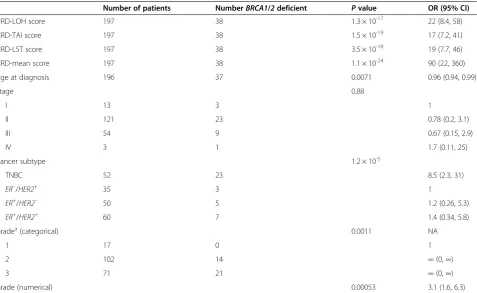
A custom Agilent SureSelect hybridization enrichment assay was developed to enable the generation of high-quality copy number and allele dosage data from low-yield, low-quality FFPE-treated tumor samples. The development of this assay is described in detail in Materials and Methods in Additional file 1. Improved performance of the SNP se-quencing assay on both frozen and FFPE tumor samples compared with SNP microarray data is shown in Additional file 2. SNP data were used to calculate LOH, HRD-TAI, and HRD-LST scores. One hundred and ninety-seven of 215 samples gave scores that passed the quality control criteria used. Thirty-eight of these samples wereBRCA1/2 deficient. In univariate logistic regression analysis, each of the HRD scores (LOH, TAI, and HRD-LST) was significantly associated withBRCA1/2deficiency (Table 1). Univariate results for age at diagnosis, breast cancer subtype, and tumor grade (both categorical and numeric) were also statistically significant (Table 1). Can-cer stage was not associated withBRCA1/2status.
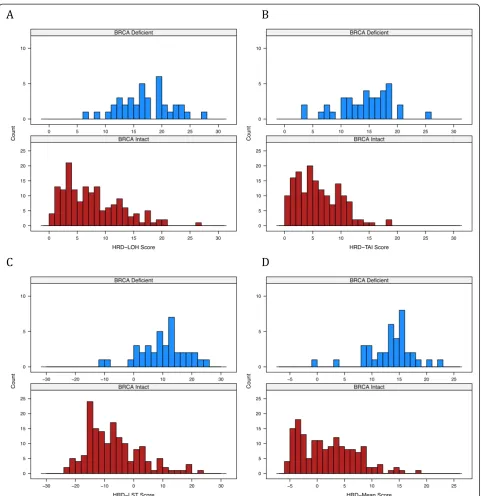
individual subtype, significant association is also seen for all scores except in the ER–/HER2+ subtype (Table S5 in Additional file 1). The distribution of scores is shown for BRCA1/2-deficient versus BRCA1/2-intact samples in Figure 1. High HRD scores were observed in BRCA1/2-intact tumors, in addition to BRCA1/2-defi-cient tumors, suggesting that a subset of these tumors have HR deficiency via some alternate mechanism.
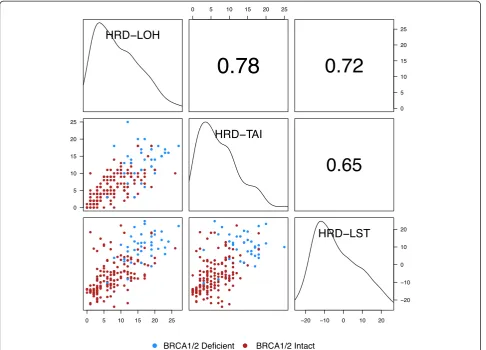
Pairwise correlations of the HRD-LOH, HRD-TAI, and HRD-LST scores were examined graphically, and quanti-fied with Spearman rank-sum correlation. All pairwise correlations of scores showed positive correlation signifi-cantly different from zero (P< 10-16) (Figure 2).
Table 2 presents the results of a three-term multivariable logistic regression including HRD-LOH, HRD-TAI, and HRD-LST scores as predictors of BRCA1/2deficiency. In this analysis, both HRD-TAI (P= 0.00016) and HRD-LST (P= 0.00014) scores captured significantBRCA1/2 deficiency information independent of the other scores. The HRD-LOH score did not reach statistical signifi-cance (P= 0.069).
Since each of the HRD measures appears to offer additional information that could be potentially clinically
useful, we explored the utility of combining the three scores. Our first approach was to combine the HRD scores according to the best linear combination from a logistic regression model to predict BRCA1/2 deficiency in this dataset. The resulting model-based score was:
HRD‐model ¼0:11xHRD‐LOH þ0:25xHRD‐TAI
þ0:12xHRD‐LST
A disadvantage of this approach is that the optimal weights for individual HRD scores are overfitted because of the relatively small size of the dataset and moderate correlations between the scores.
An alternate approach is to consider a simple arith-metic mean of the three scores (HRD-Mean score). A ra-tionale for averaging the scores is that all three scores essentially count events, breakpoints, or regions between breakpoints associated with HR deficiency. Moreover, according to univariate association of the scores with BRCA1/2deficiency (Table 1), they seem to capture rele-vant events equally well.
[image:4.595.61.539.110.403.2]To assess whether the HRD-Mean score adequately cap-tured the BRCA1/2 deficiency information of its three Table 1 Results from univariate logistic regression with HRD scores or clinical variables as predictors ofBRCA1/2 deficiency
Number of patients NumberBRCA1/2deficient Pvalue OR (95% CI)
HRD-LOH score 197 38 1.3 × 10⁻¹⁷ 22 (8.4, 58)
HRD-TAI score 197 38 1.5 × 10⁻¹⁹ 17 (7.2, 41)
HRD-LST score 197 38 3.5 × 10⁻¹⁸ 19 (7.7, 46)
HRD-mean score 197 38 1.1 × 10⁻²⁴ 90 (22, 360)
Age at diagnosis 196 37 0.0071 0.96 (0.94, 0.99)
Stage 0.88
I 13 3 1
II 121 23 0.78 (0.2, 3.1)
III 54 9 0.67 (0.15, 2.9)
IV 3 1 1.7 (0.11, 25)
Cancer subtype 1.2 × 10⁻⁵
TNBC 52 23 8.5 (2.3, 31)
ER–/HER2+ 35 3 1
ER+/HER2– 50 5 1.2 (0.26, 5.3)
ER+/HER2+ 60 7 1.4 (0.34, 5.8)
Gradea(categorical) 0.0011 NA
1 17 0 1
2 102 14 ∞(0,∞)
3 71 21 ∞(0,∞)
Grade (numerical) 0.00053 3.1 (1.6, 6.3)
Odds ratios for HRD scores are reported per interquartile range of the score. The odds ratio for age is reported per year. The odds ratio for grade (numerical) is per unit. CI, confidence interval;ER, estrogen receptor;HER2, tyrosine kinase-type cell surface receptorHER2; HRD, homologous recombination deficiency; HRD-LOH, homologous recombination deficiency-loss of heterozygosity; HRD-LST, homologous recombination deficiency-large-scale state transition; HRD-Mean, mean of the three HRD scores; HRD-TAI, homologous recombination deficiency-telomeric allelic imbalance; NA, not available; OR, odds ratio; TNBC, triple-negative breast cancer.a
components, we tested three bivariate logistic regression models. Each included the HRD-Mean score and one of the three individual scores. None of the component scores added significantly to the HRD-Mean score at the 5% sig-nificance level (HRD-LOH, P= 0.89; HRD-TAI, P= 0.09; HRD-LST, P= 0.28). In contrast, in each of the bivariate models’ HRD-Mean score added significant information
to the individual scores (P= 1.4 × 10⁻⁸ for HRD-LOH; P= 2.9 × 10⁻⁷for HRD-TAI;P= 2.8 × 10⁻⁸for HRD-LST).
[image:5.595.58.540.86.583.2]The HRD-Mean score was also compared with the HRD model score. In a bivariate logistic regression model, the HRD model score did not add significant in-dependentBRCA1/2deficiency information to the HRD-Mean score (P= 0.089).
Figure 1Distribution of scores inBRCA1/2-intact andBRCA1/2-deficient samples. (A)Homologous recombination deficiency-loss of hetero-zygosity (HRD-LOH) score.(B)Homologous recombination deficiency-telomeric allelic imbalance (HRD-TAI) score.(C)Homologous recombination deficiency-large-scale state transition (HRD-LST) score.(D)Mean of the homologous recombination deficiency (HRD-Mean) score. Red bars,
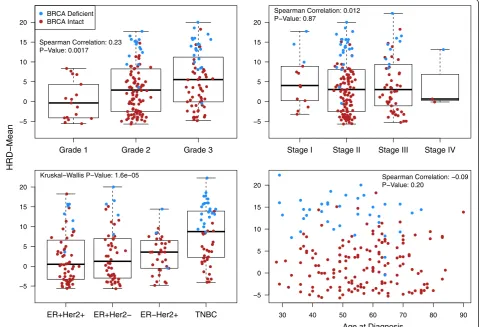
Data for tumor stage and grade and for age at diagnosis were available for the majority of samples (Table S1 in Additional file 1). Associations of these clinical variables with the HRD-Mean score are shown in Figure 3. The HRD-Mean score was not significantly correlated with tumor stage or age at diagnosis at the 5% confidence level,
but there was significant correlation with tumor grade (Spearman correlation 0.23, P= 0.0017). The HRD-Mean score also differed significantly among breast cancer sub-types (P= 1.6 × 10⁻⁵) according to a Kruskal–Wallis one-way analysis of variance test.
Heterogeneity of the HRD-Mean score among clinical breast cancer subpopulations was examined in multivari-able logistic regression models. For each clinical varimultivari-able we added a term for the interaction with the HRD-Mean score to a model including all clinical variables and the HRD-Mean score. None of the interaction terms reached significance at the 5% significance level. We therefore found no evidence to suggest that the probability of BRCA1/2 deficiency conferred by the HRD-Mean score varies among clinical subpopulations.
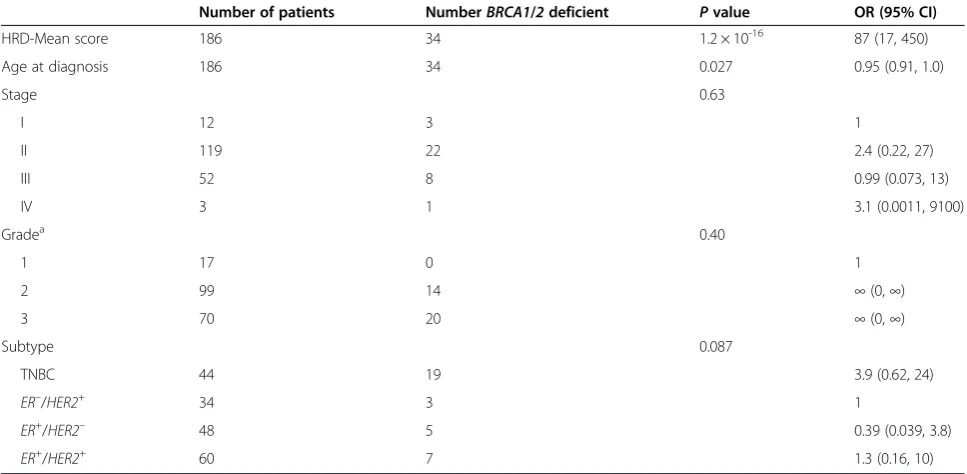
[image:6.595.57.544.89.439.2]Multivariable analysis was used to examine a model based on the HRD-Mean score and all available clinical variables. The HRD-Mean score captured significant BRCA1/2deficiency information that was not captured by clinical variables (P = 1.2 × 10⁻¹⁶). Of the available clinical Figure 2Spearman correlation of three different homologous recombination deficiency scores.Panels above the diagonal show
correlation. Diagonal panels show density plots. HRD-LOH, homologous recombination deficiency-loss of heterozygosity; HRD-LST, homologous recombination deficiency-large-scale state transition; HRD-TAI, homologous recombination deficiency-telomeric allelic imbalance.
Table 2 Results from a three-term multivariable logistic regression model with HRD-LOH, HRD-TAI, and HRD-LST scores as predictors ofBRCA1/2deficiency
Score Pvalue OR (95% CI)
HRD-LOH 0.069 3.0 (0.89, 9.8)
HRD-TAI 0.00016 5.8 (2.1, 16)
HRD-LST 0.00014 7.4 (2.4, 23)
[image:6.595.56.292.627.682.2]variables, only age at diagnosis maintained significance in the multivariable setting (P= 0.027) (Table 3).
To assess the robustness of the hybridization enrichment assay, 42 samples were run in duplicate. Both sets of data were analyzed separately in a blinded analysis. The Pearson correlation coefficient was 0.89 for the HRD-LOH score, 0.92 for the HRD-TAI score, 0.84 for the HRD-LST score, and 0.93 for the HRD-Mean score (Additional file 3).
Discussion
Defects in homologous recombination, includingBRCA1/ 2defects, are a relatively frequent event in TNBC, and the exploitation of these defects in the clinical setting is under intensive study. Less is known about the frequency of homologous recombination defects in other subtypes of breast cancer. In this study, the frequency of BRCA1/2 mutations ranged from ~8 to ~16% across four subtypes of breast cancer as defined by immunohistochemistry sub-typing. Sequencing of matched tumor and normal DNA samples determined that 75% ofBRCA1/2mutant tumors
carried a germlineBRCA1/2mutation. The most common method for loss of the second allele was via loss of hetero-zygosity; however, 17% of the tumors did not have loss of heterozygosity but carried somatic deleterious mutations in addition to their germline mutation. In addition, an ap-parently sporadic breast tumor was seen in one individual carrying aBRCA2somatic deleterious mutation.BRCA1/2 deficiency, including deleterious mutations and BRCA1 promoter methylation, ranged from ~10 to ~37% across the four subtypes.
Three independent studies recently reported the devel-opment of DNA-based genomic scores that were associ-ated with defects in BRCA1/2 [11-13]. In addition, all three scores have been shown to either predict sensitivity to platinum drugsin vitro, and/or pathologic response to neoadjuvant platinum treatment [12-14].
All three scores showed strong correlation with BRCA1/2 deficiency regardless of subtype, and the fre-quency of elevated scores suggests that a significant pro-portion of all breast tumor subtypes carry defects in the
5 0 5 10 15 20
Grade 1 Grade 2 Grade 3
BRCA Deficient BRCA Intact
Spearman Correlation: 0.23 P Value: 0.0017
Spearman Correlation: 0.012 P Value: 0.87
5 0 5 10 15 20
Stage I Stage II Stage III Stage IV
5 0 5 10 15 20
ER+Her2+ ER+Her2 ER Her2+ TNBC
Kruskal Wallis P Value: 1.6e 05
HRD
Mean
30 40 50 60 70 80 90
5 0 5 10 15 20
Spearman Correlation: 0.09 P Value: 0.20
[image:7.595.59.539.91.418.2]Age at Diagnosis
Figure 3Association of clinical variables with the HRD-Mean score.Upper left panel: tumor grade; upper right panel: tumor stage; lower left panel: tumor IHC subtype; lower right panel: age at diagnosis. Mean of the homologous recombination deficiency-loss of heterozygosity, homologous recombination deficiency-large-scale state transition, and homologous recombination deficiency-telomeric allelic imbalance scores (HRD-Mean score).
homologous recombination DNA repair pathway. These findings suggest that agents which target or exploit DNA damage repair may prove effective across a subset of tumors from all subtypes of breast cancer.
All three scores were significantly correlated with one another, suggesting that they all measure the same core genomic phenomenon. However, logistic regression ana-lysis indicates that the scores could be combined result-ing in stronger association with BRCA1/2 deficiency in this dataset. Further study is required to define a robust optimal model for response to clinical agents in an ad-equately powered dataset. In this study, an optimized model (HRD model) did not capture additionalBRCA1/ 2 deficiency information when compared with the arith-metic mean (HRD-Mean score) of the three scores.
Implementation of these scores, either singly or in combination, in the clinical setting requires an assay that is compatible with core needle biopsies that have been formalin fixed and paraffin embedded. Samples of this type yield very low-quantity and low-quality DNA. DNA extracted from these FFPE-treated samples does not per-form well in SNP microarray analysis.
Liquid hybridization-based target enrichment tech-nologies have been developed for production of libraries for next-generation sequencing. These methodologies enable targeted sequencing of regions of interest after reduction in genomic complexity, resulting in decreased sequencing costs. Preliminary tests indicated that the
available assays should be compatible with DNA derived from FFPE DNA. In this study we report the develop-ment of a capture panel that targets ~54,000 SNPs dis-tributed across the genome. Allele counts from the sequencing information this panel provides can be used for copy number and loss of heterozygosity reconstruc-tion, and the calculation of all three of the HRD scores. In addition, BRCA1 and BRCA2 capture probes are in-cluded on the panel, which enable high-quality mutation screening for deleterious variants in these genes in the same assay.
Conclusions
BRCA1/2 mutations are most common in TNBC;
[image:8.595.56.540.101.338.2]how-ever, both germline and somatic mutations were observed in all subtypes of breast cancer. In contrast,BRCA1 pro-moter methylation was confined almost exclusively to TNBC. Elevated HRD scores were highly associated with BRCA1/2 deficiency regardless of breast cancer subtype, and the most robust predictor of HRD deficiency is likely to be a combination of all three individual HRD scores. The combination of a robust score capable of identifying tumors with defects in homologous recombination DNA repair, and an assay compatible with FFPE clinical patho-logical specimens should facilitate the development and use of agents targeting double-stranded DNA damage repair in the clinical setting. In addition, these data suggest that such Table 3 Results from multivariable logistic regression ofBRCA1/2deficiency
Number of patients NumberBRCA1/2deficient Pvalue OR (95% CI)
HRD-Mean score 186 34 1.2 × 10⁻¹⁶ 87 (17, 450)
Age at diagnosis 186 34 0.027 0.95 (0.91, 1.0)
Stage 0.63
I 12 3 1
II 119 22 2.4 (0.22, 27)
III 52 8 0.99 (0.073, 13)
IV 3 1 3.1 (0.0011, 9100)
Gradea 0.40
1 17 0 1
2 99 14 ∞(0,∞)
3 70 20 ∞(0,∞)
Subtype 0.087
TNBC 44 19 3.9 (0.62, 24)
ER–/HER2+
34 3 1
ER+
/HER2– 48 5 0.39 (0.039, 3.8)
ER+
/HER2+ 60 7 1.3 (0.16, 10)
Odds ratio for the HRD-Mean score is reported per interquartile range of the score. The odds ratio for age at diagnosis is reported per year. This analysis includes 186 patients with complete clinical records. Thirty-four patients wereBRCA1orBRCA2deficient. CI, confidence interval;ER, estrogen receptor;HER2, tyrosine kinase-type cell surface receptorHER2; HRD-Mean, mean of the homologous recombination deficiency-loss of heterozygosity, homologous recombination deficiency-large-scale state transition, and homologous recombination deficiency-telomeric allelic imbalance scores; OR, odds ratio; TNBC, triple-negative breast cancer.a
agents may have utility across all subtypes of breast cancer when combined with an appropriate biomarker.
Additional files
Additional file 1:Detailed description of the Materials and Methods described in the manuscript, and Tables S1 to S5 showing data analysis not included in the main text.
Additional file 2: Figure S1.Showing allele dosage data generated by SNP microarrays (upper panels) or custom hybridization enrichment followed by next-generation sequencing (lower panels). (A) Frozen samples; (B) FFPE samples.
Additional file 3: Figure S2.Showing correlation between duplicate samples run on the Agilent SureSelect hybridization enrichment assay. Pearson correlation coefficient = 0.93 for HRD-Mean.
Abbreviations
BRCA:breast cancer gene;ER: estrogen receptor; FFPE: formalin-fixed paraffin-embedded;HER2: tyrosine kinase-type cell surface receptorHER2;
HR: homologous recombination; HRD: homologous recombination deficiency; HRD-LOH: homologous recombination deficiency–loss of heterozygosity; HRD-LST: homologous recombination deficiency–large-scale state transition; HRD-Mean: mean of HRD-LOH, HRD-LST, and HRD-TAI scores; HRD-TAI: homologous recombination deficiency–telomeric allelic imbalance; SNP: single nucleotide polymorphism; TNBC: triple-negative breast cancer.
Competing interests
KMT, VA, AG, and JSL receive a salary from Myriad Genetics, Inc. (Salt Lake City, UT, USA), own shares and share options in Myriad Genetics, Inc., and are inventors on patents that relate to technology used in the manuscript. EH, CN, JR, BM, SK, JP, TVT, JC, DI, ZS, ET, MP, and AZ receive a salary from Myriad Genetics, Inc. and own shares and share options in Myriad Genetics, Inc.
Authors’contributions
KMT jointly conceived of the study (with JSL), participated in its design and coordination, and helped to draft the manuscript. VA developed the algorithms to estimate the allele specific copy number, contamination with benign tissue, and assay failure, and participated in calculation of these parameters and in statistical analysis. EH participated in the statistical analysis, contributed to analysis and interpretation of data, and helped to draft the manuscript. CN directed laboratory operations, participated in DNA extraction, hybridization assays, and data analysis. JR contributed to analysis and interpretation of data, and validated the statistical results. BM performed theBRCA1/2sequence analysis and variant calling. SK performed DNA extractions, hybridization capture assays, and DNA sequencing. JP performed DNA extractions, and methylation assays. TVT performed methylation assays, DNA extractions, hybridization capture assays and DNA sequencing. JC performed DNA extractions. DI participated in data acquisition and analysis. ZS performed microscopic evaluation of all tissue samples for tumor content and enrichment. ET prepared hematoxylin and eosin slides and prepared tissue for DNA extraction. MP participated in the process and algorithm design and in the data analysis. AZ performed SNP sequence analysis. AG participated in study design and coordination, and helped to draft the manuscript. JSL jointly conceived of the study (with KMT), participated in its design and coordination, and helped to draft the manuscript. All authors read and approved the final manuscript.
Received: 19 March 2014 Accepted: 6 November 2014
References
1. Fong PF, Boss DS, Yap TA, Tutt A, Wu P, Mergui-Roelvink M, Mortimer P, Swaisland H, Lau A, O’Connor MJ, Ashworth A, Carmichael J, Kaye SB, Schellens JHM, de Bono JS:Inhibition of poly(ADP-ribose) polymerase in tumors from BRCA mutation carriers.NEJM2009,361:123–134. 2. Byrski T, Gronwald J, Huzarski R, Grzybowska E, Budryk M, Stawicka M,
Mierzwa T, Szwiec M, Wisniowski R, Siolek M, Dent R, Lubinski J, Narod S:
Pathologic complete response rates in young women withBRCA1
-positive breast cancers after neoadjuvant chemotherapy.J Clin Oncol
2010,28:375–379.
3. Foulkes WD, Stefansson IM, Chappuis PO, Bégin LR, Goffin JR, Wong N, Trudel M, Aksien LA:GermlineBRCA1mutations and a basal epithelial phenotype in breast cancer.J Natl Cancer Inst2003,95:1482–1485. 4. Comen EA, Davids M, Kirchhoff T, Balistreri L, Hanse J, Kosarin K, Offit K,
Robson ME:Prevalence ofBRCA1andBRCA2mutations in Jewish women with triple negative breast cancer [abstract].J Clin Oncol2008,26:22002. 5. Atchley DP, Albarracin ET, Lopez A, Valero V, Amos CI, Gonzalez-Angulo AM,
Hortobagyi GM, Arun BK:Clinical and pathologic characteristics of patients with BRCA-positive and BRCA-negative breast cancer.J Clin
Oncol2008,26:4282–4288.
6. Young SR, Pilarski RT, Donenberg T, Shapiro C, Hammond LS, Miller J, Brooks KA, Cohen S, Tenenholz B, Desai D, Zandvakill I, Royer R, Li S, Harod SA:The prevalence ofBRCA1mutations among young women with triple-negative breast cancer.BMC Cancer2009,9:86.
7. Hartman A-R, Kaldate RR, Sailer LM, Painter L, Grier C, Endsley RR, Griffin M, Hamilton SA, Frye CA, Silberman MA, Wenstrup RJ, Sandback JF:Prevalence of BRCA mutations in an unselected population of triple-negative breast cancer.Cancer2011,118:2787–2795.
8. Gonzalez-Angulo AM, Timms KM, Liu S, Chen H, Litton JK, Potter J, Lanchbury J, Stemke-Hale K, Hennessy BT, Arun BK, Hortobagyi GN, Do KA, Mills GB:Incidence and outcome of BRCA mutations in unselected patients with triple receptor-negative breast cancer.Clin Cancer Res2011,
17:1082–1089.
9. Xu Y, Diao L, Chen Y, Liu Y, Wang C, Ouyang T, Li J, Wang T, Fan Z, Fan T, Lin B, Deng D, Narod SA, Xie Y:Promoter methylation ofBRCA1in triple-negative breast cancer predicts sensitivity to adjuvant chemotherapy.
Ann Oncol2013,24:1498–1505.
10. Hu X, Stern HM, Ge L, O’Brien C, Haydu L, Honchell CD, Haverty PM, Peters BA, Wu TD, Amler LD, Chant J, Stokoe D, Lackner MR, Cavet G:Genetic alterations and oncogenic pathways associated with breast cancer subtypes.Mol Cancer Res2009,7:511–522.
11. Abkevich V, Timms KM, Hennessy BT, Potter J, Carey MS, Meyer LA, Smith-McCune K, Broaddus R, Lu KH, Chen J, Tran TV, Williams D, Iliev D, Jammulapati S, FitzGerald LM, Krivak T, DeLoia JA, Gutin A, Mills GB, Lanchbury JS:Patterns of genomic loss of heterozygosity predict homologous recombination repair defects in epithelial ovarian cancer.Br J Cancer2012,107:1776–1782. 12. Birkbak NF, Wang ZC, Kim J-Y, Eklund AC, Li Q, Tian R, Bowman-Colin C, Li Y,
Greene-Colozzi A, Iglehard JD, Tung N, Ryan PD, Garber JE, Silver DP, Szallasi Z, Richardson AL:Telomeric allelic imbalance indicates defective DNA repair and sensitivity to DNA-damaging agents.Cancer Discov2012,2:366–375. 13. Popova T, Manié E, Rieunier G, Caux-Moncoutier V, Tirapo C, Dubois T,
Delattre O, Sigal-Zafrani B, Bollet M, Longy M, Houdayer C, Sastre-Garau X, Vincent-Salomon A, Stoppa-Lyonnet D, Stern M-H:Ploidy and large-scale genomic instability consistently identify basal-like breast carcinomas withBRCA1/2inactivation.Cancer Res2012,72:5454–5462.
14. Telli M, Jensen KC, Abkevich V, Hartman A-R, Vinayak S, Lanchbury J, Gutin A, Timms K, Ford JM:Homologous recombination deficiency (HRD) score predicts pathologic response following neoadjuvant platinum-based therapy in triple negative andBRCA1/2mutation-associated breast cancer (BC).Cancer Res2012,72:PD09-04.
15. Beaudet AL, Tsui LC:A suggested nomenclature for designating mutations.Hum Mutat1993,2:245–248.
Submit your next manuscript to BioMed Central and take full advantage of:
• Convenient online submission
• Thorough peer review
• No space constraints or color figure charges
• Immediate publication on acceptance
• Inclusion in PubMed, CAS, Scopus and Google Scholar
• Research which is freely available for redistribution