R E S E A R C H A R T I C L E
Open Access
Evaluating diverse electronic consultation
programs with a common framework
Delphine S. Tuot
1,12*, Clare Liddy
2,3, Varsha G. Vimalananda
4,5, Jennifer Pecina
6, Elizabeth J. Murphy
1,12,
Erin Keely
7,8, Steven R. Simon
9,11, Frederick North
10, Jay D. Orlander
5,11and Alice Hm Chen
1,12Abstract
Background:Electronic consultation is an emerging mode of specialty care delivery that allows primary care providers and their patients to obtain specialist expertise without an in-person visit. While studies of individual programs have demonstrated benefits related to timely access to specialty care, electronic consultation programs have not achieved widespread use in the United States. The lack of common evaluation metrics across health systems and concerns related to the generalizability of existing evaluation efforts may be hampering further growth. We sought to identify gaps in knowledge related to the implementation of electronic consultation programs and develop a set of shared evaluation measures to promote further diffusion.
Methods:Using a case study approach, we apply the Reach, Effectiveness, Adoption, Implementation and Maintenance (RE-AIM) and the Quadruple Aim frameworks of evaluation to examine electronic consultation implementation across diverse delivery systems. Data are from 4 early adopter healthcare delivery systems (San Francisco Health Network, Mayo Clinic, Veterans Administration, Champlain Local Health Integration Network) that represent varied organizational structures, care for different patient populations, and have well-established multi-specialty electronic consultation programs. Data sources include published and unpublished quantitative data from each electronic consultation database and qualitative data from systems’end-users.
Results:Organizational drivers of electronic consultation implementation were similar across the systems (challenges with timely and/or efficient access to specialty care), though unique system-level facilitators and barriers influenced reach, adoption and design. Effectiveness of implementation was consistent, with improved patient access to timely, perceived high-quality specialty expertise with few negative consequences, garnering high satisfaction among end-users. Data about patient-specific clinical outcomes are lacking, as are policies that provide guidance on the legal implications of electronic consultation and ideal remuneration strategies.
Conclusion:A core set of effectiveness and implementation metrics rooted in the Quadruple Aim may promote data-driven improvements and further diffusion of successful electronic consultation programs.
Keywords: E-consult, Electronic consultation, Evaluation, Quadruple aim, RE-AIM
Background
The demand for specialty care is growing and is pre-dicted to exceed specialist workforce capacity in the United States by 2025 [1]. Electronic consultation, which provides a way for primary care providers (PCPs) and
their patients to obtain specialty expertise without an in-person patient visit to the specialist, has emerged as a mode of specialty care delivery that may address the impending supply-demand mismatch for specialty care.
Studies of individual early adopter electronic consult-ation programs in North America have demonstrated benefits consistent with the overarching goal of achiev-ing the quadruple aim [2]: high-quality care delivery that improves population health [3–5] and achieves high sat-isfaction among providers [6–8], care-team members, and patients, [9] while introducing cost-savings from * Correspondence:[email protected]
1Center for Innovation in Access and Quality at Priscilla Chan and Mark Zuckerberg San Francisco General Hospital and Trauma Center, University of California San Francisco, San Francisco, CA 94110, USA
12Deparment of Medicine, University of California, San Francisco, San Francisco, CA, USA
Full list of author information is available at the end of the article
new efficiencies [10,11]. Two systematic reviews that in-cluded international programs have also reported that electronic consultation programs are associated with im-proved access to specialty care and enhanced care co-ordination, high satisfaction among primary and specialty care providers, and positive patient experience [12,13].
Despite these data, electronic consultation programs have not achieved widespread use in the United States. The use of variable evaluation metrics across health sys-tems and concerns related to the generalizability (or lack thereof ) existing evaluation efforts may be hampering further growth, alongside financial and cultural barriers. Using a case study approach with four very different health delivery systems, we apply the Reach, Effective-ness, Adoption, Implementation and Maintenance (RE-AIM) [14] and the Quadruple Aim [2] frameworks of evaluation to highlight the generalizability of elec-tronic consultation program implementation. In so doing, we also identify gaps in knowledge to promote areas of future study and propose a set of shared evalu-ation measures to promote future study.
Methods
Definitions
Electronic consultations (e-consults) are asynchronous provider-provider consultations that occur within an electronic health record (EHR) or a web-based portal. E-consults allow providers, most commonly PCPs, to access specialist input for clinical questions that may be addressable without an in-person specialty care visit. Electronic consultation systems allow specialists to ad-dress consultative needs through chart review and com-munication with the referring provider, and ensure adequate diagnostic workup prior to a face-to-face patient visit when necessary. There are three main types
of electronic consultation systems. (1) They can exist in-dependently or (2) in parallel to referral processes (either electronic– known as e-referrals -- or paper/fax based), which carry the expectation of a specialty care visit. (3) Alternatively, some are integrated into the overall re-ferral process, creating integrated electronic consultation and referral systems, in which all requests for specialty expertise are electronically initiated and specialist re-viewers respond to each request with the appropriate form of consultation, including scheduling the patient for an in-person visit.
Study design and data sources
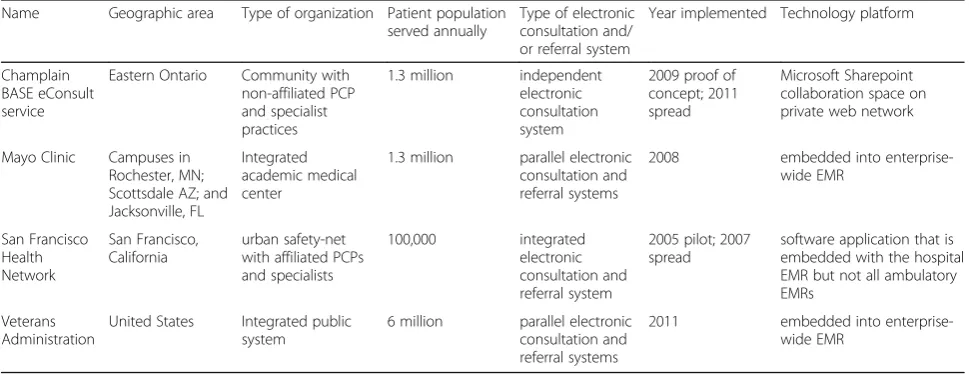
We used a case study design to explore the impact of electronic consultation system implementation across 4 diverse healthcare delivery systems. The systems were selected because they represent varied organizational structures, care for different patient populations, have well-established multi-specialty electronic consultation programs that represent the three types of systems, and have undergone independent evaluations of program im-plementation and local impact (Table 1). Data sources from each health delivery system included published quantitative data from each system’s electronic consult-ation database and qualitative data from each system’s end-users. Additionally, some unpublished data from each system were provided by co-authors.
Evaluation frameworks: RE-AIM and quadruple AIM
[image:2.595.56.541.545.732.2]The five constructs of the RE-AIM framework [14] (Reach, Effectiveness, Adoption, Implementation, Main-tenance) formed the basis for analysis in this study along with the Quadruple Aim framework to further refine Ef-fectiveness measures. RE-AIM is well-suited to our case study as it addresses critical aspects of implementation in real-world settings and identifies facilitating and
Table 1Characteristics of four health systems
Name Geographic area Type of organization Patient population served annually
Type of electronic consultation and/ or referral system
Year implemented Technology platform
Champlain BASE eConsult service
Eastern Ontario Community with non-affiliated PCP and specialist practices
1.3 million independent electronic consultation system
2009 proof of concept; 2011 spread
Microsoft Sharepoint collaboration space on private web network
Mayo Clinic Campuses in Rochester, MN; Scottsdale AZ; and Jacksonville, FL
Integrated academic medical center
1.3 million parallel electronic consultation and referral systems
2008 embedded into enterprise-wide EMR
San Francisco Health Network
San Francisco, California
urban safety-net with affiliated PCPs and specialists
100,000 integrated electronic consultation and referral system
2005 pilot; 2007 spread
software application that is embedded with the hospital EMR but not all ambulatory EMRs
Veterans Administration
United States Integrated public system
6 million parallel electronic consultation and referral systems
hindering factors to success, which are particularly im-portant for external validity. Additional file 1: Table S1 summarizes the dimensions of these validated frame-works with associated definitions and evaluation ques-tions pertinent to electronic consultation programs.
The Reach and Effectiveness constructs reflect patient-level measures and together, they measure the im-pact of an intervention on a given population.Reach con-siders the extent to which a sample of participants reflects the overall eligible population for that intervention. Effect-iveness measures reflect short-term and/or long-term patient-level outcomes, including unintended positive and negative consequences. They can be categorized into 4 domains using the Quadruple Aim framework:Population Health, Patient Satisfaction, Care Team Satisfaction and
Financial Implications[2]. Measures ofAdoptionand Im-plementation are organizational measures that focus on translatability of an intervention to other settings. Adop-tionis related to the absolute number, proportion and rep-resentativeness of providers who use a new program.
Implementation refers to the extent and fidelity of the intervention compared to intended design/workflow, including barriers and enablers to local implementation and program modifications for success. TheMaintenance
dimension of the framework addresses the extent to which the intervention is sustainably embedded within routine organizational practice (Additional file1: Table S1).
Results
Case studies
Four case studies were performed, examining electronic consultation implementation in systems that represent different structures of specialty care delivery: a commu-nity setting with non-affiliated individual PCP and spe-cialty care practices; an integrated tertiary care academic medical center; an urban safety-net system with affiliated PCPs and specialists; and a fully integrated public deliv-ery system (Table1).
Champlain local health integration network (LIHN)
The Champlain BASE™ (Building Access to Specialists through eConsultation) program was developed in 2009. It is based in the Champlain health region of Eastern Ontario, Canada, which has a population of 1.3 million individuals, roughly half of whom reside in the city of Ottawa [15]. Independent PCPs who sign up for the BASE service can submit e-consults to any specialist who has agreed to provide this service, from any internet-connected device via the service’s secure Share-Point platform, attaching any files they deem pertinent (e.g. images, test results). A BASE program manager allocates the e-consult to a specialist in the specialty group selected by the PCP. That specialist responds with expert advice, a recommendation for referral, or a
request for additional information. This service exists in parallel to existing referral practices in the Champlain health region and is not embedded into any particular EHR. Specialist reviewers are remunerated for their e-consult activities using the fee schedule for in-person consultation pro-rated to time spent, from a combin-ation of regional, provincial, and research funding.
Mayo Clinic
This is an academic not-for-profit tertiary care academic medical center with three major campuses in Rochester, Minnesota; Scottsdale, Arizona; and Jacksonville, Florida. E-consults for the primary care population were offered to PCPs in 2008. In 2010 the program was expanded to allow Mayo specialists to request e-consults from other Mayo specialists. The electronic consultation program exists in parallel to the electronic referral system that providers use to order face-to-face specialty visits; both systems are embedded into the EHR, so that specialist reviewers can review any background data to complete e-consults. Completed e-consults are available in the EHR and the patient portal for subsequent review by ordering providers and patients, respectively [15]. Spe-cialist reviewers at the Mayo clinic are salaried, do not receive additional compensation to perform e-consults but do receive some protected time.
San Francisco Health Network (SFHN)
The SFHN is San Francisco’s publicly funded safety-net healthcare delivery system. All specialty services are pro-vided at the acute care hospital, Zuckerberg San Francisco General Hospital and Trauma Center (ZSFG). Requests for specialty care come from fourteen SFHN primary care clinics and an affiliated network of twelve community health centers. The referral base consists of approximately 100,000 patients. Since 2007, all requests for ZSFG spe-cialty services are initiated as e-consults through the elec-tronic referral and consultation program that is embedded into the EHR [16]. ZSFG specialists are all salaried; spe-cialist reviewers receive work credit for their e-consult activities.
Veterans administration (VA)
would a traditional face-to-face referral; the two systems exist in parallel. Patient data is available for review within the EHR. Specialists have the option to convert e-consult requests to face-to-face referrals and vice versa. VA providers are usually salaried and specialists receive workload credit based on the time spent to complete each e-consult.
Evaluation
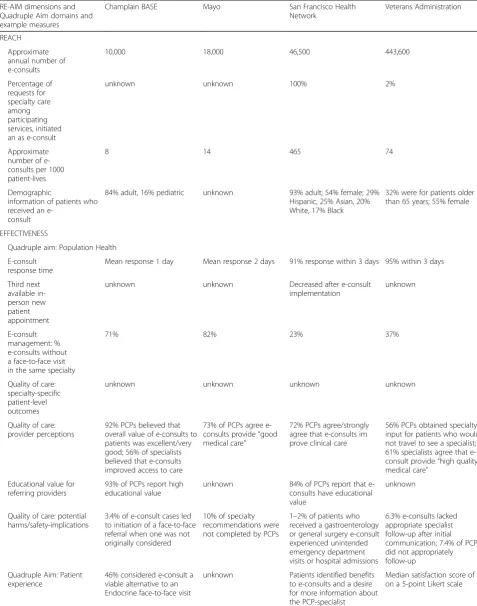
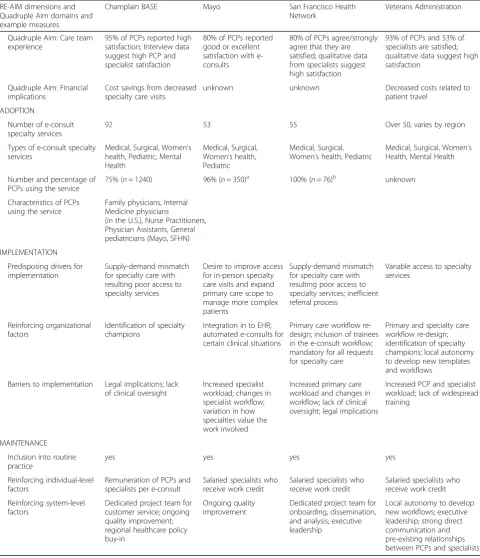
Application of the RE-AIM and Quadruple Aim frame-works to the evaluation of each electronic consultation implementation is detailed below. Key data from each system pertinent to measures within each RE-AIM di-mension and Quadruple Aim domain are also summa-rized in Table2.
Reach
Across the four systems, the annual number of e-consults ranges from 10,000 to 443,600, representing a range of e-consults/1000-patient lives of 1 to 378. Demographic characteristics of patients who receive e-consults have been sparsely published, though VA data suggest that patients who received an e-consult lived in more rural areas than those who received a face-to-face visit [17]. In SFHN, the population that receives an e-consult is similar to its overall racially/ethnically di-verse patient population.
Effectiveness
Population Health. Timely access to specialty care is the main measure that has been used to evaluate the effectiveness of each electronic con-sultation system on population health. Two systems have reported a mean e-consult response time of 1–2 business days; the other two sys-tems report that 91–95% of e-consults were completed within 3 busi-ness days. Wait times for in-person specialty care visits, measured by third next available specialty care in-person appointments, a widely-accepted metric of wait time for primary care access published by the Institute for Healthcare Improvement [18], declined in SFHN as a result of implementing the electronic consultation program [19]. These data are not available for the other systems. The percentage of e-consults associated with an avoidable in-person visit ranges from 37 to 82% in the delivery systems where e-consult is an adjunct to the traditional referral system and is approximately 23% in SFHN, where all requests for non-urgent am-bulatory specialty care are initiated as e-consults [5, 20–22].
None of the systems in this case study have reported data on patient level outcomes, although providers con-sistently perceive e-consults as delivering high quality specialty care for patients. In prior survey studies, over 90% of PCPs participating in the BASE and Boston VA electronic consultation systems believed that e-consults provided faster specialty care for their patients and
nearly three-quarters of Mayo clinic and SFHN PCPs agreed that e-consults provide“good medical care”[6,8,
23, 24]. Additional data from each system demonstrate
that 50–60% of specialists agree that e-consults provide good medical care [8,24,25].
All four healthcare delivery systems have docu-mented positive and negative unintended conse-quences related to their electronic consultation implementation. In the BASE and SFHN systems, ap-proximately 85–90% of PCPs self-reported high levels of educational value inherent to e-consult communi-cation [26]. Additionally, 3.4% of e-consults in the BASE system resulted in initiation of a face-to-face referral when not originally contemplated by the PCP, a potentially important safety indicator [27]. Potential patient harms associated with e-consults have been evaluated at the Mayo clinic, in two specialties at SFHN, and in 5 specialties in the VA. A chart review of 187 e-consults with recommendations from the most common e-consult specialties at the Mayo clinic demonstrated that specialist e-consult recommenda-tions were not completed 10% of the time [20]. In SFHN, among patients who received an e-consult and were not scheduled for an in-person general surgery or gastroenterology face-to-face appointment, 1–2% of patients experienced emergency department visits or hospital stays related to the content of their e-consult [28]. However, none of these harms were clearly due to lapses in communication during the consultation process. In one VA medical center, only 0.8% of 61,931 e-consults to 5 medical specialties did not have a specialist response. Chart review demonstrated that 6.3% of e-consults did not have appropriate spe-cialist follow-up after the initial communication and 7.4% did not have appropriate documented PCP follow-up [22].
Patient satisfaction. Patient satisfaction with e-consults has been evaluated in three of the four systems with sur-veys and focus groups and has been generally positive. Nearly one-half of patients who received an initial in-person endocrinology consultation reported being open to the idea of receiving an e-consult from the BASE sys-tem instead, considering it a viable alternative to many but not all face-to-face appointments for diabetes and endo-crine conditions [9]. In SFHN, focus group participants also appreciated improved access to specialty care with e-consult but voiced a desire to receive more information about the PCP-specialist communication [29]. A group of 15 Veterans from the Pittsburg VA who completed a sur-vey about e-consults reported a mean satisfaction score of 5/5 on a Likert scale [30].
Table 2Evaluation data pertinent to the Reach Effectiveness Adoption Implementation Maintenance (RE-AIM) framework for each delivery system
RE-AIM dimensions and Quadruple Aim domains and example measures
Champlain BASE Mayo San Francisco Health Network
Veterans Administration
REACH
Approximate annual number of e-consults
10,000 18,000 46,500 443,600
Percentage of requests for specialty care among participating services, initiated an as e-consult
unknown unknown 100% 2%
Approximate number of e-consults per 1000 patient-lives
8 14 465 74
Demographic
information of patients who received an
e-consult
84% adult, 16% pediatric unknown 93% adult; 54% female; 29% Hispanic, 25% Asian, 20% White, 17% Black
32% were for patients older than 65 years; 55% female
EFFECTIVENESS
Quadruple aim: Population Health
E-consult response time
Mean response 1 day Mean response 2 days 91% response within 3 days 95% within 3 days
Third next available in-person new patient appointment
unknown unknown Decreased after e-consult
implementation
unknown
E-consult management: % e-consults without a face-to-face visit in the same specialty
71% 82% 23% 37%
Quality of care: specialty-specific patient-level outcomes
unknown unknown unknown unknown
Quality of care: provider perceptions
92% PCPs believed that overall value of e-consults to patients was excellent/very good; 56% of specialists believed that e-consults improved access to care
73% of PCPs agree e-consults provide“good medical care”
72% PCPs agree/strongly agree that e-consults im prove clinical care
56% PCPs obtained specialty input for patients who would not travel to see a specialist; 61% specialists agree that e-consult provide“high quality medical care”
Educational value for referring providers
93% of PCPs report high educational value
unknown 84% of PCPs report that e-consults have educational value
unknown
Quality of care: potential harms/safety-implications
3.4% of e-consult cases led to initiation of a face-to-face referral when one was not originally considered
10% of specialty recommendations were not completed by PCPs
1–2% of patients who received a gastroenterology or general surgery e-consult experienced unintended emergency department visits or hospital admissions
6.3% e-consults lacked appropriate specialist follow-up after initial communication; 7.4% of PCPs did not appropriately follow-up
Quadruple Aim: Patient experience
46% considered e-consult a viable alternative to an Endocrine face-to-face visit
unknown Patients identified benefits to e-consults and a desire for more information about the PCP-specialist communication
system [23, 24]. Unpublished data from SFHN and Mayo Clinic are similar. Interviews with PCPs and specialists from three systems corroborate these data [7,31,32].
[image:6.595.57.538.110.669.2]Financial Implications. Only two of the four systems in this case series have available cost data; both have sug-gested cost savings attributed to decreased face-to-face
Table 2Evaluation data pertinent to the Reach Effectiveness Adoption Implementation Maintenance (RE-AIM) framework for each delivery system(Continued)
RE-AIM dimensions and Quadruple Aim domains and example measures
Champlain BASE Mayo San Francisco Health Network
Veterans Administration
Quadruple Aim: Care team experience
95% of PCPs reported high satisfaction; Interview data suggest high PCP and specialist satisfaction
80% of PCPs reported good or excellent satisfaction with e-consults
80% of PCPs agree/strongly agree that they are satisfied; qualitative data from specialists suggest high satisfaction
93% of PCPs and 53% of specialists are satisfied; qualitative data suggest high satisfaction
Quadruple Aim: Financial implications
Cost savings from decreased specialty care visits
unknown unknown Decreased costs related to patient travel
ADOPTION
Number of e-consult specialty services
92 53 55 Over 50, varies by region
Types of e-consult specialty services
Medical, Surgical, Women’s health, Pediatric, Mental Health
Medical, Surgical, Women’s health, Pediatric
Medical, Surgical, Women’s health, Pediatric
Medical, Surgical, Women’s Health, Mental Health
Number and percentage of PCPs using the service
75% (n= 1240) 96% (n= 350)a 100% (
n= 76)b unknown
Characteristics of PCPs using the service
Family physicians, Internal Medicine physicians
(in the U.S.), Nurse Practitioners, Physician Assistants, General pediatricians (Mayo, SFHN)
IMPLEMENTATION
Predisposing drivers for implementation
Supply-demand mismatch for specialty care with resulting poor access to specialty services
Desire to improve access for in-person specialty care visits and expand primary care scope to manage more complex patients
Supply-demand mismatch for specialty care with resulting poor access to specialty services; inefficient referral process
Variable access to specialty services
Reinforcing organizational factors
Identification of specialty champions
Integration in to EHR; automated e-consults for certain clinical situations
Primary care workflow re-design; inclusion of trainees in the e-consult workflow; mandatory for all requests for specialty care
Primary and specialty care workflow re-design; identification of specialty champions; local autonomy to develop new templates and workflows
Barriers to implementation Legal implications; lack of clinical oversight
Increased specialist workload; changes in specialist workflow; variation in how specialties value the work involved
Increased primary care workload and changes in workflow; lack of clinical oversight; legal implications
Increased PCP and specialist workload; lack of widespread training
MAINTENANCE
Inclusion into routine practice
yes yes yes yes
Reinforcing individual-level factors
Remuneration of PCPs and specialists per e-consult
Salaried specialists who receive work credit
Salaried specialists who receive work credit
Salaried specialists who receive work credit
Reinforcing system-level factors
Dedicated project team for customer service; ongoing quality improvement; regional healthcare policy buy-in
Ongoing quality improvement
Dedicated project team for onboarding, dissemination, and analysis; executive leadership
Local autonomy to develop new workflows; executive leadership; strong direct communication and pre-existing relationships between PCPs and specialists a
Data are pertinent to the Rochester site only b
specialty care appointments and decreased travel costs incurred by patients. Taking into account the techno-logical start-up costs of electronic consultation imple-mentation, administrative and personnel costs associated with system maintenance, specialist remuneration based on time-spent per e-consult communication, and intentionally avoided specialist in-person visits based on PCP report, the BASE system calculated an average cost of $16.71 CAD per e-consult and a break-even point for the system with a total volume of 7818 e-consults [11]. A national VA study examining 217,000 e-consults to 13 different specialties between 2011 and 2013 suggested $2,800,000 savings from avoided patient travel to in-person specialty care visits. The VA evaluation did not take into account any fixed costs associated with im-plementation of the electronic consultation system [17].
Adoption
All four systems are multi-specialty, with over 50 par-ticipating medical, surgical, pediatric, women’s health, and mental health specialties. In 2016, the percentage of PCPs that requested e-consults for their patients using the BASE, Mayo and SFHN systems ranged from 75 to 100%, with a greater percentage in the system that mandated the use of e-consults for initial ambulatory specialty care requests. Such data are not readily available from the VA, due to its decentralized implementation. In all U.S, systems, participating PCPs included family physicians, internal medicine physicians, nurse practitioners and physician assis-tants; pediatricians also used the Mayo and SFHN services [26, 32, 33]. Only family physicians and nurse practitioners submitted e-consults in the BASE system [34]. Demographic characteristics and level of experi-ence of PCPs who submit e-consults versus those who do not are not available.
Implementation
Poor access to specialty care and existing inefficiencies in the traditional referral process were the common main drivers for implementation across all health sys-tems [23,24,35,36]. Despite this overarching similarity, local reinforcing factors and challenges influenced im-plementation [36–38]. For example, the types of e-consult specialties offered by each system were influ-enced by requests from local PCPs as well as the pres-ence/absence of local specialty physician champions. Local strategies to ensure success that were similar across all 4 systems included primary care workflow re-design and active involvement of physician cham-pions. Customizable templates and integration with the EHR were local reinforcing factors that were unique to the VA. Implementation barriers common to all four sites included increased and/or different PCP and
specialist workload, lack of clinical oversight, and con-cern about the legal implications of electronic communication.
Maintenance
Each of these four electronic consultation systems started as pilot projects with few participating specialties and referring providers. Submitting e-consults is now routine practice in each system. Common reinforcing factors for growth have included: investment in a core implementation team with a program manager, health information technology expert, PCP champion, and spe-cialist champion; development of fair reimbursement strategies for providers; and a commitment to system quality improvement [35]. In the VA, widespread growth has been attributed to de-centralized activities. Decisions about workflow management and template development have been delegated to local specialty services, allowing hundreds of individual services differing in size, staffing, wait times, and clinical settings, to tailor the e-consult program according to local needs and constraints [32]. This contrasts with the BASE and SFHN system, where e-consult activities have been centrally managed.
Discussion
Electronic consultation is a disruptive innovation that has challenged the status quo of specialty health care de-livery traditionally limited to face-to-face patient-provider encounters [19, 32]. Disruptive innovations often provide the most value to individuals or groups unable to participate in successful status quo processes [39]. It is not surprising that early adopters of electronic consultation systems, including some in this case series, have been motivated by challenges in access to, or effi-ciency of, specialty care delivery through traditional face-to-face consults alone. As this analysis demon-strates, while the organizational drivers of implementa-tion were similar across our early adopter health systems, unique system-level facilitators and barriers in-fluenced local adoption and implementation, ultimately affecting the final design of each system. Despite these differences, implementation of this disruptive innovation was consistently associated with improved patient access to timely, perceived high-quality specialty expertise and few negative consequences.
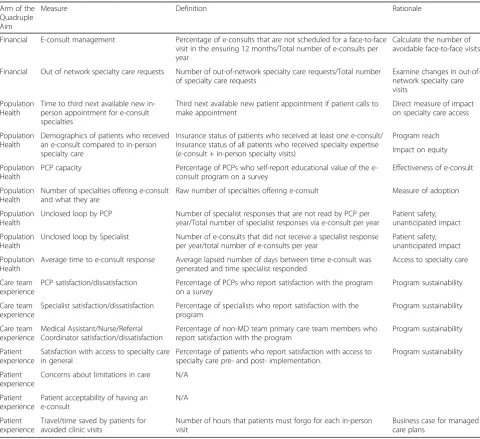
Effectiveness and Adoption. In one of their landmark re-ports, the Institute of Medicine stated that standardized metrics for health and health care could provide bench-marks for progress and system performance [40]. With that guiding principle, we propose a set of metrics for electronic consultation rooted in the Quadruple Aim that stem directly from the implementation analysis depicted in this manuscript (Table 3). These metrics have been vetted by diverse stakeholders in electronic consultation, including leaders in healthcare delivery, payers, and professionals with expertise in quality, and provide an important step forward to promote high-value dissemination. Next steps will need to include validation on a national level through a formal consensus-building process.
By applying the RE-AIM framework for program implementation, we were able to identify characteris-tics associated with greater Reach and Adoption of electronic consultation programs. Consistent with data from newer programs, local penetration across patient and PCP populations was highest in the delivery system with an integrated electronic consultation and referral system, in which an e-consult was the initial step in the referral pathway [41]. Overall reach was lower in systems with separate electronic consultation and electronic referral systems, though PCP adoption in those systems was higher when a priority was placed on primary care system re-design. By contrast,
[image:8.595.57.538.294.733.2]Effectiveness measures were similar amongst the sys-tems. E-consult response time was excellent in all 4
Table 3Proposed core effectiveness metrics for electronic consultation programs, using the Quadruple Aim framework
Arm of the Quadruple Aim
Measure Definition Rationale
Financial E-consult management Percentage of e-consults that are not scheduled for a face-to-face visit in the ensuring 12 months/Total number of e-consults per year
Calculate the number of avoidable face-to-face visits
Financial Out of network specialty care requests Number of out-of-network specialty care requests/Total number of specialty care requests
Examine changes in out-of-network specialty care visits
Population Health
Time to third next available new in-person appointment for e-consult specialties
Third next available new patient appointment if patient calls to make appointment
Direct measure of impact on specialty care access
Population Health
Demographics of patients who received an e-consult compared to in-person specialty care
Insurance status of patients who received at least one e-consult/ Insurance status of all patients who received specialty expertise (e-consult + in-person specialty visits)
Program reach
Impact on equity
Population Health
PCP capacity Percentage of PCPs who self-report educational value of the e-consult program on a survey
Effectiveness of e-consult
Population Health
Number of specialties offering e-consult and what they are
Raw number of specialties offering e-consult Measure of adoption
Population Health
Unclosed loop by PCP Number of specialist responses that are not read by PCP per year/Total number of specialist responses via e-consult per year
Patient safety; unanticipated impact
Population Health
Unclosed loop by Specialist Number of e-consults that did not receive a specialist response per year/total number of e-consults per year
Patient safety; unanticipated impact
Population Health
Average time to e-consult response Average lapsed number of days between time e-consult was generated and time specialist responded
Access to specialty care
Care team experience
PCP satisfaction/dissatisfaction Percentage of PCPs who report satisfaction with the program on a survey
Program sustainability
Care team experience
Specialist satisfaction/dissatisfaction Percentage of specialists who report satisfaction with the program
Program sustainability
Care team experience
Medical Assistant/Nurse/Referral Coordinator satisfaction/dissatisfaction
Percentage of non-MD team primary care team members who report satisfaction with the program
Program sustainability
Patient experience
Satisfaction with access to specialty care in general
Percentage of patients who report satisfaction with access to specialty care pre- and post- implementation.
Program sustainability
Patient experience
Concerns about limitations in care N/A
Patient experience
Patient acceptability of having an e-consult
N/A
Patient experience
Travel/time saved by patients for avoided clinic visits
Number of hours that patients must forgo for each in-person visit
sites, as was the perceived quality of care inherent to electronic consultation, the educational value to refer-ring providers, and overall program satisfaction by di-verse stakeholders. Importantly, these findings from early U.S. and Canadian adopters are consistent with newer U.S. programs [42–45]. Analyses of European e-consult systems have also reported similar data: levels of provider satisfaction and educational benefit exceeding 90% [46, 47] and response time for hu-manitarian e-consults for international providers who are geographically isolated from specialists have been reported to be 1–3 days [48].
The use of validated frameworks for comparative program evaluation facilitates the identification of knowledge gaps. From this analysis, we note a paucity of data about which patient populations are directly benefiting from e-consults. Demographic data for pa-tients who receive an e-consult compared to the gen-eral population served by a healthcare delivery system would be helpful for stakeholders concerned about replicating health inequities associated with prior technology-driven programs [49]. Additionally, while electronic consultation systems have improved timely access to specialty expertise, data associating im-proved clinical outcomes and electronic consultations are lacking. One lone trial has demonstrated de-creased emergency department utilization among pa-tients randomized to receive a cardiology e-consult compared to those randomized to participate in the usual cardiology referral process [3]. Since the clinical benefits of in-person specialty care visits have not been robustly demonstrated for all specialties, the lack of a gold standard to which e-consults can be com-pared may be contributing to the paucity of data and is one reason why we have not included clinical bene-fits in our list of proposed core evaluation metrics. Nevertheless, this area represents a large gap in the
Effectiveness literature and may warrant a large, multi-specialty clinical trial. Similarly, the financial implications and return on investment for electronic consultation implementation need to be further examined.
This study also demonstrates thatImplementationand
Maintenancecould be facilitated by policies that provide guidance on the legal implications of electronic consult-ation, ways to provide clinical oversight, and ideal remu-neration strategies to account for increased provider workload while remaining aligned with the strategic di-rections of ongoing health care reform. The California Medicaid 2020 waiver [50] is a promising policy example that promotes the use of e-consult across California, as it provides financial incentives for specialty care re-design among public delivery systems, including funds for non-traditional specialty care encounters.
Despite providing important data about the implemen-tation of electronic consulimplemen-tation programs across diverse healthcare delivery systems, the analysis is limited by the small number of programs included in this case series. Also, this study does not prove a direct relationship be-tween electronic consultation program implementation and patient outcomes, such as specialty care access. Nonetheless, the comparable magnitude of impact across the four programs pertinent to Reach and Effect-iveness is reassuring, as are similar data that have emerged from newer programs.
Conclusion
Successful implementation of electronic consultation programs is occurring across diverse health care delivery systems in North America, consistently improving timely access to specialist expertise. The use of an evaluation framework with common metrics, as proposed here, is important to promote ongoing adoption and diffusion. As additional reach, outcome, safety, and cost data emerge from existing and nascent programs, electronic consultation may become a standard mode of specialty care delivery.
Additional file
Additional file 1:Table S1.RE-AIM dimensions, definitions and evaluation questions pertinent to electronic consultation implementation. Description: The 5 RE-AIM domains are listed, with definitions of each domain, and example metrics or questions for each domain pertinent to the implementation of electronic consultation. (DOCX 31 kb)
Abbreviations
BASE:Building Access to Specialists through eConsultation; EHR: Electronic health record; LIHN: Local Health Integration Network; PCP: Primary care provider; RE-AIM: Reach, Effectiveness. Adoption, Implementation, Maintenance; SFHN: San Francisco Health Network; VA: Veterans Affairs; VAMC: Veterans Affairs Medical Centers; ZSFG: Zuckerberg San Francisco General Hospital
Acknowledgements
Not applicable.
Funding
This work was supported by the Blue Shield of California Foundation. This funding body had no role in the study design, data analysis/interpretation or manuscript preparation.
Availability of data and materials
All data presented were obtained with permission from co-authors and leaders from the four delivery systems. These data are not publically available for routine use by other investigators, but may are available from the corresponding author on reasonable request.
Authors’contributions
Ethics approval and consent to participate
This study was approved by the University of California, San Francisco Institutional Review Board (study number: 11–05827). This study did not include direction patient contact and thus formal consent was not obtained.
Consent for publication
N/A.
Competing interests
The authors declare that they have no competing interests.
Publisher’s Note
Springer Nature remains neutral with regard to jurisdictional claims in published maps and institutional affiliations.
Author details
1Center for Innovation in Access and Quality at Priscilla Chan and Mark Zuckerberg San Francisco General Hospital and Trauma Center, University of California San Francisco, San Francisco, CA 94110, USA.2C.T. Lamont Primary Health Care Research Centre, Bruyère Research Institute, Ottawa, ON, Canada. 3Department of Family Medicine, University of Ottawa, Ottawa, ON, Canada. 4
Center for Healthcare Organization and Implementation Research, Edith Nourse Rogers Memorial VA Medical Center, Bedford, MA, USA.5Department of Medicine, Boston University School of Medicine, Boston, MA, USA. 6Department of Family Medicine, Mayo Clinic, Rochester, MN, USA. 7
Department of Medicine, University of Ottawa, Ottawa, ON, Canada.8The Ottawa Hospital, Ottawa, ON, Canada.9Harvard Medical School, Boston, USA. 10
Department of Primary Care Internal Medicine, Mayo Clinic, Rochester, MN, USA.11VA Boston Healthcare System, Boston, USA.12Deparment of Medicine, University of California, San Francisco, San Francisco, CA, USA.
Received: 26 September 2017 Accepted: 15 October 2018
References
1. Dall Tim WT, Ritashree C, Will I. The Complexities of Physician Supply and Demand: Projections from 2014 to 2025. Washginton, DC: IHS Inc. for the Association of American Medical Colleges; 2016.
2. Bodenheimer T, Sinsky C. From triple to quadruple aim: care of the patient requires care of the provider. Ann Fam Med. 2014;12(6):573–6.
3. Olayiwola JN, Anderson D, Jepeal N, Aseltine R, Pickett C, Yan J, et al. Electronic consultations to improve the primary care-specialty care Interface for cardiology in the medically underserved: a cluster-randomized controlled trial. Ann Fam Med. 2016;14(2):133–40.
4. Cruz ML, Gleason N, Wang M, Wrenn K, Gonzales R. Transforming the endocrine consult: asynchronous provider consultations. Endocr Pract. 2015; 21(5):514–21.
5. Tuot DS, Murphy EJ, McCulloch CE, Leeds K, Chan E, Chen AH. Leveraging an electronic referral system to build a medical neighborhood. Healthc (Amst). 2015;3(4):202–8.
6. Kim Y, Chen AH, Keith E, Yee HF Jr, Kushel MB. Not perfect, but better: primary care providers' experiences with electronic referrals in a safety net health system. J Gen Intern Med. 2009;24(5):614–9.
7. Liddy C, Afkham A, Drosinis P, Joschko J, Keely E. Impact of and satisfaction with a new eConsult service: a mixed methods study of primary care providers. J Am Board Fam Med. 2015;28(3):394–403.
8. Angstman KB, Adamson SC, Furst JW, Houston MS, Rohrer JE. Provider satisfaction with virtual specialist consultations in a family medicine department. Health Care Manag (Frederick). 2009;28(1):14–8. 9. Keely E, Traczyk L, Liddy C. Patients' perspectives on wait times and the
referral-consultation process while attending a tertiary diabetes and endocrinology Centre: is Econsultation an acceptable option? Can J Diabetes. 2015;39(4):325–9.
10. Gleason N, Prasad PA, Ackerman S, Ho C, Monacelli J, Wang M, et al. Adoption and impact of an eConsult system in a fee-for-service setting. Healthc (Amst). 2016.
11. Liddy C, Deri Armstrong C, Drosinis P, Mito-Yobo F, Afkham A, Keely E. What are the costs of improving access to specialists through eConsultation? The Champlain BASE experience. Stud Health Technol Inform. 2015;209:67–74.
12. Liddy C, Drosinis P, Keely E. Electronic consultation systems: worldwide prevalence and their impact on patient care-a systematic review. Fam Pract. 2016;33(3):274–85.
13. Vimalananda VG, Gupte G, Seraj SM, Orlander J, Berlowitz D, Fincke BG, et al. Electronic consultations (e-consults) to improve access to specialty care: a systematic review and narrative synthesis. J Telemed Telecare. 2015;21(6):323–30.
14. Glasgow RE, Klesges LM, Dzewaltowski DA, Estabrooks PA, Vogt TM. Evaluating the impact of health promotion programs: using the RE-AIM framework to form summary measures for decision making involving complex issues. Health Educ Res. 2006;21(5):688–94.
15. Pecina JL, North F. Early e-consultation face-to-face conversions. J Telemed Telecare. 2016;22(5):269–76.
16. Chen AH, Kushel MB, Grumbach K, Yee HF, Jr. Practice profile. A safety-net system gains efficiencies through 'eReferrals' to specialists. Health Aff (Millwood) 2010;29(5):969–971.
17. Kirsh S, Carey E, Aron DC, Cardenas O, Graham G, Jain R, et al. Impact of a national specialty e-consultation implementation project on access. Am J Manag Care. 2015;21(12):e648–54.
18. Institute for Healthcare Improvement. Third Next Available Appointment [Available from: http://www.ihi.org/resources/Pages/Measures/ ThirdNextAvailableAppointment.aspx].
19. Chen AH, Murphy EJ, Yee HF Jr. eReferral--a new model for integrated care. N Engl J Med. 2013;368(26):2450–3.
20. Pecina JL, Frank JM, North F. A retrospective study on how primary care providers manage specialists' recommendations after an e-consultation. SAGE Open Med. 2016;4:2050312116682127.
21. Tran C, Liddy C, Pinto N, Keely E. Impact of question content on e-consultation outcomes. Telemed J E Health. 2016;22(3):216–22. 22. Singh H, Esquivel A, Sittig DF, Murphy D, Kadiyala H, Schiesser R, et al.
Follow-up actions on electronic referral communication in a multispecialty outpatient setting. J Gen Intern Med. 2011;26(1):64–9.
23. Liddy C, Rowan MS, Afkham A, Maranger J, Keely E. Building access to specialist care through e-consultation. Open Med. 2013;7(1):e1–8. 24. McAdams M, Cannavo L, Orlander JD. A Medical Specialty e-Consult
Program in a VA Health Care System. Federal Practitioner. 2014;31(5):26–31. 25. Keely E, Drosinis P, Afkham A, Liddy C. Perspectives of Champlain BASE
specialist physicians: their motivation, experiences and recommendations for providing eConsultations to primary care providers. Stud Health Technol Inform. 2015;209:38–45.
26. Kwok J, Olayiwola JN, Knox M, Murphy EJ, Tuot DS. Electronic consultation system demonstrates educational benefit for primary care providers. J Telemed Telecare. 2017; 1357633X17711822.
27. Liddy C, Drosinis P, Fogel A. Keely E. Canadian Family Physician: Prevention of delayed referrals through the Champlain BASE eConsult Service; 2017. [in press] 28. Ulloa JG, Russell MD, Chen AH, Tuot DS. A cohort study of a general surgery
electronic consultation system: safety implications and impact on surgical yield. BMC Health Serv Res. 2017;17(1):433.
29. Olayiwola JN, Knox M, Dube K, Lu EC, Woldeyesus T, James IE, et al. Understanding the potential for patient engagement in electronic consultation and referral systems: lessons from one safety net system. Health Serv Res. 2017.
30. Rodriguez KL, Burkitt KH, Bayliss NK, Skoko JE, Switzer GE, Zickmund SL, et al. Veteran, primary care provider, and specialist satisfaction with electronic consultation. JMIR Med Inform. 2015;3(1):e5.
31. Straus SG, Chen AH, Yee H Jr, Kushel MB, Bell DS. Implementation of an electronic referral system for outpatient specialty care. AMIA Annu Symp Proc. 2011;2011:1337–46.
32. Gupte G, Vimalananda V, Simon SR, DeVito K, Clark J, Orlander JD. Disruptive innovation: implementation of electronic consultations in a veterans affairs health care system. JMIR Med Inform. 2016;4(1):e6.
33. Pecina JL, North F. A retrospective analysis of medical record use in e-consultations. J Telemed Telecare. 2016.
34. Liddy C, Deri Armstrong C, McKellips F, Keely E. A comparison of referral patterns to a multispecialty eConsultation service between nurse practitioners and family physicians: the case for eConsult. J Am Assoc Nurse Pract. 2016;28(3):144–50.
36. Kirsh SR, Ho PM, Aron DC. Providing specialty consultant expertise to primary care: an expanding spectrum of modalities. Mayo Clin Proc. 2014; 89(10):1416–26.
37. North F, Uthke LD, Tulledge-Scheitel SM. Internal e-consultations in an integrated multispecialty practice: a retrospective review of use, content, and outcomes. J Telemed Telecare. 2015;21(3):151–9.
38. Houston MS, Myers JD, Levens SP, McEvoy MT, Smith SA, Khandheria BK, et al. Clinical consultations using store-and-forward telemedicine technology. Mayo Clin Proc. 1999;74(8):764–9.
39. Hwang J, Christensen CM. Disruptive innovation in health care delivery: a framework for business-model innovation. Health Aff (Millwood). 2008;27(5): 1329–35.
40. Vital signs. Core metrics for health and health care progress. Washington: The National Academies Press; 2015. IOM (Institute of Medicine) 41. Barnett ML, Yee HF Jr, Mehrotra A, Giboney P. Los Angeles safety-net
program eConsult system was rapidly adopted and decreased wait times to see specialists. Health Aff (Millwood). 2017;36(3):492–9.
42. Gleason N, Prasad PA, Ackerman S, Ho C, Monacelli J, Wang M, et al. Adoption and impact of an eConsult system in a fee-for-service setting. Healthc (Amst). 2017;5(1–2):40–5.
43. Lee BJ, Forbes K. The role of specialists in managing the health of populations with chronic illness: the example of chronic kidney disease. BMJ. 2009;339:b2395.
44. Wasfy JH, Rao SK, Kalwani N, Chittle MD, Richardson CA, Gallen KM, et al. Longer-term impact of cardiology e-consults. Am Heart J. 2016;173:86–93. 45. Davis A, Gilchrist V, Grumbach K, James P, Kallenberg R, Shipman SA.
Advancing the primary/specialty care Interface through Econsults and enhanced referrals. Ann Fam Med. 2015;13(4):387–8.
46. Patterson V, Wootton R. A web-based telemedicine system for low-resource settings 13 years on: insights from referrers and specialists. Glob Health Action. 2013;6:21465.
47. Wootton R, Liu J, Bonnardot L. Quality Assurance of Teleconsultations in a store-and-forward telemedicine network - obtaining patient follow-up data and user feedback. Front Public Health. 2014;2:247.
48. Wootton R, Geissbuhler A, Jethwani K, Kovarik C, Person DA, Vladzymyrskyy A, et al. Long-running telemedicine networks delivering humanitarian services: experience, performance and scientific output. Bull World Health Organ. 2012;90(5):341–7D.
49. Arcaya MC, Figueroa JF. Emerging trends could exacerbate health inequities in the United States. Health Aff (Millwood). 2017;36(6):992–8.