Benard O. Muok (Correspondence)
bmuok @ yahoo.com
+254735859357This article is published under the terms of the Creative Commons Attribution License 4.0 Author(s) retain the copyright of this article. Publication rights with Alkhaer Publications. Published at: http://www.ijsciences.com/pub/issue/2018-06/
DOI: 10.18483/ijSci.1716; Online ISSN: 2305-3925; Print ISSN: 2410-4477
Developing an Innovative and Sustainable
Market-Based Systems for Enhancing Diffusion
of Clean Cooking Solutions in Kenya
Benard O. Muok
1
1
Director, Centre for Research, Innovation and Technology, Jaramogi Oginga Odinga University of Science and Technology, P.O. Box 210-40601, BONDO, KENYA
Abstract: The aim of the study was to look at evidence of barriers in the development of clan cooking solutions market in Kenya and made actionable recommendations on how to improve the diffusion of clean cooking solutions within a market based approach. The ultimate goal is to enhance the adoption and diffusion of clean cooking solutions through innovative and sustainable market approach that addresses issues such as a demand-driven approach to facilitate adoption of clean cooking solutions. The study was conducted in ten (10) representative counties in Kenya including Kwale (Coast region), Migori (South Western region), Homa Bay (South Western region), Kisumu (Lake Victoria region), Vihiga (Western region), Nakuru (Central Reft region), Kajiado (South Rift region), Machakos (South Eastern region) and Meru (North Eastern region). The study was carried out through a national level inventory to provide a broad idea of the status of clean cooking solution market. The study used mixed methods and approaches including desk reviews, stakeholder interviews, case studies and focus group discussions. Both quantitative and qualitative data was collected using mixed methodologies such as desk review, household surveys using questionnaires, key informant interviews and focus group discussions to capture all actors in the value chain including producers, traders, consumers, researchers, development agents and policy makers. The key issues rotate around affordability, availability, quality, suitability and awareness including capacity. What is required is adoption of a strategic approach to addressing the various challenges that have been identified including creating a condusive policy framework to unlock to the potentials of clean cooking solution in the country.
Keywords: Clean Cooking Solutions, Sustainable Market, Opportunities, Challenges, Policy
1. Introduction
In the last decade, the need for cleaner and efficient energy alternatives to address health and environmental problems associated with continued use of traditional cooking methods has been gaining momentum at national and international levels. In a global consensus highlighting the critical role of access to energy for sustainable development, the United Nations in 2012 launched the Sustainable Energy for All (SE4All) initiative that ambitiously targets a universal access to electricity and modern cooking energy systems by 2030. Goal 7 of the United Nations’ Sustainable Development Goals “ensure access to affordable, reliable, sustainable and modern energy for all” by 2030 put clean and efficient energy at the centre stage. Yet, out of the world’s estimated 1.5 billion people who live without electricity access and 3 billion who rely on traditional cooking fuels, more than 95 per cent are either in sub-Saharan African (SSA) or developing Asia and 84 per cent are in rural areas (International Energy
Agency (IAEA, 2015). To achieve universal access to clean cooking energy for the world over the next 15 years, a total of around US$ 31 billion per year will be required (World Energy Outlook, 2017).
Developing an Innovative and Sustainable Market-Based Systems for Enhancing Diffusion of Clean Cooking Solutions in Kenya
http://www.ijSciences.com Volume 7 – June 2018 (06)
58
linked to an estimated 15,000 deaths (of mainly women and children) in Kenya and 18,900 deaths in Tanzania annually (Clough, 2012; Lambe et al. 2015; UNIDO, 2015).
The cookstoves are regarded as one of the oldest and simplest household technologies for cooking in many developing countries. For East Africa, the development of the cookstove sector started in the 1980s, with the introduction of the charcoal cookstove by the Kenyan Ceramic Jiko (KCJ). Since then, several improved clean cooking technologies have been introduced into the market to serve both urban and rural communities. There has been wide variation in the adoption and diffusion of clean cooking solutions in East African countries. In Tanzania, the rate of adoption and diffusion of clean cookstoves has been rather slow, due to the low capacity for large-scale commercialization and the fact that most of the clean cooking initiatives have been smaller scale donor-assisted projects with short-lived funding (Clough, 2012). Kenya has the most advanced clean household energy sector in East Africa in terms the adoption of improved cookstoves technologies, diversity of producers and products, marketing and distribution of products (Lambe et al. 2015).
There are several innovative cookstove initiatives and programs designed to address the socio-economic and environmental challenges. For instance, institutions such as the Global Alliance for Clean Cookstoves have been at the forefront of supporting the development of improved clean cookstoves programmes and initiatives in East Africa. We also see a growing cookstove sector that has the potential for large-scale commercialization given the correct financial and business development support. In order to achieve large-scale adoption and diffusion of clean household solutions, there is a need for recognition of the relevance of clean household energy use to the larger economy, especially in rural areas. The creation of an enabling environment is critical for adoption and diffusion of clean cooking solution in Kenya and Tanzania. Such an environment must foster the formulation and implementation of pro-poor economic policies, regulation and institutions that remove market barriers, nurture home-grown innovations, facilitate access to finance and credit for the development and upscale of clean cooking initiatives.
Despite the decades of efforts, penetration rates remain low, which is an indication of persisting and unaddressed barriers. This study looked at evidence and made actionable recommendations on how to improve the diffusion of clean cooking solutions within a market based approach. The ultimate goal is to enhance the adoption and diffusion of clean
cooking solutions through innovative and sustainable market approach that addresses issues such as a demand-driven approach to facilitate adoption of clean cooking solutions.
2. Methodology 2.1 Study area
The Study was conducted in representative counties in Kenya including Kwale (Coast region), Migori (South Western region), Homa Bay (South Western region), Kisumu (Lake Victoria region), Vihiga (Western region), Nakuru (Central Reft region), Kajiado (South Rift region), Machakos (South Eastern region) and Meru (North Eastern region).
2.2 Data collection
The study was carried out through a national level inventory to provide a broad idea of the status of clean cooking solution market. The study used random and purposive sampling techniques to identify respondents in rural (cooking solution producers, users and retailers), peri-urban (consumers, distributers and manufactures of cook stoves) and urban settlements (consumers, distributers and manufactures of clean cook stoves). The study design was based on a simple random sample. The study adopted standard sampling procedure to come up the sample numbers for a large Cochran (1963:75). Using this procedure a total of 467 households were interviewed, 71 per cent who were women, majority (83 per cent) between the ages of 25-45 years. The study also interviewed and 27 traders. The study was conducted between December 2017 to February 2018.
The study used mixed methods and approaches including desk reviews, stakeholder interviews, case studies and focus group discussions. Both quantitative and qualitative data was collected using mixed methodologies such as desk review, household surveys using questionnaires, key informant interviews and focus group discussions to capture all actors in the value chain including producers, traders, consumers, researchers, development agents and policy makers.
2.3 Data handling and analysis
Data was cleaned, collated and analyzed using SPSS version 24. Quantitative data were analyzed at 95 per cent confidence level. Qualitative information from focus group discussions (FGD) was analyzed using both content and thematic analysis to complement the quantitative information.
3. Results
3.1 Use of clean cooking solution in rural and peri-urban households
Developing an Innovative and Sustainable Market-Based Systems for Enhancing Diffusion of Clean Cooking Solutions in Kenya
http://www.ijSciences.com Volume 7 – June 2018 (06)
59
cooking solution while in peri-urban areas the average was 54 per cent (Fig. 1). Of those using clean cooking solutions, all were using improved
cookstoves while on 13 per cent were using improved cookstoves with a clean fuel (mainly briquette).
Fig. 1 Use of clean cooking solutions in peri-urban and rural areas
Figure 2: Traditional cooking stoves: a) Mother and a child using three-stone traditional stove in a poorly aerated room in Oyola Village, Kisumu County, Kenya; b) Poorly constructed jiko bora failed and lead to return to traditional three stone stove
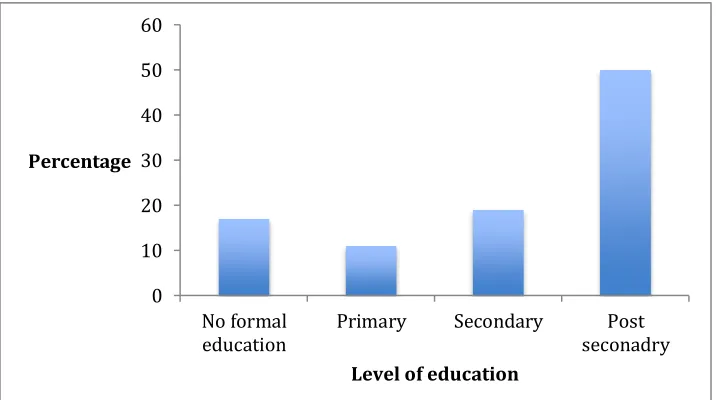
Majority of the respondents using clean cooking solutions were recorded in household where the household head had post-primary education accounting for 69 per cent of the total users (Fig. 3).
Fig. 3 Education levels of the head of household using clean cooking solutions
0 10 20 30 40 50 60
Rural Peri-urban
Perentatge
Location
Improved cookstoves Clean fuel
0 10 20 30 40 50 60
No formal
education Primary Secondary seconadryPost
Percentage
Developing an Innovative and Sustainable Market-Based Systems for Enhancing Diffusion of Clean Cooking Solutions in Kenya
http://www.ijSciences.com Volume 7 – June 2018 (06)
60
This observation could simply mean that household with high education level are likely to have a higher disposable income so they could afford to the cost of buying clean cooking solutions. Another way to explain this could be to higher aweless levels due to better education and exposure to external world. This observation brings to the discussion the role of awareness and affordability as key issues in adoption of clean cooking solution. The fact that peri-urban
areas have easier access to clean cooking solution distribution channel is also another issues. This is reinforced by the observation that of the households, which did not have clean cooking solutions, clean cooking solutions majority (57 per cent) responded that they could not afford the cost of buying an improved cookstove while equally high number (27 per cent) was because the products were not available (Fig. 4), almost all from rural areas.
Figure 4 Reasons for not having clean cooking solution The study confirms earlier study that use of clean cooking solutions is still very low in east Africa, especially in the rural areas (DGICK 2013). Penetration of clean cooking solutions (CCS) is better in the peri-urban areas.
3.2 Type and source of clean cooking solutions
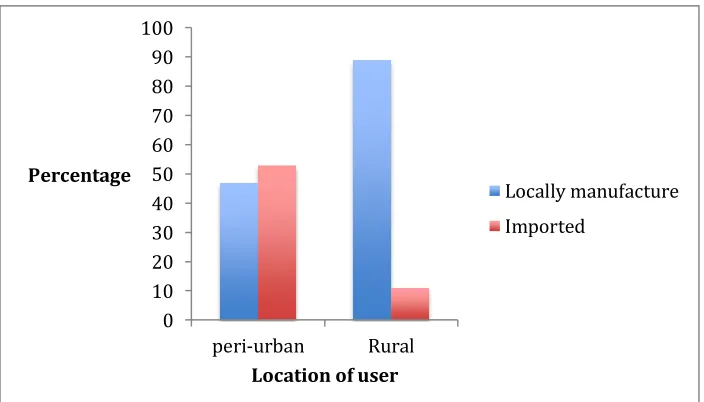
The study interrogated whether the stoves are imported or locally manufactured. Of the respondents using improved cookstoves, majority (89 per cent) of the households in rural areas are using locally manufactured improved cookstove, while in the peri-urban areas the ratio of imported and locally manufactured stoves are almost equal (Fig. 5).
Fig. 5 Use of imported verses locally manufactured improved cookstoves
0 10 20 30 40 50 60
Cannot afford the
cost
Not aware Not available in
the local market
Does not fit cooking
style
Others
Percentage
Reseason for not having clean cooking solution
0 10 20 30 40 50 60 70 80 90 100
peri-urban Rural
Percentage
Location of user
Developing an Innovative and Sustainable Market-Based Systems for Enhancing Diffusion of Clean Cooking Solutions in Kenya
http://www.ijSciences.com Volume 7 – June 2018 (06)
61
The study identified two main types of improved cook stoves (ICS), 1) portable ICS and 2) fixed ICS (Table 1). While the portable were found both in rural and peri-urban areas, the fixed type is predominantly in the rural areas. The portable systems are light, easy
to transport and can be carried and used in different locations. Most of the portable stoves are for charcoal burning or liquid biofuel (Fig. 6) with only very few designed for firewood, which are currently emerging in the market such as the burn stove.
Fig. 6 Some portable improved cookstoves a) Gaia ethanol stove b) Gaia ethanol stove showing flame, c) Kenya Ceremic Jiko d) TERI Gasifier stove
On the other hand, fixed ICS are predominantly found in the rural areas. They are fixed either on the floor or on a wall, and are mostly are firewood stoves. The stoves exist in different sizes and designed and are fitted with chimney. One example is Upezi jiko (Fig. 7). The thermal efficiency of improved cookstove ranges from 18 per cent to 45
per cent depending on the design configuration. However, all the improved cooked stoves exhibit the rocket principal for enhanced draft and combustion efficiency allowing for sufficient primary air underneath the pieces of sticks and enough draft chamber for full combustion.
Developing an Innovative and Sustainable Market-Based Systems for Enhancing Diffusion of Clean Cooking Solutions in Kenya
http://www.ijSciences.com Volume 7 – June 2018 (06)
62
Table 1: Table 1. Classifications of improved cook stoves
Improved solutions Clean cooking solutions
Basic improved Intermediate Advance Modern Renewable energy
stoves
Example: Kenya
Ceramic Jiko
(KCJ), Kuni
Mbili stove,
Uhai Jiko
Example: Ecozoom, Burn stove (Jikokoa), Jiko Upezi,
Example: TERI Gasifier stove, Philips Gasifier stove
Example: LPG Example: Biogas, ethanol gel stove; Gaia ethanol stove
Key features:
Small functional improvement
over baseline
technology; artisan produced
Key features:
Rocket principal to enhance combustion efficiency; some with high end materials and good finishing
Key features: Fan jet or natural draft gasifier with very high combustion efficiency and reduced
emission; often attain tier 3- 4
Key features: Relies on fossil fuel or electricity; zero emission with very high efficiency
Key features: Derived from renewable non-woody fuel; some are supplement energy sources
What is included:
Basic efficient charcoal Basic
efficient wood
What is included:
Portable rocket
Fixed rocket chimney
Highly improved
What is included:
Fan gasifier
Char stove
What is included: LPG;
Electric cooker; Kerosene
What is included:
Biogas
Ethanol
Solar oven
Fireless cookers
3.3 Financing for clean cooking solutions and reason for stove type selection
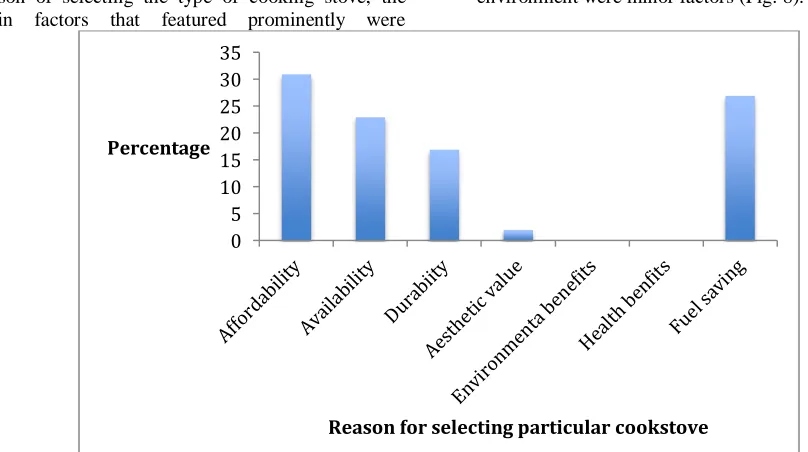
When the respondents were asked about the main reason of selecting the type of cooking stove, the main factors that featured prominently were
affordability (31 per cent), fuel saving (27 per cent), availability (23 per cent) and durability (17 per cent). The other factors such as aesthetic value, health and environment were minor factors (Fig. 8).
Fig. 8 Reasons for selecting particular type of cookstove This observation clear reinforces the main factors of adoption of clean cooking solution where affordability comes on top of the range while the other factors such as availability, durability and fuel
saving (efficiency) are also key. While response lead to the point of general of the stoves, the observed that only a very few products have quality marks and warranty (Fig. 9).
0 5 10 15 20 25 30 35
Percentage
Developing an Innovative and Sustainable Market-Based Systems for Enhancing Diffusion of Clean Cooking Solutions in Kenya
http://www.ijSciences.com Volume 7 – June 2018 (06)
63
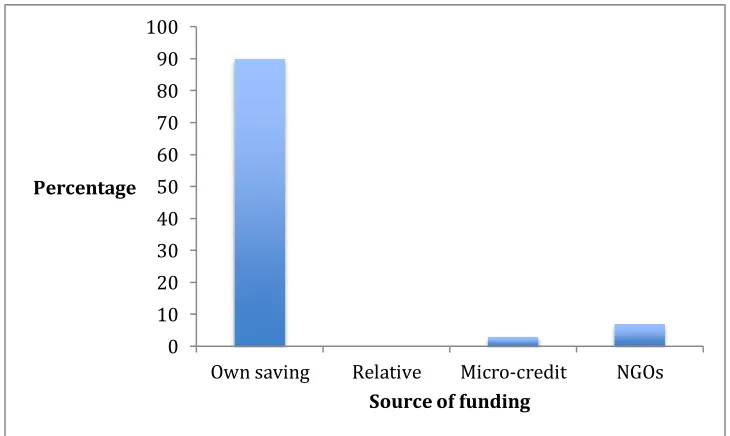
Fig. 9 Kenya Bureau of Standards (KeBs) Quality mark The study, further recorded very level of financing mechanism. With affordability of the products being a major issue lack of financing mechanism is bound have a negative impact on the adoption. Majority of the household interviewed (90 per cent) indicated that they used their own savings to purchase the product, 7 per cent per cent were given free by NGOs while 3
per cent paid through a micro-credit scheme (Fig. 10). It is worth noting that micro-credit is playing negligible role in the distribution of clean coking solution. A few that were mention include Kenya Women Microfinance Bank and a few local SACCO however; their role so far is negligible.
Fig. 10 Source of finance
The poor or lack of financing mechanism is made worse by the observation that there is little or lack of ICT innovation to support the market. Use of ICT in marketing and distribution of CCS is minimal with only 15 per cent per cent of the traders indicating
they are using ICT while 85 per cent per cent are yet to embrace ICT (Fig. 11). Innovation in ICT has been used successfully in solar solutions distribution is Kenya with M-KOPA being used to distribute solar solutions to millions of household.
0 10 20 30 40 50 60 70 80
KeBS mark Warranty
P
er
ce
n
ta
ge
yes no
0 10 20 30 40 50 60 70 80 90 100
Own saving Relative Micro-credit NGOs
Percentage
Developing an Innovative and Sustainable Market-Based Systems for Enhancing Diffusion of Clean Cooking Solutions in Kenya
http://www.ijSciences.com Volume 7 – June 2018 (06)
64
Fig. 11 Use of ICT in clean cooking solutions distribution
3.5 Awareness levels on the importance of clean cooking solutions
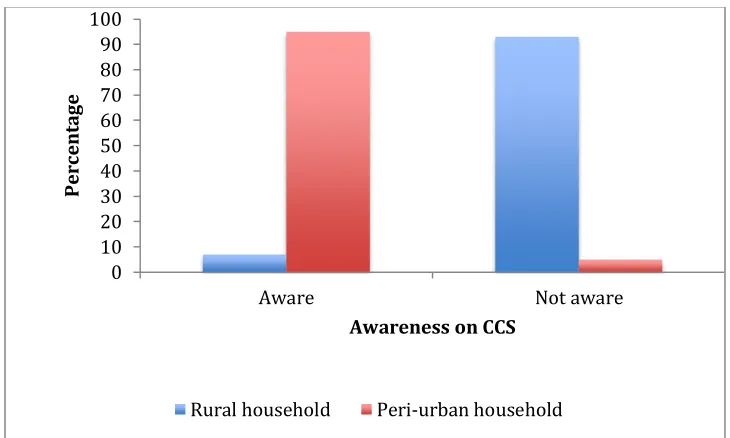
Awareness level on clean cooking solution is still low especially in the rural areas where awareness level
was as low as 7 per cent compared to peri-urban 95 per cent (Fig. 12).
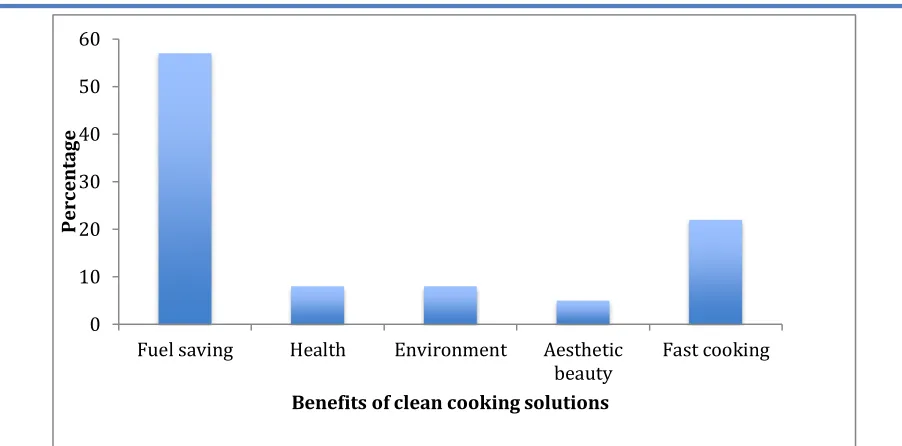
Fig. 12 Awareness level on clean cooking solution For those who were aware, the main benefit they associate with clean cooking solutions is fuel saving which was scored by 57 per cent of the households
following by fast cooking at 22 per cent (Fig. 13). Health, environment and aesthetic were not much of a consideration by the households.
0 10 20 30 40 50 60 70 80 90
Use ICT Does not use ICT
P
er
ce
n
ta
ge
Use of ICT in distribution
0 10 20 30 40 50 60 70 80 90 100
Aware Not aware
P
er
ce
n
ta
ge
Awareness on CCS
Developing an Innovative and Sustainable Market-Based Systems for Enhancing Diffusion of Clean Cooking Solutions in Kenya
http://www.ijSciences.com Volume 7 – June 2018 (06)
65
Fig. 13 Respondents opinion on the benefits of clean cooking solutions Health and environmental benefits are among the
main massage by clean cooking solution actors. The fact that the household sees it differently could point to some breakdown in communication. The study went further to interrogate on the communication strategy used to reach the households, which also
gave a negative picture. For example, when the households were as about the source of information about clean cooking solution, the majority responded that they just saw the products in the market and decided to try them out (Fig. 14).
Fig. 14 Source of information
4. Discussion and recommendation 4.1 Discussion
The past few years have seen great innovation in improved cookstoves. The innovation is driven by the introduction of climate financing and Carbon Emission Reduction (CER) trading targeting the improved cookstove market. These new technologies are having higher efficiency and more aesthetic value to attract not only the poor but also the middle class users. In our study these types of stoves were recorded predominantly in the peri-urban areas and
hardly in the rural areas.
The emerging pattern of the type of stoves and their distribution in rural and urban areas need to focus on a wider perspective on the barriers and catalyst that sees specific stoves suited for specific conditions. The key issues rotate around affordability, availability, quality, suitability and awareness including capacity. The improved biomass stoves are mainly locally produced and thus more affordable, available and suited for local cooking conditions,
0 10 20 30 40 50 60
Fuel saving Health Environment Aesthetic
beauty Fast cooking
P
er
ce
n
ta
ge
Benefits of clean cooking solutions
0 10 20 30 40 50 60
Percentage
Developing an Innovative and Sustainable Market-Based Systems for Enhancing Diffusion of Clean Cooking Solutions in Kenya
http://www.ijSciences.com Volume 7 – June 2018 (06)
66
most of the modern ICS are imported, expensive and in some cases not suited for local cooking conditions. To try to demystify these issues one of the questions we are asking is what constitutes affordability and to what extent does affordability affects quality? In the rural areas where clean cooking solution penetration is lowest, it was noted that the products in the market are more or less locally made and are cheaper compared to the imported products. That meant that household were more likely to buy locally made products. As many studies, have concluded in the past (Adkins e al 2010), locally made products are of lower quality. For example, since the 1980s when the Kenya Ceramic Jiko entered the market, local manufacturing was taken over by the informal sector (juakali). With no Standards to control the trade a lot of sub-standard products entered the market with many stoves not lasting more than 3 months in use at best. This could have made the users to give up on ICS and revert to traditional methods that they are used to.
Though, the locally manufactured stoves seems to be the majority in rural areas, the pertinent question to be asked is the differences in quality between the locally manufactured stoves and imported in terms of fuel efficiency, emissions and other benefits expected from improved cookstoves. In our study it has been demonstrated that the locally manufactured cookstoves are predominantly in the rural areas and are characterized with low thermal efficiency but are more affordable while the more modern improved cookstoves are found mainly in the peri-urban areas but are relatively more expensive.
Innovation in ICT has been used to a high success in solar market in Kenya. For example in solar market traders have invested in ICT innovation such as M-KOPSA to make the product available. In the contrary CCS is yet to see this type of innovation in the market. The current study recorded very low use of ICT in marketing and distribution of CCS with only 15 per cent of the traders indicating they are using ICT while 85 per cent are yet to embrace ICT. Focusing on ICT innovation could help to lower the cost of CCS and help in up scaling the CS market. Another key emerging issues is about awareness, as it were, there is low awareness level especially in the rural areas and this could be a key factor contributing the low penetration of clean solutions witnessed in households in rural areas. As noted in Muok and Makokha (2017), scholars have always argued that low penetration of clean energy is associated with high poverty levels in Africa, lessons learnt from development of mobile phone market gives a different picture. The rapid adoption of mobile phones in some of the poorest countries in the world
has far exceeded expectations. Mobile phone subscriptions on the continent have risen from 16 million in 2000 to 376 million in 2008. The question is what is the mobile phone market getting that clean cooking solution market does not get. Awareness could be the silver bullet. It could be a question of the message being used and how it is passed. It was conspicuously noted that for those who are awareness of the benefits of clean cooking stoves, the main benefit was fuel saving and to a lesser context fast cooking. This is contrary to the message the actors in the industry are using that of health and environment. The question is how is this message passed and to who? The current study further revealed that there is very little communication reaching the households, especially in rural areas. Most of the households, who have clean cookstoves, just found them in the market and decided to try them out. This contrary to the mobile phone market, which invested heavily in communication strategy and made sure the right message reach the right people.
4.2 Key recommendations
Awareness and capacity building: One of the challenges of up-scaling clean cooking solution has to do with low awareness among users, especially in rural areas as well as other stakeholders. There is need to focus on awareness creation and capacity building of stakeholders (policy makers, entrepreneurs, financiers and consumers) and build as institutional and infrastructure capacity needed to support clean cooking solutions market.
Multi-sectoral action: Clean cooking solutions is a cross-sectoral issue and its implementation should engage diverse public and private stakeholders from across the development spectrum, including but not limited to policymakers, health, agriculture, financial sector, environment, and education, as well as private sector actors and gender. This could include strengthening existing frameworks such as national Clean Cookstove Associations, Sustainable Energy Access Forum Kenya (SEAF-K) etc.
Developing an Innovative and Sustainable Market-Based Systems for Enhancing Diffusion of Clean Cooking Solutions in Kenya
http://www.ijSciences.com Volume 7 – June 2018 (06)
67
options (such as electricity, LPG, ethanol, biogas, and solar) is built.
Standard and quality assurance: Having Standards is an important area to support the market. The Draft cookstove Standard in Kenya need to be completed and rolled out. This could also help to benchmark the process in the neighboring countries in East Africa. Together with this is the need to develop a voluntary testing and labeling scheme to support the market and protect consumers. This has been done successfully by Lighting Africa for the solar market.
Use of ICT Innovation: Unlike solar market, cooking solution market is yet to fully utilize technology innovation, especially ICT to support market development. There is need to invest in ICT innovation to support the market. This will also to help in making the technology accessible to poor communities in the rural areas though easy payment system such as mobile phone payment.
Financing clean cooking solution: Develop a financing mechanism to support research and development of clean cooking solution market as well as suitable low-interest and long-tenure loans and investment financing for supporting and scaling up successful initiatives. This should include a deliberate attempt to attract private sector financing.
Monitoring: Improved monitoring of household energy use, including primary and supplementary cooking fuels and technologies, as well as those used for heating and lighting, must be adopted to accurately track, measure impact, and assess progress towards achieving universal access. Each country needs to have ain in-built system of monitoring and reporting. Assessment of impacts on health, environment, climate, gender and livelihood is crucial to understanding the full burden of polluting fuels and technology combinations.
Conclusion
The production and use of clean and sustainable cooking technologies present a substantial opportunity for social and economic development. Different types of clean cooking stoves, using different raw materials are produced locally to suit local conditions. As has been observed throughout this study, the clean cooking sector in Kenya is in a transition towards a transformative stage, affording the diverse actors the opportunity to make a positive, visible and sustainable impact in the provision of clean energy for the rural masses. The prospect for large-scale adoption and diffusion of clean cooking solutions is tremendous due to a combination of multiple trends, including availability and access to fuel-efficient cookstove technology, locally with low
emissions, the rising demand for alternatives and efficient biomass fuel production technologies, innovative business models coupled with growing market potential, new carbon financing opportunities; and the global agenda for clean energy, such as Sustainable Energy For All initiative and Global Alliance for Clean Cookstoves. What is required is adoption of a strategic approach to addressing the various challenges that have been identified including creating a condusive policy framework to unlock to the potentials of clean cooking solution in the country.
Acknowledgements
This study was supported by the African Climate Technology and Finance Centre and Network (ACTFCN) under the GEF Trust Fund (GEFTF) and the Special Climate Change Fund (SCCF) funding and National Research Fund (NRF), Kenya. The project is implemented by Jaramogi Oginga Odinga University for Science and Technology (JOOUST) as the lead organization in partnership with African Technology Policy Studies Network (ATPS), Clean Cookstoves Association of Kenya, University of Dar es salaam, Tanzania and Pennsylvania State University, USA.
Reference
1. Adkins E., Tyler E., Wang J., Siriri D., Modi V. 2010. Field
testing and survey evaluation of household biomass
cookstoves in rural sub-Saharan Africa Edwin. Energy for
sustainable development; 172–185.
2. Clough, L. (2012). The Improved Cookstove Sector in East
Africa: Experience from the Developing Energy Enterprise Programme (DEEP). GVEP International, London. United Kingdom.
3. Delegation of German Industry and Commerce in Kenya
(DGICK). 2013. Target market study Kenya. Delegation of German industry and commerce in Kenya. Solar PV and wind power. Nairobi: German Energy Desk, July 2013.
Available at
<http://www.africansolardesigns.com/resources_32_7304717 25.pdf>, last accessed March 15, 2018.
4. International Atomic Energy Agency (IAEA) (2015). Energy
poverty, Available at
<http://www.iea.org/topics/energypoverty/>, last accessed on June 13, 2018.
5. Lambe, F., Jürisoo, M., Wanjiru, H. and Senyagwa, J. (2015).
Bringing Clean, Safe, Affordable Cooking.
6. Muok B. O. and Makokha, W.B. (2017). Accelerating access
to energy to rural poor in Kenya through pico-solar market
development. International Journal of New Technology and
Research.
7. UNIDO (2015). Baseline Report on Clean Cooking Fuels in