R E S E A R C H A R T I C L E
Open Access
Drug overdose in the ED: a record linkage
study examining emergency department
ICD-10 coding practices in a cohort of
people who inject drugs
Rehana Di Rico
1*, Dhanya Nambiar
1,2, Mark Stoové
1,2and Paul Dietze
1,2Abstract
Background:Drug overdose is a leading cause of mortality and morbidity amongst people who inject drugs (PWID).
Drug overdose surveillance typically relies on the International Classification of Diseases (ICD-10) coding system, however its real world utilisation and the implications for surveillance have not been well characterised. This study examines the patterns of ICD-10 coding pertaining to drug overdoses within emergency departments for a cohort of known PWID.
Methods:Cohort data from 688 PWID was linked to statewide emergency department administrative data between
January 2008 and June 2013. ICD-10 diagnostic codes pertaining to poisonings by drugs, medicaments and biological substances (T-codes T36-T50) as well as mental and behavioural disorders due to psychoactive substance use (F-codes F10-F19) were examined.
Results:There were 449 unique ED presentations with T or F code mentions contributed by 168 individuals. Nearly
half of the T and F codes used were non-specific and did not identify either a drug class (n= 160, 36%) or clinical reaction (n= 46, 10%) and 8% represented withdrawal states. T and F codes could therefore be used to reasonably infer an illicit drug overdose in only 42% (n= 188) of cases. Majority of presentations with T or F overdose codes recorded only one diagnostic code per encounter (83%) and representing multiple-drug overdose (F19.- = 18%) or unidentified substances (T50.9 = 17%) using a single, broad diagnostic code was common.
Conclusions:Reliance on diagnoses alone when examining ED data will likely significantly underestimate incidence of
specific drug overdose due to frequent use of non-specific ICD-10 codes and the use of single diagnostic codes to represent polysubstance overdose. Measures to improve coding specificity should be considered and further work is needed to determine the best way to use ED data in overdose surveillance.
Keywords:Australia, ICD-10, Poisoning, Overdose, People who inject drugs, Cohort, Record linkage, Emergency
services, Surveillance
* Correspondence:[email protected]
1Centre For Population Health, Burnet Institute, 85 Commercial Road,
Melbourne, VIC 3004, Australia
Full list of author information is available at the end of the article
Introduction
People who inject drugs (PWID) experience dispropor-tionate morbidity and mortality related to their drug use [1,2]. Opioid overdose, in particular, is a leading cause of mortality amongst PWID [1]. Non-fatal opioid overdose is common amongst PWID [3–6] and associated with an in-creased risk of subsequent fatal overdose [7,8]. Monitor-ing overdose occurrence therefore presents a key surveillance target and a potential opportunity to inform interventions to reduce opioid related deaths.
Internationally, there is growing interest in utilising‘ syn-dromic surveillance’, like that used for infectious disease outbreaks, for drug related harms [9, 10]. The ongoing, systematic gathering of clinical and non-clinical data could provide timely, actionable information on new or emerging drug trends and help facilitate prompt interven-tion and responses [9, 10]. PWID frequently attend hos-pital emergency departments (EDs) [11], including for overdose-related presentations [12], and so ED data offer potential utility for surveillance and a rich source of infor-mation on drug-related morbidity.
Challenges arise, however, when using health data to study non-fatal opioid overdose due to lack of consensus regarding a case definition of opioid overdose in the litera-ture and a lack of sensitivity and specificity of hospital diagnostic coding practices in detecting these cases [13– 18]. The World Health Organization (WHO) Inter-national classification of diseases (ICD) is the most com-monly employed diagnostic coding method used in health-related administrative data, currently at its tenth revision (ICD-10). The clinical syndrome of any ‘drug overdose’ is typically represented by two broad ranges of codes within the ICD-10;“T36 to T50 Poisoning by drugs, medicaments and biological substances” (‘T-codes’) and
“F10 to F19 Mental and behavioural disorders due to psychoactive substance use” (‘F-codes’). Consensus state-ments released by the WHO Substance Abuse Depart-ment recommend that ICD-10 F-codes specifying ‘acute intoxication’should be used to classify drug overdoses in people with known substance use disorders, reserving the T-codes for poisonings in non-substance dependent people [13,14]. In practice, however, both T-codes and F-codes are used variably in the clinical setting [15, 16]. These non-standardised coding practices limit the validity and utility of ICD-10 codes in drug overdose surveillance [17, 18]. A thorough understanding of real world ICD-10 cod-ing practices is essential to optimiscod-ing surveillance efforts.
In this paper we examine F-codes and T-codes in ED attendances among a cohort of known PWID, whose drug use trends [5,19], rates of ED attendance and rea-sons for presentation [11, 20] have been characterised previously. Here, we focus specifically on the extent to which different ICD-10 codes are used in coding over-dose attendances and consider the implications of this
coding for understanding patterns and trends in the pre-sentations of PWID in the ED.
Methods
Study population
Six-hundred and eighty-eight PWID were recruited through a combination of respondent-driven sampling, snowball sampling and peer outreach between 2008 and 2010 as part of The Melbourne Injecting Drug User Co-hort Study (MIX) [5]. Participants resided in urban Mel-bourne, the second largest city in Australia, were aged 18 or over, regularly (at least monthly) injected either heroin or methamphetamine in the six months prior to baseline recruitment and had a valid Medicare number (needed to access the universal healthcare system in Australia and used in MIX for record linkage). Most (n= 563, 82%) par-ticipants reported heroin injection, in isolation or with other substances, within the month prior to recruitment. Further details of the MIX study and baseline cohort char-acteristics are described elsewhere [5].
Administrative emergency department data
Australian ED data are collected through separate systems in each state and territory. We accessed clinical data from the Victorian Emergency Minimum Dataset (VEMD), a statewide health database containing de-identified demo-graphic, administrative and clinical details from all 24-h EDs in Victoria. Thirty-eight EDs reported to VEMD dur-ing the study period, with 19 EDs located within the greater Melbourne area where most of the study cohort resided. Full descriptions of this database are available elsewhere [21]. Computer software at each reporting ED passively extracts demographic, administrative and clinical data from working clinical documents used in patient care. The software allocates the relevant ICD-10 codes for each encounter by mapping the clinical diagnoses entered by clinicians in their discharge documentation to a signifi-cantly abridged set of ICD-10 codes accepted for VEMD reporting (there are approximately 1100 codes in VEMD versus over 60,000 in the full ICD-10 manual). To this end, ED clinicians are not involved in, or directly respon-sible for, VEMD data collection or ICD-10 code selection [22]. Data are reported to VEMD with only minor input from local administrative staff. This is in contrast to hos-pital admitted episode data, which are collected by dedi-cated coding staff at each hospital who are trained to retrospectively review all clinical notes and encode data according to strict criteria, including ICD-10 code selec-tion, specifically for submission to the Victorian Admitted Episode Dataset.
Record linkage
identify all ED presentations for the cohort between January 2008 to June 2013. Deterministic record linkage was used, based on 100% match across Medicare number, first three letters of the first name (recorded in VEMD under the variable ‘Medicare Suffix’), date of birth and sex. Linked VEMD data were provided to the researchers, de-identified and encrypted by CVDL, with each partici-pant assigned a unique identifier.
ICD-10 coding and case definitions
The VEMD records diagnoses according to the Inter-national Classification of Diseases, Tenth Revision, modi-fied for use in Australia (ICD-10-AM). The sixth edition was in use during the study period. The VEMD records a primary diagnosis and up to two additional diagnoses (herein referred to as ‘secondary’and‘tertiary’diagnoses). Potential overdoses or poisonings were identified using an
‘any mention’ method [23], which included any mention of the relevant F or T code at any diagnostic level (primary, secondary or tertiary). The F-codes included in this study were F10.0 to F19.9, encompassing“mental and behavioural disorders due to psychoactive substance use”. T-codes included were T36.0 to T50.9, representing“ poi-soning by drugs, medicaments and biological substances”. T-codes were limited to non-medicinal substances whose primary use was for the feeling they cause [23]. Diagnoses in the T code range T51.0-T65.9 (n= 16) represented toxic effects from licit substances such as alcohol, tobacco, as well as other chemicals which could be used for the feeling they cause but are chiefly used for other purposes (eg. organic solvents) and were not included as ‘drug poisons’, in keeping with major coding practices inter-nationally [23]. External cause codes (eg. X42, X62, Y12) characterise overdoses as accidental, intentional or of un-determined intent but are not collected by VEMD and were therefore not included in our analysis. Within the range of included T and F codes, there were subsets per-taining to opioids specifically. Opioid specific T-codes in-cluded T40.0-T40.4 and T40.6 and opioid specific F-codes included F11.0-F11.9. The F-code range F19.0 to F19.9 was also explored in regards to polysubstance abuse and co-ingestion.
Analysis
Analysis was conducted using Stata-14, which includes ICD-10 mapping functionality. Frequencies and propor-tions were used to describe the range of T and F codes ob-served in the cohort, based on the highest ranked diagnosis across primary, secondary and tertiary diagnoses. Frequen-cies and proportions were also used to describe the distri-bution of relevant ICD-10 codes across the diagnostic levels (primary, secondary or tertiary), as well as any co-mentions of T and F codes within the same encounter.
Results
There was a total of 3459 ED presentations for the cohort during the five and half year study period. Diagnostic data were missing in 436 records (13%) due to patients leaving after clinical advice about treatment options (without be-ing seen by a definitive service provider) (n= 31) or leav-ing at risk without treatment (n= 405) and therefore did not require a diagnostic code to be recorded in VEMD. Ninety-three percent of the remaining 3023 records had only a primary diagnosis recorded, with 7% having a sec-ondary diagnosis and less than 1% having a tertiary diagnosis.
There were 232 T-code mentions across all diagnostic fields in the study period and, when accounting for re-cords with multiple T-codes within the same encounter (n= 4), this represented 228 unique presentations (7%) for
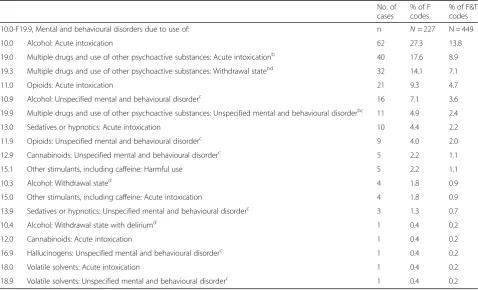
‘poisonings’. There were 232 F-code mentions across all diagnostic fields in the study period and, after accounting for cases with multiple F-codes in the same encounter (n= 5), this represented 227 (7%) unique presentations for
‘mental and behavioural disorders due to psychoactive substances’. Only six cases had both F and T codes re-corded within the same encounter, resulting in a total of 449 unique presentations containing F or T codes, con-tributed by 168 individuals. One third of all F and T code encounters (n = 138, 31%) were due to five individuals with repeat presentations. Demographic details for the 168 individuals at their first F or T code diagnosis in the study period are presented in Table1.
clinical presentation which could not distinguish between presentations related to overdose or withdrawal. There were 37 (8%) F-codes which specified withdrawal from substances as opposed to overdose. Therefore, the highest ranked F or T code per encounter could be used to rea-sonably infer an illicit drug overdose (ie. specifying both an illicit drug class (excludes alcohol) AND a clinical reac-tion of ‘poisoning’ or ‘acute intoxication’) less than half the time (n= 188, 42%).
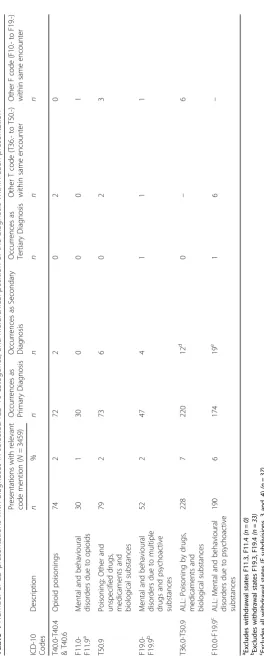
Table 4 excludes codes representing withdrawal states to look more closely at potential overdose related pre-sentations and depicts the diagnostic level (primary, sec-ondary or tertiary) that overdose related codes occur, along with T or F-code co-mentions within a given en-counter. A subset of specific ICD-10 code categories
were chosen, representing opioid poisonings, mental and behavioural disturbances related to opioids, the highest occurring T and F categories (T50.- and F19.-), as well as all poisonings and all mental and behavioural disturbances due to psychoactive substances. The table shows that when present, F or T codes were frequently primary diag-noses and there was very little overlap, both within or be-tween categories as most overdose-related F or T code presentations received only a primary diagnosis for the en-counter (n = 346, 83%). Opioid poisonings were more commonly diagnosed than mental and behavioural distur-bances due to opioids. Opioid poisoning represented one third of all T-code poisonings (n = 74, 32%) and mental and behavioural disorders due to opioids represented 13% (n= 30) of F-code diagnoses.
Discussion
We examined how a selection of F and T codes were assigned within ED data for a cohort of 688 known PWID between January 2008 and June 2013. Our findings sug-gest that ED diagnostic codes used in isolation are not suitable for surveillance of specific drug overdoses in Victoria. There were 449 unique presentations with F and T codes mentioned during the study period. Nearly half of the F and T codes utilised in the cohort were non-specific and either did not identify the drug class involved (36%) or the exact nature of the clinical effect of the drug (over-dose versus withdrawal, 10%). As such, only 188 (42%) of F or T codes could be used to reasonably infer an illicit drug overdose event, with the ICD-10 code referencing both an illicit drug class and a clinical reaction of ‘ poison-ing’or‘acute intoxication’. Despite the WHO recommen-dation to utilise F-codes of ‘acute intoxication’ to characterise overdose in substance dependent persons [14], T-codes for poisonings were more commonly as-cribed in this cohort of known PWID, most of whom would be considered clinically substance dependent. A large proportion of ‘acute intoxication’codes related to al-cohol toxicity (45%) rather than illicit substances.
[image:4.595.55.291.112.538.2]There was a wide dispersion of F and T codes within the cohort, implicating up to seven different drug classes and 18 different substances as primary causes of overdose. Within our cohort, whose patterns of drug use have been well characterised and predominantly involve the use of heroin, other opioids and stimulants [5], this suggests a high degree of misclassification of overdoses and poison-ings within the ED. It is well recognised that ED clinicians face numerous diagnostic challenges in classifying drug overdoses. A prospective observational study in a large, tertiary ED in Melbourne, Australia showed that clini-cians’impressions of the substances involved in suspected recreational drug overdose matched laboratory blood tests in 78% of cases, however this figure dropped to 46% when exploring opioids specifically [24]. In a culture where
Table 1Demographic characteristics of 168 participants at their first F or T code diagnosis in ED during the study period
N= 168 %
Mean Age 28.1 years (SD 4.3) – –
Proportion by age group (years)
15–19 6 4
20–24 40 24
25–29 66 39
30–34 52 31
35–39 3 2
40–44 1 1
Sex Male 104 62
Female 64 38
Preferred Language English 167 99
Vietnamese 1 1
Country of birth Australia 137 82
Vietnam 8 5
England 3 2
New Zealand 3 2
Other 14 8
Missing 3 2
Marital status Never married 70 42
De Facto 5 3
Married 2 1
Not stated/missing 91 54
Usual Accommodation Private residence (with others) 115 68
Private residence (alone) 14 8
Supported Residential Service (community based)
4 2
Boarding house/Hostel 3 2
Homeless 3 2
Homeless shelter / Other refuge 2 2
Other 2 2
Table 2Distribution of the 228 T-codes assigned during study period, in order of frequency (highest ranked onlya)
T36-T50, Poisoning due to: No. of cases % of T codes % of F&T codes
n N= 228 N= 449
T50.9 Other and unspecified drugs, medicaments and biological substancesb 77 33.8 17.1
T40.1 Heroin 37 16.2 8.2
T42.4 Benzodiazepines 33 14.5 7.3
T40.6 Other and unspecified narcotics 16 7.0 3.6
T39.1 4-Aminophenol derivatives 11 4.8 2.4
T43.9 Psychotropic drug, unspecified 11 4.8 2.4
T42.7 Antiepileptic and sedative-hypnotic drugs, unspecified 10 4.4 2.2
T40.2 Other opioids 9 4.0 2.0
T40.3 Methadone 6 2.6 1.3
T43.6 Psychostimulants with abuse potential 4 1.8 0.9
T40.0 Opium 3 1.3 0.7
T40.7 Cannabis (derivatives) 3 1.3 0.7
T41.2 Other and unspecified general anaesthetics 3 1.3 0.7
T40.4 Other synthetic narcotics 2 0.9 0.4
T43.0 Tricyclic and tetracyclic antidepressants 2 0.9 0.4
T40.9 Other and unspecified psychodysleptics [hallucinogens] 1 0.4 0.2
a
In cases with multiple T codes per encounter (n= 4), the highest ranked diagnosis was taken b
Diagnosis does not specify drug class
Table 3Distribution of the 227 F-codes assigned during study period, in order of frequency (highest ranked onlya)
No. of cases
% of F codes
% of F&T codes
F10.0-F19.9, Mental and behavioural disorders due to use of: n N= 227 N = 449
F10.0 Alcohol: Acute intoxication 62 27.3 13.8
F19.0 Multiple drugs and use of other psychoactive substances: Acute intoxicationb 40 17.6 8.9
F19.3 Multiple drugs and use of other psychoactive substances: Withdrawal statebd 32 14.1 7.1
F11.0 Opioids: Acute intoxication 21 9.3 4.7
F10.9 Alcohol: Unspecified mental and behavioural disorderc 16 7.1 3.6
F19.9 Multiple drugs and use of other psychoactive substances: Unspecified mental and behavioural disorderbc 11 4.9 2.4
F13.0 Sedatives or hypnotics: Acute intoxication 10 4.4 2.2
F11.9 Opioids: Unspecified mental and behavioural disorderc 9 4.0 2.0
F12.9 Cannabinoids: Unspecified mental and behavioural disorderc 5 2.2 1.1
F15.1 Other stimulants, including caffeine: Harmful use 5 2.2 1.1
F10.3 Alcohol: Withdrawal stated 4 1.8 0.9
F15.0 Other stimulants, including caffeine: Acute intoxication 4 1.8 0.9
F13.9 Sedatives or hypnotics: Unspecified mental and behavioural disorderc 3 1.3 0.7
F10.4 Alcohol: Withdrawal state with deliriumd 1 0.4 0.2
F12.0 Cannabinoids: Acute intoxication 1 0.4 0.2
F16.9 Hallucinogens: Unspecified mental and behavioural disorderc 1 0.4 0.2
F18.0 Volatile solvents: Acute intoxication 1 0.4 0.2
F18.9 Volatile solvents: Unspecified mental and behavioural disorderc 1 0.4 0.2
a
In cases with multiple F codes per encounter(n = 5), the highest ranked diagnosis was taken b
Diagnosis does not specify drug class c
Diagnosis does not specify clinical syndrome d
[image:5.595.60.539.409.699.2]co-ingestion is increasingly common, and pre-hospital na-loxone administration (an opioid antagonist) is widely available, the classic opioid poisoning toxidrome of pupillary meiosis, respiratory depression and stupor may not manifest [25]. Toxicological assays are not yet rapid or reliable enough to be clinically useful in acute overdose [26] and precise identification of the causative agent may be clinically irrelevant in the ED context with critically un-well, obtunded or agitated patients who require immedi-ate, symptom directed, supportive care regardless of aetiology [25]. Many overdoses are managed by ambu-lance services in the community itself without requiring subsequent hospitalisation [27–29], however Victorian ambulance clinical practice guidelines recommend that patients who have not responded within ten minutes to naloxone treatment in the community or have other com-plicating features should be brought to hospital [30]. This increases the complexity of the ED casemix, further chal-lenging clinicians’abilities to accurately identify the sub-stances involved in overdoses or poisonings. An additional effect of this on ICD-10 coding may be that, even if an opioid overdose is the underpinning primary event, the clinical diagnosis chosen in ED may pertain to the compli-cating features necessitating transportation to ED, rather than the overdose itself. For example, a clinician may enter a diagnosis reflecting ‘polysubstance overdose’ be-cause the patient failed to respond to community adminis-tered naloxone or record only the medical complications of overdose such as aspiration pneumonia. These coding practices limit the sensitivity and specificity of ICD-10 codes in detecting overdose presentations.
The most common single overdose-related code used was “T50.9: Other and unspecified drugs, medicaments and biological substances”. The official WHO definition states the ‘T50.9’code is applicable when substances are
‘not elsewhere classified’, listing examples of “acidifying agents, alkalizing agents, immunoglobulin, immunologi-cals, lipotropic drugs and parathyroid hormones and de-rivatives” [31]. These substances are highly unlikely to be the most common primary cause of drug overdose in our cohort of PWID with a known predilection for the use of heroin, other opioids and stimulants. Our findings there-fore suggest that, in clinical practice, it appears ‘T50.9’is being adopted as a means to classify encounters where
‘unknown’or ‘unspecified’substance(s) are involved. The
‘F19.-’category, encompassing codes F19.0-F19.9, was the most common diagnostic category seen in the cohort, representing “mental and behavioural disorders due to multiple drugs and psychoactive substances”. Once again, this category is non-specific, referring to‘multiple drugs’ but not implicating any specific agent or drug class. WHO recommends‘F19.-’codes are used in cases when“two or more psychoactive substances are known to be involved but it is impossible to assess which substance contributed
most”or“when the exact identity of some or all the psy-choactive substances being used is uncertain or unknown” [31]. It is plausible that, despite clinicians’intensive efforts in ED, the specific substances involved in a drug overdose cannot be identified. However, the high frequency use of this code within a cohort of known PWID with relatively stable drug usage patterns [19] suggests that other con-textual factors, such as a lack of understanding of the im-portance of detailed clinical documentation for surveillance efforts, insensitive data collection tools and competing priorities in a busy ED, may be influencing non-specific coding practices as well. Studies have shown insufficient awareness about ICD-10 coding practices amongst both clinicians and trained coders [16, 22] and there has been criticism that the significantly abridged ICD-10 codes do not adequately capture all substances, particularly new and emerging drugs, forcing clinicians’ diagnoses to be mapped back to inappropriate codes [15]. It is unclear, however, whether increasing the number and specificity of codes available will yield more accurate data. Our study revealed that majority (83%) of overdose en-counters with F or T code diagnoses had only a primary diagnosis recorded, despite the option for clinicians to rec-ord up to three. In the context of general medical or surgi-cal presentations, a single diagnosis may be appropriate and reflect single organ system dysfunction, however in the context of drug poisoning or overdose, co-ingestion is increasingly common and warrants numerous diagnostic entries to reflect each involved substance. In the busy ED setting, broad non-specific headings such as ‘other and unspecified drugs’ or ‘multiple drugs and psychoactive substances’may appear convenient and all-encompassing default options to indicate polysubstance overdose, rather than individually entering multiple different agents.
regarding the ICD-10 tool and its appropriateness for drug overdose diagnosis in ED and consideration of the in-volvement of trained, dedicated coders within EDs (similar to clinical coding used for inpatient records [33]) to re-lieve the data collection burden from busy clinical staff and potentially improve data quality and consistency.
Limitations
Limitations of this study include the known shortcom-ings of administrative data quality in terms of complete-ness and accuracy, as well as the potential for missed VEMD patient records in the deterministic linking process. The CVDL reviewed their linkage algorithm nu-merous times to minimise the false negative rate and linked data was closely interrogated by multiple authors to ensure there were no duplicate records. The range of F and T codes included in this study were in line with those commonly used for overdose research and surveil-lance internationally, however a key limitation for re-search of this type, using administrative-level data, is that the rate of under- or over- ascertainment of cases cannot be known. Whilst we assume that true overdoses are of sufficient clinical acuity and severity to feature prominently within diagnostic coding for that encounter, it is acknowledged that some cases may have been allo-cated alternative ICD-10 codes in the ED and therefore not identified by this study. Similarly, it cannot be accur-ately determined if the encounters with the included T and F codes truly reflected illicit substance overdose. Given the large number of EDs involved, it was not feas-ible to extract patient level data on toxicology results and vital clinical observations to confirm a clinical over-dose for every case. Nonetheless, by utilising a cohort of people who are known to inject drugs (and are therefore at higher risk of illicit drug overdose than the general population) and examining data from multiple EDs statewide, we were able to capture a high number of po-tential overdose events and describe patterns and trends in the real-life application of overdose-related ICD-10 codes. There is a growing body of research examining the sensitivity and specificity of ICD-10 coding in identi-fying illicit drug overdose [17, 18] and this will be an area of key relevance for informing surveillance case def-initions in future. The limitations of this study are akin to the challenges faced by overdose surveillance efforts at large, and only highlight the importance of further re-search in this area, to identify opportunities for improv-ing data quality and surveillance targets.
Conclusion
There is a disconnect between the idealised usage of the ICD-10 codes and its application in everyday practice. Broad, non-specific coding with single primary diagnoses are frequently employed within EDs to classify drug
overdoses and therefore reliance on diagnoses alone when examining ED data will likely significantly under-estimate incidence of drug overdose for any specific drug. Nonetheless, EDs are at the coal face of serious overdoses and can still play a valuable role in drug sur-veillance. Further work is needed to determine the best way to use ED data in syndromic surveillance.
Abbreviations
CVDL:Centre for Victorian Data Linkage; ED: Emergency Department; ICD: International Classification of Diseases; ICD-10: International Classification of Diseases, Tenth Revision; ICD-10-AM: International Classification of Diseases, Tenth Revision, Australian Modification; MIX: Melbourne Injecting Drug User Cohort Study; PWID: People Who Inject Drugs; VEMD: Victorian Emergency Minimum Dataset; WHO: World Health Organization
Acknowledgements
This study was made possible by the contribution of many people, including the original MIX investigators; the team who recruited the participants and the participants themselves; the Centre for Victorian Data Linkage for their cooperation and expertise in assisting with access to departmental databases; and colleagues at Burnet Institute for their guidance and technical assistance.
Funding
MIX was funded by The Colonial Foundation Trust and the National Health and Medical Research Council (NHMRC Grant #545891, 1126090, and the Centre for Research Excellence into Injecting Drug Use, APP1001144). The Burnet Institute receives valuable support from the Victorian Operational Infrastructure Support Program. The funders had no role in the study design; in the collection, analysis and interpretation of data; in the writing of the report; and in the decision to submit the article for publication. PD is a recipient of an NHMRC Research Fellowship (1136908) and has received funding from Gilead Sciences Inc. for an investigator-driven grant and an untied educational grant from
Reckitt Benckiser for work unrelated to this study. MS is a recipient of an NHMRC Research Fellowship and has received support through CREIDU for work unrelated to this study.
Availability of data and materials
All data used in this study are protected under the privacy policies of Victorian Department of Health and Human Services‘Deed of Acknowledgment and Confidentiality’. Signed confidentiality agreements prevent us from sharing the data.
Authors’contributions
RD performed the literature review, participated in study concept and design, liaised with the Centre for Victorian Data Linkage regarding data release and accuracy, manually reviewed the outcomes of linkage, undertook the data analysis and interpretation, and drafted the manuscript. DN participated in original cohort data submission for record linkage and critically reviewed the manuscript. MS critically reviewed the manuscript. PD refined the study concept and design, assessed with interpretation of results and critically reviewed the manuscript.All authors read and approved the final manuscript.
Ethics approval and consent to participate
Written informed consent, including consent to access Medicare information, was obtained from all participants during enrolment in the MIX study and MIX was approved by the Victorian Department of Human Services (now Department of Health) and Monash University Human Research Ethics Committees. The present study was approved by the Victorian Department of Health and Human Services.
Consent for publication
Not applicable.
Competing interests
Publisher’s Note
Springer Nature remains neutral with regard to jurisdictional claims in published maps and institutional affiliations.
Author details
1Centre For Population Health, Burnet Institute, 85 Commercial Road,
Melbourne, VIC 3004, Australia.2Department of Epidemiology & Preventive
Medicine, Monash University, 553 St Kilda Road, Melbourne 3004, VIC, Australia.
Received: 8 January 2018 Accepted: 22 November 2018
References
1. Mathers BM, Degenhardt L, Bucello C, Lemon J, Wiessing L, Hickman M. Mortality among people who inject drugs: a systematic review and meta-analysis. Bull World Health Organ. 2013;91:102–23.
2. Warner-Smith M, Darke S, Day C. Morbidity associated with non-fatal heroin overdose. Addiction. 2002;97:963–7.
3. Darke S, Ross J, Hall W. Overdose among heroin users in Sydney, Australia: I. prevalence and correlates of non-fatal overdose. Addiction. 1996;91:405–11. 4. Karlsson T, Butler K, Uporova J, Roxburgh A. Australian drug trends 2017.
Preliminary findings from the illicit drugs reporting system (IDRS). 2017.
http://www.drugtrends.org.au/reports/2017-idrs-preliminary-findings. Accessed 19 Dec 2017.
5. Horyniak D, Higgs P, Jenkinson R, Degenhardt L, Stoové M, Kerr T, et al. Establishing the Melbourne injecting drug user cohort study (MIX): rationale, methods, and baseline and twelve-month follow-up results. Harm Reduct J. 2013;10:11.
6. Fatovich D, Bartu A, Davis G, Atrie J, Daly F. Morbidity associated with heroin overdose presentations to an emergency department: a 10-year record linkage study. Emerg Med Australas. 2010;22:240–5.
7. Stoové MA, Dietze PM, Jolley D. Overdose deaths following previous non-fatal heroin overdose: record linkage of ambulance attendance and death registry data. Drug Acohol Rev. 2009;28:347–52.
8. Caudarella A, Dong H, Milloy M, Kerr T, Wood E, Hayashi K. Non-fatal overdose as a risk factor for subsequent fatal overdose among people who inject drugs. Drug Alcohol Depend. 2016;1:51–5.
9. Ising A, Proescholdbell S, Harmon KJ, Sachdeva N, Marshall SW, Waller AE. Use of syndromic surveillance data to monitor poisonings and drug overdoses in state and local public health agencies. Inj Prev. 2016;22(Suppl 1):i43–9. 10. Mccormick M, Koziol J, Development SK. Use of a new opioid overdose
surveillance system, 2016. Rhode Island Medical Journal. 2017;100(4):37–9
http://www.rimed.org/rimedicaljournal/2017/04/2017-04-37-health-mccormick.pdf. Accessed 8 Jan 2018.
11. Nambiar D, Spelman T, Stoové M, Dietze P. Are people who inject drugs frequent users of emergency department services? A cohort study (2008–2013). Substance Use Misuse. 2017.https://doi.org/10.1080/10826084.2017.1341921.
12. Backmund M, Schuetz C, Meyer K, Edlin B, Reimer J. The risk of emergency room treatment due to overdose in injection drug users. J Addict Dis. 2009;28:68–73. 13. World Health Organization. Programme on substance abuse. Deaths related
to drug abuse: report on a WHO consultation. Geneva: World Health Organization; 1993.http://apps.who.int/iris/handle/10665/58700. Accessed 8 Jan 2018.
14. World Health Organization. Subst Abus Department. Opioid Overdose -Trends, Risk Factors, Interventions and Priorities for Action. 1998.
http://apps.who.int/iris/handle/10665/64993. Accessed 8 Jan 2018. 15. Wood DM, Conran P, Dargan PI. ICD-10 coding: poor identification of
recreational drug presentations to a large emergency department. Emerg Med J. 2011;28:387–9.
16. Shah AD, Wood DM, Dargan PI. Survey of ICD-10 coding of hospital admissions in the UK due to recreational drug toxicity. QJM - Mon J Assoc Physicians. 2011;104:779–84.
17. Reardon JM, Harmon KJ, Schult GC, Staton CA, Waller AE. Use of diagnosis codes for detection of clinically significant opioid poisoning in the emergency department: a retrospective analysis of a surveillance case definition. BMC Emerg Med. 2016;16:11.
18. Rowe C, Vittinghoff E, Santos GM, Behar E, Turner C, Coffin PO. Performance measures of diagnostic codes for detecting opioid overdose in the emergency department. Acad Emerg Med. 2017;24:475–83.
19. Scott N, Caulkins JP, Ritter A, Dietze P. Patterns of drug preference and use among people who inject drugs in Melbourne, Australia. Addict Res Theory. 2015;23:459–68.
20. Nambiar D, Stoové M, Dietze P. Frequent emergency department presentations among people who inject drugs: a record linkage study. Int J Drug Policy. 2017;44:115–20.
21. Department of Health & Human Services. Victoria State Government Victorian Emergency Minimum Dataset (VEMD).https://www2.health.vic.gov. au/hospitals-and-health-services/data-reporting/health-data-standards-systems/data-collections/vemd(2017). Accessed 9 Aug 2017.
22. Marson R, McD Taylor D, Ashby K, Cassell E. Victorian emergency minimum dataset: factors that impact upon the data quality. Emerg Med Australas. 2005;17:104–12.
23. Injury Surveillance Workgroup 7. Consensus recommendations for national and state poisoning surveillance. The safe states Alliance. Atlanta, GA. 2012.
http://c.ymcdn.com/sites/www.cste.org/resource/resmgr/injury/isw7.pdf. Accessed 2 Dec 2017.
24. West E, Cameron P, O’Reilly G, Drummer OH, Bystrzycki A. Accuracy of current clinical diagnosis in recreational drug-related attendance to the emergency department. Emerg Med Australas. 2008;20:333–8.
25. Boyer EW. Management of Opioid Analgesic Overdose. N Engl J Med. 2013; 367:146–55.
26. Wu AHB, McKay C, Broussard LA, Hoffman RS, Kwong TC, Moyer TP, et al. National Academy of Clinical Biochemistry Laboratory medicine practice guidelines: recommendations for the use of laboratory tests to support poisoned patients who present to the emergency department. Clin Chem. 2003;49:357–79.
27. Dietze PM, Cvetkovski S, Rumbold G, Miller P. Ambulance attendance at heroin overdose in Melbourne: the establishment of a database of ambulance service records. Drug Alcohol Rev. 2000;19:27–33.
28. Dietze P, Jolley D, Cvetkovski S, Cantwell K, Jacobs I, Indig D. Characteristics of non-fatal opioid overdoses attended by ambulance services in Australia. Aust N Z J Public Health. 2004;28:569–75.
29. Willman MW, Liss DB, Schwarz ES, Mullins ME. Do heroin overdose patients require observation after receiving naloxone? Clin Toxicol. 2017;55:81–7. 30. Ambulance Victoria Clinical Practice Guidelines.https://www.ambulance.vic.
gov.au/paramedics/clinical-practice-guidelines(2016). Accessed 11 Nov 2017. 31. World Health Organization. Browse ICD-10 Version: 2008.http://apps.who.
int/classifications/icd10/browse/2008/en(2016). Accessed 8 Jan 2018. 32. Slavova S, Bunn TL, Talbert J. Drug overdose surveillance using hospital
discharge data. Public Health Rep. 2014;129:437–45.