City, University of London Institutional Repository
Citation
:
Mann, W., Sheng, L. & Morgan, G. (2016). Lexical-Semantic Organization in Bilingually Developing Deaf Children With ASL-Dominant Language Exposure: Evidence From a Repeated Meaning Association Task. Language Learning, 66(4), pp. 872-899. doi: 10.1111/lang.12169This is the accepted version of the paper.
This version of the publication may differ from the final published
version.
Permanent repository link:
http://openaccess.city.ac.uk/16778/Link to published version
:
http://dx.doi.org/10.1111/lang.12169Copyright and reuse:
City Research Online aims to make research
outputs of City, University of London available to a wider audience.
Copyright and Moral Rights remain with the author(s) and/or copyright
holders. URLs from City Research Online may be freely distributed and
linked to.
1
Lexical-Semantic Organization in Bilingually Developing Deaf Children with ASL-dominant Language Exposure: Evidence from a Repeated Meaning Association Task
Wolfgang Mann 1, 2, 3, Li Sheng 3, & Gary Morgan 2
1
University of Roehampton
2
City University London
3
The University of Texas at Austin
Keywords: Sign bilingual, vocabulary knowledge, semantic development, lexical-semantic organization, words association, vocabulary acquisition
Corresponding author at: School of Education, University of Roehampton,
Roehampton Lane, SW15 5PJ.
Tel.: +44 (0)20 8392 6281
2 Abstract:
This study examined the lexical-semantic organization skills of bilingually developing deaf children in American Sign Language (ASL) and English as compared to a monolingual hearing control group. A repeated meaning-association paradigm was used to assess retrieval of semantic relations in deaf 6-10 year-olds with exposure to ASL from birth by their deaf parents (N = 12). Responses were coded as syntagmatic (ice cream-delicious) or paradigmatic (e.g. night-day). Deaf children’ responses in L1 and L2 were
3 Acknowledgments:
This research was supported by a Marie Curie International Outgoing Research Fellowship within the 7th European Community Framework Programme awarded to the
4 Introduction
The acquisition of word meanings is a fundamental aspect of language development and once children have begun to acquire lexical items it is of great interest how they organize their steadily growing vocabulary into an efficient system (e.g. Bloom, 2002). Up until recently theories of lexical development were based on only typically hearing children acquiring spoken languages (see Clark, 1993, for a review of lexical acquisition). It is of interest if these findings relate also to deaf children acquiring a signed language (e.g. British Sign Language: Woll, 2013).
Previous research investigated how children acquire basic organizational principles (e.g., thematic and taxonomic relations between words) and developmental changes in the use of these semantic links (Markman, 1991; Waxman & Gelman, 1986). This work established that children form semantic networks through the combination of strong links between words that are closely related and weaker links between words that share fewer semantic relations (see Clark, 2009, for a review). This development of networks also has an effect on semantic memory as it enables individuals to structure information in such a way that it can be later searched more efficiently. These changes in vocabulary storage are therefore linked to children’s developing memory efficiency, growth in speed of retrieving lexical items from the memory store, and faster assimilation of world knowledge (Gathercole, 2003).
5
Studies using single-word association tasks to measure children’s semantic knowledge show that children are apt to produce word associations of both syntagmatic and paradigmatic nature (Nelson, 1977). Syntagmatic responses are words that follow the stimulus in a syntactic sequence (e.g., cold-outside) or words that share a thematic relationship with the stimulus (e.g., cold-sweater, cold-winter); whereas paradigmatic responses are words from the same word class (or paradigm) as the stimulus (e.g., cold-hot) (Sheng, McGregor, & Marian, 2006). Both response types bear clear semantic relations to the stimulus but syntagmatic responses may be derived from tangible perceptual and conceptual experiences whereas paradigmatic responses represent more abstract linguistic relationships. Hence, paradigmatic responses are sometimes regarded as developmentally more mature (Lippman, 1971; Nelson, 1977).
Lexical-semantic organization in monolingual children
Children are exposed to massive amounts of information as they are acquiring much of their vocabulary in the school years. A typical school-age child acquires 3,000 - 5,000 new words each year or about 10 to 13 words per day (Miller & Gildea, 1987). It has been suggested that children utilize two types of information when acquiring the meaning of a lexical item: 1) linguistic and 2) perceptual (Nelson, 1991). This is based on the idea that knowledge of word meaning is understood as the interconnected range of a learner’s different associations with that word, including linguistic associations and perceptual associations.
6
nodes, are linked to other nodes that share semantic relationships. The strength of these links varies, depending on the degree of meaning overlap between words and/or the frequency of co-occurrence of words. For instance, upon hearing the word dog, the conceptual node representing that word is activated. Then the activation spreads such that nodes bearing strong links to the activated node (e.g., cat or animal) are immediately activated and are produced early on in free or continuous word association whereas weakly linked nodes (e.g., leash) receive a smaller and/or delayed activation and are produced later in free or continuous word association (Sheng & McGregor, 2010). A mature network will consist of many links with the strength of the activation diminishing the further it moves away from its core. This effect of spreading activation has been observed and reported in many studies and under different experimental conditions for first and second language (for a review, see McNamara & Holbrook, 2003).
7
progressively more difficult as semantic activation travels along the network (Elbers & van Loon-Vervoorn, 1998; Sheng & McGregor, 2010).
Lexical-semantic organization in bilingual children
8
in the Spanish task, the high English experience groups produced less paradigmatic and syntagmatic responses than the high Spanish experience groups.
Studying semantic networks in signing deaf children
As described, most studies of the development of semantic networks have focused on hearing children learning spoken languages. In comparison, we know very little about this in deaf child users of signed languages (Marshall, Rowley, & Atkinson, 2014). Most deaf signers, particularly those in Western or urban societies, are bilingual to some degree as they may be exposed to signs while, at the same time, acquiring the language of the linguistic majority. Lexical acquisition in sign bilingual deaf populations is interesting because it provides both a means of studying language acquisition in itself, and a way of comparing language acquisition across different contexts of age of first exposure. Only a small percentage of deaf children (5-10 %) have deaf parents and receive signed language input from birth (Mitchell & Karchmer, 2004). These children reach developmental milestones in their signed language at a comparable pace to hearing children learning spoken languages (Corina & Singleton, 2009; Morgan & Woll, 2002; Newport & Meier, 1985; Schick, 2003) and their vocabulary growth patterns during the first years have been reported to be similar (Anderson & Reilly, 2002; Woolfe, Herman, Roy, & Woll, 2010).
9
form (Meir, 2012), leaving deaf children without this resource for augmenting their face-to-face learning experiences (Goldin-Meadow & Mayberry, 2001). Also, both the number
of users of a given signed language as well as the contexts by which signed language can
be observed are very reduced compared with spoken language. As a result, little is known
about whether deaf children who use a signed language have similar experiences to their
hearing peers in learning new lexical items through formal or informal ways (Marschark
& Wauters, 2008). Despite these different experiences in learning language by deaf children many studies of ASL and other sign languages suggest similar developmental trends to those reported for spoken languages (ASL: Novogrodsky, Fish, & Hoffmeister, 2014, Novogrodsky, Caldwell-Harris, Fish, & Harris, 2014; BSL: Mann & Marshall, 2012; Marshall, Rowley, Mason, Herman, & Morgan, 2013, Mason et al., 2010; Italian Sign Language: Tomasuolo, Fellini, Di Renzo, & Volterra, 2010). For instance, recent research on lexical semantic acquisition in ASL by Novogrodsky and colleagues explored depth of lexical knowledge in deaf children ages 4-18 years, specifically the acquisition of synonyms (Novogrodsky, Fish, & Hoffmeister, 2014) and antonyms (Novogrodsky, Caldwell-Harris, Fish, & Hoffmeister, 2014). Children’s performance on a set of receptive multiple choice tasks revealed similar developmental trajectories reported for hearing children acquiring a spoken language, including growing reliance on semantic knowledge and less on phonological knowledge (Novogrodsky, Fish, & Hoffmeister, 2014). Similarly, a study on semantic knowledge in BSL by Marshall and colleagues (2013) showed an increase in deaf children’s productivity and semantic clustering of responses in their signs in BSL on a semantic fluency task.
10
sign language has reported similar organization of the lexicon in signed languages to spoken languages, studies that directly compared lexical-semantic organization in deaf children’s L1 (signed language) and their L2 (spoken language) are rare. Although deaf children with deaf parents are native and fluent users in their L1 that language is not the language they are learning to read and use with the wider hearing community.
We examined the accessibility of semantic information in bilingually developing deaf children with ASL-dominant language exposure and monolingual hearing children, using a repeated word association paradigm. Our main goals were: (a) to investigate the status of lexical–semantic organization, specifically the number and accessibility of paradigmatic and syntagmatic relations in L1 (i.e., ASL) of deaf children with deaf parents -referred to as ‘native signers’- in relation to their L2 (i.e., English) and (b) to compare deaf children’s lexical-semantic organization in both ASL and English to hearing children’s lexical-semantic organization in English.
With regard to the first goal, we hypothesized that deaf children would generate an overall larger number of paradigmatic and syntagmatic relations in ASL compared to English due to their earlier access to sign but show similar accessibility of these types of semantic relations in both languages/modalities over multiple elicitation trials1.
With regard to the second goal, we expected that deaf native signers’ proportion of generated semantic responses in ASL but not in English would be similar to the hearing control with activation patterns in both modalities showing a similar spread and also comparable frequency of response to hearing peers. The between-group differences in semantic performance for English were expected due to deaf children’s limited access
11
to the same auditory base than normally hearing children do (Goldin-Meadow & Mayberry, 2001).
The comparison between deaf ASL-English bilinguals and hearing English monolinguals was carried out, as follows: First, we explored deaf bilinguals’ semantic performance in ASL and English across multiple elicitation trials, using a repeated word association paradigm adapted from Sheng and colleagues (2012). For this analysis, we calculated the mean proportions of different types of responses, i.e., paradigmatic and syntagmatic. Second, we examined changes in the relative frequency of responses for ASL and English (deaf bilinguals) and for English (hearing monolinguals) at each elicitation point. In addition, we investigated possible effects of vocabulary size, an index of general language/verbal ability, on children’s ability to form semantic links. Given the posited close relationship between abstract paradigmatic responses and decontextualized verbal explanation we expected to find the ability to form paradigmatic associations to be strongly correlated with vocabulary. Lastly, we examined the effects of age in our analysis of children’s performances, given the relatively wide age range (6 -10 years) of the deaf sample.
Methods Participants
12
intellectual disability) other than deafness. All participants were exposed to ASL from birth by their deaf parent(s) and are thus considered to be native signers.
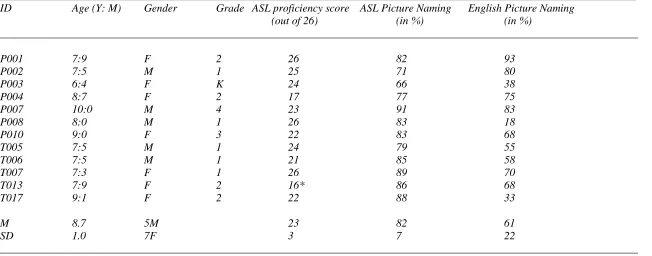
To determine participants’ ASL proficiency, we used a questionnaire adapted from Quinto-Pozos, Forber-Pratt, & Singleton (2011) and Peña, Reséndiz, and Gillam (2007). Teachers (8 deaf, 2 hearing) rated participants’ signed language proficiency at school based on vocabulary, sentence production, and comprehension. Ratings were combined to produce a mean score for children’s ASL proficiency. Data from this questionnaire are included in Table 1. In addition, teachers self-assessed their own ASL skills on a set of two 5-point scales, one for receptive skills, the other for productive skills, adapted from Haug (2011). This was carried out to confirm the validity of ASL proficiency of the participants based on the information provided in the teacher questionnaires. Average rating was M = 4.9 (SD = .31, range = 4-5) for receptive skills and M = 4.9 (SD = .31, range= 4-5) for productive skills with ‘5’ indicating near-native signing competency.
The hearing comparison group (HG) comprised 49 (22 boys) age-matched children between the ages of 6-11 years (M = 8.5, SD = 1.3) recruited from a local primary school. All children were monolingual native speakers of English. Deaf and hearing groups were equivalent in age, t(59) = 1.331, p = .19. None of the participants had any cognitive delays, as reported by their teachers. Ethical approval and parent consent for all participants was obtained prior to the beginning of the study.
13
the naming task for ASL and the hearing group’s performance on the same task in English (D: M = 81.72, SD = 7.42; HG: M = 75.62, SD =10.16, t(59) = -1.950, p =.06). In comparison, deaf participants produced a smaller proportion of responses on the naming task for English than the hearing control (D: M = 58.33, SD = 22.48; HG: M = 75.59, SD = 1.83, t(59) = 2.558, p = .02). One possible explanation for the marginally higher score by deaf participants for ASL could be that some items were more familiar to them compared to hearing test takers, e.g., SIGN, WEBCAM, or TEXT.
Table 1 – Insert here
Stimuli
14
ASL. One signer had a background in linguistics, the other in educational psychology. Both had taught at the school where the study was carried out and were well acquainted with the sign vocabulary used by children in the target group. Following these discussions 66 of the 80 items were accepted for adaptation without further changes and could be translated directly to ASL. Of the remaining 14 items, 10 items required a change to the target item (and development of new distractor items). These included the sign for PARIS, which was replaced by NEW YORK, in part because the sign in ASL is fingerspelled but also to make the item more culturally appropriate. Three items required a change to the label, due to differences between British English and American English. These items were tap (faucet in American English), rugby (football in American English), and rubbish (trash in American English). Upon completion of the item revisions, the final list was presented to the deaf experts, who agreed that it was a representative sample of ASL vocabulary items for the targeted age group. These items were then adapted for English.
Procedures
15
examples of incorrect responses (e.g., CAR, RUN). Following the instruction, children could practice on two items, CARROT and DOG. During practice, the examiner, a different deaf native signer, provided non-contingent feedback and encouraged only single-sign or word responses. During the ASL task, some children copied the target sign or generated a regional variation of the target sign. These children were reminded by the examiner to generate different signs with a related meaning. Accepted response formats for the English task included voicing, fingerspelling in ASL, or writing in English.
The procedures for eliciting English responses were similar. Target words were presented in digital print. While this approach made the test conditions no longer identical it is the best condition of presenting English words to deaf children.
16
presented in randomized order across children. The rationale for not videotaping children’s responses in ASL was to make task administration more time efficient for practitioners. We accounted for possible inaccuracies by using a deaf native signer to administer the task. To ensure fidelity of the administration, approximately 20% (5 out of 24) of initial sessions were observed live by the first author. No administration errors or inconsistencies were noted. Inter-rater reliability (see ‘Reliability’) was sufficiently high although we agree that the live assessment of the appropriateness of responses for the meaning association task remains challenging. We are working towards developing a corpus of acceptable associations
Due to time restrictions it was not possible to collect performance data for English on both item sets for all deaf children. Therefore, only one set (‘A’) was used for comparative analysis of deaf bilinguals’ semantic performance for ASL and English and for analysis of deaf bilinguals and hearing monolinguals’ performance for English.
17 Coding
Paradigmatic and syntagmatic sign/word associations were coded, following Sheng, McGregor, & Marian (2006): paradigmatic associations included synonyms (e.g.,
happy-excited), antonyms (e.g., old-new), co-ordinates (e.g., cherry-strawberry), superordinates (e.g., cat-animal), sub-ordinates (shop-Safeway), or direct negations of the stimulus sign (e.g., proud-not proud). Syntagmatic associations indicated thematic relationships with the prompts (e.g., hospital-doctor, bike-ride, drip-water). Errors encompassed no responses, which included ‘don’t know’ responses or repetitions of the stimulus or earlier responses, phonological responses (e.g., cat-cap), and unrelated responses (e.g., bike-hungry). Any responses that could be either paradigmatic or syntagmatic were coded as paradigmatic. We did not code for phonological similarity.
Reliability
18 Results
Semantic Organization in Deaf Bilinguals’ L1 and L2.
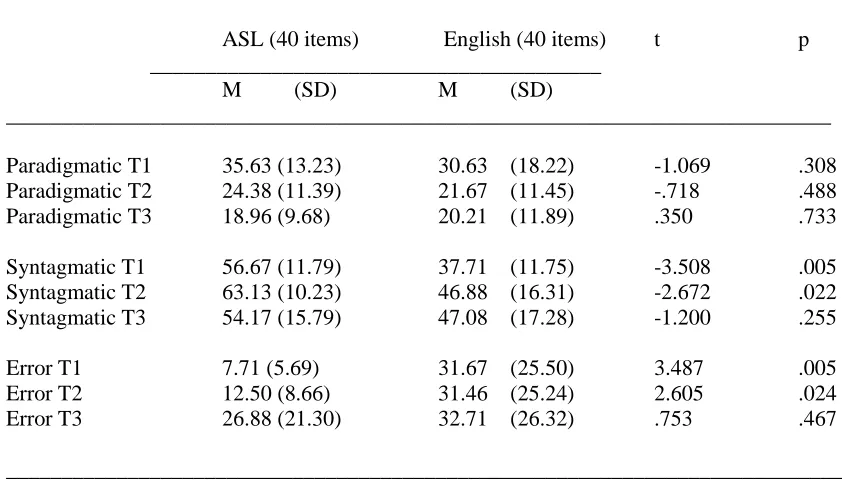
Mean proportions of deaf participants’ paradigmatic and syntagmatic responses in ASL and English are shown in Table 2. A majority of the children’s responses (ranging from 67.29% for English at Trial 3 to 92.30% for ASL at Trial 1) belonged to these two categories. The rest of the responses were phonological errors (e.g., for ASL: producing the sign AWAKE as a response for SURPRISED or THROW for ASK: AWAKE and
SURPRISED are two-handed signs that share the same location (face) and handshape (fingerspelling for G) but differ in movement: in the sign for SURPRISED the touching of the thumb and index is more accentuated whereas the emphasis in the sign AWAKE is on the opening movement; THROW and ASK share the same location and movement but differ in the handshape: THROW opens to a 5-handshape whereas ASK ends in an X-handshape), unclassifiable responses (e.g., for ASL: AWARD for the prompt SATURDAY; for English: energy as response for mirror; thunder as response for boots), or ‘don’t
know’ responses.
Two parallel 2 (language) x 3 (first, second, and third trial) repeated measures ANOVAs were conducted, one with the proportion of paradigmatic responses (averaged over participants), the other with the proportion of syntagmatic responses as the dependent variable.
Deaf children’s paradigmatic responses did not differ significantly for ASL and for English, F(1, 11) = .357, p = .56, ηp2 = .03. There was an effect of trial, F(2, 22) =
19
paradigmatic responses between Trial 1 (M = .33) and Trial 2 (M = .23), p < .05, and between Trial 1 and Trial 3 (M = .20) p < .05. There was no Language x Trial interaction, F(2, 122) = 2.027, p = .16, ηp2 = .16, indicating that patterns of paradigmatic responding
were not significantly different across languages.
In comparison, we found a significant effect of language on deaf children’s syntagmatic performance, F(1, 11) = 7.137, p = .022, ηp2 = .39, with children generating
more responses in ASL (M = .58) than in English (M = .44, p < .05). There was no effect of trial, F(2, 22) = 3.688, p = .06, ηp2 = .25. The language main effect was qualified by a
statistically significant interaction between Language and Trial, F(2, 22) = 4.430, p = .04, ηp2 = .29. Pairwise comparisons showed that deaf children produced more syntagmatic
responses in ASL than English during the first two elicitations whereas the difference between languages was less pronounced for the third elicitation.
To summarize, there was no effect of language for deaf children’s paradigmatic performance. In both languages finding responses became progressively more difficult although the decrease in responses was only significant between the first two elicitations. Syntagmatic performance by deaf children for L1 and L2 was different in that they generated more responses in ASL compared to English. These differences were significant for the first two elicitations but not for the third elicitation.
Comparing Semantic Organization in Deaf and Hearing Children.
20
monolinguals’ semantic performance in English (L1). These analyses were carried out via 2 (deaf bilingual, hearing monolingual) × 3 (Trials 1, 2, and 3) mixed-model ANOVAs with paradigmatic/syntagmatic scores as the dependent variables.
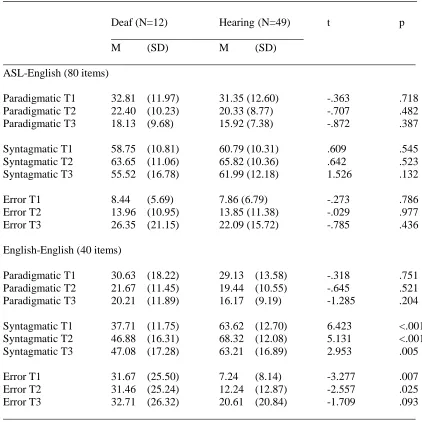
Insert Table 3 here
Deaf bilinguals’ L1 (ASL) and hearing monolinguals’ L1 (English). Comparisons between paradigmatic performance for ASL (deaf bilinguals) and English (hearing monolinguals) revealed no significant differences, F(1, 59) = .439, p = .51, ηp2 = .01.
There was an effect of trial F(2, 118) = 78.369, p < .001, ηp2 = .57 with responses
decreasing between Trial 1(M = .32) and Trial 2 (M = .21) and between Trial 2 and Trial 3 (M = .17), p < .001. There was no Group x Trial interaction, F(2, 118) = .051, p = .93, ηp2 = .00, indicating that patterns of paradigmatic responding were similar across groups
and languages.
Similarly, there were no significant differences between syntagmatic performance for ASL (deaf bilinguals) and English (hearing monolinguals), F(1, 59) = 1.375, p = .246, ηp2 = .02. As before, there was an effect of trial, F(2, 118) = 6.300, p = .003, ηp2 = .10, as
syntagmatic responses increased from Trial 1 (M = .60) to Trial 2 (M = .65), p < .05, followed by a significant decrease between Trial 2 and Trial 3 (M = .59), p < .001. There was no interaction between Group x Trial, F(2, 118) = .978, p = .35, ηp2 = .02.
21
groups produced significantly fewer paradigmatic responses at each consecutive elicitation trial. In comparison, the groups showed a significant increase in syntagmatic responses from the first to second elicitation trial and a significant decrease from the second to third elicitation trial.
Deaf bilinguals and hearing monolinguals semantic performance in English. Paradigmatic performance in English did not differ significantly between groups, F(1, 59) = .569, p = .45, ηp2 = .01. There was an effect of trial F(2, 118) = 35.638, p < .001, ηp2 =
.38 with responses decreasing between Trial 1(M = .30) and Trial 2 (M = .21) and between Trial 1 and Trial 3 (M = .18), p < .001. There was no Group x Trial interaction, F(2, 118) = .399, p = .67, ηp2 = .01, indicating that patterns of paradigmatic responding
were similar across groups.
Syntagmatic performance in English revealed significant group differences, F(1, 59) = 28.507, p < .001, ηp2 = .33, indicating that hearing children (M = .65) generated
more syntagmatic responses than deaf children (M = .44), p < .001. The effect of trial was significant, F(2, 118) = 6.006, p = .011, ηp2 = .09, as syntagmatic responses increased
from Trial 1 (M = .51) to Trial 2 (M = .58), p < .001, followed by a minimal decrease between Trial 2 and Trial 3 (M = .55). There was no interaction between Group x Trial, F(2, 118) = 2.916, p = .08, ηp2 = .05.
Lexical-Semantic Organization and Vocabulary Size.
Next, we conducted correlational analyses to examine possible links between
22
grow in tandem, we first checked if we needed to control for age. For bilingually developing deaf children, age (in months) was significantly correlated with performance on the picture-naming task for ASL (r = .59, p < .05) but not for English (r = .18, p = .58). With regard to semantic performance, we found no significant correlation between age and paradigmatic performance (r = .24, p = .46) but between age and syntagmatic performance (r = .57, p = .05) for ASL. For English, there was no significant correlation between age and either paradigmatic (r = -.10, p = .76) or syntagmatic performance (r = .40, p = .20)
For monolingual hearing children, there was a strong correlation between age and performance on the picture-naming task (r = .63, p < .001). In addition, we found strong correlations between age and paradigmatic performance (r = .32, p < .05) and between age and syntagmatic performance for English (complete set: r = .29, p < .05). Therefore, we controlled for age in our follow-up analyses.
23
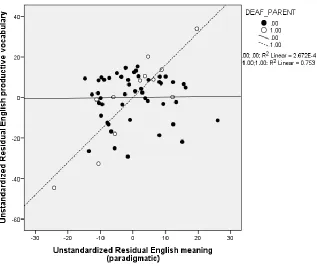
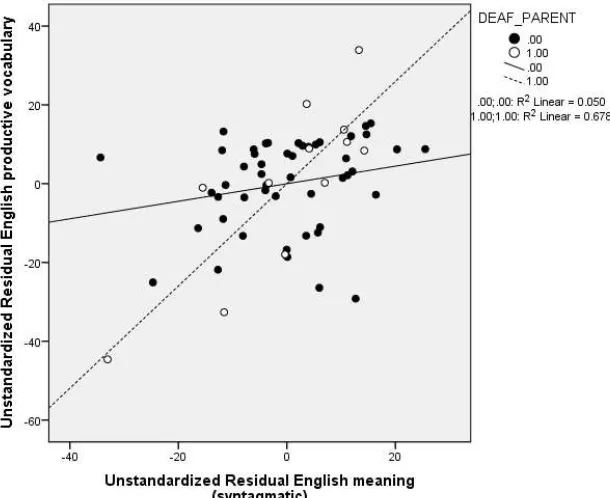
Figures 1–2 are scattergrams illustrating the partial correlations between individual scores
for picture-naming performance and paradigmatic/syntagmatic responses for English
controlling for age in both deaf and hearing samples. The scattergrams and regression
lines show the strong associations between vocabulary and semantic performance for the
small sample of deaf children. As can be seen in figures 1 and 2, the scattergrams
illustrate the lower performance and wider range of vocabulary scores in the deaf sample
compared to the hearing sample, with low and high scores in the deaf group
corresponding to low and high performance on the semantic measures but also the
massive range in scores for the deaf group whereas the range for the hearing group is
much more limited.
Age Effects on Lexical-Semantic Organization.
24
paradigmatic responses (M = .28) than younger children (M=.18). A main effect of trial, F(2, 94) = 50.781, p < .001, ηp2 = .52, showed a significant decrease in participants’
responses between Trial 1 (M = .31) and Trial 2 (M = .21) and between Trial 1 and Trial 3 (M = .17, p < .001 for comparisons between Trial 1 and Trial 2 and Trial 1 and Trial 3, p < .05 for comparison between Trial 2 and Trial 3). There was no Trial x Age interaction, F (2, 94) = .122, p = .85, ηp2 = .00.
Syntagmatic performance showed no difference between age groups, F(1, 47) =.539, p = .467, ηp2 = .01. There was a main effect of trial, F(2, 94) = 4.011, p = .041, ηp2
= .08, as responses increased between Trial 1 (M = .63) and Trial 2 (M = .69), p = .003, followed by a decrease between Trial 2 and Trial 3 (M = .64), p = .04. In addition, there was a marginally significant interaction between Trial x Age, F (2,94) = 3.689, p = .05, ηp2 = .07. Post-hoc tests indicated a significant decrease in syntagmatic responses
between Trial 2 (M = .68) and Trial 3 (M = .60, p < .001) for younger children and a significant increase in responses between Trial 1 (M = .63) and Trial 2 (M = .69, p < .05) for older children. None of the group differences across elicitation trials were significant.
Discussion
25
children’s performance in ASL and English. Next, we examine the similarities and differences between the bilingual deaf and the monolingual hearing group for L1 semantic performance, followed by a comparison of these groups for English semantic performance. Finally, we discuss the theoretical and practical implications of the reported work and provide suggestions for future studies.
Lexical-Semantic Organization in Deaf Sign Bilinguals’ L1 and L2
Similarities in deaf children’s L1 and L2 lexical-semantic organization. With reference to our first goal, we found comparable performances by bilingually developing deaf children in ASL and English on a repeated word association task, including: a) a larger proportion of syntagmatic links than paradigmatic links in each language, b) a comparable number of network links of paradigmatic responses, and c) a steady decrease in the production of paradigmatic responses across all trials versus a significant increase in production of syntagmatic responses from trial 1 to trial 2.
26
task provides a window into the underlying organization of the mental lexicon. From a spreading activation perspective (Collins & Loftus, 1975), these findings indicate that deaf children’s semantic networks in ASL consist of more semantic links compared to that in their L2 English but show a similar activation spread across languages.
The comparison of paradigmatic/syntagmatic performance across multiple elicitation trials provides us with more nuanced information about how deaf bilinguals go about retrieving lexical items from their semantic networks. If bilingual deaf children have exposure to both ASL and English but are influenced by the same language learning mechanisms as monolingual hearing children we should see a similar semantic performance in both languages. This was exactly what we observed in the effect of trial, namely the same relative frequency in paradigmatic and syntagmatic responses across multiple elicitation trials as semantic activation becomes attenuated along its path of travel from the node of origin (Collins & Loftus, 1975; McClelland, 1995; Nevid, 2009). A closer look at Table 2 shows that the observed decrements in deaf children’s paradigmatic associations in ASL and English co-occurred with an increase in errors. At the same time, syntagmatic associations stayed relatively stable over trials. As expected deaf bilinguals produced significantly more error responses (‘I don’t know’) for English compared to ASL.
27
possible reason that deaf children produced significantly more syntagmatic than paradigmatic associations could be that there are potentially more such responses available as syntagmatic associations may entail a broad range of semantic relations (temporal, spatial, causal, collocational) compared to paradigmatic associations which are taxonomic.
The semantic performance demonstrated by deaf bilinguals in L1 and L2 is consistent with patterns demonstrated by multiple groups of individuals in previous studies including typically developing monolingual English and bilingual Mandarin-English and Spanish-Mandarin-English school-age children (Sheng, McGregor, & Marian, 2006; Sheng, Bedore, Peña, & Fiestas, 2013). Similar to their hearing peers, the current sample of bilingual deaf children demonstrated spreading activation of their semantic networks (Collins & Loftus, 1975) in both ASL and English. The observed high amount of error responses in English across elicitation trials may be attributed to language experience, in particular deaf children’s limited language access as a result of their hearing loss. This is consistent with a recent claim by Hoff and colleagues (2012) that the difference between monolingual and bilingual children’s skills in any language depends on how the level of exposure to that language.
28
associations. Paradigmatic performance remained the same across elicitation trials for both languages. These findings were in line with our expectations of deaf children’s smaller vocabulary in English and was further confirmed by their lower picture-naming performance for English compared to ASL.
Lexical-Semantic Organization in Deaf Sign Bilinguals and Hearing Monolinguals Similarities in deaf bilinguals/hearing monolinguals’ L1 lexical-semantic organization.
With reference to our second goal, we compared bilingually developing deaf children’s semantic performance in their L1 (ASL) to monolingual hearing children’s English performance. Findings revealed striking similarities across the two groups, suggesting that L1 semantic development is remarkably similar despite modality and linguistic differences (e.g., verb agreement). This is in line with previous findings by Novogrodsky and colleagues on deaf children’s acquisition of synonyms (2014) and antonyms (2014) in ASL as well as with research on other sign languages (Italian Sign Language: Tomasuolo et al., 2010; BSL: Mann & Marshall, 2012). The similarity in semantic performance suggests that deaf and hearing children are using similar age-appropriate organizational principles to structure their mental filing systems.
29
to the targets so that generating paradigmatic associations became more demanding with each new elicitation. With regard to syntagmatic responses, both groups showed an increasing pattern between the first and the second elicitation trial. In addition, both groups generated more syntagmatic responses than paradigmatic responses across all elicitation trials. These findings demonstrate that the semantic system is organized according to both paradigmatic and syntagmatic relations. In addition, they support a point we made earlier regarding the availability of syntagmatic responses due to the broad range of semantic relations they entail compared to paradigmatic associations.
Similarities in deaf bilinguals/hearing monolinguals’ English lexical-semantic organization. In comparing deaf bilinguals' L2 with hearing monolinguals' L1, we found similar response patterns across elicitation trials, including a steady decrease in the production of paradigmatic relations and an increase in syntagmatic responses between first and second trial, followed by a decrease between the second and third trial. These response patterns were the same for deaf children’s L1.
30
size (i.e., picture-naming task). This result is similar to studies with hearing L2 English bilinguals, which found robust group differences (e.g., Gollan, Montoya, Fennema-Notestine, & Morris, 2005; Roberts, Garcia, Desrochers, & Hernandez, 2002).
Our findings are in line with an argument from the literature on spoken language that language development in bilingually developing children is a function of the relative amount of exposure (Hoff, 2006; Hoff et al., 2012). This argument is of particular relevance in the context of deaf bilinguals most of whom may not receive balanced input in either L1 or L2, partly because their hearing parents do not sign but also due to limited access to spoken language as a result of their hearing loss. While all deaf children in our study were exposed to ASL from birth by their deaf parents, their access to (spoken) English had been possibly affected by their hearing loss. Although we did not directly measure amount of language exposure, the reported strong correlations between sign bilinguals’ performance on the picture-naming task and their paradigmatic/syntagmatic responses for English suggest that children’s ability to form these association is at least partially driven by vocabulary size. In comparison, these correlations were much weaker for deaf children’s L1, ASL and for hearing children’s L1, English, both languages that children have access to from birth. This suggests that the link between vocabulary size and the organization of the lexicon may be more complex than previously assumed.
Effect of Age.
31
literature on lexical development which shows that school-age children gain semantic depth by acquiring semantic connections that are categorical, synonymous, or antonymous in nature (Nelson, 1977). While we did not conduct such analysis for our deaf sample due to small size we would expect to see the same patterns in a larger group of age-matched deaf native signers, given the similar developmental trajectories in signed and spoken language acquisition (Corinna & Singleton, 2009, Newport & Meier, 1985, and others).
32
vocabulary tasks, can be used by teachers of deaf pupils to guide their educational planning by pinpointing areas of weakness, as well as strengths, in pupils’ vocabulary knowledge.
The current study provides valuable preliminary data on bilingually developing deaf children’s semantic knowledge in their L1 (ASL) and L2 (English), which needs to be replicated with a larger sample from different sites to allow/substantiate any conclusive statements. In our approach, we controlled for exposure to sign language by focusing on children with at least one deaf parent. This is critical in exploring deaf children’s ASL and English skills on their own and also in allowing us to compare them to typically developing hearing peers with access to language from birth. However, since the majority of deaf children are born to hearing parents, it would be useful for future research to further explore the importance of early (dual) language input in non-native signers. Similarly, we encourage research that examines the effect of deafness on development of semantic knowledge. One way of doing this could be by comparing deaf signers and hearing signing controls and see how they differ on ASL and English association responses. A third area for future studies could explore similarities and differences between deaf and hearing L2 English learners by adding a control group of spoken bilinguals L2 English performing on the current study task.
Conclusions
33
34
References:
Akhtar, N., Jipson, J., & Callanan, M. A. (2001). Learning words through overhearing.
Child Development, 72, 416–431.
Anderson, D. & Reilly, J. (2002). The MacArthur communicative development
inventory: normative data for American Sign Language. Journal of Deaf Studies and Deaf Education, 7(2), 83-106.
Bialystok, E. & Feng, X. (2011). Language proficiency and its implications for
monolingual and bilingual children. Language and literacy development in bilingual settings, 121-138.
Bizer, S. & Karl, A. K. (2002b). Perlesko: Prüfverfahren zur Erfassung lexikalisch- semantischer Kompetenz gehörloser Kinder im Grundschulalter. Manual. Hamburg : Fachbereich Erziehungswissenschaften, Universität Hamburg.
Bloom, P. (2002). How children learn the meaning of words. MIT Press. Clark, E. V. (2009). First language acquisition. Cambridge University Press. Clark, E. V. (1993). The lexicon in acquisition, Cambridge University Press,
Cambridge.
Collins, A. M. & Loftus, E. F. (1975). A spreading-activation theory of semantic processing. Psychological Review, 82(6), 407-428.
Corina, D. & Singleton, J. (2009). Developmental social cognitive neuroscience: Insights
from deafness. Child development, 80(4), 952-967.
Doherty, M. & J. Perner. 1998. Metalinguistic Awareness and Theory of Mind: Just Two Words for the Same Thing? Cognitive Development 13: 279–305.
35
De Houwer (Eds.), The acquisition of Dutch (pp. 301-378). Amsterdam: John Benjamins; 1998.
Gathercole, S. (2003). The development of memory. Journal of Child Psychology and Psychiatry, 39(1), 3-27.
Goldin‐Meadow, S. & Mayberry, R. I. (2001). How do profoundly deaf children learn to
read? Learning Disabilities Research & Practice, 16(4), 222-229.
Gollan, T. H., Montoya, R. I., Fennema-Notestine, C., & Morris, S. K. (2005).
Bilingualism affects picture naming but not picture classification. Memory &
Cognition, 33(7), 1220-1234.
Haug, T. (2011). Approaching Sign Language Test Construction: Adaptation of the German Sign Language Receptive Skills Test. Journal of Deaf Studies and Deaf Education, 16(3), 343-361.
Hoff, E. (2006). How social contexts support and shape language development.
Developmental Review, 26(1), 55-88.
Hoff, E., Core, C., Place, S., Rumiche, R., Señor, M., & Parra, M. (2012). Dual language
exposure and early bilingual development. Journal of child language, 39(01), 1-27.
Lieven, E. V. (1994). Cross-linguistic and cross-cultural aspects of language addressed to children. In C. Gallaway & B. Richards (Eds.), Input and interaction in language acquisition (pp. 56-73). New York, NY, US: Cambridge University Press
Lippman, M. (1971). Correlates of contrast word associations: Developmental trends.
Journal of Verbal Learning and Verbal Behavior, 10, 392-399.
36
British Sign Language. Language Learning, 62(4), 1024-1051.
Mann, W., Roy, P., & Morgan, G. (2015). Adaptation of a vocabulary test from British Sign Language to American Sign Language. Language Testing. Doi:
0265532215575627.
Marchman, V. A., Fernald, A., & Hurtado, N. (2010). How vocabulary size in two
languages relates to efficiency in spoken word recognition by young Spanish–
English bilinguals. Journal of Child Language, 37(04), 817-840.
Markman, E. M. (1991). Categorization and naming in children: Problems of induction. MIT Press.
Marshall, C., Rowley, K., & Atkinson, J. (2014). Modality-dependent and-independent
factors in the organisation of the signed language lexicon: Insights from semantic
and phonological fluency tasks in BSL. Journal of psycholinguistic
research, 43(5), 587-610.
Marshall, C. R., Rowley, K., Mason, K., Herman, R., & Morgan, G. (2013). Lexical organization in deaf children who use British Sign Language: Evidence from a semantic fluency task. Journal of Child Language, 40(1), 193-220.
Marschark, M. & Wauters, L. (2008). Language comprehension and learning by deaf students. In M. Marschark & P. Hauser (Eds.), Deaf cognition: Foundations and outcomes, (pp. 309-350). Oxford University Press.
Mason, K., Rowley, K., Marshall, C. R., Atkinson, J. R., Herman, R., Woll, B., &
Morgan, G. (2010). Identifying specific language impairment in deaf children
37 McClelland, J. L. (1995). A connectionist perspective on knowledge and development. In
T. J. Simon & G. S. Halford (Eds.), Developing cognitive competence: New approaches to process modeling (pp. 157–204). Hillsdale, NJ: Erlbaum.
McNamara, T. P. & Holbrook, J. B. (2003). Semantic memory and priming. Handbook of Psychology (pp. 445–474). Hoboken, NJ: Wiley.
Meir, I. (2012). The evolution of verb classes and verb agreement in sign languages.
Theoretical Linguistics,38(1-2), 145-152.
Mellon, N. K., Niparko, J. K., Rathmann, C., Mathur, G., Humphries, T., Napoli, D. J.,
Handley, T., Scambler, S., & Lantos, J. D. (2015). Should All Deaf Children
Learn Sign Language? Pediatrics, 136(1), 170-176.
Miller, G. A. & Gildea, P. M. (1987). How children learn words. Scientific American,
257(3), 94-99.
Mitchell, R. E. & Karchmer, M. A. (2004). Chasing the mythical ten percent: Parental hearing status of deaf and hard of hearing students in the United States. Sign Language Studies, 4(2), 138-163.
Morgan, G. & Woll, B. (Eds.)(2002). Directions in sign language acquisition (Vol. 2). John Benjamins Publishing.
Nelson, K. (1991). Varied domains of development: A tale of LAD, MAD, SAD and RARE and surprising events in our RELMS. In F. Kessel, M. Bornstein, & A. Sameroff (Eds.), Contemporary constructions of the child: essays in honor of William Kesen (pp. 123–142). Hillsdale, NJ: Lawrence Erlbaum Associates. Nelson, K. (1977). The syntagmatic-paradigmatic shift revisited: A review of research
38
Nevid, J.S. (2009). Psychology: Concepts and applications (3rd ed). Boston, MA: Cengage Learning.
Newport, E. L. & Meier, R. P. (1985). The acquisition of American Sign Language. Lawrence Erlbaum Associates, Inc.
Novogrodsky, R., Caldwell‐Harris, C., Fish, S., & Hoffmeister, R. J. (2014). The
development of antonym knowledge in American Sign Language (ASL) and its
relationship to reading comprehension in English. Language Learning, 64(4), 749-770.
Novogrodsky, R., Fish, S., & Hoffmeister, R. (2014). The acquisition of synonyms in American Sign Language (ASL): Towards a further understanding of the components of ASL vocabulary knowledge. Sign Language Studies, 14, 225-249. Peña, E., Reséndiz, M., & Gillam, R. (2007). The role of clinical judgments of
modifiability in the diagnosis of language impairment. Advances in Speech-Language Pathology, 1 – 14, DOI:10.1080/14417040701413738.
Roberts, P.M., Garcia, L.J., Desrochers, A.,&Hernandez, D. (2002). English performance
of proficient bilingual adults on the Boston Naming Test. Aphasiology, 16, 635–
645.
Quinto-Pozos, D., Forber-Pratt, A. J., & Singleton, J. L. (2011). Do developmental
communication disorders exist in the signed modality? Perspectives from
professionals. Language, speech, and hearing services in schools, 42(4), 423-443.
39
Sheng, L., McGregor, K. K., & Marian, V. (2006). Lexical-semantic organization in bilingual children: Evidence from a repeated word association task. Journal of Speech, Language and Hearing Research, 49(3), 572-587.
Sheng, L. & McGregor, K. K. (2010). Lexical-semantic organization in children with specific language impairment. Journal of Speech, Language and Hearing Research, 53(1), 146-159.
Sheng, L., Bedore, L. M., Peña, E. D., & Fiestas, C. (2013). Semantic development in Spanish–English bilingual children: Effects of age and language experience. Child development, 84(3), 1034-1045.
Sheng, L., Peña, E. D., Bedore, L. M., & Fiestas, C. E. (2012). Semantic deficits in Spanish-English bilingual children with language impairment. Journal of Speech, Language and Hearing Research, 55(1), 1-15.
Tomasuolo, E., Fellini, L., Di Renzo, A., & Volterra, V. (2010). Assessing lexical
production in deaf signing children with the Boston naming test. Language, Interaction and Acquisition/Langage, Interaction et Acquisition, 1(1), 110-128. Vinson, D. P., Cormier, K., Denmark, T., Schembri, A., & Vigliocco, G. (2008). The
British Sign Language (BSL) norms for age of acquisition, familiarity, and iconicity. Behavior Research Methods, 40(4), 1079-1087.
Waxman, S.R. & Gelman, R. (1986). Preschoolers' use of superordinate relations in classification and language. Cognitive Development, 1(2), 139-156.
40
Woolfe, T., Herman, R., Roy, P., & Woll, B. (2010). Early vocabulary development in deaf native signers: a British Sign Language adaptation of the communicative development inventories. Journal of Child Psychology and Psychiatry, 51(3), 322-331.
Zhao, L., Kipper, K., Schuler, W., Vogler, C., Badler, N., & Palmer, M. (2000). A
machine translation system from English to American Sign Language. In
Envisioning Machine Translation in the Information Future (pp. 54-67). Springer
41
Table 1: Deaf participant information
__________________________________________________________________________________________________________ ID Age (Y: M) Gender Grade ASL proficiency score ASL Picture Naming English Picture Naming
(out of 26) (in %) (in %)
____________________________________________________________________________________________________________________
P001 7:9 F 2 26 82 93
P002 7:5 M 1 25 71 80
P003 6:4 F K 24 66 38
P004 8:7 F 2 17 77 75
P007 10:0 M 4 23 91 83
P008 8:0 M 1 26 83 18
P010 9:0 F 3 22 83 68
T005 7:5 M 1 24 79 55
T006 7:5 M 1 21 85 58
T007 7:3 F 1 26 89 70
T013 7:9 F 2 16* 86 68
T017 9:1 F 2 22 88 33
M 8.7 5M 23 82 61
SD 1.0 7F 3 7 22
42 Table 2: Mean proportions (Standard Deviations) of Deaf Participants’ Paradigmatic,
Syntagmatic Responses and Errors as a Function of Language and Trial
_____________________________________________________________________
ASL (40 items) English (40 items) t p _________________________________________
M (SD) M (SD)
___________________________________________________________________________
Paradigmatic T1 35.63 (13.23) 30.63 (18.22) -1.069 .308 Paradigmatic T2 24.38 (11.39) 21.67 (11.45) -.718 .488 Paradigmatic T3 18.96 (9.68) 20.21 (11.89) .350 .733
Syntagmatic T1 56.67 (11.79) 37.71 (11.75) -3.508 .005 Syntagmatic T2 63.13 (10.23) 46.88 (16.31) -2.672 .022 Syntagmatic T3 54.17 (15.79) 47.08 (17.28) -1.200 .255
Error T1 7.71 (5.69) 31.67 (25.50) 3.487 .005 Error T2 12.50 (8.66) 31.46 (25.24) 2.605 .024 Error T3 26.88 (21.30) 32.71 (26.32) .753 .467
43 Table 3: Mean proportions (Standard Deviations) of Paradigmatic, Syntagmatic Resposes and
Errors as a Function of Group and Trial
_____________________________________________________________________
Deaf (N=12) Hearing (N=49) t p ___________________________________
M (SD) M (SD)
___________________________________________________________________________ ASL-English (80 items)
Paradigmatic T1 32.81 (11.97) 31.35 (12.60) -.363 .718 Paradigmatic T2 22.40 (10.23) 20.33 (8.77) -.707 .482 Paradigmatic T3 18.13 (9.68) 15.92 (7.38) -.872 .387
Syntagmatic T1 58.75 (10.81) 60.79 (10.31) .609 .545 Syntagmatic T2 63.65 (11.06) 65.82 (10.36) .642 .523 Syntagmatic T3 55.52 (16.78) 61.99 (12.18) 1.526 .132
Error T1 8.44 (5.69) 7.86 (6.79) -.273 .786 Error T2 13.96 (10.95) 13.85 (11.38) -.029 .977 Error T3 26.35 (21.15) 22.09 (15.72) -.785 .436
English-English (40 items)
Paradigmatic T1 30.63 (18.22) 29.13 (13.58) -.318 .751 Paradigmatic T2 21.67 (11.45) 19.44 (10.55) -.645 .521 Paradigmatic T3 20.21 (11.89) 16.17 (9.19) -1.285 .204
Syntagmatic T1 37.71 (11.75) 63.62 (12.70) 6.423 <.001 Syntagmatic T2 46.88 (16.31) 68.32 (12.08) 5.131 <.001 Syntagmatic T3 47.08 (17.28) 63.21 (16.89) 2.953 .005
44
45
46
47
WINTER HUGE TRASH ASK EMPTY
CORKSCREW GOSSIP
SATURDAY HOLIDAY SURPRISED PEOPLE WAIT