City, University of London Institutional Repository
Citation:
Caudrelier, V., Crampe, N. and Zhang, Q. C. (2013). Set-theoretical reflection equation: Classification of reflection maps. Journal of Physics A: Mathematical andTheoretical, 46(095203), doi: 10.1088/1751-8113/46/9/095203
This is the unspecified version of the paper.
This version of the publication may differ from the final published
version.
Permanent repository link:
http://openaccess.city.ac.uk/2150/Link to published version:
http://dx.doi.org/10.1088/1751-8113/46/9/095203Copyright and reuse: City Research Online aims to make research
outputs of City, University of London available to a wider audience.
Copyright and Moral Rights remain with the author(s) and/or copyright
holders. URLs from City Research Online may be freely distributed and
linked to.
City Research Online: http://openaccess.city.ac.uk/ [email protected]
Set-theoretical reflection equation:
Classification of reflection maps
V. Caudrelier
a, N. Cramp´e
band Q.C. Zhang
aa Centre for Mathematical Science, City University London,
Northampton Square, London EC1V 0HB, UK
b CNRS, Universit´e Montpellier II, Laboratoire Charles Coulomb, UMR 5221,
Place Eug`ene Bataillon - CC070, F-34095 Montpellier, France
Email: [email protected], [email protected], [email protected]
Abstract
The set-theoretical reflection equation and its solutions, the reflection maps, recently in-troduced by two of the authors, is presented in general and then applied in the context of quadrirational Yang-Baxter maps. We provide a method for constructing reflection maps and we obtain a classification of solutions associated to all the families of quadrirational Yang-Baxter maps that have been classified recently.
Introduction
The Yang-Baxter equation, introduced to study a gas of spin with a δ interaction [1] or a 2-dimensional solvable statistical model in [2], has been developed in many directions and found applications in different areas of mathematics and physics. Much of the effort has been concen-trated on the so-calledquantum Yang-Baxter equation which is at the heart of the field of quantum integrable systems. Although less well-known, the set-theoretical solutions of the Yang-Baxter equa-tion have also attracted some attenequa-tion. This quesequa-tion goes back to Drinfeld [3] (and even to [4] where a solution was given). Then, different aspects have been developed and numerous connections have been established with, for example, the geometric crystals [5, 6], the soliton cellular automatons [7, 8], the scattering of multicomponent solitons [9, 10, 11], the discrete integrable systems [12, 13] and the Lax or transfer matrices [14, 15]. In view of these applications, there is also a lot of effort put into the possibility of classifying the solutions of the set-theoretical Yang-Baxter equations [16, 17]. In the context of quantum integrable systems with boundaries, there exists, in addition to the Yang-Baxter equation, a second equation: the reflection equation. This equation was introduced to encode the reflection on the boundary of particles in quantum field theory [18] and to prove the integrability of quantum models with boundaries [19]. This equation appears also as the defining relations for subalgebras of quantum groups [20, 21] which are the symmetry of quantum models such as the BCn Sutherland models [22, 23], as a relation to construct commuting familly of time
evolutions for box-ball system with reflectiong end [24] and as a consistency relation for the coordinate Bethe ansatz applied to the δ gas with boundaries [25] and impurity [26].
Motivated by all these fields of application of the set-theoretical Yang-Baxter equation and of the reflection equation, we propose in this article to explore the interplay between these two notions and to study the set-theoretical reflection equation. Surprisingly, this equation was introduced only very recently by two of the authors [27] in the context of factorization of vector soliton interactions on the half-line. There, it appeared naturally as the equation ensuring that the interactions of the polarizations of anN-soliton solution among themselves and with the boundary factorises consistently as a sequence of soliton-soliton and soliton-boundary interactions. At the origin of the study in [27] lie the results of [28]. The latter falls into the vast area of integrable PDEs on the half-line for which various related approaches can be found in [29] (classical r matrix approach), [30] (B¨acklund transformations approach), [31] (symmetry algebra approach) or [32] (inverse scattering method approach).
1
Set-theoretical reflection equation
We present some elements and facts of the theory of reflection maps and set-theoretical reflection equation first introduced at the end of the paper [27]. To do so, we first need to recall some definitions related to YB maps (see e.g. [14]).
1.1
Yang-Baxter maps
LetS be a set and R:S×S →S×S a map from the Cartesian product ofS onto itself,
R(X, Y) = (U, V)≡(f(X, Y), g(X, Y)). (1.1)
DefineRij :SN →SN as the map acting asRon theith andjth copies ofS in theN-fold Cartesian
productSN and identically on the others. More precisely, for i < j,
Rij(X1, . . . , Xn) = (X1, . . . , Xi−1, f(Xi, Xj), . . . , g(Xi, Xj), Xj+1, . . . , Xn), (1.2)
Rji(X1, . . . , Xn) = (X1, . . . , Xi−1, g(Xj, Xi), . . . , f(Xj, Xi), Xj+1, . . . , Xn). (1.3)
In particular, forN = 2, R12 ≡ R. If R satisfies the following Yang-Baxter relation
R12R13R23=R23R13R12, (1.4)
as an identity on S×S×S, then R is called a Yang-Baxter map. In addition, if R satisfies
R21R12 =Id , (1.5)
thenR is called a reversible Yang-Baxter map.
It is useful to introduce the so-called parametric Yang-Baxter map R(a, b) which is an important special case obtained by considering S×Σ, where Σ is some parameter set (usually C), instead of
onlyS as before. The corresponding map
R: (X, a;Y, b)7→(f(X, a;Y, b), a;g(X, a;Y, b), b)≡(fab(X, Y), a;gab(X, Y), b), (1.6)
is conveniently written asR(a, b) and seen as acting only on S×S:
R(a, b) : (X, Y)7→(fab(X, Y), gab(X, Y)). (1.7)
It satisfies the parametric YB equation
R12(a, b)R13(a, c)R23(b, c) =R23(b, c)R13(a, c)R12(a, b), (1.8)
and the corresponding reversibility condition reads
R21(b, a)R12(a, b) =Id . (1.9)
The notion of parametric maps is important, for example, for YB maps arising from the study of vector or matrix soliton solutions of certain classical integrable nonlinear equations [10, 11, 9].
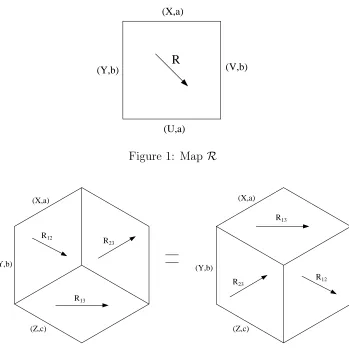
There is a well-known pictorial description of YB maps (see e.g. [16]). A map R defined by (1.6) is associated to a quadrilateral as in Fig. 1. Then, the parametric YB equation (1.8) can be understood as the consistency condition ensuring that the two possible orders of action of the mapR
(Y,b)
(X,a)
(V,b)
R
[image:5.595.126.475.74.422.2](U,a)
Figure 1: Map R
R12
R12
R13
R23
R13
R23
(Z,c) (Z,c)
(Y,b) (Y,b)
(X,a) (X,a)
Figure 2: Graphical representation of the set-theoretical Yang-Baxter equation
1.2
Reflection maps
Based on the form of the quantum reflection equation [18, 19] and on the important role played by its set-theoretical version in [27], we now introduce the following general definition of a reflection map.
Definition 1.1 Given a Yang-Baxter map R, a reflection map B is a solution of the set-theoretical reflection equation
B1R21B2R12=R21B2R12B1, (1.10)
as an identity on S×S. The reflection map is called involutive if
BB =Id . (1.11)
In general this reads
B: (X, a)7→(ha(X), σ(a)), X ∈S , a∈Σ, (1.12)
for some mapsha and σ. One can then use the convenient notation B(a) for a parametric reflection
map but one has to keep in mind the nontrivial action of σ when composing a reflection map with other maps. To illustrate this, we give the definition of a parametric reflection map as follows:
Definition 1.2 Given a parametric Yang-Baxter map R12(a, b), a, b ∈ Σ and a map σ : Σ → Σ, a parametric reflection mapB(a) is a solution of the parametric set-theoretical reflection equation
B1(a)R21(σ(b), a)B2(b)R12(a, b) =R21(σ(b), σ(a))B2(b)R12(σ(a), b)B1(a) (1.13)
as an identity on S×S. The reflection map is called involutive if σ is an involution in Σ and
B(σ(a))B(a) =Id . (1.14)
Note that classes of parametric reflection maps were constructed in [27] for S =CPn−1, Σ = C and
σ(k) = −k∗ with R
12(k1, k2) being the parametric YB map corresponding to the vector nonlinear
Schr¨odinger equation.
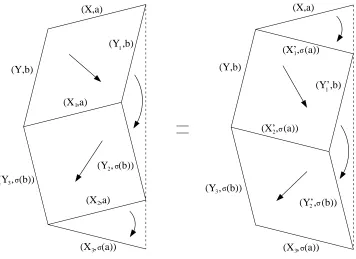
Analogous to the quadrilateral description of a YB map, we introduce a pictorial description of a reflection map as a half-quadrilateral shown in Fig. 3. The set-theoretical reflection equation
(X,a)
(a))
B
a
(h (X),σ
Figure 3: Map B
can then be depicted as in Fig. 4. Let us remark that this visualization is reminiscent of the face representation of the reflection equation in [33, 34, 35]. There are also similitudes between Fig. 4 and half of the figure representing the tetrahedron equation for interaction round-a-cube [36, 37]. Explicitly, the left-hand side represents the following chain of maps
(X, a;Y, b)−−→R12 (X
1, a;Y1, b)
B2
−−→(X1, a;Y2, σ(b))
R21
−−→(X2, a;Y3, σ(b))
B1
−−→(X3, σ(a);Y3, σ(b))
with
X1 =fab(X, Y), Y1 =gab(X, Y) , Y2 =hb(Y1),
X2 =gσ(b)a(Y2, X1) , Y3 =fσ(b)a(Y2, X1) , X3 =ha(X2).
Similarly, the right-hand side means
(X, a;Y, b)−B−→1
(X′
1, σ(a);Y, b)
R12
−−→(X′
2, σ(a);Y1′, b)
B2
−−→(X′
2, σ(a);Y2′, σ(b))
R21
(X , (a))3σ
(Y , (b))3 σ
(X,a)
(Y,b)
σ
1 1
(X’, (a))
(Y’,b)
σ
σ
(X’, (a))2
(Y’, (b))2
(X , (a))3σ 1
(Y ,b)
(Y , (b))3 σ
(X,a)
(Y,b)
(X ,a)1
(X ,a)2
[image:7.595.123.479.78.337.2](Y , (b))2 σ
Figure 4: Graphical representation of the reflection equation
with
X′
1 =ha(X) , X2′ =fσ(a)b(X1′, Y) , Y1′ =gσ(a)b(X1′, Y),
Y′
2 =hb(Y1′), X3 =gσ(b)σ(a)(Y2′, X2′), Y3 =fσ(b)σ(a)(Y2′, X2′).
So, Eq. (1.13) ensures that the two ways of obtaining (X3, Y3) from (X, Y) lead to the same result.
1.3
Transfer maps
We conclude this presentation on the theory of reflection maps by defining the notion of transfer maps in analogy with that introduced in [14]. Fix N ≥2 and define for j = 1, . . . , N the following maps ofSN into itself,
Tj =Rj+1j. . .RN jB−
j RjN. . .Rjj+1Rjj−1. . .Rj1B+j R1j. . .Rj−1j, (1.15)
whereB+ is a solution of
B1R21B2R12=R21B2R12B1, (1.16)
and B− a solution of
B1R12B2R21=R12B2R21B1. (1.17)
Proposition 1.3 For any reversible Yang-Baxter map R, the transfer maps (1.15) commute with each other
TjTℓ =TℓTj , j, ℓ= 1, . . . , N . (1.18)
Of course, this result transfers immediately to the case of parametric maps.
2
Reflection maps for quadrirational Yang-Baxter maps
In this section, we provide a classification of solutions for reflection maps associated to the 10 fam-ilies of quadrirational YB maps found in [16, 17]. To achieve this, we consider a certain class of functions of rational type and use an adaptation of the folding argument used in [27]. This is further combined with a duality property which we derive from the particular properties of quadrirational maps exhibited in [16]. The overall amount of work required is reduced by applying the notion of symmetry as explained below.
2.1
Symmetry and quadrirational Yang-Baxter maps
We first need the following proposition shown in [17].
Proposition 2.1 Let s(a) be an involutive symmetry of the parametric Yang-Baxter map R(a, b)
i.e.
s(a)2 =Id and s(a)×s(b) R(a, b) =R(a, b) s(a)×s(b). (2.1)
The map defined by
Rs(a, b) = s(a)×Id R(a, b) Id×s(b)
(2.2)
is a Yang-Baxter map.
Such symmetry maps s(a) allow one to relate YB maps that look different a priori. This is in particular the case for quadrirational YB mapsi.e.maps of a certain rational form acting onS =CP1
with parameter set Σ =C: theF families and theH families (in the notations of [16, 17]) are related
by such symmetry maps. In general, in the context of YB maps, different maps may indeed be related to actual different underlying systems. But in the context of reflection maps, the following proposition shows that symmetries leave the set of solutions invariant.
Proposition 2.2 The map B(a)is a parametric reflection map for the parametric Yang-Baxter map
R(a, b) if and only if the map B(a) is a parametric reflection map for the parametric Yang-Baxter map Rs(a, b).
Proof: The proof of this proposition consists in writing the set-theoretical reflection equation for
Rs(a, b) expressed thanks to (2.2). Then, remarking for example that Id×s(b)
K1(a) =K1(a) Id×
s(b)
and using that s(a)2 = Id, one proves that this equation is equivalent to the set-theoretical
reflection equation forR(a, b).
Our proposition therefore implies that the reflection maps for theFI toFV families are the same as
Type fab(X, Y) gab(X, Y) P
FI aY P bXP (1−
b)X+b−a+(a−1)Y b(1−a)X+(a−b)XY+a(b−1)Y
FII YaP Xb P aX−XbY−+Yb−a
FIII YaP Xb P aXX−−bYY
FIV Y P XP 1 + Xb−−aY
[image:9.595.158.440.80.321.2]FV Y +P X+P Xa−−bY
Table 1: Families F for the quadrirational map
to the F families, which we reproduce in Table 1 for completeness. Finally, since these families involve parameters, we will work directly with parametric maps.
2.2
Method
We propose an adaptation of the folding method that was used in [27] to obtain families of reflection maps from the YB map associated to the vector nonlinear Schr¨odinger equation. Roughly speaking, the idea is to see a reflection map as a YB map modulo some folding applied on the variables on which the YB map acts. More precisely, here we start from Fig. 1 and impose thatb =σ(a) for some map σ and that Y =ϕa(X) and V =ϕa(U) for some map ϕa depending on a. For convenience, we
assume thatσ is an involution as well as ϕa, the latter meaning that
ϕσ(a)(ϕa(X)) = X . (2.3)
Now, since (U, V) is related to (X, Y) by the YB map R(a, b), we obtain two possibilities for
ex-pressing V in terms of X
V = ϕa faσ(a)(X, ϕa(X))
= gaσ(a)(X, ϕa(X)). (2.4)
This provides a functional equation constraining admissible functions ϕa and σ. So, for each such
admissible pair (ϕa, σ), there is a well-defined map between V and X which we denoteha
V = ha(X), (2.5)
and which can be computed using (2.4). The map ha together with σ are our candidates to get a
reflection map B as in (1.12).
1With the understanding thatFI I I,HI I IA andH B
To complete our set of functional equations, we can also look at the folding method from the point of view of the inverse map R−1(a, b) which maps (U, V) to (X, Y) = (g
ba(V, U), fba(V, U))
(due to the reversibility of R) and the companion map R(b, a) which maps (V, X) to (Y, U) ≡
( ¯fba(V, X),¯gba(V, X))2. From the folding with the inverse map, we get the constraints
Y = ϕa gσ(a)a(ϕa(U), U)
= fσ(a)a(ϕa(U), U). (2.6)
Notice that, at first glance, this provides a new constraint for ϕ and σ. However, for the quadri-rational maps we consider in this paper, listed in Table 1, we have R12(a, b) = R21(b, a) i.e.
fab(X, Y) = gba(Y, X). Therefore, the constraint given by (2.6) is equivalent to (2.4). Now,
pro-vided that admissible functions (ϕa, σ) and the related ha are found, we deduce that Y = ha(U).
Using this last result and the folding for the companion map R(b, a), we get
Y = ha g¯σ(a)a(ha(X), X)
= ¯fσ(a)a(ha(X), X). (2.7)
The quadrirational maps considered in this paper satisfy the following additional property
¯
fab(X, Y) =gba(Y, X), g¯ab(X, Y) =fba(Y, X). (2.8)
Taking account of these properties, one gets
Y = ha faσ(a)(X, ha(X))
= gaσ(a)(X, ha(X)). (2.9)
Comparing (2.4) and (2.9), we observe thatϕa andhaplay completely dual roles. Therefore, if ϕa is
chosen to be of a certain form, thenhashould be of the same form and vice versa. This is reminiscent
of the properties derived in [16] concerning the quadrirationality of a YB map, its companion map and their inverses. Also, the involution property (2.3) should hold forha.
Combining the ideas of the folding of YB map and the duality between ϕa and ha, we are able
to classify solutions of the set-theoretical reflection equation for the 5 families of quadrirational YB maps presented in [16]. In our context, it is natural to choose ϕa and ha to be both M¨obius maps
with coefficients being first order polynomials in a:
ϕa(X) =
p1(a)X+p2(a)
p3(a)X+p4(a)
, ha(X) =
q1(a)X+q2(a)
q3(a)X+q4(a)
, (2.10)
wherepj(a) =p0j +p1ja and pj(a) =qj0+q1ja. This corresponds to 16 free parameters a priori. We
also chooseσ to be an involutive M¨obius map, which gives 3 additional parameters:
σ(a) = c1a+c2
c3a−c1
. (2.11)
We then solve for these 19 parameters by inserting into the following constraints as explained above
ha(X) =gaσ(a)(X, ϕa(X)), (2.12)
ϕσ(a)(ϕa(X)) = X , hσ(a)(ha(X)) =X . (2.13)
The resulting solutions are inserted in the set-theoretical reflection equation to check their validity.
2Note that conventions for these maps may vary in the literature but results are unaffected by such variations since
2.3
Classification
It is straightforward to check that the identity map (i.e. both ha and σ are the identity map) is a
solution for all families so in the following, we only present nontrivial solutions, by which we mean that either σ or ha or both are not the identity map. With the exception of one solution for the
FI solution, all the maps satisfying (2.12) and (2.13) are reflection maps as we found by inspection.
Note that these operations have been performed with the help of symbolic computation softwares. The final results are reported in Table 2. Note that we did not find any solution for theFV family.
The duality property is explicitly shown in the table: the roles of ha and ϕa can be swapped. All
solutions depend on an arbitrary parameterµ. In view of the results in [27], this could be interpreted as the parameter controlling the boundary and, accordingly, the integrable boundary conditions of the underlying integrable systems associated to the quadrirational YB maps of theF families.
Type σ(a) ϕa(X) (resp. ha(X) ) ha(X) (resp. ϕa(X) )
µ2 a
µX a
(X(1+µ)−µ−a)µ X(a+µ)−(1+µ)a
FI a+µ 2−1 a−1
(a+µ2−1)X X(a−µ−1)+aµ
a+µ−Xµ−1 a−1
1−a a(µ2−1)+1
(a−1)X X(a+µa−1)−aµ
µa+1−Xµ−a 1+a(µ2−1)
µ2 a
a
µ(X−1) + 1 − aX
µ
FII
−a+ 2µ 2XX
−1
a−µ−aX a−2µ
FIII µ 2 a aX µ − aX µ
FIV −a+ 2µ −X X−a+µ
Table 2: Reflection maps for quadrirational map FI −FIV
In the geometric construction of the quadrirational maps FI −FV in [16], the so-called singular
points play an important role. It turns out that we can make use of these points in our construction to obtain other reflection maps which we call degenerate. This is achieved by allowingϕa(X) in (2.4)
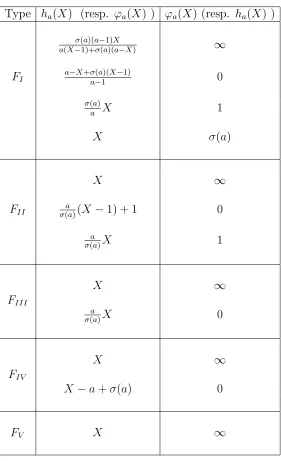
property still holds for these degenerate cases. We present the results in Table 3.
Type ha(X) (resp. ϕa(X) ) ϕa(X) (resp. ha(X) )
σ(a)(a−1)X
a(X−1)+σ(a)(a−X) ∞
FI a−X+σa(−a1)(X−1) 0
σ(a)
a X 1
X σ(a)
X ∞
FII σ(aa)(X−1) + 1 0
a
σ(a)X 1
X ∞
FIII
a
σ(a)X 0
X ∞
FIV
X−a+σ(a) 0
[image:12.595.149.430.115.576.2]FV X ∞
Table 3: Degenerate reflection maps
Conclusions and perspectives
derive a classification of reflection maps associated to them, thus providing a large family of such maps in addition to the two classes originally found by two of the authors in [27] from the study of factorization of vector soliton interactions in the presence of an integrable boundary. Some ideas of the latter paper were adapted here to perform a rather ”brute force” construction. It would be nice to reinterpret our results in more geometrical terms along the lines of the use of results on pencils of conics which led to the classification in [16]. More generally, one can also wonder how the general and abstract construction of YB maps as performed in [38, 39] can be adapted to yield a general construction of the associated reflection maps.
The results of this paper open the way to a wider programme of understanding reflection maps in the context of quad-graph systems and fully discrete integrable systems. Indeed, just like YB maps are one aspect of the idea of discrete integrability related to the 3D consistency approach, one can ask the important question of the meaning of a reflection map in the context of 3D consistency on a quad-graph. We are currently investigating this challenging issue and will report our results in a forthcoming paper. When this is understood, it will be interesting to see if the interpretation of a reflection map as an object encoding the integrable interaction between a soliton and a boundary which was found in [27] in the context of the vector nonlinear Schr¨odinger equation also holds in the realm of fully discrete integrable systems. We also believe that reflection maps can have a wide range of applications, for example in quantum algebra, in geometric crystals or in the soliton cellular automaton.
It seems also quite plain to us that different generalizations of the set-theoretical reflection equa-tion introduced in this paper are possible, mimicking existing generalizaequa-tions of the quantum reflec-tion equareflec-tion. Indeed, after the introducreflec-tion of the quantum reflecreflec-tion equareflec-tion in [18, 19], a more general structure, known as quadratic algebras, was introduced in [40]: the structure that is con-sidered in that paper involves four different matrices subject to general Yang-Baxter like equations. It could be interesting to study the set-theoretical analog of these quadratic algebras. Following the same idea, it may be possible to define a reflection type equation associated to the dynamical set-theoretical Yang-Baxter equation [41]. In the quantum context, this type of equation has been studied e.g. in [42].
References
[1] C.N.Yang,Some exact results for the many-body problem in one dimension with repulsive delta-function interaction, Rev.Lett.19 (1967) 1312.
[2] R.J.Baxter, Partition function of the eight-vertex lattice model, Ann.Phys. 70 (1972) 193;
Asymptotically degenerate maximum eigenvalues of the eight-vertex model transfer matrix and interfacial tension, J.Stat.Phys. 8 (1973) 25; Exactly solved models in statistical mechanics
(Academic Press, 1982).
[3] V.G.Drinfeld, On some unsolved problems in quantum group theory, Quantum groups (Leningrad, 1990), Lecture Notes in Mathematics, edited by P. P. Kulish (Springer Verlag, Berlin, 1992), Vol. 1510, pp. 1-8.
[4] E.K.Sklyanin, Classical limits of SU(2)-invariant solutions of the Yang-Baxter solution.
[5] A.Berenstein and D.Kazhdan, Geometric and unipotent crystals, GAFA special volume (2000) 188 and arXiv:math/9912105.
[6] P.Etingof, Geometric crystals and set-theoretical solutions to the quantum Yang-Baxter equa-tions,Commun.algebra 31 (2003) 1961 andarXiv:math/0112278.
[7] D.Takahashi and J.Satsuma, A soliton cellular automaton, J.Phys.Soc.Japan 59 (1990) 3514.
[8] G.Hatayama, A.Kuniba and T.Takagi, Soliton cellular automata associated with crystal bases,
Nucl.Phys. B577 (2000) 619 and arXiv:solv-int/9907020.
[9] V.M.Goncharenko, Multisoliton solutions of the matrix KdV equation, Theor. Math. Phys. 126
(2001) 81.
[10] T.Tsuchida, N-Soliton Collision in the Manakov Model, Prog.Theor.Phys. 111 (2004) 151 and
arXiv:nlin/0302059.
[11] M.J.Ablowitz, B.Prinari and A.D.Trubatch, Soliton interactions in the vector NLS equation,
Inverse Problems20 (2004) 1217.
[12] V.E.Adler, A.I.Bobenko and Yu.B.Suris, Classification of integrable equations on quad-graphs. The consistency approach,Commun.Math.Phys. 233 (2003) 513 and arXiv:nlin/0202024.
[13] V.G.Papageorgiou, A.G.Tongas and A.P.Veselov, Yang-Baxter maps and symmetries of inte-grable equations on quad-graphs,J.Math.Phys. 47 (2006) 083502 and arXiv:math/0605206.
[14] A.P.Veselov, Yang-Baxter maps and integrable dynamics, Phys.Lett. A314 (2003) 214 and
arXiv:math/0205335.
[15] Y.B.Suris and A.P.Vesolv, Lax matrices for Yang-Baxter maps, J.Nonlin.Math.Phys. 10 (2003) 223 and arXiv:math/0304122.
[16] V.E.Adler, A.I.Bobenko and Yu.B.Suris,Geometry of Yang–Baxter maps: pencils of conics and quadrirational mappings,Commun.Anal.Geom. 12 (2004) 967 and arXiv:math/0307009.
[17] V.G.Papageorgiou, Yu.B.Suris, A.G.Tongas and A.P.Veselov, On quadrirational Yang-Baxter Maps, SIGMA 6 (2010) 033 and arXiv:0911.2895.
[18] I.V.Cherednik,Factorizing particles on a half line and root systems,Theor.Math.Phys.61(1984) 977 and Teor.Mat.Fiz. 61 (1984) 35.
[19] E.K.Sklyanin,Boundary conditions for integrable quantum systems, J.Phys. A21 (1988) 2375.
[20] P.P.Kulish and E.K.Sklyanin, Algebraic structures related to the reflection equations, J.Phys.
A25 (1992) 5963 and hep-th/9209054.
[21] A.Molev, M.Nazarov and G.Olshansky, Yangians and classical Lie algebras,Russ.Math.Surveys
51 (1996) 205 and hep-th/9409025.
[23] V.Caudrelier and N.Crampe, Integrable N-particle Hamiltonians with Yangian or reflection al-gebra symmetry, J.Phys. A37 (2004) 6285 and math-ph/0310028.
[24] A.Kuniba, M.Okado and Y.Yamada,Box-ball system with reflecting end, J.Nonlin.Math.Phys.
12 (2005) 475 and nlin/0411044.
[25] M.Halln¨as and E.Langmann, Exact solutions of two complementary 1D quantum many-body systems on the half-line,J.Math.Phys. 46 (2005) 052101 and math-ph/0404023.
[26] V.Caudrelier and N.Crampe, Exact results for the one-dimensional many-body problem with contact interaction: Including a tunable impurity, Review Math.Phys. 19 (2007) 349 and
cond-mat/0501110.
[27] V.Caudrelier and Q.C.Zhang, Yang-Baxter and reflection maps from vector solitons with a boundary, arXiv:1205.1133.
[28] V.Caudrelier and Q.C.Zhang, Vector Nonlinear Schr¨odinger Equation on the half-line, J.Phys.
A45 (2012) 105201 and arXiv:1110.2990.
[29] E.K.Sklyanin,Boundary conditions for integrable equations, Funct.Anal.App. 21 (1987) 164.
[30] I.T.Habibullin, Integrable initial-boundary value problems, Theor.Math.Phys. 86 (1991) 28; P. N. Bibikov, V. O. Tarasov, A boundary-value problem for the nonlinear Schr¨odinger equation,
Theor.Math.Phys. 79 (1989) 334.
[31] B.G¨urel, M.G¨urses and I.T.Habibullin,Boundary value problems for integrable equations com-patible with the symmetry algebra, J.Math.Phys. 36 (1995) 6809 and solv-int/9411001.
[32] A.S.Fokas, A Unified Approach to Boundary Value Problems, CBMS-SIAM (2008).
[33] C.Ahn and W.M.Koo,Boundary Yang-Baxter equation in the RSOS representation, Statistical models, Yang-Baxter equation and related topics, Tianjin (1995) 3-12 andhep-th/9508080.
[34] H.Fan, B.-Y.Hou and K.-J.Shi, General solution of reflection equation for eight-vertex SOS model, J.Phys. A28 (1995) 4743.
[35] R.E.Behrend, P.A.Pearce and D.L.O’Brien, Interaction-Round-a-Face models with fixed boundary conditions: The ABF fusion hierarchy, J.Stat.Phys. 84 (1996) 1 and
arXiv:hep-th/9507118.
[36] R.J.Baxter, The Yang-Baxter equations and the Zamolodchikov Model, Physica 18D (1986) 321.
[37] V.V.Bazhanov, V.V.Mangazeev and S.M.Sergeev, Quantum geometry of 3-dimensional lattices,
J.Stat.Mech.0807:P07004,2008 andarXiv:0801.0129.
[38] A.Weinstein and P.Xu, Classical solutions of the Yang-Baxter equation, Commun.Math.Phys.
48 (1992) 309.
[40] L.Freidel and J.M.Maillet, Quadratic algebras and integrable systems, Phys.Lett. B262(1991) 278.
[41] Y.Shibukawa, Dynamical Yang-Baxter maps, Int.Math.Res.Notices 36 (2005); Dynamical Yang-Baxter maps with an invariance condition, Publ.Res.Inst.Math.Sci. 43 (2007) 1157 and
arXiv:0704.3109.