Defining Feasibility and Pilot Studies in
Preparation for Randomised Controlled Trials:
Development of a Conceptual Framework
Sandra M. Eldridge1*, Gillian A. Lancaster2, Michael J. Campbell3, Lehana Thabane4, Sally Hopewell5, Claire L. Coleman1, Christine M. Bond6
1Centre for Primary Care and Public Health, Queen Mary University of London, London, United Kingdom,
2Department of Mathematics and Statistics, Lancaster University, Lancaster, Lancashire, United Kingdom,
3School of Health and Related Research, University of Sheffield, Sheffield, South Yorkshire, United Kingdom,4Clinical Epidemiology and Biostatistics, McMaster University, Hamilton, Ontario, Canada,
5Nuffield Department of Orthopaedics, Rheumatology and Musculoskeletal Sciences, University of Oxford, Oxford, Oxfordshire, United Kingdom,6Centre of Academic Primary Care, University of Aberdeen, Aberdeen, Scotland, United Kingdom
Abstract
We describe a framework for defining pilot and feasibility studies focusing on studies con-ducted in preparation for a randomised controlled trial. To develop the framework, we under-took a Delphi survey; ran an open meeting at a trial methodology conference; conducted a review of definitions outside the health research context; consulted experts at an interna-tional consensus meeting; and reviewed 27 empirical pilot or feasibility studies. We initially adopted mutually exclusive definitions of pilot and feasibility studies. However, some Delphi survey respondents and the majority of open meeting attendees disagreed with the idea of mutually exclusive definitions. Their viewpoint was supported by definitions outside the health research context, the use of the terms‘pilot’and‘feasibility’in the literature, and par-ticipants at the international consensus meeting. In our framework, pilot studies are a subset of feasibility studies, rather than the two being mutually exclusive. A feasibility study asks whether something can be done, should we proceed with it, and if so, how. A pilot study asks the same questions but also has a specific design feature: in a pilot study a future study, or part of a future study, is conducted on a smaller scale. We suggest that to facilitate their identification, these studies should be clearly identified using the terms‘feasibility’or ‘pilot’as appropriate. This should include feasibility studies that are largely qualitative; we found these difficult to identify in electronic searches because researchers rarely used the term‘feasibility’in the title or abstract of such studies. Investigators should also report appropriate objectives and methods related to feasibility; and give clear confirmation that their study is in preparation for a future randomised controlled trial designed to assess the effect of an intervention.
OPEN ACCESS
Citation:Eldridge SM, Lancaster GA, Campbell MJ, Thabane L, Hopewell S, Coleman CL, et al. (2016) Defining Feasibility and Pilot Studies in Preparation for Randomised Controlled Trials: Development of a Conceptual Framework. PLoS ONE 11(3): e0150205. doi:10.1371/journal.pone.0150205
Editor:Chiara Lazzeri, Azienda Ospedaliero-Universitaria Careggi, ITALY
Received:August 13, 2015
Accepted:February 10, 2016
Published:March 15, 2016
Copyright:© 2016 Eldridge et al. This is an open access article distributed under the terms of the Creative Commons Attribution License, which permits unrestricted use, distribution, and reproduction in any medium, provided the original author and source are credited.
Data Availability Statement:Due to a requirement by the ethics committee that the authors specified when the data will be destroyed, the authors are not able to give unlimited access to the Delphi study quantitative data. These data are available from Professor Sandra Eldridge. Data will be available upon request to all interested researchers. Qualitative data from the Delphi study are not available because the authors do not have consent from participants for wider distribution of this more sensitive data.
Introduction
There is a large and growing number of studies in the literature that authors describe as feasi-bility or pilot studies. In this paper we focus on feasifeasi-bility and pilot studies conducted in prepa-ration for a future definitive randomised controlled trial (RCT) that aims to assess the effect of an intervention. We are primarily concerned with stand-alone studies that are completed before the start of such a definitive RCT, and do not specifically cover internal pilot studies which are designed as the early stage of a definitive RCT; work on the conduct of internal pilot studies is currently being carried out by the UK MRC Network of Hubs for Trials Methodology Research. One motivating factor for the work reported in this paper was the inconsistent use of
terms. For example, in the context of RCTs‘pilot study’is sometimes used to refer to a study
addressing feasibility in preparation for a larger RCT, but at other times it is used to refer to a small scale, often opportunistic, RCT which assesses efficacy or effectiveness.
A second, related, motivating factor was the lack of agreement in the research community
about the use of the terms‘pilot’and‘feasibility’in relation to studies conducted in preparation
for a future definitive RCT. In a seminal paper in 2004 reviewing the literature in relation to
pilot and feasibility studies conducted in preparation for an RCT [1], Lancasteret alreported
that they could find no formal guidance as to what constituted a pilot study. In the updated UK Medical Research Council (MRC) guidance on designing and evaluating complex interventions published four years later, feasibility and pilot studies are explicitly recommended, particularly in relation to identifying problems that might occur in an ensuing RCT of a complex interven-tion [2]. However, while the guidance suggests possible aims of such studies, for example, test-ing procedures for their acceptability, estimattest-ing the likely rates of recruitment and retention
of subjects, and the calculation of appropriate sample sizes, no explicit definitions of a‘pilot
study’or‘feasibility study’are provided. In 2010, Thabane and colleagues presented a number
of definitions of pilot studies taken from various health related websites [3]. While these defini-tions vary, most have in common the idea of conducting a study in advance of a larger, more
comprehensive, investigation. Thabaneet alalso considered the relationship between pilot and
feasibility, suggesting that feasibility should be the main emphasis of a pilot study and that‘a
pilot study is synonymous with a feasibility study intended to guide the planning of a large scale investigation’. However, at about the same time, the UK National Institute for Health Research (NIHR) developed definitions of pilot and feasibility studies that are mutually exclu-sive, suggesting that feasibility studies occurred slightly earlier in the research process and that
pilot studies are‘a version of the main study that is run in miniature to test whether the
compo-nents of the main study can all work together’. Arainet al. felt that the NIHR definitions were
helpful, and showed that studies identified using the keyword‘feasibility’had different
charac-teristics from those identified as‘pilot’studies [4]. The NIHR wording for pilot studies has
been changed more recently to‘a smaller version of the main study used to test whether the
components of the main study can all work together’(Fig 1). Nevertheless, it still contrasts
with the MRC framework guidance that explicitly states:‘A pilot study need not be a“scale
model”of the planned main-stage evaluation, but should address the main uncertainties that
have been identified in the development work’[2]. These various, sometimes conflicting,
approaches to the interpretation of the terms‘pilot’and‘feasibility’exemplify differences in
current usage and opinion in the research community.
While lack of agreement about definitions may not necessarily affect research quality, it can become problematic when trying to develop guidance for research conduct because of the need for clarity over what the guidance applies to and therefore what it should contain. Previous research has identified weaknesses in the reporting and conduct of pilot and feasibility studies [1,3,4,7], particularly in relation to studies conducted in preparation for a future definitive of Sheffield (£8000), NIHR RDS London (£2000),
NIHR RDS South East (£2400), Chief Scientist Office Scotland (£1000). The funders had no role in study design, data collection and analysis, decision to publish, or preparation of the manuscript.
RCT assessing the effect of an intervention or therapy. While undertaking research to develop guidance to address some of the weaknesses in reporting these studies, we became convinced by the current interest in this area, the lack of clarity, and the differences of opinion in the research community, that a re-evaluation of the definitions of pilot and feasibility studies was needed. This paper describes the process and results of this re-evaluation and suggests a con-ceptual framework within which researchers can operate when designing and reporting pilot/ feasibility studies. Since our work on reporting guidelines focused specifically on pilot and fea-sibility studies in preparation for an RCT assessing the effect of some intervention or therapy, we restrict our re-evaluation to these types of pilot and feasibility studies.
Methods
The process of developing and validating the conceptual framework for defining pilot and fea-sibility studies was, to a large extent, integral to the development of our reporting guidelines, the core components of which were a large Delphi study and an international expert consensus meeting focused on developing an extension of the 2010 CONSORT statement for RCTs [8] to randomised pilot studies. The reporting guidelines, Delphi study and consensus meeting are therefore referred to in this paper. However, the reporting guidelines will be reported sepa-rately; this paper focuses on our conceptual framework.
Developing a conceptual framework
—
Delphi study
Following research team discussion of our previous experience with, and research on, pilot and feasibility studies we initially produced mutually exclusive definitions of pilot and feasibility studies based on, but not identical to, the definitions used by the NIHR. We drew up two draft reporting checklists based on the 2010 CONSORT statement [8], one for what we had defined as feasibility studies and one for what we had defined as pilot studies. We constructed a Delphi survey, administered on-line by Clinvivo [9], to obtain consensus on checklist items for inclu-sion in a reporting guideline, and views on the definitions. Following user-testing of a draft Fig 1. NIHR definitions [5,6].
version of the survey with a purposive sample of researchers active in the field of trials and pilot studies, and a workshop at the 2013 Society for Clinical Trials Conference in Boston, we further refined the definitions, checklists, survey introduction and added additional questions.
The first round of the main Delphi survey included: a description and explanation of our
definitions of pilot and feasibility studies including examples (Figs2and3); questions about
participants’characteristics; 67 proposed items for the two checklists and questions about
over-all appropriateness of the guidelines for feasibility or pilot studies; and four questions related to
the definitions of feasibility and pilot studies:How appropriate do you think our definition for a
pilot study conducted in preparation for an RCT is?How appropriate do you think our definition for a feasibility study conducted in preparation for an RCT is?How appropriate is the way we have distinguished between two different types of study conducted in preparation for an RCT? How appropriate are the labels‘pilot’and‘feasibility’for the two types of study we have Fig 2. Definitions of pilot and feasibility studies used in on-line Delphi survey.
doi:10.1371/journal.pone.0150205.g002
Fig 3. Examples of different types of pilot and feasibility study used in the on-line Delphi survey [10,
11,12].
distinguished? Participants were asked to rate their answers to the four questions on a
nine-point scale from‘not at all appropriate’to‘completely appropriate’. There was also a space for
open comments about the definitions. The second round included results from the first round and again asked for further comments about the definitions.
Participants for the main survey were identified as likely users of the checklist including tri-alists, methodologists, statisticians, funders and journal editors. Three hundred and seventy potential participants were approached by email from the project team or directly from Clin-vivo. These were individuals identified based on personal networks, authors of relevant studies in the literature, members of the Canadian Institute of Health Research, Biostatistics section of Statistics Society of Canada, and the American Statistical Society. The International Society for Clinical Biostatistics and the Society for Clinical Trials kindly forwarded our email to their entire membership. There was a link within the email to the on-line questionnaire. Each round lasted three weeks and participants were sent one reminder a week before the closure of each survey. The survey took place between August and October 2013. Ethical approval was granted by the ScHARR research ethics committee at the University of Sheffield.
Developing a conceptual framework
—
Open meeting and research team
meetings
The results of the Delphi survey pertaining to the definitions of feasibility and pilot studies
were presented to an open meeting at the 2ndUK MRC Trials Methodology Conference in
Edinburgh in November 2013 [13]. Attendees chose their preferred proposition from four propositions regarding the definitions, based variously on our original definitions, the NIHR and MRC views of pilot and feasibility studies and different views expressed in the Delphi sur-vey. At a subsequent two-day research team meeting we collated the findings from the Delphi survey and the open meeting, and considered definitions of piloting and feasiblity outside the
health research context found from on-line searches using the terms‘pilot definition’,
‘feasib-lity definition’,‘pilot study definition’and‘feasibility study definition’in Google. We expected
all searches to give a very large number of hits and examined the first two pages of hits only from each search. From this, we developed a conceptual framework reflecting consensus about the definitions, types and roles of feasibility and pilot studies conducted in preparation for an RCT evaluating the effect of an intervention or therapy. To ensure we incorporated the views of all researchers likely to be conducting pilot/feasiblity studies, two qualitative researchers joined the second day of the meeting which focused on agreeing this framework. Throughout this process we continually referred back to examples that we had identified to check that our emerging definitions were workable.
Validating the conceptual framework
—
systematic review
To validate the proposed conceptual framework, we identified a selection of recently reported studies that fitted our definition of pilot and feasibility studies, and tested a number of hypothe-ses in relation to these studies. We expected that approximately 30 reports would be sufficient to test the hypotheses. We conducted a systematic review to identify studies that authors described as pilot or feasibility studies, by searching Medline via PubMed for studies that had
the words‘pilot’or‘feasibility’in the title. To increase the likelihood that the studies would be
those conducted in preparation for a randomised controlled trial of the effect of a therapy or
intervention we limited our search to those that contained the word‘trial’in the title or
abstract. For full details of the search strategy seeS1 Fig.
identifying the way researchers characterised their study and any possible future study and the relationship between them; we expected investigators to describe these aspects of their studies in a similar way in protocols and reports of findings. Two research team members indepen-dently reviewed study abstracts to assess whether each study fitted our working definition of a pilot or feasibility study in preparation for an RCT evaluating the effect of an intervention or
therapy. Where reviewers disagreed, studies were classed as‘possible inclusions’and
disagree-ments resolved by discussion with referral to the full text of the paper as necessary. Given the difficulty of interpreting some reports and to ensure that all research team members agreed on inclusion, the whole team then reviewed relevant extracted sections of the papers provisionally agreed for inclusion. We recognised that abstracts of some studies might not include appropri-ate information, and therefore that our initial abstract review could have excluded some rele-vant studies; we explored the extent of this potential omission of studies by reviewing the full texts of a random sample of 30 studies from the original 150. Since our prime goal was to tify a manageable number of relevant studies in order to test our hypotheses rather than iden-tify all possible relevant studies we did not include any additional studies as a result of this exploratory study.
We postulated that the following hypotheses would support our conceptual framework:
1. The words‘pilot’and‘feasibility’are both used in the literature to describe studies
under-taken in preparation for an RCT evaluating the effect of an intervention or therapy
2. It is possible to identify a subset of studies within the literature that are RCTs conducted in preparation for a larger RCT which evaluates the effect of an intervention or therapy.
Authors do not use the term‘pilot trial’consistently in relation to these studies.
3. Within the literature it is not possible to apply unique mutually exclusive definitions of pilot and feasibility studies in preparation for an RCT evaluating the effect of an intervention or therapy that are consistent with the way authors describe their studies.
4. Amongst feasibility studies in preparation for an RCT which evaluates the effect of an inter-vention or therapy it is possible to identify some studies that are not pilot studies as defined within our conceptual framework, but are studies that acquire information about the feasi-bility of applying an intervention in a future study.
In order to explore these hypotheses, we categorised included studies into three groups that
tallied with our framework (seeresultsfor details): randomised pilot studies, non-randomised
pilot studies, feasibility studies that are not pilot studies. We also extracted data on objectives, and the phrases that indicated that the studies were conducted in preparation for a subsequent RCT.
Validating the conceptual framework
—
Consensus meeting
Results
Developing a conceptual framework
—
Delphi study
Ninety-three individuals, including chief investigators, statisticians, trial managers, clinicians, research assistants and a funder, participated in the first round of the Delphi survey and 79 in the second round. Over 70% of participants in the first round felt that our definitions, the way
we had distinguished between pilot and feasibility studies, and the labels‘pilot’and‘feasibility’
were appropriate. However, these four items had some of the lowest appropriateness ratings in the survey and there were a large number of comments both in direct response to our four sur-vey items related to appropriateness of definitions, and in open comment boxes elsewhere in
the survey. Some of these comments are presented inFig 4. Some participants commented
favourably on the definitions we had drawn up (quote 1) but others were confused by them (quote 2). Several compared our definitions to the NIHR definitions pointing out the differ-ences (quote 3) and suggesting this might make it particularly difficult for the research commu-nity to understand our definitions (quote 4). Some expressed their own views about the definitions (quote 5); largely these tallied with the NIHR definitions. Others noted that both the concept of feasibility and the word itself were often used in relation to studies which inves-tigators referred to as pilot studies (quote 6). Others questioned whether it was practically and/ or theoretically possible to make a distinction between pilot and feasibility studies (quote 6, quote 7), suggesting that the two terms are not mutually exclusive and that feasibility was more of an umbrella term for studies conducted prior to the main trial. Some participants felt that, using our definitions, feasibility studies would be less structured and more variable and there-fore their quality would be less appropriately assessed via a checklist (quote 8). These responses regarding definitions mirrored what we had found in the user-testing of the Delphi survey, the Society for Clinical Trials workshop, and differences of opinion already apparent in the litera-ture. In the second round of the survey there were few comments about definitions.
Developing a conceptual framework
—
Open meeting and research team
meetings
There was a wide range of participants in the open meeting, including senior quantitative and qualitative methodologists, and a funding body representative. The four propositions we devised to cover different views about definitions of pilot and feasibility studies are shown in Fig 5. Fourteen out of the fifteen attendees who voted on these propositions preferred proposi-tions 3 or 4, based on comments from the Delphi survey and the MRC guidance on designing and evaluating complex interventions respectively. Neither of these propositions implied mutually exclusive definitions of pilot and feasibility studies.
Definitions of feasibility outside the health research context focus on the likelihood of being
able to do something. For example, the Oxford on-line dictionary defines feasibility as:‘The
state or degree of being easily or conveniently done’[14] and a feasibility study as:‘An
assess-ment of the practicality of a proposed plan or method’[15]. Some definitions also suggest that
a feasibility study should help with decision making, for example [16]:‘The feasibility study is
an evaluation and analysis of the potential of a proposed project. It is based on extensive
inves-tigation and research to support the process of decision making’. Outside the health research
context the word‘pilot’has several different meanings but definitions of pilot studies usually
focus on an experiment, project or development undertaken in advance of a future wider experiment, project or development. For example the Oxford on-line dictionary describes a
pilot study as:‘Done as an experiment or test before being introduced more widely’[17].
Sev-eral definitions carry with them ideas that the purpose of a pilot study is also to facilitate
deci-sion making, for example‘a small-scale experiment or set of observations undertaken to decide
how and whether to launch a full-scale project’[18] and some definitions specifically mention
feasibility, for example:‘a small scale preliminary study conducted in order to evaluate
feasibil-ity’[19].
In keeping with these definitions not directly related to the health research context, we agreed that feasiblity is a concept encapsulating ideas about whether it is possible to do
some-thing and thata feasibility study asks whether something can be done,should we proceed with it,
and if so,how. While piloting is also concerned with whether something can be done and whether and how we should proceed with it, it has a further dimension; piloting is implement-ing somethimplement-ing, or part of somethimplement-ing, in a way you intend to do it in future to see whether it can
be done in practice. We therefore agreed thata pilot study is a study in which a future study or
part of a future study,is conducted on a smaller scale to ask the question whether something can be done,should we proceed with it,and if so,how. The corollary of these definitions is that all pilot studies are feasibility studies but not all feasibility studies are pilot studies. Within the
context of RCTs, the focus of our research, the‘something’in the definitions can be replaced
with‘a future RCT evaluating the effect of an intervention or therapy’. Studies that address the question of whether the RCT can be done, should we proceed with it and if so how, can then be classed as feasibility or pilot studies. Some of these studies may, of course, have other objectives but if they are mainly focusing on feasiblity of the future RCT we would include them as feasib-lity studies. All three studies used as examples in our Delphi survey [10–12] satisfy the
defini-tion of a feasiblity study. However, a study by Piotet al, that we encountered while developing
the Delphi study, does not. This study is described as a pilot trial in the abstract but the authors present only data on effectiveness and although they state that their results require confirma-tion in a larger study it is not clear that their pilot study was conducted in preparaconfirma-tion for such
a larger study [20]. On the other hand, Palmeret al‘performed a feasibility study to determine
whether patient and surgeon opinion was permissive for a Randomised Controlled Trial (RCT)
[12]. Heazellet aldescribe the aim of their randomised study as‘to address whether a rando-mised controlled trial (RCT) of the management of RFM [reduced fetal movement] was
feasi-ble’[10]. Their study was piloting many of the aspects they hoped to implement in a larger trial
of RFM, thus making this also a pilot study, whereas the study conducted by Palmeret al,
which comprised a questionnare to clinicians and seeking patient opinion, is not a pilot study but is a feasibility study.
Within our framework, some important studies conducted in advance of a future RCT to evaluate the effect of a therapy or intervention are not feasibility studies. For example, a sys-tematic review, usually an essential pre-requisite for such an RCT, normally addresses whether
the future RCT isnecessaryordesirable, not whether it isfeasible. To reflect this, we developed
a comprehensive diagrammatical representation of our framework for studies conducted in preparation for an RCT which, for completeness, includes, on the left hand side, early studies that are not pilot and feasibility studies, such as systematic reviews and, along the bottom, details of existing or planned reporting guidelines for different types of study (S2 Fig).
Validating the conceptual framework
—
Systematic review
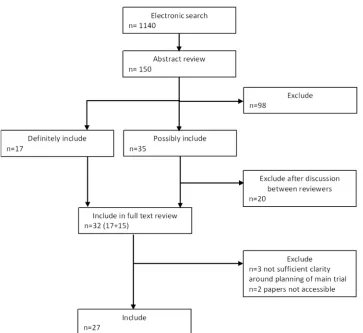
From the 150 most recent studies identified by our electronic search, we identified 27 eligible reports (Fig 6). In keeping with our working definition of a pilot or feasibility study, to be included the reports had to show evidence that investigators were addressing at least some fea-sibility objectives and that the study was in preparation for a future RCT evaluating the effect of an intervention. Ideally we would have stipulated that the primary objective of the study should be a feasibility objective but, given the nature of the reporting of most of these studies, we felt this would be too restrictive.
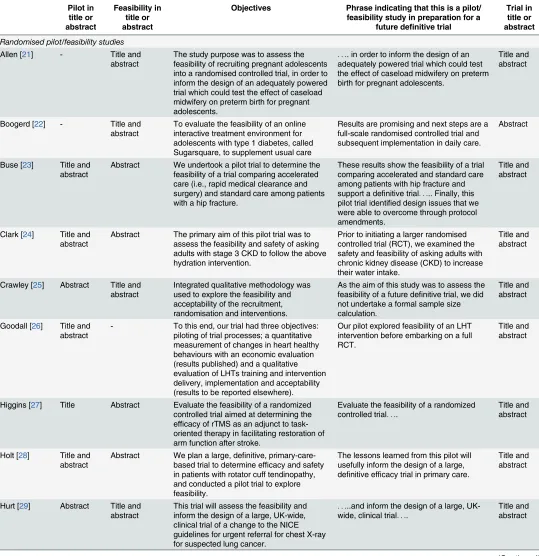
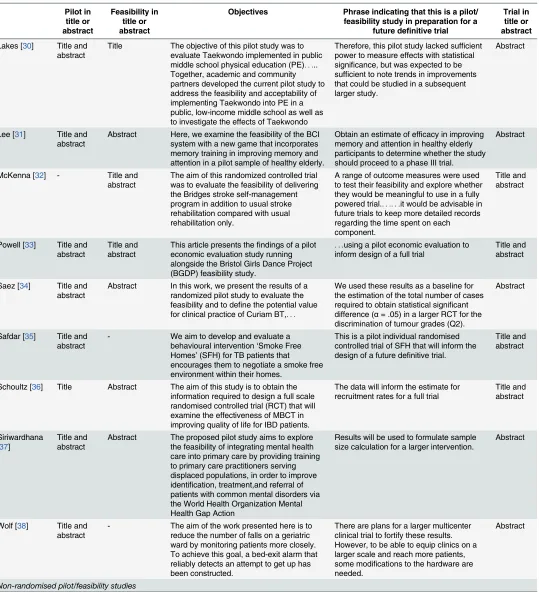
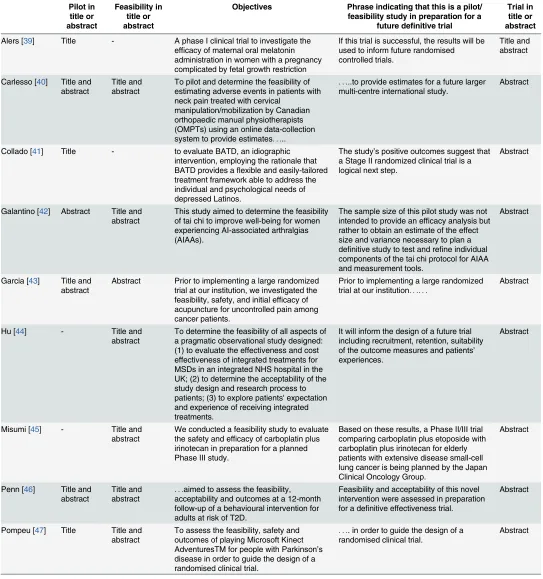
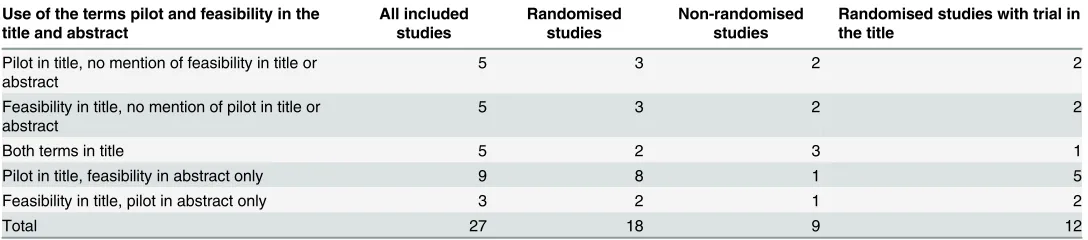
The 27 studies are reported inTable 1and results relating to terminology that authors used
summarised inTable 2. Results inTable 2support our first hypothesis that the words‘pilot’
and‘feasibility’are both used in the literature to describe studies undertaken in preparation for a randomised controlled trial of effectiveness; 63% (17/27) used both terms somewhere in the title or abstract. The table also supports our second hypothesis that amongst the subset of feasi-bility studies in preparation for an RCT that are themselves RCTs, authors do not use the term ‘pilot trial’consistently in relation to these studies; of the 18 randomised studies only eight
con-tained the words‘pilot’and‘trial’in the title. Our third hypothesis, namely that it is not
possi-ble to apply unique mutually exclusive definitions of pilot and feasibility studies in preparation for an RCT that are consistent with the way authors describe their studies, is supported by the
characteristics of studies presented inTable 1and summarised inTable 2. We could find no
design or other features (such as randomisation or presence of a control group) that distin-guished between those that investigators called feasibility studies and those that they called pilot studies. However, the fourth hypothesis, that amongst studies in preparation for an RCT evaluating the effect of an intervention or therapy it is possible to identify some studies that explore the feasibility of a certain intervention or acquire related information about the feasibil-ity of applying an intervention in a future study but are not pilot studies, was not supported; we
identified no such studies amongst those reported inTable 1. Nevertheless, we had identified
two prior to carrying out the review [10,15].
abstract. Thus our assumption that an initial screen using only abstracts resulted in the omis-sion of some pilot and feasiblity studies was correct.
Validating the conceptual framework
—
Consensus meeting
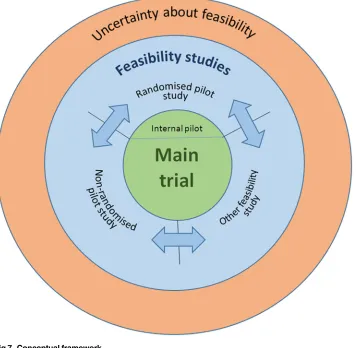
International consensus meeting participants agreed with the general tenets of our conceptual framework including the ideas that all pilot studies are feasibility studies but that some feasibil-ity studies are not pilot studies. They suggested that any definitive diagrammatic representation should more strongly reflect non-linearity in the ordering of feasibility studies. As a result of their input we produced a new, simplified, diagrammatical representation of the framework (Fig 7) which focuses on the key elements represented inside an oval shape on our original dia-gram, omits the wider context outside this shape, and highlights some features, including the non-linearity, more clearly.
The finalised framework
Fig 7represents the framework. The figure indicates that where there is uncertainty about future RCT feasibility, a feasibility study is appropriate. Feasibility is thus an overarching
con-cept within which we distinguish between three distinct types of study.Randomised pilot
[image:11.612.201.564.73.406.2]stud-iesare those studies in which the future RCT, or parts of it, including the randomisation of
Table 1. Categorisation and description of the 27 pilot/feasibility studies identified in our systematic review. Pilot in title or abstract Feasibility in title or abstract
Objectives Phrase indicating that this is a pilot/ feasibility study in preparation for a
future definitive trial
Trial in title or abstract Randomised pilot/feasibility studies
Allen [21] - Title and abstract
The study purpose was to assess the feasibility of recruiting pregnant adolescents into a randomised controlled trial, in order to inform the design of an adequately powered trial which could test the effect of caseload midwifery on preterm birth for pregnant adolescents.
. . .. in order to inform the design of an adequately powered trial which could test the effect of caseload midwifery on preterm birth for pregnant adolescents.
Title and abstract
Boogerd [22] - Title and abstract
To evaluate the feasibility of an online interactive treatment environment for adolescents with type 1 diabetes, called Sugarsquare, to supplement usual care
Results are promising and next steps are a full-scale randomised controlled trial and subsequent implementation in daily care.
Abstract
Buse [23] Title and abstract
Abstract We undertook a pilot trial to determine the feasibility of a trial comparing accelerated care (i.e., rapid medical clearance and surgery) and standard care among patients with a hip fracture.
These results show the feasibility of a trial comparing accelerated and standard care among patients with hip fracture and support a definitive trial. . ... Finally, this pilot trial identified design issues that we were able to overcome through protocol amendments.
Title and abstract
Clark [24] Title and abstract
Abstract The primary aim of this pilot trial was to assess the feasibility and safety of asking adults with stage 3 CKD to follow the above hydration intervention.
Prior to initiating a larger randomised controlled trial (RCT), we examined the safety and feasibility of asking adults with chronic kidney disease (CKD) to increase their water intake.
Title and abstract
Crawley [25] Abstract Title and abstract
Integrated qualitative methodology was used to explore the feasibility and acceptability of the recruitment, randomisation and interventions.
As the aim of this study was to assess the feasibility of a future definitive trial, we did not undertake a formal sample size calculation.
Title and abstract
Goodall [26] Title and abstract
- To this end, our trial had three objectives: piloting of trial processes; a quantitative measurement of changes in heart healthy behaviours with an economic evaluation (results published) and a qualitative evaluation of LHTs training and intervention delivery, implementation and acceptability (results to be reported elsewhere).
Our pilot explored feasibility of an LHT intervention before embarking on a full RCT.
Title and abstract
Higgins [27] Title Abstract Evaluate the feasibility of a randomized controlled trial aimed at determining the efficacy of rTMS as an adjunct to task-oriented therapy in facilitating restoration of arm function after stroke.
Evaluate the feasibility of a randomized controlled trial. . ..
Title and abstract
Holt [28] Title and abstract
Abstract We plan a large, definitive, primary-care-based trial to determine efficacy and safety in patients with rotator cuff tendinopathy, and conducted a pilot trial to explore feasibility.
The lessons learned from this pilot will usefully inform the design of a large, definitive efficacy trial in primary care.
Title and abstract
Hurt [29] Abstract Title and abstract
This trial will assess the feasibility and inform the design of a large, UK-wide, clinical trial of a change to the NICE guidelines for urgent referral for chest X-ray for suspected lung cancer.
. . ...and inform the design of a large, UK-wide, clinical trial. . ..
Title and abstract
Table 1. (Continued) Pilot in title or abstract Feasibility in title or abstract
Objectives Phrase indicating that this is a pilot/ feasibility study in preparation for a
future definitive trial
Trial in title or abstract
Lakes [30] Title and abstract
Title The objective of this pilot study was to evaluate Taekwondo implemented in public middle school physical education (PE). . ... Together, academic and community partners developed the current pilot study to address the feasibility and acceptability of implementing Taekwondo into PE in a public, low-income middle school as well as to investigate the effects of Taekwondo
Therefore, this pilot study lacked sufficient power to measure effects with statistical significance, but was expected to be sufficient to note trends in improvements that could be studied in a subsequent larger study.
Abstract
Lee [31] Title and abstract
Abstract Here, we examine the feasibility of the BCI system with a new game that incorporates memory training in improving memory and attention in a pilot sample of healthy elderly.
Obtain an estimate of efficacy in improving memory and attention in healthy elderly participants to determine whether the study should proceed to a phase III trial.
Abstract
McKenna [32] - Title and abstract
The aim of this randomized controlled trial was to evaluate the feasibility of delivering the Bridges stroke self-management program in addition to usual stroke rehabilitation compared with usual rehabilitation only.
A range of outcome measures were used to test their feasibility and explore whether they would be meaningful to use in a fully powered trial.. . .. . .it would be advisable in future trials to keep more detailed records regarding the time spent on each component.
Title and abstract
Powell [33] Title and abstract
Title and abstract
This article presents thefindings of a pilot economic evaluation study running alongside the Bristol Girls Dance Project (BGDP) feasibility study.
. . .using a pilot economic evaluation to inform design of a full trial
Title and abstract
Saez [34] Title and abstract
Abstract In this work, we present the results of a randomized pilot study to evaluate the feasibility and to define the potential value for clinical practice of Curiam BT,. . .
We used these results as a baseline for the estimation of the total number of cases required to obtain statistical significant difference (α= .05) in a larger RCT for the discrimination of tumour grades (Q2).
Abstract
Safdar [35] Title and abstract
- We aim to develop and evaluate a behavioural intervention‘Smoke Free Homes’(SFH) for TB patients that encourages them to negotiate a smoke free environment within their homes.
This is a pilot individual randomised controlled trial of SFH that will inform the design of a future definitive trial.
Title and abstract
Schoultz [36] Title Abstract The aim of this study is to obtain the information required to design a full scale randomised controlled trial (RCT) that will examine the effectiveness of MBCT in improving quality of life for IBD patients.
The data will inform the estimate for recruitment rates for a full trial
Title and abstract
Siriwardhana [37]
Title and abstract
Abstract The proposed pilot study aims to explore the feasibility of integrating mental health care into primary care by providing training to primary care practitioners serving displaced populations, in order to improve identification, treatment,and referral of patients with common mental disorders via the World Health Organization Mental Health Gap Action
Results will be used to formulate sample size calculation for a larger intervention.
Abstract
Wolf [38] Title and abstract
- The aim of the work presented here is to reduce the number of falls on a geriatric ward by monitoring patients more closely. To achieve this goal, a bed-exit alarm that reliably detects an attempt to get up has been constructed.
There are plans for a larger multicenter clinical trial to fortify these results. However, to be able to equip clinics on a larger scale and reach more patients, some modifications to the hardware are needed.
Abstract
Non-randomised pilot/feasibility studies
Table 1. (Continued) Pilot in title or abstract Feasibility in title or abstract
Objectives Phrase indicating that this is a pilot/ feasibility study in preparation for a
future definitive trial
Trial in title or abstract
Alers [39] Title - A phase I clinical trial to investigate the efficacy of maternal oral melatonin administration in women with a pregnancy complicated by fetal growth restriction
If this trial is successful, the results will be used to inform future randomised controlled trials.
Title and abstract
Carlesso [40] Title and abstract
Title and abstract
To pilot and determine the feasibility of estimating adverse events in patients with neck pain treated with cervical
manipulation/mobilization by Canadian orthopaedic manual physiotherapists (OMPTs) using an online data-collection system to provide estimates. . ...
. . ...to provide estimates for a future larger multi-centre international study.
Abstract
Collado [41] Title - to evaluate BATD, an idiographic intervention, employing the rationale that BATD provides aflexible and easily-tailored treatment framework able to address the individual and psychological needs of depressed Latinos.
The study’s positive outcomes suggest that a Stage II randomized clinical trial is a logical next step.
Abstract
Galantino [42] Abstract Title and abstract
This study aimed to determine the feasibility of tai chi to improve well-being for women experiencing AI-associated arthralgias (AIAAs).
The sample size of this pilot study was not intended to provide an efficacy analysis but rather to obtain an estimate of the effect size and variance necessary to plan a definitive study to test and refine individual components of the tai chi protocol for AIAA and measurement tools.
Abstract
Garcia [43] Title and abstract
Abstract Prior to implementing a large randomized trial at our institution, we investigated the feasibility, safety, and initial efficacy of acupuncture for uncontrolled pain among cancer patients.
Prior to implementing a large randomized trial at our institution. . .. . .
Abstract
Hu [44] - Title and
abstract
To determine the feasibility of all aspects of a pragmatic observational study designed: (1) to evaluate the effectiveness and cost effectiveness of integrated treatments for MSDs in an integrated NHS hospital in the UK; (2) to determine the acceptability of the study design and research process to patients; (3) to explore patients' expectation and experience of receiving integrated treatments.
It will inform the design of a future trial including recruitment, retention, suitability of the outcome measures and patients’ experiences.
Abstract
Misumi [45] - Title and abstract
We conducted a feasibility study to evaluate the safety and efficacy of carboplatin plus irinotecan in preparation for a planned Phase III study.
Based on these results, a Phase II/III trial comparing carboplatin plus etoposide with carboplatin plus irinotecan for elderly patients with extensive disease small-cell lung cancer is being planned by the Japan Clinical Oncology Group.
Abstract
Penn [46] Title and abstract
Title and abstract
. . .aimed to assess the feasibility, acceptability and outcomes at a 12-month follow-up of a behavioural intervention for adults at risk of T2D.
Feasibility and acceptability of this novel intervention were assessed in preparation for a definitive effectiveness trial.
Abstract
Pompeu [47] Title Title and abstract
To assess the feasibility, safety and outcomes of playing Microsoft Kinect AdventuresTM for people with Parkinson’s disease in order to guide the design of a randomised clinical trial.
. . .. in order to guide the design of a randomised clinical trial.
Abstract
participants, is conducted on a smaller scale (piloted) to see if it can be done. Thus randomised pilot studies can include studies that for the most part reflect the design of a future definitive trial but, if necessary due to remaining uncertainty, may involve trying out alternative strate-gies, for example, collecting an outcome variable via telephone for some participants and on-line for others. Within the framework randomised pilot studies could also legitimately be called
randomised feasibility studies. Two-thirds of the studies presented inTable 1are of this type.
Non-randomised pilot studiesare similar to randomised pilot studies; they are studies in which all or part of the intervention to be evaluated and other processes to be undertaken in a future trial is/are carried out (piloted) but without randomisation of participants. These could also legitimately be called by the umbrella term, feasibility study. These studies cover a wide range from those that are very similar to randomised pilot studies except that the intervention and control groups have not been randomised, to those in which only the intervention, and no
other trial processes, are piloted. One-third of studies presented inTable 1are of this type.
Feasibility studies that are not pilot studiesare those in which investigators attempt to answer a question about whether some element of the future trial can be done but do not implement the intervention to be evaluated or other processes to be undertaken in a future trial, though they may be addressing intervention development in some way. Such studies are
rarer than the other types of feasibility study and, in fact, none of the studies inTable 1were of
this type. Nevertheless, we include these studies within the framework because they do exist; the Palmer study [15] in which surgeons and patients were asked about the feasibility of rando-misation is one such example. Other examples might be interviews to ascertain the acceptabil-ity of an intervention, or questionnaires to assess the types of outcomes participants might think important. Within the framework these studies can be called feasibility studies but can-not be called pilot studies since no part of the future randomised controlled trial is being con-ducted on a smaller scale.
Investigators may conduct a number of studies to assess feasibility of an RCT to test the effect of any intervention or therapy. While it may be most common to carry out what we have
referred to asfeasibility studies that are not pilot studiesbeforenon-randomised pilot studies,
andnon-randomised pilot studiesprior torandomised pilot studies, the process of feasibility work is not necessarily linear and such studies can in fact be conducted in any order. For com-pleteness the diagram indicates the location of internal pilot studies.
Discussion
[image:15.612.35.579.90.210.2]There are diverse views about the definitions of pilot and feasibility studies within the research community. We reached consensus over a conceptual framework for the definitions of these studies in which feasibility is an overarching concept for studies assessing whether a future Table 2. Summary of terms used in 27 pilot/feasibility studies.
Use of the terms pilot and feasibility in the title and abstract
All included studies
Randomised studies
Non-randomised studies
Randomised studies with trial in the title
Pilot in title, no mention of feasibility in title or abstract
5 3 2 2
Feasibility in title, no mention of pilot in title or abstract
5 3 2 2
Both terms in title 5 2 3 1
Pilot in title, feasibility in abstract only 9 8 1 5
Feasibility in title, pilot in abstract only 3 2 1 2
Total 27 18 9 12
study, project or development can be done. For studies conducted in preparation for a RCT assessing the effect of a therapy or intervention, three distinct types of study come under the umbrella of feasibility studies: randomised pilot studies, non-randomised pilot studies, feasibil-ity studies that are not pilot studies. Thus pilot studies are a subset of feasibilfeasibil-ity studies. A review of the literature confirmed that it is not possible to apply mutually exclusive definitions of pilot and feasibility studies in preparation for such an RCT that are consistent with the way authors
describe their studies. For example Leeet al[31], Boogerdet al[22] and Wolfet al[38] all
describe randomised studies exploring the feasibility of introducing new systems (brain com-puter interface memory training game, on-line interactive treatment environment, bed-exit
alarm respectively) but Leeet aldescribe their study as a‘A Randomized Control Pilot Study’,
with the word‘feasibility’used in the abstract and text, while the study by Boogerdet al. is titled
‘Teaming up: feasibility of an online treatment environment for adolescents with type 1
diabe-tes’, and Wolf at al describe their study as a pilot study without using the word‘feasibility’.
[image:16.612.206.566.84.432.2]Our re-evaluation of the definitions of pilot and feasibility studies was conducted over a period of time with input via a variety of media by multi-disciplinary and international researchers, publishers, editors and funders. It was to some extent a by-product of our work developing reporting guidelines for such studies. Nevertheless, we were able to gather a wide range of expert views, and the iterative nature of the development of our thinking has been an Fig 7. Conceptual framework.
important part of obtaining consensus. Other parallel developments, including the recent establishment of the new Pilot and Feasibility Studies journal [48], suggest that our work is, indeed, timely. We encountered several difficulties in reviewing empirical study reports. Firstly, it was sometimes hard to assess whether studies were planned in preparation for an RCT or whether the authors were conducting a small study and simply commenting on the fact that a larger RCT would be useful. Secondly, objectives were sometimes unclear, and/or effectiveness objectives were often emphasised in spite of recommendations that pilot and feasibility studies
should not be focusing on effectiveness [1,4]. In identifying relevant studies we erred on the
side of inclusiveness, acknowledging that getting these studies published is not easy and that there are, as yet, no definitive reporting guidelines for investigators to follow. Lastly, our elec-tronic search was unable to identify any feasibility studies that were not pilot studies according to our definitions. Subsequent discussion with qualitative researchers suggested that this is because such studies are often not described as feasibility studies in the title or abstract.
Our framework is compatible with the UK MRC guidance on complex interventions which
suggests a‘feasibility and piloting’phase as part of the work to design and evaluate such
inter-ventions without any explicit distinction between pilot and feasibility studies. In addition, although our framework has a different underlying principle from that adopted by UK NIHR, the NIHR definition of a pilot study is not far from the subset of studies we have described as randomised pilot studies. Although there appears to be increasing interest in pilot and feasibil-ity studies, as far as we are aware no other funding bodies specifically address the nature of such studies. The National Institute for Health in the USA does, however, routinely require published pilot studies before considering funding applications for certain streams, and the Canadian Institutes of Health Research routinely have calls for pilot or feasibility studies in dif-ferent clinical areas to gather evidence necessary to determine the viability of new research directions determined by their strategic funding plans. These approaches highlight the need for clarity regarding what constitutes a pilot study.
There are several previous reviews of empirical pilot and feasibility studies [1,4,7]. In the
most recent, reviewing studies published between 2000 and 2009 [7], the authors identified a large number of studies, described similar difficulty in identifying whether a larger study was
actually being planned, and similar lack of consistency in the way the terms‘pilot’and
‘feasibil-ity’are used. Nevertheless, in methodological work, many researchers have adopted fairly rigid
definitions of pilot and feasibility studies. For example, Buggeet alin developing the ADEPT
framework refer to the NIHR definitions and suggest that feasibility studies ask questions about ‘whether the study can be done’while pilot trials are‘(a miniature version of the main trial), which aim to test aspects of study design and processes for the implementation of a larger main
trial in the future’[49]. Although not explicitly stated, the text seems to suggest that pilot and
feasibility studies are mutually exclusive. Our work indicates that this is neither necessary nor desirable. There is, however, general agreement in the literature about the purpose of pilot and
feasibility studies. For example, pilot trials are‘to provide sufficient assurance to enable a larger
definitive trial to be undertaken’[50], and pilot studies are‘designed to test the performance
characteristics and capabilities of study designs, measures, procedures, recruitment criteria, and operational strategies that are under consideration for use in a subsequent, often larger, study’
[51], and‘play a pivotal role in the planning of large-scale and often expensive investigations’
[52]. Within our framework we define all studies aiming to assess whether a future RCT is
do-able as‘feasibility studies’. Some might argue that the focus of their study in preparation for a
future RCT is acceptability rather than feasibility, and indeed, in other frameworks, such as the RE-AIM framework [53], feasibility and acceptability are seen as two different concepts. How-ever, it is perfectly possible to explore the acceptability of an intervention, of a data collection
the use of the term‘feasibility study’for a study in preparation for a future RCT is not incompat-ible with the exploration of issues other than feasibility within the study itself.
There are numerous previous studies in which the investigators review the literature and seek the counsel of experts to develop definitions and clarify terminology. Most of these relate
to clinical or physiological definitions [54–56]. A few explorations of definitions relate to
con-cepts such as quality of life [57]. Implicit in much of this work is that from time to time defini-tions need rethinking as knowledge and practice moves on. From an etymological point of
view this makes sense. In fact, the use of the word‘pilot’to mean something that is a prototype
of something else only appears to emerge in the middle of the twentieth century and the first use of the word in relation to research design that we could find was in 1947—a pilot survey [58]. Thus we do not have to look very far back to see changes in the use of one of the words we have been dealing with in developing our conceptual framework. We hope what we are
propos-ing here is helpful in the early twenty-first century to clarify the use of the words‘pilot’and
‘feasibility’in a health research context.
We suggest that researchers view feasibility as an overarching concept, with all studies done in preparation for a main study open to being called feasibility studies, and with pilot studies as
a subset of feasibility studies. All such studies should be labelled‘pilot’and/or‘feasibility’as
appropriate, preferably in the title of a report, but if not certainly in the abstract. This recom-mendation applies to all studies that contribute to an assessment of the feasibility of an RCT evaluating the effect of an intervention. Using either of the terms in the title will be most help-ful for those conducting future electronic searches. However, we recognise that for qualitative studies, authors may find it convenient to use the terms in the abstract rather than the title. Authors also need to describe objectives and methods well, reporting clearly if their study is in preparation for a future RCT to evaluate the effect of an intervention or therapy.
Though the focus of this work was on the definitions of pilot and feasibility studies and exten-sive recommendations for the conduct of these studies is outside its scope, we suggest that in choosing what type of feasibility study to conduct investigators should pay close attention to the major uncertainties that exist in relation to trial or intervention. A randomised pilot study may not be necessary to address these; in some cases it may not even be necessary to implement an intervention at all. Similarly, funders should look for a justification for the type of feasibility study that investigators propose. We have has also highlighted the need for better reporting of these studies. The CONSORT extension for randomised pilot studies that our group has devel-oped are important in helping to address this need and will be reported separately. Nevertheless, further work will be necessary to extend or adapt these reporting guidelines for use for non-ran-domised pilot studies and for feasibility studies that are not pilot studies. There is also more work to be done in developing good practice guidance for the conduct of pilot and feasibility studies.
Supporting Information
S1 Fig. Search strategy to identify studies that authors described as pilot or feasibility stud-ies.
(DOCX)
S2 Fig. Initial comprehensive diagrammatic representation of framework. (DOCX)
Acknowledgments
We thank Alicia O’Cathain and Pat Hoddinot for discussions about the reporting of qualitative
Coleman was funded by a National Institute for Health Research (NIHR) Research Methods Fellowship. This article presents independent research funded by the NIHR. The views expressed are those of the authors and not necessarily those of the NHS, the NIHR or the Department of Health.
Author Contributions
Conceived and designed the experiments: SE GL MC LT SH CB. Performed the experiments: SE GL MC LT SH CB CC. Analyzed the data: SE GL MC LT SH CB CC. Contributed reagents/ materials/analysis tools: SE GL MC LT SH CB. Wrote the paper: SE GL MC LT SH CB CC.
References
1. Lancaster GA, Dodd S, Williamson PR. Design and analysis of pilot studies: recommendations for good practice. Journal of evaluation in clinical practice. 2004; 10(2):307–12. Epub 2004/06/11. doi:10. 1111/j.2002.384.doc.xPMID:15189396.
2. Craig P, Dieppe P, Macintyre S, Michie S, Nazareth I, Petticrew M. Developing and evaluating complex interventions: the new Medical Research Council guidance. British Medical Journal. 2008; 337.
3. Thabane L, Ma J, Chu R, Cheng J, Ismaila A, Rios LP, et al. A tutorial on pilot studies: the what, why and how. BMC medical research methodology. 2010; 10:1. Epub 2010/01/08. doi: 10.1186/1471-2288-10-1PMID:20053272; PubMed Central PMCID: PMCPmc2824145.
4. Arain M, Campbell MJ, Cooper CL, Lancaster GA. What is a pilot or feasibility study? A review of cur-rent practice and editorial policy. BMC medical research methodology. 2010; 10:67. Epub 2010/07/20. doi:10.1186/1471-2288-10-67PMID:20637084; PubMed Central PMCID: PMCPmc2912920.
5. National Institute for Health Research. NIHR Evaluation, Trials and Studies | Glossary 2015. Available: http://www.nets.nihr.ac.uk/glossary/feasibility-studies. Accessed 2015 Mar 17.
6. National Institute for Health Research. NIHR Evaluation, Trials and Studies | Pilot studies 2015. Avail-able:http://www.nets.nihr.ac.uk/glossary/pilot-studies. Accessed 2015 Mar 17.
7. Shanyinde M, Pickering RM, Weatherall M. Questions asked and answered in pilot and feasibility ran-domized controlled trials. BMC medical research methodology. 2011; 11:117. Epub 2011/08/19. doi: 10.1186/1471-2288-11-117PMID:21846349; PubMed Central PMCID: PMCPmc3170294.
8. Schulz KF, Altman DG, Moher D. CONSORT 2010 statement: updated guidelines for reporting parallel group randomized trials. Annals of Internal Medicine. 2010; 152(11):726–32. Epub 2010/03/26. doi:10. 7326/0003-4819-152-11-201006010-00232PMID:20335313.
9. CLINVIVO. Clinvivo Limited 2015 [cited 2015 9 April]. Available:http://www.clinvivo.com/.
10. Heazell AE, Bernatavicius G, Roberts SA, Garrod A, Whitworth MK, Johnstone ED, et al. A randomised controlled trial comparing standard or intensive management of reduced fetal movements after 36 weeks gestation—a feasibility study. BMC pregnancy and childbirth. 2013; 13:95. Epub 2013/04/18. doi:10.1186/1471-2393-13-95PMID:23590451; PubMed Central PMCID: PMCPmc3640967.
11. Colon HM, Finlinson HA, Negron J, Sosa I, Rios-Olivares E, Robles RR. Pilot trial of an intervention aimed at modifying drug preparation practices among injection drug users in Puerto Rico. AIDS and behavior. 2009; 13(3):523–31. Epub 2009/03/25. doi:10.1007/s10461-009-9540-3PMID:19308722.
12. Palmer AJ, Thomas GE, Pollard TC, Rombach I, Taylor A, Arden N, et al. The feasibility of performing a randomised controlled trial for femoroacetabular impingement surgery. Bone & joint research. 2013; 2 (2):33–40. Epub 2013/04/24. doi:10.1302/2046-3758.22.2000137PMID:23610700; PubMed Central PMCID: PMCPmc3626218.
13. In Conference Ltd. 2nd Clinical Trials Methodology Conference | 18–19 November 2013 EICC, Edin-burgh, Scotland 2013. Available:http://www.methodologyconference2013.org.uk/. Accessed 2015 Mar 17.
14. Oxford Dictionaries. Oxford Dictionaries | feasibility 2015. Available:http://www.oxforddictionaries.com/ definition/english/feasibility. Accessed 2015 Mar 17.
15. Oxford Dictionaries. Oxford Dictionaries | feasibility study 2015. Available:http://www. oxforddictionaries.com/definition/english/feasibility-study. Accessed 2015 Mar 17.
16. Wikipedia. Feasibility study 2015 [cited 2015 17 March]. Available:http://en.wikipedia.org/wiki/ Feasibility_study.
18. Collins. Collins English Dictionary | pilot study 2015. Available from:http://www.collinsdictionary.com/ dictionary/english/pilot-study. Accessed 2015 Mar 17.
19. Wikipedia. Pilot experiment 2015. Available:http://en.wikipedia.org/wiki/Pilot_experiment. Accessed 2015 Mar 17.
20. Piot C, Croisille P, Staat P, Thibault H, Rioufol G, Mewton N, et al. Effect of cyclosporine on reperfusion injury in acute myocardial infarction. The New England journal of medicine. 2008; 359(5):473–81. Epub 2008/08/02. doi:10.1056/NEJMoa071142PMID:18669426.
21. Allen J, Stapleton H, Tracy S, Kildea S. Is a randomised controlled trial of a maternity care intervention for pregnant adolescents possible? An Australian feasibility study. BMC medical research methodol-ogy. 2013; 13:138. Epub 2013/11/15. doi:10.1186/1471-2288-13-138PMID:24225138; PubMed Cen-tral PMCID: PMCPmc4226005.
22. Boogerd EA, Noordam C, Kremer JA, Prins JB, Verhaak CM. Teaming up: feasibility of an online treat-ment environtreat-ment for adolescents with type 1 diabetes. Pediatric diabetes. 2014; 15(5):394–402. Epub 2013/12/20. doi:10.1111/pedi.12103PMID:24350732.
23. Buse GL, Bhandari M, Sancheti P, Rocha S, Winemaker M, Adili A, et al. Accelerated care versus stan-dard care among patients with hip fracture: the HIP ATTACK pilot trial. Canadian Medical Association Journal. 2013; 186(1):E52–E60. doi:10.1503/cmaj.130901PMID:24246589
24. Clark WF, Sontrop JM, Huang S-H, Gallo K, Moist L, House AA, et al. The chronic kidney disease Water Intake Trial (WIT): results from the pilot randomised controlled trial. BMJ Open. 2013; 3(12): e003666. doi:10.1136/bmjopen-2013-003666PMID:24362012
25. Crawley E, Mills N, Beasant L, Johnson D, Collin SM, Deans Z, et al. The feasibility and acceptability of conducting a trial of specialist medical care and the Lightning Process in children with chronic fatigue syndrome: feasibility randomized controlled trial (SMILE study). Trials. 2013; 14:415. Epub 2013/12/07. doi:10.1186/1745-6215-14-415PMID:24304689; PubMed Central PMCID: PMCPmc4235039.
26. Goodall M, Barton GR, Bower P, Byrne P, Cade JE, Capewell S, et al. Food for thought: pilot random-ized controlled trial of lay health trainers supporting dietary change to reduce cardiovascular disease in deprived communities. Journal of Public Health (Oxford, England) 2014; 36(4):635–43. Epub 2013/11/ 28. doi:10.1093/pubmed/fdt112PMID:24277778.
27. Higgins J, Koski L, Xie H. Combining rTMS and task-oriented training in the rehabilitation of the arm after stroke: a pilot randomized controlled trial. Stroke Research and Treatment. 2013; 2013. doi:10. 1155/2013/539146
28. Holt TA, Mant D, Carr A, Gwilym S, Beard D, Toms C, et al. Corticosteroid injection for shoulder pain: single-blind randomized pilot trial in primary care. Trials. 2013; 14:425. Epub 2013/12/12. doi:10.1186/ 1745-6215-14-425PMID:24325987; PubMed Central PMCID: PMCPmc3878869.
29. Hurt CN, Roberts K, Rogers TK, Griffiths GO, Hood K, Prout H, et al. A feasibility study examining the effect on lung cancer diagnosis of offering a chest X-ray to higher-risk patients with chest symptoms: protocol for a randomized controlled trial. Trials. 2013; 14:405. Epub 2013/11/28. doi: 10.1186/1745-6215-14-405PMID:24279296; PubMed Central PMCID: PMCPmc4222751.
30. Lakes KD, Bryars T, Sirisinahal S, Salim N, Arastoo S, Emmerson N, et al. The Healthy for Life Taek-wondo Pilot Study: A Preliminary Evaluation of Effects on Executive Function and BMI, Feasibility, and Acceptability. Mental health and physical activity. 2013; 6(3):181–8. Epub 2014/02/25. doi:10.1016/j. mhpa.2013.07.002PMID:24563664; PubMed Central PMCID: PMCPmc3927879.
31. Lee TS, Goh SJ, Quek SY, Phillips R, Guan C, Cheung YB, et al. A brain-computer interface based cognitive training system for healthy elderly: a randomized control pilot study for usability and prelimi-nary efficacy. PloS one. 2013; 8(11):e79419. Epub 2013/11/22. doi:10.1371/journal.pone.0079419 PMID:24260218; PubMed Central PMCID: PMCPmc3832588.
32. McKenna S, Jones F, Glenfield P, Lennon S. Bridges self-management program for people with stroke in the community: A feasibility randomized controlled trial. International journal of stroke: official journal of the International Stroke Society. 2013. Epub 2013/11/22. doi:10.1111/ijs.12195PMID:24256085.
33. Powell JE, Carroll FE, Sebire SJ, Haase AM, Jago R. Bristol girls dance project feasibility study: using a pilot economic evaluation to inform design of a full trial. BMJ Open. 2013; 3(12):e003726. doi:10. 1136/bmjopen-2013-003726PMID:24362013
34. Saez C, Marti-Bonmati L, Alberich-Bayarri A, Robles M, Garcia-Gomez JM. Randomized pilot study and qualitative evaluation of a clinical decision support system for brain tumour diagnosis based on SV (1)H MRS: evaluation as an additional information procedure for novice radiologists. Computers in biol-ogy and medicine. 2014; 45:26–33. Epub 2014/02/01. doi:10.1016/j.compbiomed.2013.11.009PMID: 24480160.
tuberculosis and lung disease: the official journal of the International Union against Tuberculosis and Lung Disease. 2015; 19(2):237–43. Epub 2015/01/13. doi:10.5588/ijtld.14.0615PMID:25574925.
36. Schoultz M, Atherton IM, Hubbard G, Watson AJ. The use of mindfulness-based cognitive therapy for improving quality of life for inflammatory bowel disease patients: study protocol for a pilot randomised controlled trial with embedded process evaluation. Trials. 2013; 14:431. Epub 2013/12/18. doi:10. 1186/1745-6215-14-431PMID:24341333; PubMed Central PMCID: PMCPmc3878510.
37. Siriwardhana C, Adikari A, Van Bortel T, McCrone P, Sumathipala A. An intervention to improve mental health care for conflict-affected forced migrants in low-resource primary care settings: a WHO MhGAP-based pilot study in Sri Lanka (COM-GAP study). Trials. 2013; 14:423. Epub 2013/12/11. doi:10.1186/ 1745-6215-14-423PMID:24321171; PubMed Central PMCID: PMCPmc3906999.
38. Wolf KH, Hetzer K, zu Schwabedissen HM, Wiese B, Marschollek M. Development and pilot study of a bed-exit alarm based on a body-worn accelerometer. Zeitschrift fur Gerontologie und Geriatrie. 2013; 46(8):727–33. Epub 2013/11/26. doi:10.1007/s00391-013-0560-2PMID:24271253.
39. Alers NO, Jenkin G, Miller SL, Wallace EM. Antenatal melatonin as an antioxidant in human pregnan-cies complicated by fetal growth restriction—a phase I pilot clinical trial: study protocol. BMJ Open. 2013; 3(12):e004141. doi:10.1136/bmjopen-2013-004141PMID:24366583
40. Carlesso LC, Macdermid JC, Santaguida PL, Thabane L. Determining adverse events in patients with neck pain receiving orthopaedic manual physiotherapy: a pilot and feasibility study. Physiotherapy Canada Physiotherapie Canada. 2013; 65(3):255–65. Epub 2014/01/10. doi:10.3138/ptc.2012-28 PMID:24403696; PubMed Central PMCID: PMCPmc3740991.
41. Collado A, Castillo SD, Maero F, Lejuez CW, Macpherson L. Pilot of the brief behavioral activation treat-ment for depression in latinos with limited english proficiency: preliminary evaluation of efficacy and acceptability. Behavior therapy. 2014; 45(1):102–15. Epub 2014/01/15. doi:10.1016/j.beth.2013.10. 001PMID:24411118; PubMed Central PMCID: PMCPmc4103902.
42. Galantino ML, Callens ML, Cardena GJ, Piela NL, Mao JJ. Tai chi for well-being of breast cancer survi-vors with aromatase inhibitor-associated arthralgias: a feasibility study. Alternative therapies in health and medicine. 2013; 19(6):38–44. Epub 2013/11/21. PMID:24254037.
43. Garcia MK, Driver L, Haddad R, Lee R, Palmer JL, Wei Q, et al. Acupuncture for treatment of uncon-trolled pain in cancer patients: a pragmatic pilot study. Integrative cancer therapies. 2014; 13(2):133– 40. Epub 2013/11/28. doi:10.1177/1534735413510558PMID:24282103.
44. Hu X, Hughes J, Fisher P, Lorenc A, Purtell R, Park AL, et al. A pragmatic observational feasibility study on integrated treatment for musculoskeletal disorders: Design and protocol. Chinese journal of integrative medicine. 2013. Epub 2013/12/18. doi:10.1007/s11655-013-1557-9PMID:24338185.
45. Misumi Y, Nishio M, Takahashi T, Ohyanagi F, Horiike A, Murakami H, et al. A feasibility study of carbo-platin plus irinotecan treatment for elderly patients with extensive disease small-cell lung cancer. Japa-nese journal of clinical oncology. 2014; 44(2):116–21. Epub 2013/12/18. doi:10.1093/jjco/hyt195 PMID:24338555.
46. Penn L, Ryan V, White M. Feasibility, acceptability and outcomes at a 12-month follow-up of a novel community-based intervention to prevent type 2 diabetes in adults at high risk: mixed methods pilot study. BMJ Open. 2013; 3(11):e003585. doi:10.1136/bmjopen-2013-003585PMID:24227871
47. Pompeu JE, Arduini LA, Botelho AR, Fonseca MB, Pompeu SM, Torriani-Pasin C, et al. Feasibility, safety and outcomes of playing Kinect Adventures! for people with Parkinson's disease: a pilot study. Physiotherapy. 2014; 100(2):162–8. Epub 2014/04/08. doi:10.1016/j.physio.2013.10.003PMID: 24703891.
48. Lancaster GA. Pilot and feasibility studies come of age! Pilot and Feasibility Studies. 2015; 1(1):1.
49. Bugge C, Williams B, Hagen S, Logan J, Glazener C, Pringle S, et al. A process for Decision-making after Pilot and feasibility Trials (ADePT): development following a feasibility study of a complex inter-vention for pelvic organ prolapse. Trials. 2013; 14:353. Epub 2013/10/29. doi: 10.1186/1745-6215-14-353PMID:24160371; PubMed Central PMCID: PMCPmc3819659.
50. Lee EC, Whitehead AL, Jacques RM, Julious SA. The statistical interpretation of pilot trials: should sig-nificance thresholds be reconsidered? BMC medical research methodology. 2014; 14:41. Epub 2014/ 03/22. doi:10.1186/1471-2288-14-41PMID:24650044; PubMed Central PMCID: PMCPmc3994566.
51. Moore CG, Carter RE, Nietert PJ, Stewart PW. Recommendations for planning pilot studies in clinical and translational research. Clinical and translational science. 2011; 4(5):332–7. Epub 2011/10/28. doi: 10.1111/j.1752-8062.2011.00347.xPMID:22029804; PubMed Central PMCID: PMCPmc3203750.
53. Glasgow RE, Vogt TM, Boles SM. Evaluating the public health impact of health promotion interventions: the RE-AIM framework. American journal of public health. 1999; 89(9):1322–7. Epub 1999/09/04. PMID:10474547; PubMed Central PMCID: PMCPmc1508772.
54. Le Reste JY, Nabbe P, Rivet C, Lygidakis C, Doerr C, Czachowski S, et al. The European general prac-tice research network presents the translations of its comprehensive definition of multimorbidity in fam-ily medicine in ten European languages. PloS one. 2015; 10(1):e0115796. Epub 2015/01/22. doi:10. 1371/journal.pone.0115796PMID:25607642; PubMed Central PMCID: PMCPmc4301631.
55. Vanderver A, Prust M, Tonduti D, Mochel F, Hussey HM, Helman G, et al. Case definition and classifi-cation of leukodystrophies and leukoencephalopathies. Molecular genetics and metabolism. 2015; 114 (4):494–500. Epub 2015/02/05. doi:10.1016/j.ymgme.2015.01.006PMID:25649058.
56. San L, Serrano M, Canas F, Romero SL, Sanchez-Cabezudo A, Villar M. Towards a pragmatic and operational definition of relapse in schizophrenia: A Delphi consensus approach. International journal of psychiatry in clinical practice. 2015:1–9. Epub 2014/12/31. doi:10.3109/13651501.2014.1002501 PMID:25547440.
57. Post MW. Definitions of quality of life: what has happened and how to move on. Topics in spinal cord injury rehabilitation. 2014; 20(3):167–80. Epub 2014/12/09. doi:10.1310/sci2003-167PMID: 25484563; PubMed Central PMCID: PMCPmc4257148.