This content has been downloaded from IOPscience. Please scroll down to see the full text.
Download details:
IP Address: 130.159.82.179
This content was downloaded on 01/04/2016 at 15:16
Please note that terms and conditions apply.
Controlled merging and annihilation of localised dissipative structures in an AC-driven damped
nonlinear Schrödinger system
View the table of contents for this issue, or go to the journal homepage for more 2016 New J. Phys. 18 033034
(http://iopscience.iop.org/1367-2630/18/3/033034)
PAPER
Controlled merging and annihilation of localised dissipative
structures in an AC-driven damped nonlinear Schrödinger system
Jae K Jang1,3
, Miro Erkintalo1
, Kathy Luo1
, Gian-Luca Oppo2
, Stéphane Coen1
and Stuart G Murdoch1 1 Dodd-Walls Centre and Department of Physics, The University of Auckland, Private Bag 92019, Auckland 1142, New Zealand 2 SUPA and Department of Physics, University of Strathclyde, Glasgow G4 0NG, UK
3 Current address: Department of Applied Physics and Applied Mathematics, Columbia University, New York, NY 10027, USA
E-mail:[email protected]
Keywords:nonlinear resonator, localised dissipative structure, soliton interaction, dissipative systems
Abstract
We report studies of controlled interactions of localised dissipative structures in a system described by
the AC-driven damped nonlinear Schrödinger equation
(
equivalent to the Lugiato–Lefever model
)
.
Extensive numerical simulations reveal a variety of interaction scenarios that are governed by the
properties of the system driver, notably its gradients. In our experiments, performed with a nonlinear
optical
fibre
(
Kerr
)
resonator, the phase profile of the driver is used to induce interactions of the
dissipative structures on demand. We observe both merging and annihilation of localised structures,
i.e. interactions governed by the dissipative, out-of-equilibrium nature of the system. These
interactions fundamentally differ from those typically found for conventional conservative solitons.
1. Introduction
Localised structures coexisting with a homogeneous background are ubiquitous phenomena in extended dissipative systems driven far from equilibrium. These structures consist of solitary excitations that manifest themselves as electrical pulses in nerves[1], concentration spots in chemical reactions[2,3], oscillons in water waves[4,5]and in granular matter[6,7],filaments in gas discharges[8,9], patches and fairy circles in vegetation [10,11], or feedback and cavity solitons in nonlinear optics[12–18]. More generally, they are referred to as localised dissipative structures(LDSs)or dissipative solitons[19,20].
Like other solitons, LDSs can interact and collide with each other, sometimes with particle-like
characteristics. But while conventional solitons of conservative integrable systems always emerge unscathed from collisions[21], LDSs can form bound states, merge into one, or even annihilate[20]. These complex interactions arise from the non-integrability of nonlinear dissipative systems, and their study is of particular interest to better understand systems outside thermal equilibrium. Merging and annihilation of solitons have been extensively studied experimentally in non-integrableconservativesystems, mostly with optical waves[22– 27], but also, more recently, with matter waves[28]. In contrast, although several authors have reported complex behaviours of ensembles of LDSs in various settings, experimental observations have been uncontrolled and mostly qualitative(see, e.g.[6,7,20]). It is only in gas discharges[29]and in vertically drivenfluids[5]that quantitative measurements of the interaction laws have been obtained, with[5]also resolving the merging dynamics. These two latter examples are realisations of, respectively, a reaction-diffusion system and a parametrically driven damped nonlinear Schrödinger equation(NLSE)near the 2:1 resonance.
Here we report on a detailed numerical and experimental study of controlled merging and annihilation dynamics of LDSs in a system described by an AC-driven damped NLSE near the 1:1 resonance. Experiments are performed in a nonlinear opticalfibre(Kerr)resonator, in which we can excite LDSs at selected and precise positions, and systematically induce their interactions. The interactions are triggered by manipulating the phase profile of the driver; the outcome controllably depends on the driving frequency and strength. Two LDSs either OPEN ACCESS
RECEIVED 3 November 2015
REVISED 9 February 2016
ACCEPTED FOR PUBLICATION 1 March 2016
PUBLISHED 24 March 2016
Original content from this work may be used under the terms of theCreative Commons Attribution 3.0 licence.
Any further distribution of this work must maintain attribution to the author(s)and the title of the work, journal citation and DOI.
merge into one, or annihilate each other. In both cases, we temporally resolve the collision dynamics and clearly observe the dissipative nature of the interaction through analysis of the energy balance.
2. Model equations and numerical simulations
To better illustrate our experimentalfindings, we start our discussion by presenting numerical results. In dimensionless form, the AC-driven damped NLSE reads
S
iY + Y Y + Y = - Y +t ∣ ∣2 xx i i eiDt. ( )1
This equation represents in our case the mean-field behaviour of a Kerr resonator[30–32], but is also the small amplitude limit of the AC-driven sine-Gordon equation[33,34]. It has applications in non-equilibrium systems ranging from plasma physics[35]to Josephson junctions[36], highlighting the general applicability of our study. The equation can be cast into an autonomous form by substitutingΨ(t,x)=ψ(t,x)eiΔt
S
iyt +∣ ∣y y2 +yxx= -iy+ D +y i ( )2
which will be used throughout our work. This form is also referred to as the Lugiato–Lefever equation
(LLE)[30].
Depending on the driving strengthSand its frequencyΔ, equation(2)exhibits a range of solutions, which have been extensively investigated[30–34]. Briefly, the simplest steady-state(yt=0)solutions are
homogeneous(ψx=0), and they satisfy the well-known cubic steady-state equation
X =Y3- D2 Y2+ D +( 2 1)YwithX=∣ ∣S2andY=∣ ∣y2. The steady-state curve(YversusX)is
single-valued forD < 3, whereas forD > 3it assumes an S-shaped hysteresis cycle with three possible states. The latter range is of more relevance to our experimental configuration[16,17], and thus the focus of our work. Only the upper and lower states that exist forD > 3are homogeneously stable(bistability): the intermediate, negative slope, branch is unconditionally unstable. The upper branch exhibits however a Turing-pattern instability(also known as modulation instability)with respect to inhomogeneous perturbations, which can lead to the formation of a stationary periodic pattern[30]. The lower branch only exhibits such instability close to the folding point for a very small range of parameters(Y>1 and 3 < D <2)but is otherwise stable. LDSs can manifest themselves under conditions of coexistence of a patterned solution and a stable homogeneous solution. They can be understood to coincide with the patterned solution over afinite region inx, and with the
homogeneous lower-state solution elsewhere[37].
We are interested in the dynamics that take place when two LDSs collide. Unlike conservative solitons, widely separated LDSs of the AC-driven NLSE(or LLE)are phase-locked to the driver, and thus all of them possess identical traits(for givenXandΔ), including frequency(Δ)and velocity. Accordingly, unassisted collisions occur only when two LDSs are sufficiently close to interact attractively[38,39], yet such interactions are difficult to explore controllably. Inducing collisions by suitably modulating the phase of the driver[40–42]
addresses that issue. Specifically, givenS x( )=S0exp i[f( )]x , an LDS atxLwill move towards the local
maximum off(x)with a drift velocity ofdxL dt = ¢f( )xL [43,44]. A collision is thus observed when exciting,
for example, two LDSs on opposite sides of a local maximum off(x)[42].
To illustrate such induced collisions, we numerically integrate equation(2)using the split-step Fourier method. We assume a Gaussian driver phase profile x 0 exp x x2
02
( ) ( ) ( )
f =f - . To create LDSs symmetrically distributed about the phase maximum atx=0, we use the initial condition
x x x x x
0, 2 sech L sech L . 3
( ) ⎡⎣ [ ( )] [ ( )]⎤⎦ ( )
y = D D - + D +
The initial LDS separation 2xL=70 is chosen to be much larger than their characteristic width(~ D1 )[32–
34,45]so as to avoid any interactions during the transients leading to the LDS formation. Figures1(a)and(b) show typical results for two different sets of driver frequencyΔand strengthS0, as listed in the caption, and with
f(0)=0.5 rad andx0=30. These parameters are chosen to replicate our experiments. Note that the
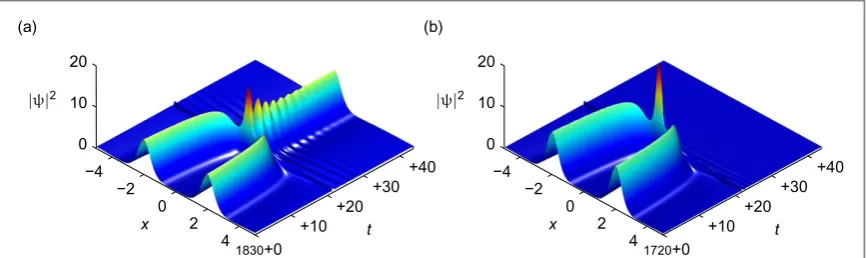
homogeneous background on which the LDSs are superimposed is only just visible infigures1(a)and(b) because of its small level,Y∼0.5. For clarity, thefigures neglect the initial portion of the simulation(which lasts for more thant=1700), during which the two LDSs slowly approach each other from their initial separation of2xL=70. In both cases, it can be seen that the LDSs drift towards each other until they are close enough to
interact. The outcome of the collision is, however, markedly different. Indeed, for[Δ,S0]=[2.91, 1.87]the two
LDS merge into one(figure1(a)), while for[Δ,S0]=[3.64, 2.10]the intracavityfield after the interaction is
globally reduced to the homogeneous solution, i.e. the two LDSs annihilate one another(figure1(b)). It is apparent that the interactions depend on the parameters of the driver. This has been numerically explored further by systematically varying our four control parameters,Δ,S0,f(0), andx0, over a wide range.
We have found thatΔandS0mainly govern the outcome of the collision, while the phase modulation
parametersf(0)andx0mostly determine the speed at which the LDSs approach each other, i.e. set the timing of
2
the collision. Infigure2, we summarise the numerically observed outcome of the interaction as a function ofS0
andΔfor the same driver phase modulationf(x)as above. As can be seen, merging(green)and annihilation
(blue)occur in clearly distinct, but adjacent, regions. For a given driving strengthS0, the system favours
annihilation over merging at higher driving frequencies. This can be related to the closer proximity to the folding point atD ~c p2∣ ∣S02 8, beyond which LDSs cease to exist in this system[33]. Interestingly, in the area marked ‘bound states’no collision occurs. Instead, the two LDSs form a stable bound state[38,46–49]: repulsive interactions of the LDSs resist the drift induced by the driver phase modulation. Not surprisingly, this region slightly grows at the expense of the‘merging’region when a shallower phase modulation is used(the merging/ annihilation boundary is mostly unaffected). In the grey region, labelled‘breathing’, the individual LDSs exhibit breathing as a result of an underlying Hopf bifurcation[34]. Their interaction can lead either to merging or annihilation, depending on the phase of their breathing at the onset of the collision. The bound-state and breather regimes will not be further discussed here because experimental limitations currently prevent us from observing them. We also note that there exists other systems with overall similar phenomenology, such as those described by Ginzburg–Landau equations, including e.g.fibre lasers[46,50].
Experimental realisation
We now describe our experimental configuration, implemented in the optical domain. Specifically, we induce controllable LDS interactions in a coherently driven passive opticalfibre resonator that exhibits instantaneous Kerr nonlinearity. In the high-finesse limit, this system is known to be governed by the LLE(2), withψ(t, x)
[image:4.595.120.554.62.191.2]representing the slowly varying envelope of the electricfield[31]. The LDSs of such Kerr resonator have been observed experimentally before and are usually referred to as temporal cavity solitons[16–18]. These are pulses of light that continuously circulate in the resonator, yet remain stationary in a reference frame that is moving at Figure 1.Numerically simulated dynamics of induced LDS interactions forf(0)=0.5rad andx0=30. In(a)[Δ,S0]=[2.91, 1.87]
and two LDSs merge into one; in(b)[Δ,S0]=[3.64, 2.10]and two LDSs annihilate one another.
Figure 2.Results from numerical simulations illustrating the outcome of LDS interactions as a function of driving frequencyΔand strengthS0forf( )0 =0.5 rad, andx0=30. Each solid dot represents a distinct simulation. No LDSs exist in the white-colour coded
[image:4.595.123.554.230.427.2]the group velocity of the driving light in thefibre. The transverse coordinatexin equation(2)is thus a‘fast-time’ xtthat is defined in such a reference frame and that allows to describe the temporal profile of thefield envelope. In contrast,tis a‘slow-time’that describes changes in thefield envelope over consecutive roundtrips around the resonator. The normalisation is such that dimensional time-scalesτ′andt′(units of s)and the electricfield envelopeE t( ¢ ¢,t)(units of W1/2)are related to the dimensionless variables in equation(2)by[16]
t t
t L E
L
, 2 , . 4
R ∣ 2∣
( )
a t t a
b y
g a
= ¢ = ¢ =
HeretRis the roundtrip-time of the resonator,αis equal to half the percentage of total power loss per
round-trip,Lis the resonator length, andβ2(<0)andγare, respectively, the anomalous group-velocity dispersion and
Kerr nonlinearity coefficients of thefibre. The driving strengthS0is related to the powerPinof the
continuous-wave(cw)laser driving the resonator asS0=(Ping q aL 3 1 2) , whereθis the intensity transmission coefficient of the coupler used to inject thefield into the resonator. Finally,Δcharacterises the frequency detuning of the cw driving laser atωfrom the closest resonator resonance atw0,DtR(w0-w a) .
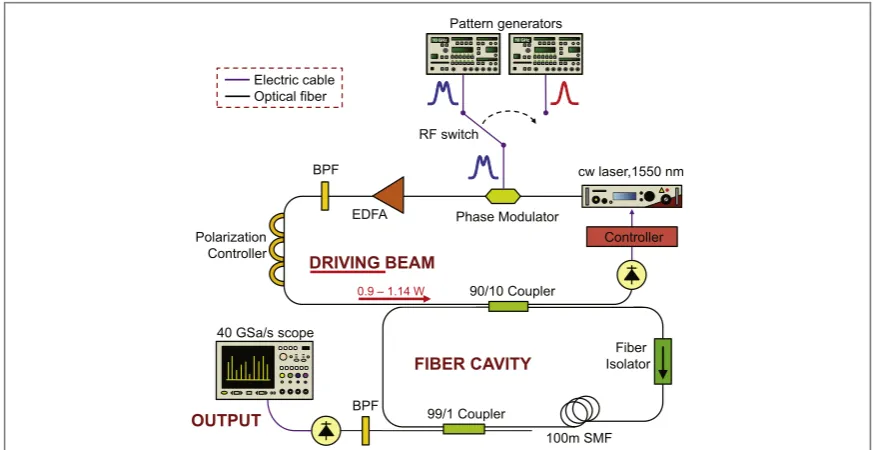
A detailed schematic of our experimental setup is shown infigure3. Overall, it is similar to the ones used in [44,51]. Note that these two previous studies were concerned with the manipulation of widely separated solitons, that were fully independent from one another; here in contrast we use similar tools to induce and study
collisionsof LDSs, i.e. a configuration in which solitons are closely interacting. As a coherent driver, we use a narrow linewidth cw laser at 1550nm wavelength, which is amplified up to 1.14W using an erbium-dopedfibre amplifier(EDFA)before being coupled into the resonator by a 90/10fibre coupler(θ=0.1). Noise accumulated during the amplification stage is mostly removed with an optical band-passfilter(BPF). The resonator is composed of 100m of standard silica single-modefibre(SMF), withβ2=−21.4 ps2km−1andγ=1.2
W−1km−1. It also incorporates an optical isolator to prevent resonance of stimulated Brillouin scattering radiation, and a 99/1fibre coupler through which the intracavity dynamics are monitored with a fast photodiode and a real-time oscilloscope. The overallfinesse of the resonator was measured to be
21.5
=p a~ . The BPF at the 1% outputfilters out the homogeneous cw background that coexists with the LDSs, thereby improving the signal-to-noise ratio of our data[16]. The resonance frequencies of our optical
fibre ring generally exhibitfluctuations due to environmental perturbations. To maintain afixedΔ, we therefore actively actuate the driving laser frequency to follow any changes in the resonances, by locking to a set level the optical power reflected off the resonator input[16,17,44]. Changing the lock point allows us to controllably adjustΔ, but we remark that the accuracy with which we can do so is insufficient to explore the formation of bound states since they manifest themselves over a narrow range of driver frequencies(seefigure2). In this context, we also note that, with our current configuration, we are unable to reach power levels required to explore interactions of breathing LDSs.
[image:5.595.117.554.61.286.2]To controllably induce LDS interactions, we phase modulate the resonator drivingfield with a 10 GHz electro–optic modulator. The modulator is driven by one of two 10 GHz programmable pattern generators,
Figure 3.Experimental setup. cw: continuous-wave, EDFA: erbium-dopedfibre amplifier, BPF: band-pass-filter, SMF: single-mode
fibre.
4
selected with an electronic switch. The pattern generators are synchronised to each other by a single external clock, such that the repetition rate of their output patterns is identical to the resonator free-spectral range. The
first generator(left infigure3)is configured to produce a pattern of two 130 ps full-width-at-half-maximum electronic pulses with 200 ps separation. These are fed to the phase modulator in the initial stage of the experiment. During that stage, we mechanically perturb the resonator, which results in the direct excitation of two LDSs at the two phase maxima[51]. After the LDSs are stably formed and trapped at the maxima[44], we activate the electronic switch and the phase modulator feed is abruptly changed(within a few nanoseconds)to the output of the second pattern generator. That generator is set to produce a pattern made up of a single pulse whose delay is adjusted to lie halfway between the two pulses generated by thefirst generator. Accordingly, the LDSs in the resonatorfind themselves approximately symmetrically positioned about the new single maximum of the phase profile. As in the simulations offigure1, the LDSs thus start drifting towards that maximum, interacting once sufficiently close to each other. Note that the new driver phase profile takes a few photon lifetimes(∼1μs)to get imprinted inside the resonator after the switch, but that transient is negligible compared to the time it takes for the LDSs to collide/interact. Also, we have carefully verified that the∼0.5rad phase modulation amplitude used in our experiments is small enough for the abrupt switch in phase profile not to directly excite or erase LDSs as in[51].
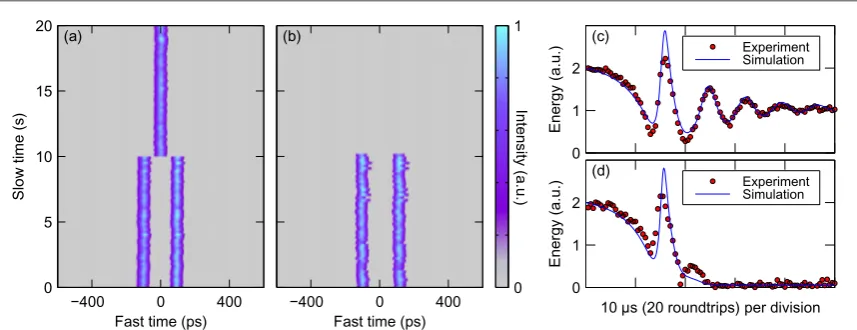
The temporal intensity profile of the intracavity light measured at the 1% output of the resonator is recorded every second by the oscilloscope(triggered by the pattern generators). Typical results are shown infigures4(a) and(b)as density plots representing vertical concatenations of successive recordings that have been obtained for [Δ,S0]=[2.91, 1.87]and[3.64, 2.10], respectively. Thefirst 10s of the measurements are very similar: two
LDSs with 200 ps separation are stably trapped at the maxima of the phase pulses defined by thefirst pattern generator. After switching to the single phase pulse pattern(which occurs att;10 s)and inducing the LDS interaction, a single LDS is seen to remain for[Δ,S0]=[2.91, 1.87]while both disappear when[Δ,S0]=[3.64,
2.10]. These results are strongly indicative of merging and annihilation, which is in agreement with numerical simulations. Indeed, the simulation results infigure1use the very same parameters as the experiments here. Yet, these results are limited by the slow 1 frame per second acquisition rate of the oscilloscope, which hinders direct interpretation.
To clearly establish the origin of the observed dynamics, we have recorded the roundtrip-by-roundtrip evolution of the intracavity energy on the real-time oscilloscope. Typical experimental results for merging and annihilation are shown as red circles infigures4(c)and(d), respectively. Here we have normalised the energy such that a single isolated LDS carries an energy of 1 in arbitrary units. The results unambiguously reveal the dissipative nature of the interactions: for[Δ,S0]=[2.91, 1.87]the energy falls from two to one, implying
[image:6.595.123.552.62.227.2]merging; for[D,S0]=[3.64, 2.10]the energy falls from two to zero, implying annihilation. Note that for the sake of clarity we only show short 50μs long segments of the overall evolutions during which the interaction dynamics take place. These segments were recorded approximately 5ms after the electronic switch controlling the phase modulation feed was activated. We note that this large delay further highlights that our results cannot be explained in terms of direct LDS erasure(and excitation)by the abrupt switch in phase profile. Indeed, such dynamics typically occur in less than 100μs, i.e. two orders of magnitude faster[51]. In fact, the 5ms delay agrees well with the time expected for the LDSs to drift sufficiently close to each other to interact, as confirmed by
full numerical simulations of our experiment with equation(2)and that predict a 6.1ms(5.8 ms)delay for merging(annihilation), respectively.(Small discrepancies can be attributed to experimental uncertainties.)As a
final confirmation, infigures4(c)and(d)we also plot, as blue solid lines, the energy evolutions extracted from the numerically simulated merging and annihilation events shown infigure1(post-processed to take into account the BPF at the resonator output). The outstanding agreement clearly confirms that merging and annihilation of LDSs occur in our experiment.
3. Conclusions
We have demonstrated, to the best of our knowledge, thefirst example of experimentally controlled interactions of LDSs. Our study also provides thefirst quantitative analysis of such interactions in an AC-driven nonlinear Schrödinger system, and more generally, in any nonlinear dissipative system near the 1:1 resonance. We have numerically identified a diversity of interaction scenarios for different parameters of the system driver. Experiments performed in an optical resonator show unequivocal evidence of possible selection of LDS interaction by the operator from merging to annihilation and paves the way to similar controlled experiments in other systems[52]. These soliton interactions are fundamentally different from their counterparts in
conservative integrable systems where localised structures typically tunnel through each other. Controllable outcome of the interaction process could potentiallyfind application in the coding of optical signals in optical information processing and communications.
Acknowledgments
We acknowledgefinancial support from the Marsden fund of the Royal Society of New Zealand. M Erkintalo also acknowledges support from the Finnish Cultural Foundation.
References
[1]Hodgkin A L and Huxley A F 1952J. Physiol.117500–44 [2]Pearson J E 1993Science261189–92
[3]Lee K J, McCormick W D, Ouyang Q and Swinney H L 1993Science261192–4 [4]Wu J, Keolian R and Rudnick I 1984Phys. Rev. Lett.521421–4
[5]Clerc M G, Coulibaly S, Mujica N, Navarro R and Sauma T 2009Phil. Trans. R. Soc.A3673213–26 [6]Umbanhowar P B, Melo F and Swinney H L 1996Nature382793–6
[7]Lioubashevski O, Arbell H and Fineberg J 1996Phys. Rev. Lett.763959–62 [8]Astrov Yu A and Logvin Yu A 1997Phys. Rev. Lett.792983–6
[9]Astrov Yu A and Purwins H-G 2001Phys. Lett.A283349–54 [10]Lejeune O, Tlidi M and Couteron P 2002Phys. Rev.E66010901
[11]Fernandez-Oto C, Tlidi M, Escaff D and Clerc M G 2014Phil. Trans. R. Soc.A37220140009 [12]Taranenko V B, Staliunas K and Weiss C O 1997Phys. Rev.A561582–91
[13]Schäpers B, Feldmann M, Ackemann T and Lange W 2000Phys. Rev. Lett.85748–51 [14]Barland Set al2002Nature419699–702
[15]Ackemann T, Firth W J and Oppo G-L 2009Adv. At. Mol. Opt. Phys.57323–421
[16]Leo F, Coen S, Kockaert P, Gorza S-P, Emplit Ph and Haelterman M 2010Nat. Photon.4471–6 [17]Jang J K, Erkintalo M, Murdoch S G and Coen S 2013Nat. Photon.7657–63
[18]Herr T, Brasch V, Jost J D, Wang C Y, Kondratiev N M, Gorodetsky M L and Kippenberg T J 2014Nat. Photon.8145–52 [19]Akhmediev N N and Ankiewicz A ed 2008Dissipative Solitons: From Optics to Biology and Medicine(Berlin: Springer)
[20]Purwins H-G, Bödeker H U and Amiranashvili Sh 2010Adv. Phys.59485–701 [21]Zakharov V E and Shabat A B 1973Sov. Phys. JETP37823–8
[22]Shih M-f, Segev M and Salamo G 1997Phys. Rev. Lett.782551–4 [23]Rotschild C, Alfassi B, Cohen O and Segev M 2006Nat. Phys.2769–74
[24]Tikhonenko V, Christou J and Luther-Davies B 1996Phys. Rev. Lett.762698–701 [25]Shih M-f and Segev M 1996Opt. Lett.211538–40
[26]Królikowski W and Holmstrom S A 1997Opt. Lett.22369–71
[27]Królikowski W, Luther-Davies B, Denz C and Tschudi T 1998Opt. Lett.2397–9 [28]Nguyen J H V, Dyke P, Luo D, Malomed B A and Hulet R G 2014Nat. Phys.10918–22 [29]Bödeker H U, Liehr A W, Frank T D, Friedrich R and Purwins H-G 2004New J. Phys.662 [30]Lugiato L A and Lefever R 1987Phys. Rev. Lett.582209–11
[31]Haelterman M, Trillo S and Wabnitz S 1992Opt. Commun.91401–7 [32]Wabnitz S 1993Opt. Lett.18601–3
[33]Barashenkov I V and Smirnov Yu S 1996Phys. Rev.E545707–25 [34]Barashenkov I V and Zemlyanaya E V 1999PhysicaD132363–72 [35]Kim H C, Stenzel R L and Wong A Y 1974Phys. Rev. Lett.33886–9 [36]Ustinov A V 1998PhysicaD123315–29
[37]Lugiato L A 2003IEEE J. Quantum Electron.39193–6
[38]Cai D, Bishop A R, Grønbech-Jensen N and Malomed B A 1994Phys. Rev.E491677–9
6
[39]Brambilla M, Lugiato L A and Stefani M 1996Europhys. Lett.34109–14 [40]Rozanov N N 1992Opt. Spectrosc.72243–6
[41]Rosanov N N, Fedorov A V, Fedorov S V and Khodova G V 1993 Diffractive transverse patterns in wide-aperture passive and active nonlinear optical systems and discrete-analogous method for nonlinear optical processing of information SPIE2039pp 330–41
[42]McIntyre C, Yao A M, Oppo G-L, Prati F and Tissoni G 2010Phys. Rev.A81013838 [43]Firth W J and Scroggie A J 1996Phys. Rev. Lett.761623–6
[44]Jang J K, Erkintalo M, Coen S and Murdoch S G 2015Nat. Commun.67370 [45]Coen S and Erkintalo M 2013Opt. Lett.381790–2
[46]Afanasjev V V, Malomed B A and Chu P L 1997Phys. Rev.E566020–5 [47]Barashenkov I V, Smirnov Yu S and Alexeeva N V 1998Phys. Rev.E572350–64 [48]Grelu P and Akhmediev N 2004Opt. Express123184–9
[49]Rosanov N N, Fedorov S V and Shatsev A N 2009Opt. Spectrosc.106869–74 [50]Grelu P and Akhmediev N 2012Nat. Photon.684–92
[51]Jang J K, Erkintalo M, Murdoch S G and Coen S 2015Opt. Lett.404755–8