every month at a reasonably rapid rate at www.threatenedtaxa.org. All articles published in JoTT are registered under Creative Commons Attribution 4.0 International License unless otherwise mentioned. JoTT allows allows unrestricted use, reproduction, and distribution of articles in any medium by providing adequate credit to the author(s) and the source of publication.
www.threatenedtaxa.org
ISSN 0974-7907 (Online) | ISSN 0974-7893 (Print) Building evidence for conservation globally
Journal of Threatened Taxa
For Focus, Scope, Aims, Policies, and Guidelines visit https://threatenedtaxa.org/index.php/JoTT/about/editorialPolicies#custom-0 For Article Submission Guidelines, visit https://threatenedtaxa.org/index.php/JoTT/about/submissions#onlineSubmissions For Policies against Scientific Misconduct, visit https://threatenedtaxa.org/index.php/JoTT/about/editorialPolicies#custom-2 For reprints, contact <[email protected]>
Communication
Foraging preferences of honey bees Apis cerana in
Dakshina Kannada, Karnataka, India
A.G. Suhas Krishna & Rajashekhar K. Patil
26 April 2019 | Vol. 11 | No. 6 | Pages: 13756–13764 DOI: 10.11609/jott.4265.11.6.13756-13764
Partner
Member
Publisher & Host
OPEN ACCESS
Communica
tion
DOI:https://doi.org/10.11609/jott.4265.11.6.13756-13764
Editor: P.A. Sinu, Central University of Kerala, Kasaragod, India. Date of publication: 26 April 2019 (online & print)
Manuscript details: #4265 | Received 17 May 2018 | Final received 11 January 2019 | Finally accepted 08 April 2019
Citation:Krishna, A.G.S & R.K. Patil (2019). Foraging preferences of honey bees Apis cerana in Dakshina Kannada, Karnataka, India. Journal of Threatened Taxa
11(6): 13756–13764. https://doi.org/10.11609/jott.4265.11.6.13756-13764
Copyright: © Krishna & Patil 2019. Creative Commons Attribution 4.0 International License. JoTT allows unrestricted use, reproduction, and distribution of this article in any medium by adequate credit to the author(s) and the source of publication.
Funding: None.
Competing interests:The authors declare no competing interests.
Author Details: A.G. Suhas Krishna is Assistant Professor, Department of Zoology, Vivekananda Degree College. He is interested in insects such as honey bees and other aspects of biodiversity. He is also a part time research scholar in Department of Applied Zoology, Mangalore University, Konaje. Dr. Rajashekhar K. Patil is retired Professor, Department of Applied Zoology, Mangalore University. He is interested in insect physiology, behaviour and neurobiology.
Author Contribution: AGSK has done all the experiments, AGSK & RKP have written the manuscript.
Acknowledgements: The authors are grateful to Mangalore University for providing the necessary facilities and requirements to carry out this research work.
Foraging preferences of honey bees Apis cerana in
Dakshina Kannada, Karnataka, India
A.G. Suhas Krishna 1 & Rajashekhar K. Patil 21,2 Department of Applied Zoology, Mangalore University, Mudipu - Manjanady Road, Mangalagangotri, Mangaluru,
Karnataka 574199, India.
1 [email protected] (corresponding author), 2 [email protected]
Abstract: Honey bees visit flowers for collecting nectar and pollen. Pollen serves as a source of protein for the survival of honeybees.
To understand the dependence and preference of the honey bee species Apis cerana on different pollen resources, we carried out a study to analyze the distribution of different types of pollen in honey in various regions of the coastal plains of the Western Ghats. Fourteen different honey samples from different sites ranging in elevation from 55m to 135m were collected and analyzed. Acetolysis and centrifugation were used for pollen extraction from different honey samples. The extracted pollen was mixed with glycerin jelly and transferred to a glass slide for microscopic analysis. The primary source of pollen as revealed by the current study were found to be Areca catechu, Cocos nucifera, Ixora coccinea, Mimosa pudica, and Psidium guajava. Morphotype analysis revealed 12 different plants to be the source of the pollen. Each honey sample collected from different locations, however, had only three to six types of pollen indicating that honeybees visit a narrow or a small number of pollen sources. Therefore, based on our study, we conclude that lesser types of pollen in each honey sample indicates that their food resources are getting limited. Therefore, it is necessary to conserve pollen resources for the better survival of honey bees and the environment.
Keywords:Areca catechu, Cocos nucifera, coastal plains, Ixora coccinea, melissopalynological analysis, Mimosa pudica, nectar, pollen,
Psidium guajava, Western Ghats. ISSN 0974-7907 (Online)
ISSN 0974-7893 (Print)
INTRODUCTION
Among all insects that pollinate, honeybees are considered to be one of the crucial pollinators (Ballantyne et al. 2017). Animal pollination directly affects about three-quarters of essential crop types, including most fruits, seeds, and nuts (Smith et al. 2015). Honeybees collect different types of pollen and they are added or mixed with honey intentionally or accidentally. Melissopalynological analysis, or studies on pollen, are helpful in determining the geographical and botanical origin of honey (Louveaux et al. 1978; von der Ohe et al. 2004). These studies also evaluate the plant source required for honey production and such knowledge about the pollen resource helps improve beekeeping practices. A few melissopalynological studies were carried out in India, and our study aims to present the foraging preferences of honeybees in the coastal plains of the Western Ghats.
Vegetation of Dakshina Kannada that lies along the Western Ghats expresses itself with thousands of species and several hundred genera of plants. It harbours several endemic and rare plants; this range of diversity is because of the physiological and geographical positioning of Dakshina Kannada along the coastline, exposed to elevations ranging from sea level to about 4,500ft. It consists of the Western Ghats in the east and the seashore in the west. The soil is mostly lateritic and the topography of the district is plain up to 30km inside the coast and changes to undulating hilly terrain sharply towards the east in the Western Ghats (Dakshina Kannada District Profile 2015). Trees such as Bamboo, Rosewood Dalbergia latifolia, and Teak
Tectona grandis are found in the hilly areas towards the
east. In rural Dakshina Kannada, houses are situated
between farmlands or plantations of Arecanut Areca catechu and Coconut Cocos nucifera (Anonymous 2015). The earliest research on the pollen present in honey was done by Pfister (1895) by carrying out an analysis of French, Swiss, and European honey. Deodikar et al. (1958) initiated palynological studies in Maharashtra in India. Later, others from different parts of India such as Andhra Pradesh (Ramanujam & Kalpana 1991; Lakshmi & Suryanarayana 2004; Ramakrishna & Swathi 2013; Devender & Ramakrishna 2015), Bihar (Suryanarayana et al. 1992), Himachal Pradesh (Sharma 1970; Sharma & Raj 1985), West Bengal (Bhattacharya et al. 1983; Chakraborti & Bhattacharya 2011; Kamble et al. 2015), Uttarakhand (Garg & Nair 1974), Karnataka (Chauhan & Murthy 2010; Shubharani et al. 2012; Raghunandan & Basavarajappa 2013), Orissa (Upadyay & Bera 2008,
2012, 2014), and Madhya Pradesh (Chauhan & Quamar 2010; Sahney & Seth 2013) conducted studies on these aspects.
MATERIALS AND METHODS
From February 2016 to April 2016, 14 honey samples were collected from 14 different locations of Dakshina Kannada District, which covers from 12.520N & 74.530E to 12.870N & 74.880E in the state of Karnataka, India,
and has an area of 4,559km2 (Dakshina Kannada District
Profile 2015; Fig. 1). Beekeepers of different areas of Dakshina Kannada were approached and samples were collected from them with the intention of understanding the pollen preferences of honey bees in the district. The geographical position of the honey samples collected was also noted down and all 14 honey samples from different sites ranging in elevation of 55–135 m were sampled (Table 2).
The samples were stored in containers. Honey samples were collected from several apiaries of domesticated Apis cerana indica colonies. All honey
samples were unprocessed and raw during the time of collection and they were extracted using honey extracting machines from honeycombs by beekeepers. The detailed information on the different honey samples collected is included in Table 1.
allocated to one of four frequency classes: i) predominant pollen type (>45%), ii) secondary pollen type (16–45%), iii) important minor pollen types (3–15 %), and iv) minor pollen types (<3%) (Louveaux et al. 1978; Song et al. 2012). Absolute pollen count in 1g of honey sample was also made. Pollen grains were observed using light microscopy; scanning electron microscopy was also used to observe predominant pollen types.
RESULTS
From the 14 honey samples, 12 pollen morphotypes were identified (Image 1). Eleven samples appeared to be unifloral with predominant pollen and three to be multi-floral. In the samples Irde (DK-Ir-01), Mithanadka (DK-Mi-05), and Mitoor (DK-Mt-14), Ixora coccinea was the predominant pollen with pollen ranging from 46% to 60%. In the samples Bettampady (DK-Be-03) and Kadaba (DK-Ka-09), Cocos nucifera was the predominant pollen ranging from 50% to 60%. In samples Mudipu (DK-Mu-06), Belvai (DK-Bl-08), Kundadka (DK-Ku-11), it was
found that Psidium guajava pollen was predominant, ranging from 60% to 68%. In sample Deppuni (DK-Dp-10), Areca catechu was predominant with 48% pollen and in samples Derlakatte (DK-De-07) and Uppinangady (DK-Up-13), Mimosa pudica was predominant, ranging from 50% to 68% (Table 1). Some of the pollen such
as M. pudica, P. guajava, A. catechu, C. nucifera,and
I. coccinea were predominant (Image 2) and can be considered as important source of forage for honey bees
in Dakshina Kannada.
Pollen of some species such as Areca catechu in
samples DK-Ka-09 and DK-Be-03, Cocos nucifera in
samples Ir-01, Pa-04, Mi-05, Mu-06, DK-Bl-08, DK-Dp-10, DK-Pu-12, DK-Up-13, and DK-Mt-14,
Ixora coccinae in sample Dk-Pa-04, Mimosa pudica
in samples DK-Ke-02 and DK-Ku-11, Moringa olifera
in samples DK-Ir-01 and DK-Pa-04, Psidium guajava
in samples DK-Pu-12 and DK-Ke-02, and Syzigium in
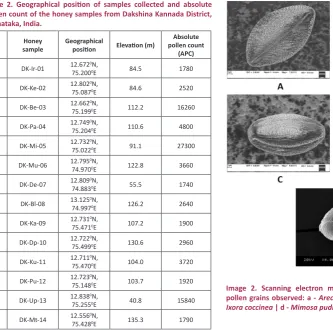
sample DK-De-07 were found to be secondary pollen, whereas some others appeared to be minor pollen in specific samples, the details of which are given in Table 1. Geographical position of the honey samples collected from different sites is given in Table 2. Absolute pollen count was measured per gram of honey samples; minimum number of absolute pollen count was found in sample DK-De-07 with 1,740 pollen grains and maximum in sample DK-Mi-05 with 27,300 pollen grains. Percentage of pollen belonging to different plant species present in each of the honey samples were calculated.
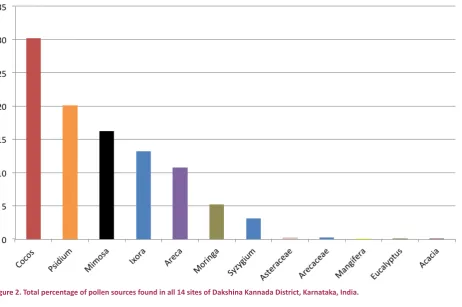
Cocos nucifera found in all honey samples was 30.142%, which was the maximum. The minimum percentage of pollen source was found to be Acacia sp., Mangifera indica, and Eucalyptus sp. (Table 3; Fig. 2). Twelve plant species identified as pollen sources belonged to
Table 1. Frequency class of pollen and data of pollen analysis performed with the honey samples collected from different locations in Dakshina Kannada District, Karnataka, India.
Honey sample
Type of pollen Predominant pollen
(>45%) Secondary pollen(16–45 %) Important minor pollen(3–15 %) Minor pollen(<3%)
1. DK-Ir-01 Ixora coccinea (46%) Cocos nuciferaMoringa olifera (30%), (20%) Areca catechu (3%) Mimosa pudica
2. DK-Ke-02 Nil Mimosa pudica Psidium guajava(42%), (41%) Cocos nucifera(15%) Asteraceae
3. DK-Be-03 Cocos nucifera (50%) Areca catechu(45%) Psidiumguajava(5%) Nil
4. DK-Pa-04 Nil Moringa oliferaIxora coccinea (31%), (40%), Cocos
nucifera (21%) Mimosa pudica (7%) Mangifera indica 5. DK-Mi-05 Ixora coccinea (60%) Cocos nucifera (30%) Mimosa pudica(10%) Nil
6. DK-Mu-06 Psidiumguajava (60%) Cocos nucifera (26%) Areca catechu(12%) Acacia sp., Eucalyptus sp.
7. DK-De-07 Mimosa pudica (50%) Syzygium sp. (35%) Cocos nucifera(15%) Nil
8. DK-Bl-08 Psidium guajava (68%) Cocos nucifera (32%) Nil Nil
9. DK-Ka-09 Cocos nucifera (60%) Areca catechu(30%) Mimosa pudica (9%) Asteraceae
10. DK-Dp-10 Areca catechu (48%) Cocos nucifera (35%) Mimosa pudica (15%) Psidium guajava
11. DK-Ku-11 Psidium guajava (60%) Mimosa pudica (23%) Cocos nuciferaSyzygium sp. (6%) (7%), Areca catechuolifera , Moringa
12. DK-Pu-12 Nil Psidium guajava Cocos nucifera (35%)(41%), Areca catechuMimosa pudica (10%), (10%) Arecaceae,Syzygium sp.
13. DK-Up-13 Mimosa pudica (68%) Cocos nucifera (26%) Psidium guajava (4%) Arecaceae,Moringa olifera 14. DK-Mt-14 Ixora coccinea (48%) Cocos nucifera (40%) Moringa olifera (10%) Mimosa pudica
Irde Ir-01), Kelinja Ke-02), Bettampady Be-03), Parladka Pa-04), Mithanadka Mi-05), Mudipu Mu-06), Derlakatte De-07), Belvai (DK-Bl-08), Kadaba (DK-Ka-09), Deppuni (DK-Dp-10), Kundadka (DK-Ku-11), Punacha (DK-Pu-12), Uppinangady (DK-Up-13), Mitoor (DK-Mt-14).
seven families. Three species belonged to Arecaceae, three to Myrtaceae, and two to Fabaceae;Rubiaceae,
Anacardiaceae, Asteraceae, and Moringaceae had one
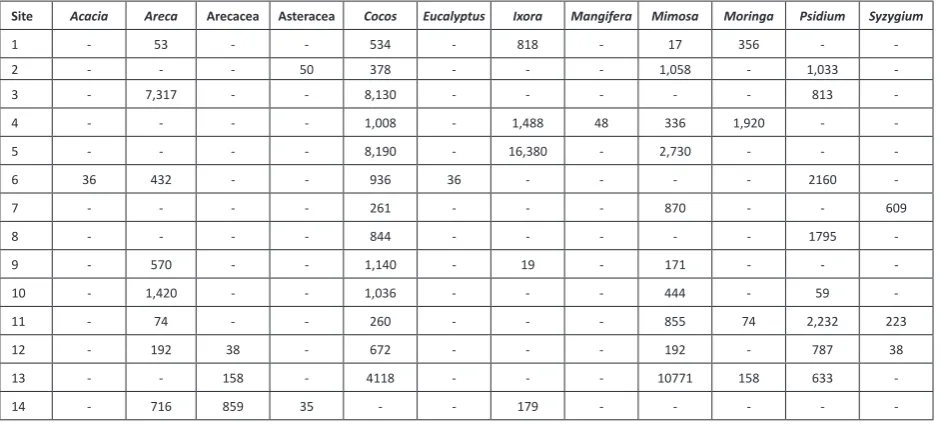
species each (Table 4). Pollen count of each of the pollen sources found in all the samples was also made (Table 5). Cocos nucifera was found in honey samples collected from all 14 sites and therefore can be considered as one of the most important pollen sources in Dakshina
Kannada.
DISCUSSION
The protein that pollen provides is essential for brood production and development of young honey bees. Pollen is also the primary source of protein to honey bees. Stored pollen grains along with glandular secretions containing enzymes and acids is called
bee bread. Larval honey bees feed on bee bread and brood food mixture. Enzymes and acids are added to the pollen by the bees so that it can be preserved for long term (Ellis et al. 2010). In order to complete the development of the body, newly emerged bees also feed on bee bread. The requirement of bee bread by a single worker bee larva is estimated to be about 124–145 mg; this consists of about 30mg of protein. A diet of high protein pollen increases the longevity of worker bees and also improves brood rearing; brood rearing gets reduced when supported by pollen grains low in protein. It is observed that honey bees choose pollen based on the physical configuration and odour of the pollen rather than based on their nutritive value. On average, 15–30 % of the colony’s forager bees collect pollen, and a single bee can carry and bring back pollen load that weighs about 35% of the bee’s body weight. Bees carry pollen on their hind legs, on specialized structures commonly
Table 2. Geographical position of samples collected and absolute pollen count of the honey samples from Dakshina Kannada District, Karnataka, India.
Honey
sample Geographical position Elevation (m)
Absolute pollen count
(APC)
1. DK-Ir-01 12.67275.20000N, E 84.5 1780
2. DK-Ke-02 12.80275.08700N, E 84.6 2520
3. DK-Be-03 12.66275.19900N, E 112.2 16260
4. DK-Pa-04 12.74975.20400N, E 110.6 4800
5. DK-Mi-05 12.73275.02200N, E 91.1 27300
6. DK-Mu-06 12.79574.97000N, E 122.8 3660
7. DK-De-07 12.80974.88300N, E 55.5 1740
8. DK-Bl-08 13.12574.99700N, E 126.2 2640
9. DK-Ka-09 12.73175.47100N, E 107.2 1900
10. DK-Dp-10 12.72275.49900N, E 130.6 2960
11. DK-Ku-11 12.71175.47000N, E 104.0 3720
12. DK-Pu-12 12.72375.14800N, E 103.7 1920
13. DK-Up-13 12.83875.25500N, E 40.8 15840
14. DK-Mt-14 12.55675.42800N, E 135.3 1790
Image 2. Scanning electron microscope images of predominant pollen grains observed: a - Areca catechu | b - Cocos nucifera | c - Ixora coccinea | d - Mimosa pudica | e - Psidium guajava.
called pollen baskets, also known as corbicula (Ellis et al. 2010).
It is assumed that pollen found in honey sediment falls into the nectar while in the flower, which is then transported in the bee’s honey stomach to the hive. This pollen will be present during the ripening process, and also appear finally in ripe honey (Maurizio 1951).
Our study reveals the variation in the amount and type of pollen present in the samples. Several uncontrollable factors influence the presence of pollen types in honey samples; some of them are the availability of pollen, unbalance in the abundance of flowers among plant species, and the honey bee’s collection preferences. In fact, there is a necessity of more studies addressing these questions more specifically with controlled experiments (Oliveira et al. 2010). The presence of pollen types in honey samples indicates the botanical origin of the honey to that region. Battesti & Goevry (1992) verified that climatic conditions influence the metalliferous and polleniferous potential of the local flora. Pollen richness in the honey sample depends on the pollen production by the parent plant, climatic conditions, the distance from the beehive to the flower field, filtering of pollen by the bees’ proventriculus, the diameter of
Table 3. Plant species and the percentage of pollen found in honey samples obtained from different sites in Dakshina Kannada District, Karnataka, India.
Plant species Site 1 Site 2 Site 3 Site 4 Site 5 Site 6 Site 7 Site 8 Site 9 Site 10 Site 11 Site 12 Site 13 Site 14 Total %
1. Acacia sp. - - - 1% - - - 0.071 2. Areca catechu 3% - 45% - - 12% - - 30% 48% 2% 10% - - 10.714
3. Arecaceae - - - 2% 1% - 0.214
4. Asteraceae - 2% - - - 1% - - - 0.214
5. Cocos nucifera 30% 15% 50% 21% 30% 26% 15% 32% 60% 35% 7% 35% 26% 40% 30.142 6. Eucalyptus sp. - - - 1% - - - 0.071 7. Ixora coccinea 46% - - 31% 60% - - - 48% 13.214 8. Mangifera indica - - - 1% - - - 0.071 9. Mimosa pudica 1% 42% - 7% - - 50% - 9% 15% 23% 10% 68% 2% 16.214 10. Moringa olifera 20% - - 40% - - - 2% - 1% 10% 5.214 11. Psidium guajava - 41% 5% - - 60% - 68% - 2% 60% 41% 4% - 20.071 12. Syzygium sp. - - - 35% - - - 6% 2% - - 3.071
Table 4. Plant species as pollen sources, their families, habit, and number of sites in which they are found in Dakshina Kannada District, Karnataka, India.
Plant species Family Habit Number of sites
1 Acacia Fabaceae Tree 1 2 Areca catechu Arecaceae Tree 7
3 Arecaceae Arecaceae Tree 2
4 Asteraceae Asteraceae Creeper 2
5 Cocos nucifera Arecaceae Tree 14 6 Eucalyptus sp. Myrtaceae Tree 1 7 Ixora coccinea Rubiaceae Shrub 4 8 Mangifera indica Anacardiaceae Tree 1 9 Mimosa pudica Fabaceae Herb 11 10 Moringa olifera Moringaceae Tree 5 11 Psidium guajava Myrtaceae Tree 8 12 Syzygium sp. Myrtaceae Tree 3
Wilson 1929; Todd & Vansell 1942). For example, if the bees feed on syrup containing pollen, the pollen content of the honey stomach is reduced to one-half or one-third in the first 15–30 min after feeding. Therefore, it must be reckoned that the amount of pollen in the honey is dependent on the time taken by the bee to return from the source of forage to the hive. So a question arises whether a selection process of pollen grains according to their size takes place during the transfer of pollen through the proventriculus, which would alter the relative proportions of different pollen grains (Whitcomb & Wilson 1929; Todd & Vansell 1942). An experiment
conducted by Maurizio (1949), however, verified that neither the size of the pollen nor the concentration of the syrup nor the original pollen content of the syrup significantly affected the rate of pollen disappearing from the honey stomach. Therefore, the amount of pollen is indeed reduced but no selection process is known that would alter the proportions of different types of pollen present in the syrup.
Table 5. Pollen sources and their pollen count in different sites in Dakshina Kannada District, Karnataka, India.
Site Acacia Areca Arecacea Asteracea Cocos Eucalyptus Ixora Mangifera Mimosa Moringa Psidium Syzygium
1 - 53 - - 534 - 818 - 17 356 -
-2 - - - 50 378 - - - 1,058 - 1,033
-3 - 7,317 - - 8,130 - - - 813
-4 - - - - 1,008 - 1,488 48 336 1,920 -
-5 - - - - 8,190 - 16,380 - 2,730 - -
-6 36 432 - - 936 36 - - - - 2160
-7 - - - - 261 - - - 870 - - 609
8 - - - - 844 - - - 1795
-9 - 570 - - 1,140 - 19 - 171 - -
-10 - 1,420 - - 1,036 - - - 444 - 59
-11 - 74 - - 260 - - - 855 74 2,232 223
12 - 192 38 - 672 - - - 192 - 787 38
13 - - 158 - 4118 - - - 10771 158 633
-14 - 716 859 35 - - 179 - - - -
-will lead to the downfall of agriculture and economy of the area. Artificial pollination is unimaginable and is practically very difficult. Therefore, honey plants which are essential pollen sources must be protected and conserved well.
REFERENCES
Anonymous (2015). Agriculture Contingency Plan for District: Dakshina Kannada, Agricorp, 28. <http://www.crida.in/CP-2012/ statewiseplans/Karnataka%20(Pdf)/GKVK,%20Bangalore/KAR13-DAKSHINA%20KANNADA%2031.03.2011.pdf>
Anklam, E. (1998). A review of analytical methods to determine the geographical and botanical origin of honey. Food Chemistry 63: 549–562.
Ballantyne, G., K.C.R. Baldock, L. Rendell & P.G Willmer (2017). Pollinator importance networks illustrate and clinical values of bees in a highly speciose plant community. Scientific Reports 7: 8389. https://doi.org/10.1038/s41598-017-08798-x
Battesti, M.J. & C. Goeury (1992). Efficacite de Ghalysemelito palynologique quantitative pour la certification des origins geographiqueetbotaniquedesmiescorses. Review of Palaeobotany
and Palynology 75: 77–102.
Bhattacharya, K., S. Chanda, S. Gupta & P. Ganguly (1983). Analysis
of pollen load from a honey sample from Salt Lake City. Calcutta
Science and Culture 49: 222–224.
Chakraborti, T. & K. Bhattacharya (2011). Floristic composition and physic-chemical parameters of honey samples from West Bengal.
Indian Journal of Aerobiology 24(2): 59–64.
Chaturvedi, M. (1983). Pollen analysis of autumn honeys of Kumaon
region. Proceedings of Indian National Science Academy 49:125-133.
Chauhan, M.S. & S. Murthy (2010). Melittopalynologial investigation of honeys from Chamarajanagar District, southern Karnataka, India.
Geophytology 39(1–2): 41–47.
Chauhan, M.S. & M.F. Quamar (2010). Melissopalynological studies of honeys from Harda District, Madhya Pradesh. Phytomorphology
69(3&4): 122–127.
Dakshina Kannada District Profile (2015). Government of Karnataka. Deodikar, G.B., N. Shah, C.V. Thakar & S.R. Salvi (1958). Morphological
characterization of pollen grains of some major bee plants of Mahabaleshwar hills. Proc. 17th International Bee Keeping Congress,
Bologna and Rome 2: 214–217.
Devender, R. & H. Ramakrishna (2015). Palynodiversity in Trigona honey from Pederu Forest Division of Vishakpatnam District Andhra
Pradesh, India. Geophytology 45(2): 221–226.
Ellis, A., J.D. Ellis, M.K. O’Malley & C.M. ZettelNalen (2010). The Benefits of Pollen to Honey Bees. ENY152,UF/IFAS Extension.
Erdtman, G. (1952). Pollen Morphology and Plant Taxonomy.
Angiosperms. Almquist & Wicksell, Stockholm, USA, 539pp. Garg, A. & P.K.K. Nair (1974). Honey pollen load as bioindicator of bee
pasturage in Bhimtal area of western Himalaya. Indian Journal of Palynology 29: 87–109.
Kamble, K.D., R.S. Pandit & K.L. Rao (2015). Melittopalynological investigation of honey from Sunderbal region, West Bengal, India.
Proceedings of National Academy of Sciences, Section B, Biological
Science 85(1): 101–106.
Lakshmi, K. & M.C. Suryanarayana (2004). Melittopalynological investigation of Apis dorsata honeys from forest areas of Cuddaph
District, Andhra Pradesh. Journal of Palynology 40: 189–198.
Louveaux, J., A. Maurizio & G. Vorwhol (1978). Method of
melissopalynology. Bee World 59: 139–157.
Maurizio, A. (1949). Wird das Pollenbild des Honigs durch die Vorrgange in der Honigblase beeinflusst? Beih Schweiz Bienenztg
2(18): 422.
Maurizio, A. (1951). Pollen analysis of honey. The Bee World 32(1):
1–5.
Maurizio, A. (1975). Microscopy of honey, pp240–257. In: Crane, E. (ed.). Honey: A Comprehensive Survey. Heinemann and International Bee Research Association, London, 608pp.
Oliveira, P.P., C. van den Berg & F.A.R. Santos (2010). Pollen analysis of
honeys from Caatinga vegetation of the state of Bahia, Brazil. Grana 33: 292–294.
Pfister, R. (1895). Versucheinermikroskopie des Honigs,
Forschungsbereichlebensmittal, BezzHygineforense
Chemphama-kogn 2(25): 20.
Ponnuchemy, R., V. Bonhomme, S. Prasad, L. Das, P. Patel, C. Gauchrel, A. Pragasam & K. Anupama (2014). Honey pollen: using melissopalynology to understand foraging preferences of bees in tropical south India. PLoS ONE 9(7): e101618.
Raghunandan, R.S. & S. Basavarajappa (2013). Analysis of multifloral honey of the giant honey bee, Apis dorsata F., for pesticide residues
in southern Karnataka, India. European Journal of Zoological
Research 2(3): 22–28.
Ramakrishna, H. & S. Swathi (2013). Pollen diversity in some Apis
florae honeys from Adilabad District, Andhra Pradesh, India.
Geophytology 42(1): 11–20.
Ramanujam, C.G.K. & T.P. Kalpana (1991). Pollen analysis of Prosopis
juliflora honeys from Ranga Reddy District, A.P., and its relevance to
apiculture and social forestry. Journal of Palynology 27: 345–368.
Sahney, M. & K.H. Seth (2013). Melissopalynological analysis of winter honeys of Rewa District, M.P., India. Indian Journal of Aerobiology
6(1&2): 1–10.
Shubharani, R., V. Sivaram & P. Roopa (2012). Assessment of honey plant resources through pollen analysis in Coorg honeys of
Karnataka State. International Journal of Plant Reproductive Biology
4(1): 31–39.
Smith, M.R., G.M. Singh, D. Mozaffarian & S.S. Myers (2015). Effects of decreases of animal pollinators on human nutrition and global health: a modeling analysis. The Lancet 386(10007): 1964–1972.
https://doi.org/10.1016/S0140-6736(15)61085-6
Suryanarayana, M.C., G.M. Rao & T.S.M.S. Singh (1992). Studies on
pollen sources for Apis cerana Fabr. and Apis mellifera L. bees at Muzzaffarpur, Bihar, India. Apidologie 23: 33–46.
Song, X.-Y., Y.-F. Yao & W.-D. Yang (2012). Pollen analysis of natural
honeys from the central region Shanxi, north China. PLoS ONE 7(11):
e49545.
Todd, F.E. & G.H. Vansell (1942). Pollen grains in nectar and honey.
Journal of Economic Entomology 35: 728–731.
von der Ohe, W. (1994). Unifloral honeys: chemical conversion and pollen reduction. Grana 33: 292–294.
von der Ohe, W., O.L. Persano, M.L. Piana, M. Morlot & P. Martin
(2004). Harmonized methods of melissopalinology. Apidologie 35:
18–25.
Whitcomb, W. & H.F. Wilson (1929). Mechanics of digestion of pollen by the adult honey bee and the relation of undigested parts to dysentery of bees. Research Bulletin Agriculture Experiment. State
University of Wisconsin Madison 92: 1–27.
ISSN 0974-7907 (Online) | ISSN 0974-7893 (Print)
April 2019 | Vol. 11 | No. 6 | Pages: 13631–13814 Date of Publication: 26 April 2019 (Online & Print)
DOI: 10.11609/jott.2019.11.6.13631-13814 www.threatenedtaxa.org
publishing peer-reviewed articles online every month at a reasonably rapid rate at www.threatenedtaxa.org. All articles published in JoTT are registered under Creative Commons Attribution 4.0 International License
unless otherwise mentioned. JoTT allows allows unrestricted use, reproduction, and distribution of articles in any medium by providing adequate credit to the author(s) and the source of publication.
Editorial
Building evidence for 20 years! – Sanjay Molur, P. 13631
Articles
Effect of socio-ecological factors and parasite infection on body condition of
Brown Mouse Lemur Microcebus rufus (Mammalia: Primates: Cheirogaleidae)
– Andry Herman Rafalinirina, Jeannot Randrianasy, Patricia C. Wright & Jonah Ratsimbazafy, Pp. 13632–13643
Identification of suitable habitat for Swamp Deer Rucervus duvaucelii duvaucelii (Mammalia: Artiodactyla: Cervidae) in Chitwan National Park, Nepal
– Shravan Kumar Ghimire, Man Kumar Dhamala, Babu Ram Lamichhane, Rishi Ranabhat, Khim Bahadur KC & Shashank Poudel, Pp. 13644–13653
Communications
The diversity and conservation of mammals in the Dodo Coastal Forest in southwestern Côte d’Ivoire, western Africa: a preliminary study
– Serge Pacome Keagnon Soiret, Célestin Yao Kouakou, Béné Jean-Claude Koffi, Blaise Kadjo, Philippe Kouassi, Peñate José Gomez, Reiko Matsuda Goodwin & Inza Kone, Pp. 13654–13666
Resource selection by Javan Slow Loris Nycticebus javanicus E. Geoffroy, 1812 (Mammalia: Primates: Lorisidae) in a lowland fragmented forest in
Central Java, Indonesia
– Mahfut Sodik, Satyawan Pudyatmoko, Pujo Semedi Hargo Yuwono & Muhammad Ali Imron, Pp. 13667–13679
Species composition and abundance of rodents in Kafta-Sheraro National Park, Ethiopia: preliminary results
– Alembrhan Assefa & Chelmala Srinivasulu, Pp. 13680–13689
Colour aberration in Indian mammals: a review from 1886 to 2017 – Anil Mahabal, Radheshyam Murlidhar Sharma, Rajgopal Narsinha Patil & Shrikant Jadhav, Pp. 13690–13719
Nesting trees of the Red Giant Gliding Squirrel Petaurista petaurista (Mammalia: Rodentia: Sciuridae) in a tropical forest of Namdapha National Park, India
– Murali Chatakonda Krishna, Awadhesh Kumar & Om Prakash Tripathi, Pp. 13720–13726
Insights into the diet and feeding behaviour of Red-capped Lark Calandrella cinerea (Aves: Passeriformes: Alaudidae)
– Mary Mwangi, Nathan Gichuki, Robert Chira & Peter Njoroge, Pp. 13727– 13733
Baseline biodiversity and physiochemical survey in Parvati Kunda and surrounding area in Rasuwa, Nepal
– Jessie Anna Moravek, Mohan Bikram Shrestha & Sanjeevani Yonzon, Pp. 13734–13747
Diversity and community structure of Odonata (Insecta) in two land use types in Purba Medinipur District, West Bengal, India
– Priti Ranjan Pahari, Shubha Sankar Mandal, Subhadeep Maiti & Tanmay Bhattacharya, Pp. 13748–13755
Foraging preferences of honey bees Apis cerana in Dakshina Kannada, Karnataka, India
– A.G. Suhas Krishna & Rajashekhar K. Patil, Pp. 13756–13764
Additions to the lichen biota of Assam State, India
– Rupjyoti Gogoi, Siljo Joseph, Sanjeeva Nayaka & Farishta Yasmin, Pp.13765–13781
Short Communications
Study of nesting behaviour of Asian Paradise Flycatcher Terpsiphone paradisi (Aves: Passeriformes: Monorchidae)from southern West Bengal, India
– Nilemesh Das & Shuvadip Adhikari, Pp. 13782–13785
A checklist of fish species from three rivers in northwestern Bangladesh based on a seven-year survey
– Imran Parvez, Mohammad Ashraful Alam, Mohammad Mahbubul Hassan, Yeasmin Ara, Imran Hoshan & Abu Syed Mohammad Kibria, Pp. 13786–13794
New plant distribution records to Indian states and addition to the flora of Myanmar
– Kanakasabhapathi Pradheep, Ganjalagatta Dasaiah Harish, Ranbir Singh Rathi, Joseph John Kattukkunnel, Sheikh Mohmmad Sultan, Khoisnam Naveen, Iyyappan Jaisankar, Anjula Pandey, Sudhir Pal Ahlawat & Rita Gupta, Pp. 13795–13804
Notes
Sighting of Arunachal Macaque Macaca munzala Sinha et al., 2005 (Mammalia: Primates: Cercopithecidae) in Sakteng Wildlife Sanctuary, Bhutan
– Sonam Tobgay, Kumbu Dorji & Norbu Yangdon, Pp. 13805–13807
Rediscovery of an endemic Indian moth Gurna indica (Moore, 1879) (Lepidoptera: Erebidae: Arctiinae) after 125 years
– Aparna Sureshchandra Kalawate, Neha Upadhyay & Banani Mukhopadhyay, Pp.13808–13810
The Nepal Pipewort Eriocaulon nepalense var. luzulifolium (Commelinids: Poales: Eriocaulaceae): a new distribution record for southern India – Murugan Soumya & Maya C. Nair, Pp. 13811–13814