
Abstract: Beginning with the punched card system, through the condition of the PC with the mouse and keyboard, too the touch screen interface, shows the rapid innovation in the IT sector within almost 100 years. These innovations triggered many changes, not only through simplification in data processing but also in people's minds. Their desires and conceptions like the technology of today must look like, had changed and these accordingly must also the information nowadays accordingly be offered. It deals with the change of the world through information technology and its consequences, among other things how information technology came into being, what technological changes it brought as well as the changes that the networking of information technology brought. The focus here is on historical events and the resulting emergence of the Internet. The Internet has enabled the emergence of new markets and complete changes in business processes, from product development to the acceleration of business processes, their outsourcing to the emergence of new markets. The German market is discussed here. Keywords : Market distribution, mobile internet, outsourcing, reasons for using IT, smartphone.
I. INTRODUCTION
T
he vacuum tube was replaced by the transistor invented in 1948. The new transistor was smaller, consumed less current and produced less heat [1]. Over time, the transistors became smaller and smaller and are still widely used in many electronic circuits.The new era of microcomputers, also called single-user desktop computers, began in 1971 when chip manufacturer Intel was able to integrate a much smaller processor on a single chip [2]. Today, chip manufacturers of modern chips are still working on the miniaturization of the chip itself and its components. For example, Intel launches a new processor on the market every two to three years.
These two ground-breaking inventions made now only a race with the time. Not only have the chips become much smaller, more and more transistors have also been integrated into the chip itself, thus increasing the performance of a processor. For comparison, the first microprocessor, Intel 4004, had only 2,300 transistors and in one of the last processors of the type Intel Core i7, 731 million transistors are already integrated in the chip [3].
Gordon Moore, co-founder of Intel, is said to have already said in 1965 that the integration density (number of transistors per unit area) on integrated circuits will double every 12 to 24 months [4]. This "Moore's law" was later also interpreted as follows. The performance of microprocessors or computers
Revised Manuscript Received on October 05, 2019.
Georg Rockel, Economics and Management, Mendel University Brno, Czech Republic.
will double every 18 months, or the price of computer-aided information processing will halve every 18 months [5].
In the 60s of the 20th century, a complex computer system was used in large companies, which today is regarded as the origin of the application of a computer in a company. That was the birth of the mainframe computer. A central mainframe computer is a computer which is located at a central point of an institution, a company, a plant or a complex plant and solves all tasks arising in a certain area [6]. This mainframe computer is completely isolated from the outside world and internally consists of a series of parallel applications which, apart from a few batch-operated data interfaces, have no direct contact whatsoever with each other [7].
These mainframes are still used today, mainly because of their high reliability and also for cost reasons because it is the ideal platform for virtualizations [8].
IBM recognized the market potential and introduced the new Personal Computer (PC) in 1981, with the operating system MS-DOS from Microsoft for individual data processing and Intel processor [9]. Thus the basic hardware of a computer, which in turn could be extended by other hardware components, was created for private use and the PC industry found itself on the advance. The operating system MS-DOS was oriented to the input of certain commands in the corresponding lines and thus more suitable for specialists who were familiar with this programming. All that was missing was the right software that every user could use without any problems. Microsoft developed an operating system with a graphical user interface and successfully introduced Windows 3.0 in 1990 and Windows 95 five years later [10]. With this introduction, Microsoft has managed to become the dominant IT platform to this day, as the software met the needs of customers and thanks to the graphical user interface, users were able to adapt it to their needs.
II. EMERGENCEOFARCHITECTURES
Client–server model
The proliferation of PCs since the early 1990s of the 20th century had triggered a new trend in network building and connectivity that continues today.
A client-server architecture was developed which, in comparison to mainframes, does not distribute the data or its processing to individual databases, i.e. computers.
Communication takes place between the server and the client by the server (service provider) providing the services and the client (service user) retrieving these services. There is no communication between the individual clients.
The Change of the World through IT and its
Consequences
The server has access to a database, processes the request and sends the client a response to the posed request. The server also provides security and manages the network.
The basic model thus represents a one-to-one connection, which has a two-stage structure and is not static. This allows applications to be assembled as building blocks, even though they are installed on several distributed computers [11]. With this invention, a logical network was created in which the participants, e.g. an operating system or an application, can share.
The manufacturers of special programs have also adopted this model as their own. For example, the SAP systems are based on a three-level client-server architecture principle, there is a presentation level, an application level, and a database level. These three levels communicate with each other via the network infrastructure, and for this reason, this basic system is also called the R/3-System [12].
Internet
In the 60s of the 20th century, the US Department of Defense awarded a contract for the development of a secure communication system, the solution being packet switching [13]. A message was first broken down into individual packets, sent via different lines and then reassembled into a message by the recipient.
In order not to exchange the packets, a TCP/IP protocol (Transmission Control Protocol / Internet Protocol) was developed in 1973 and introduced as a standard in the US military in 1983. The IP splits the message into individual packets, provides them with addresses and transmits them to the recipient and TCP monitors the data transport and corrects the errors that have occurred [14].
In addition to the military network, other computer networks, so-called LANs (Local Area Network), also emerged, which from 1994 onwards could also be used for commercial purposes [15].
To be able to connect the information pages by so-called "hyperlinks", which means to enable for the user to be forwarded from one document to another, a service, the World Wide Web (WWW), has been developed. A browser, for example Internet Explorer, retrieves the document, written in Hypertext markup language (HTML), from a web server, transmits it using HyperText Transfer Protocol (HTTP), and displays it on the screen. Here, too, the further development of the client-server architecture is visible.
A new era of communication had dawned when computers could be connected to the telephone network and from home with computers around the world, the Interconnected network (Internet) was on the rise. And the WWW standard created a global, virtual network of billions of websites.
III. MOBILECOMPUTING
Definition
it was important for a company to be "flexible", but times are changing and now there is another parameter, today's companies need to be "mobile". What is not done and invented to take on a pioneering role in a competition, even if only for a short time? Because one thing is certain, the competition will follow.
In recent years, the relatively new field of application
"Mobile Computing" has acquired a significance that should not be underestimated. The flexibility and performance of the technical possibilities have contributed to this.
Thomas Fuchß defines the term "mobile computing" as a discipline whose task is to provide concepts, architectures, languages, and solutions, to realize all these [16]. He continues: “The goal of mobile computing is to provide users and their applications with effective computer-aided concepts, procedures, and solutions that enable them to read and process (private) data and information in a heterogeneous environment with always insecure connections, regardless of time and place“ [16].
And this is the new trend to be "independent of place and time" in other words to be "mobile" this is what today's companies want to be. Independence from time was made possible by the invention and spread of the Internet. And the independence from the location was until now possible to a limited extent, for around in order to be able to access personal or company-internal data, one would have to be connected to a local computer, where the data is stored, via the Internet. The providers have discovered this gap and offer "Cloud Computing" as a solution. It is a virtualization of computing and storage resources (in the "cloud"), which means the data is located in a virtual place and can be accessed in real-time via Internet-enabled end devices, no matter where you are [17]-[18]. One becomes less dependent on a single PC, but more and more on an Internet connection.
Mobile device
Mobile devices are primarily notebooks and their further development into tablet PCs or mobile phones and their further development into smartphones that have access to the Internet via wireless data transmission, Wireless Local Area Network (WLAN) or Bluetooth.
Notebooks, Tablet PCs and Smartphones
The development cycles of new hardware are getting shorter and shorter. The first the first commercial portable computer was launched by Adam Osborne [19]. First, the screens were black and white, then available in grayscale and finally there was the first color LCD.
Fig. 1.Own Illustration: Sales of desktop PCs, notebooks and Tablet PC (in Germany, in millions of units) [21]
[22] [23]
In 2012, for the first time in Germany, around 2 Mio. units more Tablets were sold than desktop PCs. In 2013, 1.3 million desktop PCs and 5.5 million Tablets were sold. A total of 13.6 million PCs & Tablet PCs were sold in 2014, with desktop PCs accounting for 12%, notebooks for 40% and Tablets for 48% of total sales. From 2015 to 2018, sales fell to a similar level from 8.6 million units in 2010 to 8.9 million units in 2018, representing an increase of 3.5 %.
[image:3.595.45.294.455.551.2]Compared to notebooks, Tablet PCs do not have a keyboard, they are controlled via a touch-sensitive screen - touchscreen. According to “Fig. 1”, The following graph shows the distribution of market shares.
Fig. 2.PC market distribution for Germany
Nevertheless, there was a market shift. The market share of desktop PCs decreased from 18% in 2010 to 10% in 2018, the share of Notebooks decreased from 77% in 2010 to 45% in 2018 and the share of Tablet PCs increased to from 5% in 2010 to 45% in 2018.
Mobile phones, PDAs and Smartphones
People live together in groups and maintain their social contacts through communication. From smoke signals to telegraphs and original telephones to mobile phones, the development stages of mass communication are designed to overcome distance.
First a small categorization of the terminal equipment:
Mobile phones are primarily a device that enables voice communication via a radio network.
Personal Digital Assistant (PDA) are small computers that fulfil the task of an organizer.
Smartphone is a mixture of mobile phone and PDA. They work like computers and have a touch screen.
Fig. 3.Terminal equipment categorization
Between 1992 and 2018, the number of mobile communications connections in Germany rose from 0.95 million to 5.7 billion, an increase of 14417% over 16 years. This development is shown graphically in the following “Fig. 4”.
Fig. 4.Number of mobile lines and smartphone users in Germany from 1992 to 2018 (in millions) [24]
Every fifth employee in Germany receives a permanent smartphone from his employer. 40 percent of employees occasionally use their private devices for their work. For comparison: In 2011, only 8 percent of employees received a mobile phone from his employer. Every third person at that time used their private mobile phone from time to time for work as well. [25].
The majority of mobile phone users use it to send SMS messages. Furthermore, it is mainly used as an entertainment medium, i.e. to watch videos or listen to music on the move. Since it is a multifunctional device, many people use it to take pictures or record videos. A relatively small number of users connect to the Internet via their mobile phones to write e-mails, surf the Internet or download data.
[image:3.595.300.552.604.835.2]In the following “Fig. 5”, the application possibilities of a mobile phone are shown graphically.
The majority of smartphone users use it for photography and video recording, closely followed by the Internet. It is mainly used as an entertainment medium and work tool.
[image:4.595.306.548.74.221.2]In the following “Fig. 6”, the application possibilities of a smartphone are shown graphically.
Fig. 6.Use of smartphones [27]
The smartphone has led to a significant increase in the use of the Internet, as can be seen in Fig. 11 Development of mobile communications connections Germany (in millions).
[image:4.595.45.293.123.278.2]In the following “Fig. 7”, we see the sales development of smartphones and their increase in sales to 221.4% from 10.4 million units in 2010 to 23 million units in 2018.
Fig. 7.Sales of desktop PCs, notebooks and Tablet PC compared with the Sales of Smartphones (in Germany, in
millions of units)
The smartphone has similar characteristics to PC devices, in terms of hardware technology, software technology and the use of the Internet. The biggest difference lies in the telephony area and the size.
This could have led to the assumption, that just as the notebook is replacing the PC desktop, the tablet is replacing the notebook, and the smartphone is also taking its place in the market.
The smartphone has developed completely independently and opened a new market. This one established itself parallel to the PC market and exceeded this in 2018 by a factor of 2.6 (sales: PC & Tablet market in 2018 8.9 million units, compared to the smartphone market in 2018 23 million units). In “Fig. 8” we can see that there exists a positive correlation between the PC & Tablet Market and Smartphone Market in Germany. The conclusion is that if the request on PC & Tablet
[image:4.595.303.551.331.480.2]increases, so does the request on Smartphones.
Fig. 8.Positive correlation of the between the PC & Tablet Market and Smartphone Market in Germany
Smartphones are on the advance due to their functional diversity and individual upgrading with additional application programs.
[image:4.595.47.293.362.542.2]In 2015, the smartphone already outperformed the mobile phone in terms of sales [28].
Fig. 9.Sales and revenue of smartphones in Germany in the years 2009 to 2019 (in millions of units)
In 2018, sales of smartphones amounted to 23.0 million units and of mobile phones to 1.5 million units in Germany, which corresponds to a factor of 15.3. [29]
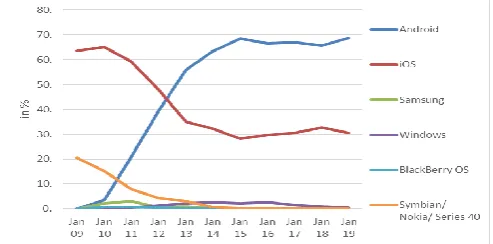
The following “Fig. 10” shows the market shares of the leading mobile operating systems for Internet use with mobile phones in Germany from January 2009 to January 2019.
Fig. 10. Market shares of the leading mobile operating systems in Internet usage with mobile phones in Germany
[image:4.595.306.553.593.715.2]By 2013, Android (Google) had already established itself, as the leading mobile operating system for Internet use with smartphones, with a market share of 55.79%. Within only 4 years, Android (2009: 0.05% market share) Android was able to conquer the position of market leader. The iOS (Apple) came second in 2013 with 35.06% (2009: 63.64% market share), followed by Symbian (Nokia) with just 3.08% in 2013 (2009: 20.57% market share). Today, the market is led by only 2 leading providers, with Android in first place with 68.60%, followed by iOS 30.43% and the remaining providers only 0.90% share. These two vendors form an oligopolistic market and are in intense competition with each other, with iOS losing more than half of its market share since 2009.
The many possibilities of the smartphone and the convenience of tablet PCs contributed to the increase in the use of the mobile Internet. The use of mobile applications, so-called apps, deserves special mention. These applications are also very diverse but will not be discussed in detail here. Mobile operators are expecting a sustained boom in the use of the mobile Internet and are therefore already investing today in the expansion of their networks to cope with increasing data volumes and ensure faster downloads. This is the new 5G standard (download speed of up to 20 Gigabit per second) which replaces the 4G standard (download speed of up to 500 megabits per second) [31].
[image:5.595.305.551.56.208.2]The following “Fig. 11” shows the development of the volume of data transmitted in mobile communications in Germany from 2005 to 2018 (in millions of gigabytes).
Fig. 11. Development of the volume of data transmitted in mobile communications in Germany from 2005 to 2018
(in millions of gigabytes)
IV. RESULTSANDDESCUSSION
Reasons for the use of IT in companies
[image:5.595.53.294.418.565.2]As early as the end of 2002, 89.4% of the companies surveyed stated the acceleration of business processes as one of the most important reasons for the use of information technologies. Other reasons include flexible adaptation to customer requirements, improvements in quality, the reduction of personnel or material costs and the development of new products. In the following “Fig. 12”, the reasons are shown graphically.
Fig. 12. Reasons for using IT [32]
V. CONCLUSION
Effects of IT changes
Starting from the database system to enterprise resource planning, ERP systems, and the Internet, companies had time to slowly but surely restructure their value chains. New IT is the cause of a further division of labour and specialization at the corporate level [33]. With increasing interdependence between business solutions and information management, the relevance of IT for business is increasing, and with it the importance of coordinating business and information strategy [33]. Each of these new developments or improvements led to an increase in the network within a company and between the companies involved,
which in turn enabled the development of new products and services, such as outsourcing (outsourcing of tasks of a department to specialists, e.g. accounting) or out-tasking (outsourcing of individual tasks to specialists.), which contributed to a shift of tasks between the companies involved in a network. This reorganization of tasks also entails a change in the existing infrastructure.
Already in 2007, 54% of manufacturing enterprises and 59% of service enterprises had partially or completely outsourced their business processes. Accounting and human resources are often outsourced to concentrate on the core process. Customer service is mainly provided by the company itself, as it is part of the core process.
The following “Fig. 13” shows the outsourcing of business.
[image:5.595.305.551.587.722.2]REFERENCES
1. B. Rudolf, “Elektrotechnik und Elektronik für Maschinenbauer und Verfahrenstechniker,” vol. 5, p. 150, 2008
2. W. Klaus, “Mikroprozessortechnik – Grundlagen, Architekturen,
Schaltungstechnik und Betrieb von Mikroprozessoren und
Mirkocontrollern,” vol. 3, p. 2, 2009
3. T. Kaminski, (2014, March). Intel, Prozessoren von Intel – eine Erfolgsgeschichte, Hintergrundinformation [Online] Available: https://ziladoc.com/downloadFile/intel-cpu-meilensteine-deutsch_pdf
4. H. Tobias: “Technische Informatik – Ein Tutorium der
Maschinenprogrammierung und Rechnertechnik,” vol. 1. p. 2, 2011 5. K. C. Laudon, J. P. Laudon, and D. Schoder, “Wirtschaftsinformatik –
Eine Einführung,” vol. 2, p. 219, 2010
6. J. Heidepriem, “Prozessinformatik 1 – Grundzüge der Informatik,” p. 78, 2000
7. D. Masak, “Moderne Enterprise Architekturen,” p. 41, 2005
8. U. Weigand, and M. Schwidefsky, „Vom Exot zum Standard – Lunix
im Unternehmen,” in IT Technologien, Lösungen, Innovationen, Berlin, pp. 193-195, 2007
9. K. C. Laudon, J. P. Laudon, and D. Schoder, “Wirtschaftsinformatik – Eine Einführung,” vol. 2, p. 225, 2010
10. A. S. Tanenbaum, “Moderne Betriebssysteme,” vol. 3. p. 937, 2009
11. W. Lassmann, “Wirtschaftsinformatik – Nachschlagewerk für
Studium und Praxis,” vol. 1, p. 147, 2006
12. F. J. Heiss, E. Weirich, and G. Gratzl, Gisela, “SAP NetWeaver Web Application Server,” p. 59, 2005
13. W. Fritz, Wolfgang, “Internet-Marketing und Electronic Commerce – Grundlagen, Rahmenbedingungen, Instrumente,” vol. 3, p. 34, 2004 14. M. Precht, N. Meier, and D. Tremel, “EDV-Grundwissen – Eine
Einführung in die Theorie und Praxis der modernen EDV,” vol. 7, p. 565, 2004
15. W. Fritz, “Internet-Marketing und Electronic Commerce –
Grundlagen, Rahmenbedingungen, Instrumente,” vol. 3, p. 37, 2004
16. T. Fuchß, Thomas: „Mobile Computing – Grundlagen und Konzepte
für mobile Anwendungen,” p. 17, 2009
17. C. Baun, and M. Kunze, “Cloud Computing, Web-basierte dynamische IT-Services,” vol. 2, pp. 4-6, 2011
18. R. Vogel, and T. Koςoğlu, “Desktopvirtualisierung, Definietionen – Architekturen – Business-Nutzen,” vol. 1, pp. 119-121, 2010 19. B. Mutschler, G. Specht, “Mobile Datenbanksysteme,” p. 17, 2004
20. IT-techBlog, (2006. October 09). Unternehmen in der
Internetökonomie, Ziele des IKT-Einsatzes [Online] Available: https://www.it-techblog.de/know-how-intel-centrino-mobiltechnologi e-im-detail/10/2006/
21. Statista GmbH, (2019. September 02). Number of desktop PCs and notebooks sold on the consumer market in Germany from 2005 to 2018
(in 1,000 devices) [Online] Available:
https://www.statista.com/statistics/462726/pcs-and-notebooks-sales-v olume-germany/
22. Statista GmbH, (2019. September 02). Number of tablet PCs sold to private consumers in Germany from 2010 to 2018 (in millions)
[Online] Available:
https://www.statista.com/statistics/460123/tablets-consumer-market-s ales-volume-germany/
23. Statista GmbH, (2019. September 02). Technik-Shopping in
Deutschland [Online] Available:
https://de.statista.com/infografik/16197/absatz-von-ausgewaehlten-el ektronischen-geraeten-in-deutschland/
24. Statista GmbH, (2019. September 02). Number of mobile phone connections in Germany from 1992 to 2018 (in millions) [Online] Available:
https://www.statista.com/statistics/461836/mobile-phone-connections -germany/
25. Bundesverband Informationswirtschaft, Telekommunikation und neue Medien e. V. (Bitkom), (2019. September 02). Smartphones erobern
den Berufsalltag [Online] Available:
https://www.bitkom.org/Presse/Presseinformation/Smartphones-erobe rn-den-Berufsalltag.html
26. Focus Online, (2019. September 02). Das Handy als
Multifunktionsgerät [Online] Available:
https://www.focus.de/digital/handy/mobilfunktrend-das-handy-als-m ultifunktionsgeraet_aid_425481.html
27. Bundesverband Informationswirtschaft, Telekommunikation und neue Medien e. V. (Bitkom), (2019. September 02). Smartphone als mobiler
Alleskönner im Alltag [Online] Available:
https://www.bitkom.org/sites/default/files/file/import/Bitkom-Pressek
onferenz-Smartphone-Markt-Konjunktur-und-Trends-16-02-2016-Pra esentation-final.pdf
28. Statista GmbH, (2019. September 02). Wann das Smartphone das
Handy überholte [Online] Available:
https://de.statista.com/infografik/8333/anzahl-der-mobilfunk-anschlu esse-nach-endgeraet-weltweit/
29. Statista GmbH, (2019. September 02). Technik-Shopping in
Deutschland [Online] Available:
https://de.statista.com/infografik/16197/absatz-von-ausgewaehlten-el ektronischen-geraeten-in-deutschland/
30. Statista GmbH, (2019. September 02). Market share of leading mobile operating systems in the internet usage on mobile devices in Germany from January 2009 to May 2019 [Online] Available: https://www.statista.com/statistics/461981/mobile-operating-systems-internet-usage-share-germany/
31. TECHBOOK.de, Axel Springer SE, (2019. September 02). Das ist der Unterschied zwischen LTE, 4G und 5G [Online] Available: https://www.techbook.de/mobile/smartphones/lte-4g-unterschied-mo bil-smartphone
32. Leibniz-Zentrum für Europäische Wirtschaftsforschung IKT-Report, (2003. June). Unternehmen in der Internetökonomie, Ziele des
IKT-Einsatzes [Online] Available:
ftp.zew.de/pub/zew-docs/div/IKTRep/IKT_Report_2003.pdf 33. E. Fleisch, “Das Netzwerkunternehmen - Strategien und Prozesse zur
Steigerung der Wettbewerbsfähigkeit in der "Networked Economy",” pp. 4-5, 2001
34. Leibniz-Zentrum für Europäische Wirtschaftsforschung IKT-Report, (2007. September). Internetwirtschaft weiter auf dem Vormarsch,
Auslagerung von Geschäftsprozessen [Online] Available:
ftp.zew.de/pub/zew-docs/div/IKTRep/IKT_Report_2007.pdf
AUTHORSPROFILE
![Fig. 5. Use of mobile phones [26]](https://thumb-us.123doks.com/thumbv2/123dok_us/8166330.251060/3.595.300.552.604.835/fig-use-of-mobile-phones.webp)
![Fig. 12. Reasons for using IT [32]](https://thumb-us.123doks.com/thumbv2/123dok_us/8166330.251060/5.595.305.551.587.722/fig-reasons-for-using-it.webp)
