Abstract Background/Objectives: Korea's NTIS is a S&T information service, and its export demand is increasing in developing countries due to excellence. In this paper, we developed GPIS to improve user experience of foreign users and introduce NTIS.
Methods/Statistical analysis: According to the previous research, it is necessary to have practical experience of NTIS for overseas users as a means of exporting NTIS. The existing NTIS global portal only provides a simple introduction of NTIS. Therefore, in this paper, we implement real working functions of program, project, human resource, and outcome information, which is the core of S&T information service, and build sample data so that overseas users can experience NTIS service.
Findings: In this paper, GPIS is developed based on open source. The system language was supported in four languages for foreign users: Russian, Spanish, English and Korean. It is designed to organically link program announcements, project information, human resource information and outcome information. And developed a page that introduces analysis and application technology through science and technology information.
Improvements/Applications: The GPIS was designed and developed in order to develop the actual processed scientific data and essential functions to be utilized and understood by overseas users and NTIS developing countries. Therefore, I expect that it will be more helpful to improve the export and awareness of NTIS in Korea.
Keywords: Science & Technology Information, Global Science & Technology Information Service, NTIS, NDSL, GPIS
I.INTRODUCTION
The National Science & Technology Information Service (NTIS), launched in March 2008, is a S&T information service that provides information on national research and development projects, including program, projects, human resource, research facilities. As a technology knowledge information portal, it was developed with the aim of establishing a comprehensive information management system at the national level in order to improve the inefficiency and redundant investment, which appeared in more than 130 research institutes under the individual departments independently promoting and managing research tasks [1-3]. Accordingly, NTIS is conducting an
Revised Manuscript Received on May 22, 2019.
Il-Kwon Lim, Biotech Policy Research Center, KRIBB, 125 Gwahak-ro, Yuseong-gu, Daejeon 34141, Korea.
Chul Su Lim, NTIS Center, KISTI, 245 Daehak-ro, Yuseong-gu, Daejeon, 34141, Korea.
Ki Seok Cho, NTIS Center, KISTI, 245 Daehak-ro, Yuseong-gu, Daejeon, 34141, Korea.
Byeong-Jeong Kim, Chungcheong Branch, KISTI, 245 Daehak-ro, Yuseong-gu, Daejeon, 34141, Korea.
integrated service that collects information related to science and technology in related organizations and provides them to users in accordance with processing and refining according to 422 information standards. As of October 2017, NTIS has provided about 118.52 million national science and technology information. Among these national R&D information, scholarly original information such as papers, patents, and reports is being provided through the National Digital Science Library (NDSL). NDSL is a science and technology information service platform, providing more than 100 million content search and content search services[4-6].
Due to the excellence of Korea's e-government system and science and technology information service, it is increasing demand for overseas export. According to previous studies, it was suggested that NTIS should be trained or educated for users to learn the merits of NTIS and make the system more familiar to export the information system to overseas [7]. In this paper, we propose a system to build a GPIS (Global Platform for Science and Technology Information Service, hereinafter referred to as "GPIS") system in order to enhance export and experience of S&T information service in Korea. It is designed to be able to learn and learn.
In Korea, S&T information service is managed by NTIS according to institutional linkage and information giant, and original data of scientific information such as thesis is managed by NDSL. However, the foreign countries that are subject to the export of science and technology information services in Korea are the developing countries, so we designed the system to include both NTIS that manages science and technology information and NDSL service that manages scientific and technical information. GPIS has the function to manage business, task, manpower, achievement, status and so on, so that foreign users who want to export NTIS can experience the core service of NTIS and provide sample data of national science and technology information It was developed to experience actual NTIS service.
The composition of this paper is as follows. In Section 1, we describe the necessity and background of this paper. In Section 2, we discuss the existing research on global science and technology information services, NTIS and NDSL. Section 3 describes the design direction and contents of the system, and Section 4 introduces the GPIS system actually implemented. Section 5 describes the conclusion and future work.
Implementation of GPIS System for Global R&D
Science and Technology Information Service
II.RELATEDRESEARCH
In accordance with the excellence of NTIS, the introduction for overseas users and research for overseas technology transfer were conducted. In Section 2, we describe the current state of services of NDSL and NTIS that should be reflected in the Global Science and Technology Information Service Research and GPIS.
2.1.Existing research
According to a study by ‘Sharing of National R&D
Information through the construction of NTIS Global Portal Service’, NTIS has the world's first national R&D portal and high recognition in Korea. But Overseas, they had a lack of publicity and low awareness. As a result, research was conducted to establish a NTIS global portal for the purpose of promoting and introducing overseas [8]. However, in the case of NTIS Global Portal, the information provided by NTIS is limited due to the low rate of nationalization of national R & D information. Figure 1 shows the main screen of the NTIS Global Portal, which was established in 2011, and Figure 2 shows the NTIS Global Portal, which is currently being serviced [9].
[image:2.595.312.537.253.512.2]Figure 1.NTIS Global Portal Main Screen(2011)
Figure 2.NTIS Global Portal Main Screen(2018, recent)
As of 2018, NTIS Global Portal provides only information
for simple introduction of NTIS through menus such as
'About NTIS', 'Statistics', 'Search', 'Collaboration', and 'NEWS'. The search menu should provide R&D related information, but it provides only limited services according to the ratio of English to scientific information [9].
In addition, according to the thesis, 'A Case Study on International Technology Transfer of Korean Public
Information Systems and Recommendations for NTIS' This is
a case study on export of SW overseas in Korea such as Korea UNS-PASS of Korea Customs Service (KCS), KONEPS of Public Procurement Service (PPS) and KIPOnet of Korean Intellectual Property Office (KIPO) and other. And NTIS has made efforts to export Vietnam, Kazakhstan, and Costa Rica to other countries. Thereafter NTIS technology transfer suggested that information marketing should be done as shown in Table 1 [7].
Table 1NTIS information Marketing Aspects of
Information Marketing
NTIS Information Marketing
Continuity • Establishing human network • Cooperation with third parties subdivision • Examining how much national
R&D is funded
• Examining how national R&D is leaded
• Examining the capacity of operating the system
• Examining how national
ministries operate with others • Feasibility Study
• Ex-post evaluation
familiarity • Conducting research on
economical benefit of NTIS • Demonstrating detailed methods
of how to apply
• Mutual exchange of work force
2.2. Service Status of NTIS and NDSL
Korea's NTIS service is a national R&D knowledge portal that integrates and provides all information related to national R&D projects (information on 422 national R&D standards in 6 fields of programs, projects, human resources, research facility, equipment and outcome information). Through the NTIS, it is possible to grasp the R & D information of the departments of the ministries and agencies in a transparent and rapid manner. Also, by integrating the national R & D project information, it is possible to improve the efficiency of the national R & D investment by reducing the similar / Contributing. Table 2 shows the R & D information managed by NTIS [1, 10].
Table 2Status of NTIS data (as of 2017)
Classification Quantity Classification Quantity
All National S&T
[image:2.595.67.277.329.677.2]Human resources 186,177 R&D outcomes 4,532 thousand
Domestic and foreign papers
77,833 thousand
Domestic and foreign
patents 35,081 thousand
Reports 93,404 Policy Trends 82,128
Public R&D projects 3,707 Overseas R&Dprojects 80,242
[image:3.595.72.277.259.435.2]Figure 4 is a conceptual diagram of NTIS. As shown in the figure, the target user is a person in charge of planning, evaluating and managing R&D tasks including universities, researchers, and companies for general users and technology development. In order to collect national R&D information, 422 information standards were selected, and information was exchanged with 17 representatives, research institutes, and government-funded research institutes, and the collected information was processed and refined [1, 11].
Figure 3.NTIS Conceptual diagram
Among the information provided by NTIS, S&T original information such as papers, patents, and reports are provided through NDSL linkages. Since 2001, NDSL service has started to support foreign academic journals and procedures needed for all researchers in Korea. Since then, it has provided more than 100 million scientific and technological information and provided high quality information to researchers, It contributes to national science and technology innovation. Table 3 shows the amount of scientific and technical information and information provided [4-6].
Table 3Main content of NDSL(as of 2017)
Category Description Quantity
Paper Domestic/Overseas papers, Domestic
dissertation 77,411,289
Patent
Korea Patent / Practical / Design, US Patent Registration, European Patent, Japanese Patent, International Patent, etc.
35,118,688
Report National R&D report, various analysis reports,
etc. 288,183
Trends
Overseas Science and Technology Trends, Science and Technology Policy Trends, Global Trends in Information Services, etc.
27,055
Journal/ Proceeding Journal/Proceedings Bibliography Journal : 116,524
Proceeding : 261,967
Researcher/Research Institution
Researcher Information, Research Institution Information
Researcher : 264,715 Researcher Institution: 12,970
III.SYSTEMDESIGN
The main target country for NTIS 'overseas exports is developing countries. Currently, NTIS provides more than 20 application functions and services such as analytical cloud, research ecosystem map, and performance information in conjunction with NDSL in conjunction with
[image:3.595.96.509.466.667.2]Figure 4.GPIS Whole conceptual diagram
GPIS is based on multi-language support for use by foreign users of various nationalities and languages. Basic languages are English and Korean, and Kazakhstan and Costa Rica are designed to use Russian and Spanish languages. The users
[image:4.595.58.538.355.642.2]are divided into general user, research institute, researcher, etc., and designed to utilize GPIS and identify the characteristics of NTIS. Table 4 below shows the functional design details of GPIS.
Table 4functional design
GPIS is designed to enable foreign users to operate and utilize actual functions, which requires data for operation. To do this, NTIS extracts some data, deletes user identification and important information, and makes it possible to operate in GPIS after processing as sample data. We also added a cautionary note to prevent users from misunderstanding the actual data when using these data. Types of sample data are program, project, dissertation, biological resources, research report, patent, human resource, and equipment information.
IV.IMPLEMENTATION
The main functions of GPIS are program information, project information, human resource information and outcome information. In particular, it contains information and functions for project management, selection of tasks, agreement, management, and final evaluation according to the research task execution
process. In the case of the workforce information, the researcher 's performance is Functio
n Level 1 2 3 1 2 3
detail of function
Information
portal Sign up, Login, Unified Search Human
Resources management info
Researcher registration number issuance, Human search
Program managemen t info
Program info, Program
announcement
History information managemen t
Basic info,
Affiliation,
Education, career, Paper, Patent
Project managemen t info
Project search, Project apply Outcome info
Paper, Patent, Research report, Facilities equipment, Biological resource
selection evaluation
Evaluation
committee selection, Evaluation,
Approval of
evaluation result
Statistics Investment, Project, Human
resources, Outcome
Project convention Analysis
Introduction page including Research ecosystem map, TOD, COMPAS, STAR-Value
Final evaluation
Evaluation
committee selection, Evaluation
Administrato r
Notice, Q&A, Membership
management, Common code
management
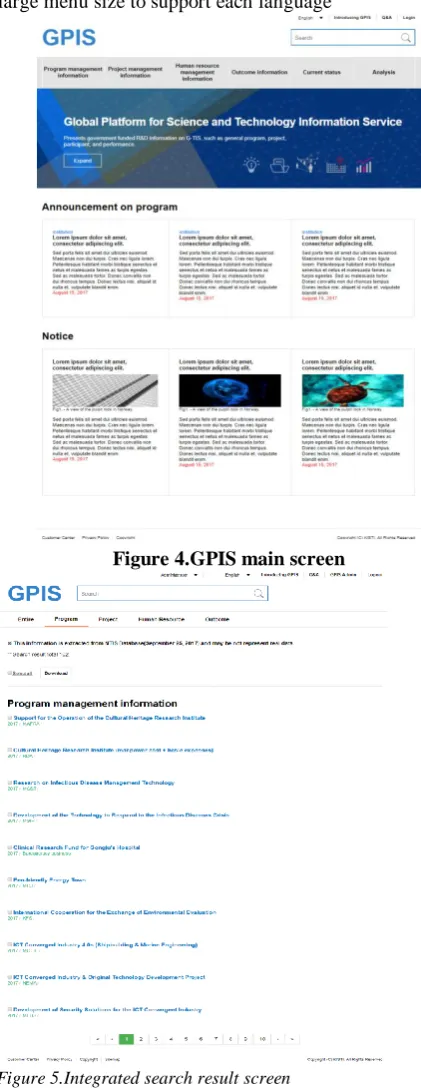
implemented through performance information function. Figure 5 is the main screen of the implemented GPIS. In the upper right corner, you can change the language. Each menu is located at the top of the page. This menu made efforts such as large menu size to support each language
Figure 4.GPIS main screen
Figure 5.Integrated search result screen
The upper right part of Figure 5 is the integrated search function. When searching, the project information can be integrated or retrieved by each information as shown in Figure 6. In the middle of the main page, program announcements and noticeare exposed so that users can check on research projects and special issues. The program announcement and project management functions, which are core functions of GPIS, are linked to the program information at the upper level and the data of the project information. It also provides a linkage between the researcher participating in the project and the outcome of the
human resource so that projects, human resources, and outcomes information are linked and utilized in an organic way.
Figure 7 shows the details of the program announcement, and Figure 8 shows the project information screen. In addition, as shown in Figure 9, it is structured so that it can express and support the step-by-step process of the research project as well as the simple information management.
[image:5.595.322.537.150.842.2]Figure 6Detail screen of program announcement
[image:5.595.342.523.159.289.2]Figure 7 project info screen
[image:5.595.325.535.289.626.2]Figure 8.Step-by-step process screen of project
However, since the statistical functions shown in Figure 10 are not actual data, we visualized the sample data simply. In order to guide the application and application method through the research information, the analysis function is a research ecosystem map, TOD (Technology Opportunity
Discovery), COMPAS (COMPETITIVE ANALYSIS
SERVICE), STAR-VALUE (Science & Technology Information Analysis for R&D-Value), and the implementation of the analysis function is beyond the scope of the GPIS system conceived in this paper [12].
V.CONCLUSION
In this paper, we developed the GPIS system to improve the user experience of NTIS, the S&T information service of Korea, and to improve the user experience of overseas users. In the case of NTIS Global Portal, which is already being serviced, it is focused on simple introduction of NTIS. Therefore, in this paper, we will use GPIS to provide services such as programs, projects, human resources, outcomes. Such user experience for foreign users will help to understand domestic SW, raise awareness and export abroad. In addition, since the core SW such as web, was, DB is developed as open source, there is no problem in installing or distributing sample countries. It will be necessary to increase the number of multilingual support in 4 languages and to add functions for managing the original texts of the achievements, and it will be necessary to improve the users through feedback of actual users.
ACKNOWLEDGMENT
This research was supported by Korea Institute of Science and Technology Information (KISTI).
REFERENCES
1. NTIS web.Description of NTIS. [updated Mar. 2018; cited 21 may 2018], Available from: www.ntis.go.kr(website)
2. Han SW, NTIS white paper.Daejeon in Rep. of Korea: KISTI; 2015. p.317 (book)
3. Gang JY, Nam YH, Oh HJ. An Evaluation of Web-Based Research Records Archival Information Services and Recommendations for Their Improvement: NTIS vs. NKIS.Journal of records management & archives society of Korea.2017; 17(3):139-160. DOI : http://dx.doi.org/10.14404/JKSARM.2017.17.3.139
4. NDSL web.Description of NDSL. [cited 21 may 2018], Available from: ndsl.kr(website)
5. NDSL Leaflet.Daejeon in Rep. of Korea: KISTI; 2017. p.10. (leaflet), Available from: www.ndsl.kr/ndsl/about/pr/leaflet.do(website)
6. Lee JH, Lee EB, Kim HM. Analysis and Service Quality Evaluation on NDSL Website.Journal of information management.2006; 37(4):69-91. DOI : http://dx.doi.org/10.1633/JIM.2006.37.4.069
7. Lee EJ, Kang IJ, Lim CS, Choi KS, Lee BH.A Case Study on International Technology Transfer of Korean Public Information Systems and Recommendations for NTIS.The Journal of the Korea Contents Association. 2016; 16(10):533-545. DOI : http://dx.doi.org/10.5392/JKCA.2016.16.10.533
8. Jhun SJ. Sharing of National R&D Information through the construction of NTIS Global Portal Service.Proceedings of the Korea Contents Association 2011.2011; 9(1):493-493. Available from: http://www.riss.kr/link?id=A100281555
9. NTIS global web. [updated Mar. 2018; cited 21 may 2018], Available from: https://www.ntis.go.kr/en(website)
10.Seo BJ, 2017 NATIONAL INFORMATIZATION WHITE PAPER. Daegu in Rep. of Korea: NIA; 2017.p. 616. (book)
11.Choi HS, Kim JS, Design of a NTIS Information Integration Model based on a Standard Integration Platform.Journal of KIISE.2012; 18(6):484-488.