International Journal of Innovative Technology and Exploring Engineering (IJITEE) ISSN: 2278-3075, Volume-8 Issue-6C, April 2019
Abstract: Smart Solar Street Light is the fully automated street light , which aim is to reduce the power consumption by automatically switch on/off the lights and transfer the saved energy to other neighbour street lights. This paper gives the solution to two problems: First light will on/off according to the vehicle movement on the road and Second Lights will be automatically on/off by sensing the day/night. This automation of street lights do not need the human intervention and saved energy will be redirected to other poles or it can be used in other work. At the same time status of the street lights, battery life and other information are shared by the server using the Wi-Fi module integrated with the poles. Sensing of vehicle/day/night will be done by the sensors and program will run in Ardunio Uno R3 microcontroller. The sensors sense the vehicle on the road and switch on the lights but lights will be switched off when vehicle passes the pole. So, this paper will discuss lots of situation and accordingly the Smart Street Lights work.
Index Terms: Smart Street Light, IR sensors, Arduino Uno R3, Light Dependent Register, Smart City.
I. INTRODUCTION
The Internet of Things (IoT) is a progressive correspondence technology that expects to deliver an undetectable and inventive structure to associate a plenty of digital gadgets with the Internet. Hence, it plans to make the Internet more immersive furthermore, unavoidable. The rising IoT advertise is continuously picking up energy as administrators, merchants, producers, and endeavors start to perceive the open doors it offers. Concurring to the most recent forecast by marketsandmarkets, the overall IoT market expected to grow from USD 170.57 Billion(2017) to USD 561.04(2022),with the compound annual growth of 26.9%. This more noteworthy level of the income in 2022 is normal through application S/W, building IoT platforms, service-based opportunity.
A smart city is a perplexing or complex system described by the escalated utilization of Information and Communication Technology (ICT), meaning to make urban communities more appealing and more supportable, and exceptional spots for advancement and entrepreneurship. The real partners incorporate application designers, specialist co-ops, residents, government and open specialist organizations, the exploration network, and stage developers. Furthermore, the smart city cycle comprises of various ICT advances, improvement platforms, maintenance, and supportability, applications for developing nationals, and
Revised Manuscript Received on January 10, 2019.
Rakesh Roshan, Department of CSI, University of Kota, Kota, India
Dr. Om Prakash Rishi, Department of CSI, University of Kota, Kota,
India.
specialized, social, and also financial key execution pointers. Therefore, IoT frameworks will assume a crucial part in the arrangement of substantial scale heterogeneous infrastructure. Computerization/Automation assumes an undeniably critical part on the world economy and in day by day life. Programmed frameworks are being favored over manual framework. The research work indicates programmed control of streetlights can save an energy/power for reuse in other devices.
For the smart city, street lights are one of the important components. The street lights are not a complex thing but due to the urbanization, the numbers of street lights are going to increase day by day, so the saving of power consumption is the challenges for the government.
Earlier road lights were controlled manually where a control switch is fix in every pole of the road lights. From that point onward, another technique that has been utilized was optical control strategy done utilizing high weight sodium light in their framework. So, due to the lots of power consumption smart solar light is the only option in future but at the same time cost of Smart pole should be reduced. This paper considers the LED street lights for the smart solar street lights.
The setup of solar lights is quite expensive, so there is a requirement of using the maximum natural energy in minimum cost.
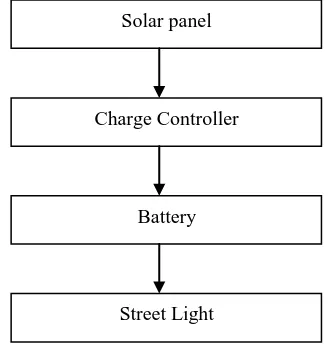
Fig. 1: Abstract of Connectivity
Smart Solar Street Light Using WiFi, IR Motion
Sensor and LDR for the Smart City
Rakesh Roshan, Om Prakash Rishi
Solar panel
Charge Controller
Battery
[image:1.595.346.510.494.669.2]II. SURVEY OF LITERATURE
Y.K.Tan et al[1] explored the use of smart sensors for controlling the dc grid LED lighting. The experimental work of this paper shows the saving of energy in comparison to similar lighting performance. According to their result, 44% energy was saving as compared to the ac fluorescent system. Mustafa et al[2] gives the solution for the automatic on/off the street lights according to the day or night. They used the microcontroller PICI16F877A for controlling the street lights. They used the C Language for the programming.
Noriaki Yoshiura et al[3] developed the smart street light system consisting of LED lights, brightness sensors, motion sensors and communication networks. The driver or pedestrians cannot distinguish from the normal street lights and smart lights because when they come before that the lights on and after that the lights off.
Yusnani Mohd Yusoff et al[4] developed the smart street lights based on Malaysian environment. They integrated the Wireless Sensor Network, Servers, Sensors to implement the Smart light system and controlling the light intensity using Pulse Width Modulation (PWM) technique.
Adele Sittoni et al[5] presented circuit model that can analyse the behavior of Power Line Communication(PLC) for the street light control. Their approach is capable to evaluate the quality of PLC signal in huge network of different technology. The consequences of a few reproductions, with signals in the recurrence extend 95-148.5 kHz, have been contrasted and the results of some lab explores over a test line. Fares S. El-Faouri et al[6] developed the prototype for the smart-street lighting system based on the photo voltaic(PV) source. These street light alone working as a standalone off grid system and in future connected to the other grid for a larger system.
Omkar Rudrawar et al[7] proposed the smart system which can efficiently control the street light’s intensity. This paper used the intensity control system that is based on the TRIAC. The intensity of lights are controlled based on the load of traffic on the road measured by the sensors and then light automatically switched on/off. The system can also be monitored through some Graphical User Interface.
III. CURRENT SCENARIO OF INDIAN STREETS
In India, 27 millions street lights are glow at night. These street lights consume 20% to 30% of the energy produced by country. Only some of the street lights of Delhi and Mumbai are smart but not completely. The main problems of the street lights in India are :
Defective Lights Less use of LED Lights Wastage of energy
Unauthorized usages of electricity Very difficult to identify the fused lights Not controlled by central server
Most of the streets are manual in Metro cities, Urban areas and villages also. Some streets lights of metro cities and urban areas are solar and battery based but they worked manually or can sense only day and light not complete automatically (Most of the cases motion sensors are not there). There is no any street lights in India which is WiFi enabled and controlled by the central places.
So, there is a lot of scope or opportunities for the smart light system in the different places of India like metro cities, urban areas and villages also. Now the selected smart cities can implement the smart street lights by using these devices and sensors.
IV. CURRENT SCENARIO OF GLOBAL STREETS
Upto 2016, 50-55% of the world’s population lives in Metro Cities and Urban areas which will increase to 62-65% by 2050[8]. According to statista[9] $34.35 is to be spend by 2020 in the smart cities worldwide, the figure was $14.85 in 2015. At the same time the implementation of street lights will increase due the investment in smart cities. As we know there are not a specific criteria to identify the smart cities in world, but only hundreds of city in world are declared as a smart city. So, the current scenario of global is that not more than 4-5% of the cities are smart. Hence globally also there is a lots of opportunity for the implementation of smart solar street light system. Some cities in the world are not smart but they implemented the smart street light system. Some time the street lights replace with LED light also considered being the smart.
The biggest players who responding for Smart street light systems are:
IBM
Panasonic Cisco
V. DEVICES AND SENSORS
A. Arduino Uno R3
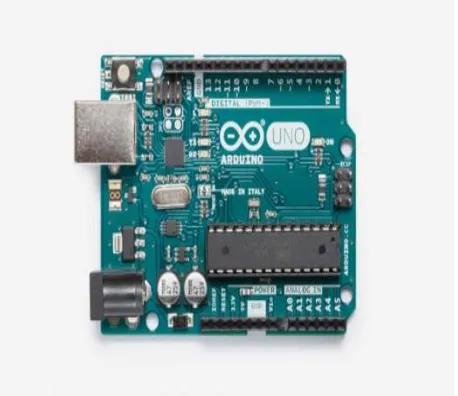
The Arduino Uno is a microcontroller with ATmega328 processor with 14 digital I/O pins and 6 Analogs input pins for the connection with different digital and analog sensors respectively.
[image:2.595.315.544.507.705.2]International Journal of Innovative Technology and Exploring Engineering (IJITEE) ISSN: 2278-3075, Volume-8 Issue-6C, April 2019
The specification of the Arduino Uno R3 is as follows: Flash Memory: 32KB
Clock Speed: 16MHz Operating Voltage: 5V Input Voltage : 7-12V
SRAM: 2KB
EEPROM: 1KB
B. IR Motion Sensor
[image:3.595.59.272.291.418.2]PIR (Passive Infrared sensors) enable you to detect movement, quite often used to identify whether a human has moved in or out in the range of sensors. They are little, cheap, low-control and simple to utilize. Hence they are generally found in Home or Office appliances. This sensor can sense the motion as well as measure the heat of an object. Passive IR sensor can measure only infrared radiation rather than emitting it.
Fig. 3: Passive IR Motion Sensor
C. LDR (Light Dependent Resistor)
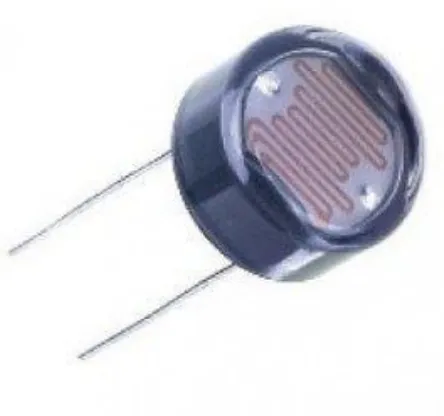
[image:3.595.55.277.541.749.2]An LDR is a resistor that contains a resistance (variable) which changes with the light intensity sensed. This register used as a light sensing circuit. This sensor is widely used in so many applications such as lighting switch, camera etc.
Fig. 4:LDR(Light Dependent Resistor)
In the LDR, , the resistance is inversely proportional to the
intensity of light that is When intensity of light will high than resistance will low and when intensity of light will low than resistance will high.
D. Wi-Fi Module (ESP8266)
ESP8266 is a system on chip low-cost WiFi module with inbuilt TCP/IP stack. By ESP8266 we can send or receive information remotely by authenticates the user. The ESP8266 help the device or sensors for connecting to internet. Each ESP8266 is pre-loaded program with an AT command. This module is very powerful for on-board processing and also capable to store, that gives the strength for integrated with sensors.
Fig. 5:ESP8266(WiFi Module) (1) Features of ESP8266 are as follows:
Flash Memory (1MB) 802.11 b/g/n
Integrated TCP/IP stack
Transmit the packets in less than 2ms WiFi direct
Integrated 32-bit CPU etc
VI. PROPOSED WORK
The traditional streets lights are power consuming as well as sometimes they are on in day time also due to the negligence of the department of electricity. And also due to the rapid growth in the urbanization, the electric poles, street lights are increasing day by day. So, now a time to save the energy/power and utilize that power to the residential and commercial areas.
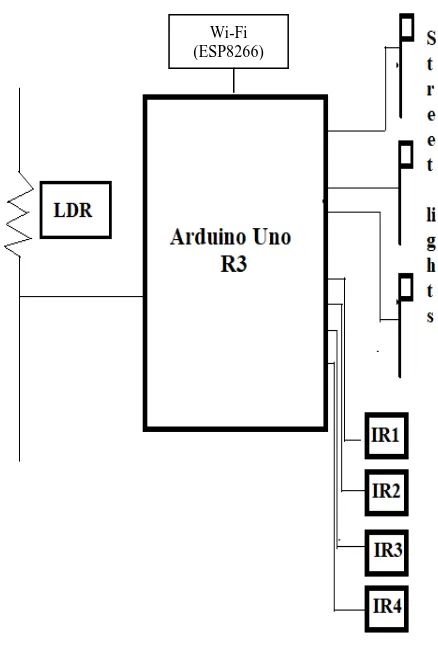
So for saving the power/energy, this paper proposing the smart solar street light system to utilize the maximum natural energy by minimizing cost. Figure 4 depicts the proposed model to implement the smart solar street lights system.
A. Working of proposed model
than accordingly gives the output to different street lights(equipped with LED lights , Solar Panel and Battery) which is connected to the 7,8,9,10,11 pin number of the Arduino Uno R3.
[image:4.595.56.275.210.536.2]Wi-Fi(Used ESP8266 due to very low cost Wi-Fi microchip) is also used to send or receive the information to or from the server or control room, so that lights can be also controlled from server. Status of different street lights can be tracked by using Wi-Fi module connected to Arduino Uno R3.
Fig. 6: Proposed model for Smart solar street light The above model (Fig 6) works in the following way: Light dependent resistor sense the natural light (Day or
night) and accordingly gives the information (0/1) to the street lights for on or off. LDR will give the value within the range of 0 to 1024, then 0 represents the darkness and 1023 represents the maximum light or brightness received by the LDR. This LDR will be connected to the analog pin of the Arduino Uno R3.
The lights will be on/off according to the vehicle running or any person walking on the road. The IR sensors sense the objects on the road and accordingly send the signals to the LED lights for on/off. The IR motion sensors are connected with the pin number 2,3,4,5 of the Arduino Uno R3. By sensing the objects the IR send the value 0 or 1 according to the vehicle or person on the road and according to these values the street lights will glow. IoT solutions can keep track that the lights are working
or not and how much energy consumed by the street lights. The controller used for phase wise street lights as well as individual lights. For this WiFi technology can be used to track the lights status. The Wifitechnology is the mostcost effective solutions for this type of projects.
B. Optimized use of Battery equipped with the Smart
Solar Lights
Now this paper proposed that there is no all street lights will be equipped with Battery lights and solar panel. The battery charged by the single smart solar light pole will be distributed to another 4-5 neighbor pole, so that the investment on infrastructure will be less compared to existing systems. The smart systems also send the information to server or control room about the charge or life of battery.
C. Sample code for controlling the LED lights using
Light Dependent Resistor(LDR)
int ldrPin = A0; int sensorValue = 0; void setup() {
pinMode(7,OUTPUT); Serial.begin(9600); }
void loop() {
sensorValue = analogRead(ldrPin); Serial.println(sensorValue); if (sensorValue<500) digitalWrite(7,HIGH);
else
digitalWrite(7,LOW); delay(100);
}
In the above code, 500 is taken as a threshold value. But the threshold value can be increased or decreased according to the location of smart street lights. If the smart street lights is within the society or colony, then there are some lights are already there due to the residential lights , so in this case the threshold value will be different.
VII. CONCLUSION
By utilizing Smart Solar Street light, the electricity department can save the energy in four ways:
By using solar system for the power generation. Save the accumulated energy by optimized
utilization of the street lights due to the use of sensors and programmed Arduino Uno R3. The accumulated energy can be utilized by the
neighbouring poles.
The cost of Smart Street light will be reduced due to the sharing of the Solar panel and batteries. Due to the use of Wi-Fi, the street lights can be controlled by the control room as well as keep track of the faulty lights, life of battery and working status of the solar panel. By using these poles and Wi-Fi module, the electricity department can help the people by sending the accident information to the concerned department for quick help to the citizens.
International Journal of Innovative Technology and Exploring Engineering (IJITEE) ISSN: 2278-3075, Volume-8 Issue-6C, April 2019
VIII. ACKNOWLEDGEMENT
By doing this research work, the theoretical ideas are implemented through practical work. Thanks to my guide Dr. O. P Rishi, Director Research, University of Kota (Rajasthan) for always support and motivate for implementing the innovative ideas. Thanks to Department of CSI, University of Kota for giving the platform for the research work.
REFERENCES
1. Y.K.Tan, T.P.Huynh, Z.Wang, “Smart Personal Sensor Network Control for Energy Saving in DC Grid Poweredf LED Lighting System”,IEEE Transaction of Smart Grid , Volume 4 Issue 2 pp 669-676.
2. Mustafa Sadd, Abdalhalim Farij, Ahamad Salah and Abdalroof Abdaljalil, “Automatic Street Light Control System Using Microcontroller”, Conference Proceeding OTEMA, At Antalya pp 92-96.
3. Noriaki Yoshiura, Yusaku Fujii and Naoya Ohta, “Smart street light system looking like usual street lights based on sensor networks”, IEEE International Symposium on Communications and Information Technologies(ISCIT), 4-6 Oct 2013
4. Yusnani Mohd Yusoff, Roszainiza Rosli, Mohd Uzir Karnaluddin and Mustaffa Samad, “Towards Smart Street Lighting system in Malaysia”, IEEE International Sysposium of Wireless Technology and Applications(ISWTA), 22-25 Sept 2013.
5. Adele Sittoni, Davide Brunelli and David Macii, “Street lighting in smart cities: A simulation tool for the design of systems based on narrowband PLC”, IEEE First International Smart Cities Conference (ISC2),25-28 Oct 2015.
6. Fares S. El-Faouri, Munther Sharaiha, Daoud Bargouth, and Ayman Faza, “A Smart Street Lighting System Using Solar Energy”, IEEE PES Innovative Smart Grid Technologies Conference Europe (ISGT-Europe),9-12 Oct 2016.
7. Omkar Rudrawar,Siddharth Daga, Janak Raj Chadha and P.S. Kulkami, “ Smart Street light system with light intensity control using Power electronics”. IEEE conference 2018 Technologies for Smart-City Energy Security and Power (ICSESP), 28-30 March 2018.