UNIVERSITI TEKNIKAL MALAYSIA MELAKA
RFID BASED DOOR ACCESS SYSTEM
This report submitted in accordance with requirement of the Universiti Teknikal Malaysia Melaka (UTeM) for the Bachelor Degree of Manufacturing Engineering
(Robotic and Automation) with Honours
By
NURHIDAYAH BT AZMI
Tarikh:
UNIVERSITI TEKNIKAL MALAYSIA MELAKA
BORANG PENGESAHAN STATUS LAPORAN PROJEK SARJANA MUDA
TAJUK :RFID BASED DOOR ACCESSS Sesi pengajian: 09110 semester 2
Saya NURHIDA YAH BT AZMI mengaku membenarkan laporan PSM ini disimpan di Perpustakaan Universiti Teknikal Malaysia Melaka (UTeM) dengan syarat-syarat kewgunaan seperti berikut:
1. Laporan PSM adalah hak milik Universiti Teknikal Malaysia Melaka dan penulis.
2. Perpustakaan Universiti Teknikal Malaysia Melaka di benarkan membuat salinan untuk tujuan pengajian sahaja dengan izin penulis.
3. Perpustakaan dibenarkan membuat salinan laporan PSM ini sebagai bahan pertukara antara institusi pengajian tinngi.
4. **Sila tandakan (
D
SULITD
TERHAD(mengandungi maklumat yang berkaita keselamatan serta kepentingan Malaysia yang termaktub dalam AKT A RAHSIA RASMI 1972)
(mengandungi maklumat TERHAD yang telah ditentukan oleh organisasi/badan dimana penyelidikan telah dijalankan)
D
TIDAK TERHADDisahkan Oleh:
Alamat tetap: 1-1. Blok F, Jalan 3, cop rasmi:
taman seri serdang, 13200 kepala batas,
Penang
DECLARATION
I hereby, declared this report entitled “RFID BASED DOOR ACCESS SYSTEM” is the
results of my own research except as cited in references.
Signature:
Author’s Name: NURHIDAYAH BT AZMI
APPROVAL
This report is submitted to the Faculty of Manufacturing Engineering of UTeM as a partial fulfillment of the requirements for the degree of Bachelor of Manufacturing
Engineering (Robotic and Automation) with Honours. The member of the supervisory committee is as follow:
Signature of Supervisor
---
i
ABSTRACT
Door is key way to access space or area. Reason to use the door was to improve security level for that area. In keeping with technological development for this time, way to access door also increasingly grows aimed to improve efficiency, security and reduce cost. Among technology that used and more commonly used is RFID, Radio Frequency Identification. RFID is technology which uses radio frequency aimed to identify and track. RFID owns a few important equipments which are tag, antenna and tag reader. Tag can be read from several centimeters and also can be read from afar until several meters depend to the radio frequency type used. Tag is vital because it keep all information of object that will in trace where all the information will keep in the memory. RFID reader is tool used by radio waves to connect RFID to one readable signal form by middleware software. RFID tag’s reader use antennas to communicate
ii
ABSTRAK
iii
ACKNOWLEDGEMENT
Bismillahirrahmanirrahim, in the name of Allah s.w.t the most gracious, the merciful, and to our prophet Muhammad s.a.w. Alhamdulillah, at last I have finished my final year project report 1 after struggling to complete it.
I would like to thank to my project supervisor, Mr. Lokman b. Abdullah for his kindness, comments, support and concern in helping me in completing this report. He also gives me his suggestions to do the project on schedule and thanks for his patience. Although he has busy with his job but he still spends time to teach me about this project. Without him, I will face difficulty in completing this project.
Lastly, thanks to my lovely parents and also my friends for giving much and good supporting times to help me to finish this project and project report. Without them, it is so hard for me to complete this project.
iv
DEDICATION
Special dedication to:
v
TABLE OF CONTENT
ABSTRACT (ENGLISH VERSION) i
ABSTRACT (MALAY VERSION) ii
ACKNOWLEDGEMENT iii
DEDICATION iv
TABLE OF CONTENT v
LIST OF TABLE vii
LIST OF FIGURE viii
LIST OF ABBREVIATION x
CHAPTER 1: INTRODUCTION
1.1 Background 1
1.2 Problem Statement 2
1.3 Project Objectives 2
1.4 Scope 3
1.5 Project Planning 3
1.6 Structure of the Report 4
CHAPTER 2: LITERATURE REVIEW
2.1 Introduction 5
2.2 Historical development 7
2.3 Application 12
2.4 Operational description of RFID system 15
2.5 Related component and software 17
vi CHAPTER 3: METHODOLOGY
3.1 Project Planning 29
3.2 Process Implementation 39
CHAPTER 4: DESIGN AND DEVELOPMENT
4.1 Designing The User Interface Of RFID Door Access 41 4.2 Designing The Project Setup Of RFID Door Access 44 4.3 Develop The User Interface Of RFID Door Access 46 4.4 Designing The Project Setup Of RFID Door Access 49
CHAPTER 5:RESULT , ANALYSIS AND DISCUSSION
5.1 Door Access Programming And Database 52
CHAPTER 6:CONCLUSION AND RECOMMENDATION 56
REFERENCE 57
APPENDICES
A Gantt chart PSM 1 58
B Gantt chart PSM 2 59
C Visual Basic 2008 Coding
LIST OF TABLE
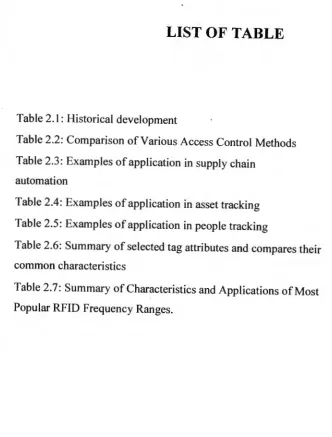
Table 2.1: Historical development
Table 2.2: Comparison of Various Access Control Methods
Table 2.3: Examples of application in supply chain
automation
Table 2.4: Examples of application in asset tracking
Table 2.5: Examples of application in people tracking
Table 2.6: Summary of selected tag attributes and compares their
common characteristics
Table 2.7: Summary of Characteristics and Applications ofMost
Popular RFID Frequency Ranges.
vii
7
10
13
14
15
20
LIST OF FIGURE
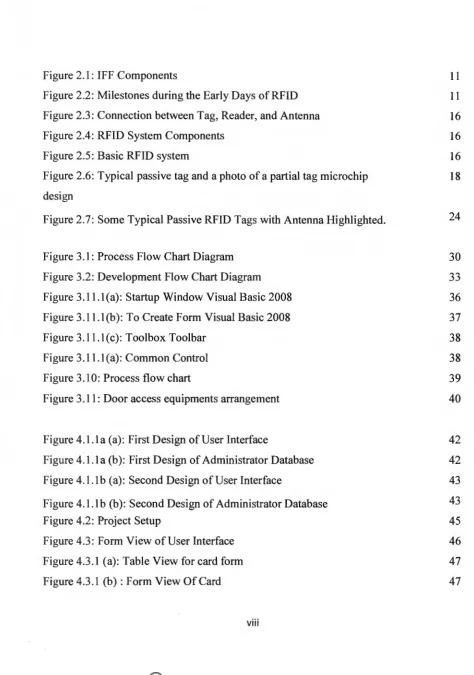
Figure 2.1: IFF Components
Figure 2.2: Milestones during the Early Days ofRFID
Figure 2.3: Connection between Tag, Reader, and Antenna
Figure 2.4: RFID System Components
Figure 2.5: Basic RFID system
Figure 2.6: Typical passive tag and a photo of a partial tag microchip
design
Figure 2.7: Some Typical Passive RFID Tags with Antenna Highlighted.
Figure 3.1: Process Flow Chart Diagram
Figure 3.2: Development Flow Chart Diagram
Figure 3.11.1(a): Startup Window Visual Basic 2008
Figure 3.11.1(b): To Create Form Visual Basic 2008
Figure 3.11.1(c): Toolbox Toolbar
Figure 3.11.1(a): Common Control
Figure 3.10: Process flow chart
Figure 3.11: Door access equipments arrangement
Figure 4.1.1 a (a): First Design of User Interface
Figure 4.1.1 a (b): First Design of Administrator Database
Figure 4.1.1 b (a): Second Design of User Interface
Figure 4.1.1 b (b): Second Design of Administrator Database Figure 4.2: Project Setup
Figure 4.3: Form View ofUser Interface
Figure 4.3.1 (a): Table View for card form
Figure 4.3.1 (b): Form View Of Card
Figure 4.3.1(c): Table View Door
Figure 4.3.1 :Form View OfDoor
Figure 4.3.1 :Table View OfCardDoor Manage
Figure 4.3.1 :Form View OfCardDoor Manage
Figure 4.4.1 : Window View of System properties
Figure 4.4.2: Window View OfMyComputer
Figure 4.4.4: Window View Sharing and Security properties
Figure 5.1.1: Form View of User Interface
Figure 5.1.2: Access Authorized
Figure 5.1.3: Access Not Authorized
Figure 5.1.4: Form View of Administrator Interface and Database
Figure 5.1.5: Complete Flow ofRFID Door Access System
ix
47
48
48
48
49
50
51
52
53
53
54
x
LIST OF ABBREVIATIONS
RFID - Radio Frequency Identification
AIDC - Automated Identification and Data Capture PC - Personal Computer
AVI - Automated Visual Inspection EPC - Electronic Product Code UHF - Ultra-High Frequency UPC - Universal Product Code RF - Radio Frequency
HF - High Frequency
LF - Low Frequency
1
CHAPTER 1
INTRODUCTION
This chapter presents the general ideas of the research. There are basically contain six main sections in this chapter, such as background, problem statement, research objectives, research scopes, importance of the research and structure of report.
1.1 Background
Door is a moveable barrier used to cover an opening. Doors are used widely and can be opened to give access and closed more or less securely using a combination of latches and locks. Doors are nearly universal in buildings of all kinds, allowing passage between the inside and outside, and between internal rooms. The doors also used to screen areas of a building for aesthetic purposes, keeping formal and utility areas separate.
2
1.2 Problem Statement
The conventional way to access the door such as using key can easily to duplicate or steal by thief. Keys cannot control when (time and days) personnel are valid. Keys do not provide with any information of when and where someone has gained access.
At some places there were using the door guard to observe the people who are in or out from the building. Guard can only be at one place at one time. Guard can be absent or late. Records can be inaccurate or difficult to read (who, when, where), if records are kept at all. A guard service is very expensive.
By the way to improve the security when accessing the door the changes has to be made. The method must be efficiently and cost effectively reducing and preventing crime as much as possible. It also can improve the quality of the living environment for residents by reducing all forms of anti-social behavior as much as possible. By employing modern technology to fight against crime to ensure residents benefit from the latest tools available in the fight against crime.
1.3 Project Objectives
The main objective is to design a RFID Door Access with monitoring system which supported by subsequent objectives as follows:
3
1.4 Scope
This project is aimed to develop a system to develop a model door access by using the RFID technology with the monitoring system. The monitoring system will be develop using Microsoft Access and must be able to monitor functions of the door access. The outcome of this project is stand-alone application to observe the status of the personnel that access to the specified door. In the project, there will consist with five doors, which only can be access by the certain position only. The monitoring system will observe the events that occur with the real time monitoring. The card will be programmed by using the Visual Basic.
1.5 Project Planning
The project planning is too identified and plans to achieve the objective with the punctual time planning. The good planning can make the project is in actual track. For a good time management planning, a Gantt chart is a suitable method in applying a guide for the project proceeds.
4
1.6 Structure of the Report
Chapter 1: Introduction
This chapter includes of background of RFID system, problem statement, research objectives, and research scopes, project planning and structure of report. All that an entire element becomes as an initial step before go through this research.
Chapter 2: Literature Review
Chapter two discusses about literature review related with RFID door access system such as definitions and description of the technology, history, benefits and drawbacks of RFID.
Chapter 3: Research Methodology
In chapter three consist of process flow chart that describes what have been done to complete this project. This chapter will also explain the way to achieve objectives of RFID door access with the monitoring system.
Chapter 4: Result and Analysis
This chapter includes the design of the system and will discuss the result and analysis to complete this research. Discussion has also details about the research have a potential to approach at the real situation. This chapter also contains the result and analysis of the research after model build up complete.
Chapter 5: Conclusion
5
CHAPTER 2
LITERATURE REVIEW
2.1 Introduction
In this age of rapid technological advancement, wireless communication is emerging as one of the more promising and useful forms of data transfer. It is getting more and more difficult to find a person who has never talked on a cell phone, listened to the radio, or even logged onto wireless internet. And one new technology that is on its way to becoming another common, everyday use of radio frequency (RF) communication is Radio Frequency Identification (RFID).
RFID is a technology that uses tiny computer chips smaller than a grain of sand to track items at a distance. RFID use radio waves to automatically identify people or objects. RFID technology belongs to a broader group of technologies known as Auto Identification (Auto-ID), (Brown.et al, 2007). There are several methods of identification such as magnetic strip, voice recognition, biometric, but the most common is bar codes.
6
range of a reader. Bar codes have other shortcomings as well. If a label is ripped or soiled or has fallen off, there is no way to scan the item, and standard bar codes identify only the manufacturer and product, not the unique item. The bar code on one milk carton is the same as every other, making it impossible to identify which one might pass its expiration date first.
RFID is a technology that offers many more benefits compared to other identification technologies such as bar coding and magnetic stripe (Moroz.R, Nov 2004). The aim of most RFID systems is to increase efficiency, reduce data entry errors and free up staff to perform more value-added functions, such as providing customer service.
Because of this technology have lot of advantages, I would like to construct the RFID door access with a monitoring system is a system that implement the RFID concept to accessing the door in term of security factors and also have the monitoring system to monitor the system.
As we know, door is a movable barrier installed in the entry of a room or building to restrict access or provide visual privacy. They were constructed of stiles (vertical planks) and rails (horizontal planks) fastened together to support panels and occasionally equipped with locks and hinges.
7
[image:21.612.105.550.141.702.2]2.1 Historical Development
Table 2.1 Historical Development (Bartneck, Klaas, Schoenherr, 2009 and Brown.M, and Patadia.S).
Year Development
1897 Guglielmo Marconi invented the radio
1937
The U.S. Naval Research Laboratory (NRL) developed the
Identification Friend-or-Foe (IFF) system that allowed friendly units such as Allied aircraft to be distinguished from enemy aircraft.
1939 IFF transponder invented in the United Kingdom used by the allies in World War II to identify aircraft as friend or foe.
1946
Leon Theremin invented an espionage tool for the Soviet Union which retransmitted incident radio waves with audio information. Sound waves vibrated a diaphragm which slightly altered the shape of the resonator, which modulated the reflected radio frequency. Even though this device was a passive covert listening device, not an identification tag, it is considered to be a predecessor of RFID technology.
1948
Harry Stockman released paper, titled "Communication by Means of Reflected Power" (Proceedings of the IRE, pp 1196–1204, October 1948). Stockman predicted that "…considerable research and
development work has to be done before the remaining basic problems in reflected-power communication are solved, and before the field of useful applications is explored."
1950
8 1971
The initial device was passive, powered by the interrogating signal, and was demonstrated to the New York Port Authority and other potential users and consisted of a transponder with 16 bit memory for use as a toll device.
1973
Mario Cardullo's U.S. Patent 3,713,148 was the first true ancestor of modern RFID; a passive radio transponder with memory. The basic Cardullo patent covers the use of RF, sound and light as transmission media.
1973
A very early demonstration of reflected power (modulated backscatter) RFID tags, both passive and semi-passive, was performed by Steven Depp, Alfred Koelle, and Robert Freyman at the Los Alamos National Laboratory. The portable system operated at 915 MHz and used 12-bit tags.
1979 Animal tagging
1980
The more sophisticated RFID technologies were employed in
applications ranging from identification of railroad cars in the United States to tracking farm animals in Europe. RFID systems were also used in wildlife studies to tag and track exotic or endangered species such as fish with minimal intrusion into their natural habitats.
1983 The first patent to be associated with the abbreviation RFID was granted to Charles Walton U.S. Patent 4,384,288.
1990
9
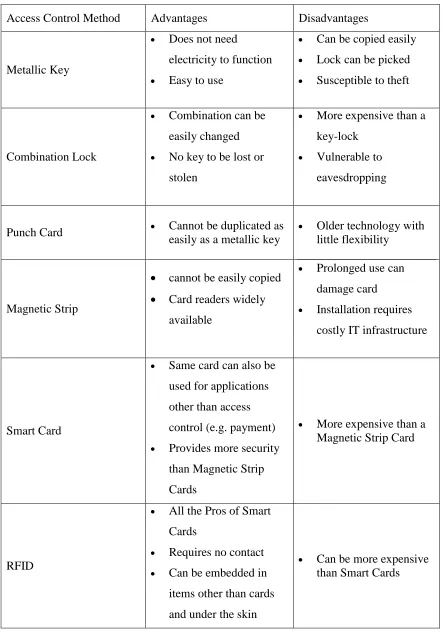
RFID card keys became popular as a replacement for traditional access control mechanisms such as metallic keys and combination locks. RFID also called contactless smart cards that provided information about the user and offered a more personalized method of access control, while being inexpensive to produce and program. Table 2.2 below compares the most common methods of access control with that of RFID access control.
1990
RFID card keys became increasingly popular as a replacement for traditional access control mechanisms such as metallic keys and combination locks.
1991 Association of American Railroads standards
1994 All US railcars RFID enabled
1999 Massachusetts Institute Of Technology Auto-id center founded
2003 EPCglobal system Version 1.0
2005 Us Department Of Defense and Wall-Mart mandates
10
Table 2.2: Comparison of Various Access Control Methods
Access Control Method Advantages Disadvantages
Metallic Key
Does not need
electricity to function Easy to use
Can be copied easily Lock can be picked Susceptible to theft
Combination Lock
Combination can be easily changed No key to be lost or
stolen
More expensive than a key-lock
Vulnerable to eavesdropping
Punch Card Cannot be duplicated as easily as a metallic key
Older technology with little flexibility
Magnetic Strip
cannot be easily copied Card readers widely
available
Prolonged use can damage card
Installation requires costly IT infrastructure
Smart Card
Same card can also be used for applications other than access control (e.g. payment) Provides more security
than Magnetic Strip Cards
More expensive than a Magnetic Strip Card
RFID
All the Pros of Smart Cards
Requires no contact Can be embedded in
items other than cards and under the skin