STUDY
by
XUEZHI ZENG
A THESIS SUBMITTED FOR THE DEGREE OF DOCTOR OF PHILOSOPHY
THE AUSTRALIAN NATIONAL UNIVERSITY
c
This thesis contains no material which has been accepted for the award
of any other degree or diploma, except where due reference is made in
the text of the thesis. To the best of my knowledge, this thesis contains
no material previously published or written by another person except
where due reference is made in the text of the thesis.
Throughout my Ph.D. journey, I have received guidance, inspiration, support and help from many amazing people whom I wish to acknowledge and appreciate.
First and foremost, I would like to express my deep gratitude to my principal supervisor, Prof. Rajiv Ranjan for his consistent support, never-ending concern, and superb guidance. He has rendered me great encouragement and support when I experience academic difficulties and personal issues. The completion of my Ph.D. study would not have been possible without his support and help. I would also like to own my sincere appreciation to my co-supervisor, Dr. Saurabh Garg. He has given me valuable suggestion and numerous support. He has resolved my academic doubts, advised me on how to write scientific papers with great patience, and arranged my visit to the University of Tasmania. I appreciate very much to my chair associate supervisor, Associate Prof. Peter Strazdins for his generous support to my research. I wish to extend my sincere gratitude to Prof. Alistair Rendell, my chair of the panel, for his encouragements, insightful comments, and great support throughout my Ph.D. study. Many thanks go to the Research School of Computer Science of Australian National University (ANU) for granting me scholarships and travel support, which enabled me to pursue doctoral study and attend international conferences. I appreciate the Commonwealth Scientific and Industrial Research Organization (CSIRO) for offering me the opportunity to work with and learn from many brilliant scientists, especially Dr. Prem Prakash Jayaraman and Dr. Carsten Friedrich. Thanks for their help and support. I also thank the University of Tasmania for offering me the visiting opportunity.
Special thanks to Dr. Sanat Bista who offered me great opportunity as a data scientist working with many amazing professionals at an Australian Government agency during my Ph.D. study.
Nowadays, deployment and operation of big data analytics applications (BDAAs) in cloud are increasingly becoming a trending practice. These applications offer orga-nizations the capabilities of constructing valuable information and extracting action-able insight for enhancing the evidence-based decision-making process. Many leading providers such as Google and Amazon provision such analytics capabilities in the form of service to customers in a pay-per-use economic model. In today’s competitive world, the potential business values of these applications depend a lot on the quality of service offered by providers. Hence, to gain competitive advantages, providers need to be more customer-focused and proactive in their marketing strategies not only to create cus-tomers awareness of their services but also meet cuscus-tomers’ best expectations for service quality. That is to say, providers must provide the required and promised services, and the services must satisfy users’ requirements, such as availability, scalability, elasticity, and so on.
Given these circumstances, it is very important and necessary for efficient methods to manage and guarantee the quality of service promised. Service Level Agreement (SLA) that represents the contract between providers and customers which captures the agreed upon guarantees regarding the quality of service is one of the effective methods. SLAs play an integral role in governing the relationships between providers and customers in the context of these applications in cloud. Besides setting the expectations by dictating the quality and the type of service, SLAs are also increasingly considered as a strong differentiator allowing a provider to offer different levels of service guarantees and to differentiate itself from its competitors. Therefore, how to manage SLAs for cloud-hosted big data analytics application (BDAAs) in ensuring SLA guarantee has become a crucial and essential aspect.
Most of the extant studies focus on SLAs management in traditional distributed computing environments like grid computing or cloud computing, which is not the case for SLA management for BDAAs in cloud. Although the research on the management of SLAs for BDAAs in cloud is now attracting growing attention, to the best of our knowledge, the study on SLA management for BDAAs in cloud is still in its infancy.
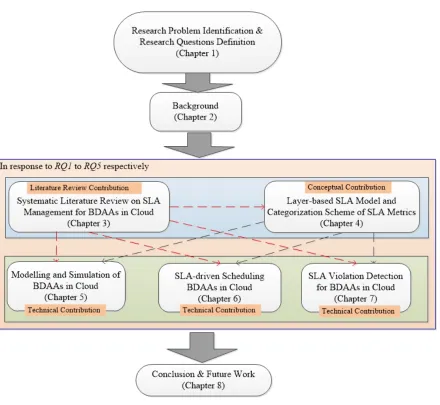
In this thesis, we focus on the research problem that how to manage SLAs for big data analytics applications in cloud in ensuring SLA guarantee. This research problem has been break down into five research questions that have been respectively addressed in Chapter 3 to Chapter 7. Accordingly, we have made five major contributions including one systematic literature review contribution, one conceptual contribution and three technical contributions.
Acknowledgments ii
Abstract iv
List of Figures xii
List of Tables xv
1 Introduction 1
1.1 Problem Identification . . . 2
1.1.1 Weakness Analysis of SLA Management from Industry Aspect . 4 1.1.2 Weakness Analysis of SLA Management from Academia Aspect 7 1.2 Research Problem . . . 8
1.3 Research Questions . . . 8
1.4 Research Framework . . . 10
1.5 Significance and Relevance . . . 10
1.6 Structure of the Thesis . . . 11
2 Background 13 2.1 Big Data . . . 13
2.1.1 Definition of Big Data . . . 13
2.1.2 Characteristics of Big Data . . . 14
2.2 Cloud Computing . . . 15
2.2.1 Cloud Computing . . . 16
2.5 The Framework of Big Data Analytics as a Service . . . 20
2.6 Service Level Agreements . . . 25
2.6.1 Definition of Service Level Agreements and Its Relevant Terms . 25 2.6.2 The Evolution of SLA . . . 27
2.7 SLAs for Cloud-hosted BDAAs . . . 31
2.7.1 Why SLAs are important for Cloud-hosted BDAAs . . . 31
2.7.2 Why are SLAs for BDAAs in Cloud sophisticated? . . . 35
2.7.3 How is SLAs for BDAAs in Cloud different from the previous evolutionary stages? . . . 35
2.8 Summary . . . 36
3 Systematic Literature Review on SLA Management for Cloud-hosted BDAAS 38 3.1 Positioning versus Existing Surveys . . . 38
3.2 The Application of SLR Methodology on SLA Management for Cloud-hosted Big Data Analytics Applications . . . 40
3.2.1 Systematic literature Review Questions . . . 40
3.2.2 Search Strategy for Primary Studies . . . 42
3.2.3 Search Criteria . . . 43
3.2.4 Selection Mechanism . . . 44
3.2.5 Data Extraction and Synthesis . . . 44
3.3 Review Results in Thematic Taxonomy of SLA Management for cloud-hosted BDAAs . . . 47
3.3.1 Actors (In response to SLRQ1) . . . 47
3.3.2 Service Layers (In response toSLRQ2) . . . 48
3.3.3 Cloud Deployment Models (In response to SLRQ2) . . . 55
3.3.4 Techniques (In response toSLRQ3) . . . 58
3.3.5 SLA Metrics (In response to SLRQ4) . . . 71
4 A New SLA Model and Categorization Scheme of SLA Metrics for
Big Data Analytics Applications in Cloud 75
4.1 Design Principles and Requirements . . . 75
4.2 Proposed Cross-layer SLA Model for Cloud-hosted BDAAs . . . 77
4.3 Multi-dimensional Categorization Scheme of SLA Metrics for Cloud-hosted BDAAs . . . 80
4.3.1 aSLA Metrics . . . 80
4.3.2 pSLA Metrics . . . 82
4.3.3 cSLA Metrics . . . 82
4.4 Detailed Example of SLAs Template for a Real Cloud-hosted BDAA . . 83
4.5 Summary . . . 90
5 Modeling and Simulation of Big Data Analytics Applications in Cloud 91 5.1 Positioning versus Existing Simulation Techniques . . . 91
5.2 Modeling Requirements for Cloud-hosted BDAAs . . . 95
5.2.1 The MapReduce Model . . . 95
5.2.2 BDSaaS-level Requirements . . . 97
5.2.3 BDPaaS-level Requirements . . . 98
5.2.4 ClaaS-level Requirements . . . 98
5.3 The Design Decisions and Architecture of IoTSim . . . 98
5.3.1 Design Principles . . . 99
5.3.2 Specific Design Considerations . . . 100
5.3.3 The Architecture of IoTSim . . . 101
5.4 The Development of Fundamental Classes and Their Correlations . . . 103
5.5 An Example of Simulation Using IoTSim . . . 107
5.6 Evaluation . . . 110
5.6.1 Experiment Setup . . . 110
5.6.2 Independent Variables . . . 111
5.7.1 Variation of the Number of MapReduce Tasks . . . 117
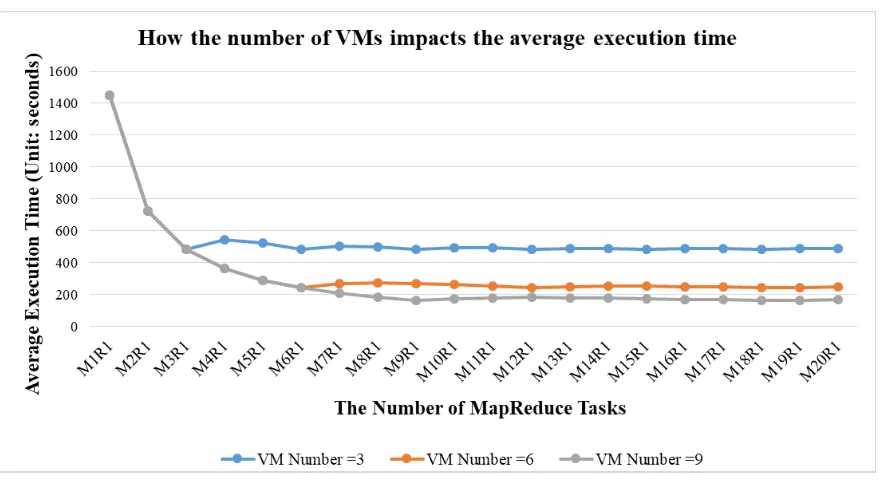
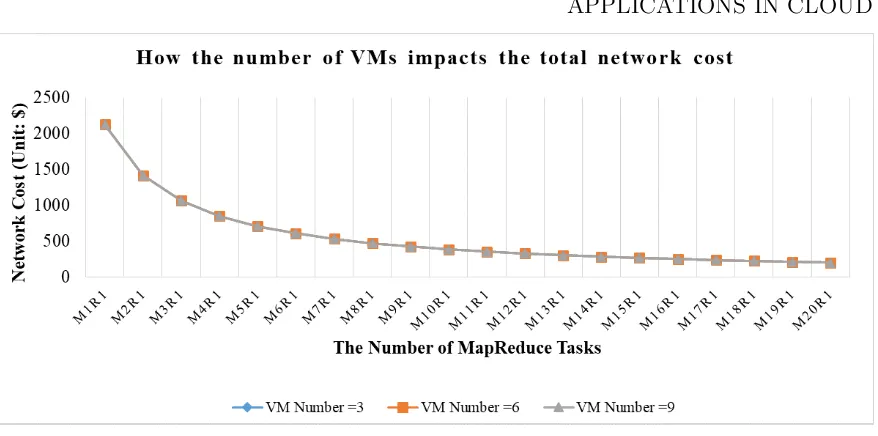
5.7.2 Variation of the Number of VMs . . . 119
5.7.3 Variation of the Types of VMs . . . 120
5.7.4 Variation of the Job Types . . . 121
5.8 Summary . . . 122
6 SLA-driven Scheduling Big Data Analytics Applications in Public Cloud 124 6.1 Positioning versus Existing Scheduling Techniques . . . 124
6.2 Cross-layer System Model for SLA-driven Scheduling BDAAs in Public Cloud . . . 126
6.3 Mathematical Model and Assumptions on the Monetary Cost . . . 129
6.3.1 MapReduce Job Model . . . 129
6.3.2 Makespan of MapReduce Job . . . 131
6.3.3 Multi-objective Optimization Problems . . . 135
6.4 Proposed MapReduce Application Scheduling Algorithm . . . 135
6.5 Evaluation . . . 137
6.5.1 Benchmarking Algorithms . . . 138
6.5.2 Experimental Setup . . . 139
6.5.3 Evaluation Scenarios . . . 142
6.6 Analysis of Experimental Results . . . 142
6.6.1 Variation in the Number of Concurrent User Requests . . . 142
6.6.2 Variation in VM MIPS Rating . . . 144
6.6.3 Variation in Deadline . . . 144
6.6.4 Variation in Budget . . . 147
6.6.5 Variation in Jobs and Deadline . . . 147
7.1 Positioning versus Existing SLA Violation Detection Techniques . . . . 151
7.2 Problem Formulation of SLA Violation Detection . . . 154
7.3 Dataset . . . 154
7.4 Feature Extraction . . . 157
7.5 SLA Violation Definition . . . 160
7.6 Examples of Features and SLA Violation Status . . . 161
7.7 Prediction Models . . . 163
7.7.1 Logistics Regression . . . 163
7.7.2 Artificial Neural Network . . . 164
7.7.3 Random Forest . . . 165
7.7.4 Extreme Gradient Boosting . . . 167
7.8 Tackling Unbalanced Data . . . 168
7.8.1 Oversampling Techniques . . . 169
7.8.2 Undersampling Techniques . . . 170
7.8.3 Combination of Oversampling and Undersampling Techniques . 171 7.9 Evaluation Metrics . . . 171
7.9.1 Accuracy . . . 172
7.9.2 Precision . . . 173
7.9.3 Recall . . . 173
7.9.4 Fβ Score . . . 173
7.9.5 Receiving Operating Characteristics (ROC) . . . 173
7.10 Evaluation and Analysis of the Prediction Models . . . 174
7.10.1 Results of Cross Validation . . . 175
7.10.2 Analysis of Prediction Outcome . . . 179
7.11 Mathematical Model and Assumptions on Providers’ Profit . . . 184
7.11.1 Admission Control Policy and Profit Loss Matrix . . . 185
7.11.2 The Formulation of a Provider’s Profit . . . 188
7.12 Experiments and Discussion . . . 189
8.2 Major Research Contributions . . . 199 8.2.1 A Novel Thematic Taxonomy of SLA Management for BDAAs in
Cloud Using Systematic Literature Review Methodology . . . . 199 8.2.2 A New SLA Model and General Categorization Scheme of SLA
Metrics for BDAAs in Cloud . . . 200 8.2.3 A New Simulation Toolkit for Modeling and Simulating BDAAs
in Cloud . . . 200 8.2.4 A New Cost-efficient SLA-driven Scheduling Algorithm for
MapRe-duce applications . . . 200 8.2.5 A Novel SLA Violation Detection for BDAAs in Cloud . . . 201 8.3 Limitations and Future Works . . . 201
Bibliography 204
1.1 Research framework . . . 9
2.1 The 3Vs. of big data . . . 15
2.2 The framework of big data analytics as a service . . . 21
2.3 SLA evolution stages with representative references . . . 29
2.4 A stock recommendation BDAA hosted in AWS Datacenter . . . 34
3.1 Systematic literature methodology applied on the survey of SLA management for cloud-hosted BDAA . . . 41
3.2 Taxonomy of SLA management for cloud-hosted BDAAs . . . 46
3.3 Statistics of the reviewed papers by layer and their breakdown . . . 49
3.4 Statistics of the reviewed papers by cloud deployment models . . . 56
3.5 Breakdown of public cloud deployment mode . . . 57
3.6 Breakdown of private cloud deployment mode . . . 57
3.7 Breakdown of hybrid cloud deployment mode . . . 58
3.8 Statistics of the reviewed papers by techniques . . . 60
3.9 Statistics of simulation technique used in the reviewed papers . . . 68
3.10 Statistics on the frequency of SLA metrics in the reviewed papers . . . 73
4.1 Categorization of requirements for layer-based BDAAs in cloud . . . 76
4.2 Cross-layer SLA model for cloud-hosted BDAAs . . . 78
4.3 Categorization scheme of SLA metrics for BDAAs in clouds . . . 81
4.4 Architecture of Google’s inventory system for retail . . . 86
5.3 The proposed layered architecture of IoTSim . . . 104
5.4 Class diagram of fundamental entities . . . 105
5.5 The basic steps in the simulation of IoTSim . . . 109
5.6 How the number of MapReduce tasks impact execution time and makespan: (a) execution time (Average, Max, Min); (b) Makespan . . . 118
5.7 How the number of VMs impacts the average execution time . . . 119
5.8 How the number of VMs impacts the total network cost . . . 120
5.9 How the VM type impacts the average execution time . . . 121
5.10 How the job type impacts the total VM cost . . . 122
6.1 A high-level system model for scheduling BDAAs in public cloud . . . 127
6.2 The compositions of makespan when executing a MapReduce job J . . . . 132
6.3 Variation in the number of concurrent user requests (a) Average Makespan; (b) Average Cost . . . 143
6.4 Variation in VM MIPS rating (a) Average Makespan; (b) Average Cost . . 145
6.5 Variation in deadline (a) Average Makespan; (b) Average Cost . . . 146
6.6 Variation in budget (a) Average Makespan; (b) Average Cost . . . 148
6.7 Variation in jobs and deadline (a) Average Makespan; (b) Average Cost . . 149
7.1 Entity relationship diagram of batch workload information in the Alibaba datase . . . 156
7.2 The structure of batch workload in Alibaba trace dataset . . . 158
7.3 Heavily skewed dataset (violated and non-violated) . . . 161
7.4 Computation and transformation process of a single neuron . . . 164
7.5 Design of a 3-layer neural network for Alibaba trace dataset . . . 166
7.6 Working mechanism of random forest . . . 167
7.7 Working mechanism of XGB . . . 168
7.8 Top 10 techniques measured by accuracy . . . 180
7.12 Top 10 techniques measured by ROC . . . 184 7.13 Radar chart of the four prediction techniques based on the five evaluation
metrics . . . 185 7.14 The capability of a prediction technique in achieving profit on different
1.1 Comparative analysis of leading providers’ SLA and their financial credit . 5
2.1 Summary on the BDAaaS framework by layer . . . 24
3.1 Academic database sources . . . 42
3.2 List of Inclusion Criteria . . . 43
3.3 List of Exclusion Criteria . . . 44
3.4 Classification of the reviewed papers on SLA Management for BDAAs in clouds by layers . . . 51
3.5 Techniques used in addressing SLA management for BDAAs in clouds . . . 59
3.6 SLA metrics and their measurement for BDAAs in clouds . . . 72
4.1 Common aSLA metrics . . . 81
4.2 Niche aSLA Metrics by different types of BDAAs . . . 82
4.3 Common pSLA metrics . . . 83
4.4 Niche pSLA metrics by the different framework at BDPaaS layer . . . 84
4.5 Common cSLA metrics . . . 85
4.6 Niche cSLA metrics by different components at CIaaS layer . . . 85
4.7 Example of aSLA, pSLA, and cSLA for Google’s inventory system . . . 89
5.1 Datacenter configuration . . . 112
5.2 Host parameters . . . 112
5.4 Job parameters . . . 113
5.3 VM parameters . . . 113
7.1 Notation used in formulating SLA violation detection problem . . . 155
7.2 Summary of the ten features and their classification by layer . . . 162
7.3 Samples of two classes (violated and non-violated Job) . . . 162
7.4 Confusion matrix in binary classification . . . 172
7.5 Cross validation result for logistics regression with default setting . . . 176
7.6 Cross validation result for a 3-layer artificial neural network . . . 177
7.7 Cross validation result for random forest with default setting . . . 178
7.8 Cross validation result for XGB with default setting . . . 179
7.9 Notation used in the mathematical model of providers’ profit . . . 186
7.10 Admission control policy matrix by providers . . . 186
Chapter 1
Introduction
We are now entering an era of “The Fourth Industrial Revolution” also known as Industry 4.0, referred to by the world economic forum [1, 2, 3]. In this revolution, we will see breakthroughs thanks to technology advancements in areas including artificial intelligence, robotics, quantum computing, 3D printing and the Internet of Things (IoT). Another technological growth area underpinning the Industry 4.0 in recent years has been big data [4, 5, 6, 7, 8], and it is changing every sector and industry regardless of size. The term big data (BD) refers to technologies and techniques that involve data that is massive, heterogeneous and fast-changing for conventional technologies, skills, and infrastructure to address efficiently. With the power and potential of exploring valuable information and ascertaining valued insights for the enhanced decision-making process, BD has become an essential technology driver of Industry 4.0 [6, 9]. In manufacturing, for example, enhancement and efficiencies in the decision making upon the information, evidence, and insight acquired by BD are expected to bring billions of dollars to the industry over the next five years [5, 10].
as per IDC [8]. On the other hand, BD is generated by an expanding IoT [14, 15, 16] via which large amounts of data is collected, i.e., sensors, machines, vehicles, and wearable devices. The installed base for the IoT will grow to approximately 212 billion devices by 2020, which includes 30.1 billion installed connected autonomous things [17, 18, 19].
Organizations can leverage big data analytics technologies on such vast data to extract valuable information, gain actionable insight and enjoy the tangible value of data. Even though data collected by individual devices may not provide sufficient information, aggregated data from a number of physical devices and virtual sensors (e.g. social media such as Facebook, Twitter) [20, 21] can provide a wealth of knowledge for essential application areas including disaster management, sentiment analysis, smart cities, and so on.
However, BD has posed substantial technological challenges including data storage, data transmission, data processing, data analysis, data visualization and so on [9, 22, 23, 24]. These challenges are non-trivial and require the flexibility, scalability, and capability of storage and computing resources. Cloud Computing (CC) [25, 26, 27] could be leveraged to tackle these challenges in Industry 4.0 as it can offer on-demand, large and scalable computing and storage resources [22, 28]. This is because, on the one hand, BD is relatively large and complex which imposes unprecedented demands on the underlying infrastructures. On the other hand, public clouds, emerged in recent years, offer massive resources available and allow general users to rent virtual machines (VMs) to run their BDAAs in a pay-as-you-go manner with ultra-high scalability and yet minimized upfront costs.
1.1
Problem Identification
features) available, reliable, secure and so on. Customers could acquire the real value of BDAAs and benefit from knowing to what extent providers deliver the promised service. However, for cloud-hosted BDAAs, customers have less control of the actual service and the level of service offered by providers in compassion with developing and deploying the applications in an on-premise environment. In today’s competitive business environment, the potential business values of BDAAs depend a lot on the quality of service (QoS) and providers must provide the required and promised services, and the services must satisfy customers’ requirements. The unsatisfactory service level of big data analytics service may lead to increased service time and so to higher costs charged to customers. As a consequence, providers will fail to achieve competitive advantages.
Therefore, an essential and tough issue arises that is the management of service level agreement (SLA) for cloud-hosted BDAAs to ensure SLA guarantee. Such that, BDAAs are behaving as expected and agreed, for instance, exhibiting the required and agreed performance, guaranteeing a minimum precision, preserving privacy and security properties, and satisfying users’ requirements such as on-demand availability, scalability, elasticity, security and so on. Actually, SLAs are increasingly considered as a critical differentiator allowing a provider to offer different levels of service guarantees and to differentiate itself from its competitors [33, 34, 35]. SLA is an efficient method to guarantee the level of service and plays an integral role in governing relationships between providers and customers.
to be uncovered. Also, the use of real infrastructures such as Amazon EC2 limits the experiments to the scale of the infrastructure and makes the reproduction of results an arduous undertaking.
Although this research area is now attracting growing attention, the study on SLA management for cloud-hosted BDAAs is still in its infancy both in industry and academia, which will be elaborated in the following sections.
1.1.1
Weakness Analysis of SLA Management from Industry
Aspect
In recent years, many providers offer a variety of big data analytics services in cloud to users on a pay-per-use basis, such as Google BigQuery [37], Amazon Redshift [38] and Microsoft Data Lake Analytics [39]. However, these leading providers offer services in the “best-effort” way, few of them deliver a solid SLA guarantee. Usually, they only commit to guarantee availability under the presence of hardware failures. For instance, even a company as large as Google offers only 99.9% guaranteed Monthly Uptime Percentage (availability) for their Google BigQuery service [40], yet some organizations require 99.99% uptime. If service uptime drops to 99.0%-99.9%, per Google’s agreement customers are eligible for a service credit equal to 10% of their bill [40]. On November 2016, Google BigQuery faced a four-hour outage resulting in 73 percent of BigQuery streaming inserts failure with a 503 error code (an HTTP response status code indicating that a server is temporarily unable to handle the request). At the peak of the problem, the failure rate was 93 percent [41, 42]. Google recognized that the impact of this outage was substantial and it caused significant disruption for those customers who rely on the products which were part of this event. Google provided those impacted customers an SLA credit for the affected timeframe according to the SLA contract [41, 42]. Google BigQuery services do not provide performance guarantees or other SLA guarantees. Its competitive services provided by Amazon, and Azure exhibit similar behaviors.
Table 1.1: Comparative analysis of leading providers’ SLA and their financial credit
Service Category
Service Name SLA Metrics Financial Credit
Data Processing
Google Cloud Dataflow [43] or Google Cloud Dat-aproc [44]
Monthly Uptime Percentage •99% - < 99.5% : 10%
•95% - < 99% : 25%
•< 95% : 50% Microsoft Azure
HDInsight [45]
Monthly Uptime Percentage •99% - < 99.9% : 10%
•< 99% : 25% Amazon Elastic
MapReduce [46]
N/A N/A Rackspace Hadoop
Service [47]
Monthly Availability •99.5% - < 99.9% : 10%
•99% - < 99.5% : 25%
•< 99% : 30% SAP Cloud Platform
Big Data Service [48]
System Availability percentage •< 99.5% : 2% of monthly sub-scription fees for each 1% below sys-tem availability
Alibaba Elastic Com-pute Service [49]
Monthly Uptime Percentage • 99% - < 99.95% : 10% of the Monthly Service Fee per Instance
• 95% - < 99% : 25% of the Monthly Service Fee per Instance
•< 95% : 100% of the Monthly Service Fee per Instance
Data Analytics
Google BigQuery [40] Monthly Uptime Percentage •99% - < 99.9% : 10%
•95% - < 99% : 25%
•< 95% : 50% Microsoft Data Lake
Analytics [50]
Monthly Uptime Percentage •99% - < 99.9% : 10%
•< 99% : 25% Amazon Redshift [38] N/A N/A
Based on Table 1.1, we could deduce that the weaknesses of SLA management for cloud-hosted BDAAs fall into the following categories.
• Lack of standard format or presentation: Providers typically published SLAs on their websites in multifarious formats which varies significantly with each other. Moreover, the relevant information may be updated without prior notice to end users. Hence, it is not easy and often time-consuming for customers to obtain and compare SLAs information from their websites and documentation.
Uptime Percentage, while SAP refers to the System Availability Percentage, and Rackspace uses Monthly Availability.
• Incompleteness metrics: SLAs in these providers’ products usually cover the availability and performance of the underlying infrastructure, leaving the SLAs at platform-level software (e.g., Hadoop cluster) and application-level (e.g., smart city, social network driven stock recommendation) largely untouched. Take Microsoft Azure HDInsight service as an instance, in this public SLA documentation, Microsoft only mentions availability (uptime) there, while ignoring or missing measurable assurances or guarantees on other SLA metrics like service response time, makespan, throughput or even energy consumption. However, there are vital factors that are not included or very imprecisely described in the currently existing SLAs. We cannot deny that availability is one of the critical qualities that need to be included in an SLA, but it is not the only one. Most importantly, big data analytics applications rely on many components (for example, data storage, data processing, etc.,) working together to meet SLAs. Each component has a different nature and features different SLA metrics.
1.1.2
Weakness Analysis of SLA Management from Academia
Aspect
Over the years, a large body of research on SLA management exist. Most of these have been conducted in traditional network environment, cluster computing environment, grid computing environment, or cloud computing environment. To the best of our knowledge, very few research specifically address the management of SLA for cloud-hosted BDAAs. The weakness from academia consists of the following aspects:
• Lack of SLA model for cloud-hosted BDAAs: There are different perspec-tives examining SLAs for cloud-hosted BDAAs. Some discuss SLAs in the cloud infrastructure level, some focus SLAs at the application level, while others ob-serve SLAs at the platform level. These different perspectives result in various SLAs with distinct features and attributes, which cause ambiguity to customers. Moreover, the studies on SLAs are relatively isolated and scattered among many papers. There is a lack of an SLA model to describe and model SLAs in a unified and structured way and demonstrate complex SLA dependencies relationships across layers while respecting the characteristics of big data analytics application.
• Absence of a general categorization scheme of SLA metrics in cloud-hosted BDAAs: The study on the categorization of SLA metrics has been considered by many researchers in telecommunication, grid computing, and cloud computing environment. However, SLA metrics in these particular environments are either oversimplified or inappropriate for cloud-hosted BDAAs as the nature and type of resources being provided and delivered is entirely different. Essentially, cloud-hosted BDAAs have a complex architecture where various components at different level interact and possess distinct and competing SLA metrics. The study on the categorization of SLA metrics for cloud-hosted BDAAs is very scarce so far.
a recent systematic literature review specifically on the SLA management for cloud-hosted BDAAs is lacking. As a result, a thematic taxonomy that gives a comprehensive outlook in this research field is missing.
• Shortcomings of extant SLA management approaches: Many approaches have been leveraged to successfully address SLA management in cloud environment. However, these approaches cannot be straightly used for cloud-hosted BDAAs due to characteristics and complexities of BDAAs. The SLA management in this context should be systematically investigated, identified and improved to tackle the issue relevant to cloud-hosted BDAAs.
1.2
Research Problem
The above analysis of SLA management weakness from both industry and academia aspects leads to our identified research problem: How to manage service level agreements for big data analytics applications in cloud in ensuring SLAs guarantee?
1.3
Research Questions
To tackle our research problem in a more step-by-step manner, we break down the above research problem into the following sub research questions (RQs):
i What is the landscape of the extant research on the management of service level agreements for cloud-hosted big data analytics applications and how to classify them from different perspectives?
ii How to describe and model service level agreements for cloud-hosted big data analytics applications (BDAAs) in a unified and structured way, and specify common and niche SLA metrics respecting characteristics of BDAAs?
Figure 1.1: Research framework
iv How to achieve SLA-driven scheduling for cloud-hosted big data analytics appli-cation (BDAAs) across layers while guaranteeing SLA?
[image:27.612.88.528.100.505.2]1.4
Research Framework
This section discusses the logical research framework shown in Figure 1.1 to ensure that our research processes and the proposed solutions are addressed using a systematic and scientifically based method. Because this research involves a combination of diverse research methods including systematic literature review, conceptual model design, software design and implementation, algorithm development and so on to our identified research problem, we discuss and justify research methods chosen as the most suitable for our study. According to Denzin and Lincoln, research methods are skills and practices that provide guidelines for researchers to address research questions and the research process [52]. They discuss the scope of problems, the research resources and the rules for researchers when they undertake research projects. Systematics literature methods, case studies, software engineering methods, model design methods, experimental methods, simulation methods, and mathematical modeling methods are examples of research methods for computer science [53]. The use of more than one type of research method (all known as mixed method) is feasible and often adopted in specific combinations [54, 55]. Since this thesis aims to explore the mechanism regarding how to manage the service level agreements for big data analytics applications in cloud in ensuring SLA guarantee. We intend to combine multiple research methods to tackle our identified research problem, such as (i) defining fundamental concepts and terms; (ii) designing conceptual model; (iii) using systematic literature review methodology to explore thematic taxonomy; (iv) using soft engineering method to design and implement simulation tool; (v) designing mathematical model and developing algorithms.
1.5
Significance and Relevance
contributions including one systematic literature review contribution, one conceptual contribution and three technical contributions. The taxonomy, conceptual model and techniques proposed in the thesis are not only significant in theory but also in practice. It is believed that the outcomes of this research would generate very positive contribution in terms of technical content, significance, and impact to the advancement of scientific research in this field of computer science.
1.6
Structure of the Thesis
The rest of this thesis is structured as follows.
Chapter 2 presents the background of our work. It contains some fundamental terms and concepts of big data, cloud computing, big data analytics applications and critical information regarding service level agreements. Moreover, in this chapter, why SLA for cloud-hosted BDAAs is imperative and remains a sophisticated challenge, and how SLA for cloud-hosted BDAAs is different from SLA for cloud computing has been analyzed.
Chapter 3 contains the first contribution of this thesis by using a systematic literature review to conduct an in-depth survey on the SLA management for cloud-hosted BDAAs. We propose a new and comprehensive thematic taxonomy, which brings benefits for future researchers to quickly understand the whole picture and identify research gaps in this research field.
solutions if meet SLAs requirements for BDAAs in cloud.
Chapter 6 addresses how to optimally schedule cloud-hosted BDAAs across layers while ensuring SLA guarantee, which makes the fourth contribution. Specifically, a new SLA-driven algorithm of scheduling cloud-hosted BDAAs that considers users’ SLA constraints has been designed and developed. This new scheduling algorithm can minimize the cost of renting cloud resources from public cloud providers to concurrently process multiple applications workloads using MapReduce model while satisfying SLA requirements.
Chapter 7 addresses how to use machine learning and resampling techniques to successfully detect SLA violations for cloud-hosted BDAAs in Alibaba’s batch workloads dataset, which are the fifth contribution. Importantly, the hidden patterns of the multiple configurations across layers are uncovered, and insightful information is provided for providers’ decision making.
Chapter 2
Background
2.1
Big Data
2.1.1
Definition of Big Data
While it is ubiquitous today, big data (BD) does not have an absolute, precise and agreed upon definition [56, 57, 58].
Amongst the most cited definitions is that included in a META Group (now Gartner) report written by Doug Laney as far back as 2001 [59]. He proposed a 3D data management concept encompassing 3Vs: Volume, Velocity, and Variety. The report remarks upon the increasing size of data, the increasing rate at which it is produced and the increasing range of formats and representations employed. Although the phrase “big data” is not explicitly mentioned in this report, the report has since been coopted as a key definition. To the best of our knowledge, this is the earliest definition of BD. From that point forward, many academia and practitioners give more definitions of BD. In 2011, an IDC report defined BD as “a new generation of technologies and architectures, designed to economically extract value from huge volumes of a wide variety of data, by enabling high-velocity capture, discovery, and analysis.” [12]
In 2012, Gartner reiterated the definition: “big data is high-volume, high-velocity and high-variety information assets that demand cost-effective, innovative forms of information processing for enhanced insight and decision making.” [60]
the need to parallelize data handling in data-intensive [61]. The characteristics of BD that force new architectures are Volume, Velocity, Variety, and Variability.
Some leading industry vendors also contribute to the definition of BD. For example, IBM defines that BD is a term applied to data sets whose size or type is beyond the ability of traditional relational databases to capture, manage, and process the data with low-latency [11]. Moreover, similar to the previous definition, it has one or more of the following characteristics – high volume, high velocity, or high variety. Microsoft provides a notably succinct definition stating that “big data is the term increasingly used to describe the process of applying serious computing power – the latest in machine learning and artificial intelligence – to seriously massive and often highly complex sets of information” [58]. This definition states in no uncertain terms that BD requires the application of significant computing power [62].
2.1.2
Characteristics of Big Data
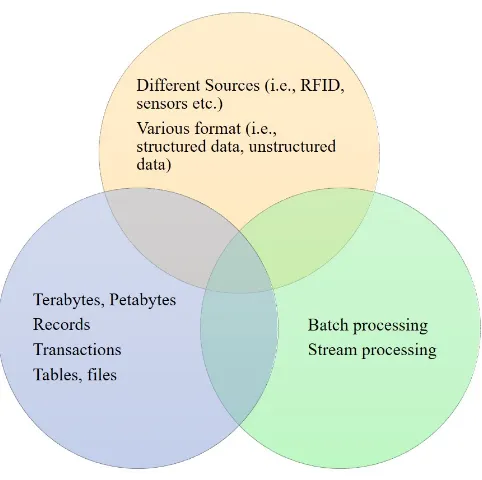
Although the above big data (BD) definitions are diverse, an agreement on the common characteristics of BD has been reached. The Volume, Variety, and Velocity (also known as 3Vs) have emerged as a universal model to describe the characteristics
of BD [63, 64, 65]. Figure 2.1 shows the 3Vs model.
Volume refers to the magnitude of data that organizations are trying to harness to improve decision-making across the enterprise. Data volume is reported in multiple terabytes and petabytes. It is worth to mention that definitions of BD volume is relative and varies by factors, such as time, the type of data, industry and even geography. Moreover, it can be smaller than the petabytes and zettabytes often referenced in articles and statistics.
Figure 2.1: The 3Vs. of big data
example, data come from sensors, smart devices, RFID tags.
Velocity refers to the rate at which data are generated and speed at which it should be analyzed and acted upon. Nowadays, large data volumes are daily generated at an unprecedented rate from heterogeneous sources (e.g., health, government, social networks, marketing), which is driving a growing need for real-time analytics and knowledge discovery.
2.2
Cloud Computing
[image:33.612.208.449.108.348.2]applications, and services) that can be rapidly provisioned and released with minimal management effort or service provider interaction [69].
2.2.1
Cloud Computing
One of the critical elements of cloud computing is the deployment model. According to NIST [69], four common cloud deployment models are stated as follows.
Public cloud: The cloud infrastructure is provisioned for open use by the general public. It may be owned, managed, and operated by a business, academic, or government organization, or some combination of them. It exists on the premises of cloud providers.
Private cloud: The cloud infrastructure is provisioned for exclusive use by a single organization comprising multiple customers (e.g., business units). It may be owned, managed, and operated by an organization, a third party, or some combination of them, and it may exist on or off premises.
Community cloud: The cloud infrastructure is provisioned for exclusive use by a specific community of consumers from organizations that have shared concerns (e.g., mission, security requirements, policy, and compliance considerations). It may be owned, managed, and operated by one or more of organizations in a community, a third party, or some combination of them, and it may exist on or off premises.
Hybrid cloud: The cloud infrastructure is a composition of two or more distinct cloud infrastructures (private or public) that remain unique entities, but are bound together by standardized or proprietary technology that enables data and application portability (e.g., cloud bursting for load balancing between clouds).
2.2.2
Three Types of Cloud Services
In general, cloud computing offers three most common types of services to end user [70, 71, 69, 67]. They are Software as a Service (SaaS), Platform as a Service (PaaS), and Infrastructure as a Service (IaaS).
hide the underlying details of software and provide an interface to work on the system. SaaS is a common delivery model for many applications.
PaaS: This type of cloud service offers a pre-built and managed application platform to customers. Customers need not spend time building underlying infrastructure for their applications. On the backend, PaaS automatically scales and provisions required infrastructure components depending on application requirements. Typically, PaaS solutions provide an API that includes a set of functions for programmatic platform management and solution development. This type of cloud service typically might contain an operating system, database management system, hosting, and data processing framework.
IaaS: This kind of cloud service gives low-level abstractions of physical devices. A cloud provider hosts infrastructure components traditionally present in an on-premises datacenter, including servers, storage, and networking hardware, as well as the virtual-ization or hypervisor layer. IaaS customers access resources and services through the internet and can use the cloud provider’s services to install the remaining elements of an application stack.
2.3
The Relationship between Big Data and Cloud
Computing
Taken separately, both big data (BD) and cloud computing (CC) can prove very beneficial to a company, providing numerous advantages in an increasingly competitive business environment. BD is an approach for maximizing the linear scalability, deploy-ment and execution flexibility, and cost-effectiveness of analytic data platforms [72]. CC is the new era of computing where efficient utilization of resources can be done with no compromise on data size, execution time and cost of execution. CC complements BD by enabling ubiquitous, convenient, on-demand network access to a shared pool of configurable computing resources that can be rapidly provisioned and released with minimal management effort or interaction [69].
BD which are relatively large and compound, and that requires the support of unique and advanced data storage, management, analysis, and visualization technologies [74, 75]. Hence, BDAAs requires lots of IT resource if users want a fast analysis of BD. Thousands of CPUs, hundreds of terabytes storages and very high-speed interconnections are demanded. For the fast analysis of BD, much more computing resources are required. Clouds are already deployed on pools of server, storage, and networking resources and can scale up or down as needed [76]. Therefore, it makes sense that organizations should look to CC as the resource provisioning platform to support their BDAAs.
While each technology is valuable on its own, many businesses are attempting to combine them to reap even more benefits. As CC has increasingly become a de facto part of doing business, more companies are choosing to implement and deploy and operate BD in cloud. By utilizing the cloud for this purpose, businesses can derive better analysis from the massive amounts of structured and unstructured data in their possession. This attribute of the cloud has proven so valuable that BD is even driving the adoption of CC across numerous industries and enterprises. CC is much cheaper for companies to use when compared to the large-scale BD resources that organizations have used before. CC also makes it much easier for companies to integrate data from numerous different sources and databases and can produce better results with a more consistent performance.
2.4
Cloud-hosted Big Data Analytics Applications
The potential of big data (BD) is unleashed when it becomes possible to mine analysis and insights from it. This is where big data analytics comes into the picture. The rise of big data analytics offers vast opportunities for existing organizations as well as for new start-ups, and both public and private organizations to construct valuable information from BD [77, 78].
business information. After analyzing data, correct tools and approaches visualize the findings in tables, graphs, and spatial charts for efficient decision making. The primary objective of big data analytics is to assist organizations to have an improved understanding of data, and thus, make efficient and well-informed decisions.
The power of big data analytics is usually released through big data analytics applications (BDAAs) that are a new type of software applications, which analyze BD using massive parallel distributed processing frameworks (e.g., Hadoop). Big data analytics has found applications across a broad range of domains such as banking and financial services, telecommunications, travel and entertainment, digital media, healthcare, manufacturing, and others [80, 81].
Leading providers offer a wide array of different types of BDAAs. For example, Google utilizes Google BigQuery [37] to offer inventory management system [82], an abundant, highly scalable, low cost and pay-as-you-go cloud-hosted BDAA to make inventory management productive and efficient. Amazon provides natural language processing-based BDAA in cloud that identifies the language of voluminous texts, extracts vital entities such as people, organizations, locations or events, and analyze sentiments in texts using Amazon Comprehend [83].
projecting they would use the cloud for BD up 5% from last year. These demonstrate that cloud-based BDAAs is a widespread phenomenon nowadays.
From the service’s perspective, the capabilities and benefits of BDAAs are uniquely placed and delivered in the form of Big Data Analytics as a Service (BDAaaS) for marketing purposes. We will give a detailed description of BDAaaS in the next subsection.
2.5
The Framework of Big Data Analytics as a
Ser-vice
In previous research works, cloud was considered as a marketplace [68, 86], where the storage and computing capabilities of cloud-based system architectures can be leased. Likewise, the rise of big data (BD) has created new business models, where businesses lease big data analytics service in a pay-as-you-go and service-oriented manner. In this direction, a new service named Big Data Analytics as a Service (BDAaaS) was introduced [86, 87].
BDAaaS represents a combination of analytics software and cloud technology to an extensible platform that can provide analytics capabilities over a variety of industries and use cases. It is a cloud-based spectrum of hardware and software services for storage and analysis of increased amounts of diverse data which have emerged in the past few years due to technological advancement and intrinsic presence of technology usage in everyday life [23, 29, 30]. Compared to hosting any data analytics software on-premises servers, BDAaaS offers solutions that are easy to deploy and most of the time has a pay-as-you-go payment system. It is part of a broader “as-a-Service” solutions such as SaaS/PaaS/IaaS. Unlike them, BDAaaS is an end-to-end service that leverages advanced technologies regarding data ingestion, data processing, data storage, and data analysis as well as management and maintenance tasks across layers.
Figure 2.2: The framework of big data analytics as a service
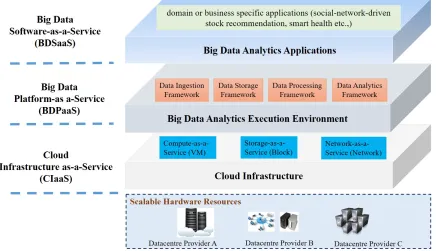
will be specialized into a concrete component. The overall framework of BDAaaS is depicted in Figure 2.2.
We can observe in this figure three levels from top to bottom: Big Data Software as a Service (BDSaaS), Big Data Platform as a Service (BDPaaS) and Cloud Infrastructure as a Service (CIaaS). Beyond the top level are usually end users who request analytics service through the interface. It is not difficult to understand that an end user is a client of the BDSaaS, which is itself a client of the BDPaaS, which is itself a client of the CIaaS. Under the level of CIaaS exists scalable hardware resources in datacenters. The details of each level are described as follows.
[image:39.612.94.530.113.364.2]computing, and accessibility of raw data). Amazon Elastic Compute Cloud (Amazon EC2) [92] is an excellent choice in this layer offering high-performance and on-demand computing resources, analogous to a server in a datacenter. Amazon Simple Storage Service (Amazon S3) is storage resources analogous to an array of hard drives [93].
Big Data Platform as a Service (BDPaaS): One level up exists the platform layer including software, tools or frameworks dedicated to BDAAs. For instance, Hadoop and its ecosystem [94]. BDPaaS emphasizes on the provision of a specialized execution environment for processing the applications, which are often instantiated over CIaaS to ensure scalability, availability, reliability, and so on. BDPaaS typically includes multiple frameworks/components as follows.
• Data Ingestion: This is the first step for the data coming from variable sources to start its journey, which deals with technologies for the ingestion of data into BDAAs. The main distinct dimension is velocity. This leads to two types of ingestion, i.e., batch and stream. Batch ingestion includes traditional Extract-Transform-Load data integration tools while stream ingestion is sub-divided into messaging systems and complex event processing engines [88]. Sample technologies for batch ingestion are Apache Sqoop [95]. Apache Kafka is a good example of stream ingestion [96].
• Data Storage: Represents technologies for persistent data storage for BDAAs. The main differentiating dimensions are volume and variety [88]. Variety distinguishes between different types of storages, i.e., distributed file systems (e.g., Hadoop HDFS [97], Google File System [98]), NoSQL (e.g., MongoDB [99], Hadoop HBase [100]) data stores, and traditional RDBMS (e.g., MySQL, Oracle etc.,). RDBMSs are mature and well support structured data, while unstructured data prefer NoSQL or distributed file systems, which is a reasonable choice for BDAAs.
In the batch-processing paradigm, a large volume of data is first stored and then processed and analyzed at once [90]. The algorithm exploits an efficient divide-and-conquer approach that split the dataset into chunks and processes each of them individually on its own machine to generate intermediate results which are eventually aggregated to a final result. Apache Hadoop MapReduce [101] has become the dominant batch processing model. The streaming processing paradigm refers to the technology that queries continuous data streams and detects conditions quickly from the time of receiving the data at the second or even millisecond level. Apache Spark [102] and Apache Storm [103] are representative examples of stream processing.
• Data Analytics: Comprises technologies responsible for the value generation which is the ultimate objective of BDAAs. Such technologies uncover hidden patterns and unknown correlations and extract insight to improve decision making [90]. This framework is differentiated by two dimensions: the type of data analytics and the type of approaches. The type of data analytics comprises descriptive, predictive and prescriptive [36, 78, 104, 105]. The type of approaches includes statistics-based method [106, 107, 108] and machine learning-based methods [108, 109, 110]. Some representative examples of BDSaaS include Google BigQuery [37], Amazon Redshift [38] and Microsoft Data Lake Analytics [39].
listening services like Salesforce.com’s Marketing Cloud [111] or BrandsEye [112]. These BDSaaS can collect social media data in close to real-time and run in it through their underpinning BD technologies and algorithms to produce insights such as near-instant feedback on the effectiveness of new marketing campaigns or alerts about emerging problems with products [113].
Table 2.1 gives a summary of the BDAaaS framework. Compared to traditional on-premises hosting environments such as dedicated server farms, the framework is more modular. Each layer is loosely coupled with the neighboring layers, allowing the flexibility to evolve separately. The framework integrates cloud computing (CC) that acts the underlying infrastructure in the whole architecture, which highlights the integral role that CC plays in BDAAs. It is worthwhile to mention that although cloud is a natural architecture and popular choice for BDAaaS, this service is not limited to just cloud architecture. Other distributed architecture can also be employed to host big data analytics services.
Table 2.1: Summary on the BDAaaS framework by layer
Layer Component Representative Examples
BDSaaS A wide range of domains •Salesforce.com’s Marketing Cloud
•BrandsEye
•Google’s inventory management system BDPaaS Data Ingestion •Batch: Sqoop
•Stream: Kafka Data Storage •DFS: Hadoop HDFS
•NoSQL: MongoDB
•RDBMS: Oracle
Data Processing •Batch: Hadoop MapReduce
•Stream: Apache Storm
Data Analysis •the type of data analytics: descriptive, predictive and prescriptive
•the type of approaches: statistics-based method and machine learning-based method
CIaaS Computing •Amazon EC2, Google Compute Engine, Azure Virtual Machines
Storage • Amazon S3, Google Cloud Storage, Azure Storage (Block Blob)
Network •Amazon VPC, Google VPC, Azure Virtual Network
takes further to pay special attention to the technologies of big data analytics and its’ application, which is more tailored to BDAAs.
2.6
Service Level Agreements
Service level agreements (SLAs) play an integral part for big data analytics applica-tions in cloud since they serve as the foundation for the expected quality level of the service between providers and customers.
2.6.1
Definition of Service Level Agreements and Its Relevant
Terms
2.6.1.1 Service Level Agreements
Multifarious definitions exist for the term service level agreement (SLA) [35, 114]. According to Marilly et al. [33], an SLA can be defined as follows: “a service level agreement is a contract between providers and customers, usually in measurable terms, what services providers will furnish and what penalties provider will pay if he cannot meet the committed goals”. Hence, an SLA is a binding agreement that specifies what providers guarantees to deliver and can be offered to other providers or customers.
Gartner defines SLA as an agreement that sets the expectations between providers and customers and describes products or services to be delivered, the single point of contact for end users’ problems and metrics by which the effectiveness of the process is monitored and approved [115].
IBM states that “a service level agreement is a contract between a provider and a customer that specifies the expectations for the level of service concerning availability, performance, and other measurable objectives. SLA records a common understanding about services, priorities, responsibilities, guarantees, and warranties between parties. SLA can also specify levels of availability, serviceability, performance, operation, or other attributes of the service” [116].
customer. SLA describes the IT service, documents service level targets, and specifies the responsibilities of providers and customers [117].
Based on these diversified definitions, this thesis focuses on SLAs as negotiated “agreements” between different parties/entities. As “agreements”, SLAs encapsulate a set of different aspects regarding the services provisioning. These refer to the agreed quality of service (QoS)– captured through different terms, the service level objectives that the service must guarantee in the form of constraints on QoS metrics, the responsibilities, and obligations of the parties, as well as the penalties in cases of non-compliance to the agreed terms. It specifies the levels of service that providers should provide to customers regarding objectives to attain different QoS aspects [35].
2.6.1.2 Service Level Objectives
Service Level Objectives (SLOs) refer to a set of formal expressions. These formal expressions have the well-known if...then structure. The antecedent (if) contains conditions and the consequent (then) contains actions. An action represents what a party has agreed to perform when the conditions are met [118].
SLOs are often quantitative and have related measurements. For customers who make informed decisions when choosing big data analytics as a service, it is best if the SLOs offered by each provider offering similar services can be easily compared.
2.6.1.3 SLA Metrics
2.6.1.4 Service Levels and Guarantees
Service levels and guarantees represent promises and guarantees with respect to graduated high/low ranges, e.g., average availability range [low: 95%, median: 97%, high: 99%,], so that it can be evaluated whether the measured metrics exceed, meet or fall below the defined service levels at a specific time point or in a certain validity period. They can be informally represented as if-then rules which might be chained in order to form graduations, complex policies and conditional guarantees, e.g., conditional rights and obligation with exceptions, violations and consequential actions: “If the average service availability during on month is below 95% then provider is obliged to pay a penalty of 20%. ”.
2.6.2
The Evolution of SLA
Over the last thirty years, service level agreement (SLA) has undergone significant evolution driven by the advancement of distributed computing paradigm in order to adapt for changes and new challenges in different computing environments per requirements. We firstly give a brief description regarding the evolution of distributed computing paradigms, then explain our proposed SLA evolutionary stages over these years.
2.6.2.1 Distributed Computing Paradigm
According to the works in [123, 124, 125, 126, 127, 128, 129, 130], the distributed computing paradigm has evolved through a number of significant phases. Mainly, they are Internet Computing [131], Peer-to-Peer Computing [132], Cluster Computing [133], Grid Computing [134], Utility Computing [135], Cloud Computing (CC) [69] and Big Data (BD) [136].
enable sharing of data, such as streaming audio or video [128]. In the 1980s, Cluster Computing has emerged, which is used for high-performance computing tasks. Another well-known distributed computing paradigm is Grid Computing that appears in the mid-1990s as an evolution of Cluster Computing [128]. In the 2000s, Utility Computing was proposed based on the idea of providing computing solutions in a very similar way as traditional real-world public utilities (such as electricity, water, gas, and telephone) [124]. Utility Computing was the first step towards pay-by-use philosophy. Around 2007, CC has emerged as a popular distributed computing paradigm [139]. CC is linked with Utility Computing based on the fact that CC is generally based on a pay-per-use model in which guarantees are offered using customized SLAs [140]. Recently, the further advancement of computer technologies and distributed processing paradigms have generated a new paradigm over the cloud at the forefront of BD. A representative example of such paradigm is MapReduce [141] programming model that is designed to work with distributed data-intensive processing big data analytics applications (BDAAs) in cloud. This has inspired an open source distributed computing framework called Apache Hadoop [94] and its ecosystem for cloud-hosted BDAAs.
2.6.2.2 SLA Evolutionary Stages
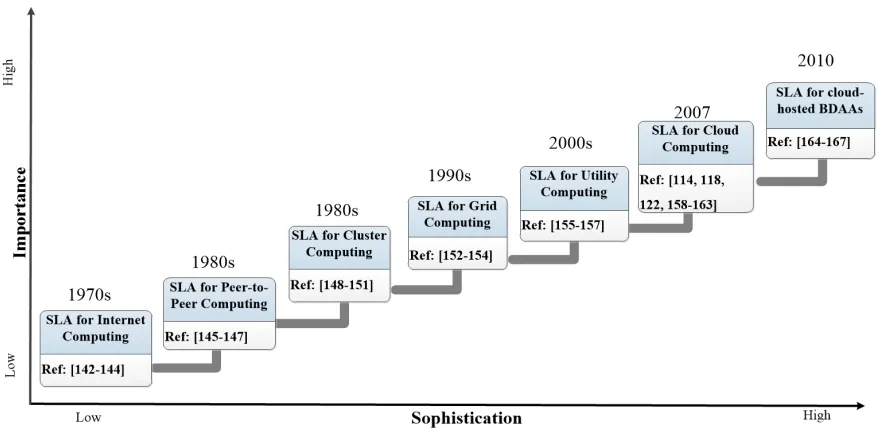
As an essential and efficient method of managing relationships between providers and customers and guaranteeing the level of service, we examined that SLA has been successfully used in all the aforementioned distributed computing environments over the last thirty years. Accordingly, SLA has experienced remarkable evolution as the distributed computing paradigm advances to cater to changes and new challenges in each distinct computing environment. Figure 2.3 proposes a pictorial representation of SLA evolution and lists some representative references in each particular evolutionary stage.
Figure 2.3: SLA evolution stages with representative references
167]. In this thesis, we are not going to detail each stage considering space. Instead, we give a brief explanation regarding SLAs for Internet Computing, SLAs for Cloud Computing and SLAs for cloud-hosted BDAAs.
[image:47.612.87.526.108.326.2]of the terms of SLAs, as it was not possible to adapt the values of SLA terms once they were deployed.
Since then, the SLA evolution continues from the stage of SLA for Peer-to-Peer computing to the stage of SLA for Utility Computing. Notably, the emergence of Grid Computing and Utility Computing triggered several important advancements in the specification of SLAs. This is because the openness and autonomy of grids and utility-oriented service provisioning model required specification formats that were not restricted to any organization or application domain’s syntax or semantics.
Further, the rapid growth of the cloud market leading to the emergence of new services, new ways for service provisioning and new interaction and collaboration models both amongst cloud providers and service ecosystems drives the extensive exploitation of SLAs for cloud computing. The continuous technological advancement of distributed computing drives the application of SLA to the current stage of SLAs for cloud-hosted BDAAs. In this stage, the importance and sophistication of SLA increases than ever before. However, the research on this particular stage is far from mature.
It is worth mentioning that although CC is widely applied, it still has some re-strictions. The fundamental restrictions lies in the correspondence between the cloud and the end devices. Such correspondence is not appropriate for a large set of cloud-based BDAAs such as the latency-sensitive applications (e.g.,disaster management, fire detection and firefighting, and content delivery applications etc.,). Hence, two new computing paradigms are proposed to address such issues. They are Fog Computing [173, 174] and Edge Computing [175, 176]:
• Fog Computing (FC): refers a novel architecture that extends the traditional CC architecture to the edge of the network. With fog, the processing of some application components (e.g., latency-sensitive ones) can take place at the edge of the network, while others (e.g., delay-tolerant and computational intensive components) can happen in the Cloud.
as any computing and network resources along the path between data sources and Cloud data centers.
FC and EC are not substitutes for CC but powerful complements. Compared to CC, compute, storage, and network resources are still the building blocks of the Cloud in FC and EC environment. However, they extend CC by enabling provisioning resources and services outside the Cloud, at the edge of the network, closer to end devices or eventually, at locations stipulated by SLAs [174]. Therefore, SLA is still a fundamental element to manage the level of service for those applications deployed in FC and EC environment, especially for latency-sensitive ones [177, 178]. For FC and EC enabled BDAAs, SLA is often influenced by many aspects (e.g., energy usage, application characteristics, service cost, network status, data locations etc.,). [178]. Hence, SLA metrics in terms of these aspects should be one of their focusing points.
2.7
SLAs for Cloud-hosted BDAAs
This thesis focuses on the evolutionary stage of SLA for cloud-hosted BDAAs. Hence we will particularly analyze why SLAs are crucial and remain a complex challenging for cloud-hosted BDAAs, and how SLAs for cloud-hosted BDAAs are different from the previous stages in the following subsections.
2.7.1
Why SLAs are important for Cloud-hosted BDAAs
Although cloud computing (CC) offers lots of capacities to supply elastic, scalable, and cost-effective computational resources, cloud-hosted big data analytics applications (BDAAs) bring their own challenge regarding the provision of promised service and quality. Typically, domain-specific BDAAs (at BDSaaS layer) subscribed by customers will be efficiently processed at BDPaaS layer using advanced processing paradigm such as MapReduce [141] by leasing elastic resources from the underlying cloud datacenters (at CIaaS layer). In such an environment, services are provided strictly on an
management of SLAs for cloud-hosted BDAAs has become of paramount importance due to the following aspects.
• Customer commitments: Clearly defined promises regarding big data analytics service and its service level reduce the chances of disappointing customers and compromising the fulfillment of the value of BDAAs. These promises also help to stay focused on serving customers’ requirements and assuring SLA guarantee.
• Increased interaction between providers and customers: Providers’ and customers’ staff are more involved in the loop than in traditional cloud providers offering. In complex cloud-hosted BDAAs deployment scenarios, there is not merely a single business entity responsible for the service delivery, but multiple different layers, business actors and entities with contrasting and competing requirements (i.e., minimum cost VS. minimum response time) interact to provide analytics services to customers and finally end users.
• Strong dependency relationships across layers: Notably, there are multiple SLAs with different properties and attributes across layers for a cloud-hosted BDAA. These SLAs have a strong dependency relationship with each upstream and downstream layer. The variety of one SLA metric such as the number of VMs (at CIaaS layer) might affect the other one such as the response time of data processing (at BDPaaS layer), which will result in the breach of the application-level SLAs
to customers.
• Key performance indicators for customers: By having “agreed” service delivered and SLA guaranteed, the confidence of customers to gain valuable information and extract insight by using the applications could be increased. In the light of this, it would be easy for customers to make an evidence-based decision.
• The price of non-conformance: If an SLA has penalties, non-performance can be costly. Therefore, by having penalties defined, customers understand that providers truly believe in their ability to achieve the performance levels. It makes the relationship clear and positive.
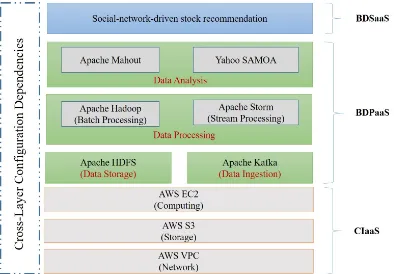
To better understand why we should pay attention to SLA-specific management for cloud-hosted BDAAs, we take social-network-driven stock recommendation as an instance [179, 180]. This is a domain-specific cloud-hosted BDAA deployed on Amazon AWS datacenter. Figure 2.4 presents the architecture of this application, which is an instantiation of the aforementioned layered-based architecture of cloud-hosted BDAAs. It is observed that the architecture of this cloud-hosted BDAA consists of multiple and heterogeneous components to process both batch- and stream-based data. The application integrates the functions of streaming free text (via Twitter API) and batching recorded tweets (through Twitter Firehose) that are contained in Amazon S3 storage buckets [93]. It consists of the following key components:
• Apache Kafka [97] is served as a data ingestion framework featured by high throughput.
• Apache Storm [103] is an advanced stream-oriented data processing engine.
• Apache Hadoop [94] represents a batch-oriented data processing framework for historical tweets.
• Apache Mahout [181] implements a set of machine learning algorithms (e.g., Naive Bayes) for grouping and classifying tweets, and runs on top of Apache Hadoop runtime environment.
• Yahoo Scalable Advanced Massive Online Analysis (SAMOA) [182] is deployed as a data analysis framework for grouping and classification of tweets pertinent to a specific stock.
Figure 2.4: A stock recommendation BDAA hosted in AWS Datacenter
[image:52.612.106.500.109.383.2]2.7.2
Why are SLAs for BDAAs in Cloud sophisticated?
Further considering the above instance, the management of SLAs in this context is extremely challenging due to the complexities imposed by this application in nature. For instance, the application spans heterogeneous and distributed software frameworks across multiple layers, which considerably impacts the allocation and configuration of datacenter resources to accommodate dynamic big data workloads and guarantee analytic results within SLA constraints. Each component of this application has different SLA requirements. For example, the application-level SLA constraints (i.e., minimize query processing, minimize data analysis delays, maximize application and data availability), platform-level SLA constraints (i.e., maximize Kafka ingestion speed, maximize HDFS I/O throughout, maximize MapReduce tasks and stream processing, minimize Mahout analysis delay), while optimizing the resources utilization of cloud datacenter in terms of CPU, network, storage and energy. It is very hard to tell how these SLAs could be defined coherently across layers and what hidden patterns among multiple configurations of this application posses.
This level of complexity in terms of SLA management also applies to other kinds of BDAAs although we only take stock recommendation application as an example.
2.7.3
How is SLAs for BDAAs in Cloud different from the
previous evolutionary stages?
Compared with its previous stage (i.e., SLAs for Cloud Computing), the stage of SLAs for cloud-hosted BDAAs demonstrates remarkable disparities in some aspects. For example:
• SLA metrics: The discrepancies of SLA metrics occur between cloud computing environment and BDAAs environment as the nature and type of resources being provided and delivered are entirely different. Although some researchers propose SLA metrics such as availability, scalability, response time, and so on that could be applied for BDAAs in cloud, it is still vital to investigate and classify SLA metrics for BDAAs in cloud in a new way reflecting characteristics of BDAAs.
• Techniques used to address SLA management: The rapid technological devel-opment brings changes to the way that SLA is managed and guaranteed for cloud-hosted BDAAs. For example, scheduling is a favorite technique to address SLA management problem in prior stages. However, they cannot be directly used in cloud-hosted BDAAs scenarios because the optimization objectives, mathe-matical formulas, and system architect are different. Hence, new algorithms or solutions should be designed and developed to deal with the scheduling changeling for cloud-hosted BDAAs.
• Layers: According to the aforementioned big data analytics as a service framework, service layers themselves and technologies in these layers bring remarkable disparity between general applications in cloud computing environment and cloud-hosted BDAAs, which transforms the way we understand and address SLA management. Concretely, different algorithms, tools, or methods should be considered and applied while understanding and respecting such disparities.
2.8
Summary
a challenging problem and how SLAs are different from the previous evolutional stages in the context of BDAAs in cloud.