Parameters for
Apple Quality-2
and the development of the ‘inner quality concept’
2001 - 2003
met Nederlandse samenvatting: Parameters voor appelkwaliteit en
de verdere ontwikkeling van het ‘innerlijke kwaliteitsconcept’,
2001-2003.
mit deutscher Zusammenfassung: Parametern für Apfelqualität
und die weitere Entwicklung des Begriffs der ‘Inneren Qualität’‚
2001-2003.
J O K E B L O K S M A , M A R T I N N O R T H O L T, M A C H T E L D H U B E R
P I E T E R J A N S J A N S O N I U S , M A R L E E N Z A N E N
●
L o u i s B o l k I n s t i t u u t , 2 0 0 4
Parameters for apple quality-2
and the development of the ‘inner quality concept’
2001-2003
met Nederlandse samenvatting: Parameters voor appelkwaliteit
en de verdere ontwikkeling van het ‘innerlijke kwaliteits concept’ 2001-2003.
mit deutscher Zusammenfassung: Parametern für Apfelqualität
und die weitere Entwicklung des Begriffs der ‘Inneren Qualität’ 2001-2003.
Joke Bloksma, Martin Northolt, Machteld Huber,
Pieterjans Jansonius, Marleen Zanen,
A
bout the organic Food, Quality and Health association (FQH)
International Research Association for Organic Food Quality and Health – Association of research institutes and stakeholders, that aims to stimulate research in the field of organic food quality and health, to present publications, and to organise scientific conferences and exhibitions.
Visit www.organicfqhresearch.org
About the Louis Bolk Instituut
The Louis Bolk Instituut has been a pioneer in innovative scientific research on farming, nutrition and healthcare since1976.
Broadening the basis of scientific research is the aim of the institute’s work. Where conventional research methods do not suffice, new methods are looked for, such as: phenomenology, participatory research,
pictomorphological investigations and conscious-intuitive methods, Rudolf Steiners philosophy being a source of inspiration.
For more information:
Louis Bolk Instituut, Hoofdstraat 24, NL 3972 LA Driebergen, The Netherlands
Phone: +31-343-523860 and Fax: +31-343-515611 E-mail: [email protected] or www.louisbolk.nl
Colofon
Louis Bolk Instituut, 2004, publication number GV V 04 organic Food, Quality and Health publication number FQH 03 ISBN 90-74021-33-6 Price € 15,-, without postage
also on www.louisbolk.nl
© The use of text parts or figures from this study with reference is
encouraged, however, please contact the editors because of ongoing development of the concept ([email protected]).
keywords
: organic food quality, Inner Quality Concept, apple,fertilisation level, compost, biodynamic field preparations, crop observations, fruit analysis, physiologic amino acid status, delayed luminescence,
spectral range luminscence, copper chloride crystallisations,
Contents
Page
1
1
Summaries
Summaries
1
1
1.1 English summary and conclusions 1
1.2 Nederlandse samenvatting en conclusies 8
1.3 Deutsche Zusammenfassung und Schlußfolgerung 15
2
2
Introduction
Introduction
23
23
2.1 Background 23
2.2 Cooperation 25
3
3
Development of ‘Vital Quality Concept’ into ‘Inner Quality Concept’
Development of ‘Vital Quality Concept’ into ‘Inner Quality Concept’
26
26
3.1 Introduction to the quality concept 26
3.2 Method: quality concept validation process 26
3.3 Results: improvements to the quality concept since 2001 28
4
4
The apple experiment (2001-2003)
The apple experiment (2001-2003)
32
32
4.1 Research questions 32
4.2 Method 33
4.3 First evaluation of the quality of the experiment 36
5
5
Overview of hypotheses and results for the different parameters
Overview of hypotheses and results for the different parameters
39
39
6
6
Discussion of the experimental factors
Discussion of the experimental factors
42
42
6.1 Field effects 42
6.2 Fertilisation level 42
6.3 Type of fertiliser 47
6.4 Biodynamic field preparations 48
7
7
Discussion about parameters and life processes
Discussion about parameters and life processes
50
50
7.1 Overview 50
7.2 Comments on specific parameters 53
8
8
Final conclusions and prospects
Final conclusions and prospects
59
59
9
9
Literature
Literature
62
62
10
10 Annexes
Annexes
66
66
List of figures and tables in this printed report
1a The renewed concept for ‘Inner Quality’ for apple.
1b Het vernieuwde concept voor ‘Innerlijke kwaliteit’ voor appel. 1c Der verbesserte Begriff der “Inneren Qualität” bei Äpfeln.
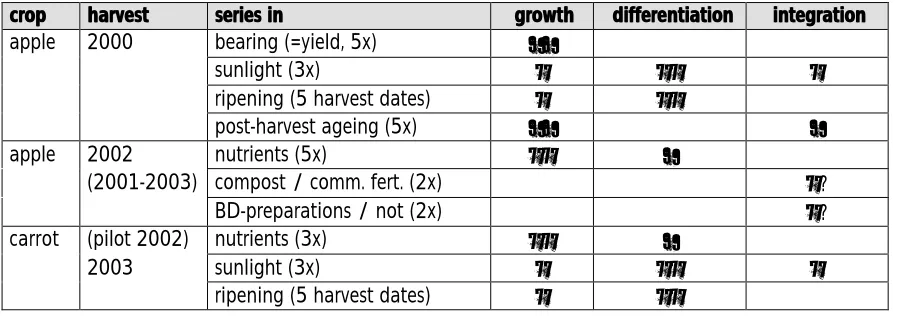
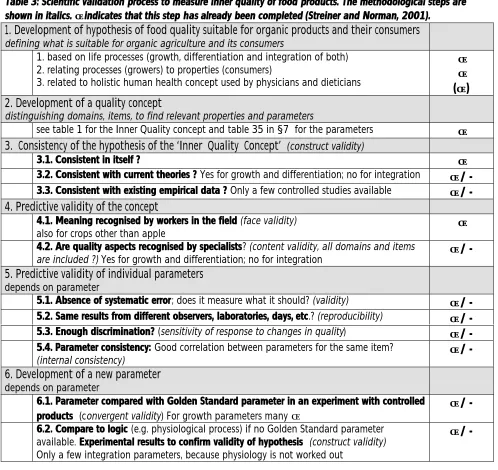
2 Overview of the FQH-experiments by LBI and the presumed effect of more of each factor on the life processes. 3 Scientific validation process to measure inner quality of food products.
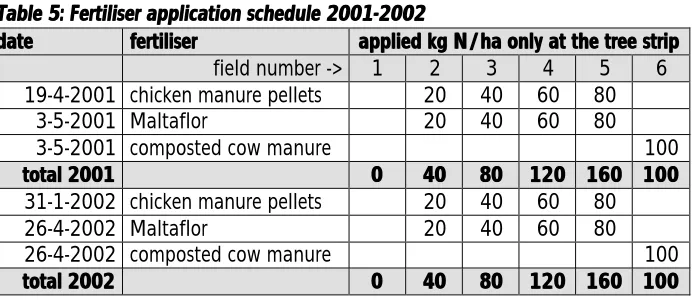
4 Growth and differentiation in several parts (organs) of the apple tree in the season. 5 Fertiliser application schedule 2001-2002.
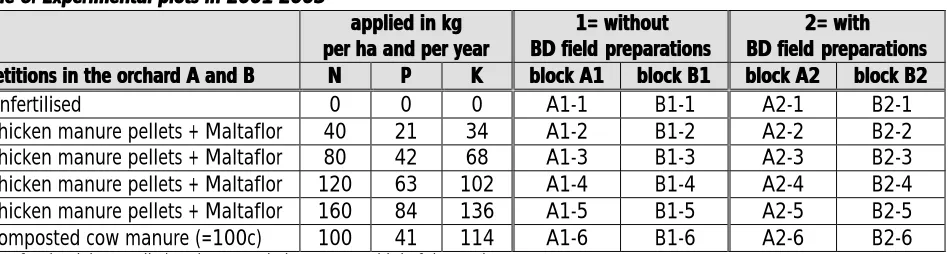
6 Experimental plots 2001-2003. 7 Layout of the plots in the orchard.
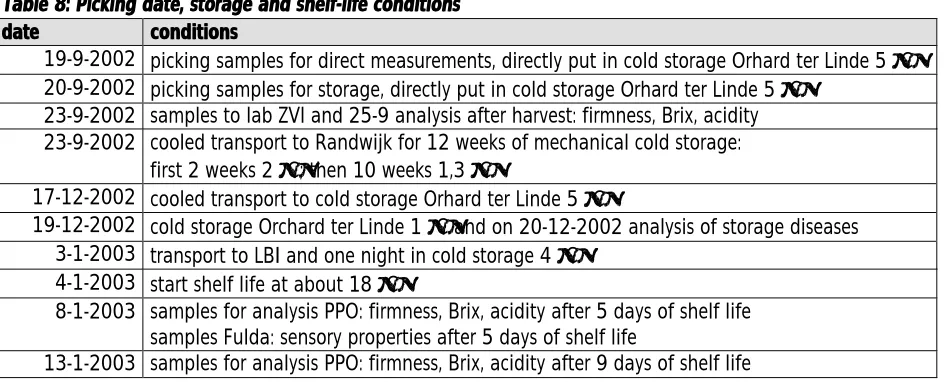
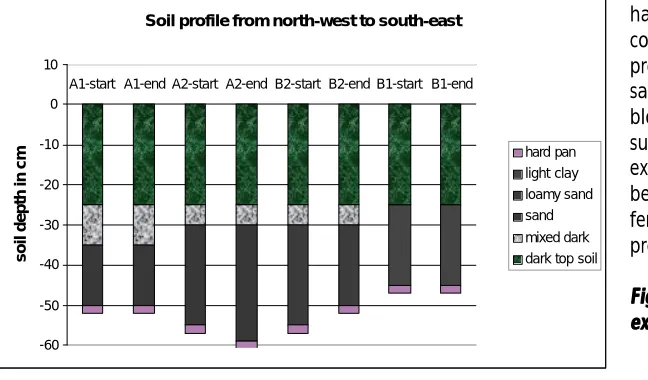
8 Picking date, storage and shelf-life conditions. 9 Description of weather conditions 2001-2003. 10 Soil profile in the experimental field.
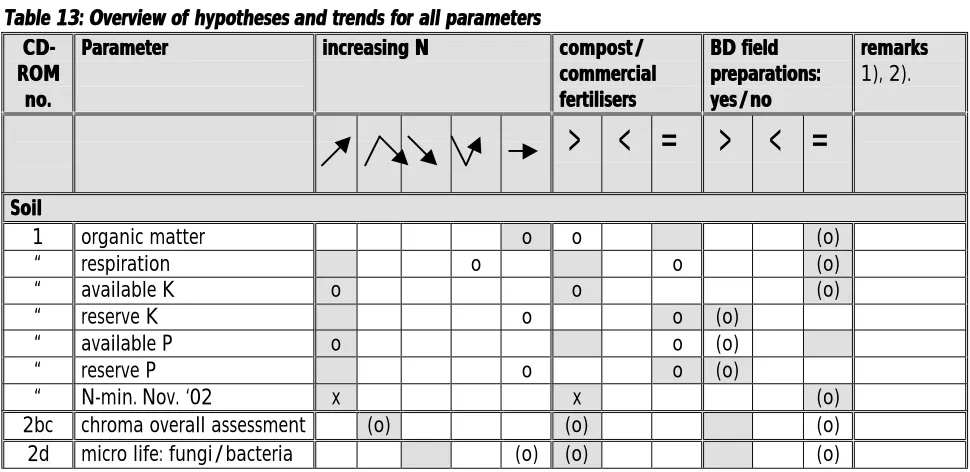
11 The development of tree vigour in 2001, 2002, 2003. 12 The development of nitrogen in leaves in 2001, 2002, 2003. 13 Overview of hypotheses and trends for all parameters. 14 Nitrogen in leaf (Aug. 2002) in the 4 blocks.
15 Fruit firmness (harvest 2002) in the 4 blocks. 16 Nitrate in soil (Autumn 2002).
17 Weed cover (2003). 18 Tree vigour (2002).
19 Nitrogen in leaves (Aug. 2002). 20 Tree flowering (2003).
21 Tree balance (2003). 22 Malic acid content. 23 Sourness in taste. 24 Calcium content of fruit. 25 Phenols content of fruit. 26 Natural fruit rot after storage. 27 Botrytis rot after inoculation of fruit. 28 Growth scores in CC-crystallisation of fruit.
29 Spectral range luminescence (R40W score Kwalis) of fruit. 30 Free amino acids content of fruit.
31 Protein ratio of fruit.
32 Different properties are best at different nitrogen levels 33 Leaf decomposition at the soil.
34 Soil life.
35 Overview of progress in finding life processes and parameters. 36 Correlations between vigour and firmness.
37 Correlations between nitrogen in fruit and firmness.
38 Correlations between free amino acids and nitrogen in fruit. 39 Correlations between phenols and fruit rot after storage.
40 Correlation between growth score in CC-crystallisation and tree vigour.
41 Correlation between growth score in spectral range luminescence (R40W) and tree vigour.
42 Differences between the two methods of delayed luminescence or fluorescence excitation spectroscopy. 43 Correlation between phenol content and fruit rot.
1
Summaries
1.1
English summary and conclusions
Parameters for apple quality and the development of the ‘Inner Quality
Concept’ 2001-2003
Joke Bloksma, Martin Northolt, Machteld Huber, Pieterjans Jansonius, Marleen Zanen, Louis Bolk Instituut, 2004.
…….
In the palm of his hand he holds all the sections, Lacks nothing, except the spirit's connections.
Goethe in Faust
Motivation
Public interest for inner quality aspects
Many organically grown products have won the acclaim of the best chefs. Growers know that good taste depends on moderate fertilisation and yields, careful ripening and freshness. The need to keep costs down, especially in conventional production but increasingly so in the organic sector as well, has however prompted concessions to be made with respect to inner quality. In an effort to cut the cost price, organic agriculture, too, is moving in the direction of higher yields, higher fertilisation levels, earlier harvests and trade chains involving lengthy journeys and extended storage. Farmers, growers and wholesalers are exploring the extent to which they can realise these economies without damaging the good level of inner quality of the products.
Also new questions have been raised about the pros and cons of genetic modification in the breeding and propagation of cultivars: Are genetically modified varieties less 'coherent', and if so, is this disadvantageous for health? Do food crops with enriched levels of vitamins or phenols enhance health? What do coherence, structure and ripeness, or typical characteristics mean in terms of taste and consumer health? These questions need to be answered.
Food quality is more than the sum of exterior characteristics, a few distinct component substances and the absence of harmful contaminants. We need to develop a new quality concept for food products. In order to satisfy today's consumers, organic and conventional production and supply chains must both respond to this demand.
Cooperation in the international association for organic Food Quality and Health (FQH)
The international research association Organic Food Quality and Health (FQH) was established to promote research into the health effects of good quality organic food. This type of research requires a coherent concept of quality with empirical parameters and a research methodology for measuring health effects. The research presented in this report thus serves the long-term research objective of FQH.
The first step was to define quality and to develop parameters to measure the different aspects of quality. To this end, we introduced the provisional concept of 'vital quality' in the first apple study. In the second apple study, this concept was further developed to 'inner quality'. A similar study has meanwhile been launched for carrots. Quality needs to be defined and measurable before the next question can be investigated, i.e. whether products with a high degree of 'inner quality' are indeed healthier for people, or certain groups of people.
Partners and financiers
Our partners in the second apple project were: Orchard ter Linde in Oostkapelle (NL), Kwalis Qualitätsforschung Fulda (D), Meluna Bio-photon research in Geldermalsen (NL), Elektro-chemisches Qualitäts labor, Weidenbach (D), Biodynamic Research Association Denmark (DK) and Louis Bolk Instituut in Driebergen (NL). In addition, we employed the services of many other parties.
New terms in the quality concept since the first apple study
The term vitality, used in the first apple study, raised considerable confusion, despite having been clearly described as the result of growth processes, and was therefore abandoned. For the same reason, the general term 'vital quality' was replaced with 'inner quality'.
It was difficult to find suitable generic terms for the product characteristics of growth, differentiation and integration, which would apply to all products. The use of the term 'structure' for the result of differentiation and the term 'coherence' for the result of integration was found to be inadequate for some products. We therefore preferred to select product characteristics for each product. For apple, for example, big size and crispness are the results of relatively strong growth processes, yellow fruit ground colour are the results ofrelativelystrong differentiation processes, while sweetness and aroma are the result of integration processes.
What is ‘Inner Quality’?
'Inner Quality' is an extension of existing quality criteria on shape and exterior, on the presence of desired and undesired substances, and on hygienic standards. Inner Quality refers to those characteristics which together result in a crop-specific product that is ripe, tasty and has satisfactory keeping quality. These characteristics develop as the crop grows, and result from the continuous interaction between growth and differentiation processes. Growers can direct these processes as desired using different crop management measures. A similar concept may be developed in the future for products of animal origin.
A Concept for Inner Quality
A coherent quality concept appropriate for living products
A quality concept must fulfil various requirements. It must of course tie in with growers' practices, regardless of whether they are organic or conventional. It is, after all, the grower who nurtures the life processes in crops or livestock. It is possible to distinguish growth processes and differentiation processes, and these processes can occur in varying proportions and degrees of mutual interaction (integration).
A quality concept should also establish a link between consumers' perception of product quality in the store and growers' perception of their crops. This will enable the grower to make adjustments in the course of the growing season, taking advantage of seasonal and soil variations, to realise optimum quality in the end product.
Consumers' wishes are never uniform: their food preferences depend on individual preferences, on their health and mood. There is a market for produce with different good qualities, just as there are people who like tart, crisp long-keeping apples while others prefer soft, sweet, aromatic apples. These different accentuations can be realised in the growing season. So there is no one optimal quality for everyone. The quality concept presented in table 1a therefore consists of three interlinked dimensions: crop management, processes and properties.
Methodology
The second apple study is part of the FQH related research programme of Louis Bolk Instituut to design and evaluate a new quality concept. The first apple study primarily concerned the design of the quality concept, and also examined growth and differentiation processes and investigated how these may be measured. In this second apple study, we designed a course of validation for the concept, and executed this in part. We also approached growers and researchers of other crops to determine whether they could subscribe to the concept and the two life processes and their integration (face validity and content validity). They did agree on the concepts of growth and differentiation. Some examples were published in a brochure on life processes in food crops (Life processes in crops, Bloksma and Huber, 2002). Difficulties arose with the concept of integration and the term vitality, and we worked on improving these. We have taken a new course in distinguishing the processes of growth and
differentiation per organ (fruit, blossom, shoot) and establishing development in relation to the course of the year. We scrapped plant hormones as an aspect of growth processes.
Table 1a: The renewed concept for ‘Inner Quality’ for apple, based on this study, literature and growers’
Table 1a: The renewed concept for ‘Inner Quality’ for apple, based on this study, literature and growers’
experience (? = still uncertain)
experience (? = still uncertain)
Inner Quality for apple
CROP MANAGEMENT
CROP MANAGEMENT
to regulate the growing crop
to communicate
with the grower
PROCESSES
PROCESSES
in the crop
to communicate
with the grower
PROPERTIES
PROPERTIES
of the crop or the final product
to communicate with
the grower, consumer and retailer
1. Growth
+ no limits in nutrients and water by optimal fertilising and watering
+ defruiting when heavy bearing
+ growth stimulating pruning
+ space (wide plant distance)
− root pruning, trunk notching
− controlled drought stress
− growth reducing pruning
• photosynthesis: primary metabolites (C-growth)
• nitrogen (and other nutrients) uptake (N-growth)
• filling reserves with starch, protein, etc
• forming mass
• maintenance of basic metabolism
• green vegetative mass, leaf size, tree vigour, fruit size, fruit weight, yield
• acid, starch
• amino acids, protein
• firmness, juiciness, crispness
• metabolic energy
• many fungal diseases and sucking insects (aphid)
• a high initial value in delayed luminescence
• perradation, fullness, expansion in CC-crystallisation pictures
2. Differentiation
+ light and dry warm growing place
+ reducing heavy growth
+ binding down young twigs
+ hormone ethylene
+ beehives for pollination
• refining, ordering
• ripening: starch -> sugars; acid -> aroma
• secundary metabolism
• induction of pollen, seeds and flower buds
• differentiated refined forms (leaf serrations, cork)
• order
• calcium, firm cell walls
• ethylen (=ripening hormone)
• ripe colours (yellow ground on fruit, autumn leaves)
• biting insects (blossom weevil, etc) and powdery mildew
• hyperbolic decay in delayed luminescence
• structure in CC-crystallisation pictures
1+2 Integration
+ growing phase-typical care for optimal proportion between growth AND differentiation
+ balanced nutrients, regular and slow release of nutrients (compost)
+ appropriate varieties
+ diseases preventing soil (by compost?)
+ diversity?
+ human attention?
+ harmonious landscape?
+ Biodynamic preparations?
• interaction between growth and differentiation in a species and stage balance =
‘maturing’
• forming sec. metabolites out of primary metabolites.
• self-regulating
• species-and stage-typical proportion of growth and differentiation properties = ‘maturation’
• tasty and red, glossy fruits = aroma + blush + shine + firmness + juiciness + sweetness
• high number of fertile generative organs (flower buds, seeds)
• phenols, vitamin C, tannin, wax, resin
• high ratio protein/total nitrogen
• self-regulation, elasticity, cell turgor, resistance to stress and diseases
• wound healing after damage
• species-typical in spectral range luminescence
There is a risk of using circular reasoning when introducing a new quality definition with experimental parameters. After all, it is difficult to introduce an unknown concept (in this case, integration) with unknown crop
management measures (such as biodynamic preparations) and to measure it with experimental parameters. Experimental parameters may correlate with established parameters (convergent validity), such as resistance to disease and evaluation of taste. In that case, the experimental parameters offer no added value and the
parameter which is least expensive to implement may be chosen. On the other hand, there may be no correlation and this would suggest that new aspects of quality have been found. Understanding might then be achieved by simultaneously working on the theoretical foundations of the new concept and executing experimental series to evaluate the concept. By logical reasoning, a new concept such as integration might be derived from known plant physiology concepts (in this case, growth and differentiation and, for example, self-regulation). This is known as
construct validity. The new concept may then be evaluated by comparing the actual results of experimental crop management measures with the expected results.
Life processes play a crucial role in this methodology: they provide the conceptual coherence and the handholds of the quality concept. 'Inner quality' can be deemed to be a meaningful concept that may be objectively measured when the experimental concepts, the implemented crop management measures and the measured parameters are found to be consistent and practically feasible over a period of several years (predictive validity). The aim of this second apple study is two-fold: pursuing further conceptual argumentation of the quality concept and conducting follow-up experimental trials on apples.
Design of the second apple experiment
Apples were chosen as our experimental crop for the development of the quality concept because considerable knowledge already exists about the inner quality aspects of apples. In addition, concepts such as growth and differentiation are commonly used by fruit growers. They acknowledge these terms and can take appropriate measures to regulate these. The downside of using apple as our experimental crop is that the apple tree is a complex organism with different organs (shoot, fruit, bud, root, trunk) which grow and differentiate in different stages. The study design reflected this complexity and subsequently it was not easy to draw conclusions from the study results. The comprehensive body of knowledge from conventional circles was used as a reference frame for evaluating the new experimental quality parameters and the new terms. The theoretical study into the quality concept was designed such that some practical questions from the orchardist involved could be answered, too.
In the first apple experiment, which took place in the same orchard, we used graduated reference series with small variations in growth and differentiation. The series were: duration of ripening, yield, sunlight exposure and post-harvest ageing.
New series were added in the second apple study in order to explore the concept of integration more extensively. One was a fertilisation series to explore the influence of fertilisation on the dynamic relationship between growth and differentiation. The second series was a dichotomous series of use or non-use of biodynamic field
preparations. Two aspects are involved in integration, namely the ratio and the degree of interaction between growth and differentiation. The aim of the fertilisation series was to explore the proportional relationship between these aspects, while we expected that the biodynamic field preparations would enhance the interaction between growth and differentiation.
In the orchard, the biodynamic preparations were laid out in duplicate, resulting in four blocks. Within each block, there was one fertilisation series made up of six different plots holding ten trees each: one plot was unfertilised, four had different dressings of commercial fertiliser and one received a dressing of semi-composted farmyard manure.
With respect to the last, we assumed that compost would influence and possibly improve the interaction between growth and differentiation. In each series, fertilisation regimes were assigned randomly to the plots. Thus we obtained two complete fertilisation series in which biodynamic field preparations were applied and two complete fertilisation series in which no biodynamic field preparations were used.
The experimental conditions were controlled for homogeneity of the plot (minor differences in soil type), differences in speed of ripening (not found), equal bearing (found) and availability of standard fruits for
It takes time for fertilisers to take effect in perennial crops, so we decided to implement the different fertilisation regimes for three years and to make a general assessment of the crop over three years, too. A detailed evaluation of the crop and the quality of the apples was conducted only in the second year, on the basis of 80 standard fruits picked from each plot. These were distributed for analysis to the different participating laboratories.
Conclusions applying to this orchard
The effect of different levels of fertilisation
Fruit growers wanted to know the optimum fertilisation regime for a high, regular yield and good fruit quality. In terms of the quality concept, we wanted to know whether the level of fertilisation effects a shift in the
proportionate relationship between growth and differentiation.
The fertilisation regimes were carried out each year in the spring. A combination of two commercially available fertilisers was used. The first, Maltaflor, is made of the waste products of conventional sugar and beer production and contains nutrients which are released very quickly. The second commercial fertiliser was organic poultry manure in pellet form, which nutrients released slightly less rapidly. The incremental steps in the fertilisation series, expressed in kilograms of nitrogen per hectare, were: 0, 40, 80, 120 and 160. This gradation applied to all nutrients but here we have distinguished them only in terms of nitrogen, since nitrogen was the limiting mineral for this orchard.
After one to two years, these fairly large differences in fertilisation had only resulted in relatively small differences in trees and apples. After two to three years it had become clear that the 0 kg N/ha and 40 kg N/ha regimes were inadequate (the trees had a non-bearing year) and that fertilising with 160 kg N/ha was too much of a good thing (poor fruit quality). As expected, higher fertilisation stimulated growth characteristics and caused a decline in differentiation characteristics: there was a longer period of shoot growth and there were more shoots, but there were also more fungal infections, darker and larger leaves, higher nitrogen levels in the bud, leaf and fruit, and more and stronger blossom formation for the following year. Higher levels of fertilisation yielded larger apples which were less firm and slightly less tart, with less blush, a lower phenol content and a greater
susceptibility to fruit rot.
For this site, a fertilisation regime of about 100 kg N/ha best realised the two-fold objective of regular yield and good inner quality. The trees were 12-year-old Elstars, a variety which is susceptible to non-bearing years, growing on weak root stocks (M9, 2460 trees/ha). The soil fixed nitrogen easily. In this orchard, it should be possible to achieve a regular yield of about 40 tonnes per hectare under organic conditions. In addition to using the optimum fertilisation regime, it is necessary to defruit on time, to water the trees in dry periods, and to prevent competition from weeds, frost damage, diseases and pests.
The effect of compost versus commercial fertilisers
Fruit growers asked us what would be the best fertiliser for a biodynamic orchard. In terms of the quality concept, we wanted to know if compost dressings would result in greater integration. In addition to the fertilisation regimes above, we included an additional regime of semi-composted farmyard manure (100 kg N/ha) applied in spring. We hypothesised that the nutrients in compost are released slowly over a longer period of time, in contrast with the commercial fertilisers used in our study which release most nutrients early in the year. We expected that the rapid availability of nutrients in spring would however better suit the requirements of the tree, and that commercial fertilisers would be easier to apply. Another advantage of commercial fertilisers is that orchardists are not dependent on adequate availability of local manure production.
the nutrient requirements of both soil and trees are fulfilled. For best results in practice, compost and commercial fertilisers could be applied in combination.
After two to three years of applying these different fertilisation regimes, we found no differences in the trees or fruits which could be attributed to different rates or patterns of nutrient release, nor did we find any indication that compost leads to better integration, besides an inclination in one of the two testing panels to give a higher assessment of taste.
The effect of biodynamic field preparations
Fruit growers wanted to know if the effect of biodynamic field preparations could be made more visible for themselves and for consumers. In terms of the quality concept, we wanted to know if the use of biodynamic field preparations resulted in greater integration.
For our trial, we mapped out two biodynamic series, i.e. a total of four blocks measuring 33 by 50 square metres. Over a period of two years, the application of biodynamic field preparations was stopped on two blocks, while their use was continued on the other two blocks and in the surrounding orchard. Since the effects of this
management measure are not clearly established, we did not know whether the period of two years without would be sufficient after 80 years of application, nor did we know whether the distance between treated and untreated plots was sufficient, or whether the application frequency (about 8 times a year) was effective.
We found a significantly higher rate of leaf decomposition in treated plots, which could not be explained by other factors. As for most other differences observed, these could also be attributed to soil differences. Only two series with biodynamic preparations could be mapped in this orchard and the differences for most parameters were small. Plots treated with biodynamic preparations had the following characteristics: greater reserves of phosphor and potassium in the soil and the fruit, higher calcium content in the leaf, more fruit rot and scab after storage, a tendency towards higher assessment of taste, more differentiation and integration in the copper chloride
crystallisations (=CC-crystallisations) and a different luminescence value.
It remains difficult to establish, methodically, the effect of a measure which needs to be applied over large areas. Statistical significance of the results could not be calculated because these series only had two independent repetitions and differences in soil conditions. Effects can only be established with certainty by conducting multiple trials which show similar tendencies.
Conclusions regarding the development of the quality concept
We found clear correlations between management measures, tree characteristics and fruit characteristics. This means that growers can regulate apple quality during the growing season. On the basis of the two apple
experiments, we can distinguish respective sets of growth and differentiation parameters and evaluate them in the light of conventional fruit cultivation science. Our results have little new value for fruit growing in practice, however. The value of our research lies in the approach developed to draw up a quality concept and the way in which we can apply this concept to crops about which little knowledge exists regarding the relationship between management measures, crop characteristics and product quality characteristics. Our research also offers a method to validate experimental parameters.
Identifying parameters
Table 1a lists the management measures, physiological processes and product characteristics found in the literature and proposed by growers on the basis of their own experiences. The parameters below were confirmed by our apple experiments.
Growth
The parameters of tree growth are: fruit-bearing (on condition of equal shoot growth and bearing in previous year), shoot growth (combination of number of shoots, shoot length, termination of shoot growth and on condition of equal bearing), leaf size or colour (on condition of equal shoot growth), nitrogen content in bud, nitrogen and magnesium contents in leaf, and scab infestation.
equal bearing and shoot growth), acidity, nitrogen content, amino acid content, protein content, tart and crisp taste, growth score on copper chloride crystallisation images, high initial delayed luminescence, susceptibility to fruit rot.
Differentiation
Parameters of tree differentiation are: autumn colours and bud formation (on condition of equal bearing). Parameters of fruit differentiation are: hue of blush, yellow ground colour, shape of fruit, sheen, starch conversion, differentiation score on copper chloride crystallisation images, hyperbolic decline of photons (Meluna, Kwalis).
Growth and differentiation
For most plant processes, both growth and differentiation are important. Many parameters can therefore express both growth and differentiation, depending on which is the limiting factor. For example, bud formation is a parameter of growth when fertilisation is the limiting factor. If the limiting factor is sunlight exposure, bud formation acts as a differentiation parameter in a light exposure series. Another example of parameters which express both growth and differentiation is the content of secondary metabolites in the plant, such as phenols, vitamins, aromas and the red colouring agents of fruit. The formation of the raw material (assimilates) is a growth process; the subsequent conversion to secondary metabolites is a differentiation process. A correlation with either growth or differentiation is found depending on when the measurements were taken and what the limiting factors are.
Integration
There are parameters which could potentially give an indication of the degree of integration. These are: resistance to diseases and pests, overall taste, phenols, ratio of proteins to free amino acids, integration score on copper chloride crystallisation images, species-specific colour ratio in spectral range luminescence (Kwalis). Universally accepted measurement methods exist for the first three, the last three have only recently been validated for carrots and wheat. The last results obtained do not yet allow clear interpretations as regards the assessment of quality. To this end, the quality concept must provide a context for these measures, and still more reference series, as used in the two apple studies, must be established.
Copper chloride crystallisations and spectral range luminescence dovetail well with the quality concept since both techniques can be evaluated on all three aspects: growth, differentiation and integration. This study produced a successful growth series, and for both techniques we found that the growth aspect correlated with many universally accepted growth parameters. Unfortunately, in this study there was too much variation in electro-chemical measurements to be able to establish differences between treatments.
Recommendations for future research
Further research is necessary to validate the quality concept. Our suggestions are listed below.
• The integration concept and its management measures need to be substantiated in plant physiological terms, so that integration experiments may be designed for apple and other crops.
• Experimental series need to be carried out for other crops than apple and carrot. Such experiments should fulfil the following requirements:
∗ a simple crop with a limited number of organs;
∗ serial implementation of management measures, with gradual changes in one factor, from too low to too high, while other factors remain constant;
∗ diseases and pests should not be prevented and eradicated after the young stage, as degree of resistance is an important integration parameter.
• The inner quality concept needs to be reviewed more extensively in the context of other quality concepts.
1.2
Nederlandse samenvatting en conclusies
Parameters voor appelkwaliteit en de ontwikkeling van het ‘Innerlijke
Kwaliteitsconcept’ 2001-2003.
Joke Bloksma, Martin Northolt, Machteld Huber, Pieterjans Jansonius, Marleen Zanen, Louis Bolk Instituut, 2004.
……
Dan heeft hij alle delen in zijn hand, Ontbreekt echter, de geestelijke band.
Goethe in Faust
Aanleiding
Maatschappelijke interesse voor innerlijke kwaliteitsaspecten
Veel biologisch geteelde producten werden geroemd om hun goede smaak door topkoks. Telers weten dat voor een goede smaak een niet al te hoog productieniveau, een matige bemesting, zorgvuldige rijping en versheid van belang zijn. Vooral in de gangbare landbouw, maar nu ook in toenemende mate in de biologische landbouw, staat de kostprijs zo onder druk dat concessies gedaan worden ten aanzien van de innerlijke kwaliteit. Ook de biologische landbouw wil hogere opbrengsten, gaat meer bemesten, oogst op een vroeger tijdstip en maakt gebruik van handelsketens met langdurig transport en opslag om de kostprijs te drukken. Boeren, tuinders en handelaren zijn op zoek hoe ver ze kunnen gaan met deze kostprijsverlaging, zonder afbreuk te doen aan de goede innerlijke kwaliteit van de producten.
Tevens zijn bij de veredeling van landbouwgewassen vragen gerezen over de voor- en nadelen van genetische modificatie. Is het zo dat genetisch gemodificeerde gewassen minder ‘samenhang’ vertonen en zo ja, is dit
ongunstig voor de gezondheid? Is het een voordeel voor de gezondheid om gewassen te veredelen met extra hoge gehaltes vitaminen of fenolen? Welke betekenis heeft samenhang, structuur en rijpheid, of product-typiciteit voor smaak en voor de gezondheid van de consument? Dit zijn de soort vragen waarop een antwoord wordt gezocht. Voedselkwaliteit moet niet beperkt worden tot een beoordeling van uiterlijk, enkele afzonderlijke inhoudstoffen en de afwezigheid van ongewenste contaminanten. Daarom is een nieuw kwaliteitsconcept voor voedingsgewassen nodig. Dit vraagstuk is voor zowel de biologische als voor de gangbare handelsketens uiterst actueel om hun consumenten te bedienen.
Samenwerking binnen de internationale vereniging ‘organic Food, Quality and Health’
De internationale onderzoeksvereniging ‘organic Food, Quality and Health’ (FQH) is opgericht om onderzoek te bevorderen naar de gezondheidseffecten van biologisch voedsel van goede kwaliteit. Daartoe is een
samenhangend kwaliteitsbegrip nodig met toetsbare parameters en onderzoeksmethodieken om
gezondheidseffecten te meten. Dit lange termijn doel is de context van het hier gepresenteerde onderzoek. De eerste stap is het ontwikkelen van kwaliteitsbegrippen en parameters om verschillende aspecten van kwaliteit te meten. Hiervoor is het voorlopige concept van de ‘vitale kwaliteit’ geïntroduceerd in het eerste appelonderzoek. In dit tweede appelonderzoek is dit concept verder ontwikkeld tot ‘innerlijke kwaliteit’. Inmiddels is ook een vergelijkbare opzet van onderzoek naar wortel in uitvoering. Als de kwaliteit omschreven en meetbaar is, is pas de volgende stap mogelijk, namelijk het toetsen of producten met een hoge ‘innerlijke kwaliteit’ inderdaad gezonder zijn voor (bepaalde groepen) mensen.
Partners en financiers
Partners in dit tweede appelproject waren: Boomgaard ter Linde in Oostkapelle (NL), Kwalis Qualitätsforschung Fulda (D), Meluna Bio-fotonen onderzoek in Geldermalsen (NL), Elektro-chemisches Qualitäts labor, Weidenbach (D), Biodynamic Research Association Denemarken (DK) en het Louis Bolk Instituut in Driebergen (NL). Daarnaast hebben we nog gebruik gemaakt van de diensten van vele anderen.
en het interne projectenfonds van het Louis Bolk Instituut (NL).
Concept voor Innerlijke kwaliteit
Samenhangend kwaliteitsconcept passend bij levende producten
Er zijn verschillende eisen opgesteld, waaraan een kwaliteitsconcept moet voldoen. Het moet aansluiten bij hoe een (biologische) teler werkt: hij of zij verzorgt levensprocessen in het gewas of dier. Hier zijn groeiprocessen en differentiatieprocessen te onderscheiden, en deze kunnen in verschillende verhouding en onderlinge
samenwerking optreden (integratie).
Het kwaliteitsconcept moet ook een verbinding leggen tussen hoe consumenten naar de kwaliteit van het product in de winkel kijken en hoe telers naar hun gewassen kijken. Dit maakt het mogelijk dat de teler tijdens de teelt kan bij sturen naar een optimale kwaliteit van het eindproduct, inspelend op de variatie door elk seizoen en elke grondsoort. Consumenten hebben geen uniforme wensen; zij zullen voorkeur hebben voor voedsel afhankelijk van individuele voorkeur, gezondheid en gemoedstoestand. Er is een markt voor verschillende goede kwaliteiten, zoals een lang houdbare, frisse, knapperige appels naast zachte, zoete, aromatische appels. In de teelt kunnen zulke accenten al gelegd worden. De optimale kwaliteit is dus niet voor iedereen hetzelfde. In het kwaliteitsconcept (tabel 1b) zijn daarom 3 kolommen, die de relatie leggen tussen de teeltmaatregelen, de levensprocessen en de producteigenschappen.
Nieuwe termen in het kwaliteitsconcept sinds het vorige appelrapport
Het begrip vitaliteit, zoals gebruikt in het eerste appel project, gaf veel verwarring, ook al was vitaliteit in het eerste appelonderzoek eenduidig omschreven als het resultaat van groeiprocessen, zodat deze term is losgelaten. Om deze reden is ook de overall term ‘vitale kwaliteit’ vervangen door ‘innerlijke kwaliteit.
Het was lastig om termen te vinden voor de producteigenschappen van groei, differentiatie en integratie, die voor alle producten gelden. ‘Structuur’ als resultaat van differentiatie en en ‘samenhang’ als resultaat van integratie dekken het begrip niet goed voor alle producten. Daarom kiezen we bij voorkeur de producteigenschappen per product. Voor appel is bijvoorbeeld groot en knapperig het resultaat van relatief sterke groeiprocessen, gele grondkleur zijn het resultaat van relatief sterke differentiatieprocessen en zoet en aromatisch het resultaat van integratie.
Wat is ‘innerlijke kwaliteit’ ?
‘Innerlijke kwaliteit’ is een uitbreiding van bestaande kwaliteitscriteria aangaande vorm en uiterlijk, gewenste en ongewenste inhoudsstoffen en afwezigheid van ziektekiemen. Het gaat bij 'Innerlijke kwaliteit' om die
eigenschappen, die met elkaar tot een gewas-kenmerkend, gerijpt, smakelijk en voldoende houdbaar product leiden. Deze eigenschappen ontstaan tijdens de ontwikkeling van het gewas door een voortdurend samenspel van groei- en differentiatieprocessen, die door teelthandelingen van de teler kunnen worden bijgestuurd. Voor dierlijke producten is in de toekomst een vergelijkbaar begrip op te stellen.
Methodologie
Dit tweede appelonderzoek is een onderdeel van het werk van het Louis Bolk Instituut, in het kader van de FQH-vereniging, om een nieuw kwaliteitsconcept te ontwerpen en te toetsen. In het eerste appelonderzoek lag de nadruk op het ontwerp van het kwaliteitsconcept, op groei- en differentiatieprocessen en hoe deze te meten zijn. In dit tweede appelproject is een validatie-route ontworpen voor het concept, en hiervan is een deel uitgevoerd. Bij telers en onderzoekers van andere gewassen is nagegaan of het concept en de twee levensprocessen en hun integratie herkend worden (face validity en content validity). Dit was het geval voor de begrippen groei en differentiatie. Een aantal voorbeelden zijn gepubliceerd in de brochure ‘Levensprocessen in voedingsgewassen’ (Bloksma and Huber, 2002). Het begrip ‘integratie’ en de term ‘vitaliteit’ bleken problematisch en hier is aan verder gewerkt. Nieuw is dat we de processen groei en differentiatie onderscheiden per orgaan (vrucht, bloem, scheut) en de ontwikkeling plaatsen in het jaarverloop. Het noemen van plantenhormonen bij groeiprocessen is geschrapt.
Tabel 1b: Het vernieuwde concept voor ‘Innerlijke kwaliteit’ voor appel op basis van dit onderzoek, literatuur en Tabel 1b: Het vernieuwde concept voor ‘Innerlijke kwaliteit’ voor appel op basis van dit onderzoek, literatuur en ervaringen van telers (?= nog onzeker).
ervaringen van telers (?= nog onzeker).
Innerlijke Kwaliteit bij appels
TEELTMAATREGELEN
TEELTMAATREGELEN
om het gewas tijdens de teelt
‘bij te sturen’
in gesprek met de teler
PROCESSEN
PROCESSEN
in het gewas
in gesprek met de teler
EIGENSCHAPPEN
EIGENSCHAPPEN
van het gewas of het eindproduct
in gesprek met
teler, consument en handelaar
1. Groei
+ geen beperking in voedings-stoffen en water door optimale bemesting en watergift
+ vruchtdunnen bij hoge dracht
+ groeistimulerende snoei
+ ruimte (wijde plant-afstand)
− wortelsnoei, inzagen van de stam
− gecontroleerde droogtestress.
− groeiremmende snoei
• photosynthese: primaire metabolieten (C-groei)
• stikstof (en andere voedings-stoffen) opname (N-groei)
• vullen van de reserve organen met zetmeel, eiwit, etc
• massa vorming
• onderhoud (basis stofwisseling)
• groene vegetatieve massa, bladgrootte, scheutgroei, vruchtgrootte,
vruchtgewicht, opbrengst
• zuur, zetmeel
• aminozuren, eiwit
• hardheid, sappigheid, knapperigheid.
• metabolische energie
• diverse schimmelziekten en zuigende insecten (bladluizen)
• hoge aanvangswaarde bij biofotonen
• expansie, vertakking en gevuldheid in CC-crystallisatie beelden
2. Differentiatie
+ lichte en warme groeiplaats
+ beperking van groei
+ jonge takken uitbuigen
+ hormoon ethyleen
+ bijenkasten voor extra bestuiving
• verfijning, ordening
• rijping: zetmeel -> suikers; zuur -> aroma
• secundair metabolisme
• inductie van stuifmeel, zaden en bloemknoppen
• gedifferentieerde, fijne vormen (bladtandjes, kurk)
• orde
• calcium, stevige celwanden
• ethyleen (=rijpingshormoon)
• rijpe kleur (gele grondkleur op fruit, herfstkleuren op blad)
• bijtende insecten (bloesemkever, etc) en echte meeldauw
• hyperbolische afname van biofotonen
• structuur in CC-crystallisatie beelden
1+2 Integratie
+ zorg voor optimale verhou-ding tussen groei en differen-tiatie in elk groeistadium
+ voedingstoffen in goede verhouding en regelmaat in vrijkomen (compost)
+ passende rassen
+ ziektewerende bodem (door compost?)
+ diversiteit?
+ menselijke aandacht?
+ harmonieus landschap?
+ biologisch-dynamische preparaten?
• samenwerking tussen groei en differentiatie in een
verhouding die past bij soort en groeistadium
• vorming van secundaire metabolieten uit primaire metabolieten
• zelfregulatie
• bij soort en groeistadium passende verhouding tussen groei en differentiatie kenmerken
• smakelijke en rood glanzende vruchten = aroma + blos + glans + hardheid + sappigheid + zoetheid
• veel vruchtbare, generatieve organen (pitten, bloemknoppen)
• fenolen, vitamine C, tannine, was, hars
• veel eiwit tov totaal stikstof
• zelfregulatie, elasticiteit, turgor, weerstand tegen stress and ziekten.
• wondherstel na beschadiging
• producteigen kleurenverhouding in spectral range luminicentie
Het introduceren van een nieuw kwaliteitsbegrip met experimentele parameters brengt het risico met zich mee van cirkelredeneringen. Immers een onbekend begrip (in dit geval integratie), laat zich moeilijk introduceren via onbekende teeltmaatregelen (zoals biologisch-dynamische preparaten) en meten door experimentele parameters. Experimentele parameters kunnen correleren met bekende parameters (convergent validity), zoals de weerstand tegen ziekten en de optimaal gewaardeerde smaak. In dat geval voegen ze geen extra informatie toe en kan gekozen worden voor de minst dure parameter. Maar er kan ook géén correlatie gevonden worden; dit duidt op mogelijke nieuwe aspecten van kwaltiteit. De methodische houvast wordt dan gevonden door zowel te werken aan het theoretisch onderbouwen van het nieuwe begrip, als aan het uitvoeren van experimentele series die het begrip toetsen. Een nieuw begrip (zoals integratie) kan via logisch redeneren afgeleid worden uit bekende plantenfysiologische begrippen (in dit geval groei en differentiatie en bijvoorbeeld zelfregulatie: de construct validity). Het nieuwe begrip kan getoetst worden door de gevolgen van experimentele teeltmaatregelen te vergelijken met de verwachting.
De levensprocessen spelen in deze methodologie een cruciale rol; zij vormen de begripsmatige samenhang en het houvast in het kwaliteitsconcept. Als deze experimentele begrippen, uitgevoerde teeltmaatregelen en gemeten parameters zich gedurende meerdere jaren bij verschillende gewassen consistent en praktisch bruikbaar tonen
(predictive validity), dan kan vertrouwen ontstaan dat ‘innerlijke kwaliteit’ een zinvol en toetsbaar concept is. Beide wegen komen in dit tweede appelonderzoek aan bod: verdere begripsmatige onderbouwing van het kwaliteitsconcept èn een vervolg experimenteel onderzoek met appels.
Opzet van het tweede experiment met appel
Appels zijn gekozen als testgewas voor het te ontwikkelen van het kwaliteitsbegrip, omdat juist bij appels al zo veel kennis bestaat over innerlijke kwaliteitsaspecten. Bovendien zijn begrippen als groei en differentiatie
gemeengoed onder fruittelers. Zij kunnen deze begrippen herkennen en teeltmaatregelen nemen om bij te sturen. De keerzijde van appel als testgewas is dat een appelboom met de verschillende organen (scheut, vrucht,
bloemknop, wortel, stam), die in verschillende stadia groeien en differentiëren, de proefopzet en het trekken van conclusies erg complex maken. De uitgebreide gangbare kennis wordt als referentie gebruikt voor de beoordeling van de nieuwe experimentele kwaliteitsparameters en de nieuwe begrippen. Het theoretisch onderzoek naar het kwaliteitsconcept is zo opgezet, dat tevens een aantal praktische vragen uit de betreffende boomgaard
beantwoord kunnen worden.
In het eerste appel experiment in dezelfde boomgaard is gekozen voor referentieseries die in kleine stapjes varieerden tussen extremen in groei en differentiatie, te weten rijpingsduur, productieniveau, van licht naar schaduw en veroudering na pluk. In dit tweede appelonderzoek zijn series toegevoegd om het begrip ‘integratie’ verder te verkennen. Namelijk, één serie met bemestingstrappen waarbij door het bemestingsniveau de
verhouding tussen groei en differentiatie verschuift van het ene extreme naar het andere extreme. Hierover heen ligt een serie met en zonder biologisch-dynamische spuitpreparaten. Bij integratie spelen twee aspecten mee, namelijk de verhouding èn de mate van onderlinge samenwerking tussen groei en differentiatie. Het aspect van de verhouding onderzoeken we door de bemestingstrappen en de veronderstelling is dat die
biologisch-dynamische preparaten de onderlinge samenwerking tussen groei en differentiatie verhogen. In de serie met bemestingstrappen door handelsmeststoffen is ook nog een variant met compost opgenomen vanuit de
veronderstelling dat compost een verschuiving en mogelijk een betere samenwerking tussen groei en differentiatie zal laten zien.
In de boomgaard lagen 4 grote blokken, waarvan 2 wel en 2 niet met Bd-spuitpreparaten zijn behandeld. Binnen elk blok lag een bemestingsserie van 6 veldjes met elk 10 bomen: 1 veldje onbemest, 4 veldjes met verschillende dosering handelsmeststof en 1veldje met half verteerde compost.
De experimentele omstandigheden zijn gecontroleerd op homogeniteit van het proefveld (geringe verschillen in grondsoort), verschil in rijpingssnelheid (niet gevonden), gelijke dracht (goed gevonden) en gestandaardiseerde vruchten voor beoordeling (70-90 mm diameter, gaaf, op middelmatige hoogte in representatieve bomen, geheel tot half in de zon).
Conclusies voor deze boomgaard
Effect van bemestingsniveaus
De fruittelers hadden een vraag naar het optimale bemestingsniveau voor een hoge, regelmatige productie en een goede vruchtkwaliteit. Vanuit het kwaliteitsconcept was er de vraag of het bemestingsniveau tot een verschuiving in verhouding tussen groei en differentiatie leidt.
De bemestingstrappen zijn jaarlijks in het voorjaar uitgevoerd met een combinatie van twee handelsmeststoffen. De ene meststof is ‘Maltaflor’, gemaakt uit restproducten van gangbare suiker- en bierproductie, waaruit
nutriënten zeer snel vrij komen. De tweede handelsmeststof is biologische kippenmestkorrel, waaruit nutriënten iets minder snel vrij komen. De bemestingstrappen gelden voor alle nutriënten, maar we drukken ze hier uit in hoeveelheid stikstof omdat stikstof het beperkende mineraal is voor deze boomgaard: 0, 40, 80, 120, 160 kgN/ha.
Na 1 à 2 jaar uitvoeren bleek dat deze vrij grote verschillen in bemesting tot relatief geringe verschillen in de bomen en appels leidde, maar na 2 à 3 jaar werd duidelijk dat 0 en 40 kgN/ha toch duidelijk te weinig was (bomen kwamen in beurtjaar) en dat 160 kgN duidelijk te veel was (slechte vruchtkwaliteit).
Toename in bemestingsniveau liet inderdaad een toename zien van groeikenmerken en een afname van
differentiatiekenmerken: meer en langer doorgaande scheutgroei waardoor ook meer schimmelziekten, donkerder groen en groter blad, hogere stikstofgehalten in knop, blad en vrucht, meer en sterkere bloemknopvorming voor het volgende jaar. Bij meer mest waren de appels groter, minder hard en iets minder zuur, met een lager fenolgehalte, meer vruchtrot en minder blos.
Voor het combineren van een regelmatige productie èn appels met een goede innerlijke kwaliteit bleekt het optimale bemestingniveau voor dit perceel rondom 100 kgN/ha. Het gaat om een 12 jarige aanplant van het beurtjaargevoelige ras Elstar op een zwakke onderstam (M9, 2460 bomen/ha) op een grondsoort die stikstof gemakkelijk vasthoudt. Een regelmatige productie van about 40 ton appels/ha onder biologische
omstandigheden blijkt hier haalbaar. Naast de vermelde bemesting zijn een tijdige vruchtdunning, water geven bij droogte, voorkomen van concurrentie door onkruid, preventie van schade door nachtvorst, ziekten en plagen de voorwaarden om tot deze productie te komen.
Effect van compost in vergelijking met handelsmeststoffen
De fruittelers hadden een vraag naar de optimale meststof voor een biologisch-dynamische boomgaard. Vanuit het kwaliteitsconcept was er de vraag of compost een maatregel is die tot meer integratie leidt.
Naast deze bemestingstrappen is daarom een variant opgenomen met half verteerde biologisch-dynamische compost (100 kgN/ha) in het voorjaar. We veronderstelden dat compost nutriënten regelmatig over het jaar vrijgeeft en dat dit bij de gebruikte handelmeststoffen vooral vroeg in het jaar gebeurt. Dit laatste past beter bij de veronderstelde behoefte van de boom. Handelsmeststoffen zijn veel gemakkelijker toepasbaar en maken de boomgaard onafhankelijk van een nabije mestproductie.
In dit onderzoek bleek dat het toepassen van compost duidelijke voordelen geeft boven de handelsmeststoffen voor de bodem: meer bodemleven en snellere bladvertering. Snelle bladvertering is van belang om ziekten, zoals appelschurft, niet te laten overwinteren in de boomgaard. Toepassen van de compost liet zien dat boom en vruchteigenschappen op korte termijn (na 1 à 2 jaar toepassing) vergelijkbaar zijn met onbemeste velden en na langere termijn (2 à 3 jaar) vergelijkbaar zijn met de middelmatig bemeste velden met handelsmeststoffen. Uitgaande van het geven van 100 kgN/ha komt in het geval van compost de voeding iets meer ten goede aan opbouw van de bodemvruchtbaarheid en bij de handelsmeststoffen meer ten goede aan de boom. Van compost zal dus meer kgN/ha gegeven moeten worden om zowel bodem als boom te voeden. Voor de praktijk is de combinatie van compost en handelsmeststoffen ook een goede mogelijkheid.
Na 2 à 3-jarig gebruik van deze mestsoorten vonden we geen verschil meer in de boom of vrucht die verklaard kan worden door het verschil in dynamiek van vrijkomende nutriënten. We hebben ook geen aanwijzingen gevonden voor een betere integratie door compost, behalve de tendens tot betere smaak bij één van de twee smaakpanels.
Effect van biologisch-dynamische spuitpreparaten
De fruittelers hadden de vraag hoe ze de werking van biologisch-dynamische preparaten voor zichzelf en voor de consument duidelijk kunnen ervaren. Vanuit het kwaliteitsconcept was er de vraag of Bd-preparaten een
maatregel is die tot meer integratie leidt.
van preparaten), of de afstand tussen wel en niet behandeld ver genoeg was, en of de frequentie van toepassing (about 8 bespuitingen per jaar) effectief was. In de blokken met preparaten werd een significant snellere bladvertering gevonden, die niet verklaard kan worden door andere factoren. Voor de meeste andere verschillen geldt dat ze zowèl door preparaten als door bodemverschillen verklaard worden. Dit komt doordat er slechts 2 onafhankelijke herhalingen in de proefopzet zaten en de meeste parameters slechts geringe verschillen lieten zien. De blokken met biologisch-dynamische preparaten onderscheidden zich in: meer fosfor en kalium in de
bodemreserve en in de vrucht, meer calcium in het blad, méér vruchtrot en bewaarschurft na bewaren, tendens tot betere smaak, meer differentiatie en integratie in de kristallisatiebeelden en een andere waarde in luminicentie. Het blijft methodisch lastig om het effect vast te stellen van een maatregel die grote oppervlakten verlangt. Er is dan snel sprake van onvoldoende onafhankelijke herhalingen en van verschillen in bodemomstandigheden. De zekerheid moet gevonden worden door meerdere onderzoeken met vergelijkbare tendens.
Conclusies voor de ontwikkeling van het kwaliteitsconcept
We vonden duidelijke correlaties tussen teeltmaatregelen, kenmerken van de boom en kenmerken van de vruchtkwaliteit. Dit maakt het mogelijk dat de fruitteler tijdens het groeiseizoen kan sturen op gewenste appelkwaliteit. Op basis van beide appelonderzoeken is het mogelijk een groot deel van de parameters te groeperen als groei en differentiatieparameters en te toetsen tegen de gangbare kennis in de fruitteelt. Voor de praktische fruitteelt levert dit niet veel nieuws. De waarde van het onderzoek ligt in de werkwijze om een
kwaliteitsconcept te ontwikkelen om deze vervolgens toe te passen op gewassen waarbij weinig bekend is over de relatie tussen teeltmaatregelen, gewaskenmerken en productkwaliteitskenmerken. Ook biedt het een methode voor de validatie van de experimentele parameters.
Het karakteriseren van parameters
In tabel 1b staan teeltmaatregelen, fysiologische processen en productkenmerken genoemd op basis van literatuur en ervaringen van telers. In de beide appelonderzoeken is dit ook inderdaad gevonden voor de hierna genoemde parameters.
Groei
Parameters voor groei van de boom zijn: dracht (mits gelijke scheutgroei en dracht vorig jaar), scheutgroei (combinatie van aantal scheuten, scheutlengte, afsluiting van de scheutgroei en mits gelijke dracht), bladgrootte of -kleur (mits gelijke scheutgroei), stikstofgehalte in de knop, stikstof- en magnesiumgehalte in blad en
aantasting van schurft. Parameters voor groei van de vrucht zijn: vruchtgrootte of –gewicht (mits gelijke dracht), hardheid (bij gelijke dracht en scheutgroei), zuurgehalte, gehalten van stikstof, vrije aminozuren en eiwit, fris zure en knapperige smaak, groeiscore in kristallisatiebeelden, hoeveelheid biofotonen direct na excitatie, gevoeligheid voor vruchtrot.
Differentiatie
Parameters voor differentiatie van de boom zijn: herfstkleuren en bloemknopvorming (mits gelijke dracht). Parameters voor differentiatie van de vrucht zijn: kleur van blos, gele grondkleur, vorm van de vrucht, glans, omzetting van zetmeel, differentiatiescore in kristallisatiebeelden, hyperbolische afname van fotonen (Meluna, Kwalis).
Groei èn differentiatie
Voor de meeste plantenprocessen zijn zowel groei als differentiatie van belang. Daarom kunnen veel parameters zowel groei- als differentieparameters zijn, afhankelijk van welke factoren de beperkende factor vormen.
Bijvoorbeeld, als bemesting de beperkende factor is voor bloemknopaanleg, dan toont deze parameter zich in een bemestingserie als groeiparameter. Als licht de beperkende factor is, dan toont bloemknopvorming zich in een lichtserie als differentiatieparameter.
Integratie
Er zijn parameters met potentie om wat over de mate van integratie te zeggen. Deze zijn: weerstand tegen ziekten en plagen, aroma, zoetheid, overall smaak, fenolen, verhouding eiwit en vrije aminozuren, integratiescore in kristallisatiebeelden, producteigen kleurenverhouding in spectral range luminicentie (Kwalis). De eerste drie zijn algemeen aanvaarde meetmethoden, de laatste drie zijn recent voor wortel en tarwegevalideerde meetmethoden. De gevonden resultaten zijn echter nog niet eenduidig te interpreteren tot een kwaliteitsoordeel. Hiervoor zijn een kwaliteitsconcept nodig waarbinnen deze meetmethoden hun betekenis hebben en nog meer referentieseries, zoals in de beide onderzoeken met appel.
De koperchloride kristallisaties en de spectral range luminicentie passen goed in het kwaliteitsconcept omdat deze beide technieken beoordeeld kunnen worden op alle drie aspecten, groei, differentiatie en integratie. In dit onderzoek met vooral een geslaagde groeiserie is voor beide technieken inderdaad een correlatie gevonden voor het groei-aspect met vele algemeen aanvaarde groeiparameters. In dit onderzoek hebben we een te grote variatie gevonden bij de electrochemische metingen om verschillen tussen de behandelingen te vinden.
Aanbevelingen voor verder onderzoek
Volgende stappen in de validering van het kwaliteitsconcept zijn:
• Het plantenfysiologisch onderbouwen van het begrip integratie met bijbehorende teeltmaatregelen. Pas dan kunnen experimenten rondom integratie opgezet worden voor appel en andere gewassen.
• Uitvoeren van experimentele series voor andere producten dan appel en wortel. Eisen die aan het experiment gesteld worden zijn:
∗ eenvoudig gewas met weinig verschillende organen.
∗ variatie in teeltmaatregelen waardoor variatie in één factor in kleine stappen van tè weinig tot tè veel; andere factoren blijven constant.
∗ aanwezigheid van ziekten en plagen na de jeugdfase, omdat de mate van weerstand een belangrijk integratie kenmerk is.
• Het plaatsen van het innerlijke kwaliteitsconcept tussen andere kwaliteitsconcepten.
1.3
Deutsche Zusammenfassung und Schlußfolgerung
Parametern für Apfelqualität und
die weitere Entwicklung des Begriffs der ‘Inneren Qualität’ 2001-2003.
Joke Bloksma, Martin Northolt, Machteld Huber, Pieterjans Jansonius, Marleen Zanen, Louis Bolk Instituut 2004.
………
Dann hat er die Teile in seiner Hand, Fehlt, leider nur das geistige Band.
Goethe in Faust
Anlass
Gesellschaftliches Interesse für Aspekte der inneren Qualität
Viele Produkte aus ökologischem Anbau werden von Spitzenköchen ihres guten Geschmacks wegen gerühmt. Bauern wissen, dass für einen guten Geschmack eine nicht allzu hohe Produktion, eine mäßige Düngung, sorgfältige Reifung sowie Frische eine wichtige Rolle spielen. Vor allem in der konventionellen Landwirtschaft, neuerdings jedoch auch in zunehmendem Maße in der ökologischen Landwirtschaft stehen die Kosten dermaßen unter Druck, dass Konzessionen hinsichtlich der inneren Qualität gemacht werden. Auch in der ökologischen Landwirtschaft bemüht man sich um höhere Erträge, werden größere Mengen Dünger eingesetzt, wird früher geerntet und macht man Gebrauch von Handelsketten, bei denen längere Transport- und Lagerzeiten anfallen; dies alles um die Kosten zu drücken. Bauern, Gärtner und Händler sind auf der Suche nach Anhaltspunkten dafür, wie weit sie mit dieser Kostensenkung gehen können, ohne die gute innere Qualität der Produkte zu
beeinträchtigen.
Bei der Veredlung der Kulturpflanzen sind Fragen über die Vor- und Nachteile genetischer Modifikation
aufgekommen. Stimmt es, dass genetisch veränderte Pflanzen weniger „Zusammenhang“ aufweisen, und wenn ja, wirkt sich dies ungünstig auf die Gesundheit aus? Ist es für die Gesundheit von Vorteil, Sorten mit besonders hohen Gehalten an Vitaminen oder Phenolen zu züchten? Welche Bedeutung haben Zusammenhang, Struktur und Reife oder die Produkttypizität für den Geschmack und für die Gesundheit des Verbrauchers? Dies ist die Art von Frage, auf die eine Antwort gesucht wird.
Die Beurteilung der Qualität von Nahrungsmitteln sollte sich nicht auf Aussehen, ein paar einzelne Inhaltsstoffe und unerwünschte verunreinigende Stoffe beschränken. Darum ist für Ernährungsprodukte ein neuer
Qualitätsbegriff vonnöten. Dies ist sowohl für die ökologisch als auch für die konventionell orientierten Handelsketten eine äußerst aktuelle Frage, wenn sie ihre Verbraucher gut bedienen wollen.
Zusammenarbeit innerhalb der internationalen Vereinigung „organic Food, Quality and Health“
Die internationale Forschungsvereinigung “Organic Food, Quality and Health” (FQH) wurde gegründet, um die Forschung über die Gesundheitseffekte hochwertiger ökologischer Nahrungsmittel zu fördern. Dazu ist ein kohärenter Qualitätsbegriff mit nachvollziehbaren Parametern und Forschungsmethoden zur Messung von Gesundheitseffekten erforderlich. Diese langfristige Zielsetzung bildet den Rahmen der hier vorgelegten Untersuchung.
Der erste Schritt besteht in der Entwicklung von Qualitätsbegriffen und Parametern zur Messung einzelner Qualitätsaspekte. Dazu wurde in der ersten Untersuchung an Äpfeln der vorläufige Begriff der „vitalen Qualität“ eingeführt. In dieser zweiten Apfeluntersuchung wurde dieser Begriff zur „inneren Qualität“ weiterentwickelt. Inzwischen wird auch eine ähnlich angelegte Untersuchung in Bezug auf Möhren durchgeführt. Erst wenn Qualität umschrieben und messbar ist, ist der nächste Schritt möglich, nämlich die Prüfung, ob Produkte mit einer hohen „inneren Qualität“ in der Tat für (bestimmte Gruppen von) Menschen gesünder sind.
Partner und Geldgeber
Partner in dieser zweiten Untersuchung an Äpfeln waren: Orchard ter Linde in Oostkapelle (NL), Kwalis Qualitätsforschung Fulda (D), Meluna Biofotonen-onderzoek in Geldermalsen (NL), Elektro-chemisches
in Driebergen (NL). Außerdem haben wir von den Diensten von vielen anderen Gebrauch gemacht.
Das Projekt wurde finanziell ermöglicht von Boomgaard ter Linde (NL), Stichting Triodos Fonds (NL), Rabobank (NL), Software AG Stiftung (D), Zukunftsstiftung Landwirtschaft (D), Meluna (NL), Kwalis Qualitätsforschung (D) und dem internen Projektfonds des Louis Bolk Instituuts (NL).
Begriff der Inneren Qualität
Kohärenter Qualitätsbegriff für lebende Produkte
Es wurden unterschiedliche Kriterien aufgestellt, die ein Qualitätsbegriff erfüllen sollte. So sollte er an die
Arbeitsweise eines (ökologischen) Landwirts anknüpfen: Er oder sie unterstützt Lebensprozesse in Pflanze oder Tier. Dabei sind Wachstums- und Differenzierungsprozesse zu unterscheiden, und diese können in unterschiedlichem Verhältnis zueinander stehen und einander wechselseitig beeinflussen (Integration).
Der Qualitätsbegriff sollte auch eine Verbindung zwischen den verschiedenen Gesichtspunkten herstellen, unter denen Verbraucher die Qualität des Produktes im Laden beurteilen, und die Landwirte ihre Gewächse. Dies macht es möglich, dass der Obstbauer während der Kultur lenkend eingreifen kann, um die Qualität des Endproduktes, unter Berücksichtigung der saison- und bodenartbedingten Verschiedenheiten, zu optimieren. Verbraucher haben keine einheitlichen Wünsche; sie wählen ihre Nahrungsmittel je nach individueller Vorliebe, Gesundheit und Gemütszustand. Es besteht ein Markt für unterschiedliche, gute Qualitäten, wie zum Beispiel lang haltbare, frische, knackige Äpfel neben zarten, süßen, aromatischen Äpfeln. Während des Anbaus können bereits derartige
Schwerpunkte gelegt werden. Die optimale Qualität ist nicht für jedem gleich. Die schematische Darstellung des Qualitätsbegriffs (Tabelle 1c) enthält daher drei Spalten, in denen Kulturmaßnahmen, Lebensprozesse und die Produkteigenschaften miteinander in Zusammenhang gebracht werden.
Neue Bezeichnungen im Zusammenhang mit dem Qualitätsbegriff seit 2001
Der Begriff der Vitalität, wie er im ersten Apfelprojekt eingeführt wurde, sorgte für einige Verwirrung, obwohl „Vitalität“ in der ersten Apfeluntersuchung eindeutig als Resultat von Wachstumsprozessen definiert war; darum wurde diese Bezeichnung aufgegeben. Aus diesem Grund wurde auch der Oberbegriff „vitale Qualität“ durch „innere Qualität“ ersetzt.
Eine andere Schwierigkeit bestand darin, für die Produkteigenschaften, die sich aus Wachstum, Differenzierung und Integration ergeben, Bezeichnungen zu finden, die sich auf alle Produkte anwenden lassen. „Struktur“ als Resultat von Differenzierung und „Zusammenhang“ als Resultat von Integration decken den Begriff nicht vollständig für alle Produkte. Darum sprechen wir lieber von den Produkteigenschaften des jeweiligen Produktes. Für Äpfel ist zum Beispiel „groß und knackig“ das Resultat relativ starker Wachstumsprozesse, „gelbe Grundfarbe“ das Resultat relativ starker Differentiationsprozesse und „süß und aromatisch“ das Resultat der Integration.
Was ist "Innere Qualität"?
"Innere Qualität" ist eine Erweiterung bestehender Qualitätskriterien hinsichtlich Form und Aussehen, gewünschter und unerwünschter Inhaltsstoffe und der Abwesenheit von Krankheitserregern. Bei der "inneren Qualität" geht es um die Eigenschaften, die zusammen ein arttypisches, ausgereiftes, schmackhaftes und hinreichend haltbares Produkt ergeben. Diese Eigenschaften bilden sich während der Entwicklung des Gewächses in einem ständigen Wechselspiel von Wachstums- und Differenzierungsprozessen, die durch Kulturmaßnahmen des Bauern beeinflusst werden können. Für tierische Produkte sollte in Zukunft ein vergleichbarer Begriff erarbeitet werden.
Methodologie
Diese zweite Untersuchung an Äpfeln ist ein Teil des LBI-Programms, das, im Rahmen der Arbeit innerhalb der FQH-Vereinigung, die Entwicklung und Prüfung eines neuen Qualitätsbegriffs zum Ziel hat. In der ersten Apfeluntersuchung lag der Schwerpunkt auf dem Konzept des Qualitätsbegriffs, auf Wachstums- und