Applying MCRDR to a Multidisciplinary Domain
Ivan Bindoff1, Byeong Ho Kang1, Tristan Ling1, Peter Tenni2, Prof. Gregory Peter-son2
1 University of Tasmania, School of Computing {ibindoff, bhkang, trling}@utas.edu.au
2 University of Tasmania, Unit for Medical Outcomes and Research Evaluations {Peter.Tenni, G.Peterson}@utas.edu.au
Abstract. This paper details updated results concerning an implementation of a Multiple Classification Ripple Down Rules (MCRDR) system which can be used to provide quality Decision Support Services to pharmacists practicing medication reviews (MRs), particularly for high risk patients. The system was trained on 126 genuine cases by an expert in the field; over the course of 19 hours the system had learned 268 rules and was considered to encompass over 80% of the domain. Furthermore, the system was found able to improve the quality and consistency of the medication review reports produced, as it was shown that there was a high incidence of missed classifications under normal conditions, which were repaired by the system automatically. However, comings were identified including an inability to handle absent data, and short-comings concerning standardization in the domain, proposals to solve these shortcomings are included.
1
Introduction
Sub-optimal drug usage is a serious concern both in Australia and overseas [1, 2], re-sulting in at least 80,000 hospital admissions annually - approximately 12% of all medical admissions - the majority of these concerning elderly patients [3]. MRs are seen as an effective way to improve drug usage. However, the quality of MRs pro-duced is inconsistent across reviewers.
2
Medication Reviews
MR is a burgeoning area in Australia and other countries, with MRs seen to be an ef-fective way of improving drug usage and reducing drug related hospital admissions, particularly in the elderly and other high risk patients [1, 3].
To perform a MR, Pharmacists assess potential Drug Related Problems (DRPs) in a patient by examining various patient records, primarily their medical history, any available pathology results, and their drug regime (past and current) [9].
The expert looks for a variety of indicators between the case details provided checking for known problems, such as an: Untreated Indication – where a patient has a medical condition which requires treatment but doesn’t have the treatment; Contrib-uting Drugs – where a patient has a condition and is on a drug which can cause or ex-acerbate said condition; High Dosage – where a patient is potentially on a too high dosage because of a combination of drugs with similar ingredients; Inappropriate Drug – where a patient is on a drug that is designed to treat a condition they don’t seem to have or is contraindicated in their condition; and many others besides. Once these indicators have been identified a statement is produced explaining each prob-lem, or potential probprob-lem, and often what the appropriate course of action is.
3
Methodology
In order to produce a medication management system with intelligent decision sup-port features it was necessary to produce two major software elements. The first was a standard implementation of a database “front-end” from which it is possible for a user to enter all the details of a given patient’s case, or at least those parts which are rele-vant to the chosen domain, and which was sufficiently computationally expressive to be machine understandable which shall be referred to after this point simply as the “Domain Model”. The second was an implementation of a Multiple Classification Ripple Down Rules engine which can sufficiently encapsulate the types of conditions and knowledge required for the domain and facilitate the design of an interface from which the engine can be operated, particularly during the Knowledge Acquisition phase.
3.1.Domain Model
3.2.Ripple Down Rules
Ripple Down Rules (RDR) is an approach to building KBSs that allows the user to in-crementally build the knowledge base while the system is in use, with no outside as-sistance or training from a knowledge engineer [8]. It generally follows a forward-chaining rule-based approach to building a KBS. However, it differs from standard rule based systems since new rules are added in the context in which they are sug-gested.
Observations from attempts at expert system maintenance led to the realisation that the expert often provides justification for why their conclusion is correct, rather than providing the reasoning process they undertook to reach this conclusion. That is, they say ‘why’ a conclusion is right, rather than ‘how’. An example of this would be the expert stating “I know case X has conclusion 1 because they exhibit features r, g and n”. Furthermore, experts are seen to be particularly good at providing comparison be-tween two cases and distinguishing the features which are relevant to their different classifications [11]. With these observations in mind an attempt was made at produc-ing a system which mimicked this approach to reasonproduc-ing, with RDR beproduc-ing the end re-sult.
The resultant RDR structure is that of a binary tree or a decision list [12], with excep-tions for rules which are further decision lists. The decision list model is more intui-tive since, in practice, the tree would have a fairly shallow depth of correction [13]. The inferencing process works by evaluating each rule in the first list in turn until a rule is satisfied, then evaluating each rule of the decision list returned by that satisfied rule similarly until no further rules are satisfied. The classification that was bound to the last rule that was satisfied is given.
3.3.Multiple Classification Ripple Down Rules
The RDR method described above is limited by its inability to produce multiple con-clusions for a case. To allow for this capability - as this domain must - MCRDR should be considered [14] to avoid the exponential growth of the knowledge base that would result were compound classifications to be used.
MCRDR is extremely similar to RDR, preserving the advantages and essential strategy of RDR, but able to return multiple classifications. Contrasting with RDR, MCRDR evaluates all rules in the first level of the knowledge base then evaluates the next level for all rules that were satisfied and so on, maintaining a list of classifica-tions that should fire, until there are no more children to evaluate or none of the rules can be satisfied by the current case [13].
3.3.1. Knowledge Acquisition
Acquiring the new classification is trivial; the system merely prompts the expert to state it [13]. To acquire the new rule the expert is asked to first select valid conditions from the current case that indicate a given classification. The rule they have created thus far is then compared against the cornerstone case base. If any cornerstone cases would fire on this new rule the expert is asked to select extra condition(s) for the rule from a difference list (see Table 1) between the presented case and one of the corner-stone cases. A cornercorner-stone case is a case for which the knowledge had previously been modified and which is valid under the current context [15]. The system then re-tests all cornerstone cases in the list against the appended set of conditions, removing cases from the list that are no longer satisfied. The system repeats this process until there are no remaining cornerstone cases in the list to satisfy the rule [13] or alterna-tively the expert has stated that the cornerstone cases that remain should fire on the new rule, indicating the classification was simply missed on it earlier.
Table 1. Example of a decision list from [8, 16-18]. The list can contain negated conditions.
Cornerstone case Current test case Difference list
Rain Rain, Meeting Meeting
Meeting Meeting Not applicable
Hot Not(Hot)
[image:4.595.123.470.440.486.2]To determine where the new rule must go it must first be determined what type of wrong classification is being made. The three possibilities are listed in Table 2.
Table 2. The three ways in which new rules correct a knowledge base [13].
Wrong Classifications To correct the Knowledge Base
Wrong classification to be stopped Add stopping rule at the end of the path Wrong classification replaced by correct Add a rule at the end of the path A new independent classification Add a rule at the root
4
Results and Discussion
The system was handed over to the expert with absolutely no knowledge or conclu-sions pre-loaded. The expert was wholly responsible for populating the knowledge base. Over the course of ~19 hours they were able to add the rules required to cor-rectly classify 126 genuine MR cases that had been pre-loaded into the system.
4.4.Growth of Knowledge Base
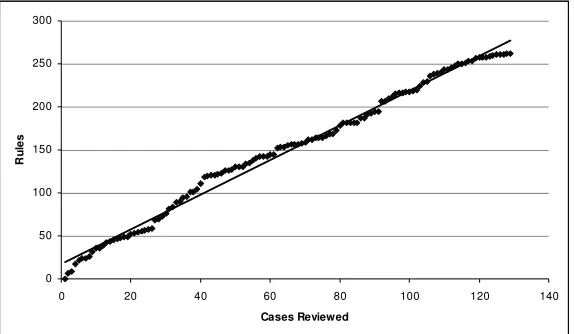
sys-tems have been shown to produce a flattening pattern when the knowledge base reaches approximately 80% of domain coverage [13].
0 50 100 150 200 250 300
0 20 40 60 80 100 120 140
Cases Reviewed
R
ul
[image:5.595.161.448.183.350.2]es
Fig. 1. The number of rules in the system grows linearly, but begins to flatten off.
4.5.Correct Conclusions Found
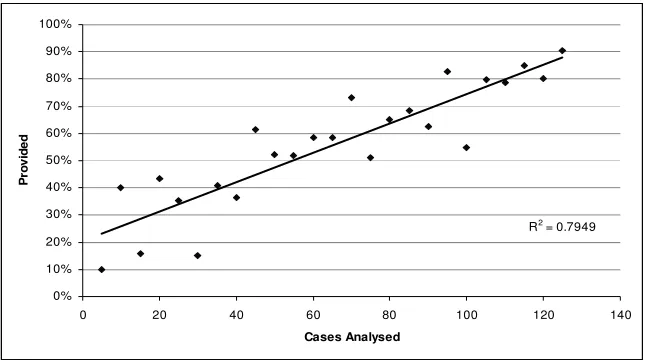
It was estimated by the expert at cessation of the experiment that the system had en-capsulated around 80% of the domain [19], this estimation is supported by the evi-dence shown in Figure 2. It can be seen that the average number of correct classifica-tions the system provided rose quite steadily into the 80th percentile, although the percentage correct from case to case did vary quite a lot, as is to be expected when re-sults are still largely influenced by the early heavy learning phase.
R2 = 0.7949
0% 10% 20% 30% 40% 50% 60% 70% 80% 90% 100%
0 20 40 60 80 100 120 140
Cases Analysed
P
ro
vi
de
[image:6.595.142.465.148.328.2]d
Fig. 2. The grouped average percentage of correct conclusions provided
[image:6.595.140.456.467.665.2]4.6.Percentage of Classifications Missed
Figure 3 showns that the percentage of cases that received updated classifications re-duced dramatically even after only a small number of cases, suggesting the system was rapidly helping to reduce the expert’s rate of missed classifications by suggesting the classifications for them. The trend-line is approximate. However, a clearly linear downward progression would be expected without the system assisting the expert.
R2 = 0.5376
0% 5% 10% 15% 20% 25% 30% 35%
0 20 40 60 80 100 120 140
Cases
P
er
ce
nt
ag
e
of
e
rr
or
s
4.7.Total Errors per Case
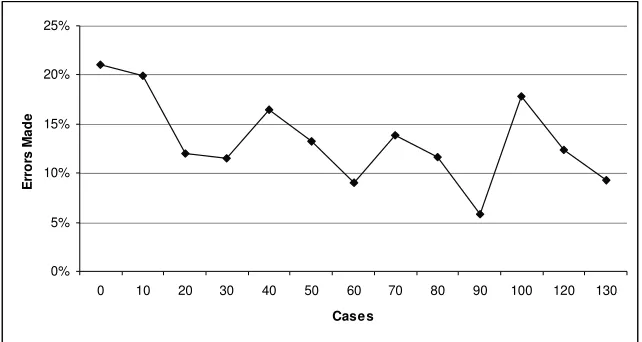
It was found that the rate of error in each case was quite high, averaging 13.5% and reaching over 50%. Shown in Figure 4 is the average errors made in each group of 10 cases considered. The local maxima around case 40 and 100 roughly match periods when the expert’s data sources changed.
0% 5% 10% 15% 20% 25%
0 10 20 30 40 50 60 70 80 90 100 120 130
Cases
E
rr
o
rs
M
ad
e
Fig. 4. The final percentage of classifications missed by expert per case
4.8.Maintainability and Usability
It has previously been demonstrated that the complex nature of the multidisciplinary domain of MR did not damage the maintainability and usability of the system [4, 18]. This result did not markedly change through the course of additional testing.
4.8.1. Structure of the Knowledge Base
[image:7.595.143.464.229.400.2]It can be determined from Table 3 that the structure of the knowledge base tree was extremely shallow and branchy, suggesting the possibility of an excessive number of exceptions has not eventuated.
Table 3. Structure of the Knowledge Base Tree, 137 branches had a length of 2.
Tree Property Value
Average Length 1.79
Length 0 41
Length 1 86
Length 2 137
Length 3 25
Length 4 5
4.9.Observations
The expert was queried regularly during the course of the experimentation, and extensively upon completion. Their comments revealed that although overall satisfied with the power of the system, they were dissatisfied primarily in two areas. Firstly, with the expressability of the domain model, as the expert found themselves unable to create certain desirable rules. For example, it was impossible for the expert to create a rule about a patient’s pathology results which expressed the more abstract concept of “increasing” or “decreasing”. Similarly, they were challenged with insufficiently de-tailed levels of grouping for the medications, with the expert finding that grouping on drug types, generic drugs, and commercial drugs too restrictive. Secondly, with fundamental limitations of the MCRDR method, since the expert was unable to create rules which used conclusions of the case as conditions in a new rule. This means the expert is unable to create rules which infer missing attributes of the case, or synonymous attributes, and then create a rule based on these inferred attributes. Further to this, it means the expert cannot necessarily represent the knowledge as efficiently or as faithfully to their own interpretation of it.
5
Conclusions
Initial experimentation suggested that the proposed method using MCRDR could suc-cessfully represent knowledge where the knowledge sources (human experts) are in-consistent. The system is shown to have reached about an 80% correct classification rate with less than 20 expert hours and only 126 cases classified – an excellent out-come in the circumstances. The knowledge base structure did not show any major de-viations from what would be anticipated in a normal MCRDR system.
From a MR perspective the system was seen to be capable of: providing classifica-tions for a wide range of Drug Related Problems; learning a large portion of the do-main of MRs quickly; producing classifications in a timely manner; and importantly, vastly reducing the amount of missed classifications that would otherwise be expected of the reviewer. It is expected that a future incarnation of this system, would be capa-ble of achieving classification rates over 90% [19].
However, it was identified that there are several shortcomings in the current incar-nation of the system. Particularly it is known that the domain model is not sufficiently expressive.
6
Further Work
The current system stands as a satisfactory proof of concept and even in its infancy is considered by the expert to be considerably more powerful than any other medication management system to date. It is clear however that the issues of standardisation and representation of data is still a hurdle, and the only obvious solution is to continue prototyping until a sufficiently expressive domain model is settled upon.
[image:9.595.128.470.451.620.2]
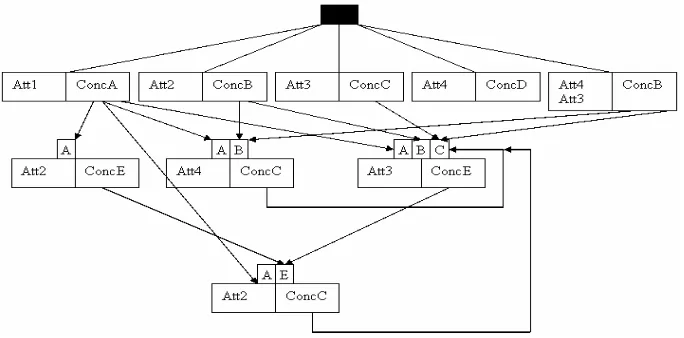
The other issues, concerning the limitations of the method, are still being investi-gated. It is proposed that to add further conditions based on existing conditions or conclusions of the case it is necessary to add to the underlying tree-like exception based rule structure of the classic MCRDR knowledge base. Imagine a case where the expert wishes to create a rule that reads “IF ConcA & ConcB & Att1 THEN ConcE”. To remain true to the exception based nature of MCRDR this rule must be represented simply as “If Att1 THEN ConcE”, but should be considered only when ConcA and ConcB are already known to be true. To achieve this effect one might add a set of switches to the “If Att1 THEN ConcE” rule. Then, when a requisite conclusion fires it would also turn on its corresponding switch and evaluate that rule. In a situation where all switches on the rule had been activated, and the condition of the rule itself were satisfied, the rule would then fire. This method would result in a graph like structure which maintains every feature of an MCRDR tree, simply extending it with optional extra layers which are dependent on one or more of the above layers’ conclu-sions. It would even be possible for lower layers to be dependent on higher layers. A possible resultant structure is represented diagrammatically in Figure 5 below. Fur-ther research is currently being undertaken to bring this concept into fruition.
References
1. Peterson, G.:Continuing evidence of inappropriate medication usage in the elderly, in Australian Pharmacist, vol. 23, 2. (2004).
2. Bates, D., Cullen, D., Laird, N., Petersen, L., Small, S., Servi, D., Laffel, G., Sweitzer, B., Shea, B., Hallisey, R.: Incidence of adverse drug events and potential adverse drug events. Implications for prevention. ADE Prevention Study Group. JAMA. vol. 29-34, (1995).
3. Peterson, G.:The future is now: the importance of medication review, in Australian Pharmacist, vol. 268-75. (2002).
4. Bindoff, I., Tenni, P., Kang, B., Peterson, G.:Intelligent Decision Support for Medi-cation Review. In: Advances in Knowledge Acquisition and Management, Confer-ence. Location, (2006).
5. Bindoff, I., Tenni, P., Peterson, G., Kang, B., Jackson, S.: Development of an intelli-gent decision support system for medication review. J Clin Pharm Ther. vol. 32, 81-8, (2007).
6. Kinrade, W., Review of Domiciliary Medication Management Review Software, Pharmacy Guild of Australia (2003).
7. Aamodt, A., Plaza, E.:Case-Based Reasoning: Foundational Issues, Methodological Variations, and System Approaches, in AICom - Artificial Intelligence Communica-tions, vol. 7, 39-59. (1994).
8. Compton, P., Kang, B., Preston, P., Mulholland, M.:Knowledge Acquisition without Analysis. In: Knowledge Acquisition for Knowledge-Based Systems, Conference. Location, (1993).
9. Tenni, P., Peterson, G., Jackson, S., Hassan, O. to I. Bindoff (2005) 10. MediFlags, http://www.mediflags.com/
11. Compton, P., Jansen, R.:A philosophical basis for knowledge acquisition. In: Euro-pean Knowledge Acquisition for Knowledge-Based Systems, Conference. Location, (1989).
12. Rivest, R.:Learning Decision Lists, in Machine Learning, vol. 2, 229-246. (1987). 13. Kang, B., Compton, P., Preston, P.: Multiple Classification Ripple Down Rules.
(1994).
14. Kang, B., Compton, P., Preston, P.:Multiple Classification Ripple Down Rules: Evaluation and Possibilities. In: AIII-Sponsored Banff Knowledge Acquisition for Knowledge-Based Systems, Conference. Location, (1995).
15. Preston, P., Edwards, G., Compton, P.:A 2000 Rule Expert System Without a Knowledge Engineer. In: AIII-Sponsored Banff Knowledge Acquisition for Knowl-edge-Based Systems, Conference. Location, (1994).
16. Compton, P., Jansen, R.:Cognitive aspects of knowledge acquisition. In: AAAI Spring Consortium, Conference. Location, (1992).
17. Kang, B., Compton, P.: A Maintenance Approach to Case Based Reasoning. (1994). 18. Bindoff, I.:An Intelligent Decision Support System for Medication Review, in
![Table 2. The three ways in which new rules correct a knowledge base [13].](https://thumb-us.123doks.com/thumbv2/123dok_us/8439096.333893/4.595.123.470.440.486/table-ways-new-rules-correct-knowledge-base.webp)