Learning flexibility: The
environment and a case study
Frank R. Young and Peter Gibbings
Faculty of Engineering and Surveying
University of Southern Queensland, Toowoomba, Australia
This paper outlines the flexible student learning environment in the Faculty of Engineering and Surveying before concentrating on evaluating one online learning option. This Faculty provides a variety of high quality on-campus, distance education and on-line academic programs and various learning strategies for the heterogeneous student cohort (national and international). By accessing appropriate flexible learning and different learning
experiences, students are empowered to determine learning opportunities and methodologies to suit their personal needs
The off-campus mode study may disadvantage students since they don’t have the benefit of face-to-face instructions or to participate in formative assessments delivered informally in lectures. This may lead to feelings of remoteness and isolation leading to poorer learning, lower results in assessments, and may also contribute to drop-out rates, particularly in first year courses. To overcome this inequity, the usual training materials presented for a first year course in 2005 were supplemented with PowerPoint lectures, enhanced with synchronous audio, and a series of quizzes to be used as formative assessments. The lectures and quizzes were presented online via a course web site and were designed to become an integral part of the learning experience. An evaluation of the effectiveness of these strategy demonstrated improved students’ learning, a positive contribution to the learning experience, increased enjoyment of the course, and a strong learning motivator. Students reported feeling less disenfranchised with the university and having a greater affinity with the lecturer.
Keywords: Breeze, quiz, online, education, flexible learning, pedagogy, spatial science
Introduction
Education pedagogy and choice should evolve to empower students to determine learning opportunities and methodologies to suit their personal and professional needs in preparedness for work environment policy, technology and application challenges and new approaches and the opportunities in multiple and varied work environments (Young 2005a and 2005b). A single program of study in the traditional face-to-face on-campus lecture and tutorial structure is too limiting for today's student cohort. Hence, there is a need for various and flexible teaching methods to enable students to access appropriate flexible learning and learning experiences.
Since commencing in 1967, the University of Southern Queensland (USQ) has developed an international reputation for offering high quality on-campus, distance education and on-line academic programs for students in 106 countries world wide. The Faculty of Engineering and Surveying is one of five Faculties at the USQ and has approximately 75% of its students' off-campus studying by the distance education or on-line modes. The majority of the off-campus students are in employment while 25% of on-campus students are working part-time. Hence, the Surveying and Land Information (Spatial Science) department has a unique suit of undergraduate study options, from which individuals can choose to enter the spatial science profession, that enable graduates to fit and develop within various spatial science practices and trends. The opportunity to choose on-campus and off-campus study delivery modes and to move freely between these modes, and select different qualification levels in both the surveying and GIS majors, realises many of the dilemmas facing emerging and future spatial scientists. Particular teaching pedagogy developments to inculcate desired problem solving techniques, lateral thinking, application possibilities, teamwork and communication attributes are being employed to motivate learning and interest in professional studies and developing a more useful graduate.
Background
To address contemporary and future social pressures, education and workplace experiences, there is a need to provide a stimulating and relevant learning environment to generate enthusiasm and good learning and encourage more students to enter their chosen profession. As a starting point, the University of Southern Queensland (USQ) provides a variety of learning and educational strategies for prospective students with varying backgrounds, locations, work environment needs, forms of access and levels of learning. These options also encompass employers and government’s demands for specific graduate attributes and qualification or certification that establishes competence and meets society’s quality requirements (Ribeiro et al. 2002).
The USQ curricula accounts for a heterogeneous student cohort (national and international -Transnational) where 75% of students study by distance education because work, family or personal reasons prevent them from attending campus during normal hours (McDougall et al. 2003). While the majority of USQ students reside throughout Australia, many of the students have been recruited offshore from one of approximately 106 countries. Hence there is a diversity of pre university education and experiences, plus ongoing different facilities and experiences in their own environment, to be considered. The current school leaver student cohort generally has a broader integrated approach to knowledge and skills and their application, but lack deeper learning and understanding abilities, compared to students from alternative routes (work place, mature age, overseas experience, TAFE, etc), in material pertinent to commencing professional university study programs.
Society and governments are also increasingly scrutinising professional activity and expect higher levels and breadth of technical abilities, reporting, analysis, evaluation, assessment, conceptualisation and synthesising (Surveyors Board 2007 and Ribeiro & Mizukami 2005). Our applications of these professional practice processes must be contextualised and related to any impact on society and government thinking i.e. has social spatial connectivity. Hence, professional practice education should provide skills to enable graduates to be proactive, innovative and have lateral thinking or entrepreneurial skills. Although conclusive knowledge of future expertise is not possible (Young 1997; Young 2004 and Hannah 2004), new graduates entering professional praxis will need to have the following.
•
Good communication skills•
Current technical competence•
A high level of conceptual and thinking skills•
A capacity for innovative thinking, good judgements and analytical and critical evaluation•
An ability to adopt and adapt•
A spatial science’s technology literacy and numeracy•
A spatial connectivity ability•
A capacity for contextual understanding of their work environments•
An ability to discriminate between and use information sources•
Administrative, management and human relations abilities•
A capacity to synthesise knowledge for solving problems and decision making•
Knowledge of individual responsibilities and accountability•
Skills to manage projects within time and resource constraints•
An ability for future independent and lifetime learning•
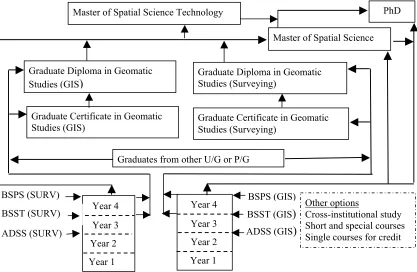
A suitably developed attitude, motivation and behaviour focus in accordance with the profession.To deliver the best learning opportunities for students to attain these skills, the USQ spatial science programs are offered as multiple pathways using varied and flexible learning options. All programs can be completed on-campus: they can also be completed off-campus so that students do not have to leave a current work place or home and to accommodate related difficulties experienced with time zone differences and time of the day available for study. Figure 1 depicts all the available spatial science programs offered at USQ, their interrelationship and the various optional graduate level exit and re-entry points. There is a high course commonality between majors with hierarchical with seamless vertical articulation progression within each undergraduate major and post graduate program.
and through the USQConnect student web portal. Students select which of these services they require to assist them in pedagogical aspects pertinent to individual needs.
Figure 1: Spatial science program’s interrelationships and entry and exit options
The spatial science courses have customised study materials developed by the staff. These may include an introductory book (assessments and administration and study information); study book; book of readings; and multimedia enhancement materials (hardcopy, CD/DVD, web sites, Wikkis, web based or student version software packages). Some courses have interactive web based teaching and assessment and an increasing number are providing recorded lectures, both verbal and the visual presentation elements, via web distribution. The first two chapters of each study book are accessible via the web to enable the distance education student to commence before the study material arrives through the post. This allows off-campus students to better manage their own time and provides a near equivalent teaching and learning experience and information access to that of the on-campus student. The media choices, communications and material support assists students to better balance their work and study commitments.
The following case study describes one specific learning enhancement in a first year course and an evaluation of its effectiveness. The holistic issues on online education, different technologies, etc., are not the focus of this paper.
Case study
One common first year course, Introduction to GPS (SVY1110), was added to Surveying and Land Information course suite in 2005 and offered as an elective to students in other Departments and Faculties. In 2005 there were 100 external and 26 on-campus students of which 12 were not from the Surveying and Land Information Department.
All external students who enrolled in SVY1110 were supplied with a study package, which included an Introductory Book that contained course specifications comprehensive curricula details) and assignments, and a USQ Study Book containing instructional materials. Internal students were expected to purchase the same materials. This information was supplemented with a dedicated web site published on a course management platform that included the following.
• general announcement messaging and electronic mail boxes,
• facilities for students to download teaching materials such as PowerPoint lectures, tutorials, and
practical exercises,
• online quizzes and student surveys,
Graduates from other U/G or P/G
studies
Graduate Certificate in Geomatic Studies (GIS)
Graduate Diploma in Geomatic Studies (GIS
)
Graduate Certificate in Geomatic Studies (Surveying)
Graduate Diploma in Geomatic Studies (Surveying)
• online discussion utility to facilitate and manage text discussions (including functions such as topics,
threads, and messages),
• synchronous chat facility, • electronic assignment submission,
• access to past and sample examination papers,
• links to useful information on the internet, and
• ancillary services such as operating instructions, help, and support.
This course used WebCT Vista platform as the communication facilities, in particular the discussion boards, allowing students to ‘learn collaboratively’ (Dillenbourg 1999, p. 7) and to ‘socialise’ (Ragan 1999) in the subject field. It also provides the all-important contact between the examiner and students (Ragan 1999), although the platform cannot completely replace the interaction that takes place during the traditional on-campus instruction.
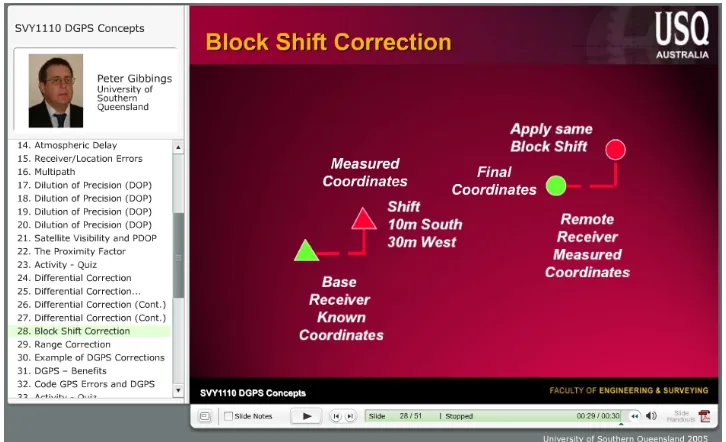
As the external students did not have the benefit of face-to-face lectures, the PowerPoint lectures that were used for internal lectures in SVY1110 were enhanced with animations and synchronous audio and offered on the web site. The voice of the course examiner (a photograph is also displayed) was also used for explaining concepts that are simultaneously being displayed on the PowerPoint slides and
synchronised to match the slide animations. This presentation closely replaced the experience of the on-campus lecture. The slides and audio operate automatically, but the student does have some control through the pause, replay, and navigation facilities. Macromedia Breeze plug-in for PowerPoint
(Macromedia Inc. and Adobe, San Jose, CA) was used to produce these presentations. Figure 2 shows an example of a Breeze presentation with the speaker’s photo in the top left hand corner, a list of slides beneath this for navigation, and the main slide display area on the right hand side.
Students could view the Breeze presentations through a personal computer web browser: slow modems problems can be overcome by using video streaming technology. Although the presentations were introduced to assist external students, internal students also found them a helpful supplement to the traditional on-campus teaching and learning activities as either a second viewing or for those occasions when they could not attend the lecture. Face-to-face learning may be superior but, like others (Hurst & Thomas, 2004), this research has shown that voice and online learning strategies also work in achieving appropriate leaning outcomes.
It was believed that by introducing these enhanced presentations, external students would have learning processes improved; would feel less alienated; would consider the lecturer was more approachable; and would feel a greater sense of belonging to the university. The presentations may consequently have the added advantage of helping to address the declining retention rates for first year students. Statistics showed that students in this course used the Breeze presentations rather than the web discussions area. The pedagogic value has also been highlighted is the satisfactory learning outcomes.
To complement these presentations, formative online quiz assessments were prepared for each particular study module to be used throughout the course. This was recommended by Reushle et al. (1999) to encourage students to reflect on their own learning needs and to provide a feeling of competence and personal control.
Several types of questions were used including multiple-choice, matching pairs, true/false, and short answer (Figure 3). Students were able to immediately check their graded quizzes against the correct answers and thereby learn from their mistakes, or reinforce that they had grasped the concepts. Since these assessments were linked to learning objectives and provided instructive feedback, they were designed to become an integral part of the students’ learning process (Isaacs, n.d.): the purpose of this study was to identify that that has occurred.
Figure 2: Example of Breeze PowerPoint presentation screen
Figure 3: Example of an online quiz question
• They could be done more than once
• They were designed to provide immediate feedback to the student on correct or incorrect answers • Summary statistics were provided at the end of the quiz so students could monitor their own progress
and adjust their learning regime if requited.
Educational research (Ruhl et al. 1987) suggests that short (10-20 minutes) information sessions, followed by engagement in short activities such as these online quizzes that reinforce the information presented, is one proven way to ensure effective delivery of educational materials. It has also been recognised that the receipt of feedback and the opportunity to reflect on this feedback, as provided with the quizzes, are important components of effective teaching and learning (Laurillard 1993). Rapid feedback is particularly desirable for the external or distance education students scattered throughout the world.
Design of online learning is important with ongoing debate on whether it is the delivery technology or the design of the instruction that improves learning (Clark, 2001; Kozma, 2001). Generally students gain significant learning benefits when learning from audio-visual media, but research suggests is not the medium of instruction, but the instructional strategies built into the learning materials that influence the quality of learning (Ally, 2004).
[image:5.595.175.418.306.484.2]Method
Students enrolled in SVY1110 in 2005 were asked to complete an online student survey questionnaire presented on the course web site immediately after the semester had finished and before the final examination in the course. Students’ answers and comments were stored electronically and entered into a spreadsheet for analysis. All enrolled students were notified by e-mail of the existence of the
questionnaire and encouraged to participate in the survey. An announcement, alerting students to the questionnaire and encouraging participation, was also placed on the web site so that it would automatically appear on screen to everyone who entered the site.
The first part of the questionnaire involved an assurance that all information was anonymous and that students’ responses would not be linked to individual details. Attitudes and perceptions with respect to the Breeze presentations and online quizzes were measured by seeking responses to various suggestions in the questionnaire. Responses were selected from a five point Likert scale (Matell & Jacoby 1971) ranging from ‘strongly agree’ to ‘strongly disagree’.
In 2005, 35 responses were received, which represented approximately 28 percent of the students enrolled in the course. Of these, 10 were internal and 25 were external students. Not all respondents answered all questions so there is some disparity in the total number of respondents to different questions. Although a request to complete the questionnaire was sent to all students, it is recognised that the results may not necessarily represent the general consensus of the entire student population in this course. This is because the results may be biased due to the fact that those who responded to the questionnaire may also be those most likely to be using the web site and online materials. These students may have a predisposition to using online materials, and may therefore be more likely to use the Breeze PowerPoint presentations and online quizzes, and may have a preference to this style of learning. Nevertheless, the results are
considered valid for the purpose intended and will provide some useful insights into the value of the Breeze presentations and online quizzes.
Results and discussion
It is not appropriate or relevant to provide full details of questions and responses in this paper. Instead, student responses to selected questions are presented and analysed to draw conclusions on the usefulness of the materials under review.
Breeze enhanced PowerPoint
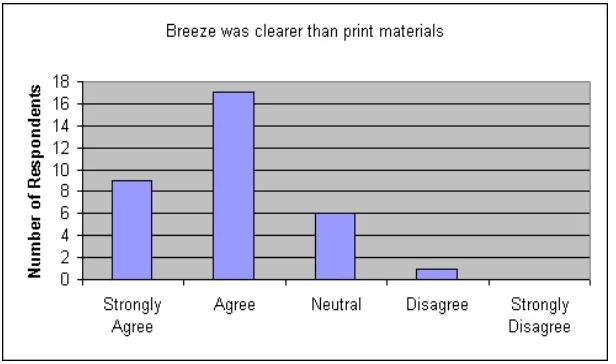
[image:6.595.145.453.506.688.2]As expected, most respondents preferred the online Breeze presentations to normal print materials. Figure 4 summarises responses to the suggestion: The Breeze (animated with voice) lectures communicated information more clearly than print materials.
Figure 4: Breeze preferred to print materials
The addition of synchronous animation and voice to poor quality PowerPoint presentations may well be a useless exercise. Therefore, the results shown in Figure 5 are important because they show that the presentations are of good quality before any enhancement. However, the addition of synchronous animations and audio was preferred to the normal PowerPoint lectures. Figure 6 summarise responses to the suggestion: “The Breeze (animated with voice) lectures communicated information more clearly than the normal PowerPoint without voice.”
[image:7.595.147.451.319.499.2]Figure 5: PowerPoint presentations communicated information clearly
Figure 6: PowerPoint better with synchronous animations and audio
An obvious reason why students would prefer the Breeze presentations is that they helped them
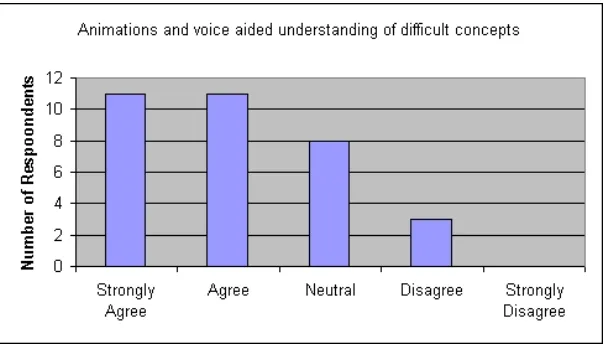
[image:7.595.148.450.588.769.2]understand the materials being presented, particularly complex concepts that may benefit from a detailed verbal and graphical explanation rather than trying to learn the concepts from print materials. This assumption was tested by asking students to respond to the assertion: “The Breeze animations and voice aided my understanding of difficult concepts in this course.” Results are shown in Figure 7.
Introducing these presentations enhanced students overall experience in the course, possibly because they felt less alienated, and more able to relate to the lecturer since they could now see his picture and hear his voice. This view is supported by responses to the suggestions, “My overall learning experience in this course was enhanced by the Breeze presentations” presented in Figure 8; “My learning experience in this course was made more enjoyable by the Breeze presentations” presented in Figure 9; and “I felt a greater affinity with the lecturer and did not feel so isolated in this course compared to others that do not have
[image:8.595.171.426.152.292.2]Breeze presentations” presented in Figure 10.
[image:8.595.171.425.328.467.2]Figure 8: Breeze enhanced overall experience in the course
Figure 9: Breeze increased overall enjoyment of the course
Figure 10: Breeze increased affinity with lecturer and decreased isolation
It is expected that this increased enjoyment of the learning experience may help convince students that they can successfully learn in the external mode, and thereby help increase the first year student's retention rate. Feeling less isolated should also contribute to the students’ engagement within the greater university community and increase their sense of belonging. Because students felt a greater affinity with the lecturer, they should consider the lecturer more approachable if they have any problems in the course.
[image:8.595.172.425.501.646.2]• Added a human touch to the learning experience
• They gave an added dimension to the presentations which helped being an external student.
• An excellent tool to complement the other printed course material. I gained a better understanding of
concepts from both the visual and audio content, and then referring to the printouts/study book.
• Helped to clearly explain what was not fully understood in the text. Would be great to have these for more subjects. Especially when studying externally.
• The presentations are excellent because topics are talked about with the use of diagrams, and you can
stop and start the presentation whenever you need to. When reading the information straight from the book, you can sometimes get lost in the terminology and then have to read it over again. Trying to read and make sense of it yourself takes a lot longer than someone explaining it clearly in a presentation.
• Hearing the words from the lecturer is great! Helps with concentration and gives you a better
understanding, wish every course had it!
There were no negative responses relating to the material and presentation method; the only exceptions being
• one student requesting more quiz questions
• one student stated “I do not recall the audio component - so I am wondering if this was somehow
missed due to not being made aware that the audio was available on them”
• “Could some improvements be done so that we can download the file onto the hard drive on the
computer instead of loading up the internet all the time?”
From these comments it can be concluded that the Breeze PowerPoint presentations have significantly compensated external students for the lack of face-to-face lectures.
Online quizzes
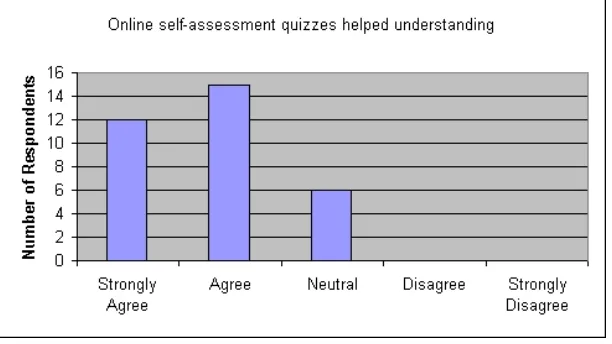
[image:9.595.147.453.437.609.2]Students expressed the opinion that the online quizzes were of great benefit to their learning, and that they much preferred the online presentation of the formative assessment to print versions offered in similar courses. Responses to the suggestion, “The online self assessment quizzes helped my understanding of each module” are shown in Figure 11; and “The quizzes are more effective online than if they were presented in the study book” in Figure 12.
Figure 11: Quizzes helped understanding of material
Again, these results must be treated with care since, as explained previously, these students may already have a predisposition to online learning. From a student perspective, perhaps unfortunately, one of the main focuses is on passing the assessment items rather than on what they learn. Responses to the proposition, “The quizzes helped me study for the final exam”, presented in Figure 13, indicates that the quizzes were of great benefit in preparing for the final summative assessment.
error’ is considered by Savin-Baden (2004) and Acar (2004) to be an important part of learning. This is supported by responses (Figure 14) to the assertion, “The summary statistics at the end of each quiz were helpful for me to gauge my understanding of the materials.”
[image:10.595.169.427.307.451.2]Figure 12: Online quizzes more effective than quizzes in print
Figure 13: Online quizzes helpful for exam study
Figure 14: End of quizzes summary statistics helped gauge understanding of learning
Comments were sought from students on their overall impression of the online quizzes. The following responses indicate that the quizzes became an integral part of the learning process.
• Quizzes were useful to keep me focused on some of the learning outcomes. A useful tool requires
interaction rather that the potential to read passively and not really take it in.
• I thought these quizzes were good at ‘filling in the gaps’.
[image:10.595.172.424.481.627.2]students (Reushle et al. 1999). If this happens they will be more likely to become ‘engaged’ in the teaching and learning activities they perform (Heimbecker 2005) and outcomes will be improved as a result (Knowles et al. 1998). Evidence of this engagement, and the use of the summary statistics by students to monitor their own progress in the course, is demonstrated by the following comments.
• They gave me a quick and succinct summary of my current course knowledge. More questions would
have been ideal.
• I used these quizzes at the beginning of the term and also the end. It was a great way to check how my
general knowledge of the topic areas is going.
• They were good to gauge where you were at for a subject and sometimes with some questions they helped answer any doubts.
• The quizzes are an excellent tool to help test your knowledge of each module.
Since the quizzes were linked to course and module learning objectives, they provided a measure of the achievement of learning goals. This was valuable information for external students to monitor their progress and, if necessary, adjust their learning strategies. Students appreciated the immediate feedback and the ability to reflect, undertake extra learning, and then go back and try the formative assessment again in a manner similar to Biggs’ “retrospective quality assurance” (Biggs 2002).
• The instant feedback on the areas where you are strong or weak helps to define where to concentrate
more study time & effort.
• Good as they provide a chance to test knowledge and give the answer straight away.
• It is a quick and easy way to test yourself and be given feedback immediately.
Student motivation can be a critical ingredient to successful learning (Knowles et al. 1998). At USQ most students studying in the external mode do so because they are already employed in some capacity in industry, and external mode allows them to study and work at the same time. This obviously places great demand on their time, so any motivation and inspiration for these students can be difficult at times.
Conclusion
USQ has a heterogeneous student cohort is a variety of study place environments throughout the world and provides flexible study paths to enable students to self design their own learning experience. The addition of more and varied learning method options enhances a student's ability and motivation to learn in whichever of the diverse learning environments they are located. This study has shown online learning, as a subset of all distance education, is concerned with providing access to educational experience (Anderson, 2004) and is learning effective.
This paper reported on students’ qualitative opinion of the effect Breeze enhanced PowerPoint
presentations and online quizzes had on their learning experience and general impressions of a first year university course. The outcomes significance was that the enhanced materials made a positive
contribution to their learning experience; was a strong student motivator; and improved student
participation. Off-campus students reported feeling less disenfranchised with the university and having a greater affinity with lecturer, both of which should help increase first year retention rates. The most important comment of all from the student survey may be: “They provide good motivation to learn.” The critical concepts of online education are not different from other forms of education: it is only the way in which these concepts are put into action that sets the online learning environment apart from other learning contexts. Hence, these research outcomes have demonstrated that this voice and online learning strategy provided the appropriate learning experience.
References
Acar, B. S. (2004). Analysis of an assessment method for problem-based learning. European Journal of Engineering Education, 29(2), 231-240.
Ally, M. (2004). Foundations of Educational Theory for Online Learning. In T. Anderson & F. Elloumi (Eds.), Theory and Practice of Online Learning (pp. 3-31). Athabasca, Canada: Athabasca University. Anderson, T. (2004). Towards a Theory of Online Learning. In T. Anderson & F. Elloumi (Eds.), Theory
and Practice of Online Learning (pp. 33-60). Athabasca, Canada: Athabasca University.
Biggs, J. (2002). The Reflective Institution: Assuring and enhancing the quality of teaching and learning.
Clark, R. E. (2001). A summary of disagreements with the “mere vehicles” argument. In R. E. Clark (Ed.), Learning from media:Arguments, analysis, and evidence (pp. 125-136). Greenwich,CT: Information Age Publishing Inc
Dillenbourg, P. (Ed.). (1999). Collaborative Learning: Cognitive and Computational Approaches. New York: Pergamon.
Hannah, J. (2004), Changing Circumstances Bring About A Changing Curriculum, 4th Transtasman Surveyors Conference Proceedings CD, Auckland, NZ.
Heimbecker, B. (2005). Changing ourselves: A gaze in the mirror.
http://www.lupinworks.com/ar/changing/bh.html, [viewed 1 November, 2005].
Hurst, D. C., & Thomas, J. (2004). Developing Team Skills and Accomplishing Team Projects Online. In T. Anderson & F. Elloumi (Eds.), Theory and Practice of Online Learning (pp. 195-239). Athabasca, Canada: Athabasca University.
Isaacs, J. (n.d.). Assessment for Learning. Brisbane: University of Queensland (Teaching & Educational Development Institute).
Kozma, R. B. (2001). Counterpoint theory of “learning with media.” In R. E. Clark (Ed.), Learning from media: Arguments, analysis, and evidence (pp. 137-178). Greenwich, CT: Information Age Publishing Inc.
Knowles, M. S., Holton, E. F., & Swanson, R. A. (1998). The Adult Learner (5th ed.). Houston, Texas: Gulf Publishing Company.
Laurillard, D. (1993). Rethinking University Teaching: A Framework for the Effective use of Educational Technology. London and New York.: Routledge.
Matell, M., S, & Jacoby, J. (1971). Is There an Optimal Number of Alternative for Likert Scale Items? Study I: Reliability and Validity. Educational and Psychological Measurement, 31(3), 657-674. Mcdougall. K, Young, F. R, Apan. A, (2003): Operational Infrastructure For Quality Distance And
Online Geospatial Programs, Cartography, 32(1),25-38.
Ragan, L. C. (1999). Good teaching is good teaching: An emerging set of guiding principles and practices for the design and development of distance education. CAUSE/EFFECT, 22(1).
Reushle, S., Dorman, M., Evans, P., Kirkwood, J., McDonald, J., & Worden, J. (1999, 5-8 December). Critical elements: Designing for online teaching. ASCILITE99 Responding to Diversity: 16th Annual Conference of the Australasian Society for Computers in Learning in Tertiary Education, Brisbane, Queensland: QUT.
Ribeiro, L. R. d. C., & Mizukami, M. d. G. N. (2005). Student Assessment of a Problem-Based Learning Experiment in Civil Engineering Education. Journal of Professional Issues in Engineering Education and Practice, 131(1), 13-18.
Ruhl, K. L., Hughes, C. A., & Schloss, P. J. (1987). Using the pause procedure to enhance lecture recall.
Teacher Education and Special Education, 10, 14-18.
Savin-Baden, M. (2004). Understanding the impact of assessment on students in problem-based learning.
Innovations in Educationand Teaching International, 41(2). Surveyors Board 2007, Competency Framework,
http://www.surveyorsboard.com.au/surveyors/competency-frameworks.php [viewed 19 July 2007]. Young, F. R. (1997): The Changing Face of education: Meeting the Surveying and Mapping Industry
Needs, The Australia Surveyor, 42(4):148-155.
Young , F. R, (2004): Geospatial Education to Empower Business Quality, Spatial Sciences Institute, Queensland, Conference 22-23 April 2004, Brisbane, CD proceedings.
Young, F. R. (2005a): Spatial Science Education Praxis Benefits Employees and Employers, AIMS Conference, 17-19 August, Yeppoon.
Associate Professor Frank Young, Head, Surveying and land Information, Faculty of Engineering and Surveying. University of Southern Queensland, PO Darling Heights, Toowoomba. Qld. 4350.
Email: [email protected]
Associate Professor Frank Young completed his initial surveying and mapping education in the Royal Australian Survey Corps while also gaining nine years of experience in geodetic and topographic surveying, photogrammetry and cartography. A further three years were spent as a senior instructor teaching in these disciplines at the School of Military Survey. Following three years lecturing at the Papua New Guinea University of Technology, he commenced lecturing at the University of Southern Queensland in 1982. He was appointed Head of Surveying and Land information (January 1991) and made an Associate Professor in Jan 2005.
As Head he is responsible for curriculum development which, at USQ, includes both external off-campus (75%) and on-campus (25%) students. Frank is also committed to his profession and is actively involved in many initiatives through the spatial science profession's Committee including the Spatial Education Advisory Committee Queensland and the Australian Spatial Information Education and Research Association. Other educational based development work has been done through the Queensland Education Working Group (QEWG), comprising government spatial information and education representatives and educational institutions. Frank's academic qualifications include a Bachelor Applied Science -Surveying (1974) from Curtin University; Graduate Diploma in Education (1978) Curtin University; Master of Science (1987) from Papua New Guinea University of Technology; and a Doctor of Philosophy (1998) University of New England.
Mr. Peter Gibbings, Faculty of Engineering and Surveying, University of Southern Queensland, PO Darling Heights, Toowoomba. Qld. 4350. Email: [email protected]
Peter Gibbings obtained his Bachelor of Surveying degree from the University of Queensland in 1979, Graduate Diploma in Technology Management from Deakin University in 1999, Master of Geomatics from the University of Southern Queensland in 2003, and Graduate Certificate in Tertiary Teaching and Learning from the University of Southern Queensland in early 2007. He is currently a Doctor of Education candidate at Queensland University of Technology.
He has over 25 years experience in the surveying profession and owned and managed his own consultancy firm in Toowoomba for 12 years. He is a licensed land surveyor and has extensive experience in all aspects of residential land development. He has been associated with the University of Southern Queensland since 1996, where he is now employed full time as a senior lecturer. As a member of a problem-based learning team in 2003 he received a University Medal for Excellence in Teaching, in 2005 received a national award from the Australasian Association for Engineering Education for excellence in engineering education, in the same year was a finalist in the Australian Awards for University Teaching, and won a Citation for
Outstanding Contributions to Student Learning in the 2006 Carrick Australian Awards for University Teaching.
Please cite as: Young, F. R. & Gibbings, P. (2007). Learning flexibility: The environment and a case study. In ICT: Providing choices for learners and learning. Proceedings ascilite Singapore 2007.
http://www.ascilite.org.au/conferences/singapore07/procs/young.pdf
Copyright © 2007 Frank Young and Peter Gibbings.