Rochester Institute of Technology
RIT Scholar Works
Theses
5-2018
Comparing Cyber Defense Alternatives Using
Rare-Event Simulation Techniques to Compute
Network Risk
Alexander Leon Krall
[email protected]Follow this and additional works at:https://scholarworks.rit.edu/theses
This Thesis is brought to you for free and open access by RIT Scholar Works. It has been accepted for inclusion in Theses by an authorized administrator of RIT Scholar Works. For more information, please [email protected].
Recommended Citation
Comparing Cyber Defense Alternatives Using
Rare-Event Simulation Techniques
to Compute Network Risk
by
Alexander Leon Krall
A Thesis Submitted in Partial Fulfillment of the Requirements for the Degree of Master of Science
in Industrial & Systems Engineering
Supervised by
Professor Michael E. Kuhl
Department of Industrial & Systems Engineering Kate Gleason College of Engineering
Rochester Institute of Technology Rochester, New York
May 2018
Approved by:
Michael E. Kuhl, Professor
Thesis Advisor, Department of Industrial & Systems Engineering
Shanchieh J. Yang, Professor
Committee Member, Department of Computer Engineering
Katie McConky, Assistant Professor
Thesis Release Permission Form
Rochester Institute of Technology Kate Gleason College of Engineering
Title:
Comparing Cyber Defense Alternatives Using Rare-Event Simulation Techniques to Compute Network Risk
I, Alexander Leon Krall, hereby grant permission to the Wallace Memorial Library to reproduce my thesis in whole or part.
Alexander Leon Krall
Acknowledgments
This effort is supported in part by the National Security Agency under grant number
Abstract
Comparing Cyber Defense Alternatives Using Rare-Event Simulation Techniques to Compute Network Risk
Alexander Leon Krall
Supervising Professor: Michael E. Kuhl
Vulnerabilities inherent in a cyber network can be exploited by individuals with
ma-licious intent. Thus, machines on the network are at risk. Formally, security specialists
seek to mitigate the risk of intrusion events through network reconfiguration and defense.
Comparison between configuration alternatives may be difficult if an event is sufficiently
rare; risk estimates may of be questionable quality making definitive inferences
unattain-able. Furthermore, that which constitutes a “rare” event can imply different rates of
occur-rence, depending on network complexity. To measure rare events efficiently without the
risk of doing damage to a cyber network, special rare-event simulation techniques can be
employed, such as splitting or importance sampling. In particular, importance sampling
has shown promise when modeling an attacker moving through a network with intent to
steal data. The importance sampling technique amplifies certain aspects of the network in
order to cause a rare event to happen more frequently. Output statistics collected under
these amplified conditions must then be scaled back to the context of the original network
to produce meaningful results. This thesis successfully tailors the importance sampling
methodology to scenarios where an attacker must search a network. Said tailoring takes
the attacker’s successes and failures as well as the attacker’s targeting choices into account.
The methodology is shown to be more computationally efficient and can produce higher
Contents
Acknowledgments . . . iii
Abstract . . . iv
1 Introduction. . . 1
2 Problem Statement . . . 3
3 Literature Review . . . 5
3.1 Network Risk . . . 5
3.1.1 Likelihood . . . 5
3.1.2 Impact . . . 7
3.2 Risk Reduction . . . 8
3.3 Rare-Event Simulation . . . 9
3.4 Literature Analysis . . . 11
4 Methodology . . . 14
4.1 Scope of Work . . . 14
4.2 Design Methods . . . 15
4.3 Importance Sampling Methods . . . 16
4.3.1 General Method . . . 16
4.3.2 Security Framework . . . 17
4.4 Implementation Methods . . . 21
4.5 Experimental Methods . . . 30
5 Experimentation . . . 33
5.1 Network Example . . . 33
5.2 Experimental Setup . . . 39
5.3 Base Case Results . . . 40
5.3.1 Computational Savings - Depth . . . 40
5.3.3 Estimate Quality - Depth . . . 43
5.3.4 Estimate Quality - Breadth . . . 46
5.4 Reconfiguration Results . . . 53
5.5 Discussion . . . 56
6 Conclusions & Future Work . . . 67
6.1 Future Work . . . 67
Bibliography . . . 69
A Variance Charts. . . 72
B Standard Simulation Comparison Charts . . . 79
List of Tables
4.1 Impact Heuristic . . . 27
4.2 CVSS Categorization Values . . . 28
4.3 CVE-2009-0658 Probability Scoring Example . . . 29
4.4 Interest Rating . . . 29
5.1 Service CVSS Categorization . . . 36
5.2 Impact Assignments . . . 39
5.3 Depth - Risk Reduction . . . 60
5.4 Breadth - Risk Reduction . . . 60
C.1 Convergence - Depth - Base Case - Number of Trials . . . 83
C.2 Convergence - Depth - Base Case - Likelihood & Variance . . . 83
C.3 Convergence - Depth - Modify Connection - Number of Trials . . . 84
C.4 Convergence - Depth - Modify Connection - Likelihood & Variance . . . . 84
C.5 Convergence - Depth - Move Connection - Number of Trials . . . 84
C.6 Convergence - Depth - Move Connection - Likelihood & Variance . . . 85
C.7 Convergence - Depth - New Machine - Number of Trials . . . 85
C.8 Convergence - Depth - New Machine - Likelihood & Variance . . . 86
C.9 Convergence - Depth - Public to Private - Number of Trials . . . 86
C.10 Convergence - Depth - Public to Private - Likelihood & Variance . . . 87
C.11 Convergence - Breadth - Base Case - Number of Trials . . . 87
C.12 Convergence - Breadth - Base Case - Likelihood & Variance . . . 88
C.13 Convergence - Breadth - Modify Connection - Number of Trials . . . 88
C.14 Convergence - Breadth - Modify Connection - Likelihood & Variance . . . 89
C.15 Convergence - Breadth - Move Connection - Number of Trials . . . 89
C.16 Convergence - Breadth - Move Connection - Likelihood & Variance . . . . 90
C.17 Convergence - Breadth - New Machine - Number of Trials . . . 90
C.18 Convergence - Breadth - New Machine - Likelihood & Variance . . . 91
C.19 Convergence - Breadth - Public to Private - Number of Trials . . . 91
C.20 Convergence - Breadth - Public to Private - Likelihood & Variance . . . 92
C.22 Static - Depth - Modify Connection - Likelihood & Variance . . . 94
C.23 Static - Depth - Move Connection - Likelihood & Variance . . . 95
C.24 Static - Depth - New Machine - Likelihood & Variance . . . 96
C.25 Static - Depth - Public to Private - Likelihood & Variance . . . 97
C.26 Static - Breadth - Base Case - Likelihood & Variance . . . 98
C.27 Static - Breadth - Modify Connection - Likelihood & Variance . . . 99
C.28 Static - Breadth - Move Connection - Likelihood & Variance . . . 100
C.29 Static - Breadth - New Machine - Likelihood & Variance . . . 101
List of Figures
3.1 Splitting Technique . . . 10
4.1 IS Methodology Flowchart . . . 16
4.2 Model Implementation Structure . . . 22
4.3 Depth-Based Machine Selection Example . . . 26
4.4 Breadth-Based Machine Selection Example . . . 26
5.1 Network Example - Base Case . . . 34
5.2 Network Example - Modify Connection . . . 37
5.3 Network Example - Move Connection . . . 37
5.4 Network Example - New Machine . . . 38
5.5 Network Example - Public to Private . . . 38
5.6 Convergence - Depth - Base Case - Computational Savings . . . 40
5.7 Convergence - Depth - Base Case - FILES Likelihood . . . 41
5.8 Convergence - Depth - Base Case - DB01 Likelihood . . . 41
5.9 Convergence - Depth - Base Case - DB02 Likelihood . . . 42
5.10 Convergence - Depth - Base Case - STORAGE Likelihood . . . 42
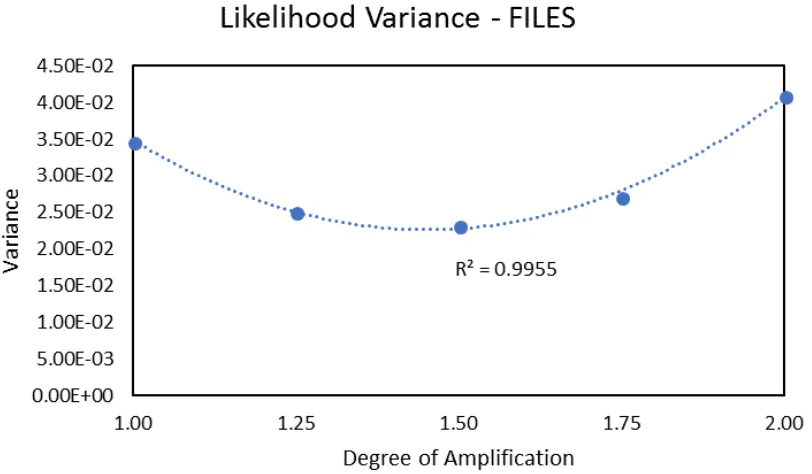
5.11 Convergence - Depth - Base Case - FILES Variance . . . 44
5.12 Convergence - Depth - Base Case - DB01 Variance . . . 44
5.13 Convergence - Depth - Base Case - DB02 Variance . . . 45
5.14 Convergence - Depth - Base Case - STORAGE Variance . . . 45
5.15 Convergence - Breadth - Base Case - Computational Savings . . . 46
5.16 Convergence - Breadth - Base Case - FILES Likelihood . . . 47
5.17 Convergence - Breadth - Base Case - DB01 Likelihood . . . 47
5.18 Convergence - Breadth - Base Case - DB02 Likelihood . . . 48
5.19 Convergence - Breadth - Base Case - STORAGE Likelihood . . . 48
5.20 Static - Depth - Base Case - FILES Likelihood . . . 49
5.21 Static - Depth - Base Case - DB01 Likelihood . . . 49
5.22 Static - Depth - Base Case - DB02 Likelihood . . . 50
5.23 Static - Depth - Base Case - STORAGE Likelihood . . . 50
5.25 Static - Breadth - Base Case - DB01 Likelihood . . . 51
5.26 Static - Breadth - Base Case - DB02 Likelihood . . . 52
5.27 Static - Breadth - Base Case - STORAGE Likelihood . . . 52
5.28 Configuration Likelihood Comparison - Depth - STORAGE . . . 54
5.29 Configuration Likelihood Comparison - Depth - DB01 . . . 54
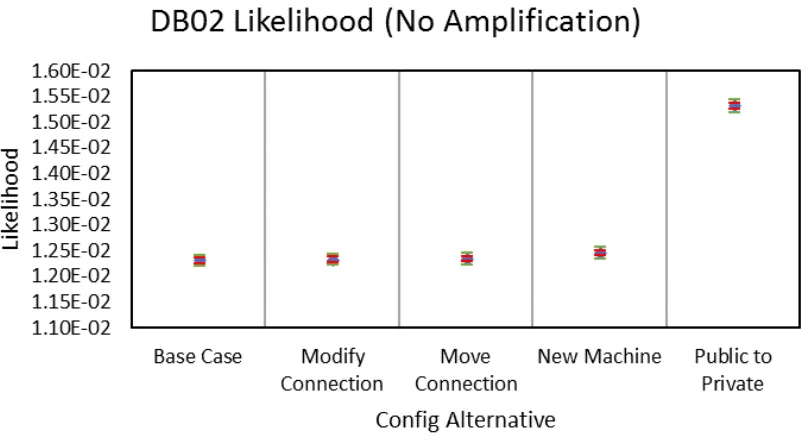
5.30 Configuration Likelihood Comparison - Depth - DB02 . . . 55
5.31 Configuration Likelihood Comparison - Depth - FILES . . . 55
5.32 Configuration Likelihood Comparison - Breadth - STORAGE . . . 57
5.33 Configuration Likelihood Comparison - Breadth - DB01 . . . 57
5.34 Configuration Likelihood Comparison - Breadth - DB02 . . . 58
5.35 Configuration Likelihood Comparison - Breadth - FILES . . . 58
5.36 Additional Trials Required - Depth . . . 61
5.37 Additional Trials Required - Breadth . . . 61
5.38 Standard Simulation - Depth - Comparison - STORAGE . . . 62
5.39 Standard Simulation - Depth - Comparison - DB01 . . . 62
5.40 Standard Simulation - Depth - Comparison - DB02 . . . 63
5.41 Standard Simulation - Depth - Comparison - FILES . . . 63
5.42 Standard Simulation - Breadth - Comparison - STORAGE . . . 65
5.43 Standard Simulation - Breadth - Comparison - DB01 . . . 65
5.44 Standard Simulation - Breadth - Comparison - DB02 . . . 66
5.45 Standard Simulation - Breadth - Comparison - FILES . . . 66
A.1 Convergence - Breadth - Base Case - FILES Variance . . . 72
A.2 Convergence - Breadth - Base Case - DB01 Variance . . . 73
A.3 Convergence - Breadth - Base Case - DB02 Variance . . . 73
A.4 Convergence - Breadth - Base Case - STORAGE Variance . . . 74
A.5 Static - Depth - Base Case - FILES Variance . . . 74
A.6 Static - Depth - Base Case - DB01 Variance . . . 75
A.7 Static - Depth - Base Case - DB02 Variance . . . 75
A.8 Static - Depth - Base Case - STORAGE Variance . . . 76
A.9 Static - Breadth - Base Case - FILES Variance . . . 76
A.10 Static - Breadth - Base Case - DB01 Variance . . . 77
A.11 Static - Breadth - Base Case - DB02 Variance . . . 77
A.12 Static - Breadth - Base Case - STORAGE Variance . . . 78
B.1 Standard Simulation - Breadth - Comparison - DB01 . . . 79
B.3 Standard Simulation - Breadth - Comparison - DB02 . . . 80
B.4 Standard Simulation - Breadth - Comparison - DB02 . . . 81
B.5 Standard Simulation - Breadth - Comparison - FILES . . . 81
Chapter 1
Introduction
In an increasingly digitized world, the need for secure systems has become a paramount
concern. Every cyber network has inherent vulnerabilities, which can be exploited by
ma-licious agents. The modern cyber-attacker has various scopes of intent: some seek to steal
protected data while others may simply want to demonstrate their prowess. Additionally,
hacking may be fueled by a political agenda; such a practice is known as hacktivism.
Re-gardless of their motivation, the cumulative actions of all attackers result in outstanding
financial loss. For example, time must be taken to fix damaged systems, intellectual
prop-erty can be stolen and distributed, etc. To mitigate these financial impacts, security
spe-cialists actively work to protect their networks. Thus, spespe-cialists and cyber-attacks are at
odds with each other in a battle of wits. The ensuing conflict results in the application of
complex tactics and stratagem as each side attempts to gain the upper hand [21]. One of
the possible outcomes of these struggles is that an attacker fulfills their intent, which will
affect the targeted institution. The National Institute of Standards and Technology (NIST)
represents the synthesis of an adverse impact and its associated likelihood of occurrence as
network risk. More formally, risk measures the extent by which an entity is threatened by
a potential circumstance or event [17].
Overall, the implied goal of a security specialist is to minimize network risk to the
greatest degree possible. Such a feat can be done by making changes to a networks
the set of actions available to an attacker. To this end, being able to decipher a network’s
relative risk provides much needed context to an IT specialist when faced with a variety of
Chapter 2
Problem Statement
A cyber network topology has the potential to be highly complex. Machines on the network
may be highly interconnected or buried several layers beneath public visibility. Given such
a network, there may be numerous opportunities to bring malicious intent to fruition. For
example, a network can simultaneously be vulnerable to a worm attack or data theft. Within
the scope of data-theft, there may be multiple databases to consider, each with their own
associated risk of unauthorized data exfiltration. The difficulty in determining the risk of
each data-theft event has the possibility to scale with a networks complexity. An additional
layer of stochasticity becomes apparent when considering an attackers approach to
com-promising a network. Different attackers may utilize different strategies to move between
machines on a network. Thus, manually determining the risk of various events may become
time consuming and invoke additional expenses. Manual determination of risk would
in-volve leveraging real attacks on the network. Any damage done to a network in the midst
of testing would need to be repaired. To this end, an analytic technique for determining
network risk is much preferred. Said risk tool should be able to handle the aforementioned
sources of stochasticity while providing an efficient and cost-effective means of analyzing
a network. The potential benefits of an analytic risk calculation tool will be addressed by
this thesis.
The first thesis objective concerns the development of an analytic risk calculation
interest. For the purposes of this investigation, events of interest will be limited to the scope
of attackers achieving machine access. The technique should be placed into an abstract
framework that is compatible with a variety of cyber network topologies. Since likelihood
and impact are pertinent to the calculation of risk, the design objective of the framework
will be to determine each of these metrics.
The second thesis objective entails implementing the theoretical framework. Realistic
and complex network topologies should be fed into the model during testing. To satisfy the
requirement of a complex system, subnets within the larger network should have machines
that are highly interconnected. Doing so should ensure that the framework is functional
and suitable for general usage. Depth and breadth-based search methods are two divergent
network movement techniques that can be utilized by attackers and should be investigated.
Additionally, the effects of network reconfiguration alternatives should be explored. These
alternatives could include the addition of new machines and the removal of connections.
The model should be developed as custom-made software.
The third, and final, thesis objective surrounds experimentation. Two contrasting
meth-ods should be used to validate the benefits of the model framework against standard
pro-cedures. The first method should involve a static number of trials. Under this validation
method, the confidence intervals of the risk output can be compared to determine which
procedure produces estimates of higher quality. The second validation method should
as-sess the number of trials needed to converge on an estimate of predetermined quality. The
number of trials required for convergence for each procedure indicates the required
com-putational effort required. Thus, the procedure that requires fewer trials is the procedure
Chapter 3
Literature Review
This section discusses the relevant related work on network risk, risk reduction, and
rare-event simulation. The section opens by providing additional depth to the notion of risk.
Following this discussion, focus is placed on means to mitigate a network’s risk.
After-wards, rare-event simulation techniques, as they pertain to risk reduction, are explored.
The section closes with an analysis of the various techniques.
3.1
Network Risk
Risk is considered to be the synthesis of the likelihood and impact of an event. Each of these
two constituents have their own unique qualities to consider. However, additional measures
may be recorded alongside risk. McQueen et al. [11] identify the time to compromise a
target as a potential metric to track since it represents a measure of effort expended by an
attacker . In their study on Supervisory Control and Data Acquisition (SCADA) systems,
the time to compromise a machine is related to the same machine’s risk. As a machine’s
risk decreases, its time to compromise increases [11].
3.1.1 Likelihood
Likelihood is said to be contingent on three factors that are related to the attacker. These
factors include the attacker’s intent, capability, and targeting [17]. An attacker’s intent
describes the skillset associated with a particular attacker. Targeting pertains to the ways
in which an attacker moves through a network. Additionally, there is a temporal nature
attached to likelihood; the likelihood of an event of interest is taken with respect to a given
period of time [13, 17]. However, if an event is certain to occur, the known frequency of
occurrence can be used in lieu of likelihood [17]. Each action performed by an attacker is
attached to a given duration of execution. According to DELL, these actions will fall within
one of twelve categories that lie in a twelve-step sequence, known as a kill chain [5]. To
determine the time consumed by each of these steps, Rege et al. [16] utilized a red team
vs. blue team style event. During such an event, a team of attackers (red team) attempt to
infiltrate a network defended by a team of security specialists (blue team). Regeet al.[16]
obtained a preliminary finding of the temporal breakdown of the attack phases over the
course of each day, with system exploitation taking up roughly 44% of the available time
and reconnaissance taking up 42% of the time. Note that in such an event, a maximum time
threshold is predetermined. An attacker, if sufficiently tenacious, could leverage an attack
indefinitely. Baiardiet al.[1] found that an attack horizon of three days yielded the most
useful data. Similarly, Regeet al.utilized an attack horizon of four days in their study [16].
Inevitably, the occurrence of an event of interest will be dependent on the attacker
suc-cessfully compromising other machines on a network. To do so, the attacker must exploit
vulnerabilities present on a series of target machines. A vulnerability is defines as a defect
in a component or an erroneous or malicious behavior performed by a user [1]. These
vul-nerabilities vary in their severity and are given ratings by the Common Vulnerability
Scor-ing System (CVSS). These scores are assigned on a scale from one to ten, where higher
scores indicated an increased probability of exploitation [2]. CVSS does not account for
unknown vulnerabilities [2]. CVSS version 3 contains four primary metrics: access vector
(AV), access complexity (AC), privileges required (PReq), and user interaction (UI) [22].
AV refers to the context in which the vulnerability exploitation is feasible. AC describes
attacker must acquire prior to exploiting a vulnerability successfully. UI describes any
interaction required from a user that is not the attacker [22]. FIRST details an explicit
methodology by which each of these metrics can be gauged [7]. Note that CVSS version
3 also assesses the possibility of a change in scope. Should the attacker be able to affect a
component whose authority is different than the vulnerable component, the scope is
con-sidered to be changed [7]. A change in scope has the potential to affect the PR metric [22].
The presence of multiple points of entry to a cyber network will also affect the
likeli-hood that events of interest occur. An event may be more or less likely depending on an
attacker’s starting position relative to the rest of the network. Thus, any risk assessments
must consider the likelihoods associated with all potential points of entry that an attacker
can utilize [13].
3.1.2 Impact
The impacts that result from cyber attacks come in various forms. These types can be
listed as follows: confidentiality - the exfiltration of sensitive information; integrity - the
placement of an asset into a non-recoverable state; and availability - the placement of an
asset into a temporarily inaccessible state [13, 17]. Additionally, impact can determined
with respect to financial damages as a means to generate a more objective comparison
[13]. Nonetheless, the measurement of impact is often statically determined by a given
institution, according to NIST [17]. MITRE assesses impact with respect to cost, technical
performance, and scheduling. Each category is ranked from minimal to severe on a one to
five scale. The aggregate of each category’s score is utilized as the event’s numeric impact
score [12]. Said method for determining impact is know as the program risk management
assessment scale [12].
Given the possibility for multiple events of interest, NIST states that a vector of impacts
can be utilized to assess events of interest separately [17]. Once the impact and likelihood
risk vector. Said risk vector can then be analyzed by security specialists when exploring
risk reduction options.
3.2
Risk Reduction
Security specialists seek to employ any number of means to reduce network risk. The
removal of attack paths is one of various such means [15]. Minimizing the pairwise
con-nectivity between machines on the network is one means to carry forth this intuition. Dinh
et al. [6] developed an optimization method to carry forth this purpose in networks with
uncertainty. Sensor technology can generate alerts when certain actions are performed on
a network. Use of these alerts and knowledge of a network’s attack graph can be utilized to
correlate isolated alerts into attack scenarios [20]. Wanget al.[20] utilize a queue graph
ap-proach to generate this correlation. Additionally, said method can hypothesize any missing
alerts and predict the occurrence of future alerts.
Although connectivity contributes to the overall risk of a network, there are various
other metrics that come into play. Noelet al.[14] describe four main metrics, pertinent to
attack graphs, whose individual scores aggregate into a cumulative measure of risk:
vic-timization, size, containment, and topology. Each of these metrics have their own
associ-ated subcategories. The victimization metric pertains largely to the inherent vulnerabilities
present on a network. The size family reflects the overall size of the attack graph.
Contain-ment refers to the compartContain-mentalization of network while topology refers to the interaction
and relationships between machines [14]. The aforementioned notion of connectivity
hap-pens to fall within the topology family of metrics [14].
The implementation of an advanced defensive measure may also assist in the reduction
of network risk. One such option known as moving target defense (MTD) causes a network
to periodically reconfigure itself [23]. The intent behind reconfiguration is to increase
an attacker’s reconnaissance periods [23]. An additional consequence of MTD is that an
3.3
Rare-Event Simulation
Simulation is one means of evaluating statistics that describe the performance of stochastic
systems. However, assessing risk may be a computationally intensive feat should an event
of interest have a sufficiently rare likelihood. Output may be unobtainable or be of
undesir-able quality with wide confidence intervals. Therefore, special advanced techniques have
been developed to handle simulation involving rare events.
Two main rare-event simulation techniques have been used historically. The first of
the two is known as splitting and the second is known as Importance Sampling (IS). The
application of these Rare-Event Simulation (RES) techniques has had limited application
to cyber security [8]. Traditionally, more of the focus of cyber security analytics has been
allocated to the detection and prevention of cyber attacks, resulting in a lack of attention
being given to modeling associated impacts [8].
The splitting technique operates by creating copies of the simulation at various states.
The copies that reach a sufficient measure of “closeness” to the rare event are saved. The
simulation will then continue, utilizing these copies to improve the efficiency of the
ex-periment [19]. This Splitting approach has been employed to model rare events related to
worm infection. An earlier application dealt with the rare event of experiencing a packet
buffer overflow, given a threshold buffer size [8]. A later application, by contrast, evaluated
the rare event that a certain percentage of susceptible machines would become infected by
the worm. Said application utilized the susceptible-infectious-removed (SIR) model [10].
Susceptible machines can become infected, while infectious machines can infect other
ma-chines. Removed machines have the infection removed and cannot become reinfected [10].
Both applications yielded superior estimations of the rare event’s likelihood when
com-pared to the output of standard simulation [8, 10]. The overall concept of the splitting
technique can be seen in Figure 3.1.
The IS technique, in contrast to splitting, operates off the notion of enhancing certain
Figure 3.1: Splitting Technique
amplified conditions are then translated back to the context of the original network to offer
usable statistics [18]. The process of network amplification in IS works by altering the
probability of obtaining a certain value for a predetermined random variable. Said
alter-ation is known as a change of measure [18]. The ratio of the original probability value to
the change of measure is the mechanism that allows for the aforementioned translation of
context. Performing a change of measure may not be straightforward as it may increase the
likelihood of one event of interest but not another [18]. Furthermore, sufficient
probabilis-tic amplification can cause the event of interest’s lack of occurrence to become rare. One
solution to this concern takes the form of the Cross-Entropy method (CE). Optimal changes
of measure can be ascertained from the implementation of the iterative CE process. The
notion of Kullback-Leibler divergence is a core feature to CE and is used to measure the
distance between two expected probability distributions. CE seeks to generate parameter
The CE method also has its own set of requirements. First and foremost, it must be
pos-sible to calculate theKullback-Leiblerdivergence of a rare event’s probability distribution.
To this end, CE works best with the exponential family of distributions [4]. Additionally,
rare-events are defined with respect to some measure of interest exceeding some threshold.
Thus, CE makes heavy usage of continuous output data that can be sorted [4].
A preliminary, proof-of-concept, application of the IS methodology to model cyber
at-tacks was produced by Krallet al.[9]. The approach has an attacker move the network until
reaching one of two backup servers that contain data within a threshold number of attack
attempts. Note that the simulation would end once reaching one of the two goals. The path
taken is produced as a result of the attacker’s choices and successes/failures while launching
assaults on the network. Once a machine target was selected, the attacker would continue
to attack the machine until either successful or the attempt threshold was exceeded [9].
Additionally, the attacker was able to change source nodes when reaching a dead-end; a
dead-end is a machine whose outgoing connections only lead to other compromised
ma-chines. Once machines on the network were compromised, they remained accessible to
the attacker. Changes of measure were performed by amplifying the probability of
suc-cessfully compromising certain machines on the network. Ultimately the results of the
preliminary experimentation showed that higher quality estimates could be produced with
the same number of trials when using IS as opposed to standard simulation. Additionally,
IS required less computation effort to produce quality results [9].
3.4
Literature Analysis
Risk reduction through network reconfiguration requires ample knowledge surrounding
the current state of the network. Information derived from optimization models, sensors,
alternatives may be worth pursuing [6, 14, 15, 20]. Nonetheless, knowledge regarding
post-modification performance can inform a security specialist of the various trade-offs
associ-ated with each reconfiguration.
Use of CVSS scores can inform the development of a probabilistic representation of
a network topology [22], based on the services present on all machines. However, they
are most explicitly relevant to an attacker’s successes and failures when moving through
a network as opposed to the attacker’s selection of target. Ultimately, the likelihood that
any events of interest will occur must be held with respect to some temporal element;
if given enough time and effort, an attacker will be able to reach any goal. Impact is
statically defined in the assessed literature, although it is possible that impact scores could
be represented stochastically and follow a unique distribution. MITRE’s classification of
impact as the aggregate score of various categories extends the notion of impact beyond
mere immediate cost. When calculating risk from these aggregate impact scores, security
analysts are able to obtain an ordered list, which enables for a prioritized defensive focus.
Ultimately, the reliance of a measure of “closeness” for the splitting technique to
func-tion [8,10,19] makes its applicafunc-tion highly unfavorable when dealing with scenarios where
an attacker moves through a network. When a network is deep and highly interconnected, it
becomes very unclear how “close” an attacker truly is to reaching a particular machine. By
contrast, IS, not relying on such a condition, makes it infinitely more favorable. Ideally, IS
would be used in conjunction with CE. However, CE’s requirements make it a very niche
methodology that cannot fit with cyber network movement. Therefore, without a means to
automate making changes of measure through CE, any amplification to an example network
for IS would need to be performed manually.
Krallet al.’s application of IS to cyber network movement has much room for
improve-ment. The attacker behavior can be updated to ascertain a more realistic notion of choice.
The attacker may choose a different target after a failure, for example. Additionally,
machine of interest enables for greater simulation efficiency: each run can potentially
Chapter 4
Methodology
This section discusses the methodology by which an analytic risk assessment technique,
based on rare-event simulation, will be carried forth. The section opens by declaring the
scope of the investigation. After this, the design methodology, inclusive of the
impor-tance sampling methodology, is discussed. Once the design methodology is established,
the implementation of the design is identified. Following the implementation, the section
is concluded with a discussion on the experimental methods.
4.1
Scope of Work
The process developed by this thesis will produce a network risk vector with respect to all
predefined events of interest. These events will be limited to the infiltration of machines
of interest where an attacker must move through the network. Assessment of other types
of events of interest may not be compatible with the developed framework and, therefore,
would require the employment of different simulation techniques.
It is assumed that the attacker starts from a singular position, external to the network.
Machines are compromised by an attacker’s assault through the targeting of services on
user-specified machines. Importance sampling will be implemented as part of the
frame-work as a means to calculate the netframe-work risk vector with greater computational efficiency
and quality of output. To fulfill this intent, the overall probability density function
service selection.
The primary objective of this thesis is to compare defensive and configuration
alter-natives for a given cyber network with the ultimate goal of reducing relative risk. Each
alternative’s risk vector must be compared against the original, unmodified network. The
percentage change in the individual elements of the risk vector can be used to gauge if
pursuing a network alternative is worth the associated cost and effort of implementation.
Connections between machines can be removed (or re-routed) or additional machines can
be added into the network as part of an analyst’s risk-reduction strategy.
4.2
Design Methods
The overall process will estimate a given network’s risk vector. Each element within the
risk vector corresponds to a data-theft event of interest. Thus the risk vector is given by
R=L×I. (4.1)
In this case,Ris the risk vector whileLis the likelihood vector, held with respect to the
same time threshold, T. Lastly, Iis the impact vector. Each entry for Iis predetermined
and is therefore loaded into the simulation as a parameter for calculating risk. However,
it should be noted that the impact could follow a distribution that varies per simulation
run. Primarily, the simulation estimates values for each entry of L. The generalized IS
methodology will evaluate each entry ofLby fulfilling the following steps:
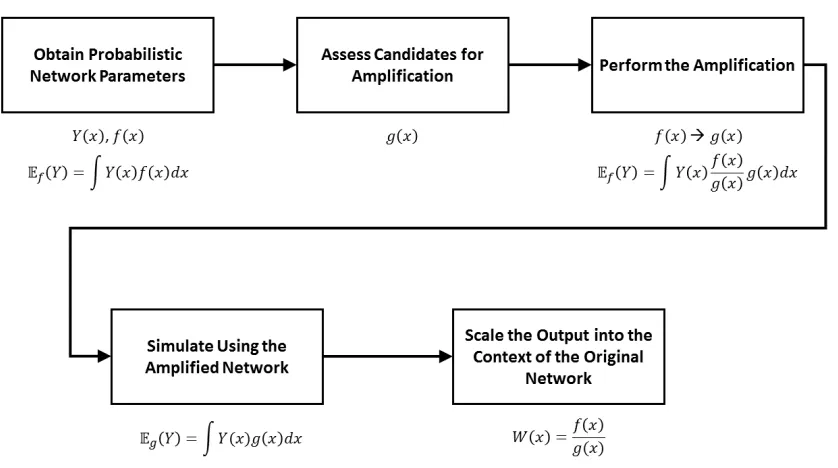
1. Obtain probabilistic network parameters;
2. Assess candidates for amplification;
3. Perform the amplification;
4. Simulate using the amplified network; and
Figure 4.1: IS Methodology Flowchart
4.3
Importance Sampling Methods
4.3.1 General Method
The generalized IS methodology, seen in Figure 4.1, starts with some metric of interest
Y with possible outcomesY(x). Each outcome, x, occurs with probability f(x). Under
standard simulation, one can calculate the expected value of Y at densityf, represented
by Ef(Y)[18]. Equation (4.2) shows how to calculate the expected value for a metric of
interest under normal circumstances,
Ef(Y) = Z
Y(x)f(x)dx. (4.2)
Parameters of the network will then be assessed for amplification, whose modification
modifies density f. The changes of measure produce probability densityg for metric Y.
Therefore, each outcome Y(x) would occur at probability g(x) when simulating under
by gg is the same as multiplying by one:
Ef(Y) = Z
Y(x)f(x)
g(x)g(x)dx. (4.3)
Pulling away the termfg from Equation (4.3) gives us the condition by which one would
simulate under amplified conditions:
Eg(Y) = Z
Y(x)g(x)dx. (4.4)
The ratio of density f to density g, given by W can then be utilized to translate the
output of the amplified simulation back to the context of the original network,
W(x) = f(x)
g(x). (4.5)
This translation works by multiplying each outcomeY(x)by each W(x). Ultimately,
the translation works by using W to replace the impact of g with f in the final output
[18]. Scaling the output from the simulation under amplified conditions produces the same
expected value as in equation (4.2):
Eg(Y W) = Z
Y(x)f(x)
g(x)g(x)dx=Ef(Y). (4.6)
4.3.2 Security Framework
The generalized IS methodology is tailored to represent cases where an attacker moves
through a network. The following shows the different variables and sets that will be utilized
in calculating the likelihood of reaching a particular target machine.
SETS:
M: set of all machines.
Z: set of all target machines,Z ⊆M.
Mv
m(j): set of vulnerable machines accessible from machinemduring attemptj,
Mmv(j)⊆Mm.
Amn: set of services on machinenvisible from machinem.
VARIABLES:
umn(j): probability of targeting machinenfrom machinemon attemptj.
vkmn: probability of targeting servicekon machinenfrom machinem.
q(j): machine/service selection probability during attemptj.
p(j): success/failure probability during attemptj.
x=
1 If servicekis compromised during attemptj.
0 Otherwise.
τz: compromising time of machinez.
fz(τz): probability that a attacker has reached machinezat compromising timeτz.
gz(τz): probability under amplified conditions.
The attacker operates by leveraging assault attempts against services present on the
machines in the network. Within the total time horizon, T, there is a maximum of J
possible attempts that the attacker can execute. Note that each attempt consumes one unit of
time. During a particular replication, there areΨtrials. Should a target,z, be compromised
during a particular trial ψ ∈ Ψ, the associated indicator variable will take a value of 1.
Otherwise, it will take a value of and0, such that,
Izψ =
1 If targetzis compromised during trialψwithin time horizonT
0 Otherwise.
(4.7)
When utilizing standard Monte Carlo simulation, the likelihood, Lz, that a particular
targetz is compromised is given by the expected value of the indicator variable [4]. It is
Lz =Ef(Iz) = 1 Ψ Ψ X ψ=1
Izψ. (4.8)
The calculations for the likelihood of reaching a target machine are held with respect
to each trial ψ. Said likelihood is dependent on the targeting, successes, and failures an
attacker experiences while moving through the network. Targeting always is done in two
phases when the attacker seeks to make an assault attempt. The first phase entails the
se-lection of a target machine. From a source, the attacker will look at all accessible machines
that are currently vulnerable. Each individual machine may have a unique selection
prob-ability, but for the purposes of this thesis, every machine is given an equal likelihood of
selection,
umn(j) = 1 |Mv
m(j)|
∀ n ∈Mmv(j). (4.9)
Once a machine has been selected, the attacker will select a vulnerable service on the
targeted machine. Each service is give a weight, which corresponds with an attacker’s
inter-ests and capabilities from a given source machine. The probability of selecting a particular
service is calculated by dividing the service’s weight by the aggregate of all weights on the
machine,
vkmn =
wk P
i∈Amnwi
∀ k ∈Amn, m∈M, n∈Mm (4.10)
The combined actions of selecting a machine and service represents the attacker’s
choice of targeting. Thus, the product of the two selection probabilities represents the
probability of a particular choice during an assault attempt, given by
q(j) =vkmnumn(j) ∀ j ∈ {1,2, ..., J}. (4.11)
each attempt, the attacker will either have a success or failure. The probability that an
at-tacker succeeds or fails during an assault attempt is dependent on the probability of success
defined for a particular service,
p(j) = pxk(1−pk)1−x ∀ j ∈ {1,2, ..., J}. (4.12)
If given a sufficiently long time period, an attacker would be able to reach every
tar-get. However, the simulation has an established time horizon, T. Therefore, there will
be cases where τz is unknown for a particular machine. The number of attempts required
to compromise a machine of interest is utilized in calculating the likelihood said machine
is compromised. As such, when τz is unavailable,T is used as a substitute, which
corre-sponds withJ attempts. Thus, the number of attempts required to compromise a machine
of interest is shown by
Jz(τz) = min (Number of attempts needed to reachzat timeτz, J). (4.13)
Formally, each assault path to a target has an associated probability. Each attempt
consists of a machine/service selection as well as a success/failure. The product of these
two elements gives each attempt an associated probability value. The combination of all
attempts forms the attacker’s assault path. Thus, the product of all attempt probabilities
gives the likelihood of compromising a machine of interest,
fz(τz) = Jz(τz)
Y
j=1
p(j)q(j) ∀ z ∈Z. (4.14)
When either elements of the success/failure or choice elements are amplified, the
prob-ability of generating a particular assault path becomes altered. When any consistent
probability of generating an amplified path is given by,
gz(τz) = Jz(τz)
Y
j=1
p0(j)q0(j) ∀ z ∈Z. (4.15)
The ratio of probability densityf to densityg for each target machine is given by:
Wz =
fz(τz)
gz(τz)
∀ z ∈Z. (4.16)
Said ratio is employed when utilizing IS since the calculation of the likelihood is held
with respect to density g rather than density f. Scaling the simulation under amplified
conditions must make use of each Wz. Thus, a modified version of Equations (4.6) and
(4.8) produces the likelihood calculation for IS:
Lz =Eg(IzWz) = 1 Ψ
Ψ
X
ψ=1
IzψWzψ. (4.17)
Tailoring the probability distribution associated with compromising a machine of
inter-est enables the application of IS. Simulation can be conducted under amplified conditions.
Once output data is received, said output can be scaled back into the context of the original
network by utilizing the ratio of the original probability density to the amplified probability
density. Thus, the likelihood a machine of interest is compromised can be determined.
4.4
Implementation Methods
The rare-event simulation techniques described in Section 4.2 are implemented with
ap-plication to a realistic and complex cyber network topology. The model receives several
inputs that are user-defined. Once these inputs are processed, several outputs will be
re-ceived. Figure 4.2 depicts how the IS methodology can be implemented. The required
1. Number of trials and replications;
2. Network topology and services;
3. Impact and target data;
4. Default service selection weights;
5. Default service success probabilities;
6. Amplifications to weights and success probabilities; and
7. Attacker movement strategy.
Figure 4.2: Model Implementation Structure
Different types of machine movement strategies can be implemented into the attacker
behavior. Depth-based search is one such method that will be evaluated. As seen in
Algo-rithm 1, the number of attempts (j), attacker’s initial starting position, attacker knowledge, target machines, success counter, and failure counter are initialized prior to movement. The
attacker knowledge describes all machines that have been compromised by the attacker so
event terminates. If the number of attempts does not exceed the maximum number allowed
(J), the assault will continue. The attacker will then scan the outgoing connections attached to its current source node. If all outgoing connections lead to compromised machines, the
attacker will attempt to change its source node such that at least one outgoing connection
leads to an un-compromised machine. If this is impossible, then the network infiltration
event ends. Once the attacker’s position is not a dead-end, then a target machine is chosen.
After a target machine is chosen, a service on the target machine is selected. Said service
is then attacked. The total number of assault attempts will increment by one regardless of
whether the attack is a success or failure. Should the attack be a success, the attacker’s
current position will be updated to be the targeted machine and the attacker knowledge will
be updated. At this time, the algorithm will check if the compromised machine is one of
the target machines. If it is a target, then the likelihood of reaching it will be calculated.
Should all target machines be compromised, infiltration will terminate and the replication
will end.
Breadth-based movement follows a similar methodology to depth-based movement and
is represented by Algorithm 2. The primary key difference is seen when the algorithm
ini-tializes. Breadth-based movement does not establish a source node. Instead, all currently
compromised machines in the attacker knowledge are treated as a collective source.
Ev-ery un-compromised machine stemming from the outgoing connections of this collective
source is a potential target for the attacker.
This distinction between machine selection strategies is displayed in Figures 4.3 and
4.4. Note that Figure 4.3 shows a source node that is used as a pivot point. Said source
is one of the currently compromised machines. Only outgoing, un-compromised machines
from this single pivot point are considered for potential targeting. By contrast, Figure
4.4 shows how all un-compromised machines connected to all compromised machines are
considered for targeting.
1: j←1
2: SourceN ode←Internet
3: Knowledge←addKnowledge(Internet)
4: T argetM achines←addT argets()
5: whilej < Jdo
6: M achineOptions←availableConnections(SourceN ode)
7: if isDeadEnd(M achineOptions) then
8: if isN ewSourceAvailable(Knowledge) then 9: SourceN ode←chooseN ewSource(Knowledge)
10: M achineOptions←scanConnections(SourceN ode)
11: else
12: break
13: end if
14: else
15: SelectedM achine←machineSelection(M achineOptions)
16: SelectedService←serviceSelection(SelectedM achine)
17: AttackStatus←attackM achine(SelectedService)
18: j ←j+ 1
19: ifisAttackSuccessf ul(AttackStatus)then
20: SourceN ode←updateSourceN ode(SelectedM achine)
21: Knowledge←Knowledge+addKnowledge(SelectedM achine)
22: if isT arget(SelectedM achine, T argetM achines) then
23: recordLikelihood(SelectedM achine)
24: if isAllT argetsCompromised(Knowledge, T argetM achines) then
25: break
26: end if
27: end if
28: end if
29: end if
30: end while
1: j←1
2: Knowledge←addKnowledge(Internet) 3: T argetM achines←addT argets()
4: whilej < Jdo
5: M achineOptions←[ ] 6: forM achine∈Knowledgedo
7: M achineOptions←M achineOptions+availableConnections(M achine)
8: end for
9: SelectedM achine←machineSelection(M achineOptions)
10: SelectedService←serviceSelection(SelectedM achine)
11: AttackStatus←attackM achine(SelectedService)
12: j←j+ 1
13: ifisAttackSuccessf ul(AttackStatus)then
14: j ←j+ 1
15: SuccessCounter ←SuccessCounter+ 1
16: Knowledge←Knowledge+addKnowledge(SelectedM achine)
17: if isT arget(SelectedM achine, T argetM achines) then 18: recordLikelihood(SelectedM achine)
19: if isAllT argetsCompromised(Knowledge, T argetM achines) then
20: break 21: end if
22: end if
23: end if 24: end while
Figure 4.3: Depth-Based Machine Selection Example
assign an impact rating to each target machine should it become compromised. MITRE
has a generalized risk rating system whose categories are cost, technical performance, and
scheduling [12]. A similar impact-rating heuristic is formed whose categories are
opera-tional, financial, and schedule. These categories are rated from1−5with5being the most
severe rating. The operational category describes the impact of the event on the ability
of the organization to perform core business functions, the financial category assesses the
direct implications on the budget, and the schedule category reflects any adjustments that
need to be made to project timelines.
Table 4.1: Impact Heuristic
Operational Financial Schedule 5
Severe Ability to perform core
business function com-pletely crippled.
Exceptional budget im-pact.
Exceptional scheduling adjustments required.
4
Significant Ability to perform core
business function is sig-nificantly impaired.
Budget significantly ex-ceeds planned amounts.
Major scheduling adjust-ments required.
3
Moderate Ability to perform core
business function is mod-erately impaired.
Budget moderately ex-ceeds planned amounts.
Moderate scheduling ad-justments required.
2
Minor Ability to perform core
business function is slightly impaired.
Budget slightly exceeds planned amounts.
Minor scheduling adjust-ments required.
1
Minimal No impact on ability to
perform core business function.
Budget is not affected. No planning adjustments re-quired.
Schedule is not affected. No planning adjustments required.
Although the probability of successfully exploiting a vulnerable service has been
de-fined, the method by which these probability values are determined has yet to be identified.
Each vulnerable service can be assigned a probability using CVSS version 3 [22]. The
methodology by which these values are assigned combine usage of Table 4.2 and Equation
(4.18).
Table 4.2: CVSS Categorization Values
Metric Category Lower Value Upper Value
Access Complexity (AC)
High 0.418 0.462
Low 0.7315 0.8085
Access Vector (AV)
Physical 0.19 0.21
Local 0.5225 0.5775
Adjacent Network 0.589 0.651
Network 0.8075 0.8925
Privileges Required (PReq)
None 0.8075 0.8925
Low 0.589 0.651
High 0.2565 0.2835
User Interaction (UI)
None 0.8075 0.8925
Required 0.589 0.651
based on its severity. FIRST classifies a methodology for assigning categories to
vulner-abilities [7]. When looking at AV, if the attacker exploits a vulnerable component via the
network stack, the categorization is either Network or Adjacent. Between these two, the
vulnerability can be exploited from a routed network, the categorization is Network. If
the attacker cannot exploit the vulnerability though the network stack, the categorization is
either Local or Physical. If the attack requires physical access to the target, the
categoriza-tion is Physical. The AC can either be Low or High. It is only High if the attacker cannot
exploit the vulnerability at will. PReq can either be None, Low, or High. If the attacker
does not need to be authorized, PReq is categorized as None. If administrator privileges are
required, PReq is High. UI is fairly straightforward. If the attacker requires another user to
perform an action, UI is Required. Otherwise, UI is None [7]. Each of these subcategories
corresponds to a range of scores, which are derived from Zhanget al.[22]. A uniform
dis-tribution is then used to give each service a single score for each subcategory for eventual
use in determining a probabilistic value. Equation (4.18) is then utilized to calculate the
final probability value for each service [22], given that there areK total services,
Consider CVE-2009-0658 as a potential vulnerability present on a service. According
to Zhanget al.[22], this vulnerability receives Local for AV, Low for AC, None for PReq,
and Required for UI. Table 4.3 shows a potential probability scoring for this particular
vulnerability.
Table 4.3: CVE-2009-0658 Probability Scoring Example Category Subcategory Score
AV Local 0.532
AC Low 0.772
PReq None 0.874
UI Required 0.601 Total Score: 0.455
Each service also takes a selection weight as an input for the IS model. The method by
which these weight inputs are seen is shown in Table 4.4. These weights are assigned to
each service according to the attacker’s interest. Said interest is controlled by an attacker’s
capabilities and intent. Interest is placed into four categories: low, medium, high, and very
high. Each category is given a high and low value which feeds into a uniform distribution
when assigning weights to services. The potential value of the weights exponentially
in-creases as the interest level inin-creases. Said exponential scaling ensures that a service of
very high interest is much more likely to be selected by an attacker than a service of low
interest.
Table 4.4: Interest Rating
Interest Lower Bound Upper Bound
Very High 6.4 9.9
High 1.6 3.2
Moderate 0.4 0.8
Low 0.1 0.2
The final input of the IS model concerns the network topology and services. An input
topology must include information regarding which machines are present on the network
and how said machines are connected to each other. Additionally, the services present
machine may or may not be visible from a particular source machine when the attacker
leverages assaults; this type of access information must be specified as an input.
Nonethe-less, once all input information has been received, the IS model can be utilized.
4.5
Experimental Methods
Comparison of the proposed IS methodology can be assessed from two distinct
perspec-tives. The first perspective seeks to contrast the quality of risk estimates between methods.
A(1−α)confidence interval can be produced for a static number of runs per replication,
where α is the probability of Type I error. The risk estimates of each test case should
be roughly the same. However, the bounds of the confidence interval should be different.
Confidence intervals with a smaller halfwidth indicate a more accurate risk estimation.
The second perspective seeks to compare the computation effort required by each
tech-nique to ascertain a quality estimate of the network’s risk. First, some measure of a quality
estimator must be established. In the case of this thesis, a quality estimate of risk is given by
a confidence interval that falls within some percentage of the mean. Thus, additional trials
will be run until each confidence interval converges appropriately. Note that convergence
necessitates checking each confidence interval at certain points within the simulation to
make sure it falls within the aforementioned criteria. Expedient convergence indicates less
expenditure of computation effort. Therefore, the number of trials required for convergence
is utilized as a measure of time. Pure computational time is not utilized as a meaningful
metric since different computers have varying hardware, which can obfuscate the utility of
the IS technique.
To increase the efficiency of the simulation, convergence will only be checked at
cal-culated milestones, represented by a specified number of trials for a particular replication.
The first milestone must be established prior to running the simulation. Should
conver-gence not be reached at a milestone, the number of trials needed to recheck converconver-gence
CONVERGENCE:
Λz: set of likelihoods of compromising targetz ¯
Lz: average likelihood of compromisingz
sz: likelihood standard deviation for machinez
tα
2,|Λz|−1: t-statistic
θ: likelihood quality threshold (%)
ψc
z: number of trials needed before re-checking convergence for machinez.
The confidence interval for the likelihood must converge to be within someθ%of the
mean. Therefore, one can determine the number of trials needed to obtain a quality
esti-mate. For each machine of interest:
¯
Lz(1 +θ)≥L¯z+tα2,|Λz|−1
sz p
ψc z
(4.19)
SubtractingL¯z from each side of Equation (4.19) gives:
θL¯z ≥tα2,|Λz|−1
sz p
ψc z
(4.20)
Equation (4.20) can be rearranged to produce:
p
ψc z =
tα
2,|Λz|−1sz
θL¯z
(4.21)
ψzc = tα
2,|Λz|−1sz
θL¯z 2
(4.22)
Ultimately, the true number of trials needed before checking convergence will be the
maximum of all ψc
z since the likelihood confidence interval needs to converge for all
ma-chines of interest.
When running experiments from both perspectives, it is possible to give additional value
interest. However, there may be multiple events of interest on a single network; assessing
each event independently would necessitate more total runs. Instead, the attacker can be
allowed to continue moving through the network, even after reaching a single machine of
interest. Thus, statistics can be collected about all events of interest simultaneously during
Chapter 5
Experimentation
This section discusses the experimentation performed using the IS model. A network
ex-ample is first established, which will be fed into the model as an input. Next, the remaining
experimentation-specific inputs will be identified. Afterwards, the results obtained by the
IS model are shown and discussed.
5.1
Network Example
One of the primary inputs to the IS model is a network topology and services. Thus,
for the purposes of experimentation, such an example network must be defined. For the
purposes of this investigation, the network presented in Figure 5.1 will be utilized as a base
case. This example network is derived from the Collegiate Penetration Testing Competition
held in 2016 [3]. The main network is composed of four sub networks, which have some
connectivity between each other.
The example represents the network infrastructure of a hypothetical healthcare-oriented
facility. All connections between machines are networked, but only some servers are
public-facing. Subnet 1 contains workstations and other machines common in a doctor’s
office. 4482 primarily deals with electronic medical records (EMR). By contrast, 4483 is
billing-oriented. 33223 deals with information technology related issues. DC01 is the
do-main controller which serves as an authentication barrier when seeking access to the file
Figure 5.1: Network Example - Base Case
workstations. XRAY-13 is a machine capable of producing x-ray images.
Subnet 2 houses the EMR functionality of the facility. WEB02 is the actual EMR
application server, with its information being stored on the DB02 database. Subnet 3 hosts
a variety of functions. WEB01 is a billing application server, with information stored on
the DB01 database. The OPS & WIKI server hosts the IT Wiki. PR runs a public relations
Twitter bot that publishes protein folding research.
Subnet 4’s primary functionality is the development of the aforementioned protein
fold-ing research. FOLDING represents an application server for the research, with information
stored on STORAGE. CI is a continuous integration server and works in conjunction with
the GIT repository server for code development. TS01 is a terminal services application
server that enables the IT workstation to remote into the other workstations on the
net-work. The BASTION server acts as a barrier between the public Internet and the rest of the
subnet.
3 to determine the success probabilities. Table 5.1 displays each service that is present
on network alongside their machine locations and CVSS categorization assignments. The
assignments for user interaction and privileges required are not shown in the table. Each
service receives a “None” for user interaction and “High” for privileges required. Table 5.1
also shows the interest categorizations utilized for assigning services selection weights.
One of the final required inputs relevant to the network topology concerns the impact
data. For the purposes of this experiment, the attacker seeks to exfiltrate data stores on the
four database servers: FILES, DB01, DB02, and STORAGE. Impact ratings are assigned
to each database in Table 5.2. The aggregate score of all three categories represents the
impact should the machine become compromised.
Various network reconfigurations are assessed in addition to the base case. The first
reconfiguration alternative can be seen in Figure 5.2. The connection between the public
relations server and protein folding application server is modified to be unidirectional. Data
can now only be sent from FOLDING to PR. This case is known as “Modify Connection.”
The second case is shown in Figure 5.3 and is known as “Move Connection.” The
con-nection from 33223 to BASTION has been moved to exist between 33223 and TS01. the
third case sees the additional of new machine functionality to the network. An additional
BASTION server, shown as BASTION2, is added to Subnet 4, as seen in Figure 5.4. This
experimental case is referred to as “New Machine.” Since the data contained on STORAGE
is significantly important to the organization, an additional layer of authentication security
may be desirable. The last alternative modifies the BASTION server to be private-facing,
shown in Figure 5.5, and is labeled as “Public to Private.”
Given these input parameters, the only remaining inputs are the number of trials and
replications as well as the degrees of amplification utilized for experimentation. Attacker
Table 5.1: Service CVSS Categorization
Services Locations Interest Access Complexity
Access Vector
Domain Controller DC01 High Low Network
Domain File Share FILES,
STORAGE Very High Low Adjacent
EMR Web Application WEB02 High High Adjacent
FreeBSD 9.1 BASTION Moderate High Network
GitLab GIT Moderate Low Adjacent
Internal IT Wiki OPS & WIKI Low High Adjacent
Jenkins CI CI Low High Adjacent
MySQL DB02,
STORAGE Very High High Adjacent
NodeJS Web Application PR Low High Adjacent
Non-HIPPAA/PCI Compliant
Billing Application WEB01 High High Network
Picture Archive and
Communication System XRAY-13 High High Network
PostgreSQL DB01 Very High High Adjacent
Print Application PRINT Low Low Adjacent
Protein Folding Application FOLDING High High Adjacent
Remote Desktop TS01 Moderate High Adjacent
SSH BASTION High High Network
Telnet STORAGE Low Low Adjacent
Terminal Services TS01 Moderate High Adjacent
Tomcat CI Moderate High Adjacent
Ubuntu 16.04-1
WEB02, DB02, DB01, PR,
CI, GIT, FOLDING, STORAGE
Low High Adjacent
Ubuntu 16.04-2 WEB01,
OPS & WIKI Low High Network
Windows 7 4482, 4483 High Low Network
Windows 8 33223 High Low Network
Windows Server 2003 XRAY-13 Moderate Low Network
Windows Server 2008 R2-1 DC01 Moderate High Adjacent
Windows Server 2008 R2-2 FILES Moderate High Network
Figure 5.2: Network Example - Modify Connection
Figure 5.4: Network Example - New Machine
Table 5.2: Impact Assignments
Impact Score
Machine Operational Financial Schedule
FILES 2 1 3
DB01 4 3 2
DB02 4 4 3
STORAGE 4 5 5
5.2
Experimental Setup
At this time, the specific settings given to the simulation will be identified. Each
experi-mental case will be run with30total replications. When testing computational efficiency,
the maximum number of possible trials will be1×108 for both depth and breadth-based
network movement. When testing for the quality of estimate, depth-based movement will
be run at a static50,000trials. Likewise, breadth-based movement will be run with a static
4×10⁶ trials when determining the quality of the estimate; this number is different
be-cause breadth-based cases require significantly more trials to produce quality estimates. In
all experimental cases,α= 0.05and the maximum number of assault attempts the attacker
can levy is J = 10, which allows for multiple machines of interest to be compromised
during a single infiltration event. Different levels of amplification will be tested for
differ-ent experimdiffer-ental cases. Amplification will be carried forth by multiplying all probabilities
of successfully compromising a service on a machine by a given factor. Note that an
am-plification of one corresponds to no network amam-plification; these cases represent usage of
standard simulation as opposed to IS. In total, amplification levels of 1x, 1.25x, 1.5x, 1.75x
and 2x will be tested. Amplification above 2x runs the risk of assigning probability values
5.3
Base Case Results
5.3.1 Computational Savings - Depth
There is an exponential decrease in the number of trials required to convergence on a quality
likelihood estimation when attackers adhere to depth-based movement. This trend can be
seen in Figure 5.6, which shows that when the degree of amplification shifts from 1x to 2x,
there is about an 83.5% reduction in the computational effort.
Figure 5.6: Convergence - Depth - Base Case - Computational Savings
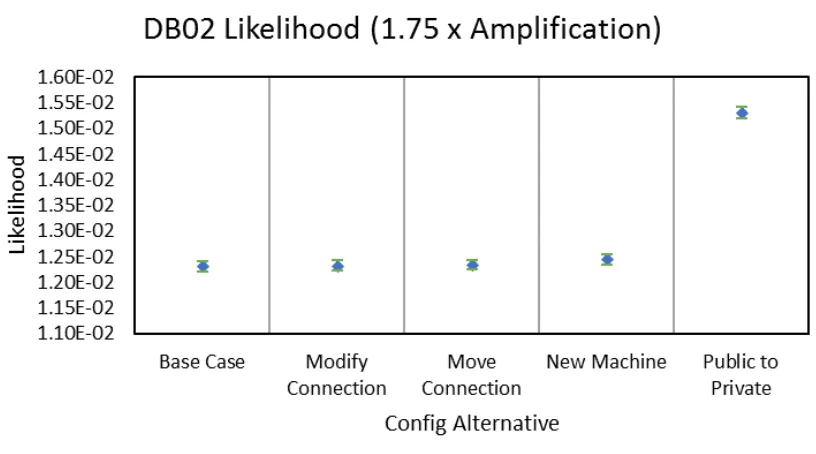
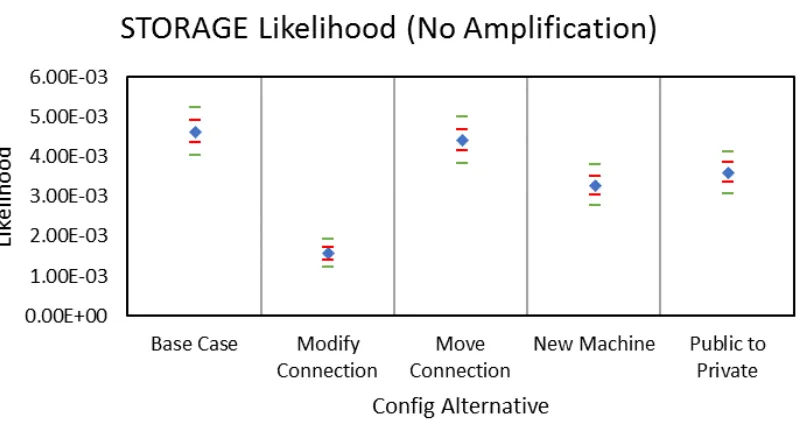
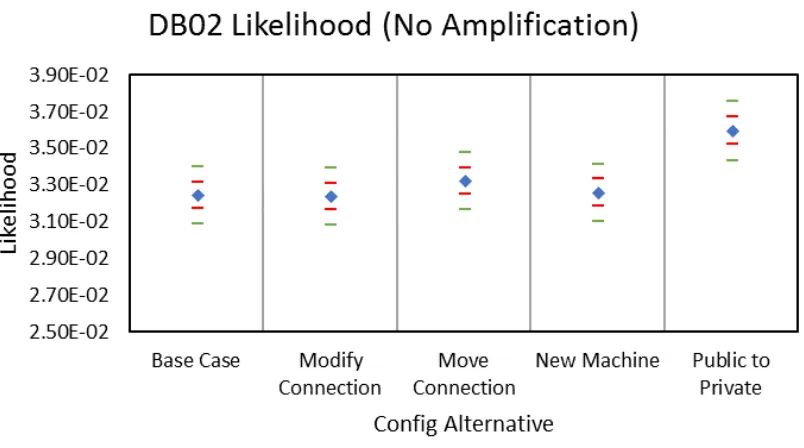
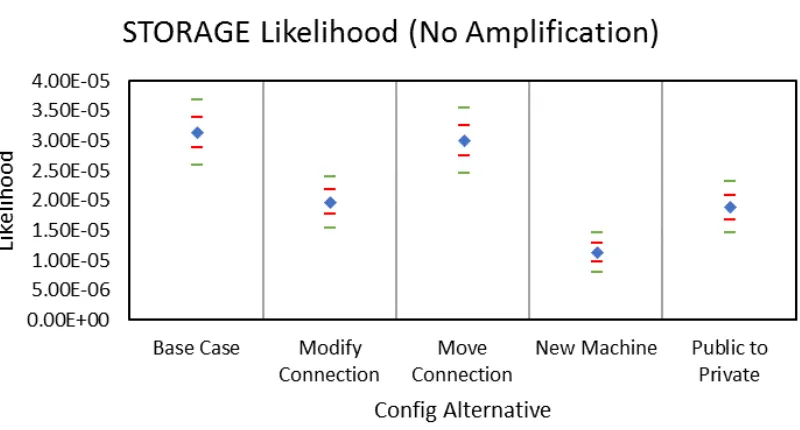
As seen in Figures 5.7 - 5.10, the confidence interval of the likelihood estimates for
compromising all database servers of interest falls within the predetermined±10%of the
mean. The confidence interval for STORAGE remains constant across all degrees of
am-plification. However, for FILES, DB01, and DB02, the confidence interval widens as the
degree of amplification increases. The DB01 and DB02 confidence intervals widen to
nearly touch the±10%limits when approaching 2x amplification.
Figure 5.7: Convergence - Depth - Base Case - FILES Likelihood
Figure 5.9: Convergence - Depth - Base Case - DB02 Likelihood
follows a parabolic curve for FILES, DB01, and DB02. For each of these events, the
variance hits a low point at around 1.5x amplification. By contrast, the variance follows an
exponential decrease for STORAGE.
5.3.2 Computational Savings - Breadth
Amplification has a similar effect on computational savings when attackers utilize
breadth-based as opposed to depth-breadth-based movement, as seen in Figure 5.15. As the degree of
am-plification increases, the number of trials required to produce a quality likelihood estimate
exponentially decreases. Shifting the degree of amplification from 1x to 2x decreases the
number of trials by about 79.8%. However, it should be noted that breadth-based movement
required a significantly larger number of trials than depth-based movement.
As seen in Figures 5.16 - 5.19, the confidence interval of the likelihood estimates for
compromising all database servers of interest falls within the predetermined±10%of the
mean. The confidence intervals for FILES, DB01, and DB02 widen as the degree of
ampli-fication increases. However, unlike in Figures 5.7 - 5.10, these confidence intervals are very
far away from the±10%limits. The confidence interval for STORAGE remains relatively
constant across all degrees of amplification although there appears to be a slight sinusoidal
pattern.
The variance of the likelihood estimates for breadth-based movement when running the
convergence method follow similar trends as those seen in Figures 5.11 - 5.14 for
depth-based movement. These figures are shown in Appendix A
5.3.3 Estimate Quality - Depth
Figures 5.20 - 5.23 shows the likelihood confidence intervals for depth-based movement
when running a static number of trials. The confidence interval for STORAGE becomes
tighter as the degree of amplification increase. By contrast, the confidence intervals for
Figure 5.11: Convergence - Depth - Base Case - FILES Variance