EFFICACY OF MODIFIED TASK ORIENTED EXERCISES
PERFORMED ON A SWISS BALL OVER CONVENTIONAL
TASK ORIENTED EXERCISE ON IMPROVING BALANCE
AMONG CHRONIC STROKE PATIENTS
DISSERTATION
Submitted for the partial fulfillment of the requirement for the degree of
MASTER OF PHYSIOTHERAPY
ADVANCED PHYSIOTHERAPY IN ELECTIVE
NEUROLOGY
by
DINESHKUMAR.S
Bearing Registration No :271420261
`
Submitted to
OCTOBER
–
2016
EFFICACY OF MODIFIED TASK ORIENTED EXERCISES
PERFORMEDON A SWISS BALL OVER CONVENTIONAL
TASK ORIENTED EXERCISE ON IMPROVING BALANCE
AMONG CHRONIC STROKE PATIENTS
DISSERTATION
Submitted for the partial fulfillment of the requirement for the degree of
MASTER OF PHYSIOTHERAPY
ADVANCEDPHYSIOTHERAPY IN ELECTIVE NEUROLOGY
by
DINESHKUMAR.S
Bearing Registration
No:
271420261OCTOBER - 2016
Submitted to
MOHAMED SATHAK A.J COLLEGE OF PHYSIOTHERAPY
144/1 NUNGAMBAKKAM HIGH ROADMOHAMED SATHAK A.J COLLEGE OF PHYSIOTHERAPY
NUNGAMBAKKAM, CHENNAI
–
600034
CERTIFICATE
This is to certify that the dissertation work entitled “EFFICACY OF MODIFIED
TASK ORIENTED EXERCISES PERFORMED ON A SWISS BALL OVER
CONVENTIONAL TASK ORIENTED EXERCISES ON IMPROVING
BALANCE AMONG CHRONIC STROKE PATIENTS” Was done by bearing
theRegistration no : 271420261. This work has been done as a partial fulfilment for the degree of Master of Physiotherapy, done at Mohamed Sathak A.J College of Physiotherapy, Chennai, and submitted in the year of OCTOBER 2016to the Tamil Nadu Dr. M.G.R Medical University.
---Prof. R. RADHAKRISHNAN, M.P.T., PGDHM
Seal & Signature of Principal
Place: Chennai
MOHAMED SATHAK A.J COLLEGE OF PHYSIOTHERAPY
NUNGAMBAKKAM, CHENNAI
–
600034
CERTIFICATE
This is to certify that the dissertation work entitled "EFFICACY OF MODIFIED TASK ORIENTED EXERCISES PERFORMED ON A SWISS BALL OVER
CONVENTIONAL TASK ORIENTED EXERCISES ON IMPROVING
BALANCE AMONG CHRONIC STROKE PATIENTS” Was done by bearing
the Registration no : 271420261. This work has been done under my direct guidance and supervision for the partial fulfilment for the degree of Master of Physiotherapy, done at Mohamed Sathak A.J College of Physiotherapy, Chennai, and submitted in the year of OCTOBER2016 to the Tamil Nadu Dr. M.G.R Medical University.
SIGNATURE OF GUIDE
---PROF. S.PARVATHI,
MPT(Neuro), M.SC(PSY),MIAP.
Place : Chennai
MOHAMED SATHAK A.J COLLEGE OF PHYSIOTHERAPY
NUNGAMBAKKAM, CHENNAI
–
600034
CERTIFICATE
This is to certify that the dissertation work entitled “EFFICACY OF MODIFIED TASK ORIENTED EXERCISES PERFORMED ON A SWISS BALL OVER
CONVENTIONAL TASK ORIENTED EXERCISES ON IMPROVING
BALANCE AMONG CHRONIC STROKE PATIENTS” Was done by bearing the Registration No : 271420261. The undersigned examiner has duly verified and examined the submitted dissertation work done by the above candidate.
---
---INTERNAL EXAMINER EXTERNAL EXAMINER
Place:Chennai
DECLARATION BY THE CANDIDATE
I hereby present and declare my dissertation titled “EFFICACY OF MODIFIED TASK ORIENTED EXERCISES PERFORMED ON A SWISS BALL OVER CONVENTIONAL TASK ORIENTED EXERCISES ON IMPROVING BALANCE AMONG CHRONIC STROKE PATIENTS” is the outcome of original work undertaken and carried out by me bearing the Registration No :271420261, under the guidance of my Guide at Mohamed Sathak A.J. College of Physiotherapy, Nungambakkam, Chennai –600034. I also declare that the material of this dissertation has not formed in any way the basis for the award of any other degree previously from the Tamil Nadu Dr. M.G.R. Medical University, Chennai.
---SIGNATURE OF THE CANDIDATE
Place:Chennai
ACKNOWLEDGEMENT
I thank the Almighty for blessing me in all aspects to complete the project successfully.
I thank our Management for providing sufficient books, good faculties and facilitating us
to explore and gain a wide knowledge.
My sincere thanks to our Correspondent Alhaj E.S.M.A. Basheer Ahmed, our
DirectorJanaba.S. Mahsooka, Mohammed SathakA.J college of physiotherapy.
I have great pleasure to express thedeep sense of gratitude to our most respected
PrincipalPROF.R.Radhakrishnan,MPT,PGDHMfor his valuable advice and encouragement.
I wish to express my sincere and heartfelt thanks to my dissertation Guide
PROF.S.Parvathi,MPT (Neuro),M.SC (PSY),MIAP for her continuous support, profound
interest and timely and valuable suggestions throughout the period of the study.
It is my privilege to render my heartfeltthanks to teaching staff and also non teaching staff
forconstant support, encouragement and constructive criticisms made me to work more.
My heartfeltthanks to my Parents, my brother and my friends for their immense support and help
for all these years in my studies.
ABSTRACT
Title: EFFICACY OF MODIFIED TASK ORIENTED EXERCISES PERFORMED ON A
SWISS BALL OVER CONVENTIONAL TASK ORIENTED EXERCISE ON IMPROVING BALANCE AMONG CHRONIC STROKE PATIENTS
Background and objective: Studies had reported wide variation in the components of
physiotherapy treatment provided to stroke patients among different setting .Therapist belief on motor development and prognosis of the condition can influence the selection of treatment techniques in the management of stroke patients .The primary aim of the study was to know the Efficacy of modified task oriented exercises performed on a swiss ball over conventional task oriented exercises on improving balance among chronic stroke patients.
Methods:Rehabilitation clinics across Chennai was chosen for this study in that total of 20 patients was taken .each group assigned 10 and 10 patients.Group 1:10 patients 60 minutes receiving task oriented exercise on swiss ball in sitting,kneeling,qudripod and standing
Group 2 :10 patients,60 minutes receiving task oriented exercise only in
sitting,kneeling,qudripod and standing .Procedure was done with the supervision of chief therapist.
Results: Twenty patients were taken for the treatment. In that The inferential statistical results
INTRODUCTION:
Stroke is the second commonest cause of death and fourth leading cause of disability worldwide (Strong 2007). Approximately 20 million people for every year will suffer from stroke and of these 5 million will not survive. A study shows that majority of stroke are ischemic in nature; 88% were ischemic, 9% were due to intra cerebral haemorrhage, and 3% were due to subarachnoid haemorrhage. Stroke is also a predisposing factor for falls, epilepsy & depression in developed countries and is a leading cause of functional impairments (Steinbach€s2000). Another study shows that annual incidence rate of stroke in India is about 145 per 100,000 population. Hypertension is the one of the major risk factors for the stroke. In Indian population stroke is relatively common in young population [Indian population 60years ≥ 7.5%
compared to the west (e.g. British population ≥ 65 years)]. In India the annual
incidence of stroke is about 145 per 100,000 per year during 2003-05 and 2005-06.
Postural control and balance are required components for walking and mobility after stroke. Particularly, training for weight-bearing on the affected side is essential. Sensory stimulation and neuro-developmental treatment, ensuring weight-bearing on the affected side, are among the conventional treatments. Postural control is reported to be the best indicator of independence in walking and daily life activities, in stroke patients. Therefore, improvement of stable standing position in hemiplegic patients and betterment of postural control is a critical step in the rehabilitation process. Correction of standing balance was found to be much more important than strengthening lower extremity muscles in improvement of daily life activities and walking capacity in the studies conducted.
Sitting not only involves the ability to maintain the body in erect posture but also the
ability to reach for the variety of objects located within and beyond€s arm length.
Inability in maintaining a proper sitting posture is one of the most common problems after stroke. Proper sitting balance is required for individuals who recovering from stroke because it is the skill that is critical for making the patient more independent for doing the activities of daily living (Dean et al 1998) and also sitting ability has been shown to be a useful prognostic indicator for outcomes after stroke (Loewen and Anderson 1990, Morgan 1994). The disability associated with poor sitting arises primarily because of muscle weakness, sensory deficits and also because of tendency to adapt behaviour to avoid threats to balance. A furthermore important cause of balance impairment in stroke is a deficit of the central integration of sensory inputs
(visual, vestibular and somatosensory)
Task oriented training is a effective method of treatment in any form of stroke survivors to improve the multi system functioning of central nervous system. Task oriented exercises have been used for quite long time by physiotherapists as an effective means of improving balance. It may reduce the causative impairment and helpful in retraining the effective task specific functional movements of the body. Few recent studies were also suggesting that Balance training in unstable surface may also improve the postural control mechanisms among neurologically impaired persons especially after stroke. There are several researches has been done on the stable surface balance training and task specific training in normal as well as hemiplegic subjects and the researchers were proven the effects of both oriented training is considered to be an effective interventions, it was performed on the stable platform surfaces. In the recent years Task oriented exercises like weight shifting exercises, trunk training exercises, sit to stand training, gait upper limb object reach deep flexion activity training, strength training, task oriented circuit training on stable and unstable surface used by various researchers to improve the balance and mobility functions in post stroke individuals. However, only very limited studies were used the swiss ball as an unstable surface balance training tool in stroke patients. In this present study we hypothesis that if the task oriented exercises performed on the unstable surfaces like Swiss ball it may reinforce the effectiveness of task specific exercises to make better clinical outcomes.
2.1 NEED FOR THE STUDY
Based on the available literatures, there are evidences to show that task oriented exercises performed on swiss ball to improve balance showed beneficial effects on balance among stroke patients. There are also evidence to support that conventional task oriented exercises performed also improves balance in stroke patients, but there are very few studies that compared the efficacy of task oriented exercises performed on Swiss ball and conventional task oriented exercises. Hence the need of my study is to compare the effect Efficacy of modified task oriented exercises performed on a swiss ball over conventional task oriented exercises on improving balance among chronic stroke and to find out which two shows the most beneficial effect in improving balance among hemi paretic patients.
2.2 OBJECTIVE
To assess the comparative effect Efficacy of modified task oriented exercises performed on a swiss ball over conventional task oriented exercises on improving balance among chronic stroke
2.3 HYPOTHESIS
NULL HYPOTHESIS
:
ALTERNATIVE HYPOTHESIS
:
There will be significant improvement in balance following balance training with modified
task oriented exercises performed on a swiss ball over conventional task oriented exercises.
2.4 OPERATIONAL DEFINITIONS:
Definition of task-related training
Unfortunately, no conclusive definition of a task-oriented approach exists in the literature. In the task-oriented approach, movement emerges as an interaction between many systems in the brain and is organized around a goal and constrained by the environment (Shumway Cook & Woollacott 2001).
2.5 PROJECTED OUTCOME:
CHAPTER
–
II
REVIEW OF LITERATURE
Mudie MH et al (2002)
Training symmetry of weight distribution after stroke: a randomized controlled pilot study comparing task-related reach, Bobath and feedback training approachesJean-francois Bayouk (2006)
An experimental study which was conducted at Concordia University, Canada among 16 Hemi paretic patients were taken for evaluating the effect of task oriented exercises for balance with and without altered sensory input. The study concluded that task oriented exercise program assisted by sensory manipulation was feasible and more effective for the improvement of the standing balance of hemi paretic subjects.Catherine M. Dean et al (1997)
Sitting training early after stroke improves sitting ability and quality and carries over to standing up but not to walking: a randomised controlled trial.surface. But when the improvements of two groups were compared those subjects who used Swiss ball had shown a significant (p=0.02) and better improvement in the BBS scores. In this present study it was also found that there was a significant increase in RMI score (p=.000) in subjects who performed task oriented exercises on a Swiss ball and stable flat surface.
Leroux A, Pinet H, Nadeau S (2006)
Task-oriented intervention in chronic stroke: changes in clinical and laboratory measures of balance and mobility. Ten stroke subjects took part in an 8-wk exercise program aimed at improving balance and mobility through various functional tasks. Clinical measures included the Berg Balance Scale and the Timed-Up-and-Go and laboratory measures included ground reaction forces and center of pressure displacement during four functional tasks. Stroke subjects showed significant improvements (P < 0.05) in the clinical measuresafter completing the exercise program. Significant improvements (P< 0.05) were also
found in postural steadiness during tandem stance and stool touch and in force production through the paretic lower limb during sit-to-stand.
Hyung-Seok Seo. Jung-Ho Lee . Young-Han Park(2014)
Effects of a Task-specific Exercise Program on Balance, Mobility, and Muscle Strength in the Elderly.Bayona NA , Bitensky J, Salter K, Teasell R(2005)
The role of task-specific training in rehabilitation therapies.Clarissa B. Oliveira, Ítalo R. T. Medeiros, Mario G. Greters, Norberto A.
F. Frota, Leandro Tavares Lucato, Milber to Scaff, and Adriana B.
Conforto
,(2011)
Abnormal sensory integration affects balance control in hemiparetic patients within the first year after stroke.
Salbach NM, Mayo NE, Robichaud-Ekstrand S, Hanley JA, Richards CL,
Wood-Dauphinee S.(2005)
The effect of a task-oriented walking intervention on improving balance self-efficacy post stroke: a randomized, controlled trial.Thielman GT, Dean CM, Gentile AM. (2004)
Rehabilitation of reaching after stroke: task-related training versus progressive resistive exercise.Hsieh CL, Hsueh IP, Mao HF(2000)
Validity and responsiveness of the river mead mobility index in stroke patients.Norris BS , Medley A. (2011)
The effect of balance confidence and context on functional reach ability in healthy older adults.Jang SH , Kim YH, Cho SH, Lee JH, Park JW, Kwon YH(2014)
Cortical reorganization induced by task-oriented training in chronic hemiplegic stroke patients.Da Silva PB, Antunes FN, Graef P, et,al.(2015)
Strength training associated with task-oriented training to enhance upper-limb motor function in elderly patients with mild impairment after stroke: a randomized controlled trial.Carla Bambirra , Maria Cecília de Betsan Rodrigues , Christina Danielli
Coelho de Morais Faria , Fátima Rodrigues de Paula(2015)
Clinical evaluation of balance in hemi paretic adults: a systematic review.Lisa Blum, Nicol Korner-Bitensky(2008)
Usefulness of the Berg Balance Scale in Stroke Rehabilitation: A Systematic Review.CHAPTER III
MATERIALS AND METHODOLOGY
4.1 MATERIALS:
1 Yardstick,
2 standard chairs (one with arm rests, one without),
Foot stool or step, Stopwatch or wristwatch, 15 ft walkway.
4.2 STUDY DESIGN:
Quasi Experimental Design – Pre test and Post test Design with Two Comparison Treatments.
4.3 POPULATION/PARTICIPANTS
:
Stroke patients from out patients in the department of Neurology, A total of 20 hemi paresis participants were assigned into 2 groups
Group 1 -10 participants – 10 participants receiving task oriented exercise on swiss ball in sitting, kneeling, qudripod and standing
4.4 CRITERIA FOR SAMPLE SELECTION
4.4.1 INCLUSION CRITERIA:
Diagnosis of first Ischemic stroke resulting hemiparesis.
Age group 45-65years.
Onset of stroke less than 3 month.
Patient with Motor assessment sitting score–3
Patient able to sit for 1 minute unsupported on a stable surface.
Patients able to understand and follow simple verbal instructions Mini mental state examination score above 24
No visual problems which would interfere with reaching to pick up objects or reading.
Berg Balance Scale score of minimum 20
4.4.2 EXCLUSION CRITERIA:
Obese patients (BMI>30)
Other neurological deficits which affect balance like cerebellar disease, Parkinsonism & vestibular disease.
Musculoskeletal abnormality like fracture, chronic stage of Osteoarthritis and ligament injury in lower extremity.
4.5 SAMPLING:
4.6 TREATMENT DURATION:
Group 1:10 patients 60 minutes receiving task oriented exercise on swiss ball in sitting, kneeling, qudripod and standing
Group 2 :10 patients,60 minutes receiving task oriented exercise only in sitting, kneeling, qudripod and standing
4.7 STUDY DURATION:
6 Months.
4.8 INSTRUMENT& TOOL FOR DATA COLLECTION:
BERG BALANCE SCALE AND
RIVERMEAD MOBILITY INDEX
4.9 STUDY SETTING:
Rehabilitation centres across Chennai.
4.10 TECHNIQUE OF DATA COLLECTION:
4.11 TECHNIQUE OF DATA ANALYSIS &
INTERPRETATION:
Data collected from subjects were analyzed using pairedƒt€ test to measure changes
between pre test and post test values of outcome measures within the group. Independentƒt€ test was used to measure changes between the groups.
Paired
•t‚ test
d
= Calculated Mean Difference of pre test & post test valuesSD = Standard Deviation
n = Number of samples
d = Difference b/w pre test & post test values
2
n
n
1)SD
-(n
1)SD
-(n
SD
Where,
n
1
n
1
|
x
x
|
t
2 1 2 2 2 2 1 1 2 1 2 1
SD
X1 = Mean difference in Group A
X2 = Mean difference in Group B
SD = Combined standard deviation of Group A and Group B
n1 = Number of patients in Group A
n2 = Number of patients in Group B
SD1 = Standard Deviation of Group A
4.12 PROCEDURE
Rehabilitation clinics across Chennai was chosen for this study in that Group 1:10 patients 60 minutes receiving task oriented exercise on swiss ball in sitting, kneeling, qudripod and standing
CHAPTER
–
IV
DATA ANALAYSIS AND INTERPRETATION
Data analysis is the systemic organization and synthesis of research data and testing of research hypothesis using these data. Interpretation is the process of making sense of the results of a study and examining the implication (Pol it& Belt, 2004). The pre test and post test values for Groups 1 & 2 were obtained before and after intervention. The improvement in balance was assessed using Berg Balance Scale and River mead Mobility Index score. The mean, standard deviation and Paired “t” test values were
used to find out whether there was any significant difference between pre test and post test values within the groups.
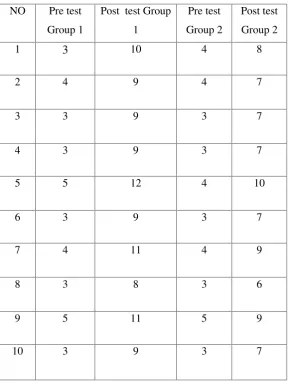
TABLE:1
PRE & POST TEST VALUES OF RIVER MEAD MOBILITY
INDEX IN GROUPS 1 & 2.
NO Pre test
Group 1
Post test Group
1
Pre test
Group 2
Post test
Group 2
1 3 10 4 8
2 4 9 4 7
3 3 9 3 7
4 3 9 3 7
5 5 12 4 10
6 3 9 3 7
7 4 11 4 9
8 3 8 3 6
9 5 11 5 9
TABLE 2
MEAN DIFFERENCE, STANDARD DEVIATION AND
PAIRED •T‚ TEST VALUES OF RIVERMEAD MOBILITY
INDEX
GROUPS
(MAS) n MEAN
MEAN DIFFERENCE
STANDARD DEVIATION
t
Value P value Group 1
Pre-test
Post test 10
3.60 9.70
6.1 0.73 26.14 p<0.001
Group 2 Pre-test Post test 10 5.50 8
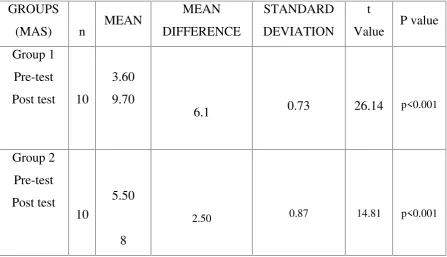
In table 2 the pre test and post test mean difference in Group 1 is 6.1 and Group 2 is 2.50.
The obtainedƒt€ value for the Group 1 (n=10) is 26.14 and for the Group 2(n=10) is 14.81.
The corresponding ƒp€ value for the Group 1 and Group 2 is the same i.e., less than 0.001.
Therefore, the result shows that there is a significant difference between Group 1 and Group 2.
The result shows that pre test, post test mean difference of MAS of
DIAGRAM 1
PRE TEST AND POST TEST MEAN VALUES OF
RIVERMEAD MOBILITY INDEX BETWEEN GROUP 1 AND
GROUP 2
3.6
5.5 9.7
8
0 2 4 6 8 10 12
DIAGRAM 2
PRE TEST AND POST TEST MEAN DIFFERENCE OF
RIVERMEAD MOBILITY INDEX BETWEEN GROUP 1 AND
GROUP 2
0 1 2 3 4 5 6 7
Category 1
TABLE 3
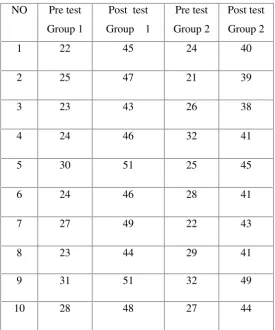
PRE TEST & POST TEST VALUES OF BERG BALANCE
SCALE IN GROUPS 1 & 2.
NO Pre test
Group 1
Post test
Group 1
Pre test
Group 2
Post test
Group 2
1 22 45 24 40
2 25 47 21 39
3 23 43 26 38
4 24 46 32 41
5 30 51 25 45
6 24 46 28 41
7 27 49 22 43
8 23 44 29 41
9 31 51 32 49
TABLE 4
MEAN DIFFERENCE, STANDARD DEVIATION AND
PAIRED •T‚ TEST VALUES FOR BERG BALANCE SCALES
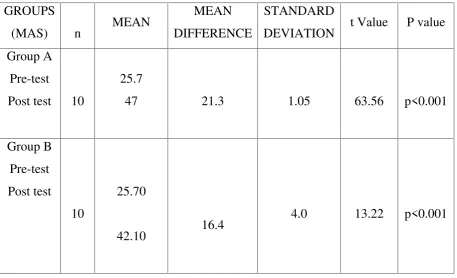
In table 4, the pre test and post test mean difference in Group 1 21.3and for the Group 2 is 16.4.
The obtained ƒt€ value for the Group 1 is 63.56 and for the Group 2 is 13.22The
corresponding ƒP€ value for the Group 1 and Group 2 is the same i.e., less than 0.001.
Therefore, the results show that there is a significant difference between Group 1 and Group 2.
The result shows that pre test post test mean difference of Berg balance scale of Group 1 is statistically significant than Group 2.
GROUPS
(MAS) n MEAN
MEAN DIFFERENCE
STANDARD
DEVIATION t Value P value Group A
Pre-test
Post test 10
25.7
47 21.3 1.05 63.56 p<0.001
Group B Pre-test Post test 10 25.70 42.10 16.4
DIAGRAM 3
PRE TEST AND POST TEST MEAN VALUES OF
BERG BALANCE SCALE BETWEEN GROUP 1 AND GROUP
2
25.7 25
47
42.1
0 5 10 15 20 25 30 35 40 45 50
DIAGRAM 4
PRE TEST AND POST TEST MEAN DIFFERENCE OF BERG
BALANCE SCALE SCALE BETWEEN GROUP 1 AND
GROUP 2
21.3
16.4
0 5 10 15 20 25
TABLE 5
INDEPENDENT•t‚ TEST VALUES
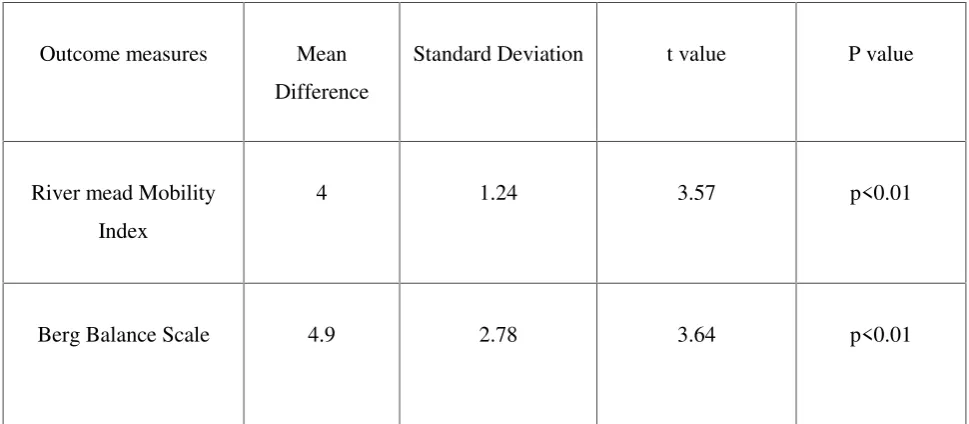
The mean difference between Group 1and Group 2 for River mead Mobility Index is 4 & for Berg Balance Scale is 4.9.
The obtained Independent ƒt€ value for River mead Mobility Index is 3.57, for Berg
Balance Scale is 3.64.
The corresponding ƒP€ value for River mead Mobility Index and Berg Balance Scale between both groups is the same i.e., less than 0.01.
Therefore, the result shows that there is a statistical significance difference for River mead Mobility Index and Berg Balance Scale between two groups
Outcome measures Mean
Difference
Standard Deviation t value P value
River mead Mobility
Index
4 1.24 3.57 p<0.01
CHAPTER V
RESULTS
The results of Paired ƒt€ test for The River mead Mobility Index score have shown the
mean difference of 6.1 (Pre Mean-3.6 and Post Mean 9.7) in group 1 and 2.50 (Pre Mean 5.5 and Post Mean 8) in group 2 (Table 2). And also, The statistical results of paired t test for berg balance scale score have shown the mean difference of 21.3 (Pre Mean 25.7, Post Mean 47) in the group 1 and 16.4 (Pre Mean 25.7, Post Mean42.1) in group 2 (Table 4).
The inferential statistical results of Independent ƒt€ test for the intergroup comparison
of Berg Balance Scale score had shown the ƒt€ value of 3.64 ( p-value= 0.01) and
intergroup comparison of River mead Mobility Index score had shown the ƒt€ value of
DISCUSSION
The purpose of this study was to assess the efficacy of modified task oriented exercises performed on a Swiss ball over conventional task oriented exercises on improving balance and mobility function post stroke. Various combination of Task oriented training on stable and unstable surfaces were effectively used to treat balance, mobility and hand function issues there are very few studies available by using a swiss ball as an unstable surface tool for non task oriented trunk control in stroke patients. As there is no study available on task oriented balance training by using swiss ball, this study aimed at comparing it with conventional task oriented exercises on stable surface. The results of this study showed that there was a significant increase in BBS score (p=0.001) in subjects with group 1 as well as in group 2 (p=.001). When comparing the improvement of balance between two groups it was found that the subjects used Swiss ball had shown a significant improvement in the BBS scores (p=0.001). The above finding may be explained by the fact that subjects those who performed task oriented exercises on a Swiss ball were subjected to high proprioceptive activation in trunk and lower limb components than the comparator group who performed task oriented exercises on stable flat surface. The statistical evidences of this study also correlated with the findings of previous study done by Akshatha Nayak et.al, on balance for non task oriented trunk control exercises on a swiss ball in stroke patients.
Within groups comparison of Rivermead mobility index score between the pre and post intervention mobility function demonstrated that there was a significant increase in RMI score with t value of 26.14 (p=.001) in subjects who performed task oriented
exercises on a Swiss ball and ƒt€ value of 14.81 (p=.001) for the subjects performed
LIMITATIONS OF THE STUDY:
Exercises on Swiss ball required greater supervision and precaution
Patient required a longer time to get accustomed to the Swiss ball
CHAPTER VI
CONCLUSION
This study was conducted to investigate the Efficacy of modified Task Oriented Exercise Performed On A Swiss Ball Over Conventional Task Oriented Exercise On Improving Balance Among Chronic Stroke Patients. Thus the statistical analysis of data concluded that
“There was statistically significant improvement in Balance following Modified Task Oriented exercises on Swiss ball than conventional Task Oriented Exercise among
REFERENCE
1. WHO (1980). Bull WHO, 58:113-130
2. Elias MF, Elias PK. Motivation and activity; Handbook of the psychology of aging. New York 1997, Van Nastrand Reinhold.
3 Nashner LM. Evauation of postural stability, movement and control. Cli Exer
Physiol.Philadelphia, Mosby. 1994
4. Akshatha Nayak, Vijaya Kumar K, Karthik Babu S. Does swiss ball training improve trunk performance after stroke?- a single blinded quasi experimental study. Ind J Physiother Occup Ther.2012;6(1):172-5
5. Marigold DS, Eng JJ, Daeson AS, Inglis JT, Harris JE, Gylfadottir S. Exercises leads to faster postural reflexes, improved balance and mobility, and fewer fall in older persons with chronic stroke. J Amer Geriatr Soc. 2005; 53:416-423
6. Bayouk, Jean Rancois A, Boucher, Jean P, Leroux, Alain BC. Balance training following stroke; effects of task oriented exercises with and without altered sensory input. International Journal of Rehabilitation Research. 2006 March;29(1): 51-59
7. Dean CM, Shepherd RB. Task oriented training improves performance of seated reaching task after stroke. A randomised control trial. Stroke 1997, April;28(4):722-8
8. Ottawa Panel, Khadilkar A, Philips K, Jean H, Lamothe C, Milne S, Srnecka J. Ottawa panel evidence based clinical practice guidelines for post stroke rehabilitation. Top Stroke Rehabili. 2006; 13(2): 1-269
10. Behm DG, Leonard AM, Young WB, Bonsey WA, Mackinnon SN. Trunk muscle electromyograhic activity with unstable and unilateral exercises. J Strength Cond Res. 2005 Feb;19(1): 193-201
11. Lehman GJ, Hoda W, Oliver S. Trunk muscle activity during bridging exercises on and off swiss ball. Chiropr Osteopat.2005
12. Abrea BC. The effects of environmental regulation on postural control after stroke. Am J Occup Ther 1995; 49: 517 -528
13. Willardson JM. Core stability training; applications to sports conditioning programs. J Strength Cond Res, 2007.
14. Thielman GT,Dean CM, Gentile AM. Rehabilitation of reaching after stroke: task related training versus progressive resisted exercises. Arch physic med Rehabil 2004;,85:1613-1618
15. Winstein CJ, Rose DK, Tan SM, et, al. A randomized controlled comparison of upper extreimity rehabilitation strategies in acute stroke: a pilot study of immediate and long term outcomes. Arch physic med Rehabil 2004,85: 620-628.
16. Hsieh CL, Hsueh IP, Mao HF. Validity and responsiveness of the rivermead mobility index in stroke patients. Scand J Rehabil Med. 2000 sep; 32(3): 140-2
17. Shegeru U, Kazufumi A, Kenichi U, Megumi E, et, al. Construct validity of functional balance scale in stroke inpatients. J Phys Ther Scien. 1998; 10(1):53-56.
18. Jung K, Kim Y, Chung Y, Hwng S. Weight-shift training improves trunk control, proprioception, and balance in patients with chronic hemiparetic stroke Tohoku J Exp Med. 2014; 232(3): 195-9
19. Cabanas-Valdes R, Cuchi GU, Bagur-Calafat C. Trunk training exercises approaches for improving trunk performance and functional sitting balance in patients with stroke: a systematic review. NeuroRehabilitation. 2013;33(4):575-92
Training in Self-directed Treatment of Stroke Patients J Phys Ther Sci. 2014;26(4):483-5
21. Bang DH, Shin WS, Noh HJ, Song MS. Effect of unstable surface training on walking ability in stroke patients J Phys Ther Sci. 2014;26(11):1689-91
22. Norris BS, Medley A. The effect of balance confidence and context on functional reach ability in healthy older adults. PM R. 2011;3(9):811-6
23. Da Silva PB, Antunes FN, Graef P, et,al. Strength training associated with task-oriented training to enhance upper-limb motor function in elderly patients with mild impairment after stroke: a randomized controlled trial Am j Phys Med Rehabil.2015;94(1):11-9
24. Kim K, Lee B, Lee W. Effect of gross motor group exercise on functional status in chronic stroke: a randomized controlled trial. Phys Ther Sci. 2014;26(7):977-80
25. Hariohm K, Prakash V. Deep flexion activity training in a patient with stroke using task-oriented exercise: a case report. Physiother Theory Pract. 2014;30(3):196-201
26. Lotte W, Ingrid Van De Port, Mathijs V, Gillian M, Gert K. Effects of Task-Oriented Circuit Class Training on Walking Competency after Stroke. Stroke. 2009;40: 2450-2459
ANNEXURE I
INFORMED CONSENT FORM
I Mr /Mrs__________________Age________here by volunteer myself to take part in the study agreed to participate in the study_________________________ Efficacy of modified Task Oriented Exercise Performed On A Swiss Ball Over Conventional Task Oriented Exercise On Improving Balance Among Chronic Stroke Patients done byDineshkumar.s MPT final year student inMohamed sathak AJ college
of physiotherapy, Chennai.
He has explained me about all the procedures to be performed and I gave my consent to participate in the study.
Place :
Date :
Participant signature : _______________________
Signature of witness : _______________________
ANNEXURE II
NEUROLOGICAL ASSESSMENT FORM FOR STROKE
Medical Diagnosis:
Referred By:
Assessed by:
SUBJECTIVE EXAMINATION
DEMOGRAPHIC DATA
Name:
Age: Sex: Date:
Address:
Growth and Development:
Chief Complaints:
History of present illness:
Past history of current condition:
Past medical and surgical History:
Personal History:
Family History:
Occupational History:
History of living environment:
Social History:
Previous functional status:
Pain History
Side :
Site :
Onset :
Duration :
Type :
Aggravating factors :
Relieving factors :
Vital Signs
Temperature :
Blood pressure :
Heart rate :
Respiratory rate :
OBJECTIVE EXAMINATION
ON OBSERVATION
Built :
Posture :
Attitude of limbs :
Muscle wasting :
Pattern of movement :
Gait :
Pressure sore :
Edema :
Tropical changes :
External appliances :
On Palpation
Tone :
Tenderness :
Warmth :
1. HIGHER MENTAL FUNCTIONS
Level of consciousness
Orientation
Person :
Place :
Time :
Memory
Immediate :
Recent :
Remote :
Attention :
Communication :
Emotional status :
2. HIGHER CORTICAL FUNCTIONS
Fund of knowledge
Calculation
Proverb interpretation
Perception:
Body scheme/ body image disorders
Spatial relation disorders
Agnosias
Apraxia
3. CRANIAL NERVES
5. MOTOR SYSTEM
Muscle Tone:
Upper limb Lower limb
Muscle Power:
Voluntary motor control:
Right Left
Upper limb
Muscle girth:
Movement time:
Associated Reactions:
6. Reflexes
Superficial:
Abdominal
AREA Rt(cms) Lt(cms)
Arm
Forearm
Thigh
Plantar
Deep:
JERKS Rt Lt
Biceps
Brachio–radialis
Triceps
Knee
Ankle
Tonic Postural Reflexes:
7. INVOLUNTARY MOVEMENTS:
8. CO-ORDINATION
Non equilibrium test:
Equilibrium test :
Balance Static Dynamic
Sitting
Standing
Centre of Gravity Control:
Balance Reactions:
Motor Strategies:
Sensory Strategies:
10. GAIT
Bio mechanical deviations
11. HAND FUNCTIONS
Reaching
Grasping
Releasing
13. OTHER SYSTEMS
Integumentary system
Pressure sore
Respiratory system
Secretion
Pattern of breathing
Deformity
Cardiovascular system
Deep vein thrombosis
Edema
Musculoskeletal system
Contracture
Subluxation
Stiffness
Heterotopic ossification
Osteoporosis
Bladder and bowel function
Gastro intestinal system
Sexual function
Vasomotor
Pseudomotor
Tropic changes
Postural hypotension
Reflex sympathetic dystrophy
14. FUNCTIONAL STATUS
Bed mobility:
Transfer:
PHYSICAL THERAPY DIAGNOSIS
Direct impairments
Indirect impairments
Composite impairments
Functional limitations
ANNEXURE
–
III
PROFORMA
Name:
Age: sex:
Diagnosis:
Date of Assessment:
Group:
Scores:
Berg Balance Scale
→
total score - 56
Test Group 1 Group 2 Total
Pre test
River Mead Mobility Index
→ total score –
15
Test Group 1 Group 2 Total
Pre test
Berg Balance Scale
Name: __________________________________ Date: ___________________
Location: ________________________________
ITEM DESCRIPTION SCORE (0-4)
Sitting to standing ________
Standing unsupported ________
Sitting unsupported ________
Standing to sitting ________
Transfers ________
Standing with eyes closed ________
Standing with feet together ________
Reaching forward with outstretched arm ________
Retrieving object from floor ________
Turning to look behind ________
Turning 360 degrees ________
Placing alternate foot on stool ________
Standing with one foot in front ________
Standing on one foot ________
River Mead Mobility Index
River mead Mobil ity Index No Parameter scores y-1, n-01 Turning over in bed
2 Lying to sitting
3 Sitting balance
4 Sitting to standing
5 Standing unsupported
6 Transfer
7 Walking inside with an aid if needed
8 Stairs
9 Walking outside (even ground)
10 Walking inside with no aid
11 Picking off floor
12 Walking outside (uneven ground)
13 Bathing
14 Up and down 4 steps