
Download details:
IP Address: 165.193.178.102
This content was downloaded on 02/08/2016 at 20:34
Please note that terms and conditions apply.
View the table of contents for this issue, or go to the journal homepage for more 2013 J. Phys.: Conf. Ser. 420 012047
Transition probability studies in
175Au
T Grahn1, H Watkins2, D T Joss2, R D Page2, R J Carroll2, A Dewald3, P T Greenlees1, M Hackstein3 R-D Herzberg2, U Jakobsson1 P M Jones1 R Julin1 S Juutinen1, S Ketelhut1, Th K¨oll4, R Kr¨ucken5, M Labiche6, M Leino1, N Lumley7,
P Maierbeck5, M Nyman1, P Nieminen1, D O’Donnell2, J Ollier6, J Pakarinen2, P Peura1, Th Pissulla3, P Rahkila1, J P Revill2.
W Rother3, P Ruotsalainen1, S V Rigby2, J Sar´en1, P J Sapple2, M Scheck2, C Scholey1, J Simpson6, J Sorri1, J Uusitalo1 and M Venhart8
1
Department of Physics, University of Jyv¨askyl¨a, P.O. Box 35, FI-40014, Finland
2
Oliver Lodge Laboratory, University of Liverpool, Liverpool L69 7ZE, United Kingdom
3
Institut f¨ur Kernphysik, Universit¨at zu K¨oln, D-50937 K¨oln, Germany
4
Institut f¨r Kernphysik, TU Darmstadt, D-64289 Darmstadt, Germany
5 Physik-Department E12, TU M¨unchen, D-85748 Garching, Germany 6
STFC Daresbury Laboratory, Daresbury, Warrington WA4 4AD, United Kingdom
7 School of Physics and Astronomy, University of Manchester, Manchester M13 9PL, United
Kingdom
8 Institute of Physics, Slovak Academy of Sciences, SK-84511 Bratislava, Slovakia
E-mail: [email protected]
Abstract. Transition probabilities have been measured between the low-lying yrast states in175Au by employing the recoil distance Doppler-shift method combined with the selective recoil-decay tagging technique. Reduced transition probabilities and magnitudes of transition quadrupole moments have been extracted from measured lifetimes allowing dramatic changes in nuclear structure within a low excitation-energy range to probed. The transition quadrupole moment data are discussed in terms of available systematics as a function of atomic number and aligned angular momentum.
1. Introduction
175 177 179 181 183 185 187 Mass Number
0 500 1000
Energy (keV)
[image:3.595.141.454.116.331.2]13/2+ 17/2+
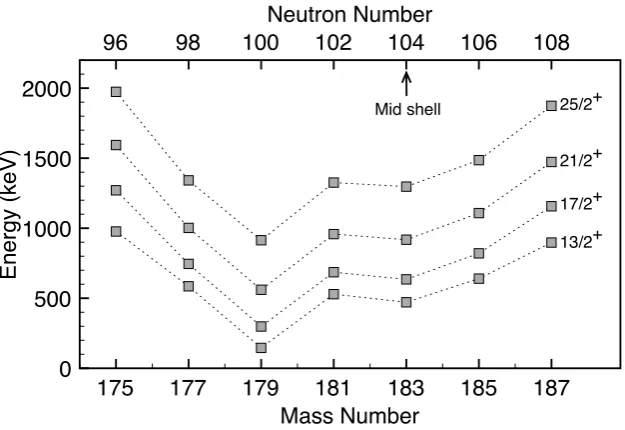
Figure 1. Partial energy-level systematics of the proton-particle i13/2 bands in the odd-mass Au nuclei near the neutron mid shell. The energies are relative to that of the 11/2−state arising from the proton-hole structure. In cases where the 11/2− proton-hole structure is not firmly established, an estimate has been made. The data are taken from Ref. [6].
A striking example of the shape coexistence can be found in Pb nuclei residing near the neutron mid shell at N = 104, where three shapes (spherical, oblate and prolate deformed) have been identified to form the three lowest-lying states [2]. In the shell-model picture the deformed configurations appearing as local minima in potential energy surfaces of the mean field are associated with multiparticle-multihole excitations across the Z = 82 shell gap [3]. Similarly to the neutron-deficient Pb nuclei, where a beautiful minimum of intruder states is observed at the neutron mid shell, the shape coexistence has been observed in the odd-Z Au nuclei in the vicinity of this region. The present article discusses the triple shape coexistence in terms of the findings of the transition probability measurements in 175Au [4].
Figure 1 shows the energy-level systematics of the odd-mass Au isotopes nearN = 104. In
175Au, the positive parity yrast bands observed in the neutron-deficient odd-mass Au isotopes
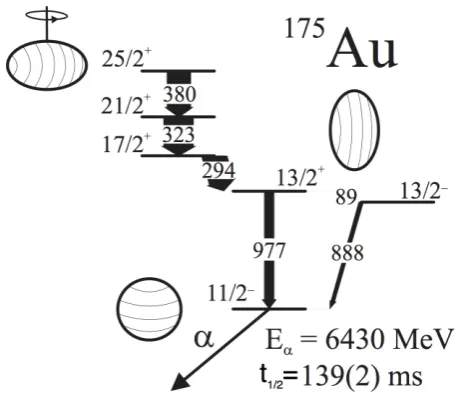
have been associated with a prolate shape and assigned to emerge from π(i13/2) intruder excitations [5]. Furthermore, the lowest 13/2+ state has been associated with the oblate configuration. Together with the spherical Iπ = 11/2− α-decaying state deduced from α-decay characteristics they form an energetically close-lying shape triplet. The partial level scheme relevant for this study is shown in Fig 2.
2. Experimental considerations and results
The recoil distance Doppler-shift (RDDS) lifetime measurements in 175Au were carried out at the Accelerator Laboratory of the University of Jyv¨askyl¨a, where the 92Mo(86Sr,p2n)175Au fusion-evaporation reaction was used in order to populate the excited states in175Au. The 86Sr beam at an energy of 401 MeV was delivered by the K130 cyclotron with an average intensity of 2 pnA. The 1 mg/cm2 thick isotopically enriched 92Mo target and the 1 mg/cm2 thick Mg degrader foil were housed in the K¨oln plunger device. The recoiling evaporation residues entered RITU gas-filled recoil separator [7] and subsequently were separated from the background mainly
Figure 2. Partial level scherme of 175Au. The data are adapted from Refs. [4, 5].
Table 1. Electromagnetic properties of the low-lying yrast transition in175Au. The values are taken from Ref. [4].
Eγ (keV) Ii (¯h) τ (ps) B(E2) (W.u.) |Qt|(eb)
997 13/2 300-11000
294 17/2 44(4) 130(10) 4.8(2)
323 21/2 11(2) 340(60) 7.6(7)
380 25/2 7(2) 240(70) 6.4(9)
arising from fission products and scattered beam. The175Au recoils were identified through their
characteristic αdecays in the GREAT focal plane spectrometer [8] and subsequently correlated with prompt γ rays recorded with JUROGAM II γ-ray spectrometer surrounding the target position.
Gamma-ray singles spectra tagged with the 175Au α decays were collected at ten target-to-degrader distances with with the JUROGAM II Ge detectors located either at 158◦ (five detectors) or 134◦ (ten detectors) with respect to the beam direction. Mean lifetimes τ were extracted for the stretched E2 transitions originating from the 17/2+, 21/2+ and 25/2+ states
[image:4.595.153.442.427.504.2]17/2
21/2
25/2
0
1
2
3
4
5
0
100
200
I
i
(
h
)
|
Q
t
| (
e
b)
2) (W
[image:5.595.120.478.114.367.2].u.)
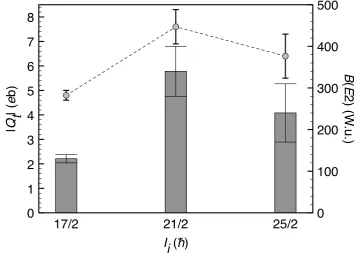
Figure 3. Transition quadrupole moments |Qt| (filled circles) and reduced transition probabilities B(E2) (filled bars) as a function of the initial spin in 175Au extracted from the lifetimes measured in Ref. [4].
3. Discussion
For a rigid rotor nucleus the values of the transition quadrupole moment|Qt|can be extracted
from the measured B(E2) values using the rotational model (see, for instance, Ref. [10] for definition). In Fig. 3 the |Qt| and B(E2) values are plotted as a function of the initial spin
of the transitions. While the |Qt| values for theIi = 21/2 and 25/2 ¯h are constant within the
error bars, the value for the Ii = 17/2 ¯h transition is considerably lower. This is also reflected
by the B(E2) values and represents typical values for collective rotational bands in the vicinity of Z = 82 [11].
The reduction of collectivity for the 17/2+ →13/2+ transition can be understood with the change in intrinsic structure of these states. A similar drop in collectivity between low-spin yrast states has been observed in188Pb [11] and in 180,182Hg nuclei, in which the the transition connects the two states with different structures [12]. In Ref. [5] the oblate configuration has been proposed for the 13/2+ state, which is in agreement with the present observation. The change in the intrinsic structure from the prolate yrast band at higher spin to the oblate structure of the 13/2+ state hinders the transition rate and therefore results in reduced collectivity.
A qualitative estimate for the mixing amplitude of the oblate component of the wave function of the 13/2+ state can be deduced from the extracted quadrupole moments. Assuming the 21/2+ and 25/2+ states to be pure rotating prolate deformed states as suggested earlier [5], the quadrupole moment for the prolate structure can be extracted as an average of the |Qt| values from these states. Furthermore, as the |Qt| value for the 17/2+ → 13/2+ transition is
hindered by the change in the intrinsic structure between these states, the oblate amplitude can be derived similarly as in Refs. [11, 12] and is on the order of 50%.
The obtained range for the lifetime of the transition from the 13/2+ state to theα-decaying 11/2− state yields to an upper limit for the B(E1) value at the 10−5 W.u. level. This is
175
Au
178Pt
180Hg
186Pb
182Hg
187Tl
196Po
194Po
195Po
2+ 4+ 6+ 2+ 4+ 6+8 ,+
10+
2+
4+
6 ,+
[image:6.595.129.470.112.342.2]8+ 10+ 25/2+ 17/2+ 21/2+ 29/2+ 2+ 4+ 6+ 8+ 2+ 4+ 2+ 4+ 6+ 17/2+ 17/2+ 21/2+ 25/2+
|Q
| (eb)
t 7 8 9 10 11 12 1 2 3 4 5 6 0Proton Number
79 80 81 84
78 82 83
Prolate-Prolate
Prolate-Oblate
Oblate-Oblate
Prolate-Spherical
Figure 4. Experimental Qt values as a function of Z for the excited states near N =
104. The transitions are labelled with the initial spin Iπ. The data are taken from Refs. [11, 12, 13, 14, 15, 16].
consistent with the single-proton transition from the mixed oblate-prolate collective state to the 11/2− near spherical state, in agreement with the suggestion in Ref. [5]. Therefore, these results indicate the existence of three markedly different structures and evolution of nuclear structure from non-collective single-particle structure through the deformed oblate and finally to the deformed prolate structures within less than 2 MeV of excitation energy.
The evolution of collectivity can also be considered as a function of Z in the region near N = 104 and at or near the Z = 82 shell closure. Figure 4 compares the|Qt| values extracted
from lifetime measurements as a function of Z for excited states in this region. The |Qt|values
indicate that the high-spin states in175Au are similar to prolate states in this region. However, the transition originating from the 17/2+ state in 175Au has a lower |Qt| value as discussed
above, and is very similar to oblate states in this region. In particular, the yrast bands in
194−196Po have been discussed as representing rather pure oblate bands [11, 13, 14] and the|Q t|
values for those bear close resemblance to that from the 17/2+ state in175Au.
It is interesting to note that the |Qt| values for the prolate structures tend to increase
slightly with the increasing Z, while the corresponding values for the oblate structures remain rather constant. On the other hand, this seems reasonable as the minimum of the intruder configurations have been observed to move away from the neutron mid shell for lighter isotopes. This can be seen in the Au case from Fig. 1.
To conclude, the lifetimes of the low-lying yrast states in 175Au have been measured using the RDDS method aided by highly selective radioactive tagging technique. The extracted B(E2) and |Qt] values provide evidence for a triad of coexisting shapes at low spin. The
of Excellence Origin and Structure of the Universe. M.V. acknowledges the support of Slovak grant agency VEGA (Contract No. 2/0105/11).
References
[1] Heyde K and Wood J 2011Reviews of Modern Physics 831467
[2] Andreyev A N, Huyse M, Duppen P V, Weissman L, Ackermann D, Gerl J, Hessberger F P, Hofmann S, Kleinb¨ohl A, M¨unzenberg G, Reshitko S, Schlegel C, Schaffner H, Cagarda P, Matos M, Saro S, Keenan A, Moore C, O’Leary C D, Page R D, Taylor M, Kettunen H, Leino M, Lavrentiev A, Wyss R and Heyde K 2000Nature (London)405430
[3] Nazarewicz W 1993Physics Letters B 305195
[4] Watkins H, Joss D T, Grahn T, Page R D, Carroll R J, Dewald A, Greenlees P T, Hackstein M, Herzberg R D, Jakobsson U, Jones P M, Julin R, Juutinen S, Ketelhut S, Kr¨oll T, Kr¨ucken R, Labiche M, Leino M, Lumley N, Maierbeck P, Nyman M, Nieminen P, O’Donnell D, Ollier J, Pakarinen J, Peura P, Pissulla T, Rahkila P, Revill J P, Rother W, Ruotsalainen P, Rigby S V, Sar´en J, Sapple P J, Scheck M, Scholey C, Simpson J, Sorri J, Uusitalo J and Venhart M 2011Physical Review C 84051302
[5] Kondev F, Carpenter M, Janssens R, Saleem K A, Ahmad I, Amro H, Cizewski J, Danchev M, Davids C, Hartley D, Heinz A, Khoo T, Lauritsen T, Lister C, Ma W, Poli G, Ressler J, Reviol W, Riedinger L, Seweryniak D, Smith M and Wiedenh ˜Aver I 2001Physics Letters B 512268 ISSN 0370-2693
[6] Data extracted using the NNDC On-Line Data Service from the ENSDF database, file revised as of 5.9.2012. M. R. Bhat, Evaluated Nuclear Structure Data File (ENSDF), Nuclear Data for Science and Technology, page 817, edited by S. M. Qaim (SpringerVerlag, Berlin, Germany, 1992).
[7] Leino M, ¨Ayst¨o J, Enqvist T, Heikkinen P, Jokinen A, Nurmia M, Ostrowski A, Trzaska W, Uusitalo J, Eskola K, Armbruster P and Ninov V 1995Nuclear Instruments and Methods in Physics Research Section B: Beam Interactions with Materials and Atoms 99653
[8] Page R, Andreyev A, Appelbe D, Butler P, Freeman S, Greenlees P, Herzberg R D, Jenkins D, Jones G, Jones P, Joss D, Julin R, Kettunen H, Leino M, Rahkila P, Regan P, Simpson J, Uusitalo J, Vincent S and Wadsworth R 2003Nuclear Instruments and Methods in Physics Research Section B: Beam Interactions with Materials and Atoms 204634
[9] Dewald A, Harissopulos S and von Brentano P 1989Zeitschrift f¨ur Physik A Hadrons and Nuclei334(2) 163 [10] Bohr A and B A Mottelson 1975 Nuclear Structure, Vol. 2: Nuclear Deformations (Benjamin, New York,
USA)
[11] Grahn T, Dewald A, M¨oller O, Julin R, Beausang C W, Christen S, Darby I G, Eeckhaudt S, Greenlees P T, G¨orgen A, Helariutta K, Jolie J, Jones P, Juutinen S, Kettunen H, Kr¨oll T, Kr¨ucken R, Coz Y L, Leino M, Lepp¨anen A P, Maierbeck P, Meyer D A, Melon B, Nieminen P, Nyman M, Page R D, Pakarinen J, Petkov P, Rahkila P, Saha B, Sandzelius M, Sar´en J, Scholey C and Uusitalo J 2006 Physical Reviev Letters 97(6) 062501
[12] Grahn T, Petts A, Scheck M, Butler P A, Dewald A, Hornillos M B G, Greenlees P T, G¨orgen A, Helariutta K, Jolie J, Jones P, Julin R, Juutinen S, Ketelhut S, Kr¨ucken R, Kr¨oll T, Leino M, Ljungvall J, Maierbeck P, Melon B, Nyman M, Page R D, Pissulla T, Rahkila P, Sar´en J, Scholey C, Semchenkov A, Sorri J, Uusitalo J, Wadsworth R and Zieli’nska M 2009Phys. Rev. C 80(1) 014324
[13] Grahn T, Dewald A, Greenlees P T, Jakobsson U, Jolie J, Jones P, Julin R, Juutinen S, Ketelhut S, Kr¨oll T, Kr¨ucken R, Leino M, Maierbeck P, Melon B, Nyman M, Page R D, Peura P, Pissulla T, Rahkila P, Sar´en J, Scholey C, Sorri J, Uusitalo J, Bender M and Heenen P H 2009Phys. Rev. C 80(1) 014323
[14] Grahn T, Dewald A, Greenlees P T, Jakobsson U, Jolie J, Jones P, Julin R, Juutinen S, Ketelhut S, Kr¨oll T, Kr¨ucken R, Leino M, Maierbeck P, Melon B, Nyman M, Page R D, Peura P, Pissulla T, Rahkila P, Sar´en J, Scholey C, Sorri J and Uusitalo J 2009European Physical Journal A39291–294
[15] Dracoulis G D, Stuchbery A E, Byrne A P, Poletti A R, Poletti S J, Gerl J and Bark R A 1986Journal of Physics G: Nuclear Physics 12L97
[16] Chamoli S K, Joshi P, Kumar A, Kumar R, Singh R P, Muralithar S, Bhowmik R K and Govil I M 2005
Phys. Rev. C 71(5) 054324
![Figure 4.Experimental Qt values as a function of Z for the excited states near N =104.The transitions are labelled with the initial spin Iπ.The data are taken from Refs.[11, 12, 13, 14, 15, 16].](https://thumb-us.123doks.com/thumbv2/123dok_us/8057412.225136/6.595.129.470.112.342/figure-experimental-values-function-excited-transitions-labelled-initial.webp)
