Earthquake Forecastin
Interoperability
GGF17 Grid Interoperability Session
Tokyo Japan
May 11 2006
Geoffrey Fox
Computer Science, Informatics, Physics
Pervasive Technology Laboratories
Indiana University Bloomington IN 47401
http://gr
ids.ucs.indiana.edu/ptliupages/presentations/
APEC Cooperation for Earthquake Simulation
n
ACES
is a seven year-long collaboration among scientists
interested in
earthquake and tsunami predication
•
Primary goal
predicting event
occurrence
; other related work
discusses
consequences of event
(Earthquake Engineering)
•
http://w
ww.quakes.uq.edu.au/ACES/
n
Charter
ed under
APEC
–
100 Years After the San Francisco Earthquake
It is now known that the M ~ 7.9 San Francisco earthquake and fire of April 18, 1906 killed more than 3000 persons. Estimates are that if such an event were to happen again today, damages could easily total well in excess of $500 Billion, with potential fatalities of many thousands of lives.
Participating Institutions
n CSIRO Australian Monash University Australia
n University of Western Australia, Perth,
Australia
n University of Queensland Australia
n University of Western Ontario Canada n University of British Columbia Canada
n China National Grid
n Chinese Academy of Sciences
n China Earthquake Administration n China Earthquake Network Center
n Brown University n Boston University
n Jet Propulsion Laboratory n Cal State Fullerton
n San Diego State University
n UC Davis n UC Irvine n UC San Diego
n University of Southern California n University of Minnesota
n Florida State University n US Geological Survey
n Pacific Tsunami Warning Center PTWC
Hawaii
n National Central University, Taiwan
(Taiwan Chelungpu-fault Drilling Project)
n University of Tokyo
n Tokyo Institute of Technology (Titech) n Sophia University
n National Research Institute for Earth
Science and Disaster Prevention (NIED) Japan
In its first seven years, ACES has:
Enhanced international cooperation and understanding
Stimulated new computational science and technology
Laid the foundations for a the new field of earthquake simulations
Established earthquake science that is analytical and predictive
rather than simply descriptive & observational
In its second five years, ACES must:
Exploit inevitable “data deluge” and detailed simulations across
micro to macro scales
Develop a series of science-based hazard mitigation products
Centralize the role of information technology with cross economy
infrastructure
Expand the membership to include other economies
Support integrated science and products of publi
interest across the member economie
1992 Landers, California Earthquake
(Courtesy H. Zebker, Stanford)
Deformation in the Eastern Mojave Shear Zone
(Courtesy G. Peltzer, UCLA)
Role of Space Technology
Synthetic Aperture Radar Interferometry (InSAR) can detect changes (both large and small) in surface deformation of the earth’s crust over synoptic scales.
Role of Information Technology
and Grids in ACES
Numerical simulations of physical, biological and social
systems
Engineering design
Economic analysis and planning
Sensor networks and sensor webs
High performance computing
Data mining and pattern analysis
Distance collaboration
Distance learning
Public outreach and education
Emergency response communication and planning
Geographic Information Systems
Background: Earthquake Forecast – Published Feb 19, 2002, in PNAS.
( JB Rundle et al., PNAS, v99, Supl 1, 2514-2521, Feb 19, 2002; KF Tiampo et al., Europhys. Lett., 60, 481-487, 2002; JB Rundle et al.,Rev. Geophys. Space Phys., 41(4), DOI 10.1029/2003RG000135 ,2003. http://quakesim.jpl.nasa.gov )
Color Scale
Decision Threshold
D.T. => “false alarms” vs. “failures to predict”
CL#03-2015
Plot of Log
10(Seismic Potential)
Increase in Potential for significant events, ~ 2000 to 2010
Eighteen significant earthquakes (M > 4.9; blue circles) have occurred in Central or Southern California. Margin of error of the anomalies is +/- 11 km; Data from S. CA. and N. CA catalogs:
After the work was completed
1. Big Bear I, M = 5.1, Feb 10, 2001 2. Coso, M = 5.1, July 17, 2001
After the paper was in press ( September 1, 2001 ) 3. Anza I, M = 5.1, Oct 31, 2001
After the paper was published ( February 19, 2002 ) 4. Baja, M = 5.7, Feb 22, 2002
5. Gilroy, M=4.9 - 5.1, May 13, 2002 6. Big Bear II, M=5.4, Feb 22, 2003 7. San Simeon, M = 6.5, Dec 22, 2003
8. San Clemente Island, M = 5.2, June 15, 2004 9. Bodie I, M=5.5, Sept. 18, 2004
10. Bodie II, M=5.4, Sept. 18, 2004 11. Parkfield I, M = 6.0, Sept. 28, 2004 12. Parkfield II, M = 5.2, Sept. 29, 2004 13. Arvin, M = 5.0, Sept. 29, 2004
14. Parkfield III, M = 5.0, Sept. 30, 2004 15. Wheeler Ridge, M = 5.2, April 16, 2005 16. Anza II, M = 5.2, June 12, 2005
17. Yucaipa, M = 4.9 - 5.2, June 16, 2005 18. Obsidian Butte, M = 5.1, Sept. 2, 2005
Interoperability Summary
n
Need to define
common infrastructure
and
domain specific standards
•
Not too many “historical” constraints; could adopt GT4, OMII, ……
•
Build Interoperable Infrastructure gatewayed to existing legacy
applications and Grids
n
Generic Middleware
•
Grid software including workflow
•
Portals/Problem Solving environments incl. visualization
•
We need to ensure that we can make security, job submission, portal, data
access (sharing) mechanisms in different economies interoperate
n
Geographic Information Systems GIS
•
Use services as defined by Open Geospatial Consortium (Web Map and
Feature Services) http://w
ww.crisisgrid.net/
n
Earthquak
e/Tsunami Science Specific
•
Satellites, sensors (GPS, Seismic)
•
Fault, Tsunami … Characteristics stored in databases
GONET Hi-net K-NET
Database for Model Construction Plate
Motion
Platform for Integrated Simulation
Data Processing, Visualization, Linear Solvers
Simulation Output
PC clusters for small-intermediate problems
Earth Simulator for large-scale problems
GIS Urban Information Tectonic Loading Earthqua keRuptur e Structure Oscillatio n Wave Propagati on Tsunami Generatio n
Earthquake Generation
Strong Motion and Tsunami Generation
JST-CREST Integrated Predictive Simulation System
Artificial Structure Oscillation
Pacific Rim
Universities
(
APRU ) PRAGMA
SERVOGrid GEON SCECGrid Vlab Earth Simulator NaregiChina National Grid Access Infrastructure Institutions
IMS
International TeraShake Pattern Informatics ALLCAL GeoFEST, PARK, VirtualCalifornia QuakeTables Sesismic InSAR PBO (GPS) U.S.A. FORMOSAT-3/COSMIC (F/C) Chines Taipei JST-CREST GeoFEM GPS Seismic Daichi (InSAR) Japan CAS LURR Seismic GPS P.R. China Pattern Informatics Polaris Radarsat Canada prototype Finley, LSM PANDAS Seismic data, fault database, GPS Australia Wave Motion Earthquake Forecast/Model Data (sharedas part of collaboration) Country
and/or Economies
Current PTWC Network of Seismic Stations
Tokyo
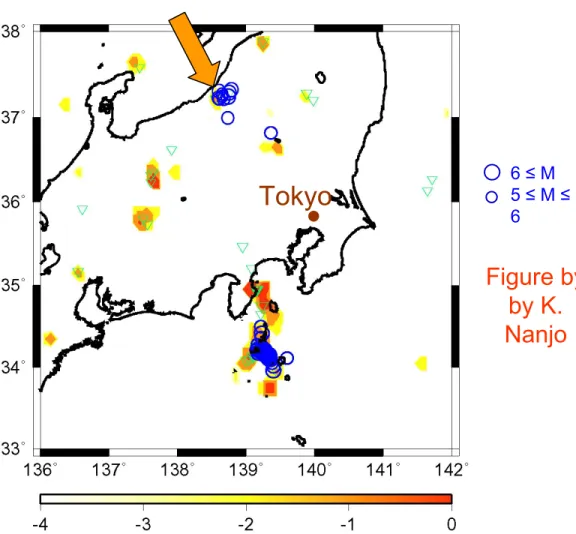
Forecasting Shallow Earthquake Locations in Japan
(<20 km Depth)
Tokyo Area, Japan. JMA Catalog is used. (K. Nanjo, JBR, J Holliday,
DLTurcotte, 2004).
Image at right was shown during lectures at Kyoto University October 13, 2004 and at Tokyo University, October 14, 2004.
Copies are available from
Professor James Mori, Kyoto U. or Professor Mitsuhiro Matsu’ura, Tokyo U.
The October 23, 2004, M = 6.8 Niigata, Japan earthquake killed at least 37 people and injured thousands. Its main shock and principal aftershocks with M 5 are shown (arrow).
Figure by by K. Nanjo
6 ≤ M 5 ≤ M ≤ 6
Plot of Log10 (Seismic Potential)