26 | Ryan Judge | Helen Hindmarch | Rob Harrison | Martin Simpson | Greg Beattie
Building & implementing knowledge:
research and innovation inspired by the
evolution of the modern stadium
Research topics Structural & Mechanical Engineering
Universities
The University of Manchester, Liverpool, Sheffield & Stanford (US)
Date of Study 2001 - 2011
Introduction
From 1988 to 2005 a total of 35 stadia and 117 football league grandstands were built in the UK heralding a new generation of stadia. The fact that modern stadia continue to shortlist and win national and international design prizes means they are significant building forms which push the boundaries and advances in architectural and engineering design. For this recognition to continue designers are required to innovate, improve and develop new methods, processes and associated technologies. Therefore, research and development (R&D) is a mandatory requirement in achieving this goal. The authors have been involved in the design of 12 national and international stadia of varying scale and complexity, nine of which are currently on-site or have completed. The scope and inspiration that these projects provide for R&D is vast however with limited resource and funding there have been four main focuses of R&D over the last ten years which are highlighted below and will be discussed in this paper:
Crowd Induced Vibration of Grandstand Structures
So far this research programme has produced two doctoral theses in collaboration with the
Universities of Manchester and Sheffield to look at vibration of grandstand structures subject to rhythmic dynamic crowd loading. The projects were undertaken to develop and validate a new crowd model/methodology for use in the design and assessment of grandstand structures to replace previous methods which were often considered to be overly conservative and unusable in design. The principal drive for the research is to improve safety of spectators and quality of experience while producing more structurally efficient and architecturally pleasing designs.
Lightweight Cable Supported Structures subjected to Blast Fragmentation
At this time this research programme, involving a single doctoral thesis, is currently being undertaken in collaboration with the University of Liverpool to investigate the robustness and resilience of structural cables when subjected to explosively generated fragment impact from a detonation close to the cables. This project was undertaken in response to the lack of knowledge and understanding in this area coupled with the threat of a terrorist attack on a stadium.
Abstract
This paper summarises how the evolution and advancement in sports stadia
design within Arup, over the last 10 years, has been used as a catalyst
for applied research programmes. The North West Structures Group has
collaborated with several universities (UK and US based) to advance technical
knowledge and understanding, and to ensure ongoing innovation. Five doctoral
research programmes have been produced focussing on critical issues such as
crowd induced vibration, robustness of cable supported structures subjected
to high velocity fragment impact, structural and geometrical optimisation and,
design management.
This paper will highlight some of the results obtained from each of these
research programmes and how they have and can be filtered back into design.
The primary aim of this paper is to demonstrate how opportunities can be
seized when working on design projects to collaborate with universities and
provide a platform for project based innovation in the construction industry.
Structural and Geometrical Optimisation
Following directly from the work
implemented on one of our stadia a research programme was undertaken at the Center of Integrated Facility Engineering (CIFE) at Stanford University to improve methods of geometrical and structural optimisation for large scale problems commonly encountered in the construction industry. Several real case studies from Arup have been used to prove the usefulness and applicability of the tools.
Design Management
At this time the research programme, involving a single doctoral thesis, is currently being undertaken in collaboration with the University of Manchester to investigate and improve the accuracy of design change impact assessments during increasingly complex projects.
Methodology
All research projects were approached differently based on the objectives of each study, available resources and project funding.
1. The two doctoral studies concerning crowd induced vibration involved: A. The development of a
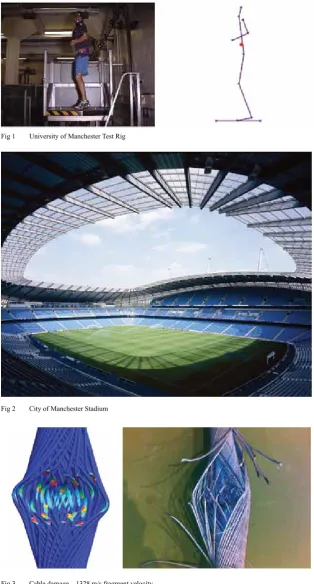
human-structure dynamic interaction model / methodology for a crowd of people bobbing on a flexible grandstand structure. This involved experimental work with individual subjects bobbing on a purpose built instrumented test rig (Fig. 1 University of Manchester Test Rig) and the development of mathematical models to simulate and recreate the observed results. The model was created in collaboration with the IStructE Joint Working Group on crowd induced grandstand vibration and The University of Surrey.
and
B. The validation, verification and development of the above model using monitored vibration data from actual stadium events at a number of different UK venues. In particular, this work
Fig 1 University of Manchester Test Rig
[image:2.595.240.555.182.767.2]Fig 2 City of Manchester Stadium
28 | Ryan Judge | Helen Hindmarch | Rob Harrison | Martin Simpson | Greg Beattie
[image:3.595.170.357.181.375.2]Fig 4 Estimation of reduced cable breaking loads plotted against impact energy for a 60mm diameter spiral-strand cable
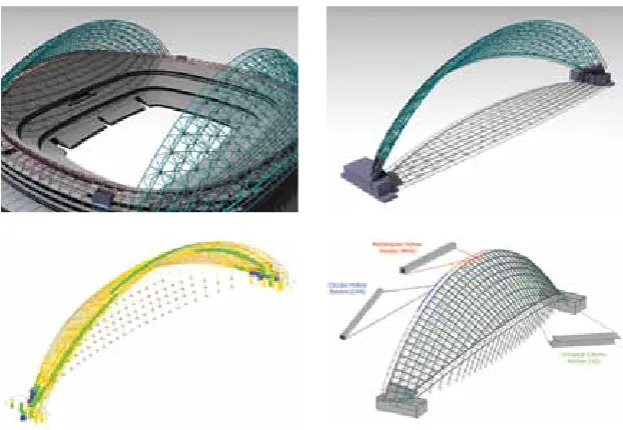
Fig 5 3D Virtual model of the roof structure (TOP). Finite element analysis model and sample member grouping with associated section types (BOTTOM)
focused on the City of Manchester Stadium (Fig. 2 City of Manchester Stadium), an Arup designed structure, for which a highly detailed FE updated model was created in order to trial the prediction methodology. Predicted results were compared to measured data for a series of sporting and concert events. Additional laboratory testing was also undertaken to better understand and develop the human body models used further.
2. The study concerning the robustness of structural cables to high velocity fragment impact involved the development of complex 3D FEA models of the individual cables and the overall cable supported structure using the LS-DYNA explicit FE solver. The numerical models were used to simulate the response and damage sustained by the cables when impacted by free-flying blast fragmentation from a vehicle borne improvised explosive device (VBIED). The numerical models were then validated against experimental tests carried out at Shrivenham Defence Academy (Fig. 3 Cable damage - 1328 m/s Fragment Velocity).
3. The study concerning structural and geometrical optimisation involved the development of an optimisation tool which works with GSA to parametrically automate the generation of structural topology, associated element selection, load application and member sizing. The optimisation tool was piloted on two industry based case studies which were the concept design of the Stockholm Arena and the detailed design of currently confidential project in UAE.
[image:3.595.42.354.449.664.2]Arup have been interviewed in order to validate, and improve functionality. Project managers are now testing the tool on current Arup projects.
Results and discussion
For the crowd induced vibration research, the model was developed and published as part of the 2008 UK IStructE guidance document ‘Dynamic performance requirements for permanent grandstands subject to crowd action’ and has since been used on a number of projects within Arup (Cardiff City
Stadium, Singapore Sports Hub and currently confidential projects in the UAE and Saudi Arabia) and external to Arup. The City of Manchester validation exercise showed that the model gave encouraging agreement to measured results and in comparison to other methodologies, available globally, was considered to offer the best combination of accuracy and robustness in terms of sensitivity to input parameters. The model is the most developed yet in terms of modelling the problem from first principles but would still benefit from additional focused research in a number of areas to improve the model further. Probably the most pressing would be the creation of a human jumping model, where applied forces are larger, to recreate the behaviours now commonly exhibited by football fans in continental Europe.
In relation to the research concerning the robustness of structural cables, both the tests and numerical simulations show good agreement in terms of the localised damage area, fragment penetration depth and individual wire failure. The results were then used to estimate the reduced breaking loads of the cables as a result of the damage sustained on impact. It was found that the breaking load post impact was still higher than the design resistance of the damage cables which demonstrates considerable robustness to such highly transient loading conditions (Fig. 4 Estimation of reduced cable breaking loads plotted against impact energy).
Regarding optimisation several case studies were investigated between Arup and CIFE during the course of the research including Topological Optimisation of the supporting arches for Stockholm roof, Member Sizing for a small scale steel building (Wigan BGC) and a 65,000 sport stadium in UAE. The largest study (stadium roof) involved sizing the structure’s 1955 members given a fixed topology and shape. The objective of the member sizing process was to minimize the total weight of the structure while satisfying structural performance criteria for strength and deflection. Prior to automating the optimisation process traditional methods had involve 39 design cycles totalling approximately 156 man hours. The automated optimisation process was able to carry out 340 iterations in 32.5 hours resulting in a saving on 1146t (~19% or ~$5million) per roof saving in steel tonnage (Fig. 5 3D Virtual Model of the roof structure (TOP); Finite element analysis model and sample member grouping with associated section types (BOTTOM)). The Wigan BGC study was undertaken to prove that a similar percentage saving could be achieved on smaller projects.
30 | Ryan Judge | Helen Hindmarch | Rob Harrison | Martin Simpson | Greg Beattie
Conclusion and next steps
The crowd induced vibration research has led to the most developed and robust prediction methodology for analysis of crowd induced vibration which is useable in design. It can lead to significant cost savings in grandstand structures and is now used widely both within Arup and externally. The current Arup focus is on making the methodology more readily useable to employees within Arup and Arup Design and Technical Fund investment has been used to develop a spreadsheet for this purpose. It is envisaged that this will be incorporated into Oasys GSA in the future making this the only piece of commercially available piece of software which has this feature. Further development of crowd models, through collaborative research, would also be of benefit, in particular, the development of a human jumping model.
The research conducted on the cables represents a first step in gaining a clear understanding of how structural cables respond to high velocity explosively generated fragment impact. Significant promise is shown from the results obtained and as such will be used to improve confidence both in robustness and resilience of cable supported structures and thereby increase the use of these structural forms when design for physical security is a key requirement. Further work is ongoing to better understand the effects of dynamic cable loss on the overall structure in the event of a blast.
The results of the research into geometrical and structural optimisation demonstrates that there is no doubt that this new technology will become common place in industry over the next decade and help designers achieve more architecturally pleasing and economically viable structural forms.
The design change management research has provided a greater appreciation of the complexity and interactions within a multidisciplinary design process. These interactions make the impact of design changes increasingly difficult to predict. A software support tool has been produced to aid in making better informed design change impact assessments and is recommended for future use alongside the existing Arup combined management system (CMS).
Acknowledgements
The acknowledgements for each research programme are listed as follows:
1. Human-Structure Dynamic Interaction in Stadia Grandstand Design, 2008 The study was funded by the EPSRC and Arup North West and undertaken at the University of Manchester. The authors appreciate contributions from the Universities of Sheffield and Surrey and the members of ISructE Joint Working Group in the UK dealing with dynamic crowd loading on permanent grandstands.
2. Crowd-Structure Dynamic Interaction in Stadia, 2011 The study was funded by the EPSRC and Arup (via DTF) through a CASE award (voucher 06000921) at the University of Sheffield. The authors appreciate the support offered by the City of Manchester Stadium management staff.
3. Lightweight Cable Supported Structures subjected to Blast Fragmentation, 2012
This study is funded by the UK EPSRC and Arup (via DTF) through a case award (No. CASE/CAN/07/107). The cables tested were provided by Bridon International Ltd and their kind contribution to this project is highly appreciated. The author would also like to thank Professor Ian Horsfall at Shrivenham Defence Academy for carrying out the fragment simulating projectile testing.
4. Improvements in solving Large Scale Optimisation problems(TBC)
This research was supported by the Stanford Graduate Fellowship (SGF) program and the Center for Integrated Facility Engineering (CIFE) at Stanford University.
5. ProCESS (Project Change Evaluation Support Software) for assessing the impact of project level design changes, 2011
This EngD research project is funded by UK EPSRC and Arup, in collaboration with the University of Manchester and supervised by Prof AW Gale. Benchmarking interviews have been carried out with individuals from AMEC, AstraZeneca, BAA and Rolls Royce.
References
Culley P, Pascoe J., Stadium Engineering, Thomas Telford, London, UK, 2005.
Flager F. BiOPT: A Scalable Method for Shape and Member Sizing Optimization of Steel Frame Structures; Thesis submitted for Doctor of Philosophy, Stanford University, USA 2011.
Flager F, Soremukun G, Shea K, Fisher M, Haymaker J. Fully Constrained Design: a Scalable Method for Discrete Member Sizing Optimization of Steel Frame Structures, CIFE Technical Report #TR201, Stanford University, 2011
Harrison R. Human-Structure Dynamic Interaction in Stadia Grandstand Design; Thesis submitted for Engineering Doctorate, University of Manchester, UK, 2008.
Hindmarch H, Gale AW, Harrison RE. A Support Tool for Assessing the Impact of Design Changes during Built Environment Projects. IEEE International Conference on Industrial Engineering and Engineering Management, 7-10 December, Macao, 2010
Hindmarch H, Gale AW, Harrison RE. Incorporating Design Management Tools and Knowledge Capture to Aid in Assessing the Impact of Structural Design Changes. ASEM 31st Annual Conference, 13-16 October, University of Arkansas, 2010
Hindmarch H, Gale AW, Harrison RE. A Proposed Construction Design Change Management Tool to Aid in Making Informed Design Decisions. 26th Annual Conference. Leeds, September 2010. Reading: ARCOM Hindmarch H, Gale AW, Harrison RE. A Proposed Construction Design Change Management Tool to Aid in Assessing the Impact of Design Changes. PMI Research and Education Conference, Washington DC, 11-14 July 2010
IStructE, DTLR and DCMS Joint Working Group., Dynamic performance requirements for permanent grandstands: recommendations for management design as assessment, IStructE, London, UK, 2008.
Jones C. Crowd-Structure Dynamic Interaction in Stadia; Thesis submitted for Doctor of Philosophy, University of Sheffield, UK, 2011.
Judge R, Yang Z, Jones SW, and Beattie G., 18th UK Association of Computational Mechanics Conf. Southampton., 29-31 March., 2010.
Judge R, Yang Z, Jones SW, and Beattie G., 1st International Conf. of Protective Structures, Manchester., 28-30 Sept., 2010.
Judge R, Yang Z, Jones SW, and Beattie G., 8th European LS-DYNA users Conf. Strasbourg., 23-24 May, 2011.
Simpson M. The Evolution of the Modern Stadium; Project Based Innovation in the Construction Industry. IABSE-IASS Symposium 2011.
Note:
This paper looks at a series of research projects on that building + implemented existing knowledge.
It also contains the doctoral research carried out by Rob Harrison (The University of Manchester) now of Arup AT+R, Chris Jones (University of Sheffield) and Forest Flager (CIFE, Stanford University)