2008
Intercept System to Edit, Control, and Analyze
Packets (ISECAP)
Grant Rogers Brinkmeyer
Iowa State University
Follow this and additional works at:https://lib.dr.iastate.edu/rtd
Part of theComputer Sciences Commons
This Thesis is brought to you for free and open access by the Iowa State University Capstones, Theses and Dissertations at Iowa State University Digital Repository. It has been accepted for inclusion in Retrospective Theses and Dissertations by an authorized administrator of Iowa State University Digital Repository. For more information, please [email protected].
Recommended Citation
Brinkmeyer, Grant Rogers, "Intercept System to Edit, Control, and Analyze Packets (ISECAP)" (2008).Retrospective Theses and Dissertations. 15415.
Intercept System to Edit, Control, and Analyze Packets (ISECAP)
by
Grant Rogers Brinkmeyer
A thesis submitted to the graduate faculty
in partial fulfillment of the requirements for the degree of
MASTER OF SCIENCE
Major: Information Assurance
Program of Study Committee: Doug W Jacobson, Co-major Professor
Sree Nilakanta, Co-major Professor Thomas Earl Daniels
Iowa State University
Ames, Iowa
2008
1457542
TABLE OF CONTENTS
LIST OF FIGURES... iv
ABSTRACT ... v
ABSTRACT ... v
CHAPTER 1. INTRODUCTION ... 1
1.1 Internet Data Packets... 2
1.2 ISEAGE Purpose and Architecture ... 6
1.3 FreeBSD and IPFW... 8
CHAPTER 2. RELATED TECHNOLOGIES ... 9
2.1 Netfilter ... 9
2.2 Ettercap... 10
2.3 APOC ... 11
CHAPTER 3. DESIGN AND IMPLEMENTATION... 13
3.1 Machine Setup... 14
3.2 IPFW to ISECAP ... 16
3.3 Pattern Matching and Event Handling ... 18
3.4 Packet Changing... 19
3.5 Connection Tracking ... 20
3.6 Packet Retransmission... 22
CHAPTER 4. PRACTICAL USES... 24
4.1 Research ... 24
4.2 Attack Testing ... 24
4.3 Cyber Defense Competitions ... 26
Chapter 5. LIMITATIONS ... 27
5.1 Network Position... 27
5.2 Layer Limitations ... 28
5.3 Other Limitations ... 28
CHAPTER 6. TESTING ... 30
6.1 Ping Test... 30
6.2 Iperf Test ... 31
6.3 Nmap Test ... 32
6.4 Future Tests ... 33
CHAPTER 7. CONCLUSIONS... 34
7.1 Future Work ... 34
APPENDIX A: TEST DATA ... 37
APPENDIX B: USER SCRIPT EXAMPLES ... 40
APPENDIX C: ISECAP SETUP INSTRUCTIONS ... 41
BIBLIOGRAPHY ... 42
LIST OF FIGURES
Figure 1. OSI Model... 2
Figure 2. Ethernet header [4]... 3
Figure 3. IP header [4]... 4
Figure 4. ICMP header [4] ... 4
Figure 5. TCP header [4]... 5
Figure 6. UDP header [4] ... 5
Figure 7. ISEAGE architecture [6]... 7
Figure 8. Low-layer packet flow ... 15
Figure 9. ISECAP module system... 17
ABSTRACT
ISECAP is an advanced packet filtering framework designed for use with the
Internet Scale Event and Attack Generation Environment (ISEAGE) at Iowa State
University. ISEAGE is a network security test bed where cyber attacks can be carried out
for security research. ISECAP functions as a FreeBSD-based general purpose packet
control system designed to alter ISEAGE network data as it is being transmitted. Scripts
are interpreted by ISECAP to modify network data in real-time, assisting in the simulation
and obfuscation of various network attacks tested at the ISEAGE facility. The ISECAP
system is developed as a flexible tool with a forward focus on ease of extensibility to meet
CHAPTER 1. INTRODUCTION
As the world becomes more automated with computers performing more tasks,
everyday life will be managed over networks such as the Internet. Businesses and
individuals alike will control every aspect of their finances with computer systems. Even
today, the world economy is dependant on computer networks to monitor stocks,
currencies, and every type of business transaction. With the prosperity of the modern
world relying on computers, it is more critical than ever to ensure these systems are secure.
In recent years laws, such as the Health Insurance Portability and Accountability Act
(HIPAA), have been passed to require the safe-guard of private health insurance
information and include sections related to information and computer system security [1].
In 2002, the Federal Information Security Management Act (FISMA) was created as a
security guideline for businesses which interact with government agencies [2]. This rule
provides extensive detail into the recommended security operations of federal contractors.
Because of the importance of computer system security, tools to facilitate rigorous
testing are required. ISECAP is one such tool. ISECAP is a FreeBSD-based general
purpose packet control system designed to alter network data as it is being transmitted. It
was created to operate as part of the Internet Scale Event Attack Generation Environment
(ISEAGE) at Iowa State University. ISECAP was designed with four goals in mind. First,
the system should allow for flexible script-based packet filtering. Second, ISECAP should
be capable of simulating man-in-the-middle (MitM) and distributed scanning network
attacks. Third, the system should execute data modifications on network traffic with a
emphasis on future extensibility by ISEAGE researchers. This paper will explain and
demonstrate how ISECAP achieves these goals.
1.1 Internet Data Packets
To have an understanding of ISECAP one must have a basic understanding of how
data moves across the Internet. Data is sent between computers in a unit known as a
packet. Each packet contains a quantity of data and instructions for delivering that data. A
packet has one or more headers which contain information about the packet itself and assist
in delivering it across the Internet and to the correct process on the destination computer.
Packet headers are most often represented by Open Systems Interconnection (OSI) Model
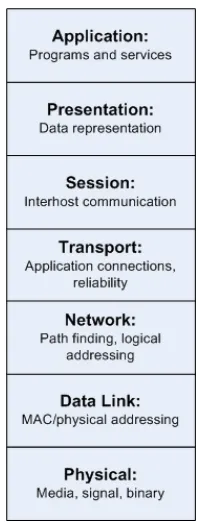
[3]. As seen in Figure 1, the OSI Model is composed of seven distinct layers that define
different aspects of moving data across a network using data encapsulation. ISECAP is
[image:9.612.270.369.442.703.2]primarily focused on the lower layers of the model.
The lowest layer in the OSI Model is the physical layer. This layer involves the
requirements for data to be transmitted over the physical medium of the network. The
physical layer allows for the network topology, data rates, and transmission modes to be
established by the transmitting and receiving devices. Data on the physical layer is in its
most basic form: bits represented by ones and zeros.
The second layer of the OSI Model is the data link layer. The data link layer uses
the physical layer to move information between adjacent nodes on the network. This layer
can include functions such as error management which allows upper layers to proceed as if
the physical layer transmitted data without error. The data link layer also handles physical
device addressing and both access and flow control over the medium. The type of data
link layer technology used in ISECAP is the IEEE 802.3 standard, known as Ethernet. As
shown in Figure 2, Ethernet packet headers are the very first part of an Ethernet data
packet. The Ethernet header contains both the source and destination media access control
(MAC) addresses for the packet. All other packet data occurs later in the packet. It is this
header that provides the fundamental instruction for data packets to traverse the Internet.
Figure 2. Ethernet header [4]
The third layer of the OSI Model is the network layer. This layer is responsible for
guaranteeing packets are sent from the original host all the way to their final destination.
In Internet traffic the Internet Protocol (IP) is used to address and detail packets at the
functionality. IP manages data as it traverses multiple link-layer networks and provides
fragmentation of packets to a size that can be accepted by the physical medium. A second
network layer protocol known as Internet Control Message Protocol (ICMP) operates in
conjunction with IP for internet traffic. ICMP is used primarily to send error messages
across networks indicating that various network services do not exist. ICMP can also be
used to determine if network nodes are functional, most notably with the ping command.
The ICMP header is displayed in Figure 4 and contains fields designed to communicate
specific messages to the receiving computer.
Figure 3. IP header [4]
Figure 4. ICMP header [4]
The fourth and final layer of primary concern to ISECAP is the transport layer.
This layer is tasked with the delivery of data to the individual applications running on
communicating computers. The transport layer handles segmentation and reassembly of
packets and makes sure the data arrives without duplication, damage, or loss. The
transport layer also handles application connection control. The most popular Internet
Protocol (UDP). As seen in Figure 5 and Figure 6 respectively, both these protocols
manage application packet distribution with specified port numbers in the packet headers.
TCP is a connection-oriented protocol that establishes a stateful and persistent connection
between two network applications. This connection is established and maintained with
TCP packet header fields such as flags and sequence numbers. TCP is used by a wide
range of application layer protocols such as File Transfer Protocol (FTP), Hypertext
Transfer Protocol (HTTP), and Post Office Protocol version 3 (POP3). UDP is an
inherently connectionless protocol that also does not guarantee reliable packet transfer. It
is most often used in areas where TCP overhead is excessive such as audio/video
[image:12.612.102.539.367.632.2]streaming and connectionless broadcast information.
Figure 5. TCP header [4]
Figure 6. UDP header [4]
The fifth, sixth, and seventh layers of the OSI Model are the session layer, the
presentation layer, and the application layer. These layers are of less immediate concern to
application layer is used by many Internet applications to control information transmission
between specified corresponding network applications. For instance HTTP has its own
application header information to ensure data functionality. Each application layer
protocol has unique header information and can be filtered by ISECAP with a specific
application layer protocol module.
1.2 ISEAGE Purpose and Architecture
A basic understanding of ISEAGE is required to understand the context in which
ISECAP will operate. ISEAGE is a multi-purpose network security research test bed at
Iowa State University. The project was designed to create a “virtual Internet” for security
researchers to test real network attacks against real equipment with the goal of improving
computing safety [5]. ISEAGE is designed to be a logically malleable networking
environment capable of simulating any provided network configuration. In this setting,
real world security solutions can be developed and tested by professors, students, and
industry professionals. Government and telecommunications officials can use ISEAGE to
simulate loss of major network infrastructure, and industry professionals can be trained in
network security standards and procedures. Finally, ISEAGE is used several times each
year to run Cyber Defense Competitions which simulate a real world security crisis. In
these competitions, teams of students attempt to design and secure a network while other
students, professors, and industry experts try to attack the networks.
The core of ISEAGE is a 64 computer cluster spread among four racks known as
“icles” [6]. Each of these computers is live-booted with FreeBSD and operates based on
network, performing tasks such as routing and packet control. Various pieces of custom
software work with the icles to perform a wide range of simulation tasks. As seen in
Figure 7, the core of ISEAGE branches out into other networks where end-users can
perform simulations and experiments. ISECAP will most likely function as a process
running on one or more icle boards. From here traffic can be routed through the board, and
thus ISECAP, where modifications will occur. Outside observers will see only ISEAGE
[image:14.612.117.523.288.670.2]background routing and will have little reason to suspect data modification.
1.3 FreeBSD and IPFW
FreeBSD is a UNIX-based operating system freely distributed to anyone. It is
designed to be a stable and secure operating system specifically developed for use in
education, research, and Internet services [7]. FreeBSD comes with a variety of software
development tools and is descended from AT&T UNIX. It differs from other versions of
BSD, such as NetBSD, in that it has a stronger focus on system performance and ease of
use. FreeBSD offers a full operating system in one package including the kernel, device
drivers, and userspace applications. It also has strong compatibility with Linux
applications. FreeBSD is known for its effective performance as a network services
operating system because of its exceptional stability and full range of development tools.
The core of ISEAGE, the icles, runs version 5 of FreeBSD. These will soon be
updated to version seven of the operating system. Because it needs to be able to be fully
integrated with ISEAGE icles, ISECAP was developed to run on FreeBSD with the tools
available on the operating system itself.
One such tool is the FreeBSD Internet Protocol Firewall (IPFW). IPFW is a packet
filtering and redirection program originally created for FreeBSD. It comes standard with
all FreeBSD installs as a loadable kernel module and also can be compiled directly into the
kernel. IPFW has been ported to, and is available on, several other operating systems
including Mac OS X, Linux, and Windows. IPFW allows for various complex filtering
capabilities making it a powerfully scalable firewall for personal and professional use.
CHAPTER 2. RELATED TECHNOLOGIES
Packet filtering has been a desirable goal since the inception of computer networks.
Several tools related to ISECAP exist. Tools such as Netfilter, Ettercap, and APOC have
been designed with similar, though not identical, goals. Each of these tools has had
varying degrees of influence on the development of ISECAP. This chapter will give a
brief overview of their technology.
2.1 Netfilter
Netfilter is an architecture for the Linux operating system designed to provide
packet control functionality. It provides a framework for packet filtering through a set of
hooks built into the network stack of the kernel [8]. The uses of Netfilter vary from simple
stateless packet filtering to complex stateful packet mangling. The Netfilter architecture
can be used to provide network address translation (NAT), firewall development, and
packet prioritization. Its most established use is in the Linux iptables firewall. Iptables is
a command line firewall program designed to filter packets based on preset rules.
Netfilter performs its functions by providing developers with hooks into the Linux
network stack. Each layer of the stack has a set of hooks specific to the control of packets
within the layer. With these hooks, developers have extremely detailed control over all
packets as they traverse the stack. This control provides an unprecedented level of
functionality when creating network filtering tools. In addition to packet control, Netfilter
offers a series of tools designed to control Linux connection tracking functions. These
tools are known as conntrack and give users and developers a window into the kernel state
attributes of connection state in firewalls and packet filtering software. This is a highly
useful feature, as any good packet filtering system designed to alter connection-based
traffic, such as TCP, requires some form of connection tracking. Netfilter’s conntrack
system was influential in the development of the ISECAP connection tracking modules.
Unfortunately, Netfilter relies on hooks within the Linux kernel itself. Therefore
no version of Netfilter exists for FreeBSD. As ISEAGE is almost exclusively based on
FreeBSD, the Netfilter architecture and corresponding packet filtering programs are of no
applicable use. ISECAP has been designed from inception with the goal of full FreeBSD
functionality.
2.2 Ettercap
Ettercap is a set of packet filter and manipulation tools specifically designed to
execute man-in-the-middle attacks. It supports packet mangling of many protocols with a
filter based system [9]. Ettercap is capable of injecting itself between network nodes
undetected through both ARP poisoning and DNS stealing, thus establishing a position of
control over the network connection.
Upon establishing this position, Ettercap uses its filter system to modify packets
passing through it. Ettercap employs an extremely complex filter system known as
Etterfilter. Etterfilter scripts are created with the use of a language designed specifically
for Etterfilter. When a script has been completely written, it is compiled and run as part of
Ettercap. The packet filter system is based on the popular libpcap and libnet packet control
frameworks. Ettercap supports plug-ins for executing MitM attacks on numerous
The Ettercap software has been ported to a wide range of operating systems
including Linux, Windows, Solaris, and several versions of BSD. While highly functional,
Ettercap does not fully meet the needs of ISEAGE. Ettercap was written with a very
narrow focus: to execute a man-in-the-middle attack. While it offers some extensibility
within this small scope, it does not perform many of the functions ISEAGE requires and
will require in the future. The Etterfilter system is also highly complex with a steep
learning curve. Before one can even write a script one must learn the Etterfilter language.
Creating new program functionality is even more challenging. ISECAP has been designed
specifically with the needs of ISEAGE in mind. ISECAP has employed an
extensibility-minded module design approach that ensures future users will be able to quickly and easily
expand its uses.
2.3 APOC
The Advanced Packet Obfuscation and Control (APOC) program was a previous
ISEAGE-related packet filtering system designed in 2006 [10]. Like ISECAP, APOC was
developed as a packet filtering mechanism. APOC is a Linux application built upon the
libnet and pcap libraries, using pcap to acquire network traffic and libnet to write modified
traffic. Much of APOC’s functionality is dependent on technology from both Netfilter and
Ettercap. APOC uses the Etterfilter system and language to create and compile scripts.
Netfilter forms the basis of APOC’s packet control, packet mangling, and connection
tracking. APOC uses the hooks provided by Netfilter to alter packets at various levels of
the network stack as specified in the Etterfilter scripts. APOC can manage data traffic at
for reading traffic and one for writing traffic, depending on the direction of traffic flow.
The interfaces operate in a full-duplex model and require a unique script for each.
APOC encountered several functional problems. The first was packet reiteration.
This problem dealt with the fact that the system inherently did not know if a packet on the
stack had yet been altered. This caused a potentially infinite loop and required that APOC
implement a system to remember recently written packets. The largest issues with APOC
involve its network performance. ISEAGE packet filter tools must be able to process large
amounts of traffic quickly in order to be useful. APOC failed in this area. First, a data
throughput connection test on the APOC system showed a decrease from a data speed of
55.5 megabits per second (Mbps) when APOC was not running to a speed of 3.75 Mbps.
Similarly, a NMap test revealed an enormous increase in latency to perform a scan using
random source IP addresses. The scan took an average of 10.885 seconds without APOC
running. With APOC running, the scan length increased to 24.554 seconds – more than
double the original time required. Between these performance issues and the fact that it
requires Linux to run, APOC makes a poor tool for implementation in the ISEAGE
environment. ISECAP is being developed with the express goal of high performance and
CHAPTER 3. DESIGN AND IMPLEMENTATION
The ISEAGE environment is in need of an efficient system for packet modification,
now and in the future. This need drove the design of ISECAP and its eventual outcome as
a functional product. The design principles of ISECAP were based on a set of four goals:
1. Flexible script-based packet filtering,
2. Simulation of man-in-the-middle and distributed scanning attacks,
3. High performance packet modification, and
4. Modular design with future extensibility.
While the logic and syntax of the ISECAP code determine the first three goals, the fourth
goal can only be accomplished through careful preliminary design. A problem that has
long plagued ISEAGE is the abundance of poorly understood code. This problem is a
direct result of students graduating and leaving behind their projects. Unfortunately many
of these projects are highly complex and, with no one to maintain them, sit either
under-used or completely ununder-used.
ISECAP’s modular design is a direct result of this problem. ISECAP divides its
tasks into a number of specific, largely self-explanatory, modules through which packets
flow. Each of these modules should be simple for future ISEAGE graduate students to
understand, modify, and expand. Updating ISECAP to meet a new demand of ISEAGE
should be a very minor task, requiring only the addition of a few functions to the ISECAP
code. Appendix C details a step-by-step setup of an ISECAP machine, which will greatly
within the ever-changing infrastructure of ISEAGE. This chapter will focus on how this
goal and the three previous goals are met by the design of ISECAP.
3.1 Machine Setup
As ISECAP is designed to run fully within ISEAGE, the ISECAP development and
test machine is built like one of the 64 icle boards. The motherboard, processor, memory,
and network interface cards are identical to those used in the ISEAGE icles. ISECAP is
running a Intel Celeron processor at 2.4 GHz with 1 GB of memory on a Supermicro
P4SCE motherboard. These motherboards include dual gigabit ethernet ports, but
ISECAP, like the icle boards, has an additional gigabit PCI network card. The only
difference between ISECAP and an icle is that the ISECAP machine uses a hard disk drive
where icles are diskless and boot from a remote server. This small difference is meant to
be more convenient and should not affect system performance in any significant way.
ISECAP was coded using the standard C programming language. This language was
selected because of its strong low level control, the availability of documentation, and the
ease with which changes can be made to network data.
ISECAP is currently running the 6.2-Release version of FreeBSD. When
integrated into ISEAGE, ISECAP will be running on version 7 of FreeBSD. Though this
has yet to be tested, no major changes were implemented to any of the systems ISECAP
uses. Therefore ISECAP should be compatible with whichever release of current FreeBSD
ISEAGE chooses to run in the future. The ISECAP machine is running a slightly modified
options IPFIREWALL
options IPFIREWALL_DEFAULT_TO_ACCEPT options DIVERT
These options load both IPFirewall and its divert socket module into the kernel. Though
both can be loaded as user processes, it was simpler for development and testing to have
them operational at all times in the kernel.
ISECAP is configured as a network gateway for the outside traffic generating
computers. This setup allows ISECAP to filter traffic at the network layer and higher.
Traffic is sent through ISECAP with the use of two external test machines referred to as
“test 1” and “test 2”. Each test machine has one of ISECAP’s ethernet cards configured as
its gateway. Each computer can then send traffic to the other through ISECAP. With this
configuration, testing of the majority of ISECAP’s functionality is simple to perform. The
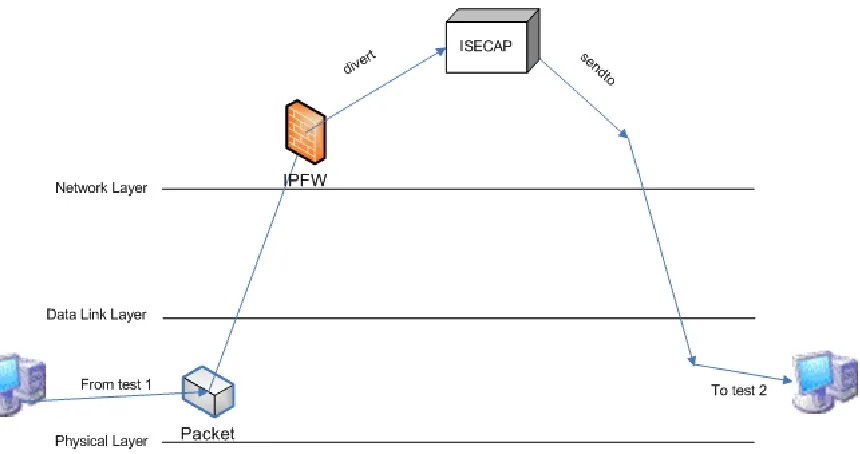
[image:22.612.111.541.419.646.2]low-layer traffic flow through ISECAP is shown in Figure 8.
3.2 IPFW to ISECAP
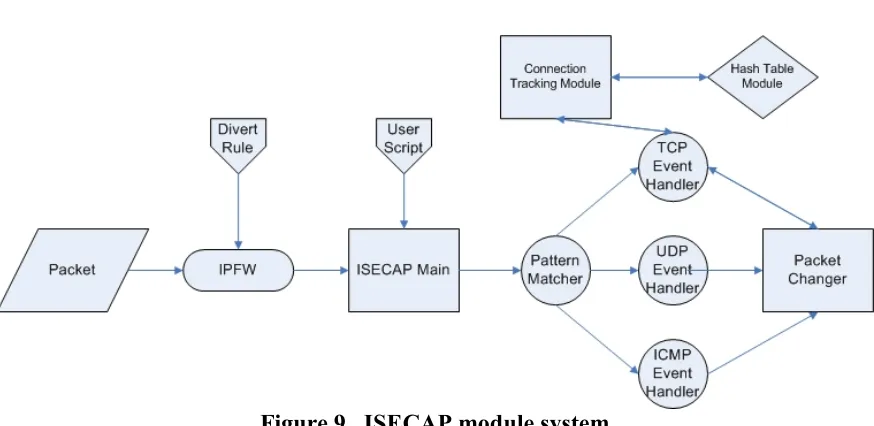
A model of the ISECAP system is displayed in Figure 9. It can be best visualized
as a packet progressing through the various modules. The packet first encounters part of
the ISECAP system at the network layer when it is passed by the kernel against a rule in
the IPFW rule table. A special type of rule known as a divert socket is inserted into the
IPFW table by the ISECAP user. Divert socket is an option in an IPFW rule statement that
forwards an unprocessed packet to a network port specified within the statement [11]. For
example:
# ipfw add 100 divert 7000 ip from 10.10.1.1 to 10.10.2.1
This shell command would add a rule to the IPFW rule table assigned rule number 100.
The rule tells ipfw to send all IP packets originating at the IP address 10.10.1.1 and
destined for the IP address 10.10.2.1 to port 7000. A program, such as ISECAP, can then
receive the unprocessed packet from the port. Appendix B contains additional examples of
IPFW divert rule statements. Diverted packets can be read as either incoming or outgoing,
but will be read exclusively as incoming for use in ISECAP. All packet diversion, in and
out, takes place at the network layer. When packet fragments are diverted, they are fully
reassembled by the kernel before they are delivered to the specified port. Divert IPFW
rules are currently entered manually by the user while executing ISECAP. The rule
Figure 9. ISECAP module system
ISECAP begins its work by taking the input script file and ordering it in a script
structure. This structure maintains a record of the diverted packet criteria and the user
desired changes to the packets that meet those criteria. A few key aspects of this data
structure are its options and expandability. The options field contains special instructions.
The first is an automatic pass option, which sends packets on unmodified. The second is
an automatic drop function, which will block all diverted packets from continuing past
ISECAP. The packet changes sub-structure already includes a wide range of header
modifications to various layers of the packet, and is easily expandable if the user wants to
make additional modifications to selected packets. The main script structure is one of the
most important aspects of ISECAP.
After acquiring the user script, ISECAP initiates the connection to the divert socket
rule. When running ISECAP, the user supplies a port number that corresponds to the
divert port in the IPFW rule. ISECAP binds itself to this port and is prepared to receive
incoming packets. The program next initiates the main functional loop which runs until
Packets are received from IPFW and loaded into a memory buffer. From here, ISECAP
sends the packet to the rest of the program by way of the pattern matcher.
3.3 Pattern Matching and Event Handling
The pattern matching module begins by checking to see if the user selected either
the pass or drop options in the script. If this selection was made, no packet processing is
needed. Otherwise the pattern matcher examines the IP header of the packet and
determines the next layer protocol. If the protocol is one supported by ISECAP, the
pattern matcher moves the packet to the correct event handler. If the protocol is not
supported by ISECAP, the default action is to pass the packet back to the IP stack
unprocessed. If the specific type of IP protocol is not supported, IP header changes are
still performed before returning the packet. The pattern matcher is meant as a hierarchical
control function which can be quickly appended to support actions for new protocols.
After being processed by the pattern matcher, the event handler corresponding to
the identified protocol is invoked. Each of the three current event handlers (ICMP, TCP,
and UDP) operate somewhat differently. The ICMP event handler is currently quite
straight-forward. It receives the packet from the pattern matcher and structures both the IP
and ICMP headers so the packet can be analyzed. After analysis, this module calls various
packet changing functions to make the necessary alterations. Additional ICMP actions can
be easily added.
The UDP event handler operates in much the same as the ICMP handler. The
packet is delivered and parsed for header information. Upon analysis the appropriate
Options such as special event handling based on attributes of the UDP packet would
expand ISECAP’s functionality. Finally, the UDP header checksum is recalculated so
packets are not rejected by the receiving node. This recalculation involves information
from the IP header, the UDP header, and the total size of the packet.
The TCP event handler is somewhat more complicated. Like the other event
handlers, when it receives a packet, the TCP handler structures the IP and TCP headers for
analysis. After analysis, the connection tracking module is invoked for the TCP packet.
This module maintains state information about connection-based TCP streams and will call
the packet modification functions at the appropriate times. As with UDP, TCP packets
require a TCP checksum recalculation. For TCP, this calculation requires information
from the IP header, the TCP header, total packet size, and the TCP options.
3.4 Packet Changing
The ISECAP packet changing module is a set of functions designed to alter packet
information based on protocol type. A packet changing function receives the appropriate
header information and user script from an event handler. It begins by parsing the change
script structure. This structure contains all packet changing information initially entered
by the user. The packet changing module checks to see which fields in the packet need to
be changed and performs the necessary data type changes. When this is complete, it alters
the packet information in memory.
A special packet changing case occurs if the user instructed a packet field to be
functions designed to return a randomized version of the appropriate field. ISECAP
currently supports random IP addresses and random application ports.
3.5 Connection Tracking
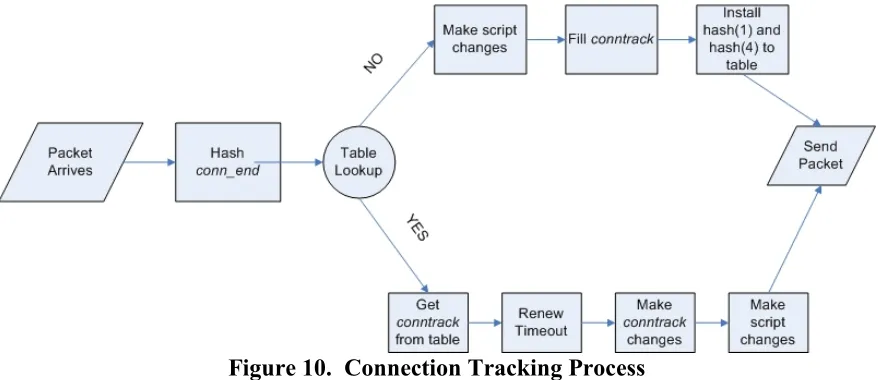
Figure 10 shows the connection tracking process in ISECAP. The purpose of ISECAP’s
connection tracking is to maintain a state table monitoring active TCP connections of
interest to the ISECAP system. Because the connection tracking needs of ISECAP are
similar to many other packet filtering programs, both Netfilter and APOC strongly
influenced the design of ISECAP’s connection tracking.
The first aspect of the connection tracking to understand is the data structures
involved. The basic data structure is called a conn_end. This structure is a simple 4-tuple
of the source IP address, source port, destination IP address, and destination port. The
second data structure of importance is the conntrack structure. This structure is a grouping
[image:27.612.102.541.473.663.2]of four conn_end structures and a variable marking the timeout value for the connection.
Figure 10. Connection Tracking Process
When a TCP packet arrives at the event handler, a conn_end structure is created
the connection hash table. The hash table lookup can result in one of two possibilities:
either the connection is new or the connection is part of a previously established stream.
If the table lookup fails to find a record corresponding to the current packet, it is
assumed to be a new connection. The TCP event handler immediately modifies the current
packet based on the user change script. After this modification, the second conn_end value
is created in the conntrack structure for this connection. The third conn_end value is
created by reversing the source and destination information of the original packet. Finally,
the fourth conn_end value is added to the conntrack structure by reversing the source and
destination information of the modified version of the current packet.
At this point, a total of four complete conn_end sub-structures exist within
conntrack. The first value represents how the packet will be seen initially on one of the
outside interfaces. The second value represents how the packet will appear as it is being
re-injected, based on the modifications by the ISECAP user script. The third value
indicates what packets received from the other side of this connection should look like
before data is re-injected and transmitted to the original host. The fourth value represents
what ISECAP will receive from the other side of this connection before any changes are
made to the packets. These values are the key to ISECAP’s connection tracking
capabilities. The first and forth conn_end structures are installed in the hash table. This
dual installation occurs because these are the two values that will enter the ISECAP
computer and result in table lookups. Finally, the new connection packet is sent back to
the network stack.
If the original packet’s hash table lookup resulted in a value, ISECAP determines
the memory address of the conntrack structure corresponding to this connection. ISECAP
then renews the timeout value, thus extending it. The TCP handler continues by modifying
the packet based on the related value in the conntrack structure. This modification ensures
the packet maintains its place within the TCP stream. After altering the packet
appropriately, the packet is retransmitted.
The hash function used in ISECAP is the Jenkins Hash. This hash function has
been proven to have efficient and fast performance for non-cryptographic implementations
[12]. Both Netfilter and APOC use the Jenkins Hash, indicating it is effective for
connection tracking in packet filtering applications. Hash table functionality is provided
by storing data with a seeded hash value. The table index value is a combination of
information about the hash table itself, the conn_end structure data, and an incremented
integer.
3.6 Packet Retransmission
When all requested and required packet functions have been completed, ISECAP
begins the reinjection process. The first step for this process is to recompute the IP header
length, which might have changed during packet alteration. This value must be accurate
for retransmission to occur without error. Divert sockets use the sendto function to
retransmit packets. Upon reinjection of the packet into the network stack, the IP checksum
is automatically recalculated to account for any changes.
When sendto is called, diverted packets are automatically flagged by the divert
functions as outgoing packets, seamlessly avoiding packet reiteration problems. This
multiple times. Because it is handled by the kernel, ISECAP can reduce processing
overhead dramatically. When the sendto function has been successfully called, the packet
CHAPTER 4. PRACTICAL USES
The uses of ISECAP are widely varied. As a general purpose packet filter solution,
ISECAP can be used to solve problems ranging from advanced firewalling to Internet
traffic shaping. Though it could be implemented in any number of environments, this
chapter will focus on the uses of ISECAP within the ISEAGE environment.
4.1 Research
As an advanced security test bed, ISEAGE has the need for a wide range of
evolving network applications. ISEAGE continues to employ the talents of computer and
network security graduate students to maintain and expand its functionality. Many of these
students will be developing security research tools based on the manipulation of packets.
ISECAP provides a perfect framework for this type of research. As ISECAP is fully
integrated with the ISEAGE FreeBSD environment and already functions as an advanced
packet filtering system, the basic code is in place to create an enormous range of network
devices. Future ISEAGE students can use modules from ISECAP intact or modify them to
any degree to meet their needs. Many upcoming projects will have a much shorter
development life-cycle because much of the groundwork can be derived from ISECAP.
ISECAP will allow for the functionality of ISEAGE to expand more rapidly than ever.
4.2 Attack Testing
Though ISEAGE is highly effective at simulating a vast number of network attacks,
ISECAP will enhance this functionality. This capability is especially important now that
scheduled to begin within a few months. Being able to run a diverse field of security
attacks against these devices is crucial to ISEAGE’s success as a security testing facility.
ISECAP will be particularly useful in expanding two types of popular network attacks:
port scanning and denial of service.
A port scan is a popular attack used to gain information about target machines. In
these attacks a variety of TCP and UDP packets are sent to a range of ports on the target
system. The response to this barrage of packets indicates which network services the
attacker can use to launch an attack. Port scans are simple to detect due to the spike in
traffic from a single host. When a port scan is detected, the IP address of the offending
machine is usually filtered or even blocked. The robust randomization function in
ISECAP provides the capabilities needed to prevent accurate port scanning detection. By
randomizing source IP addresses for all port scanning packets, an attacker can successfully
mask the identity of the originating computer. If a defender cannot determine from where
a port scan is coming, blocking the port scan and subsequent attacks becomes exceedingly
difficult.
A denial of service attack is an attempt by the attacker to either limit or end the
availability of the target computer. Types of denial of service attacks vary by traffic type
and individual packet purpose, but each attack is meant to cripple the target system with a
volume of traffic that makes the computer unable to respond to normal network requests.
The problem with standard denial of service attacks is that it is easy to trace the computer
performing it and filter all the traffic with a simple firewall rule. ISECAP overcomes this
problem by using its random functions to randomize source IP addresses and port numbers.
exceptionally difficult to stop the effects. A well-performed, random source, denial of
service attack has a high chance of success and is extremely desirable to replicate in a
security testing situation.
4.3 Cyber Defense Competitions
Cyber Defense Competitions (CDCs) are one of the most popular uses for
ISEAGE. ISECAP holds great potential as a tool for the CDC Red Team. In these
competitions the Red Team is given a limited range of IP addresses which, experience has
shown, are blocked frequently by the competing teams. ISECAP could easily randomize
individual Red Team member source IP addresses for all scanning and attack traffic. This
would not only prevent the defending teams from blocking the attacker but also likely be
of great amusement to the Red Team as the defenders attempt to isolate the source of the
scans bombarding their networks.
If implemented on an ISEAGE board or on a machine connected to one of the
external team hubs, ISECAP could be used as a launching point for numerous attacks.
After a successful ARP poisoning or DNS stealing attack, ISECAP would function as a
man-in-the-middle attack device to eavesdrop on team communications and acquire login
information and passwords from the defenders. With the man-in-the-middle position,
teams could be redirected to load various Red Team software onto their computers or
fooled to believe they are not under attack at all. With proper enhancements, the Red
Team could use ISECAP to obtain even encrypted information from normally safe
Chapter 5. LIMITATIONS
Though ISECAP provides great functionality as a security testing tool, it does have
some limitations in its ability to perform certain specific tasks. Most of these limitations
are a result of the chosen method of development for the FreeBSD platform and systems
therein. This section will document many of the limitations to the ISECAP packet filtering
system and will suggest methods of overcoming these limitations.
5.1 Network Position
ISECAP functions well within specific environments. Unfortunately, its ability to
position itself within a network, especially undetected, is limited. The ideal functioning
mode for an ISECAP machine would be to run as a transparent network bridge. Network
bridges operate as simple packet forwarding mechanisms. They are not considered a hop
on network and therefore can be virtually undetectable. They pass on traffic at the data
link layer without performing any sort of MAC or IP address routing. This position would
be ideal because other network devices would be incapable of detecting ISECAP and
therefore unable to detect changes to packets. Within FreeBSD, however, IPFirewall is
limited to only two options when a computer is used as a bridge connection: pass and drop.
Without divert sockets functionality, no method exists to pass packets to the ISECAP
program.
To solve this limitation, the user must position ISECAP on the network in a similar
undetected position by executing an ARP poisoning or DNS stealing attack. ARP
packets to ISECAP, while unaware of its presence. ISECAP could then forward the
modified traffic to the standard network gateway.
5.2 Layer Limitations
Though ISECAP has been shown to perform its function with success at the
network layer using the IP protocol, it currently is not able to handle packets at lower
layers with non-IP protocol headers. The divert socket functions are limited to IP packets,
leaving successful ethernet header or ARP packet diversion and modification outside the
scope of this project. This limitation is due to divert sockets originally being designed to
work exclusively as a kernel mechanism for network address translation on FreeBSD.
Thus far divert sockets has not been updated to include these additional abilities, but doing
so would be useful to many FreeBSD developers using divert sockets for non-network
address translation tasks.
The simplest solution to this problem would be to use another packet filtering
program to handle non-IP protocols. A heavily reduced version of Ettercap could be
implemented to handle ARP packets and ethernet headers. In fact, with some
modification, the Ettercap engine could be redesigned to simply forward these packets to
ISECAP where they could be processed by special modules. This addition would enhance
ISECAP’s functionality by providing support for another protocol and another OSI layer.
5.3 Other Limitations
The current implementation of ISECAP’s code contains some issues with transport
supporting direct control over the TCP options field, checksum recalculations are
occasionally incorrect when certain options field values are set in the packet. The options
field is an integral part of the checksum input data, and without an easy method of
obtaining these values, complications in the code have caused some checksum
calculational errors. This issue likely can be solved with a detailed code review.
Finally, a few limitations exist in the connection tracking system. An efficient
connection tracking system must be able to timeout connections after they have expired
and cease to track them. ISECAP does not currently posses the functionality to remove
entries in a timely matter from the connection tracking hash table. The connection tracking
CHAPTER 6. TESTING
While the design aspects of ISECAP are sound, no system is complete until it has
been met with rigorous examination in real world situations. Though ISECAP was
developed for use in a network simulator, the performance demands of ISEAGE will be as
great, if not greater, than real world situations. This section will detail the testing of
ISECAP and suggest future tests to be conducted.
6.1 Ping Test
The first test to which ISECAP was subjected was a basic ICMP distributed ping
test. Details of this test can be found in Appendix A. This test was to confirm three areas
of functionality. First, the test needed to allow for the proper handling of ICMP traffic.
Second, the randomization function needed to function correctly and ISECAP needed to
return all randomized traffic to the original host. Third, ISECAP needed to perform all
these functions efficiently.
ISECAP was initiated in two instances for this test. One instance was charged with
changing ping traffic to random source addresses. The other instance was charged with
translating all incoming ICMP traffic to the destination address of the original pinging
host. Traffic was captured with tcpdump on both ISECAP test interfaces to ensure
functionality.
The results of the ping test prove ISECAP is relatively efficient at handling ICMP
traffic and can perform random IP address translation with little delay. The average ping
With ISECAP filtering, the average ping latency was 526 ms. This increase of
approximately 32 percent indicates ISECAP’s modification functions are sufficiently fast.
6.2 Iperf Test
The second test performed on ISECAP was with a free tool called Iperf. Iperf is
designed to test network throughput. It performs this function by transmitting 16 KB
packets for 10 seconds on a TCP connection. To run Iperf, one of the external test
computers runs an Iperf server while the other runs a client. This test was performed
multiple times in two ways. First, Iperf was tested through the ISECAP machine without
ISECAP running. Second, the Iperf program was executed with ISECAP running.
As seen in Appendix A, the unfiltered test resulted in a throughput of 95.5 Mb/s.
Given that the data rate is limited to a theoretical maximum of 100 Mb/s by the switch
through which the connections run, this data rate is quite high and demonstrates the
efficiency of FreeBSD gateway operations. The second test, with ISECAP running,
resulted in a data rate of 72.2 Mb/s. While not as fast as the direct connection, the results
of the Iperf test are encouraging. ISECAP results in a drop of approximately 24 percent in
network throughput.
While these results are not ideal, when compared to other packet filtering programs,
such as APOC, ISECAP’s performance is exemplary. The same test was performed on
APOC, resulting in significantly worse performance [10]. When a straight connection was
run on the APOC computer the data rate was 55.5 Mb/s, while the connection with APOC
running allowed for only 3.75 Mb/s. This is a performance drop of over 93 percent and is
24 percent still allows for a high performance throughput of traffic and meets the goals set
forth in this project.
6.3 Nmap Test
The third major test performed on ISECAP was an Nmap port scan test. Nmap is a
popular port scanning tool that sends a high number of packets to a wide range of TCP
ports on the target machine. Because one of the primary goals of ISECAP is to simulate
distributed port scanning attacks, performance on this test is crucial. As seen in Appendix
A, Nmap scans were performed with the standard nmap command across the ISECAP
computer network. The first test was conducted without ISECAP running. The second
test involved two instances of ISECAP. The first instance randomized source IP addresses,
thus performing a distributed port scan. The second instance translated the return packet
destination addresses to the scanning machine.
Both tests completed successfully and found ports 22 and 80 to be open on the
target machine. The straight connection scan finished in 13.276 seconds. The ISECAP
filtered connection scan finished in 13.502 seconds. This small increase represents an
additional delay of less than 1.7 percent and is virtually insignificant.
Again, a similar Nmap test was performed by APOC using its functionality to
randomize source IP addresses. The straight Nmap scan took only 10.885 seconds while
the filtered APOC scan required 24.554 seconds, an increase of almost 130 percent. Once
again, performance is a constant challenge for packet filtering software, and is one of the
excellent speed and efficiency, indicating its usefulness as a high performance packet
filtering solution.
6.4 Future Tests
Though ISECAP performed well on numerous performance tests, the system has
yet to see a live and varied network environment. All tests presented in this chapter were
performed as a connection between only two computers. Future testing should take place
directly on the ISEAGE environment. With multiple hosts on each side of the system,
ISECAP will have much more challenging tasks to perform. One of these important tasks
will be to connection track efficiently among many hosts.
Integration into the ISEAGE environment will also provide more varied network
traffic. Testing thus far has been limited to a small subset of the possible traffic ISECAP
could encounter. New types of traffic testing could involve ISECAP’s ability to handle
malicious traffic. By implementing ISECAP at future Cyber Defense Competitions, much
CHAPTER 7. CONCLUSIONS
This paper has demonstrated the effectiveness of the ISECAP filtering system.
This chapter will conclude the paper with suggestions of future work and a summary of
ISECAP.
7.1 Future Work
ISECAP has been specifically designed to be expanded for future uses in the
ISEAGE environment. As such, there is extensive room for future additions and
improvements. One potential problem previously mentioned was the need for ISECAP to
be able to position itself on a network in an undetectable location for packet filtering. If
FreeBSD bridging divert sockets support is not added to the operating system in the future,
it would be prudent to write a set of modules for ISECAP to execute when initiated. These
modules would launch an automated ARP poisoning attack on the current network based
on the gateway IP address specified in the initial user script.
ISECAP protocol support could be expanded into the link layer and into non-IP
packets by adding modules to pass traffic into ISECAP from other methods. By borrowing
some functionality from other packet filters such as Ettercap or the standard Berkeley
Packet Filter, functions could run in parallel with ISECAP to capture this data for
processing. Such capabilities could extended into other popular protocols such as the
IEEE 802.11 standard for wireless medium communication. Also, as IP version 6 becomes
more popular, support for its unique header standards should be added.
Though ISECAP provides excellent network and transport layer change
data. When this need arises, additions should require only a few functions appended to the
current ISECAP module system. Support for popular application layer protocol such as
HTTP, DNS, FTP, and POP3 would give a finer control over specific uses of Internet
networks.
The final area in need of work is that of ISECAP’s usability. At this point, most of
the ISECAP process initiation is done manually. IPFW divert rules are entered at the
command line by the user. Change data is loaded into the change data structure by altering
the structure loading source file before compilation, and each instance of ISECAP needs to
be manually started.
A full script parsing program would make ISECAP much more user friendly. This
program would take a basic and easy-to-write script and extract the necessary information
for the ISECAP program. ISECAP would then write the conditions into a bash script
which would execute from within the program. This bash script would automatically add
all requested IPFW divert rules. ISECAP should also gain the functionality to spawn
additional instances of itself. This ability would help with everything from more efficient
connection tracking to simpler program initiation.
Finally, because ISECAP is meant to run as a part of ISEAGE, it should be
integrated into the ISEAGE graphical user control interface DeepFreeze. DeepFreeze is a
program for ISEAGE designed to provide a unified command system across all ISEAGE
components [13]. It is designed to allow easy integration for all ISEAGE projects. A
DeepFreeze graphical control interface would be a strong improvement in the usability of
7.2 Summary
ISECAP provides a solid packet filtering system and a forward-looking framework
for extensibility. Though influenced by the design of other available packet filtering
systems, ISECAP is unique in its intent and purpose as a scalable system specifically
designed for use with ISEAGE. ISECAP implements a modular design, supporting a range
of base protocol standards while allowing for future expansion. ISECAP contains a robust
pattern matching system, detailed packet altering capabilities, effective randomization
functions, and a connection tracking system. These systems come together to provide
useful enhancements to ISEAGE’s ability to perform tasks ranging from system research
to advanced attack simulation. Though the basic FreeBSD functions used to create
ISECAP still have some limitations, the extensible design of ISECAP allows for future
development to cover all areas of functionality. While some room for improvement exists,
tests of the fully functional ISECAP system have shown it to be an efficient utility.
ISECAP is a powerful tool to expand the capabilities to the ISEAGE security test bed and
APPENDIX A: TEST DATA
Ping Test Data:
Straight connection ping:
Tcpdump on em2 showing altered packets outbound:
Iperf Test Data:
Straight connection throughput:
NMap Test Data:
Straight connection port scan:
APPENDIX B: USER SCRIPT EXAMPLES
This appendix contains example IPFW rules and scripts.c information based on user needs. The format is a condition set followed by the example script(s) and rule(s).
Condition: Alter source address of IP packets from 10.10.1.1 to 10.10.10.2
myscript->script_change.ipaddr_src = "(enter IP address here)";
ipfw add 100 divert 7000 ip from 10.10.1.1 to 10.10.10.2
Conditions: Randomize source address and TCP port of TCP packets from 10.10.1.1 Alter destination address and TCP port of TCP packets to 10.10.1.1
myscript->script_change.ipaddr_src = "RANDOM"; myscript->script_change.tcpport_src = "RANDOM";
myscript->script_change.ipaddr_dst = "10.10.1.1"; myscript->script_change.tcpport_dst = "60";
ipfw add 100 divert 7000 tcp from 10.10.1.1 to any ipfw add 101 divert 7001 tcp from any to 10.10.1.1
Conditions: Randomize source address and udp/tcp ports of all ip traffic from 10.10.1.1 Pass on ICMP traffic from 10.10.1.1 unmodified
Drop all return traffic to 10.10.1.1
myscript->script_change.ipaddr_src = "RANDOM"; myscript->script_change.tcpport_src = "RANDOM"; myscript->script_change.udpport_src = "RANDOM";
myscript->script_change.change_option = PASS;
myscript->script_change.change_option = DROP;
APPENDIX C: ISECAP SETUP INSTRUCTIONS
The following are the basic instructions to setup a computer to run ISECAP:
1. Install FreeBSD 6.2 or higher on a machine with at least 3 ethernet interfaces.
2. Compile the kernel with the following options: options IPFIREWALL
options IPFIREWALL_DEFAULT_TO_ACCEPT options DIVERT
3. Add the following lines to the /etc/rc.conf file (hostname line is optional):
gateway_enable = “YES” firewall_enable = “YES” hostname = “isecap”
4. Configure the two ISECAP network cards to static IPs in the /etc/rc.conf file. An
example is shown here:
ifconfig_em1 = “inet 10.10.1.100 netmask 255.255.255.0 ifconfig_em2 = “inet 10.10.2.100 netmask 255.255.255.0
5. Restart network services with: # /etc/rc.d/netif restart.
6. Load ISECAP files and configure “script.c” settings.
7. Compile ISECAP with gcc command stored in “make” file.
8. Enter appropriate IPFW divert rules with ipfw add command.
9. Configure external computers to use ISECAP IP addresses as their default gateways.
BIBLIOGRAPHY
[1] United States Department of Health & Human Services. (2003). Summary of the
HIPAA Privacy Rule. p. 14. Retrieved July 15, 2008 from: http://www.hhs.gov/ocr/privacysummary.pdf
[2] National Institute of Standards and Technology. (2002). Title III – Information
Security. Federal Information Security Management Act of 2002. Retrieved July
13, 2008 from: http://csrc.nist.gov/drivers/documents/FISMA-final.pdf
[3] Forouzan, B. A. (2006) ‘‘The OSI Model and the TCP/IP Protocol Suite.’’ TCP/IP
Protocol Suite, 3rd edition. New York: McGraw Hill.. ch. 2.
[4] RFC Sourcebook. (2008). ‘‘Protocols’’. vol. 10 no. 1. Retrieved July 22, 2008
from: http://www.networksorcery.com/enp/default1001.htm
[5] Jacobson, Doug W. ‘‘What is ISEAGE?’’ ISEAGE: Internet-Scale Event and
Attack Generation Environment. Retrieved July 13, 2008 from:
http://www.iac.iastate.edu/iseage/what_is_iseage.htm
[6] ISU Information Assurance Center. (2005). ISEAGE Implementation Plan.
Retrieved July 13, 2008 from:
http://www.iac.iastate.edu/iseage/implementation_plan.pdf
[7] Lehey, Greg. (2006). ‘‘Introduction.’’ The Complete FreeBSD, 4th edition.
Attribution-NonCommercial-ShareAlike 2.5 License. ch. 1.
[8] Netfilter Webmaster. (2007). ‘‘What is netfilter.org?’’ The Netfilter.org Project.
Retrieved July 15, 2008 from: http://www.netfilter.org
[9] Ornaghi, Alberto and Valler, Marco. (2005) EttercapNG. Main Page. Retrieved
July 15, 2008 from: http://ettercap.sourceforge.net
[10] Hahn, Adam Lee. (2006). Advanced Packet Obfuscation and Control program
(Apoc). Iowa State University.
[11] MAN. (2007). FreeBSD Hypertext Man Pages. The FreeBSD Project. IPFW(8). Retrieved July 16, 2008 from: http://www.freebsd.org/cgi/man.cgi
[12] Mulvey, Bret. (2006). ‘‘Bob Jenkins’ Hash’’. Hash Functions. Retrieved July 22,
2008 from: http://home.comcast.net/~bretm/hash
[13] Karstens, Nathan Lyle. (2007). “Introduction”. DeepFreeze: a management
ACKNOWLEDGEMENTS
I would like to first thank my committee members Drs. Jacobson, Nilakanta, and Daniels
for their support of this project and of my graduate student career at Iowa State. I would
like to offer a special thank you to Dr. Jacobson who has given me the great opportunity of
working with a world-class security research facility at ISEAGE.
Most importantly, I would like to thank my family. Without their constant and
unconditional love and support, throughout my university career and all of life, I would not
![Figure 5. TCP header [4]](https://thumb-us.123doks.com/thumbv2/123dok_us/8119042.238941/12.612.102.539.367.632/figure-tcp-header.webp)
![Figure 7. ISEAGE architecture [6]](https://thumb-us.123doks.com/thumbv2/123dok_us/8119042.238941/14.612.117.523.288.670/figure-iseage-architecture.webp)