Supporting Queries and Analyses of Large-Scale
Social Media Data with Customizable and Scalable
Indexing Techniques over NoSQL databases
Xiaoming Gao, Judy Qiu Indiana University
Outline
§
Motivation and research challenges
§
Customizable and scalable indexing framework over NoSQL databases
§
Analysis Stack based on YARN
Motivation – characteristics of social media data
analysis
•
Big Data for social media data analysis:
- Large size: TBs/PBs of historical data
- High speed: 10s of millions of streaming social updates per day
- Fine-grained data records, mostly write-once-read-many
•
Analysis workflows contain multiple stages and analysis algorithms
Scalable data platform – two possible approaches *
•
NoSQL Databases
§
Advantages
- highly scalable
- highly fault tolerant
- inexpensive
- easy to setup and use
- flexible schema
- integration with parallel processing frameworks
§
Disadvantages (weak functionalities)
- SQL
- indices
- query optimization
- transactions
•
Parallel DBMS
§
Advantages (strong functionalities)
- SQL
- indices
- query optimization
- transactions
§
Disadvantages
- difficult to scale
- expensive
- not suitable for frequent fault
- hard to setup and use
Indexing on SQL and current NoSQL databases
Single-dimensional indices Multidimensional indices
Sorted (B+ tree) Inverted index
(Lucene)
Unsorted (Hash) R tree
(PostGIS) K-d tree(SciDB) Quad tree
Single
-field Composite Single-field Composite Single-field HBase
Cassandra Riak
MongoDB
Yes Yes
Yes Yes
Yes Yes Yes Yes Yes
•
Lack of customizability – an example query
-
get-tweets-with-text(occupy*, [2011-10-01, 2011-10-31])
-
user-post-count(occupy*, [2011-10-01, 2011-10-31])
Indexing on current NoSQL databases
•
Query execution plan using traditional Lucene indices:
get_tweets_with_text(occupy*, time_window)
Text index
IDs of tweets for occupy*
Time index
IDs of tweets for time window results
Problem:
Complexity of query evaluation = O(max(|textIndex|, |timeIndex|)) Term frequencies and ranking are unnecessary
Text index
occupyIN: 1234 2346
… (tweet id)
occupyWS … Time index 2011-10-01: 7890 3345
… (tweet id)
2011-10-02: …
•
Research challenges:
- How to support a rich set of customizable index structures?
- How to achieve general applicability on most NoSQL databases?
- How to achieve scalable index storage and efficient indexing speed?
Indexing on current NoSQL databases
•
Suitable index structures:
2011-10-01|1234
occupyIN
2011-10-02|3417
occupyWS
…
2011-10-03|4532
userID: 333
userID: 444 userID: 555
- Index on multiple (text and non-text) columns
- Included columns
•
Abstract index structure
- A sorted list of index keys
- Each key associated with multiple entries sorted by unique entry IDs
- Each entry contains multiple additional fields
- Key, entry ID, and entry fields are customizable through a configuration file
Entry IDField1 Field2 Entry ID Field1 Field2 Entry ID Field1 Field2 key1 … Entry ID Field1 Field2 Entry ID Field1 Field2 key2 Entry ID Field1 Field2 Entry ID Field1 Field2 Entry ID Field1 Field2
key3 Field1Entry ID
Field2 Entry ID Field1 Field2 Entry ID Field1 Field2 Entry ID Field1 Field2 key4
Customizable and scalable indexing framework
•
Customizability through index configuration file
<index-config>
<source-recordset>tweets</source-recordset> <index-name>textIndex</index-name>
<index-key sourcetype=“full-text”>{source-record}.text</index-key> <index-entry-id>{source-record}.id</index-entry-id>
<index-entry-field>{source-record}.created_at</index-entry-field> </index-config>
<index-config>
<source-recordset>users</source-recordset> <index-name>snameIndex</index-name>
Demonstration of Customizability
• Sorted single filed and composite indices339330 2012-09-24 453278 2012-09-25 … 2012-09-24|339330 Uid 735 2012-09-24|443319 Uid 852 … 2012-06-03|453278
• Inverted index for text data
- store frequency/position for ranking 339330 1 doc id frequency doc id frequency american 339330 1 doc id frequency outrage …
• Composite index on both text and non-text fields
Demonstration of Customizability
• Multikey index similar to what is supported by MongoDB{
"id":123456,
“name":“Shawn Williams!", “zips":[ 10036, 34301 ], ... }
Original data record
123456 10036 123456 34301 … Entry ID Zip Index
• Simulating K-d tree and Quad-tree are also possible with necessary extensions
• Join index
Get-tweets-by-user-desc(ccgrid*,
[2014-05-01, 2014-05-28]) catalog 123456
228765 ccgrid2 014 … Tweet ID User-description-tweet Index Uid 565 2014-04-02 Uid 676
How to achieve general applicability and
scalability?
- Requirements for scalable index storage and efficient indexing speed
- NoSQL databases: scalable storage and efficient random access for their data model - Mapping abstract index structure to underlying data model
- General applicability and inherited scalability
Abstract data model and index structure Mapping to table
ops HBase
Mapping to column family ops
Cassandra
Client application
Mapping to document ops
Implementation on HBase - IndexedHBase
- Efficient online updates of individual index entries
- Efficient range scans following the order of <rowkey, column name, timestamp> - Reliable and scalable index storage on HDFS
- Region split and dynamic load balancing – scalable index read/write speed
339330 2012-09-24 Field2 Entry ID Field1 Field2 Entry ID Field1 Field2 ameircan 339330 2012-09-24 Field2 Entry ID Field1 Field2 outrage entries 339330 american 2012-09-24 Filed2
Text Index Table
Integrate queries and analysis - analysis stack based on
YARN
•
Query strategies and analysis tasks as basic building blocks for workflows
Performance tests – real applications from Truthy
- Analyze and visualize the diffusion of information on Twitter
- Tweets data collected through Twitter’s streaming API
- Large data size: 10+ TB of historical data in .json.gz files
- High speed: 50+ million tweets per day, 10s of GB compressed
Performance tests – real applications from Truthy
{"text":"Americans Should be Outraged that Romney Pays Only 0.2% in Payroll Taxes http://t.co/a9I1O4F9 via
@politicususa #p2 #p2b #topprog #ctl",
"created_at":“Mon Sep 24 00:00:21 +0000 2012", "id":339330,
"entities":{
"user_mentions":[{
"screen_name":"politicususa", "id_str":"92049",
}],
"hashtags":[“#p2”, “#p2b”, “#topprog”, “#ctl”], "urls":[{
"url":"http:\/\/t.co\/a9I1O4F9", "expanded_url":null
}] },
"user":{
"created_at":"Sat Jan 22 18:39:46 +0000 2011", "friends_count":63,
"id_str":“73562", ...
},
"retweeted_status":{
"text":“Americans Should... ",
"created_at":“Sun Sep 23 21:40:10 +0000 2012", "id_str":"259227",
... },
... }
Basic range queries:
get-tweets-with-user(userID, time-window) get-retweets(tweetID, time-window)
Text queries with time constraint:
Scalable historical data loading and indexing
•
Measure total loading time for two month’s data with different cluster size on Alamo
Scalable indexing of streaming data
•
Test potential data rate faster than current stream
•
Split 2013-07-03.json.gz into fragments distributed across all nodes
•
HBase cluster size: 8
Query evaluation performance comparison
Riak: implementation using original text indices and MapReduce on Riak
Performance comparison against raw-data-scan
solutions
• Related hashtag mining: #p2, [2012-09-24, 2012-11-06]; Daily meme frequency: 2012-06
• Hadoop-FS: Hadoop MapReduce with raw File Scan
• IndexedHBase: analysis algorithms relying on index data
• Value of indexing for analysis algorithms beyond basic queries
#p2
#mitt2012
#vote #obama
Summary and future work
§
Two challenges in big social data analysis
- Targeted analysis of data subsets
- Workflows involving various processing frameworks
§
Integrated support for query and analysis is a big trend
- Deeper integration through usage of indices
§
Next step:
Query evaluation time with separate meme and time
Core components and interface to client applications
Index Configuration File User Defined Indexer … Client Application index(dataRecord) unindex(dataRecord) User Define d Indexer Basic Index Operator User Defined Index Operator search(indexConstraints) NoSQL database General Customizable Indexer- search(indexConstraints): query an index with constraints on index key, entry ID, or entry fields. Constraint type: value set, range, regular expression
- Online indexing: index each inserted data record on the fly
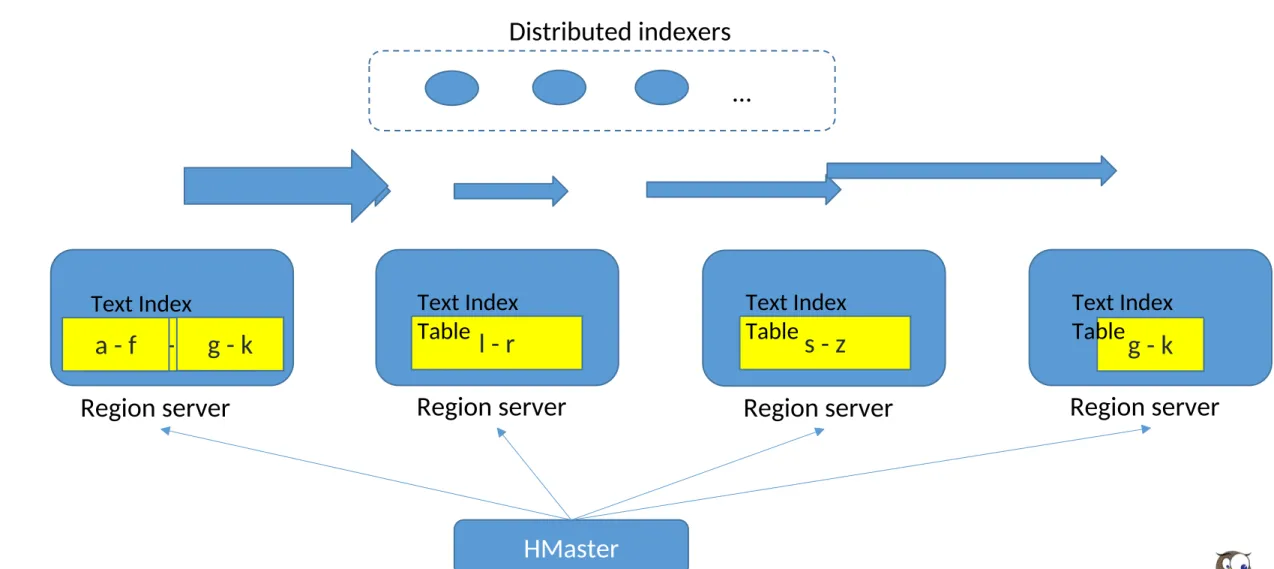
Implementation on HBase - IndexedHBase
•
Region split and dynamic load balancing for index table
Distributed indexers …
Region server Region server Region server Region server
a - k
Text Index
Tablea - f g - k Text IndexTable l - r Text IndexTable s - z Text IndexTableg - k
Apply customized indices in analysis algorithms
•
Related hashtag mining algorithm with Hadoop MapReduce
𝜎(𝑆,𝑇) =|S ∩ T| |S ∪ T|
- Jaccard coefficient:
- S: set of tweets containing seed hashtag s
- T: set of tweets containing target hashtag t
- σ > threshold means t is related to s
Step 1: use Meme Index to find S
Step 2 (Map): find every t that co-occurs with s
Step 3 (Reduce): for each t, compute σ using Meme Index to get T
Major computation done by using index instead of original data
#p2 #mitt2012
#vote #obama
Apply customized indices in analysis algorithms
•
Hashtag daily frequency generation
tweets
259227 339330 … (tweet ids)
“#p2”
… (tweet creation time) 2012-09-23 2012-09-24
Meme Index Table
- Can be done by only scanning the index - MapReduce over HBase index tables
Other components for analysis workflow construction
•
Iterative MapReduce implementation of Fruchterman-Reingold algorithm
- Force-directed graph layout algorithm
Suggested mappings for other NoSQL databases
Feature needed Cassandra Riak MongoDB
Fast real time insertion and
updates of index entries Yes. Index key as row key andentry ID as column name, or index key + entry ID as row key.
Yes. Index key + entry ID as object
key. Yes. Index key + entry ID as “_id”of document.
Fast real time read of index
entries Yes. Index key as row key andentry ID as column name, or index key + entry ID as row key.
Yes. Index key + entry ID as object
key. Yes. Index key + entry ID as “_id”of document.
Scalable storage and access
speed of index entries Yes. Yes. Yes.
Efficient range scan on index
keys Yes with order preserving hashfunction, but “not recommended”.
Doable with a secondary index on an attribute whose value is object key, but performance unknown.
Doable with Index key + entry ID as “_id” of document, but
performance unknown. Efficient range scan on entry
IDs Yes with order preserving hashfunction and index entry ID as column name.
Doable with a secondary index on an attribute whose value is object key, but performance unknown.
Doable with Index key + entry ID as “_id” of document, but