Privacy, Security and Trust
within the Context of
Privacy, Security and Trust
within the Context of
Pervasive Computing
edited by
Philip Robinson
University of Karlsruhe, Germany
Harald Vogt
ETH Zürich, Switzerland
Waleed Wagealla
University of Strathclyde in Glasgow, UK
0-387-23462-4 Print ISBN: 0-387-23461-6
Print ©2005 Springer Science + Business Media, Inc.
All rights reserved
No part of this eBook may be reproduced or transmitted in any form or by any means, electronic, mechanical, recording, or otherwise, without written consent from the Publisher
Created in the United States of America
Boston
©2005 Springer Science + Business Media, Inc.
Contents
Preface
Acknowledgments
Some Research Challenges in Pervasive Computing Philip Robinson, Harald Vogt, Waleed Wagealla
Part I The Influence of Context on Privacy, Trust and Security
Overview
Survey on Location Privacy in Pervasive Computing Andreas Görlach, Andreas Heinemann, Wesley W. Terpstra
Exploring the Relationship Between Context and Privacy Timo Heiber, Pedro José Marrón
Privacy, Security and Trust Issues Raised by the Personal Server Concept John Light, Trevor Pering, Murali Sundar, Roy Want
Part II Secure Trust Models and Management in Pervasive Computing
Overview
The Role of Identity in Pervasive Computational Trust Jean-Marc Seigneur, Christian Damsgaard Jensen
Towards a Next-Generation Trust Management Infrastructure for Open Computing Systems
Yücel Karabulut
Research Directions for Trust and Security in Human-Centric Computing Sadie Creese, Michael Goldsmith, Bill Roscoe, Irfan Zakiuddin
vii viii
1
19
23
35
49
63
65
77
PartIII Evidence, Authentication, and Identity
Overview
User-Centric Identity Management in Open Mobile Environments Mario Hoffmann
Pre-Authentication Using Infrared
Michael Kreutzer, Martin Kähmer, Sumith Chandratilleke
Architecture and Protocol for Authorized Transient Control PhilipRobinson
Part IV Social and Technical Approaches to Privacy Protection
Overview
Maintaining Privacy in RFID Enabled Environments Sarah Spiekermann, Oliver Berthold
Safeguarding Personal Data using Trusted Computing in Pervasive Com-puting
Adolf Hohl, Alf Zugenmaier
A Social Approach to Privacy in Location-Enhanced Computing Ian Smith, Anthony LaMarca, Sunny Consolvo, Paul Dourish
Author Index
Topic Index
95
99
105
113
133
137
147
157
169
Preface
Pervasive Computing is sometimes labeled as another passing “tech-nology hype”, while some people in society admit fear of the possibilities when computers are integrated into our everyday lives. Researchers are busily investigating solutions to the security requirements identified by businesses and consumers, with respect to confidentiality, privacy, digital rights maintenance and reliability of information systems.
The question of trustworthiness of spontaneously invoked interactions between devices as well as of exchanges with previously unknown human principals and with entities from unknown organizations or domains has also been raised. Furthermore, sensor networks and powerful embed-ded computers facilitate the computation of people’s location, activities, conditions and other properties that would not have been immediately available to information systems in the past. While these seem like rela-tively disparate problems, in reality we form notional mappings between these problems and hence solutions. For example, some authors refer to trusting the context as opposed to trusting a person or thing. The assurance of security within a context has then been identified as a prop-erty in the function of trusting the context. Furthermore, people tend to exchange private information with those they trust, and within an environment where trust is somehow provable. What we believe is that an investigation of the interfaces between the notions of context, privacy, security and trust may result in deeper understanding of the “atomic” problems, but also lead to more complete understanding of the social and technical issues in pervasive computing.
The goal of the workshop was not to focus on specific, even novel mechanisms, rather on the interfaces between mechanisms in different technical and social problem spaces. 21 people from different parts of the world took part in the one-day discussion, including PhD students, seasoned and junior researchers.
This workshop promises to be a lasting experience and we encourage researchers to participate in future events. We hope that you will find its proceedings useful and valuable to read.
Acknowledgments
We would like to thank all authors for submitting their work, and all members of the Program Committee, listed below, for their cooper-ation and time spent reviewing submissions. Finally, we thank Kelvin Institute, Microsoft Research, and SAP for financially supporting the publication of proceedings for the SPPC workshop 2004.
Program Committee
Jochen Haller (SAP Corporate Research, Germany) Adolf Hohl (University of Freiburg, Germany) Giovanni Iachello (Georgia Tech, USA)
Roger Kilian-Kehr (SAP Corporate Research, Germany) Marc Langheinrich (ETH Zürich, Switzerland)
I
SOME RESEARCH CHALLENGES IN
PERVASIVE COMPUTING
Philip Robinson1, Harald Vogt2, Waleed Wagealla3 1
Telecooperation Office, University of Karlsruhe, Germany
2
Department of Computer Science, ETH Zürich, Switzerland
3
Department of Computer and Information Sciences, University of Strathclyde in Glas-gow, UK
Abstract The topics of privacy, security and trust have become high priority topics in the research agenda of pervasive computing. Recent publications have suggested that there is or at least needs to be a relationship of research in these areas with activities in context awareness. The approach of the workshop, on which this proceedings reports, was to investigate the possible interfaces between these different research strands in pervasive computing and to define how their concepts may interoperate. This first article is therefore the introduction and overview of the workshop, providing some background on pervasive computing and its challenges.
1.
Introduction
walls adhered to policy. Pervasive computing however moves these re-sources from behind these centrally configured virtual walls, allowing mobility, distribution and dynamic interconnection, in order to support more advanced services and modes of usage. Living in a world where the walls, cars, stores, clothing and cafés are automatically aware of the context and hence needs of owners, users and (potential) patrons, due to embedded computers, sensors and advanced networking, can be some-times intriguing; yet on other occasions society questions the state of their privacy, becoming insecure and untrusting with respect to technol-ogy.
On April 20th 2004, as part of the Pervasive Conference in Vienna Austria, about 21 international researchers and technologists came to-gether to discuss this matter. Rather than looking at specific pervasive computing technology or security mechanisms, the goal was to gain an understanding of the relationships between context-awareness, privacy, security and trust, as these are the nuts and bolts that hold the society-technology bridge in place. By way of introduction, the publication begins with a brief overview of the State of the Art in Pervasive comput-ing, in order that the motivations of the workshop are better understood. The workshop’s themes and motivations are discussed in section 3, while section 4 provides an outline of the results of this workshop.
2.
The State of the Art in Pervasive Computing
wide-Some Research Challenges in Pervasive Computing 3
scale deployment of computing technology, while UbiComp’s initiatives were to effectively make this complex mass of technology transparent to the human user’s, especially those with limited technical “know-how”.
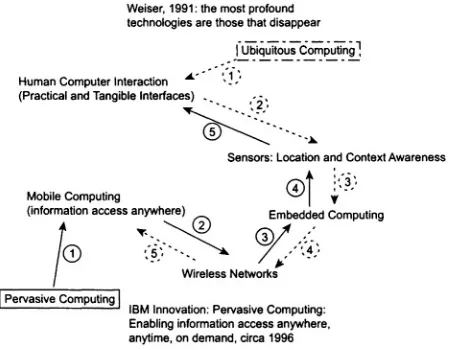
[image:14.432.107.334.291.466.2]For the purposes of the workshop themes and this publication, we consider Pervasive Computing to be comprised of five research areas - mobile computing, wireless networking, embedded computing, con-text awareness with sensor technology, and human computer interaction (HCI). An overview of these is given below, including the context within which they were discussed during the workshop. There are additional terms that may contribute to the vision of Pervasive Computing, but we have selected the ones with which we have most often encountered during workshops, conferences, seminars or discussions with other re-searchers in the field. In addition, other terms tend to be an overlap of these five themes e.g. “Wearable Computing is an overlap of Mobile Computing, Embedded Computing and HCI”. “Nomadic Computing” is an overlap of Mobile Computing and Wireless Networking.
Figure 1. Advances in both Pervasive and Ubiquitous Computing (UbiComp) show a convergence of the communities. UbiComp was initiated with a user-centric method-ology, while Pervasive was based on a bottom-up strategy for exploiting technology
2.1
Mobile Computing
Mobile Computing allows people to be on the move and still continue working with their familiar user interface and applications. Initially this meant carrying a large case, heavy yet lower-quality monitor and a large battery source. However, today’s PDAs (Personal Digital As-sistants), Laptop Computers and even some Mobile Phones are capable of supporting the basic applications that users need - word processing, communications, timetable, calculator, address book and so on. Dis-play, Microprocessor, Ergonomic, Energy and Material research have all contributed to what we refer to as a mobile computer today. Other phrases that refer to mobile computing are Nomadic Computing, where the term “Nomad” implies no real fixed place of abode, and Wearable Computing, where the feedback and control interfaces of the computing devices are built-in to the garments of the user. For example, specta-cles become displays, the CPU (Central Processing Unit) is the size and form factor of a Walkman, and a T-shirt becomes a router in a personal network [8]. These small, luggable, concealable and wearable computers have however been the targets of theft, such that individuals and compa-nies have suffered loss of expensive equipment and, moreover important, sometimes sensitive information.
2.2
Wireless Networks
Wires tend to be intrusive, as they require planning and coordination during installation, alterations in the aesthetics of the environment and hinder versatile movement. For these reasons, wireless protocols have been developed to support long-range (e.g. GSM, GPRS), local-area (e.g. IEEE 802.11), and short-range (e.g. IrDA, Bluetooth) communi-cations. Along with the nature of the data this imposes differences in the security requirements for applications that employ these protocols. The issues with security in wireless environments are well known, as the medium is generally more widespread, shared and it offers many more points of contact. Wireless networks are therefore more prone to eaves-dropping and other malicious attacks because of these characteristics.
2.3
Embedded Computing
Some Research Challenges in Pervasive Computing 5
may have their own power supply, memory, custom OS, and network interfaces. Embedded computing has been considered as contributory to Pervasive Computing, while many Pervasive systems are built by cre-ating a distributed network of micro nodes each with a special purpose. There is still a need however to coordinate and make sense of the in-teraction between these small computers by a more powerful system. However, as these embedded systems are so small and resource-limited, they do not support large-scale crypto protocols. Nevertheless, they may store data fragments that may be reconstructed by any system capable of coordinating their interaction. There is therefore some concern that Pervasive Computing systems may ignore privacy, security and trust re-quirements at the very low level, either because it is too complex or technically infeasible.
2.4
Context Awareness with Sensor Technology
One of the more significant contributions of Pervasive and Ubiqui-tous Computing has been the work in the area of location and context awareness. Research in this area suggests that computer systems need to be more informed about their environment and that of their users, in order to enhance their performance and manner in which they pro-vide computational services. The way this is done is by having various sensors distributed in the environment, including temperature, light in-tensity, movement and location, and then aggregating the information from these sensors to produce some representative value of the situation. The computer systems that receive this situation data can then adapt in order to better serve the circumstance. For example, if there are many people congregating outside of an empty meeting room, the com-puter system that automatically administers this meeting rooms may be enabled to sense the situation and try to appropriately prepare the environment for such a meeting. The major issue with these smart, sensing and adaptive environments is the degree of personal information to which they require access. This may be obtained from the RFID (Radio Frequency Identification) tags the people are wearing or some form of tracking system. While the users enjoy the benefits, they may remain incognizant of ensuing threats to their privacy by other parties also tapping into their situation traffic.
2.5
Human Computer Interaction (HCI)
in-terface in a manner that matched the human user’s perception of what these objects should represent. Today HCI has moved beyond the com-puter screen and back into the real world, where comcom-puter interfaces are being realized by manipulation of directly physically graspable ob-jects [5]. Moreover, it can be understood that the digital media is being captured in the form of physical objects. This therefore suggests that the availability and controllability of digital information must be reflective of how the associated physical objects are handled and managed.
2.6
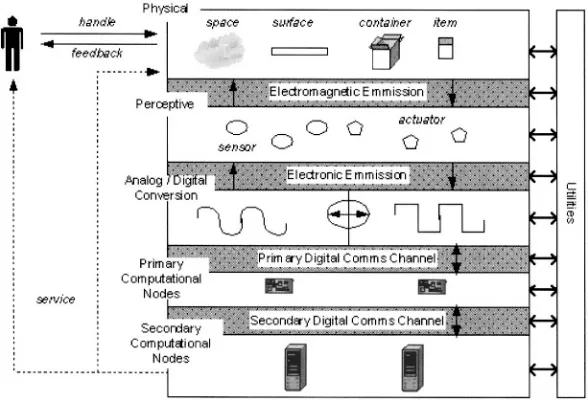
A Pervasive Computing Environment
Some Research Challenges in Pervasive Computing 7
attacks that compromise the utilities of an environment typically make the system unavailable, unless the appropriate back-up mechanism is implemented.
[image:18.432.84.378.217.423.2]We suggest that this model can be used as a generic reference when discussing any form of pervasive computing environment. Examples include Smart Spaces [11], Adaptive Environments [7], Augmented Worlds [9] and Ambient Spaces [1]. These are all specializations of the model, depicted in figure 2, where the constituents of each layer may be configured to meet the particular requirements of the system environ-ment.
Figure 2. Depiction of a Pervasive Computing Environment
3.
Workshop Themes and Motivation
The motivation for this workshop was derived from consideration of everyday situations. For example, when someone asks to momentarily use an office space, what goes through the mind of the owner? The owner may be concerned that this arbitrary person may make an overseas call and therefore leave an unwanted expense behind. Additionally, this person may browse high profile or confidential documents lying on the table or even look at the numbers stored in the phone. From an even more retrospective standpoint, the owner may have concerns about why their office was selected and how the inquirer gained the knowledge to support this decision. As the reality of pervasive computing becomes more and more apparent, these requests become more subtle, frequent and potentially impacting. Even if one concurs that this is a case of extreme paranoia, it is not easy to comprehensively reason about these concerns.
Consider the future. Devices embedded in the smart environments and worn on our bodies will communicate seamlessly about any number of different things. In such kind of interactions, huge amounts of in-formation will be shared and exchanged. Even though they may be the means of enjoying context-based and other advanced services, there is an increased risk involved in some of these interactions and collaborations, if collaborators are about to use our private possessions. Questions nat-urally arise: do you want this information shared? How can you trust the technology - yours and the environment’s? What does the environ-ment itself do, and how can you secure the access to private information, even though you may want to share it in certain contexts? This further illustrates how combined assessment of the interrelationships between trust, security, privacy and context aid in confident decision making. In every-day life we do not treat these concerns in isolation; we actually make spontaneous decisions that are based on maintaining a “comfort-able” balance. Even though we do not completely understand these basic building blocks, the potential trade-offs are intuitively understood.
3.1
Context Awareness
Some Research Challenges in Pervasive Computing 9
to refer to this as “evidence”, which has a stronger semantic affiliation i.e. supports an argument. This also stresses the urgency that context is something that may have to be proved in some situations. Therefore, to “characterize a situation” implies that we are supporting arguments for the conditions of the situation. This implies that there must be some premises or rules used to come to these conclusions. Additionally, the terms “entity” and “user” always require further clarification. We there-fore want to stick to the terms “subject” and “target”, without making any assumptions about their nature i.e. physical or electronic. Therefore the sentence “ . . . between a user and an application” would be simply replaced with “ . . . between a subject and a target”. The term “relevant” is also ambiguous, based on assumptions and is subjective. We therefore strike it from our definition as we deem that context-awareness should be a pursuit of facts.
Our definition would therefore read as: Context is any evidence that can be used to support arguments for the conditions of the situation of any subject or target, which influences their interactive behaviour.
Privacy, security and trust may hence be representative of the rules that influence the interactive behaviour between a subject and a target, or the post-assertion of the validity of the interaction and resultant con-text. Context is therefore the knowledgebase that supports the reliable derivation of meaning in an environment, while context-awareness is the ability of an entity to adapt to changing “meanings” of information.
3.2
Privacy
Technical solutions to the privacy problems in ubiquitous computing cannot stand on their own to protect our privacy rights. Privacy protec-tion has always been the subject of legislaprotec-tion, since there is an inherent conflict in service provisioning: personal data must be collected in order to adapt services to the users’ needs and preferences, but once given away, there is no technical procedure to revoke it or detain somebody from passing it on. Technology makes collecting data easy but cannot help protecting it against abuse. Thus traditionally, solutions rely on binding the collector of personal data by law to certain procedures, for example obfuscation (by anonymizing the collected data) or deletion after a certain time period.
standards. This is where a great part of privacy research in pervasive computing is aimed at.
Pervasive computing technology is often described as the ultimate tool for constant surveillance of large parts of the population, since ul-timately all actions are reflected in some networked computing device, allowing putting together personal profiles in unprecedented detail and accuracy. Users might become unaware of this fact as computers become “invisible” and careless as they become unavoidable anyway. Ronald L. Rivest put it this way: “What was once forgotten is now stored forever. What was once private is now public.”
Public concerns about the privacy problems of pervasive computing are nowadays preceded by the potential dangers of RFID technology, which is seen by many industries as a potential means for improving the efficiency of doing business. Object identification on an object level may be abused for creating profiles and exploiting user behaviour. While these concerns might sometimes be exaggerated, they are fundamentally valid. It seems however that the combination and ubiquity of small computing devices, wireless communication and sensors holds potential for far greater dangers to privacy to come.
3.3
Security
A system is generally called secure if there are measures taken to avoid a “bad” outcome, where the definition of bad greatly depends on the application scenario. The accepted concepts of security include avail-ability, authenticity, authority, integrity, confidentiality and reliavail-ability, with their proportionate significance depending on the task at hand. A great deal of security mechanisms supporting these concepts have been developed, especially since the growth of the Internet, and have gained wide acceptance in military, business and consumer applications. Ex-amples range from tamper resistant devices, cryptography and security protocols to intrusion detection systems. All these techniques will be crucial for securing pervasive computing systems, but existing incarna-tions are not all equally applicable. Security mechanisms for pervasive environments must be
scalable to the small resource provisions of “invisible” computing devices,
able to deal with devices and environments of unknown origin,
Some Research Challenges in Pervasive Computing 11
Developing such techniques is the challenge of research in this area. This does not dismiss the large resource of past work in cryptography, se-curity policies and physical sese-curity. It really calls for additional method-ologies for comprehending, implementing and integrating security at and between the different layers of pervasive environments.
3.4
Trust
Trust is multidisciplinary concept, which has been used in the fields of sociology, psychology, philosophy, and most recently in computing. Within these disciplines, trust is defined and treated from different an-gles that show its utilizations and applications. Although, there is no consensus about a definition of trust, there is a general agreement on its properties as a subjective and elusive notion. In these proceedings, contributions are concerned about the utilizations of trust in pervasive computing. The application of trust in computing is widely acknowl-edged by the term trust management [2]. This term has emerged as a new concept in computing, where it supports descriptions on how to fa-cilitate trust relationships between entities. The establishment of trust enables systems to exchange information even without the intervention of administrators to authorize these interactions.
The application of trust management systems and models in pervasive computing is about how to grant users access to resources and informa-tion based on their trustworthiness rather than the applicainforma-tion of con-ventional techniques that map authorizations to access rights. The view of trust management systems is that trust would be used as a measure for how much resources or what types of information are permitted or would be disclosed to others. This seems to fit the domain of pervasive computing quite well, since there is no fixed infrastructure and entities are not attached to specific domains, from which information about iden-tities could be obtained. There are also potential interactions with huge numbers of autonomous entities, and these interactions are triggered and established in an ad-hoc manner. Therefore, to facilitate interactions in pervasive computing, trust management is considered to be the most appealing approach to reasoning about potential users’ trustworthiness for granting them access to the required resources. Trust management aids in taking autonomous decisions on whom to trust and to what de-gree. These decisions embody reasoning about the trustworthiness and the risk involved in these interactions between entities.
that agent A wants to share or to get access to B’s resources or stored data. The first task for B is to reason about the trustworthiness of A. This reasoning is mainly based on the accumulated trust information either from previous interactions (if there are any) or from trusted third parties (aka recommendations). There are situations, in which there is inadequate information for reasoning about trust. In this case, B would either run a very restricted risk analysis, or accept the interaction on the basis of trusting dispositional factors. However, reasoning about trust when adequate information is available is much easier in comparison to the situations of no prior information. This is why some of the proposed trust management systems incorporate solutions for uncertainty. There are some other factors that influence greatly the establishment of trust, namely contextual information about the interaction, and privacy con-cerns. The combination of the trust reasoning and other factors (context and privacy) will help immensely in taking decisions regarding interac-tion requests. This shows how trust would facilitate establishing inter-actions especially under the described possible complex circumstances. Therefore, trust must be balanced against other factors: users desire to participate in interactions and to share information; and users’ concerns about security and privacy that would deter them from participation in interactions.
It is very clear from the above discussion that interactions are estab-lished on the basis of the individual’s trustworthiness rather than a fixed security policy of access right roles. The collected evidence or informa-tion, that will be made available after the interaction is finished, would serve as solid ground for possible future reasoning and decisions. This is why trust is considered as a dynamic parameter that evolves over time. The proposed trust management systems for pervasive computing are promising and encouraging [3, 6], but little is mentioned about imple-mentation of these models and their validation, which would be necessary for their adoption. Moreover, the mechanisms for trust management in-troduced some questions about their computational cost and complexity, for which studies on techniques that help keep the overhead and com-plexity low, are still welcomed.
4.
Outline of Proceedings
pro-Some Research Challenges in Pervasive Computing 13
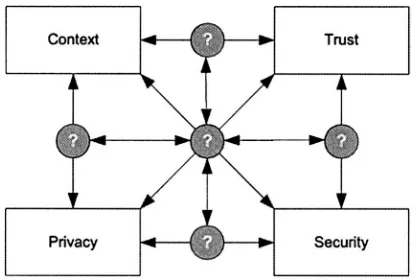
tocols, models, and architectures. The interfaces and their dependencies serve as a good research issues to tackle and to propose models that identify coherent solutions.
[image:24.432.115.323.233.373.2]The contribution we received, in terms of submitted papers, from the workshop’s participants helped in addressing and proposing solutions that would advance the developments in pervasive computing. Accord-ingly, the organizational of the workshop day and these proceedings are divided into four main sessions. Each one of them is devoted to the discussion about interfaces and relationships, as it has been illustrated in Figure 3. The discussion is not merely on the internal properties of individual themes, but on the properties of the interfaces from abstract view. The sessions during the workshop day were:
Figure 3. The view on possible interfaces between context, trust, privacy and security
and to what degree/level entities will be trusted, and what types of secu-rity policies could be specified within specific context. The influence of context shows the need for defined interface in the domain of pervasive computing. The discussion on context influences raises debatable ques-tions about: how context information would be combined with systems and applications The answers to these questions are application-specific.
2 Secure Trust Models and Management in Pervasive Computing. The security matters in pervasive computing are not about a mapping from authentications to access rights or privileges, but it is all about how much we trust users/infrastructure and systems. Trust expresses the level of access to resources that can be granted based on the available information and evidence. Trust information is mandatory for reaching decisions. For trust management to be effective, the contextualization of trust is an important step to build an appropriate level of trust on others. Trust management combines the notion of specifying security policy with the mechanisms for specifying security credential. To achieve that we also need to know the information about trust on the infrastructure and to express how confident we are on the authentication and entity recognition systems. Trust can prevent the loss of privacy by striking the balance between users’ trustworthiness and how much could be revealed. This discussion shows clearly how trust, with the combination of context, would adjust/control privacy and security.
3 Evidence, Authentication and Identity. The process of authentica-tion (authenticaauthentica-tion techniques are totally different and varies in perva-sive computing) involves collecting evidence about the identity of users. The information of both trust and context are highly considered in the process of authentication, because they give an insight view into user’s identity. The concerns of identity in pervasive computing are much big-ger than in other applications domains, because in pervasive computing there are huge number of potential users that we may not have enough information about them. Therefore, contextual information, trust in-formation, and evidence form the basis for the evaluation of identity and reasoning about it. An adequate level of available information and evidence will facilitate the process of authorizations. The relationship between evidence, authentication, and identity could be considered as a dependency relationship, in the sense that evidence is highly required for the process of authentication, which in turn provides valid identity.
Some Research Challenges in Pervasive Computing 15
information must be protected from unauthorized, unanticipated, or unintentional modification. Authentication is required to ensure that information has not been changed. Besides ensuring confidentiality and availability, it is also important to ensure that resources are used by granted users. To sum up, the proposed solutions should avoid the sep-aration between technical and social factors influencing privacy.
5.
Future Research Directions
References
[1]
[2]
[3]
[4]
[5]
[6]
[7]
[8]
[9]
[10] [11]
[12] [13]
Ambient Agoras. German Fraunhofer Gesellschaft (FhG), Darmstadt. http://www.ambient-agoras.org/.
Matt Blaze, Joan Feigenbaum, and Jack Lacy. Decentralized trust management. In Proceedings of the 1996 IEEE Symposium on Security and Privacy, pages 164–173, Los Alamitos, USA, May 1996. AT&T.
V. Cahill, E. Gray, J.-M. Seigneur, C. Jensen, Y. Chen, B. Shand, N. Dimmock, A. Twigg, J. Bacon, C. English, W. Wagealla, S. Terzis, P. Nixon, G. Seru-gendo, C. Bryce, M. Carbone, K. Krukow, and M. Nielsen. Using Trust for Secure Collaboration in Uncertain Environments. Pervasive Computing Maga-zine, 2(3):52–61, 2003.
Anind K. Dey. Understanding and Using Context. Personal and Ubiquitous Computing Journal, 5(1):4–7, 2001.
H. Ishii and B. Ullmer. Tangible Bits: Towards Seamless Interfaces between People, Bits, and Atoms. In Computing Systems (CHI), pages 234–241, 1997. Lalana Kagal, Jeffrey L Undercoffer, Filip Perich, Anupam Joshi, and Tim Finin. A Security Architecture Based on Trust Management for Pervasive Computing Systems. In Grace Hopper Celebration of Women in Computing, October 2002. David Kirsh. Adaptive Rooms, Virtual Collaboration, and Cognitive Workflow. In Cooperative Buildings. Integrating Information, Organizations, and Architec-ture, number 1670 in LNCS. Springer-Verlag, 1999.
Steve Mann. WearComp.org, WearCam.org, UTWCHI, and Steve Mann’s Per-sonal Web Page - research, 2004.
Nexus. University of Stuttgart, Germany. http://nexus.informatik.uni-stuttgart.de/.
Bruce Schechter. Seeing the light: IBM’s vision of life beyond the PC, 1999. Smart Spaces. National Institute of Standards and Technology. http://www.nist.gov/smartspace/.
SECURE Project Official Website. http://secure.dsg.cs.tcd.ie, 2002.
I
OVERVIEW
When interactions in pervasive computing are studied, the context in which these interactions are carried out must be taken into consideration. Context contributes to the meaning that a human being assigns to com-munication. The same data exchanged can mean something completely different in two different contexts. As an example, consider information about the routes to nearby hospitals. A pharmaceutical agent might query for that information sitting in a hotel room, planning a presenta-tion tour for the next day. The same informapresenta-tion might be accessed in case of an accident. Even if it is the same person accessing the same set of data, the meaning changes completely with the context in which the query is processed.
This, by all means simplified, example shows that contextual informa-tion can be used to alter the behaviour of an applicainforma-tion, to adapt it to the current needs of its user. As the application changes, so change its requirements and provisions regarding privacy, trust and security. In the case of the example, privacy is probably not a main issue. It might be desirable to allow anonymous emergency calls, or it might not, for exam-ple for discouraging false alarms. However a sales agent would probably like to introduce himself anyway. But since a simple data query for most unclassified information would normally not involve the exposure of sensitive information, privacy concerns are rather low.
Security issues are less obvious. Even though anonymity is not a main issue, the sales agent might be interested in keeping information about his queries confidential. His personal record should be able to show up in the hospital’s contact data base, but he would require the hospital’s computing service to keep his query activity undisclosed and only revealed for specific purposes, e.g. security audits or billing. The sales agent has to trust the service in having and enforcing a suitable security policy. At the same time, the sales agent has to rely on his own devices to treat application data securely. This is subject to his own security policy, which generally applies to all applications running on his devices.
anybody. Also, a user would almost surely be willing to trigger an emer-gency call using any device that is at hand. If there are several devices available, he wouldn’t even be required to trust any single device to op-erate correctly, but would likely push the emergency buttons on all of them, just to make sure.
The purpose of this rather elaborate example is to show that a change in context also changes the requirements on privacy, trust and security. These changes are analogous to the changes of the functional behaviour of an application in different contextual settings. But there is another, different aspect to contextual information. If such information becomes available to an adversary, the danger arises that through service usage, user behaviour or confidential communication is disclosed. Information about the context, in which interactions take place, can reveal sensitive information about the parties interacting, about their preferences, their goals, and the relations amongst them.
One of the most significant contextual features is the location of an entity. Lots of information can be inferred if the location of an entity is monitored, especially a human being. Therefore, location information should only be disclosed under certain well-established circumstances. This problem is addressed in the first paper, which is entitled “Survey on Location Privacy in Pervasive Computing”. It is observed that location information can be obtained by several means, either through direct communication with the respective entity, or through indirect means such as observation or inference. Several technical and non-technical approaches for maintaining and managing location privacy are discussed. The main problem is that on one hand, location information is useful for enhancing services but on the other hand, it should be disclosed only sparingly. It is often feasible, however, to restrict the use of location information to lower levels of an application only, thereby trying to avoid revealing it unnecessarily, which decreases the requirements on the trust that is put in other entities.
pri-Overview 21
vacy in context-aware systems. The framework describes the essential and interrelated components for privacy in context-aware systems. The components considered in the framework are: a data model, an ad-versary model, inference rules, and privacy requirements. The authors back the framework up with the formalization of some components using structured data.
SURVEY ON LOCATION PRIVACY IN
PERVASIVE COMPUTING
Andreas Görlach1, Andreas Heinemann2, Wesley W. Terpstra1’2
1
ITO, TU Darmstadt, Germany
{goerlach,terpstra}@ito.tu-darmstadt.de
2
GKEC, TU Darmstadt, Germany
{aheine,terpstra}@gkec.tu-darmstadt.de
Abstract The goal of ubiquitous computing research is refine devices to the where their use is transparent. For many applications with mobile devices, transparent operation requires that the device be location-aware. Un-fortunately, the location of an individual can be used to infer highly private information. Hence, these devices must be carefully designed, lest they become a ubiquitous surveillance system.
This paper overviews existing location-sensing mobile devices, vec-tors for a privacy invasion, and proposed solutions. Particular attention is paid to required infrastructure and the accuracy of the location infor-mation which can be stolen. Solutions are examined from the perspec-tive of attacks which can be reasonably expected against these systems.
Keywords: Pervasive Computing, Ubiquitous Computing, Privacy, Location Pri-vacy, Tracking, Positioning, Survey
1.
Introduction
An important question is how much privacy protection is necessary. Perfect privacy is clearly impossible as long as communication takes place. Therefore, research aims at minimizing the information disclosed. The required level of this protection is not a matter of technology; differ-ent people have differdiffer-ent privacy needs. Nevertheless, technology should not force society to accept less privacy.
The major privacy concern with mobile devices equipped with com-munications ability is that they can reveal the location of their bearers. This concern is in itself not new; people can recognize each other. What is new is the increased scope of the problem due to automated infor-mation gathering and analysis. Poorly designed mobile devices enable anyone to obtain another’s location.
If we allow automation to create an effective public record of people’s locations, discrimination against minorities will be impossible to control. AIDS patients could be identified by the offices of doctors they visit, Alcoholics Anonymous members by their group meetings, and religious groups by their churches.
This paper will present an overview of the state-of-the-art in location privacy. In Section 2, mobile devices which possess both location aware-ness and communication ability will be examined. Section 3 lists attacks by which an invader can obtain private location information. Existing countermeasures and safeguards are detailed in Section 4. These in-clude high level schemes such as policies which operate like contracts, and lower-level solutions which reduce information disclosure. Among the latter are anonymous routing algorithms, schemes for hiding within a group, methods to passively determine location, and frequency modu-lation techniques to hinder triangumodu-lation.
2.
Location-Aware Communication Devices
Many technologies can determine the location of an individual. This section provides an overview of what technologies are presently deployed and which are coming in the near future.
Survey on Location Privacy in Pervasive Computing 25
For indoor use, the Active Badges [23] from AT&T Laboratories Cam-bridge were developed. These are small devices worn by individuals which actively transmit an identifier via infrared. This information is received by sensors deployed in the environment. This system provides essentially room-level resolution and has problems following individuals due to the infrequency of updates. The environment consolidates this information and can provide the current location of an individual.
A later refinement, the Bat [24], increased the detected resolution. With the increased resolution, the Bat can be used to touch virtual hot spots. Their work reports accuracy as good as 4cm. These refined devices used ultrasonic pings similar to bat sonar. However, once again the environment measures the Bat’s location as opposed to real bats which learn about their environment.
The Cricket Location-Support System [18] system takes a similar ap-proach. It uses radio and ultrasonic waves to determine distance and thus location. Like the Cambridge Bat, resolution to within inches is possible. As opposed to the similar Cambridge work, beacons are placed in the environment as opposed to on individuals. The Cricket devices carried by individuals listen to their environment in order to determine their location. In this way, the device knows its location, while the environment does not.
An approach to location sensing which does not require new infras-tructure is taken by Carnegie Mellon University [21]. Here, the existing wireless LAN is observed by devices to recognize their location. By pas-sively observing the signal strengths of various base stations, a device can determine it’s location. Though there are no requirements for new infrastructure, there is a training overhead. During training a virtual map of signals is created which is used by the devices to determine their location.
Cell phones can be abused to provide location information. Although not originally intended for this purpose, the E-911 [19] requirements in the US forced cell phone providers to determine customer location when they dialed an emergency phone number. Although this practice was clearly beneficial, the technology has since spread. The underlying problem is the omnipresent possibility of performing triangulation (with varying accuracy, though).
by simply walking through the shelves and automatically recording the observed products.
3.
Attacks on Location Privacy
In a successful privacy attack, some party obtains unauthorized in-formation. Individuals intend that some information about themselves should be available to others, and that the rest remain private. The means by which the individual’s preferences were circumvented is the attack vector.
The main privacy concern with regards to ubiquitous computing is that many new automated attack vectors become possible. Loosely cat-egorized, automated digital devices obtain information either through communication, observation, or inference. In this section the attack vectors available in each of these channels will be explored.
3.1
First-Hand Communication
An attacker obtains private information through first-hand commu-nication when an individual unwittingly provides it directly to the at-tacker. In a world with ubiquitous computing, the threat of disclosure via accident or trickery is significant. All digital devices of a given type, by virtue of being homogeneous, make the same mistakes—and don’t learn from them. The designers of the Windows file sharing protocol never intended it to be used to obtain people’s names. Nevertheless, Windows laptops will happily reveal their owner’s name to anyone who asks it. Due to a bug in bluetooth phones, attackers may often trick the phone into revealing its address book and phone number [16]. By asking a device with known location for owner information, both of these attacks pinpoint the owner’s location, among other things. Naturally, these attacks can be built into an automated device.
Many ubiquitous devices also exhibit unwanted behaviour. The Bats and Active Badges broadcast their location information for all to hear. WLAN cards periodically emit traffic which includes their unique MAC ID. Devices providing exact their location information to location based services also seems overly permissive. At the bare minimum, these prob-lems must be addressed.
loca-Survey on Location Privacy in Pervasive Computing 27
tion information is known to the infrastructure, the threat of a system vulnerability is magnified.
3.2
Second-Hand Communication
Attacks via second-hand communication relay information from one party to another unauthorized party. The primary difference between these attacks and first-hand attacks is that the individual no longer controls the information. Fortunately, in the human scenario, talking about individuals behind their back requires some expenditure of breath. Unfortunately, aggregation and spreading of this information in a digital system is significantly easier.
This behaviour has already been observed in the Internet where Dou-bleclick regularly sells personal habit and preference information. It seems naïve to assume that the much finer grained information available from ubiquitous devices will not similarly be sold. Services are already available for individuals to locate their friends via the cell phone net-works [17].
3.3
Observation
Attackers may also obtain information by configuring devices to ob-serve their environment. The most obvious problem is the deployment of many nearly-invisible cameras in the environment. However, there are other risks which are more feasible to launch with current technology.
One of the more interesting attacks that can be launched against mo-bile communications-equipped devices is triangulation. By measuring timing delays in a signal, the attacker can determine the location of the device. This is similar to how the Bat operates, only using electromag-netic waves instead of sound waves.
3.4
Inference
One of the fears about automated privacy invasion is the compilation of a profile. After gathering large amounts of information via communi-cation and observation, an automated system combines these facts and draws inferences. Given enough data, the idea is to build a complete picture of the victim’s life.
Tracking an individual’s location through time may also enable an attacker to link information to the individual. For example, if an
indi-vidual’s car regularly sends out totally anonymous weather requests, it
might still be possible for a weather network to track the car by correlat-ing the observed request locations. Later, when the individual buys gas at an affiliate’s gas station, the network can link the individual’s name and bank account to the tracked car. Now, the network can deduce information such as where the person shops, lives, and works; who the person regularly visits; etc.
4.
Solutions
In the literature there exist several approaches to protect the loca-tion of a user. Most of them try to prevent disclosure of unnecessary
information. Here one explicitly or implicitly controls what
informa-tion is given to whom, and when. For the purposes of this paper, this information is primarily the identity and the location of an individual. However, other properties of an individual such as interests, behaviour, or communication patterns could lead to the identity and location by inference or statistical analysis.
In some cases giving out information can not be avoided. This can be a threat to personal privacy if an adversary is able to access different sources and link the retrieved data. Unwanted personal profiles may be the result. To prevent this, people request that their information be treated confidentially. For the automated world of databases and data mining, researchers developed policy schemes. These may enable adequate privacy protection, although they similarly rely on laws or goodwill of third parties.
4.1
Policies
In general, all policy based approaches must trust the system. If the systems betrays a user, his privacy might be lost. Here, the suitable counter-measure is a non-technical one. With the help of legislation the privacy policy can be enforced.
All policy based systems have the drawback that a service could sim-ply ignore the individual’s privacy preferences and say, “To use this service you have to give up your privacy or go away.” This certainly puts the user in a dilemma and he will probably accept these terms as he wants to use the service.
sys-Survey on Location Privacy in Pervasive Computing 29
tem. pawS provides users with a privacy enabling technology. This approach is based on the Platform for Privacy Preferences Project (P3P) [4], a framework which enables the encoding of privacy policies into machine-readable XML. Using a trusted device, the user negotiates his privacy preferences with the UbiCom environment.
Framework for Security and Privacy in Automotive Telematics.
A framework for security and privacy in automotive telematics, i.e. embedded computing and telecommunication technology for vehicles, is described by Duri et al. [5]. The primary goal of their framework is to enable building telematics computing platforms that can be trusted by users and service providers. They do that by installing a data protection manager to handle sensitive data. Thus they implement a middleware working with different key concepts which for example influence location data accuracy and enable user defined privacy policies.
Concepts for Personal Location Privacy Policies. Snekkens [22] presents concepts which may be useful when constructing tools to enable individuals to formulate a personal location privacy policy. Snekkens’s idea is that the individual should be able to adjust the accuracy of his location, identity, time, and speed and therefore have the power to enforce the need-to-know principle. The accuracy is dependent on the intended use of the data, and the use in turn is encoded within privacy policies.
4.2
Protecting First-Hand Communication
Most approaches address the problem of information disclosure. Many different ideas have been proposed to prevent unnecessary information from becoming known to a third party.
ANODR: ANonymous On Demand Routing. With the scenario of a battlefield in mind, Kong and Hong described in [13] their scheme ANDOR. This is a routing protocol addressing the problems of route anonymity and location privacy.
MIXes in Mobile Communication Systems. It is easy for cellular networks like GSM to track their mobile subscribers. Location informa-tion is required in order to route calls appropriately. Avoiding this by simply broadcasting is not an option because of the limited bandwidth in current cellular networks. In [6] this is investigated and the application of MIXes (see also [3]) is proposed.
In their system, the scheme does not keep the identity—telephone number—of the recipient anonymous. Only the location of the recipient
is protected. Remarkably, their system remains secure even if all of
forwarding nodes are observed by an adversary.
Mix Zones. A recent approach which is somewhat similar to mix
networks is mix zones [2]. In these networks, the infrastructure provides
an anonymity service. The infrastructure delays and reorders messages from subscribers within a mix zone to confuse an observer.
A problem with this system is that there must be enough subscribers in the mix zone to provide an acceptable level of anonymity. Beres-ford and Stajano conducted statistical attacks against these systems and found the afforded security to be quite low. Even large groups using the Active Bat remained vulnerable.
Temporal and Spatial Cloaking. In [10], Gruteser and Grunwald
propose a mechanism called cloaking that conceals a user within a group
of people. They consider a user as if, and only if, they
are indistinguishable from at least other users. To achieve this, the
accuracy of the disclosed location is reduced. Then any of the people within the disclosed area could have been the user. Similarly, they con-sider reducing the accuracy of disclosure timestamps. Like Stajano and Beresford they, too, measured anonymity in experimental setups, but unlike them Gruteser and Grundwald identified concrete values which in their view provide certain levels of anonymity.
The Cricket Location-Support System. In order to prevent the potential misuse of personal information, the most convincing solution is to not let out any information at all. This idea is applied directly to the Cricket Location-Support System [18]. As described in section 2, the mobile device never transmits at all; rather, it passively listens to its environment.
Survey on Location Privacy in Pervasive Computing 31
its location. For example, using a printer implicitly reveals that the device is near to the printer.
PlaceLab. Place Lab [20] uses a decentralized approach with WLAN hotspots as beacons thus exploiting the same idea as Cricket for outdoor environments. In order to determine its own position each device hosts a previously downloaded database of an access point to location map-ping. With their Place Bar component end users are able to adjust their location granularity when revealing location information to third parties. In addition to that the privacy and security concept of Hong et al. [11] also take access point privacy, network service privacy and web service privacy into account. Access point privacy aims at protecting access point owners by hashing the stored MAC addresses.
The Blocker Tag. A special case among pervasive devices are RFIDs. People carrying objects which contain RFIDs might not even be aware of the existence of these devices because of their size2 and their passive nature. A second specific property of RFIDs is their unability to do any computation like e.g. encryption. So they require their own measures for privacy protection.
Juels, Rivest and Szydlo examined several possible solutions in [12] ranging from destruction of the tag through less destructive approaches to regulation (i.e. policies). Since the authors see disadvantages in all of the examined solutions they present their own approach which is the development of a special tag: the Blocker Tag. This tag blocks attempts of readers to identify RFIDs. In order not to block desired RFIDs or to temporarily enable the reading of RFIDs the blocking process can be done selectively.
Hindering Triangulation. As mentioned in Section 3.3, data can be gathered by observing a device or person. On the physical layer it is usually possible to locate a sending device by recording signal delays and performing triangulation.
5.
Conclusions
The solutions we have seen can be categorized into policies and in-formation minimizing at the source. These approaches aim to address threats in the areas of first- and second-hand communication, observa-tion, and inference.
Policies seem to work well wherever consent underlies the transac-tion. For example, when information is to be provided to a service, an agreement can be reached regarding the further distribution of the information. If no agreement can be reached, then the individual will be unwilling to use the service, but the service will likewise not obtain the information or any associated remunerate. Similarly, the individual can negotiate terms about how his information may be used; this can address attacks based on inference.
There is no consent in observation. This means that policies can not be applied to these attacks since the individual is in no position to negotiate. Here, legal safeguards and countermeasures are required. Unfortunately, there is currently insufficient discourse between technical and legal experts.
Accuracy reduction techniques apply primarily to first-hand commu-nication problems. These schemes aim at reducing the amount of con-fidential information disclosed to third parties. There are a variety of techniques which obscure the location information, the timestamp of the transaction, and the identity of the individual.
As mentioned in the introduction, privacy issues are fundamentally not technical. As ubiquitous devices permeate the every-day lives of ordinary citizens, our privacy protection measures will have increasing impact on their lives. It is important that research into privacy pro-tection bear in mind what must be protected. This is more the area of social sciences, and thus requires more inter-disciplinary discourse.
6.
Acknowledgements
This work was sponsored in part by the Deutsche Forschungsgemein-schaft (DFG) as part of the PhD program “Enabling Technologies for Electronic Commerce”.
Notes
For example the Kazaa Media Desktop
The smallest RFIDs are currently only of 0.4mm * 0.4mm size.
1.
2.
Survey on Location Privacy in Pervasive Computing 33
Joseph Bailey. Internet Price Discrimination: Self-Regulation, Public Policy, and Global Electronic Commerce, 1998.
Alastair R. Beresford and Frank Stajano. Location Privacy in Pervasive Com-puting. PERVASIVE computing, IEEE CS and IEEE Communications Society, (l):46–55, 2003.
David Chaum. Untraceable Electronic Mail, Return Addresses, and Digital Pseudonyms. Communications of the ACM, 24(2):84–88, 1981.
Lorrie Cranor, Marc Langheinrich, Massimo Marchiori, Martin Presler-Marshall, and Joseph Reagle. The Platform for Privacy Preferences 1.0 (P3P1.0) Specifi-cation. http://www.w3.org/TR/P3P/, seen 2004.
Sastry Duri, Marco Gruteser, Xuan Liu, Paul Moskowitz, Ronald Perez, Monin-der Singh, and Jung-Mu Tang. Framework for Security and Privacy in Au-tomotive Telematics. In International Conference on Mobile Computing and Networking, pages 25–32. ACM Press, 2002.
Hannes Federrath, Anja Jerichow, and Andreas Pfitzmann. MIXes in Mobile Communication Systems: Location Management with Privacy. In Information Hiding, pages 121–135, 1996.
Hannes Federrath and Jürgen Thees. Schutz der Vertraulichkeit des Aufen-thaltsorts von Mobilfunkteilnehmern. Datenschutz und Datensicherung, Verlag
Vieweg, Wiesbaden, 6(6):338–348, 1995.
Klaus Finkenzeller. RFID-Handbook, 2nd Edition. Wiley & Sons LTD, 2003. I. A. Getting. The Global Positioning System. IEEE Spectrum, 30(12):36–47, December 1993.
Marco Gruteser and Dirk Grunwald. Anonymous Usage of Location-Based Services Through Spatial and Temporal Cloaking. In MobiSys, pages 31–42. USENIX, 2003.
Jason Hong, Gaetano Bordello, James Landay, David McDonald, Bill Schilit, and Doug Tygar. Privacy and Security in the Location-enhanced World Wide Web. In Proceedings of Ubicomp 2003, October 2003.
Ari Juels, Ronald L. Rivest, and Michael Szydlo. The Blocker Tag: Selective Blocking of RFID Tags for Consumer Privacy. In V. Atluri, ed. 8th ACM Conference on Computer and Communications Security, pages 103–111. ACM Press, 2003.
Jiejun Kong and Xiaoyan Hong. ANODR: ANonymous On Demand Routing with Untraceable Routes for Mobile Ad-hoc Networks. In Proceedings of the 4th ACM international symposium on Mobile ad hoc networking & computing, pages 291–302. ACM Press, 2003.
Marc Langheinrich. Privacy by Design – Principles of Privacy-Aware Ubiquitous Systems. In Gregory D. Abowd, Barry Brumitt, and Steven A. Shafer, editors, Ubicomp, volume 2201 of Lecture Notes in Computer Science, pages 273–291. Springer, 2001.
Adam Laurie. Serious Flaws in Bluetooth Security Lead to Disclosure of Per-sonal Data, http://www.bluestumbler.org, 2003.
Mobiloco - Location Based Services for Mobile Communities. http://www. mobiloco.de/.
Nissanka B. Priyantha, Anit Chakraborty, and Hari Balakrishnan. The Cricket Location-Support System. In Mobile Computing and Networking, pages 32–43, 2000.
Jeffrey H. Reed, Kevin J. Krizman, Brian D. Woerner, and Theodore S. Rap-paport. An Overview of the Challenges and Progress in Meeting the E–911 Requirement for Location Service. IEEE Communications Magazine, 5(3):30– 37, April 1998.
Bill Schilit, Anthony LaMarca, Gaetano Borriello, William Griswold, David McDonald, Edward Lazowska, Anand Balachandran, Jason Hong, and Vaughn Iverson. Challenge: Ubiquitous Location-Aware Computing and the Place Lab Initiative. In Proceedings of The First ACM International Workshop on Wire-less Mobile Applications and Services on WLAN (WMASH 2003). ACM Press, September 2003.
Asim Smailagic, Daniel P. Siewiorek, Joshua Anhalt, David Kogan, and Yang Wang. Location Sensing and Privacy in a Context Aware Computing Environ-ment. In Pervasive Computing, 2001.
Einar Snekkenes. Concepts for Personal Location Privacy Policies. In Proceed-ings of the 3rd ACM Conference on Electronic Commerce, pages 48–57. ACM Press, 2001.
Roy Want, Andy Hopper, Veronica Falcão, and Jonathan Gibbons. The Active Badge Location System. ACM Transactions on Information Systems, 10(1):91– 102, 1992.
Andy Ward, Alan Jones, and Andy Hopper. A New Location Technique for the Active Office. IEEE Personal Communication, 4(5):42–47, 1997.
[16]
[17]
[18]
[19]
[20]
[21]
[22]
[23]
EXPLORING THE RELATIONSHIP
BETWEEN CONTEXT AND PRIVACY
Timo Heiber, Pedro José Marrón University of Stuttgart
Institute for Parallel and Distributed Systems (IPVS) {timo.heiber,pedro.marron}@informatik.uni-stuttgart.de
Abstract
Keywords:
Privacy is an important consideration for context-aware systems, be-cause an individual’s context contains a large amount of personal in-formation. In this article, we describe a generic framework to model privacy in context-aware systems. We also present an example instance of the framework to demonstrate its practical application.
Pervasive computing, security, privacy, context-awareness, inference control
1.
Introduction
Most people agree that privacy protection is an important aspect of networked and distributed applications, especially in the fields of mobile and pervasive computing. However, it is hard to agree on a common def-inition of privacy, for two main reasons: First, the defdef-inition depends on the highly variable preferences of individuals and socio-cultural groups. Secondly, in contrast to the related security goal of data confidentiality, privacy is not an all-or-nothing notion. It is often acceptable to divulge a limited amount of personal data, whereas it may be unacceptable if large amounts of the same type of data become known.
someone interested in obtaining personal information (hereafter termed “adversary”) would have a multitude of opportunities. Moreover, the semantics of context information can be leveraged to infer context in-formation that is not explicitly stated in the available pieces of context information. Consider, for instance, the point that the location of a certain user’s mobile device can be used to infer information about the location of that user.
Assuming a global view of the problem, there are three main questions that influence a user’s degree of privacy in context-aware environments:
1 How much personal context data can be collected by an adversary?
2 What is the content of that context data?
3 How successful is the adversary in attributing that data to a par-ticular person?
In this paper, we present a generic framework for privacy in context-aware computing systems. We focus on how to model inference-based attacks on context information within this framework. We demonstrate the feasibility of our approach by showing how to model inferences based on the context information of location, time and identifier (sometimes called primary context [3, 8]).
This paper is structured as follows: In Section 2, we present an ex-ample scenario from which we derive a generic framework for privacy in context-aware systems in Section 3. We then discuss the formalization of this generic framework in Section 4, with a concrete instance provided in Section 5. We review the related work in Section 6. In Section 7, we summarize our approach and discuss directions for future work.
2.
Motivation
Consider a scenario with an abundant supply of context-based infor-mation systems: Location-based services track the locations of their customers and supply information relevant at their current location (e.g. route planning, public transport timetables etc.) while “infosta-tions” supply information to anyone in their transmission range. User Alice uses her personal devices to communicate with such information systems. Location tracking and communication with the location-based service is done via a mobile phone network that can provide high loca-tion resoluloca-tion (e.g. UMTS). Access to the infostaloca-tions is gained through her WLAN-equipped PDA.
Exploring the Relationship Between Context and Privacy 37
she is known to the LBS under the identifier Alice-LBS (which might be a pseudonym). The PDA uses a wireless LAN adapter with the constant device ID (MAC address) Alice_PDA.
Now consider adversary Eve that has gained access to the information generated by the transmissions of Alice’s devices (for example, a UMTS service provider that also monitors WLAN traffic at some locations). Eve could then collect two types of location traces for all users. With respect to Alice, she would obtain location traces under the ID Alice-LBS and also other location traces under the ID Alice_PDA, using the location information that comes implicitly with the WLAN transmissions.
Eve’s next step would be to correlate both types of location traces in order to see whether a pair of location traces from different sources matches. That way, two different identifiers (Alice_LBS and Alice-PDA) could be linked to the same person (Alice). Furthermore, only one suc-cess in this regard will be enough to link Alice’s identifiers Alice-LBS and Alice_PDA from this point on.
The important point of this scenario is that with increasing amounts of context information, attempts to penetrate an individual’s privacy will also be increasingly successful, because the adversary will be able to leverage the semantics of context data items to infer additional in-formation that is not explicitly stated in the context inin-formation. Even if data is only stored in pseudonymous form, adversaries will often be able to link items of context data based on their content. Moreover, the problem discussed here is not restricted to a specific application scenario, but remains valid for any form of constant identifier, for instance RFID tags that can be interrogated remotely.
Note that the amount of data used by Eve in the example above is comparatively small and restricted to identifiers and spatio-temporal coordinates. This is an indication that the privacy problems will become even worse when context-aware computing is used ubiquitously and other forms of context data are taken into account.
3.
A Generic Framework for Modeling Privacy
in Context-Aware Systems
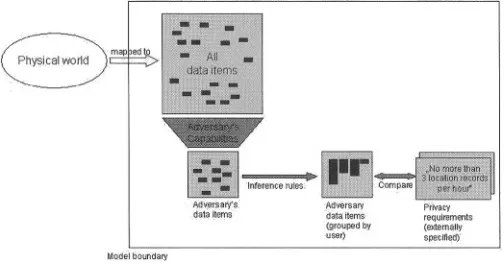
Figure 1. Generic framework for privacy
The physical world is external to our model boundaries and repre-sents the events occurring in the physical world: people walking around, people using computers to access information or send messages etc.
Some of these events leave an “electronic trace”, e.g. cause records of information to be stored on a computer system. We refer to each of these discrete records as a data item. Conceptually, we consider the set of all data items to be one database to which an adversary trying to violate people’s privacy would like to gain access. A data item may, for instance, be created when a person sends an e-mail message, or when his or her whereabouts are recorded by a location tracking system. In the example of Section 2, data items containing Alice’s location are generated at the location-based service and also due to the communication of the PDA.
A subset of all existing data items is available to an adversary
(ad-versary’s data items). The size and exact composition of this subset
depends on the adversary’s capabilities, which are a function of her
abil-ities and the access control mechanisms employed to restrict access to the data items. In the “Alice” example, we assumed Eve to have access to the data stored at both the public service and the two non-public services.
The next step of the adversary is to apply inference rules to organize