S T U D E S
l.24
PMqZL FLUTTER AT WIG'$5ER lviACZ4 NU:v%3ERSP.
FLAT
MgD SEXG33TLY @ W V E Q P,UidEESAT &kAcH bUh5BER 2 . 8 1
.
CYLhYD'RIGAL Si3ZLLS FtTd9TITH BOUPIDkml LAYERThasfe by
7 v yi Ilimi1 Judson Ander scan
I n Partial FuBff 3 k of the Raquirsrr~enta For the D e g x a e sag
Doctor
of
Phiko oophyGalifornia Institute of Ts;cbaoPsgy Pasadena, Galilornia
The
author would like to express his appreciaitio;d~ for the encour-
a g e r ~ ~ e r r t anci gcidancse given oy D r . Y . C, Fung during the devebogrlra~-& of this thesis, %hanks a r e also due to L h r . :.iisr*simn 3esae.y f o r his n ~ a i ~ y hour :- of w o r k on the i m ~ t r u r r ~ e n t a t i o n anid to 2t~irs.-
-artha iida~l-ison lorhe, help with nuA-z~eprical caPcuHaticsns.
-'L m l ~ ~ b e r sf people cheerfa;aP%y helped w i t h the preparation of the r - 2
thecjis, Ahe txyping was danz by K z i s s Helen Grorrus and the f i g u r e s were
T.'l
drawn Ly tk1-8. Lelbsnie Loosljb. & h e equations w z r e inked i n ay .-:y ?aLPe
Zetty, %%-LO s P n s helped with the rough tur%;"ing.
I:urin% one year of research, the author wws aupported ~y a
ABSTRACT
Two s e r i e s of p a n e l f l u t t e r t e s t s w e r e c a r r i e d out i n t h e
J e t P r o p u l s i o n L a b o r a t o r y ' s 1 2 inch s u p e r sonic wind tunnel, F l a t and
slightly c u r v e d p a n e l s w e r e t e s t e d a t Mach n u m b e r 2. 81.
T h e f l a t , r e c t a n g u l a r p a n e l s w e r e designed to study two-
d i m e n s i o n a l flutter. They w e r e c l a m p e d a t f r o n t and r e a r with f r e e
s i d e s which extended into the boundary l a y e r a t t h e s i d e s of t h e tunnel.
T h e s e p a n e l s f l u t t e r e d i n a two-dimensional m o d e which o c c u r r e d a t a
t h i c k n e s s r a t i o a p p r o x i m a t e l y 1 5 p e r c e n t d i f f e r e n t f r o m the p r e d i c t i o n s of existing theory. One of t h e p a n e l s exhibited a t h r e e - d i m e n s i o n a l
"rocking" f l u t t e r which h a s not been o b s e r v e d o r d i s c u s s e d before. A
t h e o r y i s developed f o r t h i s type of flutter.
T h e slightly c u r v e d p a n e l s w e r e shallow c i r c u l a r c y l i n d r i c a l
s h e l l s with t h e g e n e r a t o r s p e r p e n d i c u l a r to t h e flow direction. T h e s e
p a n e l s w e r e a l l of a s p e c t r a t i o one. It was found t h a t t h e effect of
c u r v a t u r e was destabilizing and t h a t t h e effect of i n t e r n a l p r e s s u r i z a t i o n
Section
Pz~tr~duetian
I . Flat Panels
9. 1. Deocriptiazi of Pvi-ode1
1. 2 , Irastrumerntatiian 1 . 3 . T e s t Procedure
l. 4. EqerZn-~ental Results
5. Theor~ticaB Prediction of Three-Di~iearaeicpx~al Flutter
1 . Conclwsiaska and Discussion of Flat Pans1 R e s u l t s
2 , 5ligh%;ly Cua.ved Panels 2. 4.. Bescriptiom of 2va.odeL 2. 3. Instrux~i@ntatio~k 2. 3 . T e a t Procaduse
2 . ~ ; . Z h ~ e r i m e n t a & R e ; s u S t ~
2. 5. Theoretical %if ect ol the Cavity
2 .
6.
GoncSusionsr for Curved Panels ReferenceshppendH3c
Two -Dib-rcea%aiox~aa18 Flat, Clacrapcd Panel.
Paga 44
FPt%$ter Boundaasies for Two-Dinzensio~aP, Flat P a n a I ~ . 44
-
vfind Tuwnal &tiadel for the Flat Panel Teat, .a
s
Flutter Arl~plPtudas for 0. OE 5" Flat Panels. 4 7
?besonant Frequencies for a Flak P a n e l 6 . 8 153'' Thick. 5 0 R c s n ~ u n g Frequencies far a Flat Panel 0.0193" "Tk~ick. 5 1 Xieso~and: F r e q ~ e n e i e 9 POF a Flat Panel Q. 0 % 51. " Thick. 5 2
Phase Lag for Two-Dk~iensiona1. PPuO;%;er o f Zdat, 53 Clamped Panels.
StaUc
Pr
ee sure DiffCorential Batween iviodal GadOy 54 and Free Strearii.Gaordimee Systei~., lor TB~ree-Dkl~easfranaP Flutter of 5 5
a Si"a1pPy
-
&uPpoktd~ Pa,-< :*"IC't~lba-Tcr~ Fourier Series Representation of g(z). 5 5
3 l h r ee-Dizxansisna1 &*1ueter Solution. 56 kTju&er 9sundar y for ~h.s°es-Di~1zexa~if8na1 Case. 5 7
LIST G F FIGURES Qcontd, )
Figure
22 View of B/lodel Cavity,
2 3 Typical Theoretical Flutter Boundary for GurveG Pawels.
24 Fhtter -&mpUtudes %OF Slightly Curved Pazaale.
2 6 E6veri-m&ea$a1 Flauttes- B o u w d a ~ i e s for Slightly Curved Panels.
27 Effect of Static Pressure Differential on the Flutter oP l-jlghtly Curved Panels.
dl? Phase L a g at Pdtialiora a;rP Flutter, Curved Paaaele. 2 9 Phase L a g for Curved Pane1 %30. 1.
30 P h a s e Lag for Curved Bane%
No.
3.3
B
P~zae7,e Lag for Curved PanelNo.
4. 32 Curved Panel Overa
Closed Cavity.3 3 Curvad Panel in Initial and Deflected Positions.
Page
a
960
~ E P u L , ~
B
y n a a i c pressure pasxi-sieter,
-
-
Speed sf so~snd in the fluid
Speed of sound in the panel r J A a t s x i a l 332
Sending rigidity, --"
12(2
-
d " )
i3;odulus of e*%asticiV of panel ~~aLeriaB. Frequency, cps
See equation
B
See equation 1
Panel t h i ~ b e s ~
Identity rnagrix
3 k Reduced freqtrency.
P a n e l lens&; a l a ~ T - V (in Lagrange's equations, 9nl.y) Panel length and width, s e e f i g u r e s I 4 and 32.
A l a c h nun-A h e r
F l u t t e r ~ ~ ~ a t r i x Total ps e c s w e sf iflow
Static preaaurc sf flow Perturbation p r e & s u r e
Kinetic e n s r g y
"
IirZeVelocity in the fluid Potential energy
'86oluir:s of the cavity under the panel
Dyn5sfirfs pressure pssar~zeter, 8 $ 3 5
Panel deflection, psr?itive in positive -gr directi~n
Coordinate En s t r e a ~ ~ \ ~ d s e diraction
Cosrdiaaate nornial t o plane 0% plate
Coordinate i n span~&se direction
2ati.o of sgeciiic heats
Static pressure differential asro s s the panel, positive when the cavity is at a highel- greesure than f r e e :,trearx Change in cavity v o l u r i ~ e caused a y panel. deflection
See equation I
See equation 1 5
Poiasan% ratio
-9
-
r nuid density
--
2alazl density
Phase hag ,--
Panel blu%&en* is the self-excited o a e i l l a t i ~ n of a thin @hell at B
rrteralarane v~thieh Is exposed to a flaw nearly parallel to if s surface.
h
has t ~ e c o x ~ ~ e ixnportant in the past few years becaues missiles andspacecraft requir a ves y thin coverings. P'Euttar of the various
gesaretricaf! shapeo invslared, under the various Loading and Ph@rj~;-~ah, effects, Seco~r,es a cox-qd.ex pro blaski.
X gr @at deal of theoretical %vork has been done for panel PButter
,
but there; has been re'hstivsBy little aqa3simentsP worlr. The Elutter ofbuckled flat panels has been studied experiariealally by @isley (Ref, El) and Sylve s t e p (Ref. 2). Tests have been carried out; on a variety of Rat panel8 by Greenapon and Ccald~i-nam [Ref. 39, Sylvester and B&ez (Saf. 41, T~oclc and Fung (Ref. 51, and Tusvila and Presmekl (Ref. 6 ) . A cor~:prehensi.ora review of tlaesseetical and eqerinlsntal progsess in the field of panel flutter is given by Tung in referance Y e
Two series of wind tunnel t e ~ t c were carried out at the
GaEbfornia Inotkttzta of %echnoPogy8s Jet Propulsion Laboratory 80 study
2
Of grhniary interest in the t e s t s w e r e the flutter boundaries,
the fluttez. ~-~;odci; ixxvolwed, and. whether or mot there vraS 3 iors;? ol
frequancy cuale sccnce,
I . F l a t Panebs
T h e f i r s t szriee ol t e s t s e m a designed "L ostuC:,y t i e two-
di12~ensional flutter of flat paizels with cl;ax;?~ped edges and zero r:,er.-~Srane
r 4
stress (set; f i g u r e I ) , 13.265 i s ~ n e af the sirnplie8t I-ypes of panel flt~tter,
and provide.; a e a s e %&),era e x ~ e r i r r ~ e n t can be compared with existing theory. The tBeora"%icaP side is well iznd@rstoo$ for 2~~rnck n u ~ n b e r s ba- tween 2 anzd 5 because linear piston theory can b e applied.
pk
.L he experiri.enta9 panels wer c rectangafas i n shape and w e r e
clamped at the leading edge, f r e e at t h e sides and attached tee a flexus-e at the roar. The flexure V J ~ B d e s i ~ n e d to allsw ne?i"L%~er deflection k g o r
rotatiiala off " e ~ a trailing edge, out allowed it to translate so a s t o reduce the nlel.Lb-s%ne : t r e s s , In essence, this flexuse actad a c a weak linear spring in resisting transfation.
Tks theory for this case has been w o r k e d out in d ~ $ a i l by
HoubssPt (Ref. E ) and h~ovcharn. (Wel.
9).
30th U B B ~ Linear piston theoryfar the a;lerodmaxnic f o r c e s and w e r e a b l e to find exact solutions t o the 8taMIity problerz. Linear pistan tlxeorjr yields ari aerodpan~ig: pressure
sf the form
Woubisolt finds tlnat, for z e r o a-rie~nbrakie E $ X - @ M E , flutter is
controlled uy two v a r i a b l e s A and gp. They a r e defined as
~ j : l e g a
es is th~; panel, d e n s i t y and a, fS i s the ?peed oi sepuad i n $he
i m *
pans1 rAiatcrial, 2 na critical value of
.a
at flutter is plotted i n P i g u r s:I
2 Because is g e n ~ r a U y v e r y sr all at iluttcr, the value of I
t
B
is ;2eually eaL<.,en $0 ae
6.
"". i$or cla:;;pe& panels :%,a& :P, 52 $J s p i * ~ z i t 3 dpane?^. .*i3ii~olf points oust ti~st settinil [:a
=
3 is rr;ivalent to"
''JJ
(x. t ) in the aevo- r,egieetfng the "aerody~.sasr:ir, ~ r ~ p i n ~ ; ' ' t e r m - M-
8$dgnalr ic farce.
& aad.i$ion. $O 'ch:: tv~s-dixl,ea::iorxa3 flutter & E ~ ; . c B ~ : ; u ~ ~ ~ Q ~ V C , m e
of thr par.seL:; esd~ioited s G1re~-dit7~8~,~2101"na1 $ y y e of flatter. This flutter was ckarac3f.erized ay s rockiag r,,otion with a rlodal Hlse dowu; zhe center
usi:lg l i n e a r super sonic aersdynaiiaia: the0r;r.
5- 1
A $ C panels w e r e c-~sunted in a weage-shaped aeradyna:rshe frai:.e
-
-
i.la$e of aPua;!in.iaaa~l (figurr, 3 ) . i a e fi:odel waa positkoncd a c r o 3s the
canter sf Uxe re st saction (Pic;uro 4) and w a s iso%a%ed against vibration
-2-1
4"rs.i- -ght: pjJnst,eE ~ , i i a f l ~ by '$"loatingH it on ruobezl ..;onat$. &he sr,odel was
dezigi?ed s s ?;hat, no reflected ~ " d % a c ~ ~ -$:raves bit it.
F-
k h e cxperi:.- entzl panel w P a o ~ ~ ~ o w a t c d aver a 3.12'' deep cavity i n
the f r m : ~ e , tlm25 exposing $kc panel Po supersonic faow oa one a i d s and
y- .
t'Lzfeknass on
&he
walllo.Ee
was hoped elhat this would givean
a p p r ~ x i p ~ ~ a ~ tion %s tw-dlrnernsfo~al flow e~vetr panel. A 3/32" 'venting gap@&ended along each edge csL the nasualing p a e l , s e r d n g to eqana%bee the staeic pressure bstwsen the; cavfty aa~d the free S~X~E(~EUX-I.
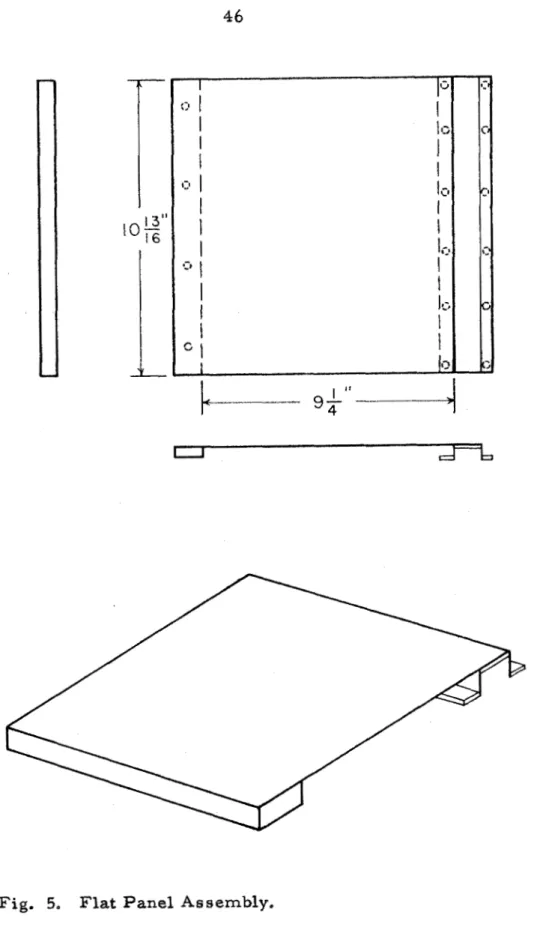
Each of ti?%@ pane18 was soldered iato a &re@-piace assembly including a p a e l ,
a
front xn-nountiamg bask, axid a flamse-
a11
inads:of
half- hard ~ P ~ P S Q W bras$ (figure 5). The flexure was EX-~achinsd f r o ma
solid bar.A
saxface plate waa used trs join the pmeP asser).ib%y as-nd the aerss- d.ynax~~lc frijilria. This V J ~ B done by inverting %he cos-cpponents, placing thein on the plate and k 1 h f w g the razounting tar and the a e x c t ~ e t o the riiodel.Vfbgatloa te3~t$ were carried out to detariziine the Is%~/saer natural fr@q~xeneias of the pa~xelhs. The r e s d t e are given in Table 1, along ~ t h theoretical vahea from !Varbutft~a ( R d . .I 4). Fair a g s e ~ x ~ ~ e a t was f~ugld
between the eqerirnantal and theoretical values for the tkvo-dixzewsicsm3. ,modes. The eeccrnci frequency listed (the three-diirrensioz~aH "rockingtq mode) was higher everimantally than predicted by e&aeory. ThSe rll^say have been due to an initial 'Qd.s.~op'~
in
Lkae panels, tibEcfP w a s a two- dfr~iensies~al deflection wl&a
value of about $).OB
Y g
at k h 8 center of &he pme%s. A deflection of.&ME;
type can stifferil the panel ~ 4 t h respect to8sme bench testing waa
also
done ts deterxzrfns t h e effect of the preseace of a finite cavity under the panel on the natural f r e q ~ e n c i e ~ af the paad. baing a bench &model (mt fie: ac4uaS1 d n d turner 3zodel) it was found that a 1 /2" deep vented chamber on one side of a panel did have an effect anthe
orderof
one sr two cycles par ~dacond.5
runs i n the tunnel Bad aanbagad a flexure &te 2s the starting shock loads on the panel. The stop system C Q M S ~ S ~ ~ ~ bf two eccentric cams and an
electric light system. The stops w@re rotated until contact was I K ~ I S L ~ B with $he flexuareu, closing a n afectsira% circuit and lighting a bulb. Each c a m was then backed of% until 0.004" clearance was obtained. This stop
systei-n worked very well tCrourgkBout tho testing and prevented further damage to
&he
flexures. The electric light system w a s ~ a ~ n e c e e d d u r i n g the realzning of the t e s t s to insure that the stoprs w e r e not hitting the flexures.'4. 2. Pnstrurzzentatis~~a
Pas~el di~placea~ents w e r e raleaeured ~4th three inductance pick- ups equally ;t;paced along the centarkirre of the I-asdel. The pickups w e r e marnPafactua.cd by Electroproducto, Ins. ob Chicago, and t h e carrier
systean was especially developed for panel flutter testing by the r6e
electronics laboratory at GALCIT
.
-4- 1'30 kilocycle carrier was used. The pickups w e r e x~-iountad 0. 1 3 '! froxrz the hotton; surface of the panels and the is,otion of the braes panels in t%xa dield generated ay the! pickup caused a change in signal.N o
mechanical contact with t h e panel w a s necessary.The signals f r o m the pickups i n the ; T I . Q ~ B % w e r e recorded tzsiag
an Ar~zpex model EFR-
I
OOA tape r e c o r d e r . An rBvl systexli was used SOthat both static deflection (due to a pCi69ib16 pressure differential between cavity and free s t r e a m ) and dynamic: deflections could be recorded. Also, a Technical Products harax-mazic analyzer with plotter w a s used to prepare plots of the power spectral density of t h e panel's vibration,
rot
3-nz Ad-Yes phase ix~eter was used to determine the phase shift between %ha three? pickup signale during r"Peo9ter. This teet tar works oaa the a e r s - c r s s ging principle.
Four e l e ~ t ~ ~ ~ , > * r a g i ~ e t ~ w e r e s~iounted in the cavity 01: the Erame. U ~ i n a g these ixnagnets, kt was gss eible to find ths resomnt lrequencies sf the panels during the prelluttar analysis, 1x1 order %a excile the bras@ panels this way, it was necessary to glua S S % ~ P B % strips of 0 . 8 12" eoft iron on %he underside of each paxi~l.
P r e 8 8u$6 taps wehe installed i l 3 the ;sot&o;rx"a sf tihe; c o d t y and on tha forward upper ~tzrface of t h e aerodymn;.i6 frwr1s,
These
tapeallowad the n~csrni&oring 0oE the static pr e @ sur e diff exantial Setaveen rovit y
and free streaz31. T h i ~ presrsure diffarantial i s d e s i g ~ a t e d by the s ~ I T A ~ ~ ~ P B ,
A P in t i ~ e follow5ng discuooisars.
One &hesa~,sesuple was mounted in t h e cavity nottonl and a n o a e r on $he underside of one oi t i h e panels. ]It was isund %ha% the fro-?la and the panel reached the eanae operatirzg te~ngarature, d t l a t h e tertlgerature on ttze ira-na Zagsing by a b u t five iA2inutes becaueje of the larger maos involved,
1. 3 , T e s t Procadurc.
The Je$ PrspuEsion Laboratory' B 12'' super staxti c d n d tuaqef w o a a contfnucauss flow ttaanzsf witk vsriat3le geori~.etry
a r o a t
calibrated for discrete hcach nurnasrs. The t e s t sec&fom$ %q!:.pas9"
high and 12" wide.The t e s t a w e r e run by holding t h e t s n ~ p e s a t u r e on the rrwdeP constant and by r a i s i n g t h e total pressure in inclrewnents.
The
f o l l a d n g gracedure was used:1. A panel of desired t h i c h e s s vvae chosen.
2. The panel a s s e m b l y was bolted to the a a r o c l y s r a ~ ~ i c f r a ~ ~ i e .
3.
The
texr2pe;ratazrs st -~iounting was noted,1. T h e amount of droop a8 the center of the panel p m e maeasurad. (Thia was a good nxesjbezara of panell imper-
fection. )
5. The f l e m r e stops w e r e s e t l t r ~ &flow only 0. 004'' deflection.
I
6.
The skssw~bled a~-mdel w a s gut in the tunnel.3. The natural frequsmci.srj of the pa~l~3i w a r e n;casured [no
flaw).
8. Flow was established and stabilixod a$ "re lowest
P
t desired for the particular sequaDce 0 % runs.9.
The stagnation tefi-iperature was adjusted s o that the nzodeE Oeiuperature was within-
4- h degree F, of &at at which the r~~aadel was assex-xibled.P 0. The root-mean- square voltage of the signal frcarxil each p i c k ~ p was *measured.
kR
13.. ahe resonantlreque~~cieewelpefcisalndusin~khe~~~agmets. 12. Five A*~linutes
of
signals f r o r i ~ the pickups w e r e recorded.13.
The
total pjras sure was raised to the next valao and steps8
Eventually a
Pt
setting was found where the amplitude of vibra- tion startad to incrsase suddenly. D a t a points w e r e then taken at closer fncrers~ento in this region, The e x a c t psE~at of harp rise in response was noted.Alter %he panel? had started $0 fluttcr, Fastax moving pictures
were iZ?&cen. These pictures helped in the identification of the flutter r11sdet.
1.4.
TWO
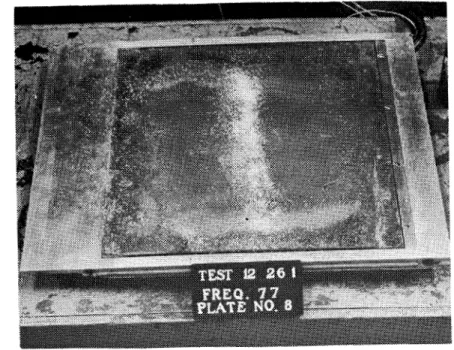
tmsa of flutter were encountered during t h e tests. One wa@ -@;.so- din?ea~;i,og~ikI and the other wasa
three-dirrnensional type sf 12uttar with a nodal line down the center of the panel. The Patter type: was not considered before, beat P$ oecurred a$ a lower value of the parameterA
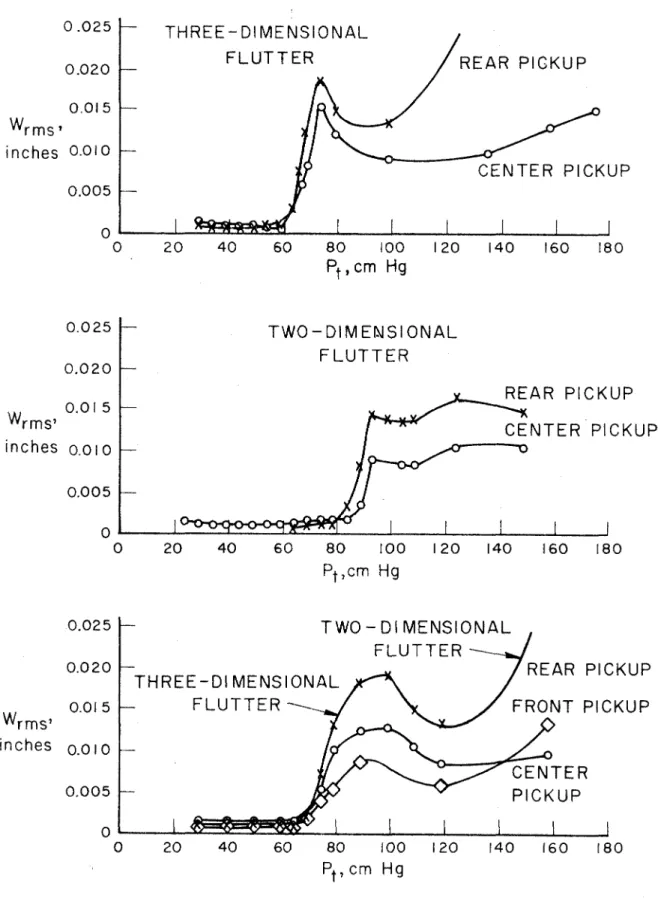
than the two-~rtzensicsnsrl flutter,E v e r y panel which was t a s%ed exhf b i k d Quttc:~. hn~plttudea sf pansf, motion as functions sf: the total presBure of t h e wind tunnel a r e
shorn 6ri. figure 6 for both types of flutter and also Por a case where three [email protected]~al flutter gradually faded into tw-dlz~enzsional ZPuttes,
The t e s t reaults are shot-m in Tabla IL Each flutter point was obtaiiled by increasing
Pt
in the rnanner outlined in fne previous9
The last case given, for Lh'z 0, 0'193" panel, i s not to be t r u s t e d a s highly as tha other cases, A s t a ~ c pressure differential sufiiciant to L ~ J W the panel in about 0.060" existed at the high value
of
Pt
needed to flattar this panel,A T h e txvs-dimensional flutter occurred at values of
---
4 which a
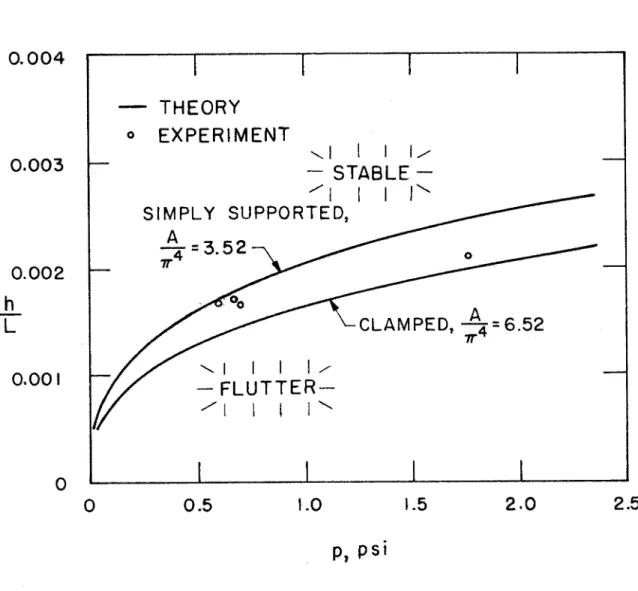
were about 35 per cent lower than those predicted for clarx:.ped two- di~eensional panels by Woubolt, lyigure '? shows the t h i c b e a s ~ a t i o requijr~~6 t o pr avant flutter a s a function o.f d n d tunnel static pressure, It is seen that these f l u t t e r pojilxts l i e between the theoretical curve8 f o ~ clamped and sinAp1.y. supported end cos%ditions. The f i r ee-dlri~ensional
A
nutter occurred at values of i n the neighborhood of 3.0.
3-
Fraquency Eanrveye during, the approach 31: flutter failed to t u r n
up any frequency coalescence3. f o r either kind of flutter. 1s: cvaa p ~ % ~ i h ] i ~
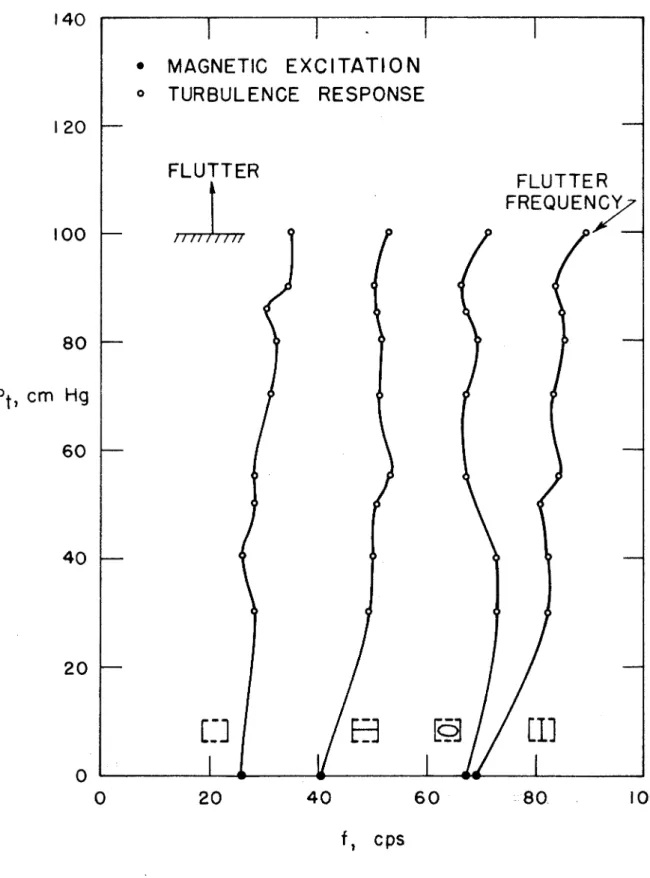
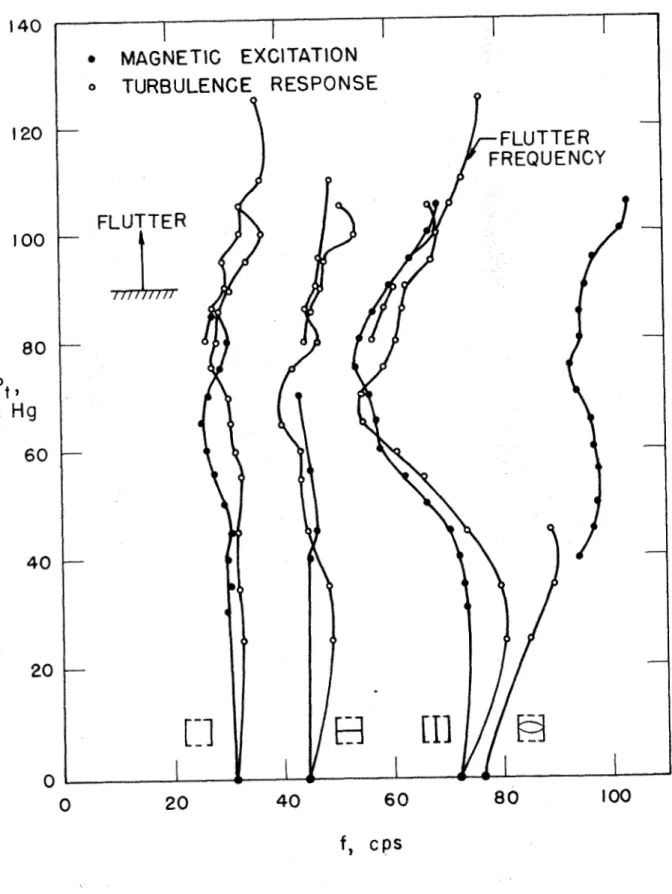
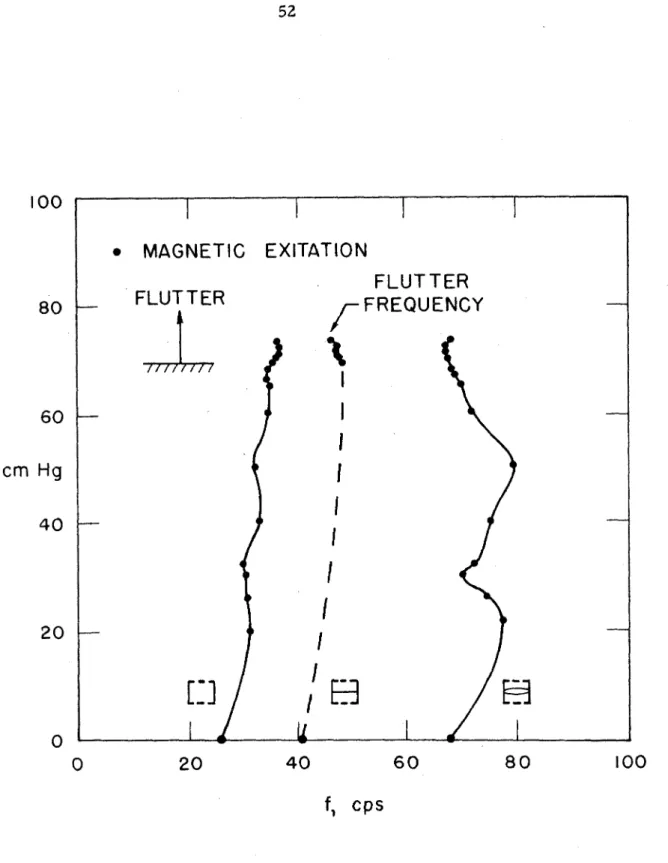
to folloas; the resonant frequencies in the p--ePlut%er region by using the m a g n e t excitation system os by a harfi~eanic analysis of the panells response (sea Pigurea E; through 18). En sansc c a s e s it was possible to fo12ow t h e s e Proqzzencies through the onset of flutter. In each canz, it w a s e a s y to see that the flutter occurred at one of the resonallb$ f r e q e n - eies. The ac:pliitudc of t h e response a$ ithie frequency g r e w rapidly as
B u t t e r started, coa~pjle%ePy dwarfing t h e r e c p n s e at the other Preqtenciea. Some phase angle data w e r e obtained, although not as much as
deeireti (only one pickup carrier s y s t c ~ x v ~ a s available for part of t h e
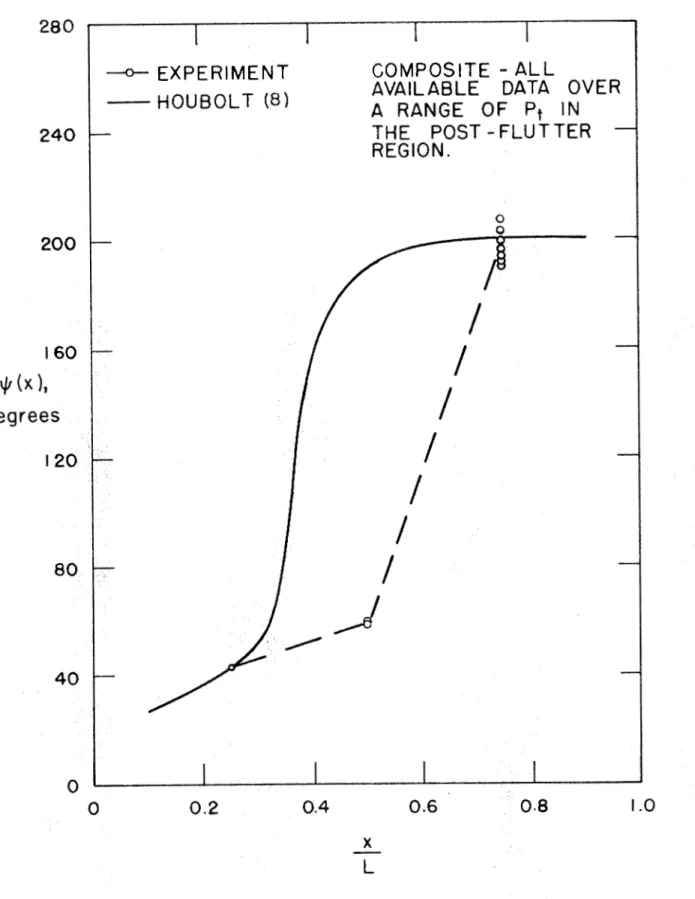
F i g u r e 12 F J ~ Q W S the phase Pag
W k %
for two-di~~ensiornal flutte?r. ,"ti$points a r e for the 0.01 51 " and 0.01 5.3" panels. The thssretical curve
i s taken frts~la work iay Houbolt {Ref. 2 ) . E s ~ e r i ~ q e n t a l l y , $h@ first pick- up (farthest eeps$r@=:) i~ rsrbitrariiiy given
a
phiha@ lag to f i t thetheoreticail curve.
The
largs change in phase lag occurs farther to the rear of the panel Ohan e a ~ e s c t ~ d , bat the tedtali phase fag agrees we11.1% Fastax camera was used in several runs, and w a s actually $be by vdhizh the three-dinaensiom1 flutter w a s first identified.
The
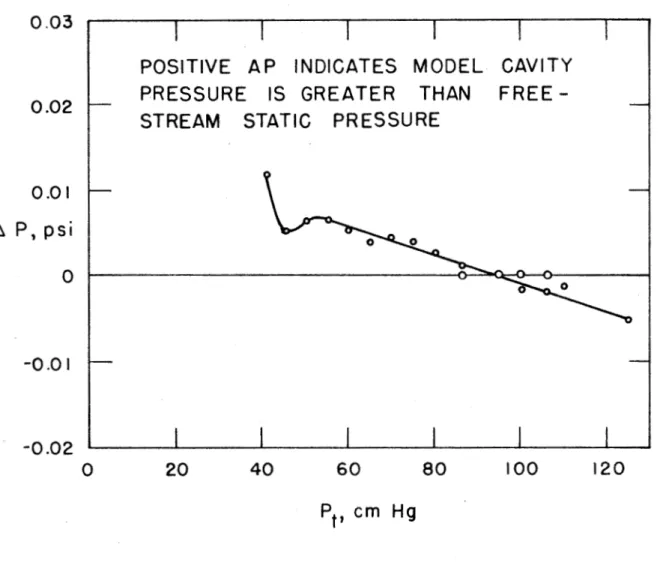
static pressure diElarentiaP between the cavity and the free stream xneasured for each run. There T U ~ S nearly a lineax rebation-ship between this pressure differential and the total prss3snra at d i c b
&a tunnel was run (as@ figure 13). The differential was quite anrall in the
PI
range where ilutte;r was initiated lor the panela of 0.0 1 5"thicknag s. Other panel. ~1ountingz;e produced ~ 0 ~ ~ 3 e w h a t differeat gsre EZ sure
relationships, l3ut general1h.g of the same type as shown i n thia figure.
All runs w e r e nzade with close control on &e nlodel t c a ~ p e r & e a ~ e ira o r d e r to n ~ i ~ x i c ~ f z e ~ r ~ o u n t i n g effects. An d l s w n c a of
-
+
1 degree I?. was made. X c%-nesk on the tempsrature effect prcavsd that the flaxpsre relieved thernxal stress so cffi%et=tively that a 1 5 degree change Pmton;perafurs only chaaged the frequencies b y 2 per cent. This survey
11
The effect of the ktsundary layes on ;the pans1 ha5 always Sean
08:
s o m e concern. In this tasting, the transition f r o i ~ ~ I=l;inar to "cu-buleat :munda~gr. Payer ~ c e t l r r e d on the panel, En order to check this effect, identical runs were made with (a)
no
*wundary layer trip, (5) with a trig sf No. 2 2 0grit,
and ( c ) ~ 5 t h a trip made of ie single strand of 0. 050''wire running a ~ r 0 8 8 the nose of the :-z!sde%, I$. was found that althseagh the No. 220 g r i t snavad %he transition point forward on the psnef, three- dir12ensiaml f l u t t e r occurred at przcisa;Ly the same
P
a s wrBth no t r i p .t
The 0.050" wire trip was then used to give a greater aiiszouat caf disturb- ance and did cause a v e r y thiclr, tur bufent boundary Layer to '3e initiated
inArncdiately beknirld the wise. This did have an effect on the panel, delaying f l u a c r until the tw-diniensional t y p e o c c u r r e d at a Bizher
Ptw 1 , 5.
-
Theoretical Prediction sf Three-Dixxx@nslonaB, FlutterTheoretical flutter botandarir?~ for the thsee-dl;me~siomL case will be calculated using L a g r a n g e t s equatiosts and linear super ssnf c s r r o d p a ~ i i c theory. Ackerat quasi- statis: aeradpanxlc theory will also b e used for cor:;-:.parisow.
-3.n atter~ript wan r L a d a to solve the pr~tallen~ v h t h clamped edge
ont ti lit ions inpZ; tihe aerod>inan;ic farces uecazie: v e r y fnvoPved a l ~ e b r a f -
cafPy. He:lce i t -wda decided to u s e sir:rp%y- supportad edge con&%ions, and to concentrate attentlor+ on the cliff erenres ~ e t w e e n twa-dfl~:ensianal and three-dlx-ensioilzal flluttor for tbs sh~-~-pEy- supported c a s e as sho't-m schcniatically ina lirare 114, The vertical displacement w(x, z , t) is p08lkive in the u p m ~ d direction,
12
I s
=
---
2 " Far an a , p r ~ ~ ~ i z - & a t e salution, the dcfltgceiom v&l% 'we taken 6 8
where
nv x
+,(x) = sin o r x
r 4,
and
Thsac f u n c t f o n ~ do no$ satisfy $ha plate $re@-edge Imcstandha~~.y conditions at z C and z
12,
but they do s a t i s f y the sinig%y+aupported ~ d g e conditions at x=
O
and x=
*
The kinetic ens,er gy of the plate is
"4
1 3
The generalized forces a r e
U
sing Lagranget s equationsd aL
- - - - J L =
Q,
d t a h , aa,
where
L
T - V ,
we obtaizx
14
W e wfPb k'irst solve the s e t of aquzztions 3 using Ackeret quasi- static .kl%asry fa$ the aerodynar:.sic: pressear@, iust Oa get a feeling for t h e problem. The pressure i s
This will give no area-dimensional aerodynaaa-ic efiecte; however, a s sfhoxm $02 tv~o~dix~x8hensioi2aB flutter, A c k ~ r e t @X&QT y can give good
reeualts at the rehtively ;Bow $requencies and high .Mach nurnbats w e are csnrjide~.fng.
%ha
s e t of equations 5 becorasT
0 when m+n = even]-el
2or the panels which w e r e tested,
(---I
=
0.0555 and ?I=
0, 3.I,
f j
coefficierSs of an n-ust vanish. T h i s leads to a n eigenvaluz problem sf the for~'dl
Det
( P -AI)
= 0where: P is a r e a l matrix.
Experience with the case s f two-dirnensiond flutter of flat panels Emaa shown that a iitur-mode solution yields an eigenvaleae only 1 per cent different f r o m the exact value. Hence, a four-mode ~ o l u t i o n
(N
=
4) was carried out for e h i ~ case. The 3urrougho 220 digital c o ~ ~ p u t e r was used.It; was f ~ u n d that for lov~ values of tho dynamic p r e s s u r e para- rsieter w the eigenvalrte s
\
a r e real. s . is raised, a critical3' 3
value i s obtained where a pair of conjugate eorrxplax eigenvalues appear, indicatillg flutter. Three-din-11eszsiorraP flutter occur 8 at
T h i s cornpas e s with the two-dinzensional ilutter boundary (obtained
using Ackeret; theory) at w
=
4.2. 9. The use of Ackeret theory hence 3provides no insight a s to why the eqerix~xemtak three-dimensional flutter occurred at a lower value of w - than the tesro-din~ensional flutter.
3.
Let us n o w devote sear attention to a solution of the llutter equa- tions [i using linearized suporsonic aasodyna~~~ics. Any realistic study
of this flutter should include a three -dir~kezm~isnaP aberodynzalrlic theory because the panel's aspect ratio is so srnaPS that r-~ioet of the panel lieu in the tip & ~ a c h cones. The basic ideas for potential supersonic flow over an oscillating thin wing w e r e set down by GarricEc and Rubinow
16
of finite -?an and infinite chord osciPParix7g ir: a periodic :panwi5e di place-man&. W e will u s e the work of Luke and St. John and hence incur all of the assun~sptions sf linearized potential flow theory, 1. e. that the fluid is inviscid and irrowtional, and that disturbances at the panel are v e r y s1xa.11.
The upper and lower w a l s of the test sectioal evere sufficiently f a - E r s ~ n the model that om ? * e f l e c t e d waves hit it. EIowever, the side waP$a d o affect the panel. T:e wi31 assume that they prevent C P O S ~ flow at the edges of the panel. If, for the solution of the velocity potential, the partell is a s ~ w n l e d to be extended outside the tunnel as
~hrsvm in f i g u r e I 5 , the s y~-irnats?p is such ?hat thf ~3 wall condition i s sati.;fied (as in the *method sf i9s:agar; for subsonic flow). This leads naturally to the u s e of a su~erpasiticpn of solutisrao for sinusaidal g(e) as developed by Luke and 5%. John.
Let us define one period sf g$z) as
W e then have the Fourier cosine series
Because of the c ~ n i p l a ~ t y 0% the aerodynamic forces and beeauee of
the very rapid c ~ n v e r g e n c e of this series, only twa term~-a~e are retained, The two Berm representation of g ( z ) is shorn in figure 1 6 , and it
4
?,m n 'P_ p(x,r,t)sinm c o s ~ + L C O S dxda ~ ( 6 ) f ~ ~ 4 + + 4 ~ ~ - ~ ( ~ ~ ; ) ] - e s h r i 2 ~ } . m = - ~ / / o o 1 2 ]
5va Luke and S t . Johnq s work shows that for g(z)
=
cos the praesrare on the surface 1s of the P O ~ ~ P T L-
j5 (*,t,t) =
pfi
(x) C O S--
eiu)tL
1
3 urtherrriore, !x?.cause the problem i s linear, fiar ggz) a
- 7
f13%
The: a q s e s s i o n
/
p,(x. t i oinT
dx can be found in reference 9. 1% is a little difficult 80 earact from t h i ~ work, ooing involvad in aCalerkin pracess and because of the US@ of non-din-:ensfona1 coordinates.
However, one can arrive
- -
at t h e result that, for a displiracenten%ta1W X
w b , z , t )
=
axJt) sin-
C81- A a z1
gisl
42
where
where
.%gain we have a s y s t e w ~ of hoalogeneoias linear algebraic equa- tions which can b e cast into an eigenvalaze problem with eigenvalue
rh
.
The p r o b l e r i ~ is of the %orrnDet
( P - A I ) = 0,
$1 whare ekae cosaiplsx matrix
P
is a functioai ofAt,
k, .jar-
3'
-e2
and2 1 .
A
dour-rnode solution was carried out on the IBWi. 7090 digitalcon-&puter for
a?$
=
2.81In order to find neutrally stable solutions, i. e . where
d
(and hence ) is real, the following -pr~)cedure is rased. Values of kand w i are aseuilied and the aigenvaluea
1
a r e calculated. In geweral, theh
a r e ( C C B ~ T A ~ ~ @ X , 6 0 w is raised until a realh
is3
found. This yields a point on the flutter boundary kvhich has values of k. w 3 , and associated with it. The r e s u l t s a r e !:hov,rn i n f i g u r e
17, Ht i s interesting that for k 4 0. 3 there is; little variation i n
A
20
For panels of the t y p e used in the vdnd tunnel test^, we have
6
z
=
C5.0x20 psiIb
.
sec 2es
=
o.
sss.i97ain 4
T
=
2110"R
Ik.
The values of (--) and p at flutter ior this special c a o e can bc found
4 1
I
*>y using the definitions oi
h
and w3. \ i / e haveh
Values of [---) and p are calculated for each point st-1 the f l u t t e r
49
bo~tlddtry with the r e s u l t s shown in figure 18. Even
at
sea level pressures, flutter occurs at k 4 0. 32.The
t e s t panel which eAi5ited &%lree-din;es?sioaaH flutter in the hwind tunnel had a value of
(-q)
=
0.001 63.A
simply- supportedpanel csE this ~ i e h e s s ratio would flutter at k
=
0. 10 and w 3=
54.65. .We can now cornpar e our r esralts:a) %wo-dirl;s.lansiod Acleeret theory b) Three-dik~lg3nsfonA Ackeset theory
c) Three-dfnzaensionzal Pinear supsrsomic theory w-
=
54. 65 321
T:%en case a) i a also worked out using Lagrangets equations f ~ l u t iplazluded
in
this work), 412 is fourz& that t h d . ~ % I c d i f f ~ r e n c ~ between a) orad b) is the t~stisrrg energy iravolved in the three-&rA-ieasional flutter. T h i ~ i s seela to raise the flutter owf~ndary. The dir"ls;rearcc Setwacn 3 )and 6 ) lies only in the aerodynailiicu. Linear supersonic theory
lower s the thr~e-dii~censiona1 ifaxtte-6. aolkmdary only s l g k l t l y P Y , o I ~ ~ ~ . ~ F ~ Z
wigh Acker et theory.
'I-a, e have not e q l a i n e d t h e occurrenca sf thraa-dir .eneioma% Iltmtha art a lower d - y n a a ~ ~ i c pressure than two-dir,,eneioual fBu%"c&r. T h i s happened for only one of the three panels toatad. Ht i& poesfble that
sonic imperf e e t i ~ n $.a Bhi s p a ~ ~ e l
a;-;
$@::-. sly, couple& \with U ~ C ~ O V J ? , @ c a v i t yand .e~aPl effects, m-ade this panel n;orPe susceptible to rocking Iluttsr, 1. 6. GsncPusions and Discussicen sf Resulk.;
e-- a
i ne Lhickx;es 6 z a t b required to ?.reven$ two-dir tcnc;io-,all blutter
of flat, u ~ a s t r e a s e d pamelis a$ Xscb ~rdrmz~-her 2 . 2 1 vms found. ajr e~zperiai-*sat to bc 1 5 p a r cant higher than the prcdictiaan of ?-Jouboltgs thcosy. The
phage ]lag 0%
~~~
panels during t~ipe9-dill~eurl.iiionah fkutte:~ asreed Pairly well v&%h $h%s t b o r y . E o coaleuc@nca of Irequencies u ~ a s sk2seuved, l:ov.iegser,~ree-dixxiew~ionak type 5:Of flutter occurred u s one of the
panels. Thc a ~ e s r y svhich was developed for this type of f l u t t e r indicates tI1a.t i t car- agpsar only at d y n a ~ . ~ i c press'c~re3 23: per cent I ~ i ~ h e r than that needed to precipitate tqiio--aicAensiomaP f l u e t ~ r .
2 2
at %he. edges of the ganef. Th3 ckax~*~piny support EI% the ends was .i.eBa- tivary rf gid, howover, as ahstm by the n g r e c n ~ e n t uetwesn $he
4wo-dr~aerasiozxaI xzatut-al frequencies and the thaoroticaf results of ilJarburtcan ( R e f , 14).
The
initial curvature ~-ziigAt have had am eflect similar to the 1niQfal curvat.ase which is studied in section 2 and is sh~gm'~ to u e destabilizing. 6 ise afgect of a salaU atatis: presstare diiferesleid w a s r;tudied .;sy Eoek and E L ng flXef. 5) for %he case oaf a % w ~ - d % ~ - r : e n ~ i a a a 8 pale1 wit31a
di$i@~ei,'st type oh illemre than that used laere. %bey found that s n l a l ~ proesura dilfereneitals laad little sffact on the f1uteer boundaries. The faiemra @upport [email protected] tfGSae .x.aAnu?Sranca t s a s s wkich would ordinarily have been induced 22y the loading.
Because %he psasBu-sPa differential was a m a U during the ccrrrent teats, th9r effect %was prsbably sr'~^sal, also. The flow conditioxa
at
t h edge of the panel pr e ~ e n t an u&iown 'Lactor kin the e ~ ~ @ r i r z ; a n t s . The inter-
action 3etwean kmu~ldary Payer, r~zsdel. cavity and ~ ~ l o v i i n g panel edse is difficult to analyze. It is posaible that these edge conditions wereresponeible for t h e appearasace of the three-dinnIea2t;ional flutter at a
d6UTe.
low d p a i x ~ l c pree
2.
-
Slightly Curved Panelis;T h s second series
of
wind tunnel. tests dealt witla the flutter of iaaltialry curved panelo. The panels were unstressed, v e r y shaPlow, and of aspect ratio one.The purpose sf the tat;ts was t o find the effect of c ~ r v a t u a ' e OD
Soaxe irateresting a e o r e l i c d results have heen given far slightly curved panells by Y a k s and Xeijdell {Ref. 1 3). Using llineaa- skaallsw
she91 theory and quasi- steady aerodyna~l-iics, they find that certain values of cuxtva%ur e are very destabilizing. A typical flutter boundary is s h o w in figure 23. Lt was not pafssible to obtain c q e r i n ~ ~ s a t s l data in the sarxe farim as presented in this figure, s o coi-apariacsn d t h this theory 15 di$ficu%t,
E , 1. Description of %.~odef
x~rode1 (figures 19, 21, and 1 2 ) was afrx-iast ideH;iQicaP to the snh; used ior flat panels. Again, the design was such that no reflected
shock waves would hit the pailel or ~ ~ a o d c l . -1
k our panel cur vat use^; were tested.
Lz' we. define
i v as the0
deflection at tZxe center of the panel ;jll~d E as the length s f thc panel, W
0
the four curvatures w e r e T;
=
O (noii.:inally flat), 0. 00'1, 0 . 0 1 3 . andw . .
0.020.
It
was felt that<
=
0.007 was t h e smallest nonzero curvature that could be rx~a~nufactzlred with precisian. E a c h of the paaneks had aD unsupported 1engtl-n of9'"
an nneupport;cd width of 9" a32 a thickzlass oi appraxi~liatel;r 9. 008".Jec,a-cae~ %kc pavsels weye to A e f i r m l y attached to a su-pportiag
fra~x-e, all nnaterlals had to be identical to prevent t r o ~ k b l a ~ d t h t h e s ~ m a l eqansion.
h
was decided to use spring cartridge brass fur t h e panels; therefore h a l f - h r d cartridge brass was used for the rest of t?ae s i s d e l .The square frames used to s q p o r t the panels (tigure 20) w e r e !>uilE; up froarl 5ar stock. They w e r e ri-~achined into the proper radii sf curvature by
a
corrtotcls =iLliaag process. %n addition, 5301id. ;alock.e?: of2
.",
The panels w(are attached to the fram@a by an oven soldering pmce ss. Tbay w e r e pretinned araumrl t h e edges by electroplating
asfdar onto the surface. Zhen they were placed in the hxiabc i,~ebds
and bald to t h e curvature by a azzlafl quantity sf steel shot. A coating 06 solder 0. 005" thick was built
up
on the frazi~8s by ixeati~lg therid inaa
ovaa and f"bodng the solder on&o the hot ~ u ~ l a c e . -4d%es cooling, the $rr%rzses w e r e placed over the! panels ;a,rd t3-m a s s e m b l y l3aked in an oven far several hours at r 5 0 O 3.A
good joint was obtained.The c a v i t y under thc pane% was r_iLade ai; tight f3;. the t e s t s :xz~z+eiy I J ~ seal in^., .ar+~an-i,' t h e edge:; i l E t h panel with wixso tunna4. wax. Tbz pyer s u r L. diPfers~-itiai & P was csal~%rolled < l u r i n g 6hc. t e s t s with the u: c o i a vacr-iuri: P I J A J . ~ .
F-
k%ae n a t u r a l iraq'lenzcrec; od tha four p a r : d c w e r e :O~died urn the
beach, En order to check the effect of the s,lodel cavity, the panel asaeniblies $?rere tested while inetalled h a the rLrodel and alr,rs out kxl
open air. The xirodel cavity was not made air tight for chi: te:;t.ing. lt was found tinat the cavity bad no significant effect orr any o i the mttaral freguanciac except those oi the sln~plr;et i.raode for tach panel (the ..i:~d& wlt.!i ~ ~ d a P lines around the a d g e s of the panel anly]. This freqcency c3ulid not oe Esund when the panel n r saxx'sly v a s installed in
v- 3
$he -~-~-rodeli. I ~ a e rssufts of trse -vi!.n-a&ion essts a r e presimtee? irk T'a2~le
UI,
T h e freqt~eracies listed w e r e taken vdth the parL& asac?,rr bky r e n t i n g in the model cavity, except those given Sox t h e bilrh-,gle!jt ~ i i % d c of eachm*
panel. I n e s e were take:? v~itll the panel.af,se~:aly out in open air.
X%
$ 8 @$own that cavity under the parpol can greatly i n ~ ~ * e a ~ ~ t h e sirdiplestfrequency. The higher x-~iode%;
are
not aflectad as xnueh.3[lt f e desirable to h a w same tl%aoreticoP frequencies to cgaxxlpare
d~
the awerf~;32snta%. values given in TablaIU.
Thase caa be cePcu1ated deroim the V++QS& in ~ e c t i o n 2 . 5. ToMeXV
PSt~3%0 the frequ~neies Par the ca~rved panels under t h e %s@u~~~ptiosm sf fa-eely-supported edges m dm
cavity ebf act. Because af t h ~ freely-supported edge conditions, tilase aticaP f requenacies aze all sa9:ewhat 1~weg: than tha eqeri~r~&ntaP v a l u e s.
The vibration t e s t s far the curved panels ware done before
~S'PB
f~xB1 ~lgnIfi:je~an~esf
% h ~ c a ~ t y effect was kno%m. The panel?; w s r e disoe s e ~ ~ r ~ b l e d begore a full e,qarixxhea%ak study of &he ES~SE?C% of a sealed c a d t y could r)e carried out.The inr;$ruri~smta~on was identical t s that used f o r the flat panel test@, Dseause the pickups were Iscated slightly c l s e e r ta each other &an in the f l a t panel rr~odel, a slight "beat" due bs interference was noticed in the pickup signal. This noise was only several 1 2 i t l U ~ 0 % t ~
B"EIB and was eunainated S y the xma of GEXB;%~P bra81 ~hie1ds 8r0t9ad the
pickups Qsse figure 2 2 % .
2. 3.
Te&
ProcadureThe teeat procedure wa8 sixxiilar 80 t h 8 for flat panels; however, there were n s stops to adjust sr droop to rcieaacrre in .&%is case. The
26 2, 4. Eqerin13entaT. X e s d t s
Each of the four panels fluttered. The flutter points are? given i n Table V, Curves of the panel response at the center pichE1Bp are given $81 figures 24 and 25. In general, the panels were ahszcsstr r~:stionPess wp
lo the f l u ~ e r bozu~dary, where large amplibdo Butter occu~red, This w a s X X O ~ true for &ha on8 flat panel tested, hawever. The designation of
a
flutter 5sean2kry was ssrflewi,~a$ar
MLrary for this panel.h
waBdecided to define flutter a s rk>otion for which the def%ec$i@rn at the ceuter
of
the panel had an pans value equal ts the t h i c h e s s 0% t h e pBatc.The flutter fur t h e s e curved panels was rrauch xrxore viballerlt than. t h e flutter of the flat p a n ~ l s . Also, evhen panels 3 and 8': w e r e iriternaEBy
presmriaed $0
&P
=
0. 650 psi, the statkc airloads b e c a ~ i . e sufficientlyhigh before flutter a ~ c u r r e d to cause
a
static dcacctisn. The front surface si t h e panel woe pashed fn and to tfna rear, while the! back part of the parsel was d r a w ~ u t x v a r d tav,'iprd the sir stream.A s It was lowered, it was noticed that there wae a tendency Ias %he fl~l%;%er to persist at slightly lower values of
P
t t1m.n at psA-fck it had started.No
data -were taken? on this phensn~enor*.A11
r e suiats given here w e r e taken a s P was being raised.t
The flutter boundaries are shown in figures 2 6 and 2.2. The
initial curvature is destabilizing. Even a slight a~z~srzat sf initial
curvature has a significant effect. There appears to be little difference
W w
caused by tile increase in curvature from
2
=
0.31 3 to7-0
=
0 - 520.L
TFds Is particularly svidenf; i n figure 2 5 . The internal prassaricatisn is stabilizing and appeazs t o %-eve a sirriilar efi'ect on each ol the panels
8acause of the l a r g e nurnbar .of closely spaced frequencies, it was found almost in~possibfe to follow the reaonaant frequenrciee sf the curvsd panels. The rx~agaeri;ic excitation system did not wark well and
the brnriodc: analysis af turbulence rssponse was difiicult t~ss interprest. These two r n e a o d s carp-~pler;.:em%: each other and bath are needed 8;s
gather aszy ~igsziffcaa frequency data. None will ;3a ~ e s e n t e d .
P h a ~ e angla data w e r e obtained for panells 1, 3 , and 4. F i g u r e 2 8 akows the phase Bag
41
(x) far thase, panels just after the initiation of flutter, The panels ~ 4 t h greater curvatu~t; have a greater arnount sf phaoe lag. Figures 29 through 39 give the ramairnder of t h e phase b g 6a&a whiclri w a s taken at higher values au"P
than at the fluttere
boundary. H e r e it is seen that raising Pt (and hence raising tl%e nioeter frequency) lowers the amlorunt of p h a s ~ l a g for panela 3 and 4.
w
D u r i n g the run of panel 2
(9
L
=
0 . 0 0 7 ) . one of the pickup lines was cut and aX% pkaea angla dab were Bast for that panel.'I'he u s e sf spring brass for the panel rilateapial was forfunatas. T h e panels w e r e desle9lely fluttered far hours without any azsticeable dax-1-&age.
3 . 5. Theoretical Efisct of the Cavity
A sin-i~plc calculatian can be c a r r i e d out t o detarrnlne the eflect of the closed cavity on the natural drequerrcies sf the curved panels. Consider the case where: the edges of the painel
are
"freely-suppor&ed". The cylindrical eoor&natc; system. is shsvax in ligrare 3 2 , The angular variable is 6 and the circular patlei covers an arc 0% angle0.
2C
the c a d t y is in equibibriuxr~ at &"a tfcirs.ies. Tha cavity voPu-sr~a and pressure when the panel i e undonected will be called V and pa,
0
s a s p e ~ t t v e l y . .After ~ H I B panel b o deflected Eo a pcagitfon w(x, 8, t ) ,
these quantities uill be denoted by
5
9 &Yo andp
+
@ ( s e e0
figure 33). k cg us a s s u m e that $.he Q21arr::zcrdps11-ii~ process ~~1"sfch takes place in the air is adiabatic and raversfole.
The
preaseares for %he un- deflected an& t h o deflacted panel are t h c ~ related byFor irrsfiniteak~id vibrations,
A'.'
I
I aThe right baad side of equation 8 0 clan be expax::;ded to give
2 9
Retaining only the linear t e r m in sciusfion 1 5 , we have
The equation of ~.a-,otiesa which will be used I o r t h e shell is the?
insdibsled Dsmel3a sqx~ation, wIxfc,Iz i a particularly useful for this t y p e of loading. (See reference I S for
a
discussion of &his equation.1
The deflection pattern sf this s ~ a s l l segr~ient corrretjponde 8 0 thataE
a cylinder with rilalxy ezir~~xr~farenti;af ~5-aves. T ~ B F B % O T B , the use ofa
Donx~elbl tyrge of eq~xatfon is justffiod.4
The syiilbol V-a i s defined hy
v - ~
V
f ( x . 8.1)=
I(x. 8 . t). The boundary conditions srr wfx, 9, ti) areTki3 deflection sat% d i e s the Psrmdary conditioaa. @ ei$i-~er En or a
is even, the pressure
st&)
=
O
and there is no cavity affect. In $his case, w(x, 8 , t) aatiafices equation 1 3 and is 8.n eigedtanctior, of theproble;n. Mowever, when n~ and n are both odd, there is a cavity effect.
If
a geaelral dEspbce~2a;ertof
t h e form-
,id+ mnx'
w ( x , ~ , * )
-
sin-
nn 8G
C
a,, sin-
9
is
asaurt-~ed, an approxir;~ake solution for the? natural b r e q ~ ~ e n c i e s can be obtained by using Galeskin's mefiod. T h e foBlsdng s e t sb equations ra;su1ta:I i C m, n, and p ace all even
31
E'or
a
shallow shell, we ziay a s s u r ~ i e thatR$
=
jl. Equation15 &an reduce^ to
The condition adstemce of a nontrivial d i s p l a c e ~ ~ ~ e n t i a &at the determimnt of' the s30efficke~ts must a r a ~ d ~ h ;
A t ~ g ~ * n * r ~ d @ solution was carried sat using the =ode@ 1x1
=
1 ,n
=
1, and rn=
1, m=
3, The: foUs\-dng avorage value$, corresponding ts t h e t e s t pasels, were used:atmosphere. MU1cf the wind tun?el t e s t s w e r e run
at
po<
1 / 2 0~%nloslpksa~e. 1% 68 appibr~nB:
that
f i e a=lias@d cavity greatly fncreasao $he freqency of 8lu"l~pfeat z130do, B B P ~ C I B ~ % ~ ~ C B P panels 'is"~it"sn ~ a ~ - i d %c.corvaS:ute. The effect on tihe ai~P;qe ior t l i
=
1 ,=
3 is ~ x ~ u e b~ ~ a 8 1 e r .
The mode ci:
=
3 , 1%=
1 and Mgkez: rnsdea could beinvestigated
for
cavity effect; howevar, I t can be seen %FB)ZZ the s e t ofequations 15 &at the cavity terxx bacon~2es omalllele colnrpared to the bending and stretching terrae far these nisdes.
X t can be esncBudsd that the s i ~ a p l a ~ t r~;ode i e greatly dfactad by &he c a ~ $ y , ht@xer odd ~ i o d s a are &acted only sligbay and higher even a-xu;odes are not dfectad at all.
The
impartant pars.>~ieter s for the cavity efie3ct ars ths cavity static prensure and volurna. The forcePo
which results
iron;
the presence of the cavity variesa s
.
Xf it is0
desired to raduce the cavity 6;rg@ct, then it is necas@arg7 $0 u s e a
large
f l . 5
volume
3~11der the t e o e panel. ~ B P @ E ~ ~ J U I @ p O B I U E ? ~ ~ ~ 1 2 1 ~ 8 % be adjusted0
to ckosoly A~latch the free B ~ X B ~ X P I static p r g ? ~ ~ u r e
OP
aE2e 1xint-a tmnea {to avoid a large otartfc P S ~ B B sure differential acrasa t h e p w e l ) and so 3 tcan
not ba reduced for %he p u r p ~ ~ e af rninin~iaing &he cavity effect.2% flutter celclalatfons bvcre carried aut using L%e ci:xipk cavity tl~eorgt developad here, It Z Y E % ~ ~ I ~ bs e q s c t e d , however, tihat %.he
presence
sf
closed cavity vgoufd tend to etaabilfzbe a panel. This is Secaurse the pressuze Boading acts asa
restoring spring force.3 3
n~-i*Abes range of 5 . 76 to 2,8'9. Three cavity depths wars; tried for a series of fiat panels which w e r e a~psro&~-iaak@ly 2Qtp wide and 33"
lsnz.
A 1 /Z'l deep cavity was 9 0 w d to give acritical
fBu1ta;er d y a a i i i cpressure 40 per cent lower than that obtained w i t h a 1 I k 2 " daep cavity.
O n
the o ~ ~ e r 'mad, when tha cavity depth was 2erSucad to %ore% ( d t i ~ the panel touching the cavity bottorri), ns flutter was found,The theory diseuaged above does not @-lain the decrease in critical dyszr%l-ie preseure found by Tuovilga and Presnell a s their cavity dsplra decreased isom k 1/22" $0 f /2". H ~ w e v a r ,
$he
asg310nlpt%~n atthe air in, &he cavity 5s in eqasi13_oriuA is not valid i f t l e ~l%attcbe~r. eiee is ]Large enough for ~ 6 8 0 n a i ~ a ~ e phenox~~em to occur.
2,6, C o n c I ~ ~ l o g l s f01
G U P V B ~
PanelsThe curved pansBe a h i b i t a d Barge a1ng1fituds flutter, tha onip8S- N d e of which was of the order of the arch rise wo/L. S e w ~ r a l of the p;awePs deflected visibly under the static airloads before flutter occur red,
1% was found that omall snic3uata