Machine Learning Techniques for High Dimensional Data
Thesis submitted in accordance with the requirements of the University of Liverpool for the degree of Doctor in Philosophy
by Yuan Chi
Abstract
This thesis presents data processing techniques for three different but related
applica-tion areas: embedding learning for classificaapplica-tion, fusion of low bit depth images and 3D
reconstruction from 2D images.
For embedding learning for classification, a novel manifold embedding method is
proposed for the automated processing of large, varied data sets. The method is based
on binary classification, where the embeddings are constructed so as to determine one
or more unique features for each class individually from a given dataset. The proposed
method is applied to examples of multiclass classification that are relevant for large scale
data processing for surveillance (e.g. face recognition), where the aim is to augment
decision making by reducing extremely large sets of data to a manageable level before
displaying the selected subset of data to a human operator. In addition, an indicator for
a weighted pairwise constraint is proposed to balance the contributions from different
classes to the final optimisation, in order to better control the relative positions between
the important data samples from either the same class (intraclass) or different classes
(interclass). The effectiveness of the proposed method is evaluated through comparison
with seven existing techniques for embedding learning, using four established databases
of faces, consisting of various poses, lighting conditions and facial expressions, as well as
two standard text datasets. The proposed method performs better than these existing
techniques, especially for cases with small sets of training data samples.
For fusion of low bit depth images, using low bit depth images instead of full images
offers a number of advantages for aerial imaging with UAVs, where there is a limited
transmission rate/bandwidth. For example, reducing the need for data transmission,
re-moving superfluous details, and reducing computational loading of on-board platforms
(especially for small or micro-scale UAVs). The main drawback of using low bit depth
imagery is discarding image details of the scene. Fortunately, this can be reconstructed
by fusing a sequence of related low bit depth images, which have been properly aligned.
To reduce computational complexity and obtain a less distorted result, a similarity
transformation is used to approximate the geometric alignment between two images of
the same scene. The transformation is estimated using a phase correlation technique.
It is shown that that the phase correlation method is capable of registering low bit
For 3D reconstruction from 2D images, a method is proposed to deal with the
dense reconstruction after a sparse reconstruction (i.e. a sparse 3D point cloud) has
been created employing the structure from motion technique. Instead of generating a
dense 3D point cloud, this proposed method forms a triangle by three points in the
sparse point cloud, and then maps the corresponding components in the 2D images back
to the point cloud. Compared to the existing methods that use a similar approach, this
method reduces the computational cost. Instated of utilising every triangle in the 3D
space to do the mapping from 2D to 3D, it uses a large triangle to replace a number
of small triangles for flat and almost flat areas. Compared to the reconstruction result
obtained by existing techniques that aim to generate a dense point cloud, the proposed
Contents
Abstract i
Contents iv
List of Figures ix
Acknowledgement x
1 Introduction 1
1.1 Research Topics . . . 1
1.1.1 Embedding Learning for Classification . . . 1
1.1.2 Image Registration & Its Application in 3D Reconstruction . . . 4
1.2 Novel Contributions . . . 7
1.2.1 Publications . . . 9
1.3 Structure of Thesis . . . 9
2 Embedding Learning for Classification 11 2.1 Background . . . 11
2.1.1 Definitions . . . 15
2.2 Unsupervised Learning Techniques . . . 16
2.3 Supervised Learning Techniques . . . 26
2.4 Semi-Supervised Learning Techniques . . . 39
2.5 Learning Techniques for Multi-Label Classification . . . 43
2.6 Techniques for Nonlinear Extension . . . 44
3 Image Registration & Its Application in 3D Reconstruction 47 3.1 Background . . . 47
3.2 Transformation Model . . . 49
3.2.1 Pinhole Camera Model . . . 49
3.2.2 Perspective Projection . . . 52
3.3 Area Based Techniques . . . 57
3.3.1 Sub-pixel Precision . . . 64
3.4.1 Detecting Features . . . 66
3.4.2 Matching Features . . . 75
3.4.3 Estimating the Transformation Model . . . 80
3.5 Area Based vs Feature Based . . . 83
3.6 Image Resampling Techniques . . . 84
3.7 Image Registration in 3D Reconstruction . . . 86
3.7.1 Structure from Motion . . . 87
4 Binary Data Embedding Framework 94 4.1 Motivation . . . 94
4.2 Mathematical Formulation . . . 96
4.3 Framework Evaluation . . . 102
4.3.1 Datasets . . . 102
4.3.2 Experimental Design . . . 105
4.3.3 Benchmark Evaluation . . . 110
4.4 Summary . . . 118
5 Image Reconstruction by Fusing Low Bit Depth Imagery 120 5.1 Motivation . . . 120
5.2 Image Reconstruction Process . . . 121
5.3 Experimental Evaluation . . . 124
5.3.1 Reconstruction Quality Assessment . . . 125
5.3.2 Further Reconstruction Quality Assessment . . . 129
6 3D Scene Reconstruction from 2D images 144 6.1 Motivation . . . 144
6.2 3D Reconstruction Process . . . 145
6.3 Experimental Evaluation . . . 149
7 Conclusions & Future Work 168 7.1 Summary . . . 168
7.2 Future Work . . . 169
A Feature Based Weight Matrix 170 A.1 LLE Style Weight . . . 172
B Data Pre-Processing Techniques 174 B.1 Simple Normalisation . . . 174
B.2 Dimensionality Reduction . . . 175
List of Figures
1.1 An example of embedding learning (taken from [13] but redrawn here):
representing a set of 3D data samples in a 2D feature space, while
pre-serving the local neighbour structure of each data sample in the original
3D feature space. . . 3
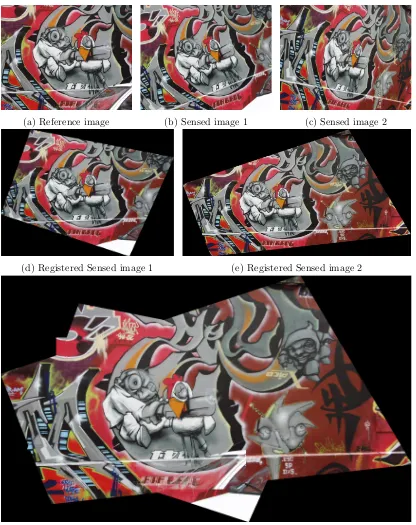
1.2 An example of image registration for the application area in image
mo-saicing . . . 5
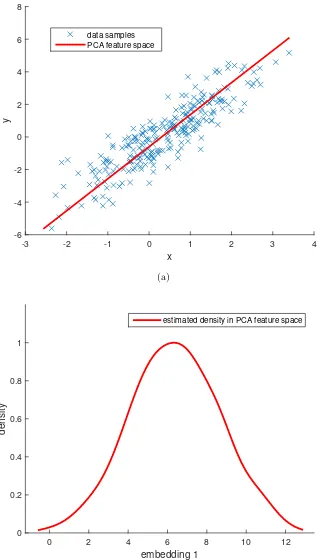
2.1 An example of embedding learning - PCA: (a) for a set of 2D data
sam-ples generated from a multivariate normal distribution, a PCA feature
space is calculated so that the corresponding variance is maximised. . . 19
2.2 An example of embedding learning - LPP versus PCA: (a) the projections
of the original 2D data in the LPP feature space have more discriminating
power, compared to those in the PCA feature space . . . 22
2.3 An example of embedding learning - LPP versus PCA (taken from [44]
but redrawn here): (a) compared to the feature space determined by
PCA, the feature space determined by LPP is less sensitive to the existing
outliers. . . 24
2.4 An example of embedding learning - FDA versus LPP versus PCA: (a)
the projections of the original 2D data in the FDA feature space possess
the most discriminant ability. . . 29
2.5 An example of embedding learning - LFDA versus FDA versus LPP: (a)
the projections of the original set in the LFDA feature space possess the
discriminant power, while preserving the local structures. . . 34
2.6 Comparison of the local structures in the original, LPP, FDA and LFDA
feature space: compared to the local structure in the original 2D feature
space, that in the resultant LFDA feature space has almost the same
structure, which demonstrates that LFDA is capable of preserving the
local structures. . . 35
2.7 An example of embedding learning - DNE versus LFDA versus FDA: (a)
the resultant feature space learned by DNE is almost the same as that
learned by LFDA (i.e. DNE is capable of discriminating data samples
2.8 An example of embedding learning - SELF versus LFDA versus PCA:
(a) the projections of the original 2D data in the SELF feature space
possess the most discriminant ability. . . 42
3.1 An example of an ideal pinhole camera. . . 50
3.2 An example of the same image under different distortions: translation,
Euclidean, similarity, affine, and projective. . . 55
3.3 An example of registering a translation distorted image by NCC - the
reference and sensed images are shown in Figure 3.2a and 3.2b,
respec-tively: (c) the difference between the reference and registered images. . . 59
3.4 An example of registering a similarity distorted image by PC - the
refer-ence and sensed images are shown in Figure 3.2a and 3.2d, respectively:
(a) and (b) the spectrum magnitudes of the reference and sensed images
in the log-polar coordinates, respectively (f) the difference between the
reference and registered images. . . 63
3.5 An example of constructing DoG images (taken from [192] but redrawn
here): within each octave, Gaussian blurred images of the original
im-age are generated so that they are separated by a constant factork, as
shown on the left column. Then, the neighbouring blurred images are
subtracted to generate the DoG images, as shown on the right column.
After finishing the above process within an octave, the blurred image is
downsampling by a factor of 2, and then the process is repeated. . . 69
3.6 An example of scale-space images in an octave for the original image
shown in Figure 3.2a. . . 70
3.7 An example of DoG images, which corresponds to the scale-space images
shown in Figure 3.6: to make them move visible, all images are in the
jet colour map. . . 71
3.8 An example of detecting extremum in a DoG image (taken from [192] but
redrawn here): comparing the intensity value of a pixel location (marked
as X) to that of its 26 neighbours at the current and adjacent images
(marked as green circles). . . 72
3.9 An example of constructing a descriptor for a keypoint [192]: within
each 4×4 window, the gradient magnitudes and orientations of all pixel
locations are calculated to from an 8 bin histogram. . . 73
3.10 An example of constructing an 8 bin histogram [192]: a gradient
orienta-tion is added to the bin covering this orientaorienta-tion (i.e. each bin covers 45
degrees), and the amount added to the bin depends on the corresponding
gradient magnitude. . . 73
3.11 A RANSAC iteration example: estimating a model for a set of 2D data
3.12 Another RANSAC iteration example: estimating a model for a set of 2D
data samples, based on two randomly selected data samples. . . 79
3.13 An example of registering a projective distorted image by SIFT and
RANSAC - the reference and sensed images are shown in Figure 3.2a and
3.2f, respectively: (a) and (b) the SIFT features detected in the reference
and registered images (marked as cyan ×), respectively (c) and (d) the
feature correspondences detected before and after employing RANSAC,
respectively (f) the difference between the reference and registered images. 82
3.14 An example of interpolating intensity value by bilinear interpolation. . . 86
4.1 All the data samples in a single example class from each of the four face
databases: Yale, ORL, PIE, and YaleB. . . 105
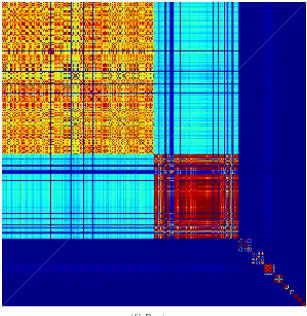
4.2 Comparison of the class structures based on the proximity matrices
com-puted from the original data samples (the entire training sets were used). 109
4.3 Sensitivity analysis of the performance of the proposed method to the
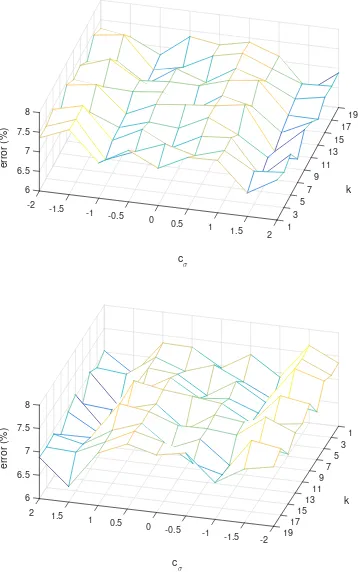
variations of the parameters kand σ (in terms of cσ), on YaleB. . . 111
4.4 Comparison of the class structures based on the proximity matrices
computed from the embedded data samples generated by the proposed
method (the entire training sets were used). . . 114
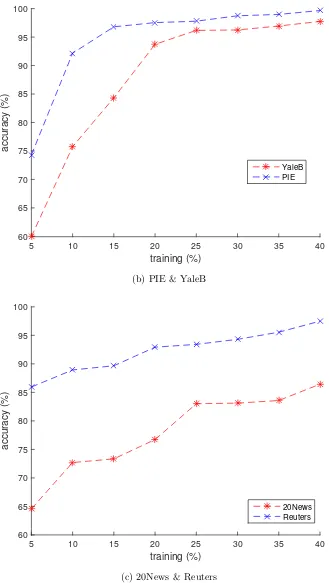
4.5 Performance of the proposed method, in terms of accuracy rate of
classi-fication and identiclassi-fication, on the six different datasets with varying the
number of data samples for training. . . 117
5.1 Examples of two 8-bit depth images and the corresponding 2-bit depth
images: Gaussian noise is present in the 8-bit depth images, and the
image structures are preserved in the 2-bit depth images. . . 122
5.2 A sequence of nine similarity distorted 2-bit depth images of the 8-bit
depth example image shown in Figure 5.1a (i.e. aerial image). . . 125
5.3 A sequence of nine similarity distorted 2-bit depth images of the 8-bit
depth example image shown in Figure 5.1c (i.e. Lena). . . 126
5.4 Registration results of the images shown in Figure 5.2. . . 127
5.5 Registration results of the images shown in Figure 5.3. . . 128
5.6 Original 8-bit depth images, and reconstructed results by fusing the
cor-responding aligned images shown in Figure 5.4 and 5.5. . . 129
5.7 The NCC and SSIM measures between the original and reconstructed
images: the reconstruction process was repeated 100 times, for different
bit depth images (i.e. from 1-bit to 7-bit). . . 130
5.8 Examples of an example under different levels of Gaussian noise and
without any blurring: the SD of Gaussian noise is varied from 8 to 64,
5.9 Examples of an example image under different levels of Gaussian noise
and a fixed Gaussian blur (i.e. the scaleσ = 1.6/√2): the SD of Gaussian
noise is varied from 8 to 64, with a constant step value of 8. . . 132
5.10 Examples of an example image under different levels of Gaussian noise
and a fixed Gaussian blur (i.e. the scale σ = 1.6): the SD of Gaussian
noise is varied from 8 to 64, with a constant step value of 8. . . 133
5.11 Examples of an example image under different levels of Gaussian noise
and a fixed Gaussian blur (i.e. the scale σ = 1.6×√2): the SD of
Gaussian noise is varied from 8 to 64, with a constant step value of 8. . 134
5.12 Examples of an example image under different levels of Gaussian noise
and a fixed Gaussian blur (i.e. the scaleσ = 1.6×2): the SD of Gaussian
noise is varied from 8 to 64, with a constant step value of 8. . . 135
5.13 The NCC and SSIM measures between the original and reconstructed
images: the reconstruction process was repeated 100 times, for different
1-bit depth images. . . 136
5.14 The NCC and SSIM measures between the original and reconstructed
images: the reconstruction process was repeated 100 times, for different
2-bit depth images. . . 137
5.15 The NCC and SSIM measures between the original and reconstructed
images: the reconstruction process was repeated 100 times, for different
3-bit depth images. . . 138
5.16 The NCC and SSIM measures between the original and reconstructed
images: the reconstruction process was repeated 100 times, for different
4-bit depth images. . . 139
5.17 The NCC and SSIM measures between the original and reconstructed
images: the reconstruction process was repeated 100 times, for different
5-bit depth images. . . 140
5.18 The NCC and SSIM measures between the original and reconstructed
images: the reconstruction process was repeated 100 times, for different
6-bit depth images. . . 141
5.19 The NCC and SSIM measures between the original and reconstructed
images: the reconstruction process was repeated 100 times, for different
7-bit depth images. . . 142
6.1 An example of forming triangles for a number of 3D points in a flat
region: (a) a number of 3D points in a flat region (i.e. they almost lie on
a common plane) (b) the projections of the 3D points in this common
plane (c) the triangles formed by employing the technique Delaunay
triangulation (d) the boundary points of this region (e) the triangles
6.2 An example of mapping a 2D image triangle to the corresponding
posi-tion in the plane determined by three 3D points. . . 150
6.3 The graf set of six 2D images of the same scene for generating a sparse
point cloud, by the SfM technique. . . 152
6.4 The bark set of six 2D images of the same scene for generating a sparse
point cloud, by the SfM technique. . . 153
6.5 The wall set of six 2D images of the same scene for generating a sparse
point cloud, by the SfM technique. . . 154
6.6 The vgm set of six 2D images of the same scene for generating a sparse
point cloud, by the SfM technique. . . 155
6.7 A sparse point cloud generated by employing the application VisualSFM
[300], based on the six 2D image shown in Figure 6.3. . . 156
6.8 A sparse point cloud generated by employing the application VisualSFM
[300], based on the six 2D image shown in Figure 6.4. . . 157
6.9 A sparse point cloud generated by employing the application VisualSFM
[300], based on the six 2D image shown in Figure 6.5. . . 158
6.10 A sparse point cloud generated by employing the application VisualSFM
[300], based on the six 2D image shown in Figure 6.6. . . 159
6.11 A dense point cloud generated by employing the application CMVS [301],
based on the sparse point cloud shown in Figure 6.7. . . 160
6.12 A dense point cloud generated by employing the application CMVS [301],
based on the sparse point cloud shown in Figure 6.8. . . 161
6.13 A dense point cloud generated by employing the application CMVS [301],
based on the sparse point cloud shown in Figure 6.9. . . 162
6.14 A dense point cloud generated by employing the application CMVS [301],
based on the sparse point cloud shown in Figure 6.10. . . 163
6.15 The 3D reconstruction result by employing the proposed method, based
on the sparse point cloud shown in Figure 6.7. . . 164
6.16 The 3D reconstruction result by employing the proposed method, based
on the sparse point cloud shown in Figure 6.8. . . 165
6.17 The 3D reconstruction result by employing the proposed method, based
on the sparse point cloud shown in Figure 6.9. . . 166
6.18 The 3D reconstruction result by employing the proposed method, based
Acknowledgement
First of all, I am extremely grateful to my primary supervisor, Prof. Jason Ralph, for his
support, advice and encouragement throughout the whole duration of my PhD study.
His deep insights helped me at various stages of my research, especially the useful
guidance during the difficult conceptual development stage. I also remain indebted
for his financial support. My sincere gratitude also goes to my co-supervisor, Dr.
Yannis Goulermas, for his invaluable insights and suggestions. I really appreciate his
willingness to meet me at short notice every time.
I wish to express my sincere appreciation to the other colleagues and friends who I
met during my time at the University of Liverpool, and those who have contributed to
this thesis and supported me in one way or the other. Special thanks here are due to our
postdoctoral researcher, Dr. Elias Griffith, whose help with MATLAB programming
was of utmost importance when I was in the early stages of my PhD study. I would also
like to take this opportunity to thank Dr. Tingting Mu and Prof. Stephen Marshall
-my viva examiners, for their very helpful comments and suggestions.
Last but not least, words cannot express the feelings that I have for my parents for
their constant unconditional support over the years - both emotionally and financially.
I would not be where I am today if it not for them, and for which I could never thank
Chapter 1
Introduction
1.1
Research Topics
There are three applications (i.e. embedding learning, image fusion, and 3D
recon-struction) considered in this thesis, but there are two main areas of work: embedding
learning and image registration. Embedding learning techniques aim to convert data
from a high dimensional representation to a lower one while preserving the intrinsic
geometry of the data, while image registration techniques aim to determine a
geomet-rical transformation that aligns two images of the same scene. Although they do not
seem directly related to each other at first, both of them are often included as
process-ing stages in applications of computer vision and other relevant areas of science and
engineering. More recently, embedding learning is used as a pre-processing stage to
enhance the performance of image registration, such as for medical imaging [1–3], and
in hyperspectral imaging [4, 5].
1.1.1 Embedding Learning for Classification
Handling measurements in a high dimensional mathematical space occurs frequently in
applications of machine learning, computer vision, data compression, and information
retrieval, as well as many other areas of science and engineering. The measurements are
often represented as feature vectors, and the vector space associated with these vectors
is called the feature space. For example, a statistical classification task commonly refers
to determining which of a set of categories (i.e. classes) one or more new measurements
(i.e. data samples) should belong to, on the basis of an existing set of measurements
whose corresponding category information (i.e. labels) is known. Many classical
clas-sification algorithms have been proposed, and they are widely employed, e.g. Neural
Networks (NNs) [6,7], Support Vector Machines (SVMs) [8,9] andk-Nearest Neighbour
(k-NN) classifiers [10, 11]. In real-world applications, data sets are usually represented
in high dimensional space. For example, a face image captured from a digital image or
a video frame often has many more degrees of freedom than that is required to define
or verification [12, 13]. Classifiers often suffer from some major problems as data
di-mension increases, such as increasing computational complexity, producing extremely
unreliable final results and so on [14, 15]. To overcome these problems, techniques that
aim to learn a compact representation of the original multivariate data sets are often
employed. These reduce dimensionality by eliminating irrelevant and/or redundant
information that is present in the original high dimensional data.
In general, embedding learning refers to the process of extracting a subset from a
set of data samples. For statistical classification, embedding learning can provide a
compact and meaningful representation for a set of data samples in a high dimensional
feature space by defining or determining a specific embedded subset of data samples
in a reasonably low dimensional feature space from the original (high dimensional)
set. The resulting embedded set should preserve some of the original properties and
characteristics of the data. An example of learning a specific set of 2D embeddings
from a set of 3D data samples is shown in Figure 1.1 [13], which was plotted by using
MATLAB 2014b. The manifold of the data set (i.e. the local neighbour structures)
that is present in the 3D space is unwrapped, as it is converted to a 2D space.
In the literature, a broad range of algorithms for embedding learning have been
proposed [15, 16]. Most algorithms differ from each other in the way that they preserve
important properties and characteristics that are present in the original set of data
samples during the learning process. The learning process refers to solving an
optimi-sation problem, which seeks to minimise or maximise an objective function, and whose
solution must satisfy a certain condition (i.e. a constraint). To achieve different
preser-vations of the important properties and characteristics, different objective functions
and the corresponding constraints are imposed according to the existing techniques.
Given a set of data samples that may have corresponding label information (i.e. which
class or classes each data sample belongs to), existing methods can be divided into the
following three categories, based on whether to utilise the label information and what
type of the label information is available. The first category is unsupervised learning,
where the techniques compute embeddings based only on certain feature properties and
characteristics that exist in the original data set, regardless of whether the
correspond-ing label information exists. The embedded set learned by unsupervised techniques is
a compact and informative representation of the original set which is based only on
features. The second category is supervised learning techniques, where the techniques
utilise the feature data and the corresponding label information when embeddings are
being constructed. The resultant supervised embeddings outperform unsupervised ones
in two ways: one is the grouping ability of the ones in the same class (i.e. keeping
in-terclass ones close together), and the other is the separation ability of the ones from
different classes (i.e. forcing interclass ones to move far apart). The last category is
15 10 5
x
0 -5 -10 -20 -10
y
0 0
5 15 20
10 25 30
10
z
(a) A set of 3D data samples
embedding 1
-0.04 -0.03 -0.02 -0.01 0 0.01 0.02 0.03
embedding 2
-0.04 -0.03 -0.02 -0.01 0 0.01 0.02 0.03 0.04
[image:14.612.145.489.91.654.2](b) An embedded set of 2D data samples
the label information is not complete (i.e. only part of the data set is labelled). Most
of these algorithms are some kind of combination of an unsupervised learning method
and a supervised one, i.e. employing an unsupervised learning method to consider all
the data samples and a supervised one to deal with only the labelled data samples.
The final performance of semi-supervised embedding learning methods are enhanced
compared to unsupervised learning, due to the employment of the supervised learning
techniques and the use of additional information (labels).
1.1.2 Image Registration & Its Application in 3D Reconstruction
Image registration is a fundamental problem in applications of image analysis related
areas. It aims to find one or more spatial transformations, so that two or more images
(commonly one reference image with one or more sensed images) of the same scene can
be geometrically aligned. Although the images are of the same scene, they differ from
each other because they may be taken at different times, from different viewpoints,
and/or by different sensors [17, 18]. For instance, in medicine, images taken from
dif-ferent modalities (i.e. using difdif-ferent wave bands, such as X-ray radiography, Magnetic
Resonance Imaging (MRI), medical ultrasonography and so on) are aligned to assist
di-agnosis. Image registration has become a crucial stage in tasks such as remote sensing,
medical imaging and computer vision, where final information is based on combining a
number of images. An example of image registration for image mosaicing [19] is shown
in Figure 1.2.
Generally, in 2D images, there are three major types of variations in images that
make them look distinct [17]. The first type of variation is caused by the process
of image acquisition, which leads to image misalignment. The second variations are
changes in the intensity values, due to changes in lighting conditions or relative contrast
in different modalities. The last type of variation is caused by changes in the scene,
such as moving objects. A spatial transformation between two images is sufficient
to remove the first type of variation, but not the other two types of variation. They
generate a more difficult problem in image registration, since an exact match is difficult
to achieve [17]. The problem would not be critical, as long as the changes in intensity
values are relatively small compared to the original intensity values, and the moving
object is not the object of interest in the taken images. As shown in Figure 1.2d, the
part of a car in the bottom right of the image (white area) is not removed after applying
image registration. Also as shown in Figure 1.2f, the final result of image mosaicing is
reasonable, because the part of the car is not the main object of interest in the three
images.
Over the years, a broad range of techniques for image registration have been
pro-posed for a wide variety of areas [17, 18, 20, 21]. Unfortunately, because images to be
(a) Reference image (b) Sensed image 1 (c) Sensed image 2
(d) Registered Sensed image 1 (e) Registered Sensed image 2
[image:16.612.114.530.67.592.2](f) Final result of image mosaicing
Figure 1.2: An example of image registration for the application area in image mosaicing
no one existing method that can achieve an optimal performance when the alignment is
across different types of sensor, platform and/or problem [18, 22]. Existing techniques
for image registration can be classified into two major categories: area based methods
and feature based ones. The area based methods process images without detecting any
the image) of predefined size are used for the estimation of corresponding
transforma-tion models, which describes mathematical relatransforma-tionships between images for alignment.
However, because they only make direct use of matching image intensity values, with
no analysis of image structures, they are sensitive to the changes in intensity value.
Compared to area based methods, feature based ones work by detecting more robust
features: usually sets of points or small blocks detected in the reference and sensed
images. The aim of these methods is to find the pairwise correspondence between the
detected features in the different images, using either the spatial relations or various
feature descriptors.
In general, the process of image registration can be divided into the following four
stages: detecting features, where the information in the images is useful for matching
is extracted; matching features, where the correspondences are established between the
features detected in the reference and sensed images; estimating the transformation
model, where the type and the parameters in the spatial transformation are estimated,
on the basis of the established correspondences of the detected features; and
trans-forming & resampling images, where the sensed images are transformed and resampled
according to the estimates of the spatial transformation [18].
Detecting Features Features commonly refer to significant areas in images, i.e. salient regions, lines or even points, which are manually selected or, preferably,
auto-matically detected [17,18]. Nevertheless, the features should be distinctive, expected to
be easily detectable and somehow stable, i.e. the same features detected from different
images should share sufficient common elements, even in situations where images do
not cover the exactly the same scene and/or the objects present in images are occluded.
Ideally, any applicable method should be able to detect the same features in all of the
possible images of the same scene, and be insensitive to any assumed type of geometric
deformation and/or additive noise.
Matching Features In this stage, the features detected in different images are matched to each other. The matching process is based on either various measures
of image intensity values between the detected features and the several nearest
neigh-bours, or a similarity measure of the descriptors constructed according to the detected
features. Since any incorrectly matched pairs of features will cause the performance to
suffer in the following stages, the algorithms proposed for matching features should be
robust. Some existing techniques (i.e. area based methods) merge the current stage
with the next one, because once the pairs of feature correspondences have been
de-termined, they can directly estimate the parameters required by the transformation
Estimating Transformation Models The spatial transformation that can geomet-rically align two images is estimated in this stage. Based on the prior information about
the assumed transformation model, the parameters required by the spatial
transforma-tion are computed using the established matched pairs of feature correspondences. The
estimated model of the spatial transformation should result in a reasonable
transforma-tion, where the corresponding matched pairs are located as close as possible. If there is
no prior information available, the estimated model should be both flexible and general
enough to handle all possible spatial transformations for geometrical alignment.
Transforming & Resampling Images After the model of a spatial transformation has been estimated, the images can be geometrically aligned by mapping the sensed
image(s) into the spatial coordinate of the reference image. Since the new pixel
coordi-nate of the registered image is determined according to that of the reference image, a
non-integer pixel location is often generated, where no appropriate intensity value can
be assigned directly. To address this problem, the sensed images are often resampled
employing an appropriate intensity interpolation technique. The choice of the intensity
interpolation technique depends on the trade-off between the registration accuracy and
the computational complexity. In general, the technique of bilinear interpolation is
sufficient enough for practical applications [18].
3D Reconstruction from 2D Images
3D reconstruction from 2D images is a challenging task in computer vision and
com-puter graphics. It represents a process of obtaining 3D information about the geometry
of a scene from 2D images of this scene. Depth data is the 3D component missing from
given 2D images. To recover depth data, image registration serves as the key part. This
is because a 3D point can be reconstructed by triangulation [23], with the use of its
cor-responding pixel locations in the 2D images that have already been matched through
image registration. To apply triangulation methods, it is an important prerequisite
that the pose and calibration of each camera used should be determined. Traditional
methods require a priori information about 3D positions, such as the 3D location and
pose of camera, or the 3D location of ground control points [23]. However, there is
a method called Structure from Motion (SfM) [23, 24], which can simultaneously and
automatically get the camera pose and scene geometry. It is achieved by employing a
method called bundle adjustment [25, 26], which is based on matched pixel locations
extracted from multiple 2D images that are overlapping and offset.
1.2
Novel Contributions
For embedding learning, a new approach has been proposed to try to overcome the
underlying structure of a given dataset. It attempts to generate a feature space formed
by distinct feature(s) of each class, which could potentially enhance the grouping of the
data samples in this class while separating them from those in the remaining classes.
Compared to the existing techniques that try to find distinguishing features, each of
which attempts to separate all classes, this approach focuses on finding the distinct
characteristics of one class at a time. It results in the following two contributions:
Firstly, the idea of One-Vs-All (OVA) [27, 28] which decomposes a multiclass
classi-fication problem into several binary ones is applied to embedding learning. It finds
distinct feature(s) for each class individually, so that the data samples in this class can
be uniquely defined, and then separated from those in the remaining ones. Secondly,
to overcome the problem of the imbalanced number of data samples when addressing
final optimisation, a weighted pairwise constraint indicator is proposed to balance the
contributions of the data samples from a target class and those from the remaining
classes.
For image registration, to reduce the usage of on-board computational resources
in small Unmanned Aircraft System (UAS) platforms, an approach can be employed
using low bit depth images instead of full bit depth ones. It only transmits the first
few Most Significant Bits (MSBs) of image data, and it is based on the assumption
that the most important information of each image (e.g. the main structure of the
scene) is contained in the MSBs. To address the problem that low bit depth imagery
can discard image details within the Least Significant Bits (LSBs), it has been found
that the discarded details may be reconstructed by fusing a sequence of related low
bit depth images if there is sufficient noise in the images, when the temporal sequence
has been aligned by image registration [29]. Additionally, the area based registration
method Phase (Fourier) Correlation is employed here, to achieve a low computational
complexity. It results of the following two contributions: Firstly, the phase correlation
method is demonstrated to be capable of registering low bit depth images (up to a
distortion caused by a similarity transformation), without any modification, or any pre
and/or post-processing. Secondly, the image details discarded due to quantisation of
low bit depth imagery can be reconstructed with high fidelity by fusing a number of
related low bit depth images with noise.
For 3D reconstruction from 2D images, a new approach has been proposed to achieve
a good trade-off between the reconstruction details and the computational load. Unlike
the common approach that maps 2D image triangles one by one to the 3D scene, it forms
several large triangles to describe a flat or almost flat region. Each of the large triangles
actually covers a number of small triangles, and they are formed based on the boundary
points of the region. It results in two contributions. Firstly, to describe a region with a
number of triangles, the triangles formed based on boundary points of this region can
triangles can achieve almost same performances when describing this region, compared
one that based on all small triangles at considerably lower computational cost.
1.2.1 Publications
Parts of the above novel contributions have been presented at conferences and published
in a journal paper:
1. Y. Chi, E.J. Griffith, and J.F. Ralph. Low bit depth images for small,
micro-scale UAVs. In 6th International Conference on Imaging for Crime Detection
and Prevention (ICDP 2015), London, UK, 15-17 Jul. 2015, pages 21–26. IET,
2015
2. Y. Chi, E.J. Griffith, J.Y. Goulermas, and J.F. Ralph. Binary data
embed-ding framework for multiclass classification. IEEE Trans. Human-Mach. Syst.,
45(4):453–464, 2015
3. Y. Chi, E.J. Griffith, J.Y. Goulermas, and J.F. Ralph. Binary data embedding
framework for face recognition. In 5th International Conference on Imaging for
Crime Detection and Prevention (ICDP 2013), London, UK, 16-17 Dec. 2013,
pages 102–107. IET, 2013
4. E.J. Griffith, Y. Chi, M. Jump, and J.F. Ralph. Equivalence of BRISK descriptors
for the registration of variable bit-depth aerial imagery. In 2013 IEEE
Interna-tional Conference on Systems, Man, and Cybernetics (SMC), Manchester, UK,
13-16 Oct. 2013, pages 2587–2592. IEEE, 2013
1.3
Structure of Thesis
This thesis is further divided into six chapters:
• Chapter 2,Embedding Learning for Classification, describes the main con-cepts of embedding learning for classification, and examines the commonly used
techniques in unsupervised, supervised and semi-supervised embedding learning,
as well as the embedding learning techniques for multi-label classification.
• Chapter 3,Image Registration & Its Application in 3D Reconstruction, shows how a pinhole camera model leads two 2D images of the same scene to be
related by a transformation model, and examines the commonly used techniques
for registering 2D images - both area based and feature based. Additionally, the
structure from motion technique is examined here, it reconstructs a 3D scene
• Chapter 4, Binary Data Embedding Framework, describes the motivation and technical details of the work that has been done for embedding learning,
and additionally an experimental evaluation is conducted to demonstrate the
performance of the proposed method.
• Chapter 5,Image Reconstruction by Fusing Low Bit Depth Image, pro-vides the motivation and whole process of the work that has been done for image
reconstruction, as well as an evaluation of the reconstruction process to show the
reconstruction quality.
• Chapter 6,3D Scene Reconstruction from 2D images, presents the motiva-tion and whole process of the work done that has been done for 3D reconstrucmotiva-tion,
and additionally an experimental evaluation is conducted to demonstrate the
per-formance of the proposed method.
Chapter 2
Embedding Learning for
Classification
This chapter, describes the background of embedding learning and introduces the
stan-dard mathematical notation that will be used in later chapters. Subsequently, a broad
review of the well known techniques for embedding learning is presented.
2.1
Background
Embedding learning aims to embed a set of data samples into a lower dimensional
fea-ture space that can capfea-ture the meaningful degrees of freedom present in the data. It
has become an essential processing stage in many applications in science and
engineer-ing [14]. In recent years, a wide range of algorithms for embeddengineer-ing learnengineer-ing have been
proposed [15, 16]. The existing algorithms can be split into two different categories,
based on whether there is an explicit relation between a set of data samples and its
corresponding set of embeddings. One is nonlinear learning, where the techniques, such
as Locally Linear Embedding (LLE) [13], Laplacian Eigenmaps (LE) [34], and other
algorithms proposed in [12, 35–40], generate resultant embeddings that have no explicit
relation to the original set. In other words, there is no linear relationship between
the original set and the corresponding embedding results. The other category is linear
learning, where there exists an explicit relation, and it is captured by a linear
map-ping/projection function. Here, the focus will be on the methods in the later category,
since they are usually insensitive to the parameters [41], have lower computational
complexity [41], and are simpler and straightforward for real-time applications. For
instance, for the purpose of classification, once a linear mapping/projection function
has been determined from a training set (i.e. a set of data used for learning), it can be
used for mapping/projecting any data sample in the corresponding test set (i.e. a set
of data used solely for testing generalisation performance) to the same feature space,
for further identification or verification.
generate embeddings only based on specific feature properties and characteristics of
a set of data samples, without explicit knowledge of the identifies or classes of the
data. For example, Principal Component Analysis (PCA) [42] aims to yield an
orthog-onal projection function, so that the corresponding embedding results are uncorrelated
to each other, and the corresponding total variance is maximised. Latent Semantic
Indexing (LSI) [43] attempts to obtain a lower rank approximation to represent the
original set. Both methods take into account the global structure of the original set
when determining the mapping functions, but not the local structure. As a result, it
is likely that the local structures of the resultant embeddings become distorted. To
overcome this problem, various methods using manifold learning and spectral analysis
have been developed to take into account the local structure information when
generat-ing embeddgenerat-ings [12, 13, 34–38, 40, 44–49]. For example, Locality Preservgenerat-ing Projections
(LPP) [44], Orthogonal Locality Preserving Projections (OLPP) [45] and Orthogonal
Neighbourhood Preserving Projections (ONPP) [45] focus more on the local structures
of the original set to preserve the essential geometry. This can be captured by pairwise
proximity information based on constructed graphs for the local neighbours of each
data sample [14]. These techniques differ from each other through different
assump-tions on how to construct graphs of local neighbours and enforce constraints: ONPP
assumes that each data sample can be represented by a linear combination of its local
neighbours, while LPP and OLPP employ similarity measures to capture graphs of
lo-cal neighbours. Additionally, both OLPP and ONPP indicate that each dimensionality
of the resultant linear mapping/projection function should be orthonormal.
When a set of data samples possesses a good arrangement between the features and
the corresponding classes (i.e. the data samples in the same class are located nearby,
while those from different classes are located far away), the above unsupervised methods
can obtain a good and informative representation of the original set, based only on
certain feature properties and characteristics, and no local information. However, for
a real world dataset, a good arrangement may not always hold. Therefore, there may
exist confusing data samples in the original set (i.e. data samples from different classes
are located nearby, and/or those in the same class are located far away), and then both
global and local structures of the original set become unreliable due to the existence of
the confusing data samples. The resultant embeddings, which are only learned on the
basis of feature properties and the characteristics of the original set, may degrade the
final performance. Additionally, the local neighbour information, which is utilised by
some unsupervised methods, is based on one type of distance measure (metric) between
each data sample and its neighbours in the original feature space. It may be influenced
when there exists a bad arrangement between the features and the labels. As a result,
these methods may fail to overcome the problem, and can increase the misclassification
space may get projected into a wrong class in the embedded feature space.
To avoid such problems, techniques that use the set of data samples and the
cor-responding label information have been proposed. These techniques are supervised
learning methods. They improve the grouping ability of the data samples in the same
class (i.e. intraclass), whilst increasing the separation ability of those from different
classes (i.e. interclass). Most of the supervised methods attempt to embed a set of
data samples, so that the data samples of intraclass are made to be close together and
the interclass data samples are as far apart as possible. For example, both Fisher
Dis-criminant Analysis (FDA) [50] and Maximum Margin Criterion (MMC) [51] achieve
this based on the additional use of the label information to capture the within-class
and between-class scatters (i.e. the estimates of the corresponding covariance matrices)
for respective intraclass and interclass information of the original set. Both methods
encourage all of the data samples of the same class to stay close together and those of
different classes to move apart, with a slight difference in the way of formulating each
objective function - FDA utilises the ratio of the two scatters, while MMC [51] utilises
the difference between the two scatters (intra- / interclass). Various other methods
have been proposed [52–66], and the majority of these are based on using rules similar
to that of FDA and MMC with slight variations or incorporating the label
informa-tion into the pairwise proximity informainforma-tion modified by the unsupervised methods.
For example, Marginal Fisher Analysis (MFA) [52], Discriminative Locality Alignment
(DLA) [53], and Discriminant Neighbourhood Embedding (DNE) [54] encourage only
the neighbouring data samples of intraclass and interclass to be nearby and far away,
respectively. They share the same idea, but differ from each other in the way that they
impose each objective function and constraints. MFA [52] is a variant of FDA, where it
considers local neighbour information by redefining the between-class and within-class
scatters, on the basis of k-NN information. DLA [53] works similar to MFA, but it
employs a criterion whose form is similarly to that of MMC (a difference rather than
a ratio). DNE [54] incorporates the label information into the graphs of local
neigh-bourhoods constructed by OLPP. Local FDA (LFDA) [57] is another variant of FDA,
where it keeps the neighbouring data samples of intraclass close, while for the data
samples of interclass, it works more strictly - it makes all of them move apart.
Repul-sion OLPP (OLPP-R) [60] uses the neighbourhoods differently compared to LFDA: it
keeps all of the data samples of intraclass close, while the neighbouring data samples
of interclass move apart. Repulsion ONPP (ONPP-R) [60] and Discriminative ONPP
(DONPP) [63] are more complex, both of them preserve the local data structure within
each class separately, while encouraging the neighbouring data samples of interclass to
move apart. They differ from each other through the use of different reconstruction
weights. ONPP-R [60] uses reconstruction weights that are calculated for all data
data samples that are close by in the original feature space. DONPP [63] uses
recon-struction weights which are calculated based on the assumption that each data sample
can be reconstructed from the remaining ones in its class.
The fully supervised learning techniques make the use of labelled data samples
when determining optimal projection functions. But in some situations, labelling data
samples is difficult, expensive or time consuming, so only a small number of them are
actually labelled. Employing unsupervised learning techniques in such cases may
gen-erate unreliable results, while employing supervised learning techniques with only the
labelled data samples may fail to discover the actually meaningful structures, due to
the small sample size. To address this problem, a group of techniques, called
semi-supervised learning have been developed to use both unlabelled and labelled data
sam-ples to build a better mapping function [63, 67–73]. The simsam-plest way to approach
semi-supervised learning is to combine an unsupervised technique and a supervised
one, i.e. using the unsupervised technique to deal with all data samples (both
un-labelled and un-labelled), while the supervised technique deals with the un-labelled data
samples. For example, Semi-supervised DONPP (SDONPP) [63] combines ONPP with
DONPP, SEmi-supervised LFDA (SELF) [69] combines PCA and LFDA, while
Semi-Supervised FDA (SSFDA) [68] and Semi-Semi-Supervised MMC (SSMMC) [68] combine
OLPP with FDA and MMC, respectively. There are other different ways to achieve
semi-supervised learning, for example methods described in [71] and [72] attempt to
learn predicted labels. A broader review on semi-supervised learning techniques can be
found in [73–75].
The algorithms for supervised and semi-supervised learning typically only aim for
single label classification, where each data sample is assigned exactly one label. For
more complex classification problems, data samples are extended from single label to
multi-label, i.e. a data sample simultaneously belongs to two or more classes. In such
cases, the above algorithms are no longer applicable. To address this problem, a variety
of algorithms for multi-label classification have been proposed [76–87]. A direct way to
achieve embedding learning for multi-label classification is to find a optimal approach
to balance some kind of statistical measure (e.g. covariance or correlation coefficient)
of the embedding results and the corresponding multi-label information. For
exam-ple, Partial Least Squares (PLS) [76, 77] attempts to maximise the covariance between
the resultant embeddings and the corresponding multi-label information. Canonical
Correlation Analysis (CCA) [79, 80] works similarly to PLS. Instead of employing
co-variance, it aims to maximise the correlation coefficient. A recent review of the existing
2.1.1 Definitions
The input to a method on linear embedding learning is a training set ofndata samples
of dimensiond, where it is denoted by an n×dmatrix X, as:
X= [x1,x2, . . . ,xn]T (2.1)
whereT denotes the transpose operator, andxi= [xi1, xi2, . . . , xid]T corresponds to the ith data samples in the training set. The ntraining data samples belong to cdifferent
classes, and this class information is modelled as ann×cbinary matrix Y as:
Y= [y1,y2, . . . ,yn]T (2.2)
whereyi = [yi1, yi2, . . . , yic]T indicates which of the c different classes (C1, C2, . . . , Cc)
that theith training data sample belongs to, and theijth element yij is defined as:
yij =
1 ifxi ∈Cj (i.e. xi belongs to Cj)
0 otherwise (2.3)
The number of the training data samples from the ith class Ci is denoted by ni (i =
1, . . . , c). The corresponding test set consists of mdata samples of dimension d, and it
is denoted by am×dmatrixXe, as:
e
X= [xe1,ex2, . . . ,exm]
T (2.4)
wherexei = [xei1,exi2, . . . ,exid]
T corresponds to theith test data sample.
The objective of the techniques for linear embedding learning is to construct a
linear mapping/projection functionψ:Rd→Rkfrom either only the training setXor both the training setX and the corresponding label informationY. The functionψis denoted by ad×kmatrixV. It generates a training set of nembeddings of dimension
k(k < d), denoted by a n×k matrixZ, as:
Z=XV = [z1,z2, . . . ,zn]T (2.5)
where zi = VTxi = [zi1, zi2, . . . , zik]T corresponds to the ith data sample in the
em-bedded training set. In the emem-bedded feature space, the dimensionality of the training
set is reduced, and additionally the manifolds in the low dimensional space that the
training data samples lie on should be recovered, as well as the discrimination between
the data samples from different classes must be enhanced [14]. Then, through the same
determined mapping/projection functionV, the corresponding test setXe are projected
to the same embedded feature space, denoted by am×k matrixZe, as:
e
Z=XVe = [ez1,ez2, . . . ,ezm]T (2.6)
wherezei=VTxei = [zei1,ezi2, . . . ,ezik]
T corresponds to theith embedded test data
sam-ple. The dimensionality of the data samples in the test set is reduced and the
discriminability of the embedded test data samples is a way to measure the final
per-formance of the determined mapping/projection function.
To give a better review of the existing embedding learning techniques, the well
known techniques on unsupervised, supervised and semi-supervised learning are each
examined in detail. Although the concept of multi-label learning is beyond the scope of
this thesis, some commonly used techniques for multi-label classification are listed for
completeness. Sometimes, since the meaningful structure of a data set lies on a
nonlin-ear space, the linnonlin-ear embedding lnonlin-earning techniques will fail to discover the nonlinnonlin-ear
structure. To overcome this problem, some techniques are developed to increase the
power of the proposed algorithms for embedding learning by extending them to
non-linear space. Some commonly used techniques for nonnon-linear extension are also listed.
2.2
Unsupervised Learning Techniques
The unsupervised learning techniques determine mapping/projection functions on the
basis of using some feature properties and characteristics of a set of data samples.
Through the mapping/projection functions that are determined, the algorithms aim to
provide a good and informative representation of the original set.
Principal Component Analysis
Principal Component Analysis (PCA) [42], also known as the Karhunen-Loeve
Trans-form (KLT) [88], is one of the most widely used methods for linear embedding learning.
PCA constructs a d×k orthogonal projection matrix V, to maximise the variance of all the embedded data samples [42]. It has a number of advantages [89]: reducing
the number of dimensions without much loss of the original information, removal of
redundancy, and reduction of noise. For the training set X, the maximisation of the variance of all the embeddings can be formulated as:
arg max
zi∈Rk 1
n−1
n X i=1
zi−
1 n n X j=1 zj 2 2 (2.7)
wherek · k2 donates the 2-norm or Euclidean norm, and the objective function can be
reformulated as [55]:
n X i=1
zi−
1 n n X j=1 zj 2 2 = n X i=1
zi−
1 n n X j=1 zj T
zi−
1 n n X j=1 zj = tr n X i=1
zi−
1 n n X j=1 zj
zi−
Then, the maximisation problem in (eq. (2.7)) is equivalent to the following:
arg max
V∈Rd×k,VTV=I k×k
tr n X i=1
VTxi−
1
n n
X
j=1
VTxj
VTxi−
1
n n
X
j=1
VTxj
T
(2.9)
where tr[·] is the trace operator, and the optimisation problem above can be
reformu-lated as:
arg max
V∈Rd×k,VTV=I k×k
trVTStV
(2.10)
whereStis defined as:
St= n
X
i=1
xi−
1 n n X j=1 xj
xi−
1 n n X j=1 xj T (2.11)
Stis called the total scatter matrix of the training setX[55]. Stabove can be expressed
more succinctly, as:
St=XT
In×n− 1 n1n×n
T
In×n− 1 n1n×n
X
=XT
In×n−
1
n1n×n
X (2.12)
whereIn×n−n11n×nis the n×ncentring matrix.
The optimal projection matrixV∗= [v1,v2, . . . ,vk] can be obtained by employing
Lagrangian multipliersλi (i= 1, . . . , k) [55]:
L(vi, λi) =vTi Stvi−λi(viTvi−1) (2.13)
Next the derivative with respect tovi is taken:
∂L(vi, λi) ∂vi
=Stvi+STtvi−2λivi (2.14)
using the fact that St is a symmetric matrix, and the derivative result is set to zero,
thus the following is obtained:
Stvi=λivi (2.15)
Clearly, the equation above is a standard eigenvalue problem. The optimal projection
matrix V∗ is obtained by Singular Value Decomposition (SVD) [90], whose columns [v1,v2, . . . ,vk] are the k standard eigenvectors of St, corresponding to the k largest
standard eigenvalues [λ1, λ2, . . . , λk].
An example of PCA embedding learning for a set of data samples in 2D is shown
in Figure 2.1. The data samples are generated from a multivariate normal distribution
with a mean of (0.392,0.207) and a covariance of [1,1.5; 1.5,3], and then the PCA
data samples are projected from the original 2D feature space into this new 1D feature
space, the corresponding variance is maximised.
To visually analyse the projected data samples in the determined 1D feature space,
the corresponding density can be estimated as follows: First, let mline represent the
slope or gradient of the determined line, then the projected coordinate of an arbitrary
data pointxi can be calculated as:
yi= [cos(arctan(mline)),sin(arctan(mline))]×[xi1, xi2]T (2.16)
Since a linear shift in the projected coordinate set Y will not have any effect on the final result of density estimation, Y can be shifted linearly so that it starts from the value of 0. This can be simply achieved by:
Y=Y−min(Y) (2.17)
where min(·) returns the minimum value. Next, a histogram, with the number of bins
being 20, is contracted based on the shifted coordinate setY. Finally, a density function is estimated by fitting it to the contracted histogram, based on the assumption that
the data samples are in a nonparametric kernel-smoothing distribution.
Latent Semantic Indexing Latent Semantic Indexing (LSI) [43] is a method that works very similarly to PCA. It operates like PCA, but without the process of centring
the data samples eq. (2.12). A document-term matrix, which identifies the occurrences
of a number of unique terms within a dataset generated by a collection of
document-like data (e.g. 1 indicates a term occurs, while 0 otherwise), is usually a sparse matrix.
Thus, the centring process (i.e. subtracting off the mean) will result in losing the
original sparseness present in the document-term matrix, and then increasing the cost
of processing and/or storing it. LSI was developed for text processing, however due
to its similarity to PCA, it has been applied to a variety of application areas, such
as information retrieval. Based on (2.10) and (2.12), LSI gets its optimal projection
function by solving the following optimisation problem:
arg max
V∈Rd×k,VTV=I k×k
trVTXTXV (2.18)
Locality Preserving Projection
Both PCA and LSI construct the optimal mapping functions based on preserving the
global structure of the original set, because of this it is likely that the corresponding
local structures are distorted. Locality Preserving Projection (LPP) [44] is a method
that was proposed to focus more on the local structures of the original set, when
con-structing the optimal mapping function. It is developed through the pairwise proximity
x
-3 -2 -1 0 1 2 3 4
y
-6 -4 -2 0 2 4 6 8
data samples PCA feature space
(a)
embedding 1
0 2 4 6 8 10 12
density
0 0.2 0.4 0.6 0.8 1
estimated density in PCA feature space
[image:30.612.157.474.86.646.2](b) the estimated density of the projected data samples in the PCA feature space
represent the local structures. As a result, it is likely that a search of nearest
neigh-bours in the resultant embedding feature space will yield a similar result, compared to
that in the original high dimensional feature space. This makes LPP particularly
use-ful in applications such as information retrieval, where a search of a nearest neighbour
is ultimately needed [44]. LPP has been demonstrated to have more discriminating
power than PCA and be insensitive to the presence of outliers [44]. The advantages are
both shown as an example of embedding learning between PCA and LPP in Figure 2.2
and 2.3. In Figure 2.2a, the data samples of two different classes are generated from
two different multivariate normal distributions, with different means (0.366,0.620) and
(7.366,6.620) while a common covariance [1,1.5; 1.5,3]. Comparing Figure 2.2b and
2.2c, it can be seen that the two estimated densities shown in Figure 2.2c have less
overlap region. It means that in the LPP feature space, the projected data samples
have better separation performance. Because a suitable distance is maintained between
the data samples of the two classes, a simple classifier based on nearest neighbour search
(e.g. 1-NN, which simply assigns a test data sample to the class of its nearest
neigh-bour) is powerful enough to achieve class discrimination. PCA feature space, although
it maximises the variance, it distorts the good arrangement between nearest neighbour
and class label (i.e. a data sample and its nearest neighbour are from the same class).
This makes the 1-NN classifier fail to achieve a good performance. The LPP feature
space preserves the local structures, which results in more discriminating power. In
Figure 2.3a, the data samples are generated from a multivariate normal distribution
with a mean of (0.879,0.548) and a covariance of [1,1.5; 1.5,3], while several outliers
are added to the Gaussians. For the same reason, the resultant LPP feature space
is less sensitive to outliers, compared to the PCA one. However, LPP may lead to
unsatisfying effectiveness due to the constructed graph of local neighbours [41]. This is
because the local neighbourhood graph is generated based on adopting the Euclidean
distance as the similarity measure between data samples, while the Euclidean distance
cannot adequately describe the intrinsic geometry of the manifold structure in the real
word [41].
LPP is a linear approximation of Laplacian Eigenmaps (LE) [34], where a linear
constraint is imposed between the original set and the determined mapping/projection
function. It attempts to minimise the pairwise distance errors between all the data
sam-ples in the embedded feature space, and then for the training setX, the corresponding minimisation problem is defined as:
arg min
zi∈Rk
n
X
i,j=1
wijkzi−zjk22 (2.19)
where the imposed linear constraint is zi =VTxi, and wij is the ijth element of the n×n weight matrix W. wij is defined based on a similarity or closeness measure
used similarity or closeness measures for weight matrix W are listed in appendix A.
wij is only nonzero when theith and jth data samples are connected. Commonly, two
different ways are used to define whether a connection exists. One is when theith data
x
-4 -2 0 2 4 6 8 10 12
y
-4 -2 0 2 4 6 8 10 12
data samples of class 1 data samples of class 2 PCA feature space LPP feature space
(a)
embedding 1
0 2 4 6 8 10 12 14 16 18
density
0 0.2 0.4 0.6 0.8 1
in PCA Feature Space
estimated density of class 1 estimated density of class 2
embedding 2
0 2 4 6 8 10 12
density 0 0.2 0.4 0.6 0.8 1
in LPP Feature Space
estimated density of class 1 estimated density of class 2
(c) the estimated densities of the projected data samples in the LPP feature space
Figure 2.2: An example of embedding learning - LPP versus PCA: (a) the projections of the original 2D data in the LPP feature space have more discriminating power, compared to those in the PCA feature space
sample is the mutual or undirected k-NN of the jth one, and vice versa; the other is
when a specific measure of the distance between theith andjth data samples is below
a pre-defined threshold. Based on the work in [44], the objective function above can
be reduced to:
1 2
n
X
i,j=1
wijkzi−zjk22 =
1 2 n X i,j=1
wijzTi zi+ n
X
i,j=1
wijzTjzj− n
X
i,j=1
wijzTi zj− n
X
i,j=1
wijzTjzi
= n X i,j=1
wijzTizi− n
X
i,j=1
wijzTi zj
=
n
X
i=1
zTi
n X j=1 wij
zi−
n
X
i,j=1
zTi wijzj
= tr n X i=1 zi n X j=1 wij
zTi −
n
X
i,j=1
ziwijzTj
= tr
ZTDZ−ZTWZ
whereD is ann×ndiagonal matrix, with its ith diagonal element diibeing:
dii= n
X
j=1
wij (2.21)
x
-3 -2 -1 0 1 2 3 4
y
-10 0 10 20 30 40 50 60 70 80
data samples of class 1 data samples of class 2 PCA feature space LPP feature space
(a)
embedding 1
0 10 20 30 40 50 60 70 80
density
0 0.2 0.4 0.6 0.8 1
in PCA Feature Space
estimated density of class 1 estimated density of class 2
embedding 2
0 1 2 3 4 5 6 7
density
0 0.2 0.4 0.6 0.8 1
in LPP Feature Space
estimated density of class 1 estimated density of class 2
(c) the estimated densities of the projected data samples in the LPP feature space
Figure 2.3: An example of embedding learning - LPP versus PCA (taken from [44] but redrawn here): (a) compared to the feature space determined by PCA, the feature space determined by LPP is less sensitive to the existing outliers.
and it can be formed from [15]:
D= diag(W×1n×1) (2.22)
where D is a diagonal matrix, the function diag(·) returns a vector corresponding to the matrix diagonal for a given input matrix or a corresponding diagonal matrix for an
input vector, and 1n×1 is a n-dimensional vector with all its elements to be 1. Thus,
the minimisation problem in (2.19) can be reduced to finding the following:
arg min
V∈Rd×k,VTXTDXV=I k×k
tr
VTXTLXV
(2.23)
where the constraintVTXTDXV=Ik×kis imposed in [44] to remove arbitrary scaling
factors in the embeddings, andL is ann×nLaplacian matrix, which is defined as:
L=D−W (2.24)
Similarly, introducing Lagrangian multipliers λi (i = 1, . . . , k), the solution to the
minimisation problem in (2.23) can be reduced to the following generalised eigenvalue
problem:
![Figure 1.1: An example of embedding learning (taken from [13] but redrawn here):representing a set of 3D data samples in a 2D feature space, while preserving the localneighbour structure of each data sample in the original 3D feature space.](https://thumb-us.123doks.com/thumbv2/123dok_us/8065977.226701/14.612.145.489.91.654/figure-embedding-learning-representing-preserving-localneighbour-structure-original.webp)