https://doi.org/10.5194/bg-16-4815-2019 © Author(s) 2019. This work is distributed under the Creative Commons Attribution 4.0 License.
Trees do not always act their age: size-deterministic tree ring
standardization for long-term trend estimation
in shade-tolerant trees
Rachel Dietrich and Madhur Anand
School of Environmental Sciences, University of Guelph, Guelph, N1G 2W1, Canada Correspondence:Madhur Anand ([email protected])
Received: 27 May 2019 – Discussion started: 13 June 2019
Revised: 4 October 2019 – Accepted: 26 October 2019 – Published: 19 December 2019
Abstract. With increasing awareness of the consequences of climate change for global ecosystems, the focus and ap-plication of tree ring research have shifted to reconstruc-tion of long-term climate-related trends in tree growth. Con-temporary methods for estimating and removing biological growth trends from tree ring series (standardization) are ill-adapted to shade-tolerant species, leading to biases in the sultant chronologies. Further, many methods, including re-gional curve standardization (RCS), encounter significant limitations for species in which accurate age estimation is difficult. In this study we present and test two tree ring stan-dardization models that integrate tree size in the year of ring formation into the estimation of the biological growth trend. The first method, dubbed size-deterministic standardization (SDS), uses tree diameter as the sole predictor of the growth trend. The second method includes the combined (COMB) effects of age and diameter. We show that both the SDS and COMB methods reproduce long-term trends in simu-lated tree ring data better than conventional methods; this result is consistent across multiple species. Further, when applied to real tree ring data, the SDS and COMB models reproduce long-term, time-related trends as reliably as tradi-tional RCS and more reliably than other common standard-ization methods (i.e. C-method, basal area increments, con-servative detrending). We recommend the inclusion of tree size in the year of ring formation in future tree ring standard-ization models, particularly when dealing with shade-tolerant species, as it does not compromise model accuracy and al-lows for the inclusion of unaged trees.
1 Introduction
Tree rings have long-served as a record of environmen-tal change in forest ecosystems. Early dendrochronological studies used tree ring chronologies from climate-sensitive species to elucidate the dynamics of growth–climate rela-tionships and reconstruct climate anomalies from periods be-fore the existence of instrumental records. However, with in-creasing awareness of the consequences of climate change for global ecosystems, the focus and application of tree ring research have shifted to reconstruction of low-frequency climate-related trends in tree growth (Gedalof and Berg, 2010; Boisvenue and Running, 2006; Jacoby and D’Arrigo, 1997). As it stands, previous optimism regarding the bene-fits of carbon fertilization for forest growth (Battipaglia et al., 2013; Norby et al., 2005) has been quelled by a lack of consistent evidence in real forests. While many studies have noted increases in long-term growth rates over time in temperate forests (Gedalof and Berg, 2010; Huang et al., 2007; Martinelli, 2004), others suggest no change (Giguère-Croteau et al., 2019; Camarero et al., 2015; Granda et al., 2014; Silva et al., 2010; Peñuelas et al., 2011). Further, in boreal and drought-prone species, growth decline (Chen et al., 2018; Dietrich et al., 2016; Girardin et al., 2011; Silva and Anand, 2013) and increased mortality (Herguido et al., 2016; Liang et al., 2016) in response to climate stress have been prevalent. Central to all of these studies is the assump-tion that long-term growth trends can be accurately and un-biasedly estimated from tree ring data.
al., 1996) and inappropriate sampling methods (Nehrbass-Ahles et al., 2014; Brienen et al., 2012). Early standardiza-tion methods (i.e. conservative detrending) were designed to maintain high-frequency variation in tree ring series and dis-card long-term, low-frequency variation. It is accepted that these methods are inappropriate for estimating long-term, climate-related growth trends (Briffa et al., 1992); however, they are still used in situations where contemporary stan-dardization methods are not applicable due to restrictive data requirements (e.g. Villalba et al., 2012; Gedalof and Berg, 2010; Wang et al., 2006).
Modern standardization methods are designed to estimate biological age- and size-related effects on tree growth in-dependent of time-related variance, thus theoretically main-taining long-term trends in the final chronologies. Among these, the conversion of tree ring widths to basal area in-crements (BAIs), and the closely related C-method (Biondi and Qeadan, 2008), as well as the use of regional curve stan-dardization (RCS; Briffa et al., 1992), and its many vari-ants (see Helama et al., 2017), have become commonplace (Peters et al., 2015). Traditional RCS relies on the assump-tion that the species-specific biological growth trend of local trees can be estimated, and thus removed, from a sufficiently large sample of trees using tree age alone. Alternatively, the BAI method assumes that the biological growth trend is suf-ficiently related to basal area accrued in a given year and, as such, chronologies presented as BAI (instead of raw ring width) contain minimal biological effects. In practice, it is unlikely that this strict relationship accounts for all the vari-ation in ring width that is related to biological size and age effects. As such, some studies have proposed explicit models of BAI that attempt to include variables related to tree age and size or environmental conditions (i.e. tree density, soil fertility, etc.; see, e.g. Linares et al., 2009; Nock et al., 2011). Similarly, the C-method (CM) assumes that tree-wise BAI (tree ring area) distributed over a growing surface in time is constant and as such, annual deviations from this trend can represent the standardized chronology (free from biological trend, Biondi and Qeadan, 2008). Both BAI and CM are best suited to open-growth, shade-intolerant trees, where the strict relationship between annual growth and expected BAI is not impeded by early competition for light.
However, due to the difficulties in separating climate-related trends that vary on long timescales from those climate-related to biological tree growth and/or succession-related environ-mental change, none of these methods are likely to produce accurate estimates of external forcing when trees from only a single age or size class are sampled (Brienen et al., 2012; Briffa and Melvin, 2011). It follows that studies which only sample even-aged stands or dominant trees are likely to pro-duce biased estimates of long-term growth. While increased awareness of sample biases has led to better prescriptions for study design (see Nehrbass-Ahles et al., 2014; Brienen et al., 2012), systematic tests of the ability of these models to
accu-rately reproduce long-term trends are still limited (e.g. Sulli-van et al., 2016; Peters et al., 2015; Esper et al., 2003).
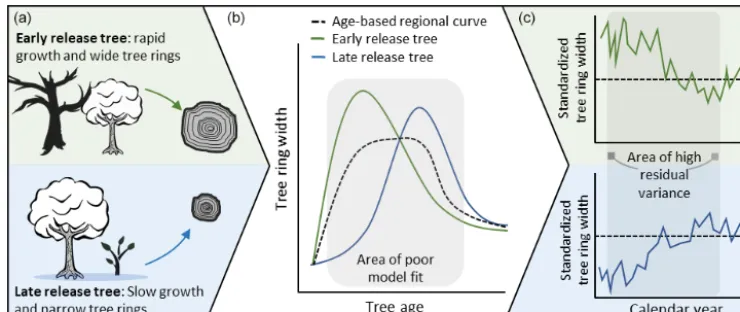
Despite these limitations, RCS remains the standard method for estimating long-term growth trends in tree ring data (Helama et al., 2017). However, the standard RCS approach encounters large limitations for many species in which accurate age estimation is difficult. Additionally, we suggest the inherent assumption of RCS that biological growth trends are sufficiently determined by tree age may not be appropriate in all species. More specifically, this assump-tion is problematic for shade-tolerant trees. Shade-tolerant species exhibit relatively low low-light mortality and thus can persist in forest understories for variable amounts of time before release from overstory light suppression. In these cases, traditional age-deterministic models exhibit high vari-ance, and thus low precision, in the period following tree establishment and leading up to the age when most trees have been released from suppression (Fig. 1). This period of ill-fit means that trees that are released relatively early (or late) from light suppression will exhibit inflated (or de-flated) growth relative to the chronology. As a result, the final chronology will show less agreement than would be expected in a shade-intolerant species. Even more problematically, if trees are sampled according to minimum size thresholds, the youngest trees in the chronology are likely to be early-release trees, leading to an artificial inflation of modern growth rates in the final chronology. While modifications to traditional RCS that address variance in contemporaneous growth rates and regional environmental conditions have been prevalent in shade-intolerant species (see Helama et al., 2017) there has been little to no focus on the improvement of standardization techniques specific to shade-tolerant tree species.
Figure 1. (a)In shade-tolerant species, young trees are stochastically released from low-light suppression in the understory.(b)Since release from suppression is not strictly related to tree age, widely used communal age trend models (RCS) poorly model tree growth in the period following establishment and leading up to the age when most trees have been released from suppression.(c)Poor model fit in this period implies that the biological growth trend is not entirely removed from individual series and leads to high residual variance when standardized tree ring series are aligned according to calendar year.
systematic evaluations of the ability of size-based models to accurately estimate long-term trends in tree ring series.
We present two tree ring standardization models that inte-grate tree size in the year of ring formation into estimation of the biological growth trend. The first model uses tree di-ameter as the sole predictor of the communal growth trend while the second includes the combined effects of both age and diameter. It follows that the objective of this study is to determine the efficacy of both models in estimating long-term growth trends in their resultant tree ring chronologies. First, we use modelled tree ring data from shade-tolerant and shade-intolerant species to make the inappropriateness of age-based models explicit for shade-tolerant trees. Further, we investigate the performance of size-based models relative to contemporary standardization methods in the presence of size thresholds in tree sampling. Last, we apply the devel-oped models to tree ring data from shade-tolerant temperate species to evaluate model performance relative to contem-porary methods, on the basis of accurate reconstruction of known long-term time-related trends in the series.
2 Methods
2.1 Model formulation
Traditional RCS makes two assumptions about tree growth: first, that trees of the same species in a given region exhibit a common growth trend as they age, and, second, that growth of an individual tree in a given year is thus a product of its age and common climatic or environmental forcing in that year (Esper et al., 2003; Briffa et al., 1992). We present a variant of the RCS method that uses tree size, measured by diameter at breast height (DBH), in the year of ring formation as the primary determinant of the common biological growth trend.
As with RCS we assume that the relationship between ex-pected growth and tree size is non-linear and can be approx-imated for a region from a sufficiently large sample of trees from the species in question. Further, we assume that using a sample of trees from a range of size and age classes ensures estimation of the common trend is not confounded by under-lying low-frequency climate or environmental forcing in the chronology (Brienen et al., 2012). The size-based regional curve model, hereafter referred to as the size-deterministic standardization (SDS) model, takes the following form:
[image:3.612.113.483.66.222.2]more complex tree ring standardization models. However, unlike division methods, the subtraction method does not provide any stabilization of variance in the resulting resid-uals; as such, it may be necessary to use a stabilization pro-cedure (i.e. log transformation, power transformation) on raw ring width data beforehand.
Tree size in a given year can be estimated by outside-in or inside-out techniques. If the pith of a tree is present in the core (or reasonably close to) DBHyis a simple summation of all previous ring widths since the year of origin, multiplied by two. Alternatively, if the pith is missed, DBHycan be cal-culated via subtraction of more modern ring widths (mul-tiplied by two) from the inside-bark diameter. In this case, inside-bark diameter is calculated as measured DBH minus bark thickness (multiplied by two), where bark thickness can be directly measured or estimated using species-specific al-lometric equations (e.g. Stayton and Hoffman, 1970).
Similar to the model formulation for SDS, RCS models were estimated with GAMs of the following form:
E(RWyi)=Bo+f1(Ageyi)+eyi, (2) where Ageyi is the age of an individual tree in a given year and the resultant standardized tree ring indices are derived from model residuals (eyi).
In addition, a more complex model that integrated inde-pendent size and age effects was also evaluated for compari-son. This model, hereafter referred to as the combined model (COMB), took the following form:
E(RWyi)=Bo+f1(Ageyia)+f2(DBHyi)+eiy. (3)
In a large variety of long-lived tree species, accurate age es-timation (pith sampling) is difficult or impossible; render-ing traditional RCS or combined models inappropriate for all trees sampled. To address this issue, the above model can incorporate unaged trees. Heref1 represents the non-linear function relating age to expected ring width for the subset of all trees that are aged (ia). In this model, ring widths from un-aged trees are assigned arbitrary ages that do not contribute to the linear approximation of the smooth term for age (i.e.
f1(Ageyia)) but these trees still contribute to the smooth term
for sizef2(DBHyi). Syntax for missing data in GAMs fol-lows the protocol provided in mgcv (Wood, 2011). In this study all GAMs were fit using the mgcv package (Wood, 2011) in the R statistical program (v.3.5.0).
In addition to the models presented above we investigated three additional standardization methods: conservative trending (CD), CM, and BAI. Conservative detrending de-scribes functions (i.e. negative exponentials, straight lines) or flexible splines fit to individual tree ring series (see Cook and Kairiukstis, 2013). In this study we use spline-fitting tech-niques rather than modified negative exponentials as they are more appropriate for shade-tolerant tree species. As above, the individual standardized tree ring width indices are de-rived from model residuals. The C-method estimates tree-specific expected ring widths by assuming constant annual
basal area increment (tree ring area) over the life span of the tree (see Biondi and Qeadan, 2008). Annual deviations from expected values thus represent standardized ring width indices. For consistency, the standard CM approach in dplR (Bunn et al., 2018) was modified in order to calculate in-dices via subtraction (residuals) instead of division. Tree ring widths were converted to BAI using the dplR package in R (Bunn et al., 2018). R code for worked examples of all standardization procedures used in this study is available (https://doi.org/10.5281/zenodo.3565813).
2.2 Simulated tree ring data
We simulated tree ring data using a well-established gap-phase model. The SORTIE-ND model was chosen over other similar gap-phase models as it better emulates understory light conditions and low-light mortality, both of which are central to the notion of age being an inappropriate determi-nant of growth in shade-tolerant species. In SORTIE, annual radial tree growth is calculated as an asymptotic function of light availability and previous tree diameter. As such, the un-derlying growth trend in SORTIE-simulated data should be well-approximated by a flexible curve estimated on the ba-sis of tree size (SDS). As such, we use this analyba-sis solely to elucidate the problematic nature of age-based standardiza-tion methods for shade-tolerant species and not to confirm the efficacy of size-based standardization methods.
For simplicity, a stand 100 % dominated by sugar maple (Acer saccharum) was simulated, as sugar maple is a model shade-tolerant species that grows in self-replacing stands. All living trees (>5 cm DBH;n=3657) in the final year of the model run were used for further analysis. Additionally, to elucidate our claim that age-deterministic growth estimation is more problematic in shade-tolerant species, we completed a similar SORTIE simulation for the shade-intolerant species white pine (Pinus strobus). Again, the stand was 100 % white pine, standard model parameters were used, and the simula-tion was run for 1000 years. All living trees (>5 cm DBH;
n=7362) in the final year of the model run were used for further analysis. Additional details regarding model parame-ters for the SORTIE simulations are provided in the Supple-ment (Sect. S1).
RWtyi=RWryi
k
1+ae−ry+1
. (4)
The logistic trend parameters (r=0.12,k=0.629,a=20) were chosen such that increases in individual tree growth averaged approximately 5 % per decade. Additionally, we tested the standardization models in their ability to detect simulated negative trends in tree growth, as previous stud-ies have noted a failure of contemporary methods to ac-curately reproduce declining growth trends (Peters et al., 2015). The simulated negative logistic trend took the form of Eq. (4) with parameters (r=0.12,k= −0.421,a=20) cho-sen such that decreases in growth averaged 5 % per decade. For completeness, we also simulated positive and negative linear trends. Results of those analyses are provided in the Supplement (Sect. S3).
A total of 60 trees were randomly selected, without re-placement, from the simulated tree populations and sub-ject to each of the six standardization methods (SDS, RCS, COMB, CD, BAI, CM). Model residuals (in the case of RCS, SDS, COMB, CD and CM) or transformed (BAI) tree ring widths were compiled into an annual mean chronology us-ing Tukey’s biweight robust mean. The resultant chronolo-gies were then tested for significant correlation with the im-posed trends using Spearman’s rank correlation coefficient. This process was bootstrap resampled (with replacement) 100 times, in order to produce confidence intervals for the resultant mean chronologies and their respective correlation coefficients.
To examine the effect of minimum size sampling thresh-olds on the accuracy of long-term trend reconstruction by each of the standardization methods, we completed the same analysis on trees from the simulated populations that ex-ceeded certain size thresholds. The thresholds employed were 10 cm DBH, which represented a practical minimum size threshold for sampling, and 30 and 50 cm DBH which represented thresholds for mature and dominant trees, re-spectively. The CD method was only applied when size thresholds exceeded 10 cm DBH due to the troublesome na-ture of fitting splines to excessively short time series. The mean Spearman’s rho for all detrending methods and sam-pling thresholds were compared using two-way ANOVA and post hoc tests.
2.3 Real tree ring data
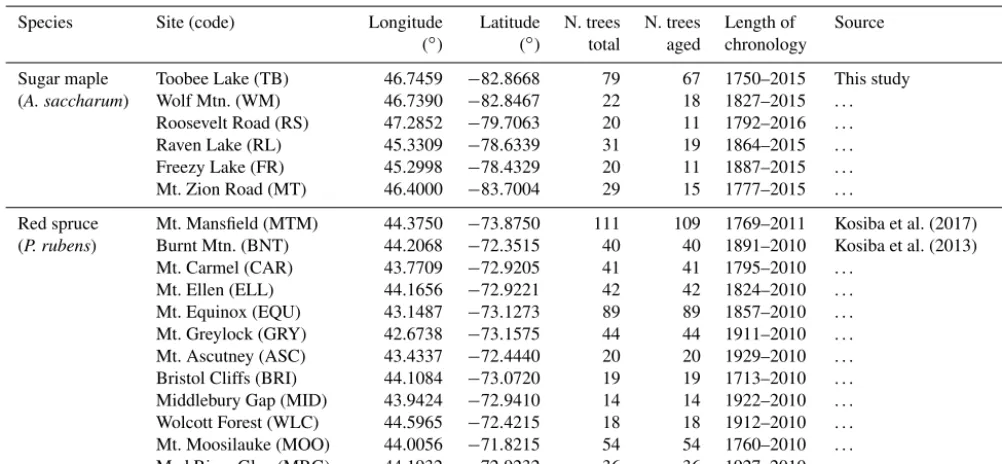
Additionally, we evaluated the performance of the six stan-dardization methods in real tree ring data from shade-tolerant species. We collected tree ring data from seven ma-ture sugar maple-dominated stands in Ontario, Canada (Ta-ble 1). Further, tree ring data sets from the shade-tolerant species red spruce (Picea rubens) were obtained from the DendroEcological Network database (https://www.uvm.edu/ femc/dendro, last access: 6 December 2019; Table 1). Red
spruce was chosen as it had sufficient replication across stud-ies in the database. Descriptions of the sampling strategstud-ies and data-processing methods for all sites considered are pro-vided in either the Supplement (Sect. S3) or in their respec-tive references (i.e. Kosiba et al., 2013, 2017). Data were considered suitable for this study if age and DBH estimates were provided and if a minimum 10 trees per site and species were sampled and accurately aged. All cores in which pith offset was estimated to be greater than 10 years were con-sidered unaged. To simplify comparisons of the resultant chronologies, unaged trees were not included in the models. Prior to model application, a time-deterministic thin plate regression spline was applied to all raw ring widths from each site. This ensured there was no underlying time trend present in the data. Since trees of multiple ages/sizes were sampled in each study we assume the removed time trend is therefore independent of biological trends in the series. For each site, residuals from the regression spline were centred according to the site-wise mean and standard deviation of raw ring widths prior to analysis.
Again, increasing and decreasing logistic trends (Eq. 4), as well as linear trends (Supplement, Sect. S3), were added to the (recentred) tree ring residuals. Trend parameters were chosen such that the increase (or decrease) in tree growth averaged 5 % per decade over the last 50 years of growth (r=0.12,k=0.276, a=20, positive trend; r=0.12, k= −0.226,a=20, negative trend). For each site all trees were subject to each of the six standardization methods (SDS, RCS, COMB, CD, BAI, and CM). Model residuals (in the case of RCS, SDS, COMB, CD, and CM) or transformed (BAI) tree ring widths were compiled into an annual mean chronology using Tukey’s biweight robust mean. The resul-tant chronologies were then tested for significant correlation with the imposed trends using Spearman’s rank correlation coefficient. In both species (sugar maple and red spruce) one-way ANOVA and Tukey post hoc comparisons were used to test for significant differences in model performance, as esti-mated by chronology correlation with the imposed trend.
3 Results
3.1 Comparisons of methods in simulated data
Table 1.Location, sample size, chronology length, and source of tree ring data sets used in this study.
Species Site (code) Longitude Latitude N. trees N. trees Length of Source (◦) (◦) total aged chronology
Sugar maple Toobee Lake (TB) 46.7459 −82.8668 79 67 1750–2015 This study
(A. saccharum) Wolf Mtn. (WM) 46.7390 −82.8467 22 18 1827–2015 . . .
Roosevelt Road (RS) 47.2852 −79.7063 20 11 1792–2016 . . .
Raven Lake (RL) 45.3309 −78.6339 31 19 1864–2015 . . .
Freezy Lake (FR) 45.2998 −78.4329 20 11 1887–2015 . . . Mt. Zion Road (MT) 46.4000 −83.7004 29 15 1777–2015 . . .
Red spruce Mt. Mansfield (MTM) 44.3750 −73.8750 111 109 1769–2011 Kosiba et al. (2017)
(P. rubens) Burnt Mtn. (BNT) 44.2068 −72.3515 40 40 1891–2010 Kosiba et al. (2013)
Mt. Carmel (CAR) 43.7709 −72.9205 41 41 1795–2010 . . .
Mt. Ellen (ELL) 44.1656 −72.9221 42 42 1824–2010 . . .
[image:6.612.128.469.373.653.2]Mt. Equinox (EQU) 43.1487 −73.1273 89 89 1857–2010 . . . Mt. Greylock (GRY) 42.6738 −73.1575 44 44 1911–2010 . . . Mt. Ascutney (ASC) 43.4337 −72.4440 20 20 1929–2010 . . . Bristol Cliffs (BRI) 44.1084 −73.0720 19 19 1713–2010 . . . Middlebury Gap (MID) 43.9424 −72.9410 14 14 1922–2010 . . . Wolcott Forest (WLC) 44.5965 −72.4215 18 18 1912–2010 . . . Mt. Moosilauke (MOO) 44.0056 −71.8215 54 54 1760–2010 . . . Mad River Glen (MRG) 44.1932 −72.9232 36 36 1927–2010 . . .
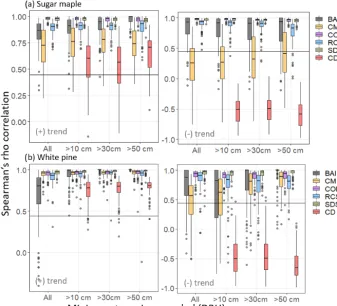
Figure 3.Spearman’s rho correlation between chronologies produced by each of the five standardization methods and the imposed positive (left column) or negative (right column) logistic trend in SORTIE-simulated(a)sugar maple and(b)white pine tree ring data. Correlation distribution created by bootstrap resampling 60 trees (rep=100) from SORTIE-simulated tree populations. The horizontal axis denotes minimum tree size (DBH) thresholds for sampling from the population. Horizontal lines indicate threshold for significant Spearman’s rho (a=0.05) for correlation between chronologies and the imposed trend.
3.2 Simulated sugar maple tree ring data
In the simulated sugar maple data, two-way ANOVA sug-gested a significant effect of both the standardization model (p <0.001) and minimum size sampling threshold (p <
0.001) on average correlation with the positive logistic trend. Alternatively, for the negative logistic trend there was a significant effect of the standardization model (p <0.001) but not of the size sampling threshold. For both positive and negative logistic trends SDS (rs=0.974±0.037, rs= 0.954±0.068, respectively) and COMB (rs=0.965±0.039,
rs=0.894±0.123, respectively) models produced chronolo-gies with significantly higher correlations than all other mod-els (p <0.001 for all) but that were not significantly dif-ferent from each other (p=0.998,p=1.000, respectively). For the positive imposed trend, BAI (rs=0.864±0.236) and RCS (rs=0.900±0.162) produced chronologies with corre-lations significantly higher than CD (rs= −0.503±0.329) and CM (rs=0.746±0.306) (with p <0.001 for all ex-amples) but that were not significantly different from each other (p=0.996). Notably, correlations exhibited by BAI chronologies were dependent on size sampling thresholds
with BAI chronologies performing best when size thresh-olds exceeded 50 cm DBH (Fig. 3a). At this threshold BAI chronologies produced significantly higher correlations than when all trees were sampled (p=0.003) and when trees>
10 cm DBH were sampled (p <0.001). The CD method pro-duced chronologies that exhibited the lowest average correla-tion with the imposed positive trend of all models (p <0.001 for all).
3.3 Simulated white pine tree ring data
In simulated white pine data, two-way ANOVA suggested a significant effect of both standardization model (p <0.001) and minimum size sampling threshold (p <0.001) on av-erage correlations for both the positive and negative lo-gistic trend analyses. For the positive trend, chronologies produced by SDS (rs=0.977±0.026), RCS (rs=0.932± 0.091), COMB (rs=0.956±0.052), and CM (rs=0.953± 0.045) produced high correlations across all sampling thresh-olds, with SDS performing significantly better than CM (p=0.006) and RCS (p=0.001). All four models pro-duced significantly higher correlations than those propro-duced by BAI (rs=0.899±0.222) or CD (rs=0.767±0.126) chronologies, with CD producing the lowest correlations of all models. Contrasts suggested that the significant effect of minimum size threshold was driven by significant dif-ferences in correlations from BAI chronologies across sam-ple thresholds, whereby BAI chronologies exhibited signif-icantly lower correlations when no minimum size thresh-olds (i.e. all trees sampled) were employed (p <0.001 in all cases; Fig. 3b).
When examining negative imposed trends, SDS (rs= 0.942±0.090) and COMB (rs=0.904±0.097) models pro-duced chronologies with significantly higher correlations than all the other models but that are not significantly differ-ent from each other (p=0.594). BAI (rs=0.750±0.390) and RCS (rs=0.772±0.245) produced chronologies with correlations significantly higher than CD (rs= −0.505± 0.316) and CM (rs=0.623±0.362) (p <0.001 for all) but that were not significantly different from each other (p= 1.00). CD chronologies exhibited significantly lower corre-lations than all other models (p <0.001 for all). Contrasts suggested that the significant effect of minimum size thresh-old was driven by significant difference in correlations of chronologies produced by BAI and CM among sampling thresholds. As evident in Fig. 3b, BAI chronologies per-formed significantly better when sampling thresholds ex-ceeded 50 cm DBH, and CM chronologies performed best when sampling thresholds exceeded 30 cm DBH.
3.4 Comparisons of methods in real tree ring data Standardization methods were evaluated on the basis of cor-relations between their resultant chronologies and known time-related trends in tree ring series from shade-tolerant species.
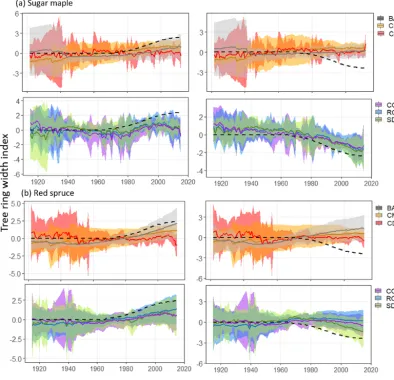
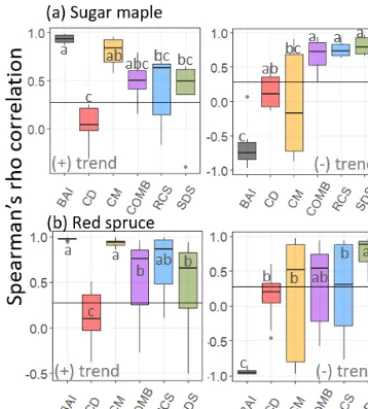
Confidence intervals surrounding chronologies produced from each of the standardization methods applied to the tree ring series from six sugar maple stands are provided in Fig. 4a for both positive and negative logistic trends. The cor-responding distributions of Spearman’s rank correlation co-efficients are provided in Fig. 5a with significant differences (p <0.05) being denoted by letters. Chronologies and cor-responding correlation coefficients for the identical analysis
performed on 12 red spruce stands are provided in Figs. 4b and 5b.
Regardless of trend direction, RCS, COMB, and SDS chronologies exhibited comparable and consistent results across both species (Fig. 5). In general, chronologies pro-duced by all three methods exhibited conservative but re-liable estimations of the imposed trends (Fig. 4). SDS produced chronologies with correlations as high or higher (Fig. 5b, negative trend) than traditional RCS chronologies. Notably, the BAI and CM methods produced strong posi-tive correlations between chronologies and the imposed trend only when the imposed trend was increasing (Figs. 4, 5) but both consistently failed to reproduce negative trends (Fig. 4). Finally, across both species, CD chronologies exhibited low correlations with the imposed trend regardless of direction (Figs. 4, 5).
4 Discussion
4.1 Size-deterministic vs. age-deterministic models for long-term trend reconstruction
Figure 4.Standardized chronologies produced by each standardization method (legend on the right side) applied to tree ring series from (a)sugar maple (n=6) and(b)red spruce (n=12) stands. Solid lines represent the resultant model-wise mean chronologies across all stands considered, while ribbons represent respective 95 % confidence intervals. Dotted lines indicate the standardized positive (left side) or negative (right side) logistic trend that was added to the raw tree ring data.
and size may not be perfectly correlated (Peters et al., 2015; Bontemps and Esper, 2011).
Unfortunately, all systematic comparisons of tree ring standardization methods in real tree ring data (e.g. Sullivan et al., 2016) are limited by their inability to validate long-term trends estimated by chronologies. In this study we evaluate standardization methods on their ability to reconstruct artifi-cial trends in tree ring data. We show that SDS and COMB models are as reliable as the traditional RCS method in ac-curately detecting long-term trends in shade-tolerant species. Further, SDS appears to provide more reliable reconstruc-tions when the underlying trend is negative. To our knowl-edge, only one other study has evaluated size-deterministic models on the basis of long-term trend reconstruction in chronologies. Bontemps and Esper (2011) compared RCS and SDS chronologies in common beech (Fagus sylvatica
L.) and conclude that both exhibit similar variations, with the magnitude of difference varying between 3 % and 7 %. However, other studies have examined the influence tree size in explicit models of BAI. In tropical tree species of varying shade-tolerance, Nock et al. (2011) note that linear mixed models of BAI that included tree diameter had more sup-port than those that included age. This result is corroborated by analyses of mixed models of BAI in Mediterranean pine species that suggest that the effect of DBH on BAI is more important than the effect of tree age (Marqués et al., 2016). In line with discussion above, Nock et al. (2011) attribute this finding to size being a more important determinant of light capture as it relates to tree height and crown size (King et al., 2005).
Figure 5.Standardized chronologies produced by each standardiza-tion method applied to tree ring series from(a)sugar maple (n=6) and (b) red spruce (n=12) stands. Solid lines represent the re-sultant model-wise mean chronologies across all stands considered while ribbons represent respective 95 % confidence intervals. Dot-ted lines indicate the standardized positive (left side) or negative (right side) logistic trend that was added to the raw tree ring data.
by choice of standardization model. Tree age can be difficult or impossible to accurately estimate for some trees. In con-trast, annual tree size can be reliability estimated from DBH and tree ring measurements more ubiquitously. We note that in this study only 66 % of sugar maple trees could be ac-curately aged. Since unaged trees are likely to be the old-est trees in the chronology, it follows that RCS chronolo-gies may exhibit poor sample replication (especially in early years) and may be significantly shorter than those typically produced by SDS or COMB models. This has obvious im-plications for data quality and suitability. Considerably prob-lematic is the “segment length curse”, whereby almost all standardization methods are ill-equipped to estimate long-term trends on timescales greater than or equal to the length of the chronology itself (Cook et al., 1995). Excessively short RCS chronologies are therefore limited in their application. A large advantage of SDS and COMB models is that they can incorporate otherwise inadmissible tree ring data.
This study does not explicitly test the efficacy of COMB models relative to SDS in the presence of unaged trees. We have also not provided evidence to suggest that the added complexity of COMB models relative to SDS is beneficial to accurate reconstruction of trends in the resultant chronolo-gies. Given the merit the of size-deterministic models pre-sented here, we suggest that future research explores the im-plications of the trade-off between model information and complexity in the presence of unaged trees.
4.2 BAI, CM, and CD methods for long-term trend reconstruction
The finding that CD did not produce accurate long-term trends in simulated tree ring data is consistent with our expectations (Peters et al., 2015; Briffa et al., 1992). We maintain CD should be avoided if the goal is long-term reconstruction from tree ring data. More interestingly, we have shown that CM and BAI, although designed for shade-intolerant open growth trees, do not reliably reconstruct neg-ative long-term trends in simulated white pine tree ring data. Further, our analysis suggests BAI is less reliable when small and young trees are sampled. This result is corroborated in our study by a failure of both methods to reconstruct nega-tive trends in real sugar maple and red spruce tree ring data. Further, this finding is in line with Peters et al. (2015), who note low reliability of BAI and that BAI is likely to produce erroneous trends when the underlying trend is of low signal, as would be the case for young and small trees that have low BAI rates and low climate sensitivity.
Both BAI and CM impart a strict relationship between tree size and growth. It has been suggested that this relation-ship may not account for the entire biological growth trend, leading to the maintenance of erroneous long-term trends in the resultant chronologies (Peters et al., 2015). Erroneous in-creasing trends are indeed noted in both sugar maple (Fig. 4a) and red spruce (Fig. 4b) chronologies produced by BAI and CM in our study. Accordingly, we caution future studies in their interpretation of BAI and CM trends in low-signal tree ring series.
Other studies have explicitly modelled size and/or age ef-fects on BAI using a mixed-effect modelling approach (e.g. Marqués et al., 2016; Camarero et al., 2015; Nock et al., 2011; Martínez-Vilalta et al., 2008). We suggest this ap-proach may better account for species- and site-specific ftors that influence expected growth rates, leading to more ac-curate estimates of long-term trends in the resultant chronol-ogy. While our findings regarding the importance of inclu-sion of size in tree ring standardization models are presented in the context of raw tree ring width models, they are also directly relevant to explicit models of BAI.
A more thorough discussion of the limitations of the CD, BAI, and CM methods, as relevant to reconstruction of long-term trends, is beyond the scope of this study. The interested reader is directed to Peters et al. (2015).
4.3 Other considerations and future research
bias), as our study is not designed to detect and isolate the ef-fects of contemporaneous differences in growth among trees that produce these biases. There is now substantial evidence to suggest that the long-standing practice of sampling only dominant trees or trees exceeding a minimum size thresh-old within a stand leads to considerable bias in the resul-tant chronology (Nehrbass-Ahles et al., 2014; Brienen et al., 2012; Briffa and Melvin, 2011). This bias is consistent across standardization methods (Duchesne et al., 2019; Nehrbass-Ahles et al., 2014). We maintain that in cases of long-term trend reconstruction, stands should be sampled according to the underlying stand age and size distribution, either through use of fixed-plots or random tree selection, regardless of the standardization procedure used.
Given the underlying physiological justification of the models presented here, we have no reason to suggest they are not broadly applicable to species of all shade-tolerance levels. We recommend future studies investigate the appli-cability of SDS and COMB models to both tree ring width and BAI data in a wider range of species. That said, shade-tolerant and broadleaf species and their applicable standard-ization procedures are underrepresented in dendrochronolog-ical studies (Zhao et al., 2019). Further, the applicability of enhanced tree ring standardization models (including tradi-tional RCS and BAI) to global tree ring data sets are limited by widely unavailable metadata (i.e. tree age and DBH) in tree ring databases. Accordingly, we recommend more strin-gent requirements on the inclusion of applicable metadata in global databases in order to accommodate more complicated standardization models. We advocate for continued refine-ment of tree ring standardization procedures that are relevant to the ecological questions they aim to address.
Data availability. Tree ring data collected in this study are avail-able at https://doi.org/10.17632/3jh73nmxf2.1 (Dietrich, 2019). Additionally, this study uses data tree ring data collected by Kosiba et al. (2013) and Kosiba et al. (2017); these data sets are available through the FEMC DendroEcological Network at https://www.uvm. edu/femc/dendro/project/14 (last access: 9 December 2019) and https://www.uvm.edu/femc/dendro/project/13 (last access: 9 De-cember 2019), respectively.
Supplement. The supplement related to this article is available on-line at: https://doi.org/10.5194/bg-16-4815-2019-supplement.
Author contributions. RD collected the data, conceived and de-signed the analysis, performed the analysis, and wrote the pa-per. MA supervised the project and provided critical feedback that helped shape research and analysis.
Competing interests. The authors declare that they have no conflict of interest.
Acknowledgements. We are grateful to the two anonymous review-ers, whose thoughtful and thorough comments greatly improved the impact and intelligibility of this paper. We are also grateful to the staff of the Ontario Forest Research Institute, who supported field-work for this study, particularly F. Wayne Bell. Further, we thank Ontario Parks and the Haliburton Forest Reserve for providing ac-cess to field sites.
Financial support. This research has been supported by the Natu-ral Sciences and Engineering Research Council of Canada (grant nos. 400453 and 519655) and the Ministry of Natural Resources and Forestry.
Review statement. This paper was edited by Sebastiaan Luyssaert and reviewed by two anonymous referees.
References
Battipaglia, G., Saurer, M., Cherubini, P., Calfapietra, C., McCarthy, H. R., Norby, R. J., and Francesca Cotrufo, M.: Elevated CO2 in-creases tree-level intrinsic water use efficiency: insights from car-bon and oxygen isotope analyses in tree-rings across three forest FACE sites, New Phytol., 197, 544–554, 2013.
Boisvenue, C. and Running, S. W.: Impacts of climate change on natural forest productivity–evidence since the middle of the 20th century, Glob. Change Biol., 12, 862–882, 2006.
Bontemps, J. D. and Esper, J.: Statistical modelling and RCS de-trending methods provide similar estimates of long-term trend in radial growth of common beech in north-eastern France, Den-drochronologia, 29, 99–107, 2011.
Brienen, R. J., Gloor, E., and Zuidema, P. A.: Detecting evi-dence for CO2fertilization from tree-ring studies: The potential role of sampling biases, Global Biogeochem. Cy., 26, GB1025, https://doi.org/10.1029/2011GB004143, 2012.
Biondi, F. and Qeadan, F.: A theory-driven approach to tree-ring standardization: defining the biological trend from expected basal area increment, Tree-Ring Res., 64, 81–97, 2008. Briffa, K. R. and Melvin, T. M.: A closer look at regional curve
standardization of tree-ring records: justification of the need, a warning of some pitfalls, and suggested improvements in its ap-plication, in: Dendroclimatology, 113–145, Springer, Dordrecht, 2011.
Briffa, K. R., Jones, P. D., Bartholin, T. S., Eckstein, D., Schwe-ingruber, F. H., Karlen, W., Zetterberg, P., and Eronen, M.: Fennoscandian summers from AD 500: temperature changes on short and long timescales, Clim. Dynam., 7, 111–119, 1992. Briffa, K. R., Jones, P. D., Schweingruber, F. H., Karlén, W., and
Shiyatov, S. G.: Tree-ring variables as proxy-climate indicators: problems with low-frequency signals, in: Climatic variations and forcing mechanisms of the last 2000 years, 9–41, Springer, Berlin, Heidelberg, 1996.
Canham, C. D., LePage, P. T., and Coates, K. D.: A neighborhood analysis of canopy tree competition: effects of shading versus crowding, Can. J. Forest Res., 34, 778–787, 2004.
Camarero, J. J., Gazol, A., Tardif, J. C., and Conciatori, F.: Attribut-ing forest responses to global-change drivers: limited evidence of a CO2-fertilization effect in Iberian pine growth, J. Biogeogr., 42, 2220–2233, 2015.
Cook, E. R. and Kairiukstis, L. A. (Eds.): Methods of den-drochronology: applications in the environmental sciences, Springer Science & Business Media, 2013.
Cook, E. R., Briffa, K. R., Meko, D. M., Graybill, D. A., and Funkhouser, G.: The “segment length curse” in long tree-ring chronology development for palaeoclimatic studies, Holocene, 5, 229–237, 1995.
Chen, L., Huang, J. G., Dawson, A., Zhai, L., Stadt, K. J., Comeau, P. G., and Whitehouse, C.: Contributions of insects and droughts to growth decline of trembling aspen mixed boreal forest of west-ern Canada, Glob. Change Biol., 24, 655–667, 2018.
Dietrich, R.: Data for: When trees don’t act their age: size-deterministic tree ring standardization for long-term trend estimation in shade tolerant tree, Mendeley Data, v1, https://doi.org/10.17632/3jh73nmxf2.1, 2019.
Dietrich, R., Bell, F. W., Silva, L. C., Cecile, A., Horwath, W. R., and Anand, M.: Climatic sensitivity, water-use efficiency, and growth decline in boreal jack pine (Pinus banksiana) forests in Northern Ontario, J. Geophys. Res.-Biogeo., 121, 2761–2774, 2016.
Duchesne, L., Houle, D., Ouimet, R., Caldwell, L., Gloor, M., and Brienen, R.: Large apparent growth increases in boreal forests inferred from tree-rings are an artefact of sampling biases, Sci. Rep.-UK, 9, 6832, https://doi.org/10.1038/s41598-019-43243-1, 2019.
Esper, J., Cook, E. R., Krusic, P. J., Peters, K., and Schweingruber, F. H.: Tests of the RCS method for preserving low-frequency variability in long tree-ring chronologies, Tree-Ring Res., 59, 81–98, 2003.
Gavin, D. G., Beckage, B., and Osborne, B.: Forest dynamics and the growth decline of red spruce and sugar maple on Bolton Mountain, Vermont a comparison of modeling methods, Can. J. Forest Res., 38, 2635–2649, 2008.
Gedalof, Z. E. and Berg, A. A.: Tree-ring evidence for limited direct CO2 fertilization of forests over the 20th century, Global Biogeochem. Cy., 24, GB3027, https://doi.org/10.1029/2009GB003699, 2010.
Giguère-Croteau, C., Boucher, É., Bergeron, Y., Girardin, M. P., Drobyshev, I., Silva, L. C., Hélie, J. F., and Gar-neau, M.: North America’s oldest boreal trees are more ef-ficient water users due to increased [CO2], but do not grow faster, P. Natl. Acad. Sci. USA, 116, 2749–2754, https://doi.org/10.1073/pnas.1816686116, 2019.
Girardin, M. P., Bernier, P. Y., Raulier, F., Tardif, J. C., Concia-tori, F., and Guo, X. J.: Testing for a CO2 fertilization effect on growth of Canadian boreal forests, J. Geophys. Res.-Biogeo., 116, G01012, https://doi.org/10.1029/2010JG001287, 2011. Granda, E., Rossatto, D. R., Camarero, J. J., Voltas, J., and
Val-ladares, F.: Growth and carbon isotopes of Mediterranean trees reveal contrasting responses to increased carbon dioxide and drought, Oecologia, 174, 307–317, 2014.
Helama, S., Lindholm, M., Timonen, M., and Eronen, M.: Detec-tion of climate signal in dendrochronological data analysis: a comparison of tree-ring standardization methods, Theor. Appl. Climatol., 79, 239–254, 2004.
Helama, S., Melvin, T. M., and Briffa, K. R.: Regional curve stan-dardization: State of the art, Holocene, 27, 172–177, 2017. Herguido, E., Granda, E., Benavides, R., García-Cervigón, A. I.,
Camarero, J. J., and Valladares, F.: Contrasting growth and mor-tality responses to climate warming of two pine species in a con-tinental Mediterranean ecosystem, Forest Ecol. Manage., 363, 149–158, 2016.
Homann, P. S., McKane, R. B., and Sollins, P.: Belowground processes in forest-ecosystem biogeochemical simulation mod-els, Forest Ecol. Manage., 138, 3–18, 2000.
Huang, J. G., Bergeron, Y., Denneler, B., Berninger, F., and Tardif, J.: Response of forest trees to increased atmospheric CO2, CRC Cr. Rev. Plant Sci., 26, 265–283, 2007.
Jacoby, G. C. and D’Arrigo, R. D.: Tree-rings, carbon dioxide, and climatic change, P. Natl. Acad. Sci. USA, 94, 8350–8353, 1997. King, D. A., Davies, S. J., Supardi, M. N., and Tan, S.: Tree growth is related to light interception and wood density in two mixed dipterocarp forests of Malaysia, Funct. Ecol., 19, 445–453, 2005. Kosiba, A. M., Schaberg, P. G., Hawley, G. J., and Hansen, C. F.: Quantifying the legacy of foliar winter injury on woody aboveground carbon sequestration of red spruce trees, Forest Ecol. Manage., 302, 363–371, https://doi.org/10.1016/j.foreco.2013.03.006, 2013 (data available at: https://www.uvm.edu/femc/dendro/project/14, last access: 6 December 2019).
Kosiba, A. M., Schaberg, P. G., Rayback, S. A., and Haw-ley, G. J.: Comparative growth-trends of five northern hard-wood and montane tree species reveal divergent trajectories and response to climate, Can. J. Forest Res., 47, 743–754, https://doi.org/10.1139/cjfr-2016-0308, 2017 (data available at: https://www.uvm.edu/femc/dendro/project/13, last access: 6 De-cember 2019).
Lehnebach, R., Beyer, R., Letort, V., and Heuret, P.: The pipe model theory half a century on: a review, Ann. Bot.-London, 121, 773– 795, 2018.
Liang, E., Leuschner, C., Dulamsuren, C., Wagner, B., and Hauck, M.: Global warming-related tree growth decline and mortality on the north-eastern Tibetan plateau, Climatic Change, 134, 163– 176, 2016.
Linares, J. C., Delgado-Huertas, A., Julio Camarero, J., Merino, J., and Carreira, J. A.: Competition and drought limit the response of water-use efficiency to rising atmospheric carbon dioxide in the Mediterranean firAbies pinsapo, Oecologia, 161, 611–624, 2009.
Marqués, L., Camarero, J. J., Gazol, A., and Zavala, M. A.: Drought impacts on tree growth of two pine species along an altitudinal gradient and their use as early-warning signals of potential shifts in tree species distributions, Forest Ecol. Manage., 381, 157–167, 2016.
Martinelli, N.: Climate from dendrochronology: latest develop-ments and results, Global Planet. Change, 40, 129–139, 2004. Martínez-Vilalta, J., López, B. C., Adell, N., Badiella, L., and
Melvin, T. M., Briffa, K. R., Nicolussi, K., and Grabner, M.: Time-varying-response smoothing, Dendrochronologia, 25, 65– 69, 2007.
Munné-Bosch, S.: Aging in perennials, Crit. Rev. Plant Sci., 26, 123–138, 2007.
Nehrbass-Ahles, C., Babst, F., Klesse, S., Nötzli, M., Bouriaud, O., Neukom, R., Dobbertin, M., and Frank, D.: The influence of sampling design on tree-ring-based quantification of forest growth, Glob. Change Biol., 20, 2867–2885, 2014.
Nock, C. A., Baker, P. J., Wanek, W., Leis, A., Grabner, M., Bun-yavejchewin, S., and Hietz, P.: Long-term increases in intrin-sic water-use efficiency do not lead to increased stem growth in a tropical monsoon forest in western Thailand, Glob. Change Biol., 17, 1049–1063, 2011.
Norby, R. J., DeLucia, E. H., Gielen, B., Calfapietra, C., Giardina, C. P., King, J. S., Ledford, J., McCarthy, H. R., Moore, D. J. P., Ceulemans, R., De Angelis, P., Finzi, A. C., Karnosky, D. F., Ku-biske, M. E., Lukac, M., Pregitzer, K. S., Scarascia-Mugnozza, G. E., Schlesinger, W. H., and Oren, R.: Forest response to ele-vated CO2is conserved across a broad range of productivity, P. Natl. Acad. Sci. USA, 102, 18052–18056, 2005.
Peñuelas, J., Canadell, J. G., and Ogaya, R.: Increased water-use efficiency during the 20th century did not translate into enhanced tree growth, Global Ecol. Biogeogr., 20, 597–608, 2011. Peters, R. L., Groenendijk, P., Vlam, M., and Zuidema, P. A.:
De-tecting long-term growth-trends using tree-rings: a critical eval-uation of methods, Glob. Change Biol., 21, 2040–2054, 2015. Silva, L. C. and Anand, M.: Probing for the influence of
atmo-spheric CO2 and climate change on forest ecosystems across biomes, Global Ecol. Biogeogr., 22, 83–92, 2013.
Silva, L. C., Anand, M., and Leithead, M. D: Recent widespread tree growth decline despite increasing atmospheric CO2, PloS one, 5, e11543, https://doi.org/10.1371/journal.pone.0011543, 2010.
Stayton, C. L. and Hoffman, M.: Estimating sugar maple bark thick-ness and volume, USDA Forest Service Research Paper NC-38, St. Paul, Minnesota, USA, 1970.
Sullivan, P. F., Pattison, R. R., Brownlee, A. H., Cahoon, S. M., and Hollingsworth, T. N.: Effect of tree-ring detrend-ing method on apparent growth-trends of black and white spruce in interior Alaska, Environ. Res. Lett., 11, 114007, https://doi.org/10.1088/1748-9326/11/11/114007, 2016. Villalba, R., Lara, A., Masiokas, M. H., Urrutia, R., Luckman, B.
H., Marshall, G. J., Mundo, I. A., Christie, D. A., Cook, E. R., Neukom, R., Allen, K., Fenwick, P., Boninsegna, J. A., Srur, A. M., Morales, M. S., Araneo, D., Palmer, J. G., Cuq, E., Aravena, J. C., Holz, A., and LeQuesne, C.: Unusual Southern Hemisphere tree growth patterns induced by changes in the Southern Annular Mode, Nat. Geosci., 5, 793, https://doi.org/10.1038/ngeo1613, 2012.
Wang, G., Chhin, S., and Bauerle, W. L.: Effect of natural atmo-spheric CO2fertilization suggested by open-grown white spruce in a dry environment, Glob. Change Biol., 12, 601–610, 2006. West, G. B., Brown, J. H., and Enquist, B. J.: A
gen-eral model for ontogenetic growth, Nature, 413, 628, https://doi.org/10.1038/35098076, 2001.
Wood, S. N.: Fast stable restricted maximum likelihood and marginal likelihood estimation of semiparametric generalized linear models, J. R. Stat. Soc. B, 73, 3–36, 2011.