Page 63
IMPROVING UNDERSTANDING AND APPROACH TO DEVELOPMENTAL DISORDERS IN STUDENTS OF THE DEGREE IN EARLY CHILDHOOD EDUCATION: INCLUSION OF
PRACTICAL ACTIVITIES BASED ON EXPERIENTIAL LEARNING AND PROJECT-BASED LEARNING
Eva Vicente Sánchez, Maria Angeles Bravo-Alvarez, Francisco Eguinoa Zaborras, Juan-José Navarro Hidalgo
Faculty of Education, University of Zaragoza, Pedro Cerbuna Street, Zaragoza, 50009, Spain
Abstract
Under the framework of a training innovation project grant in order to promote both innovation actions and improvement of students´ center learning as well as the quality of the degrees run by the University of Zaragoza during the academic year 2018-2019, some new voluntary practical activities were included in the compulsory subject of developmental disorders. This is a subject taught during the second-year of degree in Early Childhood Education.
The aims of the projects were: 1) To promote active and voluntary involvement of the students organizing the First Conference on disability and developmental disorders: training and awareness; and 2) To promote the development of specific projects that delved deeper into an issue relating to the mandatory subject and its implementation in schools for students with special educational needs. A total of 140 students in their second year of early childhood education degree participated in the project. All of them attended to the First Conference on Disability and Developmental Disorders: Training and Awareness-raising, even if 25 of them were actively engaged in organizing the conference and 4 of them developed specific projects.
The assessment was based on perceived usefulness of the project and students´ satisfaction level associated with normal and new complementary practices developed in this project. An initial and a final assessment questionnaire was designed using Google Forms.
The results showed that students who attended to the conference expressed a high degree of satisfaction with the project. They strongly valued the opportunity to learn about real educational experiences in formal and informal education. The same results were obtained in students who actively engaged in the conference and those who developed a specific project related to the subject.
Keywords: developmental disorders, project-based learning, experiential learning, special educational needs
1. INTRODUCTION
Protected by a training innovation project grant in order to promote innovation actions and improvement of students´ center learning as well as the quality of the degrees in the University of Zaragoza (Spain) during the academic year 2018-2019, some new voluntary practical activities were included in the compulsory subject of developmental disorders. The experience was based on project learning and experiential learning. It was developed in the subject of Developmental Disorders in a
transversal way. Developmental Disorders is a subject taught during the second-year of degree in
Early Childhood Education.
According to Martí, Heydrich and Rojas (2010) project-based learning is a learning model with which students work actively, being able to plan and evaluate projects that have an application in the real
world. Thus, in thisinnovation project, motivating projects were provided to the students. The projects
Page 64
The tasks developed by the students who voluntarily enrolled in the development of projects consisted in the search of documentation and materials on the specific theme chosen in order to examine more in-depth and respond to the objective set by the project, as well as in the preparation of a structured project, well written, correctly cited. The project should include a contextualization on the subject with searches of adequate bibliographic sources, a description and justification of the project's aim, a development and design of an innovative and creative proposal to respond to the aim set for the project and a final reflection on their learnings after the development of the practice.
On the other hand, Kobs (1984, p.41) defines experiential learning as “the process whereby knowledge is created through the transformation of experience”. He notes that the improvement of experiential learning can be achieved by creating learning spaces that promote the production growth of experiences for students (Kolb & Kolb, 2015). This learning offers a unique opportunity to connect theory and practice and consolidates a more meaningful, transferable and contextualized knowledge (Romero, 2010). Thus, in this innovation project it was proposed that students could join as volunteers in the organization of First Awareness Raising Conference on Disability and Developmental Disorders. Groups were organized to energize the thematic tables of the Conference. Students had to get familiarized with the invited entities, establish contact with real professionals and design the script of questions that would stimulate the specific session of the day. In turn, students had to submit a dossier with the following sections: 1) Contextualization on the topic of the table-discussion; 2) Description of the materials sought for the day and criteria used to select them; 3) Complete description of the materials finally selected and justification of their use; 4) Process of elaboration and design of the protocol of questions for the table-discussion; and 5) Final reflection on their learning after the development of the practice.
All the students enrolled in the course attended to this Conference, whether they participated or not in the innovation project, furthermore, it was open to the entire educational community. It had a great reception not only among the students of other courses, but also among family members and even external students (non-university).
Therefore, through its implementation it was intended to improve the acquisition of specific skills of the subject through voluntary practical activities based on project learning and experiential learning whose aims were: 1) To promote active and voluntary involvement of the students organizing the First Conference of Disability and Developmental Disorders: training and awareness; and 2) To promote the development of specific projects that delved deeper into an issue relating to the mandatory subject and its implementation in schools for students with special educational needs. In order to verify the objectives and to investigate the opinion of the students about the usual practices developed in the subject and the new complementary practices implemented in this project, an evaluation process was designed with the students with the following operational objectives:
- To investigate the degree of utility and satisfaction that students perceive about the practices and activities developed in the subject (the usual and the new practices implemented).
- To get to know the perception and expectations of students about the usefulness and applicability of these activities and practices in learning the contents of the subject.
Page 65 2. MATERIALS AND METHODS
2.1.Materials
The evaluation of the project was carried out through two different procedures:
- The assessment was based on the perceived usefulness of the project and the students´ satisfaction level associated with normal and new complementary practices developed in this project. An initial and a final assessment questionnaire was designed using Google Forms (Annex 1). The questionnaires consisted of 16 questions and included two initial questions on the usefulness and interest of the contents of the subject as part of their training as teachers. These questions had to be answered on a scale of 0 to 10, indicating the degree of usefulness and interest respectively (0 -not useful- to 10 -very useful-, 0 -not interesting- to 10 -very interesting-). Following these, there were 14 questions again on the usefulness and interest that they believed the development of different activities and practices would have (before starting the subject) and that they thought in fact they had (at the end of it). These questions were answered on a scale of 0 to 5 according to the degree of agreement (0 - strongly disagree - to 5 - strongly agree), and included the following practices: 1) Reading and working with materials; 2) Audiovisual materials (videos); 3) Theoretical classes; 4) Resolution of practical cases; 5) Talks from professionals; 6) Deepening projects; and 7) Participation in the organization of conferences.
- Evaluation on the satisfaction of the educational community regarding the development of the I Conference on Disability and Developmental Disorders. Paper questionnaires delivered during the development of the Conference. The questionnaire consisted of 4 questions that had to be answered on a scale from 0 to 10 (0 - strongly disagree - to 10 - strongly agree). They valued the following contents regarding the sessions: 1) Interest of the session; 2) Overall satisfaction: 3) Structure and content of the sessions; and 4) Importance of periodically repeating this type of conference.
2.2.Methods
The innovation project was aimed at all students who take the subject of Developmental Disorders (26517) of the Degree in Early Childhood Education of the Faculty of Education during the second semester of the 2018/2019 academic year, in its two teaching groups, with approximately 70 students each (total N = 140).
All the students took part in the proposal and the innovation experience, being able to detail the different sub-samples:
1. All the students participated as attendants in the «First Conference on Disability and Developmental Disorders: training and awareness-raising»: 140 students
2. Volunteer students to participate in the complementary activity "Active participation in the organization of the Conference": 25 students
3. Volunteer students to participate in the complementary activity "Deepening projects" 4 students
Activities carried out by the teachers of the subject.
- Production of new teaching materials (cases, case resolution ...)
Development of scripts for proposals of learning projects
- Management and coordination with possible external collaborator entities and agents for the development of the conference
Coordination meetings
Calendar and time management
Page 66
Design of evaluation questionnaires
Coordination of the process of questionnaire completion
Meetings or follow-up seminars with students
- Production and implementation of evaluation questionnaires on the satisfaction of the educative community with the Conference.
Activities carried out by the students:
- Development of practical activities provided in the teaching guide and in the syllabus -Completion of evaluation and satisfaction questionnaires.
- Participation in groups in the management and organization of the awareness raising conference, and specifically in the organization of some of the activities that can be developed within.
- Search of material and documentation both for the development of deepening projects, as well as for the organization of the conference.
- Design in groups of deepening projects, based on the students' own personal interests and with the possibility of being autonomous and establishing new proposals.
3. RESULTS
3.1. Initial and final evaluation. Usefulness and interest perceived in the students prior to beginning the subject and at the end of it
The initial questionnaire was passed during the first weeks of the course online and was answered by 55 students.
The final questionnaire was passed once the teaching period ended, it was also administered online and it was only answered by 18 students.
3.1.1. Interest and utility of the subject in general
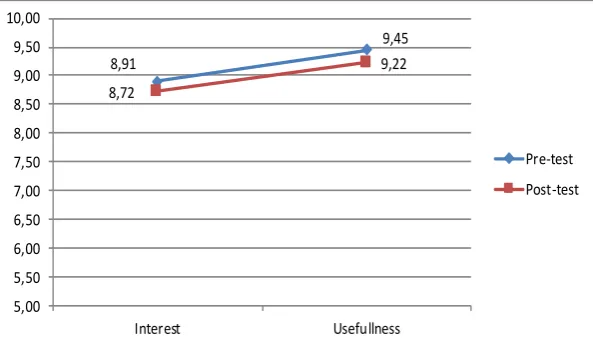
As observed in Figure 1, both the interest and the perceived usefulness by the students of the subject was quite high, with values higher than 8 out of 10. Although the average score of the students on the interest and usefulness of the subject at the beginning of the teaching period was 8.91 and 9.45 points out of 10 (respectively), in contrast to the students' averages at the end of the subjects, which were very similar although slightly lower (8.72 for interest and 9.22 for usefulness) .
8,91
9,45
8,72
9,22
5,00 5,50 6,00 6,50 7,00 7,50 8,00 8,50 9,00 9,50 10,00
Interest Usefullness
Pre-test
Post-test
Page 67
3.1.2. Interest in the activities and practices developed in the subject
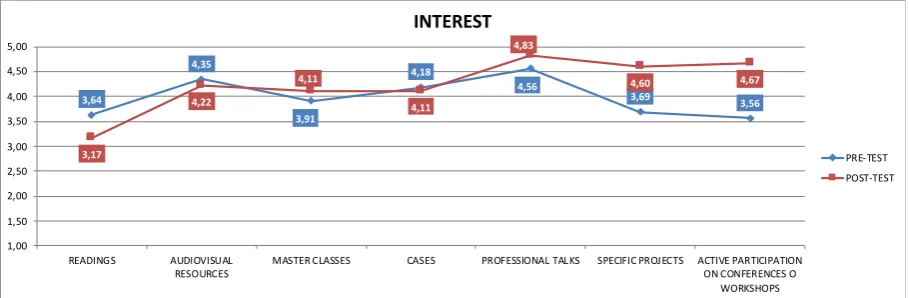
Regarding the interest generated by the different activities and practices, figure 2 shows the average assessment given by the students on the perceived interest before starting and after finishing the subject. As observed, most of the planned activities were well valued, with averages in most cases close to or over 4 points (out of 5).
At a comparative level between the initial and final evaluations, we can see how the reading of materials and texts (being in any case the lowest valued) at the end of the subject obtained an average score lower than that given at the beginning of the subject.
On the other hand, it is worth mentioning that the activities that improved their assessment of the perceived interest at the end of the subject were those that had to do with the complementary practical activities introduced this year as an innovation in the subject. These activities: both the attendance at talks by professionals, the completion of the deepening project and the collaboration in the organization and management of the Conference in which professionals participated have become the most valued activities at the end of the subject.
3,64
4,35
3,91
4,18
4,56
3,69
3,56
3,17
4,22
4,11
4,11
4,83
4,60 4,67
1,00 1,50 2,00 2,50 3,00 3,50 4,00 4,50 5,00
READINGS AUDIOVISUAL RESOURCES
MASTER CLASSES CASES PROFESSIONAL TALKS SPECIFIC PROJECTS ACTIVE PARTICIPATION ON CONFERENCES O
WORKSHOPS INTEREST
PRE-TEST POST-TEST
Figure 2. Average of the evaluations given on the interest of the activities developed in the subject in the initial evaluation (PRE) and the final evaluation (POST)
3.1.3. Usefulness of the activities and practices developed in the subject
Regarding the perceived usefulness in the different activities and practices, figure 3 shows the average assessment given by the students on the perceived utility before starting and after finishing the subject. As observed, most of the planned activities were well valued, with averages in most cases close to or greater than 4 points (out of 5).
At a comparative level between the initial and final evaluations, none of the activities reduced the perceived usefulness at the end of the subject, maintaining more or less the same usefulness for activities such as readings, viewing videos, solving practical cases and attendance to professional talks; while the master lectures, the production of deepening projects and the participation in the organization and management of the awareness-raising conference were perceived as more useful after finishing the subject.
Page 68 3,89
4,25
4,13
4,36
4,51 3,78
3,69 3,89
4,39
4,56
4,33
4,61
4,80
4,67
1,00 1,50 2,00 2,50 3,00 3,50 4,00 4,50 5,00
READINGS AUDIOVISUAL RESOURCES MASTER CLASSES CASES PROFESSIONAL TALKS SPECIFIC PROJECTS ACTIVE PARTICIPATION ON CONFERENCES O
WORKSHOPS
USEFULLNESS
PRE- TEST POST-TEST
Figure 3. Average of the assessments given on the usefulness of the activities developed in the subject in the initial evaluation (PRE) and the final evaluation (POST)
3.2. Specific results on the development of the First Awareness-raising Conference on Disability and Developmental Disorders
3.2.1. Participation level and assistance to the First Awareness-raising Conference on Disability and Developmental Disorders
The exact attendance to each of the sessions organized in the First Awareness-raising Conference on Disability and Developmental Disorders could not be controlled in a rigorous way, since the attendance was open to the public and registration was not required for their attendance. In any case, taking into account the completed questionnaires and making an estimate, it could be said that the range of attendees ranged between 40 and 60 participants per day. Data that, although modest, are positive if we take into account what has already been said about the need to register for the conference, together with no recognition or certificate for attendance and the difficulties to combine the schedule of the proposal with the teaching and non-teaching activities of the Faculty of Education and the students of this faculty.
3.2.2. Evaluation of satisfaction with regard to the development of the First Awareness-raising Conference on Disability and Developmental Disorders
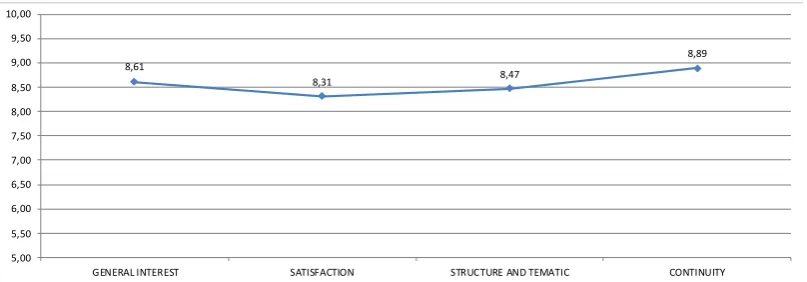
The evaluation questionnaire of the conference was passed during the days of celebration of the conference in paper format and was answered by 93 people. As observed in Figure 4, the results obtained on the satisfaction of the conference was quite good, with average scores in the four indicators over 8, enhancing that the highest average score was obtained in the question about whether they considered important that the development of an awareness-raising conference such as the one developed was repeated over time and had continuity.
8,61
8,31 8,47
8,89
5,00 5,50 6,00 6,50 7,00 7,50 8,00 8,50 9,00 9,50 10,00
GENERAL INTEREST SATISFACTION STRUCTURE AND TEMATIC CONTINUITY
Page 69 4. DISCUSSION
The start-up of the project required from the beginning a level of planning and collaboration of the teaching team that was valued as very positive in itself. Similarly, the participation of students is another element to assess as outstanding.
If we refer to the stated objectives we can conclude that they were reached in a satisfactory way. It was possible to learn about the perception students have about the subject through the different actions planned and assess the degree of acceptation not only of the complementary activities introduced as innovation in this project, but also of the rest of the activities that have been developed for a long time in the subject.
In both cases, the results indicate that the students perceive with interest and usefulness the activities developed. In addition, although it has not been verified with objective data, the teachers responsible for the subject, through students' opinions, perceived that the development of these activities could have had a relevant influence on the assimilation of the contents and learning foreseen in the subject. At the same time, the participating Associations and Educational Centers highly valued the organization of the Awareness-raising Conference on Disability and Developmental Disorders.
On the other hand, the First Awareness-raising Conference on Disability and Developmental Disorders was an element of value for the students of the subject (as observed in the results of the evaluations carried out), but also as part of the possible transversal activities and of interest for the whole educational community that the Faculty of Education may pose. For all this we can conclude that the approach proposed in this project has been very useful both internally in the subject and at a general level.
ACKNOWLEDGMENTS
This project has been recognized and has been carried out within the framework of the Call for Proposals of teaching innovation of the University of Zaragoza 2018-2019 (Project: PIIDUZ_18_332 'Incorporation of complementary practical activities based on learning by projects and learning experience').
REFERENCES
1. Martí, JA, Heydrich, M & Rojas, M 2010,´Aprendizaje basado en proyectos: una experiencia de innovación docente´, Revista Universidad EAFIT, vol. 4, no. 158, pp. 11-21, viewed 01 june 2019, <http://publicaciones.eafit.edu.co/index.php/revista-universidad-eafit/article/view/743/655>.
2. Kolb, DA 1984, Experiential learning: Experience as the source of learning and development, Prentice-Hall, New Yersey.
3. Kolb, AY & Kolb, DA 2005, ´Learning styles and learning spaces: Enhancing experiential learning in higher education¨, Academy of management learning & education, vol. 4, no. 2, pp. 193-212.