Physics and Astronomy Publications
Physics and Astronomy
1985
General factorization relations and consistency
conditions in the sudden approximation via infinite
matrix inversion
C. K. Chan
Iowa State UniversityD. K. Hoffman
Iowa State UniversityJames W. Evans
Iowa State University, [email protected]
Follow this and additional works at:
http://lib.dr.iastate.edu/physastro_pubs
Part of the
Biological and Chemical Physics Commons
The complete bibliographic information for this item can be found athttp://lib.dr.iastate.edu/physastro_pubs/441. For information on how to cite this item, please visithttp://lib.dr.iastate.edu/howtocite.html.
General factorization relations and consistency conditions in the sudden
approximation via infinite matrix inversion
Abstract
Local, i.e., multiplicative, operators satisfy well‐known linear factorization relations wherein matrix elements
(between states associated with a complete set of wave functions) can be obtained as a linear combination of
those out of the ground state (the input data). Analytic derivation of factorization relations for general state
input data results in singular integral expressions for the coefficients, which can, however, be regularized using
consistency conditions between matrix elements out of a single (nonground) state. Similar results hold for
suitable ‘‘symmetry class’’ averaged matrix elements where the symmetry class projection operators are
‘‘complete.’’ In several cases where the wave functions or projection operators incorporate orthogonal
polynomial dependence, we show that the ground state factorization relations have a simplified structure
allowing an alternative derivation of the general factorization relations via an infinite matrix inversion
procedure. This form is shown to have some advantages over previous versions. In addition, this matrix
inversion procedure obtains
all
consistency conditions (which is not always the case from regularization of
singular integrals).
Disciplines
Biological and Chemical Physics | Physics
Comments
This article is published as Chan, C. K., D. K. Hoffman, and J. W. Evans. "General factorization relations and
consistency conditions in the sudden approximation via infinite matrix inversion."
The Journal of chemical
physics
83, no. 4 (1985): 1637-1647, doi:10.1063/1.449401. Posted with permission.
General factorization relations and consistency conditions in the sudden
approximation via infinite matrix inversion
C. K. Chan, D. K. Hoffman, and J. W. Evans
Citation: The Journal of Chemical Physics 83, 1637 (1985); doi: 10.1063/1.449401
View online: http://dx.doi.org/10.1063/1.449401
View Table of Contents: http://aip.scitation.org/toc/jcp/83/4
General factorization relations and consistency conditions in the sudden
approximation via infinite matrix inversion
c.
K.
Chan,a) D.K.
Hoffman, andJ.
W. EvansAmes Laboratorybl and Department o/Chemistry, Iowa State University, Ames, Iowa 50011 (Received 4 March 1985; accepted 2 May 1985)
Local, i.e., multiplicative, operators satisfy well-known linear factorization relations wherein matrix elements (between states associated with a complete set of wave functions) can be obtained as a linear combination ofthose out of the ground state (the input data). Analytic derivation of factorization relations for general state input data results in singular integral expressions for the coefficients, which can, however, be regularized using consistency conditions between matrix elements out of a single (nonground) state. Similar results hold for suitable "symmetry class" averaged matrix elements where the symmetry class projection operators are "complete." In several cases where the wave functions or projection operators incorporate orthogonal
polynomial dependence, we show that the ground state factorization relations have a simplified structure allowing an alternative derivation of the general factorization relations via an infinite matrix inversion procedure. This form is shown to have some advantages over previous versions. In addition, this matrix inversion procedure obtains all consistency conditions (which is not always the case from regularization of singular integrals).
I. INTRODUCTION
Consider operators T defined on a Hilbert space,
JY
=
JYI ® JY2, which are local (i.e., multiplicative)on JYI • Such operators are diagonal in the JYlordinate representa-tion {r J , so thatTr,r' = Tror,r" (1.1)
where or,r' is the Dirac delta function. Throughout our
dis-cussion it is implicitly assumed that T is evaluated between
fixed JY2 states. The prime example we have in mind here is
that the energy sudden (ES) scattering theory T matrices
which are local with respect to the internal molecular (vibra-tional and rota(vibra-tional) nuclear (JYI ) coordinates. Matrix ele-ments here are taken between fixed (suitably high kinetic energy) relative momentum (JY2 ) states. If (tPM(r)J denotes some complete orthonormal set of "wave functions" on JYI , with M =
°
corresponding to the unique, positive ground state, then for TMM ,=
(MITIM') ==fdrtPt(r)TrtPM·(r),one has the well known factorization (or scaling) relations 1-3
(1.2)
where [A(M'IO)]ML
=
f dr tPL(r)tP t(r)tPM,(r)/tPo(r). For EST matrices, the tPM are, of course, chosen as (products of) molecular wave functions for the colliding species, so T MM'
are the standard transition amplitUdes (when evaluated between JY2 relative momentum states).
Often, in cases of interest, the quantum state labels de-compose asM
=
MIM2 , and we naturally consider thequan-tities
• Present address: Department of Chemistry, University of Houston, Hous· ton, Texas 77004.
bOperated for the U.S. Department of Energy by Iowa State University under Contract No. W-7405-ENG-82. This work was supported by the Office of Basic Energy Sciences.
O"M,Mi
=
l/gMiI I
ITMM' 12
, (1.3)
M2 M2
where the limits of the sum over M2(M ~) depends on
MI(Mi), andgMi = ~M2 1. In the context ofES scattering, where T represents the T matrix, we naturally choose the sum ~M, to be over (gM, -fold) energy degenerate states if possible. The u's then correspond to experimentally measur-able, degeneracy averaged cross sections. These quantities may be differential cross sections (when 0" is evaluated
between specific JY2 relative momentum states) or, alterna-tively, total fixed energy cross sections, or thermally aver-aged cross sections (after suitable averaging over JY2 states).
We have shown previously3 that provided the set of wave functions associated with each fixed MI , and the
pro-jection operator
PM,filr)
=
ItPM,M, (i)tP t,M,(r) = PM,(rli)*, M,forms a basis for a different irreducible representation of some transformation group, then one has thae
O"M M'
= J.sL
~
[G(Mi
IO)]M L O"L 0'' I g £.. I I 1
Mj L,
(1.4)
where
1 A A
[G(MiIO)]ML =-Tr(FMM,PL ), I I gL, I 1 I
Tr denotes the trace, and the operator
F
M,Mi has compo-nents given by(1.5)
The basis of this result is the observation that one can define a reduced variable x associated with each ordered pair (r,r), such that (Ar, Kr) is associated with the same x, for all trans-formation group operations K, and { PM, (il r) = PM, (x) J
forms a complete orthogonal basis for the space of square
1638 Chan, Hoffman, and Evans: Factorization in the sudden approximation
integrable functions ofx. Relations of the form ofEq. (1.4),
where
PM,
correspond to rigid rotor energy eigenspaces, and to certain symmetric top eigensubspaces, had been discov-ered earlier by direct analysis. IWhen applied to energy sudden scattering theory, these factorization relations allow exact prediction of any scatter-ing amplitude as a spectroscopic linear combination of those out of the ground state (input data). In practice, however, collisions are never strictly sudden (the T matrix is always somewhat nonlocal in the internal nuclear coordinates), but one can still attempt to use these factorization relations to predict scattering amplitudes using exact (close coupling) or experimental input data. Here we expect (and find that) in many cases inaccuracy in the predicted amplitudes out of stateM' (or M;) grows as this state increases in energy (away from the ground state). This trend is illustrated in Tables I and II of Ref. 4. It motivated extension of the factorization relations so that one can use, as input, transitions out of any fixed state to predict an arbitrary transition amplitude.3
,4
The first such formulation used an (infinite) matrix
in-version procedure to treat degeneracy averaged cross section factorization for the ES atom-rigid rotor system.4 Here the
nonzero matrix elements of G(/IO) exhibit a band structure, in the sense that [GVIO)]jl can be nonzero only ifVJ,I) satisfy the triangle inequality [i.e., the modulus of anyone is no greater than the sum of moduli of the other pair]. This obser-vation leads straightforwardly to general input state factori-zation relations via matrix inversion, as well as to corre-sponding consistency conditions between matrix elements out of a single nonground state (which are equivalent to those from the analytic approach, described below, but ap-pear in rearranged form). Generalizations of this procedure will constitute the basis of this communication.5 A later
gen-eral analytic treatment3 showed that another form of the
general factorization relations can be obtained simply by re-placingOin Eq. (1.2) withM, and in Eqs. (1.4) and (1.5) with
MI'
Singularities now appear in the factorization coefficient integrals, associated with the nodes of <PM and PM, ' but con-sistency condition imposed "orthogonality" of the ES input data to these singularities provides (several) natural ization procedures. Cauchy principal value (CPV) regular-ization suffices in several important cases. We stress here that all forms of the general factorization relations are equi-valent (by virtue of the consistency conditions) when using ES input data. However, differences will appear when these relations are used in the practical predictive context, de-scribed above, involving non-ES data, so the question arises in this context of which is the optimum form of the factoriza-tion relafactoriza-tions. Below we first review our previous analytic development of consistency conditions for the Tmatrix case3making explicit some examples which will be reconsidered using the matrix approach here. Next we present the first analogous analytic derivation of the u-consistency condi-tions. Then some simple but new observations are made re-garding the structural constraints imposed on consistency condition (and factorization relation) structure by parity. Finally we outline, in more detail, the contribution of this paper.
The analytic consistency conditions, which allow
regu-larization of, and flexibility in the factorization relation coef-ficients, can be demonstrated straightforwardly for the ES T
matrix case using the identity3
2:
<pL(r)TLM = Tr<PM(r). (1.6)L
Clearly ifr corresponds to a mode of <PM' then we obtain a
consistency condition between the transition amplitudes out of the
M
state. For example, in the collinear atom-harmonic oscillator system, with wave functions<Pj(x) = 2 -i/2(j1)-1/2(ahr)I/4e - ax'12Hj(al
/2x) j = 0,1,2, ... ,
where Hj are the Hermite polynomials, one has thae
00
2:
2 -j/2(}) - 1I2Hj(x*)Tjj = 0,j=O
(1.7)
wherex* is any oftheJ zeros of Hy• More generally, if the set
of variables r can be decomposed as a scalar r and some remaining variables r', i.e., r
=
(r,r'), where <PM has an N th-order zero in r at some point r*, then one obtains N consis-tency conditions after applyinga
n /ar",
n = 0, 1, ... , N - 1,to Eq. (1.6), and setting r
=
r*. Consider, for example, the atom-rigid rotor system where one has r = (8,<p ) (the polar angles), L = jm, and<pLir) = ~m(8,<p)
= (_ l)lm+ Im1l/2[ 21
+
1 (j -Iml)!]112
41T (j
+
1m)!
Xpr (cos 8)eim 4>.
From Eq. (1.6), one obtains
2: [
21+
1(! -
:m:)! ]
1I2p )ml(x*)1jmJm = 0, (1.8)j>lml 41T (j
+
m )!for each m,
where x* is any oftheJ - Iml zeros of pynl in the interval
- 1 <x <
+ 1.
Since pynl(x) also has zeros of order Iml atx =
±
1, 21m
I further consistency conditions are obtained by replacing P )ml(x*) with (an /axn) pr(
±
1), n = 0, 1, ... , 1m I - 1, in Eq. (1.8). Of these, the21m
I conditions, corre-sponding to n = 0, 1, ... , Iml - 1, are clearly trivial.Demonstration of analogous consistency conditions for the averaged u quantities follows using the identity3
U L M = _1_
f drofdi
oP
L (i'olro)PM (rolro)TrT"!
I I g A i l I I 0 ro
to show that [cf. Eq. (1.6)]
2:-
1
- P
L,(x)uL,M,=-l-f dro f
dio[2:-
1
- P
L,(x)L, gL, gM, L, gL,
XP!, (xo)
kM'
(xo)Tro Tt,=
~
PM, (x)f dro f
di08(x - Xo)gM,
X TroTr"lf(x). (1.9) Here x[Xo] is associated with (rlr) [(rolro)] andf(x)
=
SdrSdi
{j (x - Xo). The normalization of PL , (x), used in deriving Eq.
(1.9) and defining fix), is obtained by noting that
Chan, Hoffman, and Evans: Factorization in the sudden approximation 1639
gL,
=
Tr(PU=
J
drJ
arlPdxW
=
J
dXo[
J
drJ
arb (x -
Xo)]
IPL,
(xoW·
(1.10)
For the ES atom-rigid rotor (atom-symmetric top) cross sections up" (UjkJ"k')' one obtains I = 8~, and for the ES atom-spherical top cross sections un-' 1= 32ffl( 1 - cos
¢J ),
where
¢J
is the class parameter (angle) described in Sec. II C. Ifx corresponds to a node of PM, (x), then we obtain from Eq. (1.9) a consistency condition between the uL,M,'Often parity simplifies the structure of the factorJ.zation relations and consistency conditions. When
¢J
's orP's
are functions of a sing Ie variable, Z€[ - a,+
a], where a';;;; 00, andthus are labeled by an integer
i>O,
often one has that¢Jj
(orPj) is odd (even) in
z,
whenj is odd (even). It then follows immediately (at least for CPV regularization) that transi-tions j' _j, predicted via general ES factorization relationsfromJ-1 transitions, involve only I for which I - J andj - j'
are both even or odd. Here the consistency conditions also simplify. Since the zeros of
¢t]
(or~)
occur in pairs±
Zj(except for Zo
=
0, for oddJ),
it then follows thatl:/>O(
±
1)/¢Jdzj)Tlj=
0, which, after taking linear combina-tions, implies that independentlyI
¢Jdz;)Tlj=
0,I
¢J/(z;)Tfj=
0. (1.11)I even I odd
Sometimes when
¢J
's(P
's) are functions of several variables, the factorization relations and consistency conditions can be reduced to involve a single sum. {For the rigid rotor T ma-trix analysis, this feature follows since, trivially,[A(j'm'IJm)]jm,jomo a:bm-m',mo-m' and is also clear in Eq.
(1. 8). J Again here parity arguments often apply analogous to those above.
A
In Sec. II, we consider systems where the
¢J
's or P 's are functions of a single variable, and thus are labeled by a non-negative integer j (where j =°
corresponds to the gro~ndstate). We show, for several systems where the
¢J's
orP's
incorporate orthogonal polynomial dependence, how this leads directly to band structure in the nonzero matrix ele-ments of FVIO) = AVIO) or G!7IO) of the type described above for the atom-rigid rotor cross sections (where Pa:Pj , theLegendre polynomials). Thus the infinite matrix inversion derivation of factorization relations and consistency condi-tions of this atom-rigid rotor case applies more generally. (A more succinct derivation is also provided here.) We present the first comparison of the predictive capacity (for non-ES input) of the different forms of the general factorization rela-tions derived here (and in Ref. 4) by matrix inversion, and previously by the analytic method. Specifically we consider atom-rigid rotor models of He-HCl and H-CO cross sec-tion factorizasec-tion, using close coupling data as input. A modified matrix inversion procedure is also developed which (unlike the "standard" one) preserves time reversal invariance for downward prediction,]> j'. Results from this procedure are also compared with those from the standard matrix inversion form using the He-HCI atom-rigid rotor example. Finally we comment on cases where F!7IO) exhibits no band structure.
Some atom-rigid molecule systems are considered in Sec. III, where
¢J
's orP
's depend on several variables, but the factorization relations can still be reduced to involve a single sum. The modified band structure of the corresponding fac-torization matrices, for ground state input, is elucidated. We extend the matrix inversion procedure to obtain general state factorization relations, together with an enumeration of all consistency conditions for these systems. Here we find that the consistency conditions enumerated in the analytic approach in general form only a subset of those deriving from the matrix approach. Finally, in Sec. IV, some general-izations are indicated, together with mention of another technique for deriving general state factorization relations.II. MATRIX INVERSION DERIVATION OF
FACTORIZATION RELATIONS AND CONSISTENCY
CONDITIONS WHEN
¢J's,
P's
ARE FUNCTIONS OF ASINGLE VARIABLE
Here we consider T factorization (or U factorization) for
A
cases where the
¢J
's (P's) are functions of a single variable xand thus are naturally labeled with an integer j = 0,1,2,.·· (wherej
=
°
corresponds to the unique ground state). We primarily concern ourselves here with some special subcases, enumerated below, before returning to the general case.A.¢/s,
P's
of the form llJ1/2&j' where &j is a real valuedpolynomial of order
i>O
(with &0:==1) in some variableZ
=
z(x), and Sdx llJ& i & j = {iijThis case includes
¢J
's for the (atom--collinear) harmonic oscillator and infinitely deep square-well oscillator, and en-ergy eigenspaceP's
for the (atom-) rigid rotor system (see Table I for details). Here the components of the factorization matrices F = A or G can be written as[F!7IO)]jl = JdXllJ.'?JI,.'?JIj'9j , (2.1)
for which the following argument demonstrates fundamen-tal simplifying features. Since {.'?JI m J are linearly
indepen-dent, we can clearly express .'?JI;f!Jlj =l:~+!:oam.'?JIm' for
some real valued constants am' Thus, using orthogonality, we conclude that Sdx llJ.'?JI j.'?JIj.'?JI k is nonzero onlyifk';;;;i
+
j.By symmetry, we clearly also require that i<J
+
k,j.;;;;i+
k(which together imply k>
Ii -
jl) for this integral to be non-zero and, in fact, we can writej+j
.'?JIj.'?JIj =
I
am.'?JIm •m~ Ij-jl
(2.2)
It is thus clear that [F(]IO)]j1 is nonzero only if (],j,l)
satisfy the triangle inequality, i.e., each is no greater than the sum of the other two.5 The associated "band structure" of
F(]IO) is shown in Fig. 1, together with a natural decomposi-tion used below. It is straightforward to show that matrix elements on the band boundaries are nonzero (which is es-sential for the following). Often in cases of interest
u[ - a,
+
a], for some a';;;; 00, and the weight function llJ iseven inz, which ensures that .'?JIj are even (odd) inz, forjeven
(odd). Then the sum in Eq. (2.2) is further restricted to m with
i
+
j - m even, which implies, by simple parity arguments, that "half' the F matrix elements within the band (those with 1+ j+
J
odd) are also zero.61640 Chan, Hoffman, and Evans: Factorization in the sudden approximation
TABLE I. ES systems with ¢ 's,
P's
of the form W ' /2 9 j"ES system
Tmatrix factorization: Collinear atom-harmonic oscillator
Collinear atom-infinitely deep square-well oscillator
- . H(z = a ' /2x)
( 'l!;1 I
)'12
J
(Hermite)
u(z
= cos 1TX) = sin [(j+
I )1Txll]J I sin[1Txll]
(second-kind Chebyshev) Degeneracy averaged cross section (a) factorization: Atom-rigid rotor (2j
+
1)'/2Pj(Z = cos r)(Legendre)
Our initial goal here is to solve the matrix equation S(/) = F(/IO)S(O) (2.3)
for S(O) in terms of (part of) S(/)o A condensed version of the procedure developed by Hoffman et al.4 for analysis of atom-rigid rotor cross sections is now presented. Since [F(/I 0)
h
+ m mare nonzer:9, clearly o_ne can constructunique-ly the (semi-) inverse F+(j)-I ofF+ (j), as defined in Fig. 1. (In fact, a simple recursive formula determines matrix elements explicitly.4) Thus decomposing S(/) = [S-(/),S+(/W, where S-(/) includes the firstJ components, and S+(/) the rest (and
T denotes transpose), one has that
S(O) = F+(])-IS+(J), (2.4) and therefore
S-(]) = F-(])S(O) = F-(])F+(J)-IS+(J) C(J)S+(J)
{specifically, [S(])1j =
I
[C(J)by+dS(])h+I for j<J}l>j-j
(
conSi~~ency)
(2.5)conditIons and
S(f) = F(fIO)F+(J)-IS+(])==F(f~)S+(])
{specifically, [S(f)t
=
I
[F(fl/i1fJ+l[S(J)]Y+l}l>ll-jl
(
fact~rization).relatIOns
WIO) j
I
r
1
- - - i - - - >
r
(2.6)
FIG. I. Band structure of the factorization matrix F(]IO). Only matrix ele-ments in the shaded region, where (],j,l) satisfy the triangle i~equality, can be nonzero (including all those on the boundary). Here F-(;l denoted the first] rows ofF(]IO), and F+!./) the rest [and so F+(]i is upper triangular].
( )
:.'12
e-ax212-
..JT=ZT - -
s m-(2)'12 I _
(2
I)'12 .
(1TX) I41T
Variables
x is the separation;
a is proportional to
the classical frequency
O<x<.lis
the separation
r is the angle between r = (8,¢) and
r
= (ii,¢))A more detailed discussion of this inversion procedure can be found in Ref. 4. Clearly, predicted transitions here are obtained as only a linear combination of those with the same and greater inelasticity (i.e., I> I j' - jl). It is also clear that if
the~
's(orP's)
have definite parity, then the sums in Eqs. (2.5) and (2.6) are restricted to even I - j+
J
and I - j+
j', respec-tively. Note that, if we define F+ (fIJ) to refer to the part of F(fIJ) predicting elastic and upwards transitions (i.e., by eliminating the first j' rows of F), then clearly F+(j"Ij')F+(fIJ) = F+(j"Ij'), and F+(]IJ) = I.One naturally compares the form of the consistency conditions (2.5), where downwards transitions are predicted in terms of upwards transitions, with that described in the Introduction. The transformation from the analytic to the matrix inversion form of the consistency conditions can be achieved most easily by exploiting the properties of Gaus-sian-type numerical integration schemes associated with the
(iJi j 's (see Appendix A). Explicit expressions for the C(J) ma-trix elements result. As mentioned in the Introduction, all forms of the factorization relations are equivalent ifthe input data satisfies the ES consistency conditions. However, it is natural to ask which form is most appropriate for predictive use when we start with exact (close coupling) input scattering data or other data not satisfying the consistency conditions. Since, in the matrix inversion form, predicted transitions are obtained from those of the same or greater inelasticity only,
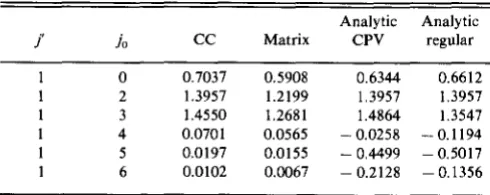
we might anticipate that such a factorization scheme would be intrinsically more stable to non-ES input data than those from analytic approach (which do not have this property). In Tables II and III, we have compared predicted He-HCl rigid rotor) degeneracy averaged,7 and H-CO (atom-rigid rotor) thermally averaged8 cross sections, obtained
us-ing close couplus-ing input data, for the matrix inversion form of the factorization relations, together with forms for two regularizations in the analytic approach.3
,9 The former is
clearly superior here for transitions of high inelasticity. Since [F(]IO)
h _
m m are also nonzero, there are anum-ber of other ways to construct an infinite, invertible matrix F+(]) by removingJ suitable rows, F-(J) (other than the first
J
rows) from F(]IO). The most obvious examples re~ult from interchanging theJ+
k andJ - k rows, for any k <j (see Fig.1) and making the corresponding interchange of components of S(J). The inversion procedure outlined above can then be repeated to give new relations of the form ofEqs. (2.4)-(2.6).
[image:7.592.40.289.376.712.2]Chan, Hoffman, and Evans: Factorization in the sudden approximation 1641
TABLE II. Comparison of close coupling He-HCl (atom-rigid rotor) de-generacy averaged cross sections (in A 2, at a total energy of772 <:,m -I) out of the j' = I state with those predicted from cross sections out of) = 2 via ES factorization relations obtained by infinite matrix inversion (Matrix); singu-lar integral Cauchy principal value regusingu-larization (Analytic CPY); singusingu-lar integral regularized according to Chang et al. (Ref. 9) (Analytic regular). Factorization relations used here include a factor of kflk} [omitted from Eqs. (1.4) and (1.5), etc.].
Analytic Analytic
j' )0 CC Matrix Cry regular
0 3.3699 2.9478 3.0916 3.1799 2 6.5567 5.9765 6.5568 6.5568 3 1.2934 1.0494 1.3236 1.1582 4 0.1613 0.1080 - 0.1634 - 0.4722 5 0.0131 0.0062 - 0.5783 - 0.6432 6 0.0006 0.0001 -0.7241 - 0.4692
Still other examples result from interchanging more than one pair of rows. Note that this interchange affects only the first kmax rows in F + (]) - I, and the first j'
+
kmax rows in theproduct F(j'IO)F+(])-1 (where kmax is the maximum k for
cases where more than one pair of rows is interchanged), so predictions of [S(j')]j' for j
>
j'+
kmax , are unaffected.Now, of course, in this procedure we do not use only wards transitions to predict [i.e., now, in S+(]), some up-wards transitions have been replaced by "equally inelastic" downwards transitions]. We thus preserve the "stability property" wherein transitions are predicted using, as input, only those of equal or greater inelasticity. One consequence of this modified treatment is to demonstrate that the analytic consistency conditions can also be solved for the compo-nents of the corresponding modified S-(]) in terms of the other (inelastic) transitions.
One desirable feature of any scheme, when applied to total fixed energy or thermally averaged cross sections, is the preservation of time reversal invariance
g/ [(J'(j')
h
=gy
[(J'(])]/. This is always satisfied in the CPV regularized analytic relations, and for the (standard) matrix approach when] <j' (since [G(j' I]) h = D/k here). However, when] > j', the (standard) matrix approach input data used does not include the downwards transition [a(])]/, and time reversal invariance is lost. It can be recovered, however, if we use a modified factorization where row j' replaces rowif -
j' [image:8.592.39.286.134.234.2]ofG(]IO) in G+(]), which means that now [(J'(])]l is used as input, and again [G(j'I])h = D/k • (The latter relation is
TABLE III. Comparison of close coupling H-CO (atom-rigid rotor) ther-mally averaged cross sections (in A 2, at T = 100 K) out of the j' = I state with those predicted from cross sections out of] = 2, via various forms ofES factorization relations (see Table II) including a factor of exp( - E]lkT)/exp( - EJkT) [omitted from Eqs. (1.4) and (1.5), etc.].
Analytic Analytic
j' )0 CC Matrix CPY regular
0 0.7037 0.5908 0.6344 0.6612 2 1.3957 1.2199 1.3957 1.3957 3 1.4550 1.2681 1.4864 1.3547 4 0.0701 0.0565 - 0.0258 - 0.1194 5 0.0197 0.0155 - 0.4499 - 0.5017 6 0.0102 0.0067 - 0.2128 - 0.1356
proved in Appendix B.) In Table IV, we have compared pre-dicted values of He-HCl (atom-rigid rotor) degeneracy averaged cross sections, obtained using close coupling input data,7 for matrix inversion forms ofF(j' I]) derived from var-ious choices of F+(]). Values reflecting time reversal invar-iance are indicated.
B. ¢/s,
P's
incorporating orthogonal polynomials in a more complicated formIn the atom-spherical top system,
P
's for the degeneracy averaged cross section have the form3Pj(n
In)
=
2j8~
I x(¢ '),where
n,
n
are sets of Euler angles,Xj(A. ') 'I' = sin[(j sin[¢
+
'/2] !)¢ '] = U . 2} [costA. 'I' '/2)](2.7)
is the character for the jth irreducible representation of R (3), and ¢' is the class parameter (angle) associated with
n '
=nn -
I (Uk are Chebyshev polynomials of the secondkind). Performing the trace to obtain factorization matrix elements produces an extra weight factor 1 - cos ¢, from the Hurwitz integral for R (3),10 with respect to which the
X
are orthogonal. The appearance of orthogonal polynomials,9 2j , which are of even order only (rather than of both even
and odd order, as Sec. II A) does not alter the band structure of F(]IO) described above, since we can easily show (using parity arguments) that 9 2; 9 2j = 2~+~ Ii _ jl am 9 2m' For
the atom-sperical top system, clearly all F matrix elements within the band will be nonzero, as well as the boundary elements.
Next we consider several examples of atom-collinear oscillator systems where the binding potential for the oscilla-tor is a well of finite depth. Here, of course, dissociation is possible and this modifies the form of the factorization rela-tions and consistency condirela-tions. Furthermore, divergences can appear in these coefficients. However, if we restrict our attention to states "deep" in the well, these difficulties can be ignored and we can use the factorization relations (1.2). For a detailed discussion of factorization relations for dissociative systems, see Ref. 11.
For a 1D Morse oscillator with potential V(x) ex:: e - 2ax
- 2e - ax , where x is the separation measured from the
po-tential minimum, the bound state wave functions satisfy
¢j(x) ex:: e - z12zll( - 2j - II12L
'J -
2j - I(Z) for j'»O, (2.8)wherez = K exp( - ax), where K is determined by the
ampli-tude of V (x), and L
1
is the generalized Laguerre polynomial of order j. The j dependence of ¢j (n) is of the form z -j L ;J(z),where
4
j is some function ofj. ~e now show that this leadsto the same band structure in F(jIO) as described above. We first make the observation that z -k L ~k(Z) is a polynomial in
liz of order k. Thus, we can write
. . A A
Z - I - } L i '(z)L / =
i+j
L
amz - mL ~m(z). (2.9)m=O i+j-m even
Orthogonality of the wave function (2.8) implies that
[image:8.592.41.286.661.758.2]1642 Chan, Hoffman, and Evans: Factorization in the sudden approximation
TABLE IV. Comparison of close coupling He-HCl (atom-rigid rotor) degeneracy averaged cross sections (in
A 2, at a total energy of 772 cm - I) with those predicted from cross sections out of the ground state (7 = 0], and the second excited state 2-+jwithj;;.2(7 = 2]. withj = 2.3.0.5 •... (7 = 2(0)]. withj = 2,1,4.5 •... (7 = 2(1)]. and with
j = 2.1.0.5 •... (7 = 2(01)]. The matrix inversion of the form of the ES factorization relations used here predicting
ufj" from Off include a factor of k
J
I kJ
[omitted from Eq. (1.5). etc.] The superscripts a indicate calculation from upwards CC transitions of Ref. 7 using k; (2l+
1 )uJj = k J(2j+
l)u if; b indicates calculation via consistency conditions; * indicates agreement with CC values by virtue oftime reversal invariance.l - j o CC j=O j=2 j=2(0)
2 0 0.5167" 0.5167* 0.3686b
input
2 1 4.1656' 4.3798 3.7970b
3.7970b
2 3 5.6717 6.5252 input input
2 4 0.9510 1.3393 input 1.3317b
2 5 0.0953 0.1819 input input
2 6 0.0054 0.0183 input input
2 7 0.0001 0.0012 input input
0 3.3699" 3.3699* 2.9478 2.9478
2 6.5567 6.8939 5.9765 5.9765
3 1.2934 1.4810 1.0494 1.4689
4 0.1613 0.2065 0.1080 0.1080
5 0.0131 0.0212 0.0062 0.0062
6 0.0006 0.0013 0.0001 0.0001
3 0 0.0596" 0.0596* 0.0313 0.0313 3 1 0.6437" 0.7371 0.5223 0.7311 3 2 4.4433" 5.1119 4.4433* 4.4433*
3 4 5.1592 6.8071 5.9199 5.9199
3 5 0.6972 1.3591 0.9655 1.3522
3 6 0.0491 0.1813 0.0950 0.0950
3 7 0.0015 0.0180 0.0053 0.0053
4 0 0.0056" 0.0056* 0.0017 0.0017
4 1 0.0717' 0.0918 0.0480 0.0480
4 2 0.6653' 0.9369 0.6653* 0.9316
4 3 4.6067" 6.0782 5.2860 5.2860
4 5 4.6141 7.5941 6.6056 6.6056
4 6 0.4416 1.4890 1.0579 1.4817
4 7 0.0160 0.1961 0.1028 0.1028
J
dx e -zt< -
lZ - i - j - kL :i(z)L :J(z)L~k(Z)
(2.10)is zero if k
>
i + j, and thus, by symmetry, also if i>
k+
j orj> k
+
i (which immediately demonstrates the bandstruc-ture in F(]IO) here). Furthermore, the latter inequalities, in turn, imply that the sum in Eq. (2.9) has a lower limit of
m =
Ii -
jl,
which directly enforces the band structure inF(]IO) (after invoking wave function orthogonality). This band structure has demonstrated previously by a direct (and rather lengthy) evaluation of F matrix elements.2 Boundary elements are clearly nonzero.
For a 1D oscillator described by a modified Poschl-Teller potential, V(x) = - v(v
+
l)1cos2 ax, where x de-notes the separation, the bound state wave functions (offin-ite number) are described by<Pj(x) a: [1 -
r]lv-
JV2C;-H 1I2(Z) for j = 0,1, ... ,( vJ, (2.11)where
z
= tanh ax, C ~ is the Gegenbauer polynomial of or-der n, and (v) is the largest integer less than v. Thus, thej dependence of <Pj (n) is of the form (1 - Z2) - jl2C ?(zj, where'TJj is some function ofj. To determine whether FUIO) here has the band structure of the above examples, we naturally ask whether [1 - r ] 1-i - Jl12C ii(Z)C Jl(Z) can be represented as a linear combination of [1 - z 2] - m12
c
:m(Z), orequiv-]= 2(1) ]=2(01)
0.3686b
input input input 6.2247b 6.2247b
input 1.3317b input input input input input input 3.2379 3.2379 6.5568* 6.5568 1.0494 1.4689 0.1080 0.1080 0.0062 0.0062 0.0001 0.0001 0.0313 0.0313 0.5223 0.7311 4.8765 4.8765 6.4975 6.4975 0.9655 1.3522 0.0950 0.0950 0.0053 0.0053 0.0017 0.0017 0.0480 0.0480 0.6653* 0.9316 5.8018 5.8018 7.2503 7.2503 1.0579 1.4817 0.1028 0.1028
alently, whether Cii(Z)C?(z) can be represented as a linear combination of [1 - r ] Ii + j - m)12C :m(z). It is clear that the
functions [1 - r] Ii + j - m)/2
c
:m(z), for m<i
+
j satisfying thecondition i + j - m even, form a set of ( (i
+
jl2)}' + 1 inde-pendent polynomials all of order i+
j, which are all even (odd) if k+
j is even (odd). (Here (A )' is the largest integer not greater thanA.) Consequently, it follows that we have the representation[1 - Z2] I - i - J1I2C ii(Z)C ?(z)
(2.12) m<i+j
i+j-m even
Using the orthogonality of the wave functions (2.11), it fol-lows that
J
dx(l -rn
1 -r]l-
i-j-k)12C~-i+
1I2(Z)X C;-j+ 112(Z)C
k-
k+ 1I2(Z)is zero if k> i
+
j (and k < (v)), and thus, by symmetry, ifi> k
+
j or j > k+
i (which immediately demonstrates the band structure of F(]IO) here). Furthermore, the latter in-equalities, in turn, imply that the sum in Eq. (2.12) has a lower limit of m =Ii -
jl,
which directly enforces the band structure of F(JIO) (after invoking wave function [image:9.590.41.399.127.425.2]Chan, Hoffman, and Evans: Factorization in the sudden approximation 1643
lity). Boundary elements are obviously nonzero. An alterna-tive argument can be made demonstrating band structure which is based on the transformation 1/t
=
1 - Z2 (seeAp-pendix B). Since the wave functions here have definite parity, the usual special features offactorization relations and con-sistency conditions follow.
Given the band structure of F(]I 0) in all of the examples of this subsection, it is now a simple matter to repeat the construction of factorization relations and consistency con-ditions using the procedures given in Sec. II A. Conversion from the analytic to the matrix form of the consistency cond-tions (and provision of explicit coefficients for the latter) is possible using properties associated with numerical Gauss integration schemes (see Appendix A).
C. General ¢'s with a single degree of freedom
For a general atom-collinear oscillator system with a single degree of freedom, the oscillator wave functions do not have the special form of Secs. II A and II B, so F(]IO) does not have the band structure described there. Here it is no longer transparent whether one can construct an inverti-ble matrix by removing certain rows from F(]IO). However, to shed some light on this question, it is instructive to consid-er the form of the] consistency conditions obtained from the analytic approach. (Here we assume no other consistency conditions exist.) If these can be solved for some set of] tran-sitions in terms of the rest (obviously not including the elastic one, since this does not appear in the consistency conditions), then the corresponding] rows can be eliminated from F(]IO) to obtain an invertible matrix. In contrast to the examples above exhibiting band structure, we anticipate that, in gen-eral, any] rows (except [F(]IO)J;k) can be eliminated. How-ever, we naturally expect that the "most stable" inversion choice will be based on one of the schemes described in Sec. II A. (This is certainly the case for a small perturbation away from a system exhibiting band structure.)
III. MATRIX INVERSION DERIVATION OF
FACTORIZATION RELATIONS AND CONSISTENCY CONDITIONS FOR SOME ES ATOM-RIGID MOLECULE SYSTEMS
The most general "rigid molecule" considered here is the symmetric top whose wave functions are proportional to the R (3) matrix elements, 12
D{"da,{3,r) = djmdcos/3)eimaeiky for Iml,lk 1..;;1, (3.1)
where
a,
/3,
r
are the usual Euler angles, andd{"dx) ex: [1
+
x](m + k)l2[ 1 _ x](m - k)l2Pj_-mk,m + k(X),where P?S are Jacobi polynomials of order I. Herej refers to the rotational momentum (of magnitude ~j(j
+
1)) and m(k )is the magnetic quantum number referring to the projection of the angular momentum onto a space- (body-) fixed axis. Setting k = 0 recovers the rigid rotor wave functions, i.e., spherical harmonics, since d{"o ex:PJml, the associated Le-gendre functions. Thus analysis of the symmetric top factori-zation matrices will reduce those of the rigid rotor after set-ting all k 's to zero. From the simple exponential dependence
with respect to a and
r,
it is clear that the factorization ma-trices have the special form[A(j'm'k'IOOO)]jmk,jomok
=
[A(j'm'k 'ILimLik )LJo
om _ m',mook _ k',ko ' (3.2)where Lim
=
m - m'=
mo, Lik=
k - k'=
ko correspond to angular momentum projection "transfers." Consequent-ly, the factorization relations can be expressed in the reduced formT(j'm'k 'ILimLik) = A(j'm'k 'ILimLik )T(OOOILimLik),
(3.3) where [T(j'm'k 'ILimLik )]j = Tjm' +J.m k' + J.k,j'm'k" Clear-ly, here, we have the physical constraints
f>max(lml,lk I) = max(lm'
+
Liml,lk'+
Lik I) jmin,f;;;.max( 1m' I, Ik 'I), jo;;;.max(lmol,lkol)
=
max(ILiml,ILik I);if/
n, (3.4)
That is, the absolute values of the magnetic quantum numbers cannot exceed the rotor state quantum number.
It is a straightforward matter to show that
A(j'm'k 'ILimLik) has a band structure by making use of the properties of the d {"k' That is, for nonzero matrix elements the set of total angular momentum quantum numbers
(j',j,jo) satisfy the triangle inequality. Specifically, we use the representation
j. +j2
d ~,k, d ~2k2 =
I
ajd {", + m"k, + k, providedj~ Iml" + m,l
Ikl
+
k21..;;lm l+
m21. (3.5)Orthogonality properties of the D{"k and symmetry proper-tiesofthed{"k can be used to show that the lower limit on the sum in Eq. (3.5) can be replaced by j = Ijl - j21 (and the constraint that Ikl
+
k21..;;lm l+
m21 dropped). Theresult-ing band structure of A(j' m' k 'ILi mLi k ) is displayed in Fig. 2. The explicit form of the coefficients aj in Eq. (3.5), can be obtained. 12 Given the aj's, expressions for the factorization
matrix coefficients (which clearly reflect the band structure) follow immediately. Again the matrix elements on the boundary of the band are nonzero.
The inversion ofEq. (3.3) here is based on the decompo-sition of A(j'm' k' ILimLik) into A ± shown in Fig. 2. The ma-trix A + (j'm'k 'ILimLik) is upper triangular and nonsingular so its inverse exists. Construction of consistency conditions and factorization relations using this inverse is analogous to Sec. II A [cf. Eqs. (2.5) and (2.6)]. (For some values ofj min,
j g'in, the counter diagonaljo
+
j =f
shown in Fig. 2 does notappear, but this does not affect the treatment.)
We now compare the number of consistency conditions, satisfied by {Tj m' + J.mk' + J.k,j'm'k': for all allowed j}, ob-tained from the matrix and analytic approaches. These numbers are denoted by N m and Na , respectively. From the way in which A +(j'm'k 'ILimLik) was constructed, we can easily see that
N m = j'
+
j g'in _ j min= j'
+
max(lLik 1,ILiml) - max(lk'+
Lik 1,lm'+
Liml). (3.6)From Ref. 3 (cf. the example given in the Introduction), we know that
1644 Chan, Hoffman, and Evans: Factorization in the sudden approximation
jo ---> j'+jmin
,
~ (j 'm' k ' I ~m~k) j'+j~in~i'-~ - - -
-'"
a '" "'" I
Na
=
[j'-max(ik'I,lm'I)]+
max(O,lk' - m'l -Ik'+
ilk - m' - ilml)+
max(O,lk' + m'l- Ik'+
ilk+
m'+
ilml),(3.7)
where the first term corresponds to internal zeros of d {;., k' ,
and the second (third) term is associated with zeros at cos/3 = x =
+
1( - 1). One can check that Nm >No' whichis clearly necessary since the matrix approach (which is based on the inversion of a nonsingular matrix) generates all the consistency conditions. We do not have a simple charac-terization of those consistency conditions "missing" from the analytic approach. Corresponding numbers for the atom-rigid rotor Tmatrix consistency conditions are simply obtained by setting k 's to zero.
Under certain conditions one finds that N m = Na • One
obvious case is when ilm = ilk = O. Here there are no non-trivial conditions from the higher order zeros at the end points in the analytic approach, and the analytic approach consistency conditions can be converted easily into the form given in the matrix approach by exploiting properties of the appropriate Gauss-type integration schemes (see Appendix
A).
We now give an explicit example, for the atom-rigid
rotor diatom T matrix factorization, in which the two
ap-proaches do not give the same number of consistency condi-tions. Letj' = 2, m' = - 1, and m = 2 = ilm. Here we have
Nm = 3 and No
=
1. Setting [T(j'm'lilm)]j ==1j+m'+A.m,Jm' and [T(2-112)]j=1jI,2_1=1j, thethree consistency conditions in the matrix approach have the form
TI
= -
2.224 84 Ts - 1.62694 T7 - 4.114 99 T9 - ••. ,(3.8a)
T)
= -
1.38743 Ts - 2.727 50 T7 - 3.412 13 T9 - ... ,(3.8b)
T2
= -
2.449 49 T4 - 4.26619 T6 - 6.38749 T8 - ....(3.8c)
Note that the consistency conditions form two groups, one satisfied by 1j withoddj, and the other by 1j with evenj. The
single consistency condition in the analytic approach, which involves 1j for oddj only, is
~+(j 'm'k' 16m6k)
FIG, 2, The row and column indicesj andjo of some points on the edges are given. Nonzero matrix elements only occur inside the polygonal region and regions with all vanishing elements are labeled by 0, The diagonals (parallel to the main diagonal) satisfy the relationsjo=j±/, Here A - consists of the first /
+
,ioio _ riO rows of A, and A + consists of the rest,(3)1/2T
+
J(7)1/2T _ IS(1l)1/2T- g 1 81 ) 17>10 s
+
~(~)1/2T7 - ~(i£»1/2T9+ ...
= O. (3.9)It can be easily verified that the two relations, (3.8a) and (3.8b), which connect 1j, with oddj, imply Eq. (3.9).
Let us give one final example with structure similar to the atom-rigid rotor T matrix factorization. For the sym-metric-top eigensubspaces spanned by all eigenvectors with fixed j and k, the corresponding projection operators have
the form P{(n In)
=
2j+ 1
D{k(n '), where n'=
nn -I.8r
The band structure of the corresponding factorization ma-trix
[G(j'k '1(0) ]jk,jok" = [G(j' k 'Iilk) ]j,jo 15k _ k',k" (3.10) follows from a special case ofEq. (3.5),12 with m;
=
k;. Deri-vation of general factorization relations thus follows the standard procedure. Determination of N m and No follows from Eqs. (3.6) and (3.7) setting m' = k', ilm = ilk.IV. CONCLUSIONS AND EXTENSIONS
We have shown that for a variety of systems where
¢
's and/orP
's incorporate orthogonal polynomial dependence, the ground state factorization relations have simplified structure, which allows derivation of general input state fac-torization relations and consistency conditions via an infi-nite matrix inversion procedure. For the case of a single de-gree of freedom (Sec. II), these consistency conditions correspond to those from the analytic approach as do the general factorization relations (with a particular choice of regularization of the singular integrals involved). The form of the factorization relations emerging here are predicted in terms of those with the same or greater inelasticity only is particularly natural as input transitions and seems to have some practical advantage as a predictive tool using exact (close coupling) input data. For the more complicated rigid-molecule systems of Sec. III, we have found, in general, that additional consistency conditions appear which are not enu-merated in the analytic approach.All examples considered here correspond to ES scatter-ing for atom (structureless particle)-molecule systems, and the factorization matrix F depends only on the molecule. It
has been noted previously that for molecule-molecule ES
Chan, Hoffman, and Evans: Factorization in the sudden approximation 1645
TABLE V. Comparison of EP cross sections (in A?) oftransitionsjU;--jd2' for para-H2-para-H2 at a total energy of 0.55 eV (from Ref. 14), and cross sections predicted from the matrix inversion from the ES factoriza-tion relafactoriza-tions using}.12 = 00, 02, 04,22, and 24 transitions as input data."
jU;--M2' EP }.12 = 00 jd2 =02 }'}2 = 04 j'}2 = 22 j'}2 = 24
00 00 4.59(1) input
00 02 2.61 input
00 04 2.43( - 2) input 00 22 3.67( -I) input 00 24 5.93( - 3) input
02 02 4.541(1) 4.666(1) input 4.662(1) 4.572(1) 4.637(1) 02 04 3.58( - I) 1.349 input 5.386( - 2) 6.732( - I) 3.689( - 2) 02 22 1.28 l.oo6( - I) input 9.970( - I) 5.578( - 19) 4.239( - I) 02 24 5.16( - 2) 1.903( - I) input 1.340( - 2)
02 44 3.oo( - 4) input
04 04 4.662(1) 4.659(1) 4.539(1) input 4.569(1) 4.637(1) 04 06 4.76( - 2) 1.191 3.164( - I) input 5.950( - I) 3.260( - 2) 04 24 9.97( -I) 9.628( - 2) 1.277 input 4.240( - I)
04 44 5.26( - 3) input
06 06 4.874(1) 4.658(1) 4.539(1) 4.662(1) 4.568(1) 4.637(1) 06 26 5.54( - I) 9.431( - 2) 1.277 9.970( - I) 4.239( - I) 22 04 1.94( - 2) 3.806( - 2) 1.032( - 2) input
22 22 4.572(1) 4.669(1) 4.578(1) 4.691(1) input 4.649(1) 22 24 6.77( -I) 1.403 3.728( - I) 5.386( - 2) input 3.689( - 2) 22 44 6.89( - 3) 9.786( - 2) 2.662( - 2) input
24 06 7.27( - 4) 3.360( - 4) 9.121( - 3) 2.368( - 3) input 24 24 4.649(1) 4.662(1) 4.576(1) 4.691(1) 4.569(1) input 24 26 3.26( - 2) 1.239 3.295( - I) 4.760( - 2) 5.984( - I) input 24 44 2.18( - I) 4.952( - 2) 6.570( - I) 5.141( -I) input 26 26 4.893(1) 4.661(1) 4.575(1 ) 4.691(1) 4.568(1) 4.649(1) 44 44 4.784(1) 4.662(1) 4.572(1) 4.688(1) 4.569(1) 4.648(1)
"The integers in the parentheses refer to the powers of 10 associated with each number.
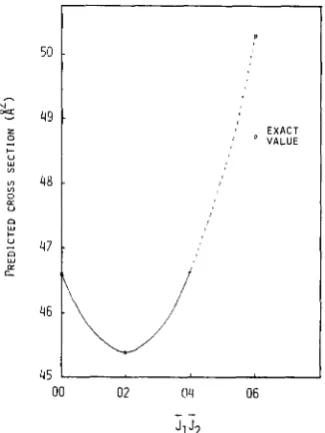
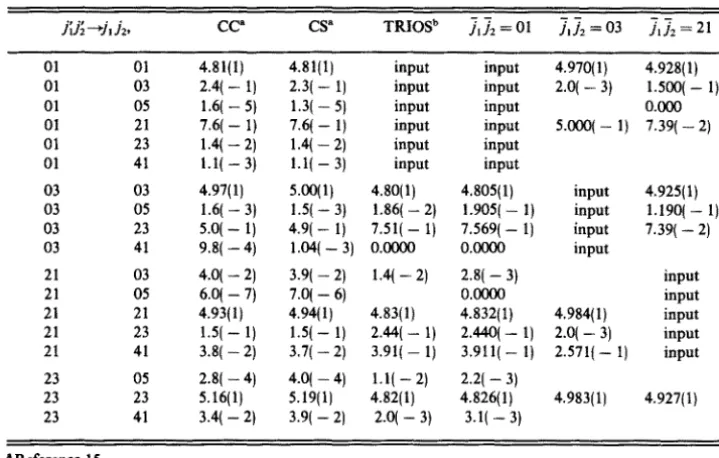
scattering, the factorization matrix is simply a tensor pro-duct of those for the individual molecules (this applies to both ground and general input state relations).3.13 Since there has been no previously published application of such general input state ES factorization relations, we present re-sults in Table V and Fig. 3 for a rigid rotor-rigid rotor model of the para-H2-para-H2 system and where input cross
sec-tions are generated using the effective potential (EP) meth-od. 14 Results for the para-H2-ortho-H2 system are presented
in Table VI using close coupling (CC) input data. 15 Factori-zation matrices used here are derived as in Sec. II A. Predict-ed values do not exhibit the same degree of systematic im-provement when the input state approaches the predicted state, as seen for atom-rigid rotor systems.4
APPENDIX A: REARRANGEMENT OF CONSISTENCY CONDITIONS
Finally it should be remarked that there exists yet an-other technique for obtaining geneal factorization relations applicable to rigid-molecule systems, where the ground state factorization coefficients are expressed in terms of 3 - j co-efficients, by exploiting 3 - j orthogonality properties. Atom-rigid rotor ES Tmatrix factorization has been treated in Ref. 4, and this analysis is extended in Ref. 5 to handle the atom-symmetric top ES system. Also, it should be men-tioned that "ground input state" factorization relations exist also for ES phenomenological cross sections,16 and that some limited extension to general input state factorization relations is possible using matrix inversion, or 3 - j ortho-gonality properties.5
The analytic form of the consistency conditions for ex-amples of Sec. II A becomes
50
N
":S 49
z EXACT
0 () VALUE
....
u
"' '"
'" 48
'"
5
:;J
t;
47 ~
V
c...
46
45
00 02 04 06
J1J2
FIG. 3. Extrapolated estimate of the 06--06 cross section in the
para-H2-para-H2 system at a total energy of 0.55 eV, using ES factorization relations with CC cross sections out 00.12 = 00, 02, 04 as input.
[image:12.590.43.401.86.395.2] [image:12.590.308.471.503.720.2]1646 Chan, Hoffman, and Evans: Factorization in the sudden approximation
TABLE VI. Comparison oree, es cross sections (in A2) for transitionsjUz ... jd2. for para-H2-para-H2 at a
total energy of2000 cm - •• and predicted cross sections uSingJ. J2 = 01, 21, and 03 ee transitions as input data. es values are generated using the coupled states approximation. TRIOS values correspond to an unsystematic derivation ofJ.J2 = 01 input state (using es data), from ground state ES factorization relations.
jU;' -->j, j2' ee' eSa TRIOSb jd2=01 J,j2 =03 J.J2 = 21 01 01 4.81(1) 4.81(1) input input 4.970(1) 4.928(1) 01 03 2A( 1) 2.3( 1) input input 2.0( - 3) 1.500{ 1)
01 05 l.6( 5) l.3( 5) input input 0.000
01 21 7.6( 1) 7.6( 1) input input 5.000{ 1) 7.39( - 2) 01 23 l.4( 2) l.4( 2) input input
01 41 \.I( - 3) I.J( 3) input input
03 03 4.97(1) 5.00(1) 4.80(1) 4.805(1) input 4.925(1) 03 05 l.6( 3) l.5( - 3) L86( 2) 1.905( 1) input 1.190( I) 03 23 5.0( -I) 4.9( I) 7.51( I) 7.569( - I) input 7.39( - 2) 03 41 9.8( 4) l.04( - 3) 0.0000 0.0000 input
21 03 4.0( 2) 3.9( 2) IA( - 2) 2.8( - 3) input
21 05 6.0( 7) 7.0( -6) 0.0000 input
21 21 4.93(1) 4.94(1) 4.83(1) 4.832(1) 4.984(1) input 21 23 L5( 1) l.5( 1) 2.44( 1) 2.440( - 1) 2.0( - 3) input 21 41 3.8( 2) 3.7( 2) 3.91( 1) 3.911( - 1) 2.57l( - 1) input 23 05 2.8( 4) 4.0( 4) 1.l( - 2) 2.2( - 3)
23 23 5.16(1) 5.19(1) 4.82(1) 4.826(1) 23 41 3A( 2) 3.9( 2) 2.0( - 3) 3.1( - 3)
• Reference 15. bReference 13.
i:
9/(xj)[S(])]1 =0 1<;;';<], (AI)/=0
where xj denote the zeros of 9 J. If (J)
J
de~ote the weightsfor the Gauss integration scheme of order j (and precision 2] - 1) based on the 9/s, then multiplying Eq. (AI) by
(J) j9j(xj), wherej
<],
and summing over i yields[S(])]j = -
1=~_J.il{J)
j9j(x])9J+tl
X])]
[S(])h+ /'i (A2)
making explicit Eq. (2.5). Some examples are given in Ref. 3. In the examples of Sec. II A, the 9/ can be Hermite, second-kind Chebyshev, or Legendre polynomials (see Table I). However, the above procedure is applicable for any set of orthogonal polynomials. The
X
j=
U
2j appearing as
projec-tion operators in the atom-spherical top degeneracy aver-aged cross section example, in Sec. II B, form such a set. For the ID Morse oscillator example, these polynomials are
Lj(t) a z -iL fi(z), where t
=
1!z, and the appropriate weight function can be trivially determined using wave func-tion orthogonality. The procedure for the ID P6schl-Teller oscillator is slightly more complicated. Since the wave func-tions here have definite parity, we can divide the consistency conditions into two independent classes [for transitions to odd (0) and even (e) labeled states], as discussed in the Intro-duction. Conversion of these to matrix form is achievedinde-pendently after noting that (i) C ~ (t ) = (1 - r) - nc i~"(z), (ii) C~(t)=(l-r)-nz-Ici~":;(z), where 1!t=l-r, pro-vide the appropriate orthogonal polynomials (and the weight function again follows from wave function orthogonality). It
is clear that for any of the systems in Sec. II A, which all exhibit parity, an analogous separate treatment of "even" and "odd" consistency conditions is possible (of course, with the same final result).
4.983(1) 4.927(1)
A
For the systems of Sec. III, involving <p 's (or P's) with several variables, the consistency conditions can be reduced to involve a sum over a singlej-type variable. For example, for the atom-symmetric top T matrices, one has
00
(1j
+
1)1/2 .
. I
- - 2 - dJmk(xjmk)T}mk;}mkJ=!m!
0, (A3)
where XJmk is a zero of d {.;k' [This reduces to the rigid-rotor result, Eq. (1.9), after setting k's to zero.] Only when ..::im
=
m -m
=
0, ..::ik = k -k
=
0, does there naturally emerge a single one-parameter class of wave functions, i.e.,d
{.;k
with fixedmk,
incorporating orthogonal polynomialsPf'_-mk,m+k (assuming
m;;;.lk
1;;;.0). Properties of the Gauss-type integration scheme based on these, lead to the desired form of the consistency conditions.APPENDIX B: PROOF OF [F(ll
J)
1;;
= 0/1 FOR MATRIXINVERSION FORMS F = A OR G OF FACTORIZATION
Here we start with the Cauchy principal value regular-ized form of the analytic factorization relations
[S(/)]j =
i:
[FCPv(j'I])]j/[S(])]/, (Bl) 1=0where we know that [FCPv(j' 1])]jI = 0l/.3 In the matrix ap-proach we have decomposed th~ integers /
= / -
U/+,
where / ± correspond to S±
(]1
(so the set / - hasj ele-ments), and have consistency conditions in the form[S(/)]I
=
I
[C(])]1m [S(])]m for /E/-. (B2)mE/'+
Substitution ofEq. (B2) into Eq. (Btl generates, with some simple rearrangement, the matrix inversion form of the fac-torization relations
[image:13.595.39.399.95.324.2]Chan, Hoffman, and Evans: Factorization in the sudden approximation 1647
+
[FCPv(j'I])]jl}
[SO)] {, (B3)so the expression in the curly brackets equals [F(j'1
])]p.
Whenj
=]
the first term in the curly brackets vanishes, and the second gives 0Jl' as required.l(a) R. Goldflam, S. Green, and D. J. Kouri, J. Chern. Phys. 67, 4149 (1977); (b) R. Goldftam, D. J. Kouri, and S. Green, ibid. 67, 5661 (1977); (c) v.
Khare, ibid. 68,4631 (1978); (d) G. A. Parker and R. T Pack, ibid. 68,1585 (1978); (e) S. Green, ibid. 70, 816 (1979); (1) D. J. Kouri, in Atom-Molecule
Collision Theory: A Guide for the Experimentalist, edited by R. B. Bern-stein (Plenum, New York, 1979).
2A. E. DePristo, S. D. Augustin, R. Ramaswamy, and H. Rabitz, J. Chern. Phys. 71, 850 (1979).
'c.
Chan, J. W. Evans, and D. K. Hoffman, J. Chern. Phys. 75, 722 (1981). 'D. K. Hoffman, C. Chan, and D. J. Kouri, Chern. Phys. 42,1 (1979).5C. K. Chan, Ph.D. thesis, Iowa State University, 1983. 6For example,
miniP.q) 2 n H
H H =p!q!
L
p + q - 2 n .P q n~O n!(p-n)!(q-n)!
[See N. N. Lebedev, Special Functions and their Applications (Prentice-Hall, Englewood Cliffs, NJ, 1965)].
7S. Chapman and S. Green, J. Chern. Phys. 67, 2317 (1977). 8S. Green and P. Thaddeus, Astrophys. J. 205, 766 (1976). 9B. Chang, L. Eno, and H. Rabitz, J. Chem. Phys. 80, 1201 (1984). JOE. P. Wigner, Group Theory and its Application to the Quantum Mechanics
of Atomic Spectra (Academic, New York, 1959).
"C. K. Chan, D. K. Hoffman, and J. W. Evans, J. Chem. Phys. 82, 1855 (1985).
12 A. R. Edmonds, Angular Momentum in Quantum Mechanics (Princeton University, Princeton, 1974). This reference includes the identity
from which ground state factorization matrix elements, for all the exam-ples of Sec. III, readily follow.
13R. Goldftam and D. J. Kouri, J. Chem. Phys. 70, 5076 (1979). 14G. Zarur and H. Rabitz, J. Chern. Phys. 60, 2057 (1974).
15T. G. Heil, S. Green, and D. J. Kouri, J. Chern. Phys. 68, 2562 (1978). 16D. A. Combe and R. F. Snider, J. Chern. Phys. 72, 2445 (1980).
![FIG. I. Band structure of the factorization matrix F(]IO). Only matrix ele-ments in the shaded region, where (],j,l) satisfy the triangle i~equality, can be nonzero (including all those on the boundary)](https://thumb-us.123doks.com/thumbv2/123dok_us/8139467.244467/7.592.40.289.376.712/structure-factorization-satisfy-triangle-equality-nonzero-including-boundary.webp)