Rochester Institute of Technology
RIT Scholar Works
Theses
Thesis/Dissertation Collections
1987
Application of the DRAM software for the dynamic
analysis of a linkage mechanism
Deepak Namdeo Rode
Follow this and additional works at:
http://scholarworks.rit.edu/theses
This Thesis is brought to you for free and open access by the Thesis/Dissertation Collections at RIT Scholar Works. It has been accepted for inclusion in Theses by an authorized administrator of RIT Scholar Works. For more information, please [email protected].
Recommended Citation
APPLICATION OF THE DRAM SOFTWARE FOR THE DYNAMIC
ANALYSIS OF A LINKAGE MECHANISM
by
Deepak Namdeo Rode
A Thesis Project Submitted
in
Partial Fulfillment
of the
Requirements for the Degree of
MASTER OF SCIENCE
in
Mechanical Engineering
Approved
by:
Approved
by:
Prof.
Qllesis AdV1.s,er)
in
Mechanical Engineering
Prof.
~'lhesis
AdV1.s,er)
Prof.
(Department Head)
TITLE OF THESIS: APPLICATION OF THE DRAM SOFTWARE FOR THE DYNAMIC
ANALYSIS OF A LINKAGE MECHANISM
I DEEPAK NAMDEO RODE HEREBY GRANT PERMISSION TO THE WALLACE MEMORIAL
LIBRARY, OF R.I.T., TO REPRODUCE MY THESIS IN WHOLE OR IN PART. ANY
ACKNOWLEDGEMENTS
I would like to express my deepest gratitude:
To my advisor Dr. Wayne W. Walter, Rochester
Institute of
Technology,
MechanicalEngineering Department,
without whose professionalism, encourangement, and direction
this effort would not have been possible.
To Dr. Richard
Budynas,
Rochester Institute ofTechnology,
MechanicalEngineering
Department,
for hissuggestions and careful checking of the software manual.
To Prof. Liu
Ti-Lin,
Rochester Institute ofTechnology,
MechanicalEngineering
Technology Department,
for his guidance and suggestions in selecting the software
problems.
To Mr. David
Beale,
MechanicalDynamics,
Inc.,
AnnABSTRACT
This study provides the application of the DRAM
software for the dynamic analysis of a linkage mechanism and
presents a simplified version of the DRAM user manual. This
user manual appears in appendix C.
The linkage mechanism which is used for the dynamic
analysis consists of three rigid cranks, and two rigid
couplers. Crank 2 of this mechanism is responsible for
transfering
motion to the other links. Kinematic andkinetic results
by
DRAM are compared with analyticalresults. Good agreement was observed.
Since the DRAM user guide is not easy to understand, it
was necessary to write a user-friendly guide. Several types
of kinematic and dynamic examples are included in this new
manual. These examples demonstrate the usefulness and
effectiveness of DRAM for the solution of progressively more
complex problems. The new manual also provides the
analytical solution of selected examples. The accuracy of
TABLE OF CONTENTS
PAGE
LIST OF FIGURES i
I. INTRODUCTION 1
II. LITERATURE REVIEW 4
III. DESCRIPTION Of MECHANISM 10
IV. COORDINATE SYSTEM 10
V- SELECTED INPUT DATA FOR THE ANALYSIS 14
VI. MATHEMATICAL EQUATIONS Of THE ANALYSIS 15
DISCUSSION 18
38
40
ANALYTICAL SOLUTION 41
PROGRAMS AND OUTPUTS 55
SIMPLIFIED VERSION OF THE
DRAM USER MANUAL 73
VII. RESULTS AN]
rIII. SUMMARY
IX. REFERENCES
X. APPENDIX A
XI. APPENDIX B
LIST OF FIGURES
FIGURE TITLE PAGE
1. LINKAGE MECHANISM. 11
2. LINKAGE MECHANISM WITH THE POSITION VECTORS 12 AND RESPECTIVE ANGLES.
3. LINKAGE MECHANISM WITH THE MARKERS AND 13 COORDINATE SYSTEMS (DRAM) .
4. COMPUTER GRAPHICS. 18
5. ANGULAR DISPLACEMENT OF LINK 6 (DRAM). 21
6. ANGULAR DISPLACEMENT OF LINK 6 (ANALYTICAL). 22
7. ANGULAR DISPLACEMENT OF LINK 7 (DRAM). 23
8. ANGULAR DISPLACEMENT OF LINK 7 (ANALYTICAL). 24
9. ANGULAR VELOCITY OF LINK 6 (DRAM). 25
10. ANGULAR VELOCITY OF LINK 6 (ANALYTICAL). 26
11. LINEAR VELOCITY OF LINK 7 (DRAM). 27
12. LINEAR VELOCITY OF LINK 7 (ANALYTICAL). 28
13. ANGULAR ACCELERATION OF LINK 6 (DRAM). 29
14. ANGULAR ACCELERATION OF LINK 6 (ANALYTICAL). 30
15. LINEAR ACCELERATION OF LINK 7 (DRAM). 31
16. LINEAR ACCELERATION OF LINK 7 (ANALYTICAL). 32
17. LINKAGE MECHANISM WITH INERTIA FORCES AND
TORQUES. 35
18. TORQUE AT LINK 2 (DRAM). 36
I. INTRODUCTION
The linkage mechanism is playing an important role in
today
5technology
because of its simplicity. Mechanicalengineers often adopt the linkage mechanism for the primary
applications of various commercial softwares which analyze
mechanical system response. DADS has recently been
introduced in which a film follower mechanism is used as a
sample example. In
fact,
this mechanism is little more thana simple application of the four bar linkage mechanism.
DRAM,
another popular commercial software package, also usesthe linkage mechanism in many sample examples in the user
manual.
Hence,
the linkage mechanism is one of the mostcommonly used and favorite mechanisms in today's changing
technology.
DADS has been developed
by
Computer Aided DesignSoftware,
Inc. DADS performs 3-Ddynamic,
inversedynamic,
kinematic,
and static analysis of physical systems operating through large displacements. Given geometries, massproperties, component characteristics, and system initial
states, DADS automatically formulates and solves equations
of motion, calculating positions, velocities, accelerations,
reaction
forces,
and energies of the system and itscomponents. The results are reported in
tabular,
curve, andanimated fashion.
DRAM determines static equilibrium and time response
systems
(machinery,
vehicles) which perform through large displacement. DRAM requires as data only a minimaldefinition of the mechanical system. It proceeds from this
data to
develop
and numerically evaluate the systemequations of motion, then reports the results as graphic
terminal
display
or print-out summaries.Several features have been incorporated into DRAM to
account for the behavior of realistic machinery and
vehicles. These are:
1 Representation of multi-degree-of-freedom
(dynamic),
constrained or unconstrained systems,
including
thezero degree-of-freedom (kinematic) system as a subset. 2 A
library
of force elements such as springs anddampers. Included in the
library
are modes of impactand Coulomb friction.
3 A
library
of motion generators (ideal motors) whichdescribe time dependent motion of various elements.
4 User-specified force effects permitting representation
of unusual or non-linear applied forces.
5 Surface-to-surface (high pair) contact.
Most commercial softwares have the ability to handle
constant velocities as well as changing velocities, to
perform a complete cycle analysis.
However,
sometimes itmay be necessary to use special velocity input subroutines
to perform the desired task. These subroutines must be
written in an acceptable form specified
by
the software.Such is the case with DRAM.
complex linkage mechanism has been analyzed. In this study,
both DRAM (Dynamic Response Of Articulate Machinery) and the
analytical solution are utilized for the dynamic analysis of
the linkage mechanism. DRAM computer graphics has also been
generated. With the
help
of computer graphics, it ispossible to
display
the motion of each link of the mechanismon the graphic terminal
during
the cycle.Since the DRAM user guide is difficult to understand,
it was necessary to
develop
a user-friendly guide todemonstrate the usefulness and effectiveness of DRAM for the
dynamic analyses of mechanical systems. While
developing
asimplified version of the DRAM user manual, it was important
to consider several different types of examples. The
examples are presented in such a fashion that the reader's
II. LITERATURE REVIEW
Every
mechanical engineer has a general understandingof the principles of dynamics.
However,
the depth andbreath of knowledge needed to accurately analyze complex,
real-word problems, not to mention the tediousness of the
calculations^
is discouraging.Considering
the limited timeand budget available for most design projects, one should not be surprised that most design engineers
typically
dovery little dynamic analysis themselves.
Instead,
they
relyeither on an analytical specialist or, more commonly, on the
build-and-test method. Dynamic analysis has been the last
of the major engineering methods to benefit from the
computer's power.
Why
has dynamic analysis, the link for all othermethods, matured only recently?
Generating
the equations ofmotion required to simulate the dynamic operation of a
mechanism is straightforward. The obstacle has been a
quick, simultaneous solution to these equations at
tiny
intervals of time over the period coveredby
the analysis.To be useful in practice, the solution must be derived in an interactive time
frame,
i.e. one or tens or hundreds ofseconds. Another reason for the late start of
computer-aided dynamic analysis lies in graphics hardware. The first general-purpose program to calculate the time
the tree-branch coordinate method to minimize computation
time.
Basically,
this approach refers each successive partof the model to one or more preceeding parts, thus producing
a matrix that is dense but greatly reduced in size. In
addition to solving dynamic problems, DRAM is also capable
of static and kinematic analyses.
The original version of the program was completed in
1969 at the
University
of Michigan under the direction ofMilton
Chace,
MDI chairman, who was then a professor ofmechanical engineering. DRAM is now marketed
by
MechanicalDynamics Inc.
In
1973,
Nicolas Orlandea wrote ADAMS (AutomatedDynamic Analysis Of Mechanical Systems) for his doctoral
thesis in mechanical engineering at the
University
ofMichigan. ADAMS was designed as a
three-dimensional,
largedisplacement dynamic program that could also handle
kinematics and statics problems. To solve the equations of
motion, ADAMS uses a sparse matrix method. The matrix is
larger than that in
DRAM,
but most of the variables have acoefficient of zero. A special solver algorithm maps out
the matrix and eliminates unnecessary operations before
ADAMS performs the actual computation. In practice this
method has been shown generally to yield faster solutions
than the tree branch approach.
Although DRAM and ADAMS are
internally
verydifferent,
connections in the input data language. The input data format for ADAMS is quite similar to that for DRAM. The
major difference lies in the additional information required to describe motion in three dimensions rather than two.
ADAMS also offers a wide range of
joints,
with revolute,translational,
cylindrical, spherical, universal, rack andpinion, and screw joints
being
available.For many problems the systematic creation of input data is all that is required of the user. In other cases it is
impossible to completely define the problem using the input language. For
instance,
DRAM provides only constantvelocity and harmonic motion generators. To provide more
flexibility,
both programs allow the user to defineforces,
motion generators, and output requests through Fortran
subroutines.
The
increasing
popularity of large displacementdynamics software is
beginning
to attract the attention ofturnkey
CAD suppliers, who are writing theinterfacing
software required for their systems.
Among
the firstvendors to announce interfaces for ADAMS and DRAM are
Applicon,
Computervision,
ControlData,
Intergraph,
McAuto,
and Sperry. For the user of dynamics software, the interface eliminates the need to enter any geometric
data;
the basic part geometry created on the CAD system in earlier
phases of design is transferred to ADAMS and DRAM. Additionally, the entry of data on constraints and forces is
in batch mode. The interactive mode is the more appropriate
for the first run, because it allows the programs to check
for input data errors. For later runs the user can switch
to batch mode to minimize computing cost.
Some of the applications of ADAMS and DRAM can
described as follows.
ADAMS is used primarily where the displacement and
forces
being
studied are in three dimensional space. Forexample, the Chevrolet
Engineering
Center used the softwareto simulate the behavior of an entire automobile as it was
driven over curbs, chuckholes, railroad
ties,
and otherhighway
obstacles. Large displacement dynamic simulation ofthis kind permits determination of the highest reaction
forces that components such as suspension bushings are
likely
to encounterduring
their lifetime. With theseforces
known,
peak stresses can be determined throughfinite-element analysis.
The DRAM program performs two
dimensional,
planarsimulations. These mechanical systems may not necessarily
lie in a single plane.
Rather,
all points of interest liein parallel planes as
they
move. These structures arerepresented as planar systems with
top,
side, or front viewsof the assembly. One of the industrial uses of DRAM was the
analysis of a Deere and Co. spring reset plow that unhooks
from embedded rocks. When the plow blade hits a rock, the
links,
stops, and springs, that permits the plow blade toescape a rock regardless of its depth or shape.
Recently,
the dynamic analyses of systems is also doneby
the DADS (Dynamic Analysis and Design System) software. DADS has been developedby
Computer Aided Design SoftwareInc. The Dynamic Analysis and Design System is a general
purpose computer program which solves kinematic and dynamic
analysis problems for a variety of real word systems. DADS builds a mathematical model of the real system to calculate
the positions, velocities, accelerations, and reaction
forces of the various components of the system. DADS
performs 3-D
dynamic,
inversedynamic,
kinematic,
and staticanalysis of physical systems operating through large displacements. DADS automatically formulates and solves
equations of motion, calculating positions, velocities, accelerations, reaction
forces,
and energies of the system and its components.Using
DADS,
the designer can simulate the behavior of awide range of alternate designs without the expense of
building
andtesting
prototypes. DADS has a largelibrary
of mechanical elements containing various
joints,
constraints, and force elements. DADS has the
following
features:1. Uses state-of-art numerical integration methods to
provide better stability and efficiency.
2. Automatic removal of redundant constraints.
3. User
friendly
preprocessor^
5. Complete planar analysis
6. User supplied subroutines.
7. Upward compatibility of the PC version to the more
sophisticated mainframe version of DADS.
There are the number of instances where engineering
time and money are very important in the analysis of
problems. DADS is very useful in these situations. Some of
the situations can be summarized as follows:
1. Where analysis is not done at all, or is done
by
hand,
DADS can reduce the time and expense ofdoing
theanalysis manually, or make analysis feasible where it was
not feasible before.
2. Where computer analysis of kinematics and large
displacement dynamics is already
being
doneby
means ofwriting special programs, or
by
inserting
equations of motion into programs, DADS'
s superior generality and ease of
use can save time and money when analyzing complex system or
when a large number of alternating designs must be
evaluated.
3. Where another general purpose kinematic and large
displacement dynamic analysis program is in use, there can
be difficulties because some of those programs are
restricted to solving either closed
loop
or openloop
problems, or are suitable only for grounded
body
problems oronly
"free-free"
problems. DADS is very general and easily
solves all those classes of problems.
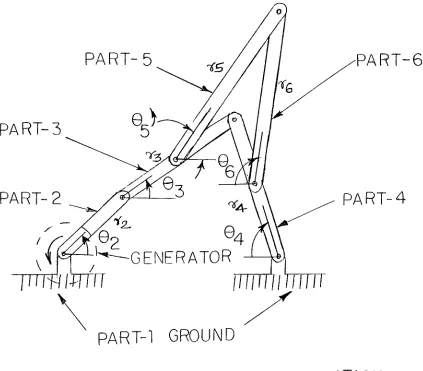
III. DESCRIPTION OF MECHANISM
The linkage mechanism presented in this study consists
of six links and is a closed
loop
type mechanism. Seefigure 1. These six links form two loops. Each
loop
hasfour links. Figure 2 describes these loops with their
assumed direction for the analysis. This mechanism has two
types of links. Link 3 is a rigid link with a 120 degree
angle between the two arms while the other links are of the
straight rigid type. The intersection of link 3 and link 6
is a point whose motion is noncircular. Figure 1 describes
the initial position of each link. The clockwise rotation
of crank 2 generates the input motion for the respective
links in the mechanism. The rest of the links have
counterclockwise rotational motion. All angles and angular
velocities measured in the counterclockwise direction are
considered positive.
IV- COORDINATE SYSTEM
The analysis of this mechanism employs a right handed
coordinate system. For DRAM analyses, two types of
coordinate systems need to be used. The first coordinate
system is called the local reference axis system, and
describes the orientation of the link and the positions of
the markers in the link. The orientation of the local
U
CO
W
O
M IH CJ w cu
to
W
CO
o
cj
B
s o
CO
o cu
CO
CJ
^
Q
S3
M
d
M
i>
g
CO
CO >* CO
W
%
MP
o o CJ
CO
e
CO H
u
tn
O
system. The global coordinate axis system is always
attached to the fixed points of the mechanism. In the
analytical solution, a simple right hand coordinate system
has been used. Figure 2 and figure 3 show the selected
coordinate systems for the analysis of the mechanism.
V- SELECTED INPUT DATA FOR DYNAMIC ANALYSIS
The
following
input data has been used in the analysisof the linkage mechanism:
Note that the link of lengths must be referred to the
local reference axis system for DRAM. Refer to figure 3.
Length of crank 2 (r2) = 2.7
inch.,
length of link 3(arm-l)(r3) = 10.8
inch.,
length of link 3 (arm-2)(r5) = 7.0inch. (for DRAM the length r5 is resolved into the x and y
components such that x=
-3.5, y=
6.0621778),
length of link 4 (r4) = 6.8inch.,
length of link 6 (r6) = 2.6inch.,
length of link 7 (r7) = 1.4 inch. The distance between the
rotational point of link 2 and link 4 is (rl=) 8.7 inch.
The rotation point of link 7 is positioned
X_
= 6.8 inch and= 4.0 inch from link 4. Angle theta 2 (T2) = 315
degree,
angle theta 3 (T3) = 53.6465
degree.,
angle theta 4 (T4) = 93.2790degree.,
angle theta 6 (T6) = -115.7399degree.,
angle theta 7 (T7) = 13.5402 degree. Crank 2 is rotating
with a constant velocity of 31.415927 rad/sec (1800
degree/sec) (cw) . Weight of link 2
= 0.15 lbf
, weight of
link 3 = 0.3
lbf,
weight of link4X
= 0.25
lbf,
weight of [image:21.551.62.496.278.684.2]of inertia of link 2 = 0.00094409 lbf inch.
sec. sq, mass moment of inertia of link 3 = 0.02437009 lbf inch. sec.
sq, mass moment of inertia of link 4 = 0.00998037 lbf inch. sec. sq, mass moment of inertia of link 6 = 0.00072108 lbf inch. sec. sq, mass moment of inertia of link 7 =
0.00018612 lbf inch. sec. sq. Note: Since DRAM
automatically divides the values input for mass and mass moment of inertia
by
gc, the values of mass and mass momentof inertia used in the DRAM input data coding need be input in lbm units.
VI. MATHEMATICAL EQUATIONS OF THE ANALYSIS
Since the DRAM results obtained needed to be checked
by
generating an analytical solution, the complex variable method was adopted for the analysis.
However,
the same analysis can be doneby
using the vector method as well. These methods have been explained in "Kinematics AndDynamics of
Machines"
by Martin,
G. H. To implement thecomplex variable method, the linkage mechanism was
considered in two loops. Figure 2 shows the two loops of the mechanism along with the vector direction of each link
in the respective loop.
The displacement, velocity and acceleration equations
are summarized here and the complete derivation of these
Displacement :
^0-CO
S
a
4-Yg
6053
-^4
COS^
=Y)CO
Velocity
:T2.(-Sin(92.)^2.^esin(S33c53--r4C-5^<&4)e^
-o---C5;
facco52.)(92-i-?3(cosa3)e3
-?^co)se^)e^-o
C4)
Acceleration:
T2(-Case>;0
Ca.D%^C-O^c^X^sf
-K3C~Si'<n3J)c%
^C-sm
2.)
O^V^s
(-Sin
3)
(%)V(3
Ceases
)
93
Second loop:
Displacement:
^Co5^i
+
7sC0is
Vricjass+^ccr.s7=":?&
o*-
--C7^Velocity: . _
+
Ty
C-S\n7)
C71
-o ---_
--
--Cc0
vr7
cos
&y
C
Bv)
= o l __ ~
,----Oo.)
tV-
os
^; c^
V*
c-sm
er)^+T7c-o
ez> coyft ^^e7;
e7
=?4(-Si
n4)^^7-1
CcoS4)
4^^-Sin<95)C%Vt5CCo3r35)g^
- -" f 1o "\
02-)
The virtual work method has been used to find the
here and the complete analysis of the virtual work is given
in appendix A.
4-[>,
+rrv7
Cf7/a3aJ
&7
7
4^2.^ K^3+Yr^
^
x3
+
<m3^^3
+"^4*4
+
(WH-W^/*s^mfycy6
4^7*7
(.13)
A FORTRAN computer program was written to compute theangular
displacement,
velocity, and acceleration of thevarious links for a complete cycle of motion. The torque
required at link 2 to drive the linkage through one complete
VII. RESULTS AND DISCUSSION
Computer Graphics:
Schematic drawings of the linkage mechanism have been
generated
by
DRAM's postprocessor on the Tektronix terminal.DRAM's ability to save the graphic information
during
asimulation, for subsequent analysis, is
being
utilizedby
means of the GRSAVE option in the input data coding. The
computer graphics of the linkage mechanism was developed
by
writing a graphics program package in the input data coding.
The various graphics statements used in the graphics program
are explained in the examples of chapter 9 of " A simplified
version of the DRAM user manual " in appendix C. Various
commands have been used to
display
the computer graphics ofthe linkage mechanism on the Tektronix terminal. These
commands are summarized in chapter 8 of " A simplified
version of the DRAM user manual ".
Figure 4 shows a hard copy of the computer graphics of
the mechanism that was obtained. Link 6 and link 7 of the
mechanism are of interest
during
the analysis.Therefore,
to
identify
the displacement of link 6 and link7,
anarrangement of the small circles have been made through the
graphics program at each respective link. The displacements
of other links could be identified in a similar manner.
Kinematics:
Since the linkage mechanism is of closed
loop type,
theCO CJ
o u 1
tn
a-a
U>
>-*
5
' o
t> M
1- tu
?
etc. in the program was detected easily due to DRAM's
ability to correct the initial input data. As result, the
input data was checked, and corrected.
A complete description of the linkage mechanism was
input to DRAM through the input data coding language. As
mentioned earlier, link 6 and link 7 are of interest in this
analysis. Their
displacements,
velocities and accelerationswere determined
by
requesting these outputs in the DRAMrequest statements. Since the step size in the output
statement of the input data coding is
50,
the complete cycleanalysis of the mechanism provides 50 values of each output
request. The time interval of two consecutive output values
is 0.004 second.
However,
the number of output values ofeach output request could be increased
by
increasing
thesteps. The values of all angles were output in degrees.
They
can be output in radiansby
using the RANGLE option inthe output statement.
In order to check the DRAM results, an analytical
solution was done with the
help
of a computer program. Thecalculated analytical results show a close match with the
DRAM results. Further more, plots of DRAM results as well
as plots of the analytical results
by
the DIS8 plottingsoftware appear to be the same.
Figure 5 though figure 16 show the plots of the DRAM
results and the analytical results. A comparison of figure
5 with figure 6 shows that the nature of these curves
. .,_.
1 1 1 1 1 1 1 1 1 1 1 1 1 1 1 1
%
<B
8> Z
ZJ-2
->--11
s s
in
>-~
0. r o u
in
6
Ma UJ
E-h
LJ
LJ
O
CE
CO
i ia
or
en
CD
cc
oo
>
LJ
HI
E-h
CD
u
H
EH
rt5
'J3
2; H Pu a
EH
U
a.
0
o
H
00s
:z:
LJ
LJ
O
en
co
Q
en
_j
ZD
CD
-en
co
>
LJ
E-_J00y
00
002
00 T
0
p
r^
M
(J
O
Eh
u CJ < Cu CO
M
Q
tJ
O
o
o a CM - O
^-^^
m t>s^
_ 1 hiE-h - a
<
u H
LJ
i >^1
YZ
-LD2
<4 1LJ
_ r 1^
CJ
- o
r--az
_j lda_
-CM _ x-t iJCO
CD
L\ - aO
O\
N^-o
CO
Hen
\1
\. uCO
yZ.\
- oLjJ
_j
1 1
\
z:
CO] \ . i M
ZD
\
LT> t QCD
\
-l\
3
z
\
az
\
- t_j^
i
CO
>
\
LJ
\
.M
ZI
\
Lf>
i i
\
-CM
E
\
\
- a\
"o
1 - a
1
o1
CDOOt
00
00S
001
0
?!
t
5
1 1 1 1 1 1 1 1 1 1 1 1
X
s
2
s
3?
Xl-I-i
o
UJ
3-uj
S3
H
^
In O
J"
H M u o
UJ J
-IN *^
u.
|-_ iJ
-i lo
o a
(0
%
X
_,
WUI
t-> Oi
o M
8"
U.
z
OI
X
KVUJ
io
o<xo UJ K
xuiuj
a. E O u
Q
O M tn
a ui IE
?
!
-^\
\
V
1 1 1 1 1 1 1 1
1
1 1 1 1 1 1 1*
s
s
3 (A X UI 0.L) >-vu a_i ro oz >u>s
I
i
I
o
E-haz
C
LJ
LJ
o
o
az
C
az
CD
az
co
>
LJ
zz
. i E-hCD
:*: o o CM LO - o CD LO - O in CM0000T
V."|
I 1oosz
r-T-r-nooos
rrp-n
OOSS
o
oCO
CDLjJ
in E< o o LO CD mf
CM o o o o o I I I II
I I I II
00SS- 000S-O0SZ-_o p < u H S3 M P U, o s; o H EH $ P W u u p D CJ o MI
s
IS
XUJUJ o.r
13
i
i
i
I
S5
a.H P
In
o
O
P
-lot W u u
z
3 < IE
_ fj
-1
5
a
M_ M
W>
P
X
*2o
wo
-in
fc*
r-t USE<0
a O
H
Mo
E-h
cn
ct:
LJ
O
O
en
cc
LJ
CO
>
LJ
t\
i i i
I
i i i iI
i i i i;
i i i iI
i i i i|
i i i i|
000SC 0000C 000SZ 00002
000SI
000OT
000S
g-oas/Ni
NQiiuaanaoou yusNii
o in o
u
H
Eh
S3 l-H
P
tn
O
a
o
p W
u u
<
S3 M
p
r-i
6
M
graph does not agree with the plotted numbers of angular
displacement of link 6 on the y axis of the analytical
graph. The tabulated numerical output from both solutions
show a close match ( see page 59 and the T6 column on page
71 of appendix B) . It appears that there is a software
problem in DRAM's plotting routine. A careful observation
shows that there is a short
delay
in plotting the firstvalue on the DRAM graph. DRAM draws a straight line from
the origin to this delayed point. This is true for all
plots of DRAM. The angular displacement of link 7 in figure
7 is consistent with the angular displacement of link 7 in
figure 8. In figure 9 the angular velocity of link 6 is
consistent with the angular velocity of link 6 in figure 10.
The linear velocity values of the plot of link 7 in figure
11 and figure 12 are consisten except near the 0.15 sec.
time area in the DRAM graph. The tabular values of the
linear velocity in this region are actually negative. In
the DRAM graph the negative values are not plotted on the y
axis. As a result, the DRAM graph is inconsistent near the
0.15 sec. region. Again
it
appears that there is asoftware problem here in DRAM's plotting routine. Figure 13
and figure 14 show the agreement of the angular acceleration
results of link 6.
Finally,
there is also an agreement ofthe linear acceleration results of link 7 in figure 15 and
figure 16.
V = R(W)
(14)
n
An
=
R(W)2-(15)
At
=K(U)
(16)AA
=\[a
+AZt
(17)where V is the linear velocity, R is the length of the
link,
W is the angular velocity of the
link,
A is the normalcomponent of acceleration,
A,
is the tangential component of tacceleration,.^
is the angular acceleration, and A^is thelinear acceleration.
Kinetic:
A schematic
drawing
of the linkage mechanism for thekinetic analysis is shown in figure 17. Shown here are the
inertia forces and torques associated with each link. Note
that the center of gravity of link 3 is taken for simplicity
at the point shown. The vitual work method was used to
determine the torque input at link 2 necessary to drive the
linkage through one complete cycle. The Newtonian method
can also used for this torque analysis, but the virtual work
method appears to be a simpler approach. The analytical
results for the torque show good agreement with DRAM'S
torque results. Plots of these torque results can be seen
O
Q
W
U <S
o
In
EH
s
S3H
01
CJ
S3 M P
o
-1
4
1
1 1 1 1 1 1 \T 1 I
1
1 I 1 I IX
-IN
2
-la.
o
i
?
iXUJUJ o.E
a
oo-JZ L
M
P
Eh <
OI
o EH
CD
iH
o
CM
E-h
az
LJ
ZD
a
C
o
E-h
o LO o o in -^^^ - o3
t) * H " inB
CM pi
. oO
cn oLJ
S3H
o
CO
P. o
UJ
EHm
2Z
<
i i
H
in t-H CH K i>i _o O H o " o * en r-H in _o o o M In " in ' CM _o - o " o . o a
0*-VIII. SUMMARY
The DRAM software package has proven its usefulness and
effectiveness in the analysis of a complex linkage
mechanism. The DRAM postprocessor has also shown its
importance in computer-aided-design. In short, it was
determined that DRAM is effectively applicable to solve
mechanical systems of the linkage type. The major findings
of this study are enumerated below:
1. The computer graphics of the linkage mechanism were
generated
by developing
a graphics program.Plotting
ofthe DRAM results was done
by
using DRAM's plottingcommands with the
help
of the Tektronix terminal.Smoothness of the curves was achieved
by increasing
thestep size in the output statement to
200,
although theinput data coding shows 50 steps. The step size of 50 is
used to abbreviate the number of output values of the
results.
2. The obtained values of the
displacements,
velocities,accelerations and torque
by
DRAM compare well with theanalytical results. The results obtained
by
DRAM are,therefore, consistent with those of the complex variable
method.
A simplified version of the DRAM user manual presents
the second part of the study. In this user manual, several
examples are presented. The examples are discussed in such
a manner that the reader's
familar^ity
with DRAM is built upsimplified and made understandable
by
referring to thesample examples from time to time. The manual also provides
chapters on getting started with DRAM and DRAM graphics on
the vax/vms system at the Rochester Institute of Technology.
Finally,
an importantthing
included in the manual is achapter on " how to overcome common mistakes and
difficulties which might occur while running DRAM ".
It was found that there are some difficulties in the
DRAM software. These difficulties can be encountered as
follows:
DRAM does not provide the angular velocity and
acceleration if the link is rotating about a fixed point.
In such a situation it was necessary to convert the
calculated angular velocity, and acceleration
by
ananalytical method into the linear velocity, and acceleration
respectively for the comparison of results. It is also
noticed
during
this thesis that there is a DRAM softwareproblem in the plotting routine. DRAM always starts the
plot from the origin regardless of the starting value. Some
IX.
REFERENCES
1
Vierck,
R. K. ,Vibration
AnalysisHarper
& RowPublishers,
Inc,
NewYork,
1979.2
Merian,
J. L. ,Engineering
Mechanics vol.2,
DynamicsJohn
Wiley
&Sons,
Inc,
NewYork,
Toronto,
1978,3
Martin,
G. H. ,Kinematics
And Dynamics of MachinesMcGraw-Hill
BookCompany,
NewYork,
1969.4
Hibbleler,
R. C. ,Encrineerincr
Mechanics,
DynamicsMacmillan
Publishing
Co.,
Inc,
New York 1983. 5DiBenedetto,
A.,
"Analysis
Of Angular Velocities andAccelerations
in Plane Linkagesby
means of NumericalProcedure",
"Journal ofMechanisms,
Transmission
and Automation in Design"vol. 105,1983.
6
Anderson,
R.A.,
Fundamentals
Of VibrationsThe Macmillan
Company,
NewYork,
1967.7
Church,
A. H. , MechanicalVibrations,
JonWilley
and
Sons,
Inc,
1967.8 DRAM user guide. Dynamic Resoonce Of Articulate
Machinery,
Mechanical DynamicsInc,
AnnArbor,
Michigan,
FifthEdition,
1979.9
Cheney
W. ; Kincaid D. , Numerical Mathematicsand
Computing
Brooks/ColePublishing
Company,
California. Second
Edition,
1985. 10 Beer F. P. , Johnston E. R. , Vector Mechanics ForEngineers,
FourthEdition,
McGraw-Hill Book company. New York.11 DADS
literature,
Dynamic Analysis and DesignSystem,,
Computer Aided DesignSoftware,
Inc.Mathematical Derivations:
Ac shown in fig. 2 the position vectors for
loop
I can bewritten as follows.
1^ Tf3
-YA~
V,
Separating
real andimaginary
parts we have^2
COS
^73 Ccj55
-T0|L05&4
-T|
(A-
1
)
T2.
Si
nG>z
-fr^
Si'nG-3
-tZ(SincS^
-0 ---(A-2-)
Rearranging
equations (1) and (2)T3
CO
5
%
=T(
-T2.C05?_
1^
CO-S-)
Let
__
q
,
-Ti
-rzCos
2-^
Cc^tVg
-q| -yYJ\Cos
(9
4
---(A-3J
tn
3\r^O^
-bl
r-'M
S'n^|
- - - -
-(
A
-4J
Squaring
and adding (3) and (4)?/
-qf~-4,
b'trr/f-V
:?-^l^|
COS
&^
+
Zb|f^,
Sin
e<\
c\\
Cos&~'\
-)-b,Sine.i,--
f
q' -t-bi+74
-rjg
)__^A_5)
2?/)
Equation 5 is a transcendental equation in
&
4 . To solve forN/q^+tf
S\'n>9
-_bl
a
^f^;
Now equation(5)becomes
\Tq^b?r
0^
Cos9
4-S,n^jSm^)_ -^ItL^Jl^Let us convert the cosine term into the tangent
by
usingC05-
I
^
\
-j--Loi?"C4-^J
2^>TSI^:
Squaring both sides we get
- _.
C~
1-b\
-T4 -t-r3J
l
+
to^c^-^
^i^ltf)
04
-tq^
*
1
(^_ci,
_bi
-T4 -\-r3)
Divide equation (2)
by
equation (1)^"CDse3
qt
h-t^,
GjS^
ta-n
cS3
-b|
-y-r^sms^j
a\
-r-^4co^-t
Velocity
: Differentiate equations (1) and (2). We get7aC'SmeOe2
l-r^CrSin
03)3-Y-f
C-^'tdO^
)
^
0
--?2Cco53";2
+73
(.co^^e^
-X*,(Co-s^)
^
=o
-Rearranging
-r3
^\r)G3e3
-I-V^iSin
<9^
Gz,
-Ta
Si
"n0Z Bz
^2.
Sm
0
^02
-?/)
Sv
n
^
-fz
O^^
&2
-^ACo54
-(
A-G)
-CA-7)
6--13
Si'ne3
f5
0)53
-t*4os^
^3
Sin
le^-^P
Similarly,
Oq
--73
s
rn<^3
-^4
S
1n^
T3
Cos
3
-7^.0*59^
^
Sin
Qe3
-4)Acceleration : Differentiate equations (6) and (7). We have
t?3(-5in3)^-74
C~C0,s4)
Ce^)'-T^
C-S,ne4)^4
"__--CA-^
4T3
(
cos
0.3
)e3
~*4(-st*
ne.<o
Cs^2"-^
CCo^o^O^
= oCA-9)
Rearranging
0- _
Y3
cose3
e3
-7^
co5^
94
e3
-X
J
-4
Cos0-)
N
-nr3Sm3
T'l
Sf'n4
?3
COS
03
-~''4^se-^^3"^
(
^i2"
Cc6e3
Co$4
-r-Sroe^SmS'^-T-^'C^)X>
zl"?3T4
sYo^Cosq.,
-^3^Cose3
sin
4
=
r3T4
Sin
( 3--|
)
-V-^4
O^lV1-t3
SoC@3
~4)Similarly,
-rjSVrj3
X
)
r 1
^4
~~i3
Co5S3
J
f
^
~T3
$i
r>
$3
T4
Sin
64
x>
T4
Sin
C3--1
}
Now the position vectors for
loop
II can be writtenas follows.
The above equation can be written in the complex torm as
f^|
Co54
-*5Cos
&s
-VHCte&c,
-YfjCose7
=v$ Cosy _ - -(A-\oJ
T4
Si
n^
+
rs-SmS^
Vr6
Sm
&
+r7 Sin6>7
-v<hsr^^
-
--(A-ll)
Rearranging
7g Cases
^^Co^^j-r^Coso^-r^CasQs
^r7Cose7
Yg
S'o
-^Sin
<p
-t_j
Si'n
&f
-~^5Sl
'^
$5"-^7
5i'n
^7
Letb2
~~t-^
si ny
-Y4
Si"n
S4
-ts
Si'n
5
Y6
QJ^Sg
~q2-?7^7
_____(A~I2)
Tg
S\nG
-b2
-T7-Sir,$7
_ . _ . _(A-13)
By
using the phase angle method we get-
2-2-2
^where
2.
cT7
Cos-Pi
~-J_!__
T
W-^.'ti
.2. , ,2. y
H*2,
^2-ilrv-Vj
, 'bto?i ri^bj
a-. ,x, -J/.
C>xS
C7-0>/)
--^-f^+b24-y7
I
f
-nfG
-VU.^
bz
h-t7x
Squaring
both sides we have\
i ?- . 5L .. V_ /.. 2..
tV "
\
After simplifying we get
?-__2-\2
+
^l
a
z
-Vy
Cos&y
-q^-r"/
C<?Sv
Velocity
: Differentiate equations (10) and (11). We getX^
C-SVrU94)C4)H'V%
[-^0
03)^5
4^
C~5Vn4)(^)
4f7(-Sln(97) C<$>7)
-0
- - - --(A-14)
yA
Cose^
C
<a,
)
4vs
Coses C&s)^
Cos&a
(s)
+-7
Cos/
7)
~o - - - -(A-/5)
5
-180
-V3
4
-1.2 0-
3
00+^z
0
5
e
3
Rearranging
equations (14) and (15) we gel
-76
s
. oe
c
c
g
)
~r^7
S(
ezC67
)
~4-X4
^mai
C^i)
-r-Tss,'n
Qs
(3^
-?6
Coo
$C
CQ6^
vrr
to07
C67)
=A
-T7S110O79,
T7
Co^(^7
f$r
'
"" ~~
"-~
-<
^
_T6SinS5 -T7S-n7
cos6
r7C2>se7
OQ~
Av7C0S<97
+8t7Si'o7-feT7 SrrCG-7)
Similarly,
7
~-^G
S'/n06
t
^
Coo>
6
-T^SinSG
^
Casc
A
B
-T7Sl'n#7
1_ _
_
13
T^
Si
n0
-ATg
COS
9^
Acceleration
:Differentiate
equations(14) and (15). We have
-T4
C-Ces^)C4)2+'^)
C-sm
4
)
&^
4.f^(-Cos .sX^34%
(^-Sm^(5)
^T^
C-Cc^e6)c6s)2'+T6
C~^"n
^<SJ>^
-r^7
C~C(*Se7)
C^7)Xh-T7
C-Si'n7)7
= OCA-'^)
- 2_
Y4
C-Si
n<S^X4jV*4
CC03et^J
04
+rs-C-5i'r)
5J>CSs)
-VTsrCcos esJ>
as-+rc c-s,,jr>eO
ce^+^CC^eG
;<r
-v77(-S\n-7j)C^73V'T7
Cco^7;e7
~oCA-17)
Rearranging
Tg
Cr^
n
G6-)
+^7
C-3i
oG7
) e7
^
-#4
C-C
06
4)
C
4 )V^
("*
n^4
)
&4
+T^Cas
^C^J
Y6(CO^0^S4-T7
CC0$e7)&7
=
TT4
(-Sin^)
C4)%f^
t
COS
43
6>4
^(-SinGisJKfe)
-H%CC05
65)^5
+T6(-5me^)Ce6^-r-T7
<bS
1^6-7XzT-
^
Ob
-^
.s
=%
e^
-P
T7
3l'r)
tS-7
Qj
-T7Ga^(P7
?5Sm66
r7sm7
!-*
C3S0&
-^7eo^o7
_
-pr7
C
os7
-G^
t7
S
i"n
7
"?t7
si'nCD^-?)
Similarly,
< *
B7
=T
SV"ni9G
T
Sm6
-T
OSG
Y7
s'v n
7
Torque :
The center of mass of each link is shown in figure 17. The
displacement,
velocity, and acceleration of each link arecalculated simultaneously in the
following
mathematicalexpressions.
Hence for each link we can write ( Refer to figure 17) :
Link 3 : ,
AS=
T~2_
COS
2L.
as
-^c-sfoe^e^
.As
-y^
[>
cos
%^
ce^2"
-t- c-
SJ^J
z.
1
&G{
^7.3Cose3
ti^
=7.3C(-CD5e3i)ce^)2H>C-sin3)>3"]
PR--G
Cos
C<? 0-0.3)
-2-GSm03PR
=2-6
C0S693C3)
PR
=1,C CC-SinGaiC^VGo^^^^
Y33
=AS
-V&G\
"V-PR,(Distance) - - -
C
A-I8J)
73
-as
+s>
-v-Pft
-% (Velocity>
----CA~
'^
yy3
-/AS -r-Erf? *PR -VI
(Acceleration)-- --C/\-*6)
SS
2-13s
=%[C-sin02)^Sc^^l
<y
OS)
-"7 -3SiA
e3
Oq
=7'3C0-S3
3
OP
- Q.<o
C-^''n3>)^3
tI
j) r-\ i
op
~z^Cc-coso3;)cp
4-c-siv>e3^3j
7^33
l^jS+
OCD
Op (Distance)><3
-BS-T-OOf
-OP^Xj
(Velocity)-X*3
~B5
T-QC]-OPrX;.; (Acceleration)~
-(
A-.2
)
_ _
-(A-2.3)
Link 2 :
y2
-LiCOSOi
-' ~
x
y^
=<ifo CC-
C05
2,)
C<%0
\c->^L)
z]
-- -
C
A
-*0C
A- 2.4)(A-2-s)
*2
=B-Si'n(9z.
- " c^A-2-r)*2.
~X%
CCo52j
RETURN
END
KEYWORD DEFINITIONS:
TIME:
Simulation time.
PAR:
Ten parameters.
NGEN:
Identification number of the generator (same as the ID
number of the generator). The NGEN can be used to branch
to the appropriate section of the subroutine when more
than 1 generator is used in the system.
X:
Is the displacement.
DX:
Is the velocity.
D2X:
Is the acceleration.
For Example:
Refer to the Mechanical Dynamics Inc'
s user guide
LINKAGE
MECHANISM C DYNAMIC ANALYSIS DPART/
1,
GROUNDMARKER/1,GMARKER,PART=1,X=0,Y=0,ANGLE=0 MARKER/
15,
POINT,
PART=1,X=8.7,
Y=0MARKER/
14, POINT,
PART=1,X=15.5,
Y=4.0PART/2,MASS=0.15,CM=3,INERTIA=0.3645,ANGLE=315 PART / 2,DEGDANGLE=-1800
MARKER/
2, GMARKER,
PART=2,X=0,Y=0,ANGLE=0 MARKER /3, GMARKER,
PART=2,
X=1.35,
Y=0,ANGLE=0MARKER/4,POINT
,PART=
2,X=2. 7,Y=0
PART/3,MASS=0. 3,CM=19,INERTIA=9. 4090,ANGLE=233
MARKER/6, POINT,
PART=3,X=0,Y=0MARKER/ 5,
GMARKER,
PART=3,X=10. 8,Y=0 ,ANGLE=0 MARKER/ 7 ,POINT,
PART=3,X=-3. 5,Y=6. 0621778 MARKER/19,GMARKER,
PART=3,X=3. 5,Y=2. 6,ANGLE=0PART/4,MASS=0. 25,CM=17,INERTIA=3. 8533,ANGLE=93
MARKER/ 16,GMARKER,PART=4,X=0,Y=0,ANGLE=0 MARKER/ 17 ,
POINT,
PART=4 ,X=3. 4,Y=0MARKER/18,GMARKER,PART=4,X=6. 8,Y=0,ANGLE=0
PART/6,MASS=0.12,CM=9,INERTIA=0.2784,ANGLE=65
MARKER/
10, POINT,
PART=6,X=0,Y=0MARKER/9,
GMARKER,
PART=6,X=1 . 3,Y=0,ANGLE=0 MARKER/8,POINT,
PART=6,X=2. 6,Y=0PART/ 7,MASS=0. 1,CM=12,INERTIA=0. 07186,ANGLE=193 MARKER / 1 3,GMARKER,PART=7,X=0,Y=0,ANGLE=0
MARKER/12 ,
POINT,
PART=7,X=0. 7,Y=0MARKER/
11, POINT,
PART=7,X=1.4,
Y=0ROTATION/1, 1=1,
J=2 ROTATION/2, 1=4,
J=5 ROTATION/3, 1=6,
J=18ROTATION/4, 1=7,
J=8 ROTATION/5,
1=10,
J=ll ROTATION/6,
1=14,
J=13 ROTATION/7,
1=15,
J=16GENERATOR/
1,
ROTATIONAL, ON=2,CONSTVEL,DEGPAR=-1800,PAR=315. ODSYSTEM/GC=386.088,JGRAV=-386.088,ERR=1.E-4,IC
OUTPUT /END=0. 2,STEPS=50
,SAVEINT,GRSAVE,NOPLOT
REQUEST/
1,
DISPLACEMENT,1=9,
J=l REQUEST/2,
DISPLACEMENT,I=12,J=14REQUEST/3, VELOCITY, 1=9,
J=lREQUEST/7,
FORCE,
1=2,
J=lGRAPHICS
GRAPHICS/1,0UTLINE=2,4
GRAPHICS/ 2,0UTLINE=5,6 GRAPHICS/3,0UTLINE=6,7
GRAPHICS/4,
CIRCLE,
CM=8,RADIUS=0. 1GRAPHICS/5,0UTLINE=8,10
GRAPHICS/6, CIRCLE,
CM=11,RADIUS=0.05 GRAPHICS/7,
0UTLINE=13,
11GRAPHICS/
8,
0UTLINE=16,
18GRAPHICS/9,
CIRCLE,
CM=19,RADIUS=
. 2
LINKAGE MECHANISM C DYNAMIC ANALYSIS 3
--DEFAULT VALUE (TSM1)
--SYSTEM/TS= 4.0000E-03
SYSTEM HAS 0
DEGREE(S)
OF FREEDOMSYSTEM WILL BE SIMULATED IN KINEMATIC MODE
* INPUT DATA LOOP CLOSURE CHECK *
j j
I ROTATION 1 DISPLACEMENT I VELOCITY I
I I ERROR I ERROR I
j j j j
I 3 1 9.B7363D-02 I 8. 48230D+01 I I 4 1 2.16149D-01 I 8.48230D+01 I
! j - j
LOOP CLOSURE DISPLACEMENT SOLUTION
CONVERGENCE WITHIN 6.51352D-15 IN 4 ITERATIONS
LOOP CLOSURE VELOCITY SOLUTION
CORRECTED INITIAL CONDITIONS
PART/
PART/ 2
PART/ 3
PART/ 4
PART/ 5
PART/ 6
KFLAG= 0 ORDER=
O.0O000000000O0OOD+0O DEG
3.150000000000000D+02 DEG
2.336465358888234D+02 DEG 6.426010474128745D+01 DEG
1.935402462335677D+02 DEG
9.3279025b8285362D+01 DEG
O.OOO0O00O0OOOOOOD+OO RAD/SEC
-3.141592653589793D+01 RAD/SEC
8.194347775570054D+00 RAD/SEC 5.458131723533457D+01 RAD/SEC
B.920737528789960D+00 RAD/SEC
1.933368376638460D+01 RAD/SEC
0 IFCT= 51 H= 0.40000D-02 ITER=
LINKAGE MECHANISM C DYNAMIC ANALYSIS 3
REQUEST NUMBER
MAGNITUDE OF THE LINEAR TIME DISPLACEMENT OF
MARKER 9 RELATIVE TO MARKER 1 0.0000E+OO 1.54806E+01 4.0000E-03 1.52741E+01 8.0000E-03 1.50745E+01 1.2000E-02 1.48857E+01 1.6000E-02 1.47105E+01 2.0000E-02 1.45507E+01 2.4000E-02 1.44077E+01 2.8000E-02 1.42821E+01 3.2000E-02 1.41743E+01 3.6000E-02 1.40B40E+01 4.0000E-02 1.40103E+01 4.4000E-02 1.39525E+01 4.8000E-02 1.39097E+01 5.2000E-02 1.38816E+01 5.6000E-02 1.38682E+01 6.0000E-02 1.38706E+01 6.4000E-02 1.38900E+01 6.8000E-02 1.39285E+01 7.2O00E-02 1.39882E+01 7.6000E-02 1.40714E+01 8.0000E-02 1.41801E+01 8.4000E-02 1.43165E+01 8.8000E-02 1.44821E+01 9.2000E-02 1.46780E+01 9.6000E-02 1.49041E+01 1.0000E-01 1.51581E+01 1.0400E-01 1.54327E+01 1.0800E-01 1.57123E+01 1.1200E-01 1.59703E+01 1.1600E-01 1.61796E+01 1.2000E-01 1.63385E+01 1.2400E-01 1.64770E+01 1.2800E-01 1.66207E+01 1.3200E-01 1.67734E+01 1.3600E-01 1.69289E+01 1.4000E-01 1.70806E+01 1.4400E-01 1.72235E+01 1.4800E-01 1.73548E+01 1.5200E-01 1.74731E+01 1.5600E-01 1.75781E+01 1.6000E-01 1.76680E+01 1.6400E-01 1.77339E+01 1.6800E-01 1.77552E+01 1.7200E-01 1.76978E+01 1.7600E-01 1.751B4E+01 1.8000E-01 1.71780E+01
MAGNITUDE OF THE ANGULAR ANGLE DISPLACEMENT (DEGS) OF
(DEGREES) MARKER 9 RELATIVE TO MARKER 1 1.82315E+01 6.42601E+01 1.87227E+01 7.57727E+01 1.90673E+01 B.57147E+01 1.92413E+01 9.44739E+01 1.92462E+01 1.02283E+02 1.90968E+01 1.09316E+02 1.B8150E+01 1.15721E+02 1.84268E+01 1.21626E+02 1.79594E+01 1.27134E+02 1.74391E+01 1.32317E+02 1.6BB95E+01 1.37210E+02 1.63299E+01 1.41B22E+02 1.57745E+01 1.46132E+02 1.5232BE+01 1.50105E+02 1.47101E+01 1.53699E+02 1.42081E+01 1.56874E+02 1.37269E+01 1.59604E+02 1.32656E+01 1.618B7E+02 1.2B240E+01 1.63756E+02 1.24034E+01 1.652B5E+02 1.20073E+01 1.66593E+02 1.16417E+01 1.67B53E+02 1.13162E+01 1.69291E+02 1.10448E+01 1.71200E+02 1.08477E+01 1.73947E+02 1.07527E+01 1.77991E+02 1.07943E+01 1.B3B64E+02 1.10015E+01 1.92070E+02 1.13643E+01 2.02793E+02 1.17B19E+01 2.15363E+02 1.20712E+01 2.28039E+02 1.21075E+01 2.39104E+02 1. 19126E+01 2.48157E+02
1.15707E+01 2.55720E+02 1.11552E+01 2.6237BE+02 1.07202E+01 2.6B510E+02 1.03117E+01 2.74312E+02 9.97605E+00 2.79841E+02 9.76614E+00 2.85032E+02 9.74402E+00 2.89723E+02
9.97829E+00 2. 93745E+02 1.05315E+01 2.97139E+02
1.143B2E+01 3.00428E+02
1.26825E+01 3.04750E+02
1.41677E+01 3.11852E+02
LINKAGE MECHANISM C DYNAMIC ANALYSIS 3
REQUEST NUMBER
MAGNITUDE OF THE LINEAR
1'IME DISPIjACEMENT of ANGLE
MARKER 12 RELATIVE ( DEGREES)
TO MARKER 14
0. 0000E+00 7. 00000E-01 1. 93540E+02
4. 0000E-03 7. 00000E-01 1. 94787E+02
8. 0000E-03 7. O0O00E-O1 1. 95403E+02
1. 2000E-02 7. 00000E-01 1. 96196E+02
1. 6000E-02 7. 00000E-01 1. 97511E+02
2. 0000E-02 7. OO000E-01 1. 99457E+02
2. 4000E-02 7. 00000E-01 2. 02003E+02
2. 8000E-02 7. 00000E-01 2. 05036E+02
3..2000E-02 7. 00000E-01 2. 0B39BEH-02
3.,6000E-02 7. 00000E-01 2. 11929E+02
4.,0000E-02 7. 00000E-01 2.. 15486E+02
4..4000E-02 7. 00000E-01
n
^i 1B973E+02 4..B000E-02 7. 00000E-01 2. 22347E+02
5..2000E-02 7. OOQOOE-01 2.,25623E+02
5,.6000E-02 7. 00000E-01 -JL.4 28868E+02 6.. 0000E-02 7. 00000E-01 2.,32194E+02
6..4000E-02 7. 00000E-01 2., 35737E+02
6..8000E-02 7. , 00000E-01 2., 39643E+02
7.. 2000E-02 7., 00000E-01 2..44052E+02
7,.6000E-02 7. .00000E-01 2..490BBE+02
8,, 0000E-02 7. , 00000E-01 2..54865E+02
B..4000E-Q2 7. , 00000E-01 2., 61494E+02
8,.8000E-02 7.. 00000E-01
n
.69097E+02 9,.2000E-02 7.. 00000E-01 2,. 77835E+02
9,.6000E-02 7..00000E-01 2., B7911E+02
1,.0000E-01 7,. 00000E-01 2., 99582E+02
1,.0400E-01 7. . 00000E-01 3,. 1310BE+02
1,.0800E-01 7, . 00000E-01 3.. 28586E+02
1,.1200E-01 7.. 00000E-01 3.. 45545E+02
1,.1600E-01 7.. OOOOOE-Ol 2.. 29387E+00
1,.2000E-01 7..00000E-01 1.. 58982E+01
1,.2400E-01 7..00000E-01 2..40943E+01
1,.2800E-01 7..00000E-01 2..70874E+01
1,.3200E-01 7,.00000E-01 2,. 64777E+01
1,.3600E-01 7,.00000E-01 2,. 37437E+01
1,.4000E-01 7,.00000E-01 1.. 99109E+01
1..4400E-01 7,.0OOO0E-01 1,. 57230E+01
1..4800E-01 7,.00000E-01 1,. 1B442E+01 1,.5200E-01 7..00000E-01 9,. 01729E+00
1,.5600E-01 7,.00000E-01 8,. 16242E+00
1..6000E-01 7,.00000E-01 1,. 03435E+01
1..6400E-01 7,.00000E-01 1,
.65245E+01
1..6800E-01 7,.00000E-01 2,. 72947E+01
1,. 7200E-01 7,
.00000E-01 4,. 29356E+01
1,. 7600E-01 7,.00000E-01 6,. 379B4E+01
1..8000E-01 7,.00000E-01 9,. 04911E+01
LINKAGE MECHANISM C DYNAMIC ANALYSIS 3
REQUEST NUMBER
MAGNITUDE OF THE LINEAR MAGNITUDE OF THE ANGULAJ
TIME VELOCITY OF ANGLE VELOCITY (RAD) OF
MARKER 9 RELATIVE
(DEGREES)
MARKER 9 RELATIVETO MARKER 1 TO MARKER 1
0.0000E+00 6.37856E+01 1.62977E+02 5.45813E+01 4.0000E-03 5.83049E+01 1.69650E+02 4.64293E+01 8.0000E-03 5.16218E+01 1.79675E+02 4.05957E+01
1.2000E-02 4.59483E+01 1.92110E+02 3.60060E+01
1.6000E-02 4.22143E+01 2.05833E+02 3.2264BE-t-01
2.0000E-02 4.03800E+01 2.19303E+02 2.92168E+01
2.4000E-02 3.98024E+01 2.31242E+02 2.67725E+01 2.8000E-02 3.97071E+01 2.41159E+02 2.4B360E+01
3.2000E-02 3.95115E+01 2.49184E+02 2.32829E+01
3.6000E-02 3.89079E+01 2.55713E+02 2.19675E+01 4.0000E-02 3.78146E+01 2.61199E+02 2.07437E+-01 4.4000E-02 3.63001E+01 2.66102E+02 1.94856E+01
4.8000E-02 3.45214E+01 2.70B93E+02 1.81013E+01
5.2000E-02 3.26875E-f-01 2.76063E+02 1.65394E+01 5.6000E-02 3.10434E+01 2.820B6E+02 1.47914E+01
6.0000E-02 2.98644E+01 2.89311E+02 1.28933E+01
6.4000E-02 2.94388E+01 2.97B00E+02 1.09277E+01
6.8000E-02 3.00209E+01 3.07198E+02 9.02194E+00
7.2000E-02 3.17632E+01 3.16B21E+02 7.34267E+00
7.6000E-02 3.46755E+01 3.25981E+02 6.0S426E+00
8.0000E-02 3.86454E+01 3.34288E-I-02 5.45953E+00
8.4000E-02 4.34923E+01 3.41706E+02 5.69897E+00
8.8000E-02 4.9006BE+01 3.48460E+02 7.06224E+00 9.2000E-02 5.49470E+01 3.54922E+02 9.85744E+00 9.6000E-02 6.09B15E+01 1.55964E+00 1.44521E+01 1.0000E-01 6.65543E+01 B.89479E+00 2.12325E+01 1.0400E-01 7.06337E+01 1.74285E+01 3.04010E+01 1.0800E-01 7.13590E+01 2.73291E+01 4.13B92E-I-01 1.1200E-01 6.59B51E+01 3.74530E+01 5.17357E+01 1.1600E-01 5.27931E+01 4.27B77E+01 5.65986E+01 1.2000E-01 3.76899E+01 3.09005E+01 5.26393E+01
1.2400E-01 3.53411E+01 1.. 30639E+00 4.36866EH-01
1.2800E-01 4.24780E+01 3~.43073E+02 3.576S6E+01
1.3200E-01 4.81478E+01 3.35325E+02 3.06692E+01
1.3600E-01 5.01821E+01 3.31534E+02 2.77023E+01
1.4000E-01 4.89070E+01 3.29869E+02 2.59504E+01
1.4400E-01 4.46838E+01 3.30560E+02 2.47242E+01
1.4800E-01 3.78293E+01 3.35567E+02 2.34733E+01 1.5200E-01 2.95685E+01 3.50631E+02 2.17033E+01
1.5600E-01 2.55835E+01 2.62070E+01 1.90992E+01
1.6000E-01 3.5B0S1E+01 6.59223E+01 1.60061E+01
1.6400E-01 5.75816E+01 8.B4510E+01 1.39807E-I-01
1.6800E-01 8.399B2E+01 1.033B7E+02 1.55543E+01
1.7200E-01 1.10829E+02 1.17152E+02 2.3427BE+01
1.7600E-01 1.34118E+02 1.32573E+02 4.02678E+01
LINKAGE MECHANISM C DYNAMIC ANALYSIS 3
REQUEST NUMBER
MAGNITUDE OF THE LINEAR
I"IME VELCICITY OF ANGLE MARKER 11 RELATIVE ( DEGREES )
TO MARKER 1
0. 0000E+00 1. 24B90E+01 2. B3540E-1-02 4.0000E-03
4. 50840E+00 2. 84787E+02 8.
0000E-03 3. 78699E+00 2. 85403E+02 1.
2000E-02 6. 23563E+00 2. 86196E+02 1.
6000E-02 9. 93223E+00 2. 87511E-I-02 2.
0000E-02 1. 3B022E+01 2..B9457E+02
2.4000E-02 1.71849E+01 2.
,92003E+02
2..
8000E-02 1. 97024E+01 2.,95036E+02
3.
2000E-02 2. 12128E+01 n
,9B39BE+02
3.
6000E-02 2. 17726E+01 3., 01929E+02
4.,
0000E--02 2. 15B97E+01 3.. 054B6E+02
4. -02 2. 09704E+01 3., 08973E+02
4.,
8000E-02 2.,02661E+01 3.. 12347E+02
5..
2000E--02 1. 98237E+01 3.. 15623E+02
5. -02 1.,99412E+01 3.. 18B6BE+02
6.,
0000E--02 2., 08319E+01 3.. 22194E+02
6. -02 2..26035E+01 3.. 25737E+02
6..
8000E- 02 2.
, 52594E+01 3..29643E+02
7. -02 2.. 872B6E+01 3.. 34051E+02
7, -02 3., 29184E+01 3.. 39088E+02
8..
0000E--02 3., 77747E+01 3..44865E+02
8. -02 4., 33297E+01 3..51494E+02
8. -02 4..97282E+01 3..59098E+02
9,.
2000E--02 5.. 72261E+01 7..B3470E+00
9, -02 6..61459E+01 1.. 79113E+01
1,. 0000E--01 7,.67225E+01 2,. 95B24E+01
1,. 0400E--01 a.. B6597E+01 4,.31075E+01 1,.
0800E--01 1.. 00041E+02 5.. 85B61E+01
1..
1200E--01 1.. 05469E+02 7.. 55453E+01
1,.
1600E--01 9,. 59417E+01 9,. 22939EH-01
1,.
2000E--01 6,. 77000E+01 1..05B98E+02 1, -01 3.. 28281E+01 1,. 14094E+02
1,.
2B00E--01 5,.54113E+00 1.. 170S7E+02
1, -01 1.. 14689E+01 2,. 96478E+02
1,.
3600E--01 2,.09121E+01 2,.93744E+02
1. -01 2,.51779E+01 2.. B9911E+02
1. -01 2..53271E+01 2..85723E+02
1, -01 2,. 13163E+01 2..81B44E+02
1, -01 1.. 22327E+01 2.. 79017E+02
1. -01 2,. 94869E+00 9,. B1624E+01
1, -01 2,.47154E+01 1,. 00343E+02
1, -01 5,. 13927E+01 1,. 06525E+02
1. -01 8,. 04302E+01 1,
. 17295E+02
1,.
7200E--01 1,. 10987E+02 1,.32936E+02
1..
7600E--01 1,. 44585E+02 1,
. 5379BE+02
1..
8000E--01 1,. 81802E+02 1,
. 80491E+02
1. -01 2,. 09496E+02 2,. 12876E+02
1.
LINKAGE MECHANISM C DYNAMIC ANALYSIS 3
REQUEST NUMBER
MAGNITUDE OF THE LINEAR TIME ACCELERATION OF
MARKER 9 RELATIVE
TO MARKER 1
0.0000E+OO 1.54301E+03 4.0000E-03 2.72731E+03 8.0000E-03 3.02351E+03 1.2000E-02 2.92359E+03 1.6000E-02 2.64141E+03 2.0000E-02 2.2B099E+03 2.4000E-02 1.90161E+03 2.8000E-02 1.54491E+03 3.2000E-02 1.24517E+03 3.6000E-02 1.02913E+03 4.0000E-02 9.06964E+02 4.4000E-02 8.63684E+02 4.8000E-02 8. 70063E+02
5.2000E-02 9.05031E+02 5.6000E-02 9.634B3E+02 6.0000E-02 1.04856E+03 6.4000E-02 1.16102E+03 6.8000E-02 1.29464E+03 7.2000E-02 1.43B94E+03 7.6000E-02 1.5B457E+03 8.0000E-02 1.72675E+03 8.4000E-02 1.86624E+03 8.8000E-02 2.00909E+03 9.2000E-02 2.166B2E+03 9.6000E-02 2.35825E+03 1.0000E-01 2.60946E+03 1.0400E-01 2.93473E+03 1.0800E-01 3.27097E+03 1.1200E-01 3.50518E+03 1.1600E-01 4.06133E+03 1.2000E-01 4.88433E+03 1.2400E-01 4.29041E+03 1.2800E-01 2.78257E+03 1.3200E-01 1.45516E+03 1.3600E-01 5.83362E+02 1.4000E-01 7.11773E+02 1.4400E-01 1.47442E+03 1.4800E-01 2.43709E+03 1.5200E-01 3.63056E+03 1.5600E-01 5.02876E+03 1.6000E-01 6.43046E+03 1.6400E-01 7.57507E+03 1.6800E-01 8.46487E+03 1.7200E-01 9.43317E+03 1.7600E-01 1.10896E+04 1.8000E-01 1.39143E+04
MAGNITUDE OF THE ANGULAR
ANGLE ACCELERATION (RADS) OF
(DEGREES)
MARKER 9 RELATIVETO MARKER 1
2.902B3E+02 -2. 50598E+03
2.96738E+02
-1. 67960E+033.01779E+02 -1. 27776E+03
3.06176E+02 -1. 03198E+03
3.10706E+02 -8.44429E+02
3.16055E+02 -6.83023E+02 3.22878E+02 -5. 43037E+02
3.31823E+02 -4. 30429E+02
3.43441E+02 -3. 52293E+02
3.57626E+02 -3. 11577E+02 1.26094E+01 -3.0561BE+02 2.51593E+01 -3.27290E+02 3.2B951E+01 -3.67021E+02 3.55619E+01 -4.14303E+02 3.43392E+01 -4. 58213E+02 3.09994E+01 -4. 87363E+02 2.72807E+01 -4.90131E+02
2.43866E+01 -4. 55743E+02 2.28598EH-01 -3.7574BE+02
2.2B161E+01 -2.445B4E+02 2.42673E+01 -5.B2284E+01 2.73656E+01 1. B8681E+02 3.25491E+01 5.05723E+02
4.06061E+01 9.07301E+02
5.26460E+01 1.