© 2013, IJCSMC All Rights Reserved 29 Available Online atwww.ijcsmc.com
International Journal of Computer Science and Mobile Computing
A Monthly Journal of Computer Science and Information Technology
ISSN 2320–088X
IJCSMC, Vol. 2, Issue. 9, September 2013, pg.29 – 36
RESEARCH ARTICLE
Performance Evaluation of AODV and
DSR Routing Protocols with PCM and
GSM Voice Encoding Schemes
Osamah Yaseen FadhilDepartment of computer engineering & Eastern Mediterranean University, Famagusta, Turkey
Abstract— A mobile ad hoc network (MANET) is one of the narrowest and most specific of research topics in the field of telecommunications. The growth of this type of network, and the large number of applications with mobility requirements, has led to a wider study and research in the analysis and enhancement of the work in this area. In such networks, nodes are communicating with each other without the need of a centralized administration. In this topology, the communication between the nodes is done by pair to pair within the coverage area. The routing is managed and organized by a number of routing protocols. A limited coverage area, collision and power consumption for mobile nodes are the main problems occurring in such networks.
In this paper, two important MANET routing protocols were used, Ad- Hoc on-Demand Distance Vector (AODV) and Dynamic Source Routing (DSR) to analyse their behaviour with two different voice encoding schemes, Pulse Code Modulation (PCM) and Global System Mobile (GSM).
Keywords— AODV; DSR; PCM; GSM; OPNET17.1
I. INTRODUCTION
Mobile ad hoc network is a new form of independent network. It is a set of wireless mobile nodes and works without centralized administration. MANET is suitable for applications that require mobility. However, there are also a number of problems in these networks. Restriction of coverage area and nodes mobility sometimes causes problems in communications. Moreover, it is necessary to increase the security and authentication programs installed on these nodes. Quality of Service (QoS) is a very important point that should be considered in the evaluation of the performance of these networks. In this paper, two important MANET protocols were analyzed: AODV and DSR. In addition, these routing protocols were used on mobile node with two encoding schemes PCM and GSM. The behaviour of the AODV and DSR with these voice encoding schemes with a different numbers of nodes and one client and server was studied. OPNET 17.1 was used for modeling a mobile ad hoc network. The OPNET modeler is one of the best simulation programs. It provides very accurate and reliable results.
II. RELATED WORK
© 2013, IJCSMC All Rights Reserved 30
set 5Km ×5Km. Network load, route discovery time, packet end-to-end delay and number of hops per route performance metrics were used to evaluate the MANET work. According to the results AODV protocol is better compared with DSR protocol.
In [3] AODV, DSR, GRP, OLSR and TORA protocols were used with simulation time 300 sec and 600 sec for 25, 85 number of mobile nodes. PCM and GSM voice encoding schemes used with random way point speed 5 and 10 m/sec for simulation area 800m×800m and 1600 m×160m. Performance metrics used are jitter, throughput, end -to-end delay variation, WLAN delay variation and packet delay variation. From the results it is observed that, AODV is better than other MANET routing protocols.
In [4] performance metrics like throughput and delay are analyzed for 50, 70 and 100 mobile nodes for DSR MANET routing protocol. It is observed that throughput is more in 100 nodes than 50 and 70. Also the delay is less for 70 nodes than 50 nodes.
In [5] it is shown that the link breakage is more in large node density. In the case of DSR, when the route breakage in a network with a large density node occurs, packets are cached and a route repair takes place. This improves the overall throughput of the system.
In [6] OLSR and AODV and DSR protocols were used. It is shown that when the number of nodes increases to 50, the DSR performance is better.
In [7] the performance of AODV, OLSR, GRP and DSR are evaluated. It is shown that, DSR does not perform well for media access delay and WLAN throughput and network load with 60 minutes simulation time for 20 nodes. The mobility node speed is 7m/sec. PCM voice encoding schemes were used. AODV is better than the others routing protocols. In addition, AODV and OLSR perform better compared with DSR.
In [8] there is a simulation work for MANET with AODV, DSDV, TORA and DSR routing protocols with simulation time 900sec and number of nodes 21.TheVoice application scheme is (G.729). The simulation area is 340m × 340m with random waypoint mobility mode. Mobility speeds are (1, 5, 10, 15, 20) meters/sec. Voice packet delay and Packet delivery fraction are evaluated in MANET. DSR is worse compared with other MANET routing protocols.
In [9] the performance of AODV and DSR are evaluated. Performance matrices throughput, delay, normalized routing protocols and packet delivery ratio are studied for 10, 20, 30, 40 and 50 number of nodes. It is observed that, the end-to-end delay is very high in DSR; however, it decreases in the case that, the number of node increases. This is due to the increase in finding destination when the number of node is increased.
III. DESCRIPTION OF ROUTING PROTOCOL
A. Ad Hoc on-Demand Distance Vector Routing (AODV)
© 2013, IJCSMC All Rights Reserved 31
nodes are no longer neighbours then the first node invalidates all routes through second node. The first node may also send an RERR messages to all nodes that used this unveiled route. AODV is using table-driven which means each node has only one hop routing information.
B. Dynamic Source Routing (DSR)
This routing protocol is a simple and efficient routing protocol designed specifically for use in the multi-hop wireless ad hoc networks of mobile nodes. Here the network is completely self-organizing and self-configuring, without the need for any existing network infrastructure or administration. DSR was the same as AODV in broadcasting RREQ packets by the source to find the destination with unicasting RREP packet. Each ROUTE REQUEST message identifies the initiator and target of the Route Discovery, and also contains a unique id-request. DSR protocol has two stages of routing "Route Discovery" and "Route Maintenance" which allow for the discovery and the repairing of the routes path between the source and destination through the network. The protocol is on-demand which means that no route occurs until there is a need for the transmission of a data packet through the network. DSR used a route cache or a route record to save the routes in the source node. DSR doesn’t need to consistently update its routing table like AODV. It also uses a cache memory which decreases the control overhead. DSR works very well in high node density low mobility networks.
IV.SIMULATION ENVIRONMENT
A. Simulation model.
OPNET is commercial software that provides performance analysis of computer networks and applications. It stands for Optimized Network Engineering Tools. OPNET is one of the best and most powerful networks modeling software. Most of the tools that a designer needs are in the OPNET library. For example, the time to begin work for the application in the server or the profile with the client can be easily specified using OPNET. In addition, it provides mobility elements: speed, area of movement, start time movement, the pause time of the mobile node and their corresponding probability type (e.g. uniform, exponential, etc.). The number of the performance metrics provided in OPNET library is enormous. It is classified in a very convenient and intelligent way for all network types.
B. Simulation parameters.
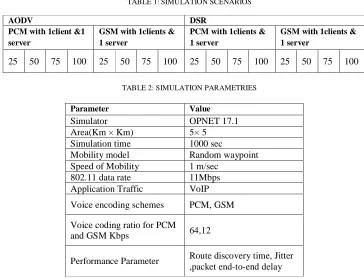
The evaluation of voice application using two different routing protocols AODV and DSR were done with different scenarios. We have two voice schemes PCM and GSM with one client and one server. And we have used a different number of the nodes (25, 50, 75 and 100).
TABLE 1: SIMULATION SCENARIOS
AODV DSR
PCM with 1client &1 server
GSM with 1clients & 1 server
PCM with 1clients & 1 server
GSM with 1clients & 1 server
25 50 75 100 25 50 75 100 25 50 75 100 25 50 75 100
TABLE 2: SIMULATION PARAMETRIES
Parameter Value
Simulator OPNET 17.1
Area(Km × Km) 5× 5
Simulation time 1000 sec
Mobility model Random waypoint Speed of Mobility 1 m/sec
802.11 data rate 11Mbps
Application Traffic VoIP
Voice encoding schemes PCM, GSM
Voice coding ratio for PCM
and GSM Kbps 64,12
© 2013, IJCSMC All Rights Reserved 32
V. PERFORMANCEMETRICS
A. Route Discovery Time
This performance metric represents the time required to discover destination among the intermediate nodes.
B. Jitter
If two packets leave the source node with time stamps t1 & t2 and are played back at the destination node at time t3 & t4, then:
Jitter = (t4 - t3) - (t2 - t1)
C. Packet end-to-end delay
It is the total delay time starting from the analog form of the voice at the source until conversion of the analog form at the destination. It includes network delay, encoding and decoding delay, compression and decompression delays
VI.SIMULATIONRESULT
The simulation results are shown in the following section in the form of line graphs. Graphs show comparison between the two protocols (AODV, DSR) by varying different numbers of nodes with PCM and GSM voice encoding schemes on the basis of different performance metrics.
A.Route Discovery Time
The route discovery time for DSR is larger than AODV in PCM and GSM because the route discovery takes a longer time at every intermediate node since DSR tries to extract information before forwarding to the next node. The same thing happens when a data packet is forwarded hop by hop. While the AODV routing protocol makes a route discovery more efficient, and using refreshable and the newest route to the destination. As the number of node increases, the route discovery time for DSR is decreases. This is due to the large number of alternative multiple routes to the destination node which is cached in its memory during the route discovery time. In additional, the route discovery time for AODV is decreases. This is due to the large number of route request messages forwarded to the destination node with routing information for the newest routes to it. But, AODV still have a less route discovery time compared with DSR protocol. This is because of AODV uses a sequence number to find the newest routes to the destination during the route discovery time [1].
© 2013, IJCSMC All Rights Reserved 33
Figure2. Route Discovery Time versus Number of Nodes for AODV and DSR with GSM
B. Jitter
Jitter values for DSR are larger than the jitter value in the AODV MANET routing protocol. DSR is visit and route through all the possible intermediate nodes to the destination. This increases the jitter. AODV uses the most refreshable and the newest route to the destination. GSM is includes more compression for the voice packet. This affects the quality of voice. GSM has a high jitter compared to PCM. In DSR, there is more probability for jitter as a node broadcasting a route request packet to its entire neighbour nodes in the network. For DSR, increasing the number of nodes causes a decrease in jitter. It is because DSR has multiple routes, during its route discovering process. DSR identifies the multiple routes to the target node which is an increase in high density and low mobility nodes.
© 2013, IJCSMC All Rights Reserved 34
Figure 4.Jitter versus Number of Nodes for AODV and DSR with PCM
C. Packet end-to-end delay
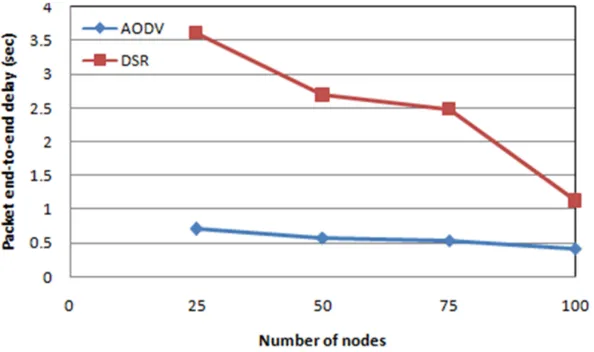
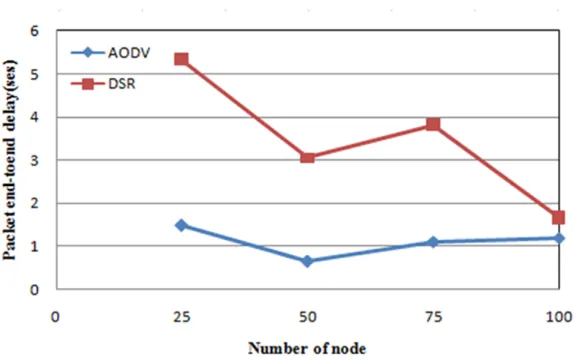
Packet end-to-end delay for DSR is larger than AODV. This is due to the fact that in the case of congestion or routing overhead, control messages get lost and so decreasing its advantage of fast establishing new routes with DSR routing. Under such conditions, DSR has a relatively high delay. GSM has more delay over PCM. This is because of the high compression of GSM, we experience more delay. In additional GSM has coding ration 12 Kbps compared to PCM 64 Kbps. In DSR, there is a high voice packet end-to-end delay because of an aggressive route caching. Increasing the number of nodes leads to a decreased the delay in DSR. Clearly, large multiple routes to the destination node are increased in high density and low mobility nodes and also it causes a decreasing route discovery time to the destination.[2],[3]. In additional, the route discovery time for AODV is decreases. This is due to the large number route request messages forwarded to the destination node with routing information for newest routes to it, during its route discovering process. However, AODV still has a better performance compared with DSR. This is because AODV used the freshness routes to the destination.
© 2013, IJCSMC All Rights Reserved 35
Figure 6.9 Packet End -to-End Delay versus Number of Nodes for AODV and DSR with GSM
VII. CONCLUSIONS
In this paper, a study was conducted for an ad hoc wireless network environment with voice applications. OPNET 17.1 was used in the simulation of the paper to model an ad hoc with voice application. AODV and DSR ad hoc routing protocols were used with PCM and GSM encoding schemes. AODV and DSR routing protocols were analyzed with PCM and GSM voice schemes using one client and one server in varying number of nodes (25, 50, 75 and 100) in the MANET.
Two classes of performance metrics were used in the evaluation of the system. The first class of performance metrics was for MANET routing (route discovery time). The second class was for voice application jitter, packet end-to-end delay. We can conclude that AODV performance is better than DSR. AODV maintains only one entry per destination in the routing table. The destination replies only to the first arrived request and ignores the rest. While DSR uses route caching aggressively and replies to all requests reaching a destination from a single request cycle.
Simulation results also showed that AODV reactive routing protocol is the best suited for MANET networks with GSM and PCM voice encoding scheme compared with DSR.[5], [6]. But, DSR has multiple routes, during its route discovering process increasing the number of nodes make DSR identifies many routes to the destination node in which these routes are increased in high density and low mobility nodes. It causes a decrease in route discovery time for the destination and makes DSR better. But, AODV is a slightly better compared with DSR. This is because AODV uses the newest route to the destination compared with DSR [7], [8].
Finally, PCM has a good quality and low end-to-end delay, but it requires a high bandwidth. GSM has fair quality and high delay but doesn’t consume bandwidth. In addition, it was determined that AODV is best to use with both voice schemes PCM and GSM with a different number of clients and one server. AODV and DSR have almost the same behaviour in a large node density e.g. 100 nodes. But still AODV has better performance than DSR.
ACKNOWLEDGMENT
I would like to thank Asst. Prof Dr. Gürcü Öz.
REFERENCES
[1] V. Sharma, H. Singh, M. Kaur, and V. Banga, June,"Performance Evaluation of Reactive Routing Protocols in MANET Networks Using GSM Based Voice Traffic Applications", Optik - Int. J. Light Electron Opt, 2012, pp. 1-4.
[2] M. Islam, A. Riaz, and M. Tarique,"Performance Analysis of Routing Protocols of Mobile Ad Hoc Networks for VoIP applications", Journal of Selected Areas in Telecommunications, (June 2012), pp. 26-33.
[3] V.Diya, K.Deepak, and S.Megha, (May 2013), "Behaviour Analysis of DSR Manet Protocal with HTTP Trafic Using OPNET Simulator", International Journal of Innovative Research in Computer and Communication Engineering, vol.1, issu.3, (May 2013), pp. 680-678.
© 2013, IJCSMC All Rights Reserved 36
[5] S. Paramjit, S. Ajay, (Mar 2013), "Performance Analysis of Routing Ad Hoc Network Using Different Routing Algorthim", International Journal of Computer Networking, Wireless and Mobile Communications (IJCNWMC), vol.3, issue.1, pp. 1-11.
[6] K.Manijeh, B.Vahide, T.Mohammed, "Performance Evaluation of Reactive, Proactive and Hybrid Routing Protocols in MANET", International Journal on Computer Science and Engineering (IJCSE), (June 2012), vol.4, issue.2, pp. 248-254.
[7] H. Zhang, J. Homer, G. Einicke, and K. Kubik, "Performance Comparison and Analysis of Voice Communication over Ad Hoc Network", CSIRO Exploration and Mining Technology Court, (2010), pp. 1- 6.