InTrans Project Reports Institute for Transportation
5-2003
Effectiveness of extra enforcement in construction
and maintenance work zones
Alireza Kamyab
Iowa State University
Tom McDonald
Brandon Storm
Mark Anderson-Wilk
Follow this and additional works at:http://lib.dr.iastate.edu/intrans_reports
Part of theCivil Engineering Commons
This Report is brought to you for free and open access by the Institute for Transportation at Iowa State University Digital Repository. It has been accepted for inclusion in InTrans Project Reports by an authorized administrator of Iowa State University Digital Repository. For more information, please [email protected].
Recommended Citation
Kamyab, Alireza; McDonald, Tom; Storm, Brandon; and Anderson-Wilk, Mark, "Effectiveness of extra enforcement in construction and maintenance work zones" (2003).InTrans Project Reports. 171.
Effectiveness of extra enforcement in construction and maintenance work
zones
Abstract
As traffic-related work zone crashes continue to increase across the nation, safety of road users and workers has become a top priority for transportation agencies. Since inattention and irresponsible behavior by drivers are surmised to contribute to the frequency of work zone crashes, a program featuring extraordinary presence of and enforcement by law officers has been implemented in many states to address this concern. A literature search of such programs and related research was conducted. While the overall benefits of these activities have been found positive, much of the evidence has been anecdotal. To assess the scope of extra work zone
enforcement programs, a survey was developed and distributed to state departments of transportation across the nation. This survey sought information regarding these efforts such as criteria for selection of target work zones, methods of enforcement operations, and beneficial results. A special survey was also designed and distributed to enforcement agencies in Iowa and other selected states. In addition to the surveys, personal contacts and office visits were conducted by the research team staff. The study found that use of extra enforcement in work zones is a common practice in many states and these activities appear to be increasing. Current literature, survey responses, and interviews have all indicated a prevalent opinion for the benefits of increased law enforcement presence and activity in work zones. Very few comments offered conclusions of negative impacts, such as additional congestion, from these efforts. However, the beneficial effects of focused enforcement have not been intensively quantified. In addition, procedures for the use of law officers in work zones are quite inconsistent across the nation, as is the general implementation of specific legislation addressing work zone traffic violations. Similar variation can be found in funding levels and sources for enforcement activities in work zones among the states. Training of law officers prior to work zone duty does not appear to be commonly required, though the value of focused training is being recognized in some states. As crashes and deaths continue to rise annually in our nation's work zones, it is imperative that demonstrated beneficial programs such as the expanded use of law officers in these locations be continued, refined, and expanded. Future study is needed to supplement the knowledge base and provide guidance to agencies when considering the use of law enforcement to calm traffic, ensure compliance with traffic laws, and thus provide for safer work zones.
Keywords
Benefits; Compliance; Construction and maintenance work zone; Extra enforcement; Financing; Interviewing; Law enforcement and criminal justice personnel; Law enforcement personnel; Legislation; Literature reviews; State departments of transportation; Surveys; Traffic calming; Traffic law enforcement; Training; Work zone safety; Work zone traffic control
Disciplines
Civil Engineering
Comments
E
FFECTIVENESS
OF
E
XTRA
E
NFORCEMENT
IN
C
ONSTRUCTION
AND
M
AINTENANCE
W
ORK
Z
ONES
Sponsored by
the Midwest States Smart Work Zone Deployment Initiative
Mid-America Transportation Center
The opinions, findings, and conclusions expressed in this publication are those of the authors and not necessarily those of the sponsor(s).
Technical Report Documentation Page
1. Report No. 2. Government Accession No. 3. Recipient’s Catalog No.
MwSWZDI Year 4 Technology Evaluation #1
4. Title and Subtitle 5. Report Date
May 2003
6. Performing Organization Code
Effectiveness of Extra Enforcement in Construction and Maintenance Work Zones
7. Author(s) 8. Performing Organization Report No.
Ali Kamyab, Tom McDonald, Brandon Storm, and Mark Anderson-Wilk
9. Performing Organization Name and Address 10. Work Unit No. (TRAIS)
11. Contract or Grant No.
Center for Transportation Research and Education Iowa State University
2901 South Loop Drive, Suite 3100 Ames, IA 50010-8634
12. Sponsoring Organization Name and Address 13. Type of Report and Period Covered
Final Report
14. Sponsoring Agency Code
Midwest States Smart Work Zone Deployment Initiative Mid-America Transportation Center
University of Nebraska-Lincoln W333.2 Nebraska Hall Lincoln, NE 68588-0530
15. Supplementary Notes
16. Abstract
As traffic-related work zone crashes continue to increase across the nation, safety of road users and workers has become a top priority for transportation agencies. Since inattention and irresponsible behavior by drivers are surmised to contribute to the frequency of work zone crashes, a program featuring extraordinary presence of and enforcement by law officers has been implemented in many states to address this concern. A literature search of such programs and related research was conducted. While the overall benefits of these activities have been found positive, much of the evidence has been anecdotal. To assess the scope of extra work zone enforcement programs, a survey was developed and distributed to state departments of transportation across the nation. This survey sought information regarding these efforts such as criteria for selection of target work zones, methods of enforcement operations, and beneficial results. A special survey was also designed and distributed to enforcement agencies in Iowa and other selected states. In addition to the surveys, personal contacts and office visits were conducted by the research team staff.
The study found that use of extra enforcement in work zones is a common practice in many states and these activities appear to be increasing. Current literature, survey responses, and interviews have all indicated a prevalent opinion for the benefits of increased law enforcement presence and activity in work zones. Very few comments offered conclusions of negative impacts, such as additional congestion, from these efforts. However, the beneficial effects of focused enforcement have not been intensively quantified. In addition, procedures for the use of law officers in work zones are quite inconsistent across the nation, as is the general implementation of specific legislation addressing work zone traffic violations. Similar variation can be found in funding levels and sources for enforcement activities in work zones among the states. Training of law officers prior to work zone duty does not appear to be commonly required, though the value of focused training is being recognized in some states.
As crashes and deaths continue to rise annually in our nation’s work zones, it is imperative that demonstrated beneficial programs such as the expanded use of law officers in these locations be continued, refined, and expanded. Future study is needed to supplement the knowledge base and provide guidance to agencies when considering the use of law enforcement to calm traffic, ensure compliance with traffic laws, and thus provide for safer work zones.
17. Key Words 18. Distribution Statement
construction and maintenance work zone, extra enforcement No restrictions.
19. Security Classification (of this report)
20. Security Classification (of this page)
21. No. of Pages 22. Price
Effectiveness of Extra Enforcement in
Construction and Maintenance Work Zones
Principal Investigator
Ali Kamyab, Former Research Scientist
Center for Transportation Research and Education, Iowa State University
Co-Principal Investigator
Tom McDonald, Safety Circuit Rider
Center for Transportation Research and Education, Iowa State University
Research Assistant
Brandon Storm
Center for Transportation Research and Education, Iowa State University
Editor
Mark Anderson-Wilk
Center for Transportation Research and Education, Iowa State University
Authors
Tom McDonald, Brandon Storm, and Mark Anderson-Wilk
Preparation of this report was financed in part through funds provided by the Midwest States Smart Work Zone Deployment Initiative, a pooled-fund study administered at the Mid-America Transportation Center, University of Nebraska-Lincoln.
Center for Transportation Research and Education Iowa State University
2901 South Loop Drive, Suite 3100 Ames, IA 50010-8634
Phone: 515-294-8103 Fax: 515-294-0467 www.ctre.iastate.edu
TABLE OF CONTENTS
ACKNOWLEDGMENTS ... vii
EXECUTIVE SUMMARY ... ix
1. INTRODUCTION... 1
Background... 1
Project Overview ... 1
2. LITERATURE REVIEW ... 2
Introduction... 2
Work Zone Law Enforcement Functions... 2
Impact of Extra Enforcement in Work Zones... 3
Work Zone Enforcement Technology ... 6
Radar and Laser ... 6
Remote Speed Enforcement... 6
Work Zone Legislation ... 8
Guidelines for Use of Extra Enforcement... 9
Enforcement Activities and Funding ... 12
Cooperative Enforcement ... 12
Dedicated Enforcement... 12
Public Opinion of Extra Enforcement in Work Zones... 13
State Work Zone Enforcement Programs ... 13
Overview of FHWA and AASHTO Survey ... 14
Arizona... 14
California... 14
Colorado ... 15
Florida ... 15
Iowa... 16
New Hampshire... 17
New Jersey ... 17
New York... 17
Oklahoma... 18
South Dakota... 18
3. SURVEYS AND INTERVIEWS ... 19
State DOT Survey... 19
Formal Policy ... 19
Selection Criteria and Work Duration... 19
Funding Sources ... 20
Law Enforcement Details... 20
Training for Law Enforcement Officers in Work Zones ... 21
Time of Enforcement and Officer Placement... 21
Effectiveness of Law Enforcement Presence... 22
Law Enforcement Survey ... 23
4. BENEFICIAL RESULTS OF EXTRA ENFORCEMENT ... 26
5. CONCLUSIONS AND RECOMMENDATIONS... 27
Conclusions... 27
Future Research ... 27
Recommendations... 28
APPENDIX A: WORK ZONE LEGISLATION ... 31
APPENDIX B: NEW JERSEY MEMORANDUM OF UNDERSTANDING BETWEEN THE DEPARTMENT OF TRANSPORTATION AND THE DEPARTMENT OF LAW AND PUBLIC SAFETY ... 39
APPENDIX C: GUIDELINES FOR USE OF VIRGINIA STATE POLICE IN CONSTRUCTION/MAINTENANCE WORK ZONES ... 47
APPENDIX D: OREGON WORK ZONE ENFORCEMENT PROJECT ... 51
APPENDIX E: STATE DOT SURVEY... 57
APPENDIX F: STATE DOT SURVEY RESPONSES ... 61
APPENDIX G: LAW ENFORCEMENT SURVEY... 81
APPENDIX H: LAW ENFORCEMENT SURVEY RESPONSES ... 85
APPENDIX I: STATE DOT AND OTHER CONTACTS... 91
ANNOTATED BIBLIOGRAPHY ... 97
LIST OF FIGURES
Figure 1. Traffic Control for Work Area Adjacent to Freeway... 11
Figure 2. Traffic Control for Single-Lane Closure on Freeway ... 11
Figure 3. Iowa DOT Extra Enforcement Funding 1996–2003 ... 16
Figure 4. Survey Response Regarding Extra Enforcement Selection Criteria ... 19
Figure 5. Survey Response Regarding Extra Enforcement Funding Sources ... 20
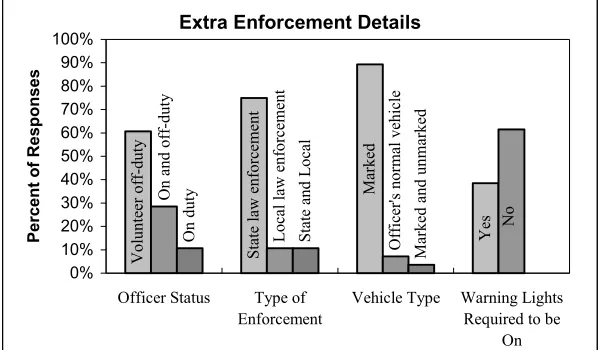
Figure 6. Survey Response Regarding Extra Enforcement Details ... 21
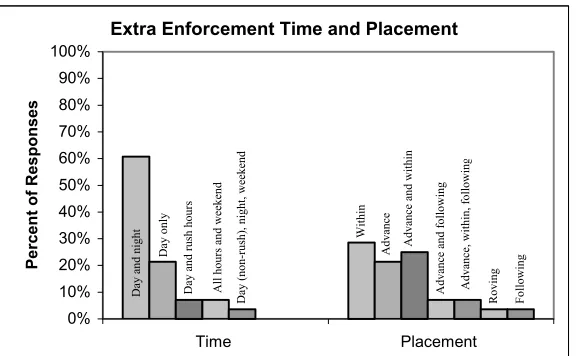
Figure 7. Survey Response Regarding Time and Placement of Extra Enforcement ... 22
Figure 8. Survey Response Regarding Extra Enforcement Effectiveness... 22
LIST OF TABLES Table 1. Guidelines for Flaggers and Uniformed Police Officers in Work Zones ... 10
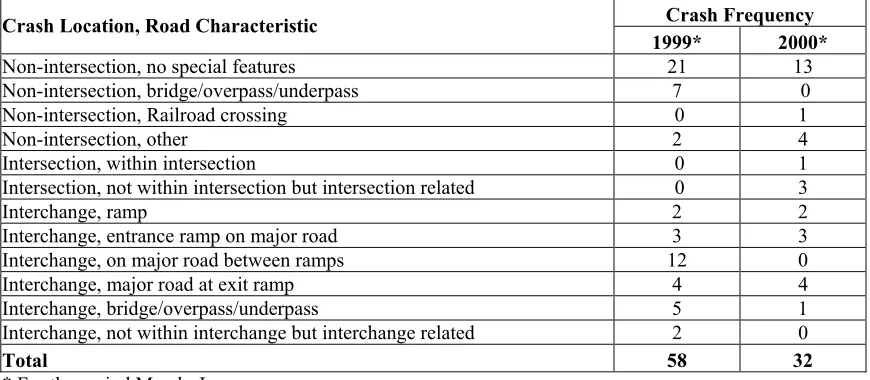
Table 2. Interstate 35/80 Work Zone Crash Frequency Comparison: 1999 (No Extra Enforcement) vs. 2000 (Extra Enforcement) ... 26
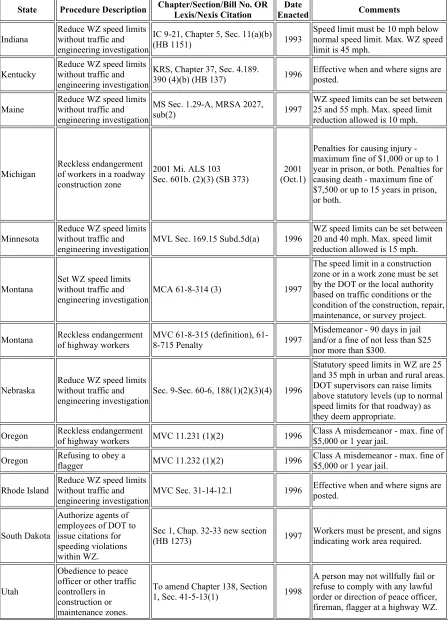
Table 3. Enhanced Fine Legislation for Speeding and Other Violations in Work Zones by State (20)... 33
ACKNOWLEDGMENTS
The authors would like to thank the Midwest States Smart Work Zone Deployment Initiative for sponsoring this research.
EXECUTIVE SUMMARY
The incidence of traffic crashes with resultant deaths and injuries has continued to increase in our nation’s work zones over the past several years. States have developed and implemented several strategies to address this issue; one of the most successful has been use of extra law enforcement activities to calm traffic and ensure compliance with traffic regulations. However, these efforts have not been uniform in application or emphasis. This study investigates the effects of extraordinary enforcement in work zones and offers recommendations for effective and more uniform utilization.
A review of literature found numerous studies relating to extra enforcement in work zones and identified several existing programs in states that utilize this potential safety benefit extensively. Topics of interest include functions, impacts, and guidelines for use of additional enforcement, new and emerging technology, funding aspects, supportive legislation, and opinions regarding benefits. In addition, ongoing programs in several states offer excellent examples of good practice. These programs include criteria for selection of appropriate projects and situations for extra enforcement, deployment and use of officers, specialized enforcement techniques, focused training for participating officers, and beneficial results.
To augment the information found in existing literature, surveys were developed and distributed to all states and several turnpike authorities. In consideration of unique backgrounds and experience, special surveys were distributed to selected law
enforcement agencies. All survey distribution was made electronically. Survey responses from the states indicated extra enforcement selection to be primarily based on traffic volumes and class of roadway, with long-term work zones most commonly addressed. Funding sources vary but most frequent are construction funds from either or both federal and state origins. Volunteer, off-duty officers from state agencies using marked vehicles are more generally used in extra enforcement efforts. Only a few states indicated that special training is required for officers prior to work zone duty. Officers are commonly deployed both day and night and in a variety of locations within and in advance of actual work activities. The states’ survey responses stated an overwhelming opinion that extra enforcement has benefits in both lowering speeds and improving safety in work zones.
The law agency survey responses offered similar results. Officers mostly serve on a volunteer basis, both on and off regular duty. Some training is offered, but it is not extensive nor specific for work zone activity. Law agency opinion is that extra enforcement does result in lower speeds and thus safer work zones.
In addition to surveys, personal interviews of engineering and law enforcement
professionals added details for actual applications of extra enforcement efforts. Officer selection, deployment, reimbursement procedures, and opinions of benefits were discussed in these conversations.
reductions with various law enforcement efforts. A review of crash history in consecutive years with and without extra enforcement showed a significant reduction in crashes when special enforcement efforts were utilized.
The study concluded that extra enforcement in work zones has become a quite common practice in the states. However, a great deal of variation in practices and procedures exists. Non-uniform application of work zone enforcement legislation and use of
formalized policies and interagency agreements were found. Source and type of funding used for these services are also quite variable, and requirements for specialized officer training is not common.
Need for additional research was identified in several areas. Definitive guidelines for project selection, officer deployment, and training could be developed. Guidance for cooperative agreements between transportation and law agencies could be devised through further research. Benefits of various extra enforcement strategies, such as higher incidence of citations and increased fines, could be better identified through focused study. A detailed analysis relating speed reduction in work zones to crash history would also be valuable.
Recommendations based on study findings include the following:
• Provide predicable funding sources and levels.
• Negotiate cooperative agreement between agencies and adopt formalized policies describing extra enforcement activities.
• Develop and implement focused training for officers.
• Establish individual points of contact in each agency.
• Compile and maintain detailed records of program activities.
• Prepare and publish an annual report describing extra enforcement activities.
1. INTRODUCTION
Background
As traffic-related work zone crashes continue to increase across the nation, safety of road users and workers has become a top priority for transportation agencies. Numerous innovations in temporary traffic control materials and techniques have been developed and deployed in recent years. Since inattention and irresponsible behavior by drivers are surmised to contribute to the frequency of work zone crashes, a program featuring extraordinary presence of and enforcement by law officers has been implemented in many states to address this concern. While the overall benefits of these activities have been found positive, much of the evidence has been anecdotal. This study examines extra enforcement programs implemented nationally to address safety concerns in work zones and identifies data that quantify beneficial results.
Project Overview
A review of literature identified several studies and programs relating to extra enforcement activities in work zones, and these are described in detail in Chapter 2.
To assess the scope of extra work zone enforcement programs, a survey was developed and distributed to state departments of transportation across the nation. This survey sought information regarding these efforts such as criteria for selection of target work zones, methods of enforcement operations, and beneficial results. To determine the unique insight from law officers, a special survey was designed and distributed to enforcement agencies in Iowa and other selected states. A summary of responses to both surveys is included in Chapter 3. Samples of the survey forms can be found in the appendix.
In addition to surveys, personal contacts and office visits were conducted by the research team staff. Several interesting details were related in these discussions and a synopsis is included with the survey responses. A full listing of contacts is contained in the appendix.
2. LITERATURE REVIEW
Introduction
Controlling vehicle speeds through work zones is accepted as an important factor in improving the safety of workers and motorists. A number of techniques are currently used by transportation agencies throughout the country to control speeds and reduce speed variation in work zones. Increasing work zone speed enforcement is a common strategy taken by states. A previous study conducted by the Center for Transportation Research and Education (CTRE) concluded that law enforcement is one the most effective management techniques with a very positive impact in reducing work zone speeds (1). A 1998 Federal Highway Administration (FHWA) report stated that the most effective way of controlling speeds in work zones is to have a staffed police car with flashing lights at the beginning of the work zone (2). That document also lists several contacts for more information about various enforcement techniques. This chapter examines states’ existing policies and practices for conducting focused police enforcement in work zones.
Work Zone Law Enforcement Functions
Police officers can be utilized in work zones in many different applications, such as the following (3):
• keeping travel lanes free of illegally parked or stalled vehicles on detour routes and major traffic arteries by arranging for removal
• controlling illegal turning movements that might restrict capacity at intersections
• directing traffic in congested situations
• providing advance warning of heavily congested or stopped traffic in advance of a problem area, such as a lane closure
• assisting in traffic control for special construction events, such as bridge beam erection, changes in traffic patterns, and blasting
• observing and reporting traffic problems on state highways or detour routes to the appropriate engineering staff
• enforcing speed and any other restrictions in or near the work zone area
• aiding in traffic control during the daily signing setup and takedown activities
• preventing intrusions into closed lanes, exits, and so forth
Another possible use for police officers is assisting or supplementing flaggers to provide a more authoritative appeal to motorists.
The National Cooperative Highway Research Program (NCHRP) Report 476 (3) lists operational requirements to help fulfill these functions for night work, as follows.
• After a lane closure has been implemented and work is underway, patrol cars should normally be stationed upstream of the work area, with flashing lights in operation.
• Patrol cars can be used to temporarily stop traffic or to create a rolling roadblock to provide full access to the roadway when installing lane and/or road closures and to shift traffic from one side of the road to the other.
• To maintain credibility of enforcement efforts, a second patrol car should occasionally be stationed downstream from the work area to issue citations for speeding or other violations.
• Patrol cars should operate radar to activate detectors on vehicles approaching the work zone.
• Patrol cars should assist with clearing crashes or incidents such as vehicle breakdowns.
• Patrol cars should assist with controlling traffic at potential problem locations, such as ramp closures, and other possible intrusion locations.
Impact of Extra Enforcement in Work Zones
Police presence and enforcement efforts generally involve the use of law officers in two strategies: stationary and mobile. An officer stationed at a specific location significantly increases speed limit compliance in that immediate area (4). A circulating police vehicle can cover a larger area but may be less effective at speed reduction.
Richards, Wunderlich, and Dudek (1985) examined the effectiveness of focused law enforcement using stationary and mobile applications in six work zones on rural and urban highways in Texas (5). The study indicated that a stationary patrol car reduced mean speeds by 5–12 mph (6 to 22 percent). A circulating patrol car was found to reduce speeds by only 2–3 mph (3 to 5 percent), indicating a lessened effectiveness compared to a stationary approach.
McCoy and Bonneson (1993) conducted a study of law enforcement in a work zone featuring a single-lane closure on an urban multilane street in Sioux Falls, South Dakota (6). An officer in a squad car was parked just downstream from a “ROAD
CONSTRUCTION AHEAD” sign with lights flashing and radar active. The police vehicle in this experiment remained stationary and did not attempt to stop speeding motorists. Only free-flowing vehicles were examined in this study, defined as those with more than four seconds of headway. Other motorists were considered to be unable to proceed at a desired speed because of traffic interference. The study concluded that average traffic speeds at the beginning of the work zone were lowered from 30 to 25 mph, although even these average speeds were still above a posted 20-mph advisory speed limitation.
Noel et al. (1988) conducted a study on a six-lane freeway in suburban Wilmington, Delaware, to analyze the effects of several work zone speed reduction techniques (7). Four applications were utilized: (a) standard flagging techniques as described in the
standard techniques plus pointing at a speed limit sign, (c) stationary police vehicle with flashing lights and active radar, and (d) unformed officer on foot signaling drivers to slow. Work zones featuring both single- and two-lane closures were studied as well as short-term (less than three days) and long-term (greater than 10 days) exposures. Two points of analysis were considered: beginning of taper and adjacent to work area. For the latter location with short-term exposure, the study found both police radar and officer on foot more effective than either flagging methods, with reductions of 4.0 and 3.5 mph, respectively, observed. Standard flagging actually resulted in a speed increase of 2.6 mph at the work site. For short-term two-lane closures, all four study methods found very similar results in slowing traffic. For long-term exposures (more than 10 days) with a single-lane closure, police radar was most effective with an observed speed reduction of 8.4 mph at the work site, followed by officer on foot with a reduction of 3.3 mph. Neither standard flagging method was found effective. For two-lane closures with long-term exposures, all treatments were observed to be effective, but police radar again was better with a speed reduction of 6.4 mph. The study concluded that law enforcement methods demonstrated strong long-term benefits in speed reduction; however, drivers in that area were familiar with a high level of police patrols as standard practice and thus reacted positively with police presence. Also, the improved results with two-lane closures could have been affected by a natural slowdown reaction by drivers when three lanes are constricted to one.
Benekohal, Resende, and Orloski (1992) evaluated the impact of the presence, then absence of marked police cars on vehicle speeds in rural interstate work zones in Illinois (8). The first part of the study measured average traffic speeds while a marked police car circulated through the work zone for four hours. The second component assessed whether a lasting impact on speeds would occur after the patrol car left at the end of this period. The study found that mean speeds of both cars and trucks in the work zone were reduced by about 4 and 5 mph, respectively, while a police car was circulating through the area. Cars and trucks exceeding the posted speed limit through the work zone were reduced by 14 and 32 percent, respectively. However, one hour after the police car left the work zone, the mean speed of cars and trucks increased by about 2.5 and 0.5 mph, respectively. This study concluded that, at least for trucks, a lasting speed reduction could be obtained by periodically assigning mobile police cars to work zones.
The Minnesota DOT examined the effectiveness of police enforcement in work zones at three different sites during 1999: a rural interstate, an urban freeway, and a metro location (9). Using a laser gun, speed data were collected with and without enforcement vehicle presence. The patrol car was located approximately 500–600 feet upstream of the work zones, with lights and flashers activated. The posted speed limit on the four-lane divided interstate was 70 mph; this was reduced to 40 mph in the work zone area during
The lasting effects of police presence were evaluated in a recently increased speed zone (65 to 70 mph) in Michigan on Interstate 96 during 1996 (10). The study indicated an average speed reduction of 5.5 mph for vehicles approaching a parked police car. Upon passing the police car, however, drivers tended to return to original speeds or higher. The study reported no discernible changes in speeds one, two, and three hours following police presence. The study concluded that due to limited resources of law agencies, this speed reduction strategy might be less effective than other options.
During the summer of 1993, a study in Iowa’s Scott County was undertaken to assess the impact of police presence in work zones. Using special funding from the Governor’s Traffic Safety Bureau and Iowa DOT, the Bi-State Regional Commission conducted an investigation of the effects of extra enforcement activities in work zones (11). Three project locations were selected: U.S. 61 in Davenport, U.S. 67 in Bettendorf, and
Interstate 80 in rural Scott County. The enforcement techniques used involved an officer in a police vehicle positioned just prior to the work zone, roving throughout the area, positioned at various locations within the work zone, and positioned after the work zone. All projects primarily used a marked enforcement vehicle parked within view of
oncoming traffic at the beginning of the work zone. Vehicle speed data were collected using NuMetrics traffic monitoring devices affixed to the road surface. All three study areas exhibited a marked decrease in traffic speed with the onset of construction
activities. Introduction of extra enforcement resulted in additional decreases of 1–2 mph. It was concluded that while extra enforcement did not have a significant impact on individual vehicle speeds, a decrease in average speed was observed in all three locations and the number of vehicles exceeding the posted limit was drastically reduced when law enforcement was present. A survey was conducted of law enforcement officers and contractors involved in the study. All stated that the presence of law enforcement made the work zone a safer environment for work crews and road users traveling through the site. Law enforcement officers also concluded that speeds were reduced and best results are achieved by their presence in advance of work zones. Sergeant Jerry Behning of the Davenport Police Department stated that the most effective technique for apprehending violators in a work zone was to conduct a speed check of vehicles entering the area, then radio to other enforcement officers just beyond the work zone for citation of offenders. This method reduced both congestion and distraction to motorists when passing through the work area.
In 2002, a study of enforcement practices was completed using data collected through telephone interviews. Schrock, Ullman, and Trout conducted surveys of 20 randomly selected law agencies across the country (12). Major topics of the interviews included funding, techniques and procedures used, locations of officer placement, coordination efforts, and most effect strategies. The study found that most responding agencies use off-duty officers on an overtime basis for work zone patrols either in total or to
supplement other on-duty officers. A few states assign officers to these duties as standard practice. About one-half of the surveyed states require contractors to hire officers
directly; in the other half, extra enforcement officers are paid by the contracting
about 45 percent prefer to circulate through the work zone area. Some officers opined that circulation was more effective, citing an increased ability to issue citations for violations, an effective deterrent in reducing speeds. About 25 percent of the states also require officers to perform as traffic controllers, but some states prohibit this activity for safety considerations. In coordination, approximately one-half of responding law
agencies become involved in the project planning process or at the pre-construction conference where the need for extra enforcement is assessed. However, about one-third of interviewed officers indicated no advance knowledge of this required activity. For effective strategies, visibility of officers was found to be most advantageous followed by a concerted media awareness campaign. A double fine law was not concluded to be especially effective in reducing work zone speeds. The study concluded that cost of extra enforcement officers is a major factor in many states, and therefore more effective and innovative use is important. Specialized units such as those described in New Jersey and South Dakota are cited as examples of effective and efficient use of officers, particularly retired staff, thus relieving pressure on reduced available on-duty officers.
Work Zone Enforcement Technology
Radar and Laser
Police enforcement relies on personal observation supplemented with technology. Jones and Lacey (1997) conducted a study in Iowa to determine the effectiveness of laser-based speed enforcement programs compared with radar during 1994–1995 (13). Radar and laser speed measurement devices were used extensively in the cities of Dubuque and Council Bluffs, respectively. Both cities increased speed enforcement activities during the study period and raised public awareness of the risk for being cited for speeding violations. Speed data were collected once each week at 10 locations in each city before and after the enforcement program implementation. The study found that the radar-based speed enforcement program decreased the percentage of vehicles traveling more than 5 mph over the posted speed limit by about 20 percent. Laser-based speed enforcement did not result in a discernible reduction of speeding in Council Bluffs. This observation may be partially explained by the prior existence of a higher level of speed compliance in that community. The researchers concluded that laser-based speed measuring devices should supplement rather than replace existing radar measuring technology.
Remote Speed Enforcement
Another technology and strategy currently considered in work zones is real-time remote speed enforcement. Due to high speeds and traffic volumes in many work zones, stopping drivers for traffic violations may be dangerous for both motorists and officers. A remote speed enforcement program uses an automated speed enforcement (ASE) system to detect violators and alert an officer located beyond the work zone of the violation (14). ASE can use a variety of technologies (e.g., radar, LIDAR, elapsed travel measurements, and in-pavement sensors) to detect vehicle speeds. When a violation is detected, a
motorist can be stopped safely. ASE programs can also mail tickets to the owner after a vehicle has been identified. In most states criminal citations cannot be issued using only ASE evidence. Legislation would be needed for tickets to be issued without a law officer personally witnessing the violation.
ASE has been widely used around the world to enforce speed laws for many years. Currently, over 75 countries (including Australia, Canada, Germany, Kuwait, the
Netherlands, Norway, Sweden, and the United Kingdom) are using ASE systems. Many studies indicate a decline in speeds on roadways using an ASE program, but no
completed studies addressing the effectiveness of ASE systems in work zones specifically were identified.
One of the many worldwide jurisdictions having experience with ASE is Victoria, Australia (15). The state of Victoria maintains an extensive photo radar enforcement program initiated in December 1989 and expanded to 54 cameras by January 1991. Along with installation of cameras, a massive public information campaign advising of
enforcement camera use and raising awareness about speeding and safety was
undertaken. A study completed in 1996 showed that the percentage of vehicles exceeding the established limit by 10 percent dropped from 23 to 2.9 percent. A 30 percent
reduction of casualty crashes on arterial roads in Melbourne and a 20 percent reduction on the 60 kilometer-per-hour rural roads were found.A goal of reducing annual fatalities to 500 by the year 2000 in Victoria was established in a 1989 safety management plan. By 1992 this goal was met and by 1994 only 378 fatalities were recorded in Victoria.
The United Kingdom Department for Transport has investigated the effectiveness of cameras to control speed (16). In April 2000, mobile and fixed-site speed and red-light cameras were installed in eight areas in England, Wales, and Scotland. Decreases in both speed and casualties have been observed in installation areas. An average speed decrease of 10 percent was found across all sites.
ASE systems have also been employed in the United States. Several communities have used or are currently using ASE. It is common for communities using ASE to experience a decline in both speeding violations and crashes (17). For example, Paradise Valley, Arizona, noted a decrease in crashes from 460 in 1986 to 224 in 1992 after implementing an ASE program. Similarly, West Valley, Utah, observed a decline from 2,130 to 1,710 crashes annually after using ASE for two years.
A Texas Transportation Institute study (14) examined whether a remote enforcement system was technically feasible and whether vehicles could be correctly identified downstream, and surveyed the attitudes of law enforcement agencies regarding the system. The study found that a downstream observer could correctly match about 84 to 88 percent of the offending vehicles. One problem observed was in transmission of photographs to an officer downstream. Speed thresholds may need to be established to ensure hardware/software processing capabilities are not overloaded. The law
officers and officials believe that modifications would need to be made to the system and/or to state codes to permit enforcement using only photographic evidence.
South Dakota completed a study during 1998 using three deterrents to reduce speeds in work zones: video/LIDAR, a Highway Patrol car, and a decoy car (18). The study found the most effective option was a decoy car parked on the shoulder. A problem found with the active Highway Patrol car was that when the officer left in pursuit of a violator, he/she was absent from his/her position at the beginning of the work zone for 15 minutes or more.
The South Dakota DOT is currently collecting data using an ASE system in work zones. South Dakota DOT is planning to present the findings at a future legislative session in support of legislation to permit direct mailing of citations.
All violators cannot be detected with ASE, especially on high speed and high volume roadways, but it is still believed that an ASE system can identify many more violators than a single police officer (14).
Work Zone Legislation
The Texas Transportation Institute (TTI) conducted a survey regarding work zone legislation in 1997 (19) and provided updated related information on the National Work Zone Safety Information Clearinghouse (NWZSIC) website in 2002 (20). The survey found that 47 states have implemented higher fines for traffic violations in work zones (see Appendix A).
Enhanced enforcement penalties in most states are applicable in all types of work zones: construction, maintenance, and utility. However, some states limit application to
construction areas only.
Of the 47 states with increased fines in work zones, 32 apply the higher penalties only to speed violations, while increased fines can be issued for all traffic violations in 11 of the states. Four states describe specific traffic violations where higher fines can be applied, such as reckless driving, driving under the influence, improper passing/overtaking, and following too closely.
Some states actively enforce more than just moving violations in work zones. The states of Michigan, Montana, Oregon, and Washington have enacted legislation allowing a driver to be charged with reckless endangerment of highway workers in a work zone. The state of Oregon also permits drivers to be cited for refusing to obey a flagger. Similarly, Utah allows tickets to be issued for failure to obey a peace officer or other traffic controllers in construction or maintenance zones.
zones use fixed amounts for violations. In Missouri, for example, moving violations in work zones are assessed the standard fine amount plus 35 dollars.
The TTI survey found that about one-half of responding states with higher work zone fines require appropriate signing to notify motorists of this fact. Furthermore,
approximately half of the states apply increased fines only if workers are present in the work zone. In addition to requiring workers to be present for higher fine application, Illinois has a policy and Tennessee a code provision requiring flashing lights to indicate workers are present.
South Dakota is the only state that authorizes agents or employees of the state department of transportation to issue citations within work zones for speeding and other violations.
Despite the commonality of increased penalties for violations among the states, analyses of fatal crashes in work zones between 1984 and 1995 indicated no consistently
measurable effect on fatal work zone crash frequency due to higher fines (19).
According to NWZSIC (20), six states have adopted legislation allowing a speed limit reduction within a work zone without a traffic engineering investigation.
Guidelines for Use of Extra Enforcement
Studies have been undertaken to establish guidelines for assigning law enforcement officers to work zones.
In 1995, the FHWA developed guidelines for use of uniformed police officers on federal-aid projects in Massachusetts (21). The FHWA conducted interviews with Massachusetts Highway Department personnel from construction, traffic, and design divisions.
Interviews were also conducted with Massachusetts Turnpike Authority, Massachusetts State Police, and Boston Police Department staff. Considering information gathered from the interviews along with consulting the national MUTCD, state of Massachusetts and local training manuals, and current nationwide practices, the FHWA recommended guidelines to determine when uniformed police officers or civilian flaggers should be used for traffic control on federal-aid projects in Massachusetts. The FHWA determined that flaggers and uniformed traffic officers should be used only when standard temporary traffic control measures do not adequately guide traffic and provide safety for motorists and workers. The guidelines also state that use of flaggers may be necessary to control traffic on alternating one-way operations or other situations where supplemental
Table 1. Guidelines for Flaggers and Uniformed Police Officers in Work Zones
Work Activity Low Speed & Low Volume High Speed & High Volume
Work in the median or roadside area (no infringement on the roadway)
Neither flaggers nor uniformed officers are required
Neither flaggers nor uniformed officers are required
Shoulder closed with concrete barrier Neither flaggers nor uniformed officers are
required
Neither flaggers nor uniformed officers are required
Shoulder closed without concrete barrier (work adjacent to traffic)
Neither flaggers nor uniformed officers are required
1 uniformed officer suggested Setting up or removing lane closures,
lane shift, or other changes in traffic pattern
1 flagger per traffic approach
suggested 1 uniformed officer per traffic approach suggested
Lane closed on multi-lane roadway with concrete barrier
Neither flaggers nor uniformed officers are required
Neither flaggers nor uniformed officers are required
Lane closed on multi-lane roadway without concrete barrier (active work adjacent to traffic)
Neither flaggers nor uniformed officers are required
1 uniformed officer per traffic approach suggested
Survey crew—roadway centerline 1 flagger per traffic approach suggested 1 uniformed officer per traffic approach suggested
Temporary Road closure (15–20 minutes)
1 flagger per traffic approach suggested
1 uniformed officer per traffic approach suggested
Ramp work 1 flagger suggested 1 flagger suggested
Moving operation in travel lane 1 flagger suggested 1 uniformed officer suggested
One lane, alternating traffic (no signal) 1 flagger at each end and at each cross street suggested 1 uniformed officer at each end and 1 flagger at each cross street
suggested
Work within intersection Flagger(s) suggested (number dependent upon field
conditions)
Mounce and Brackett (1989) (22) also developed guidelines for use of law enforcement in urban freeway work zones. The guidelines were based on an extensive literature review, field observations, and interviews with enforcement officers and traffic engineers. The researchers found that under conditions of high traffic demand,
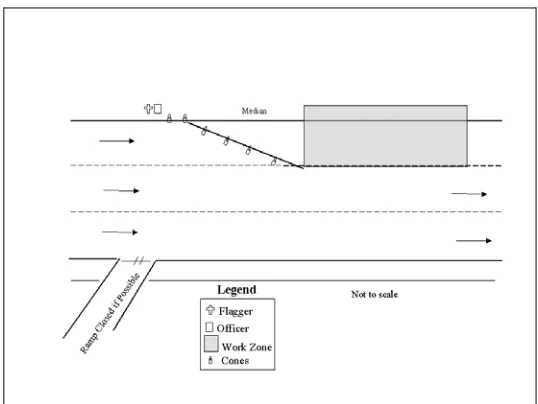
complicated roadway geometrics, unprotected and/or unusual work activity, or nighttime operations, uniformed police officers at work sites provide safer and more efficient traffic control. As illustrated in Figures 1 and 2, when any of the above conditions are
[image:23.612.169.444.250.453.2]encountered, uniformed police officers may effectively be used to replace or support flaggers. Mounce and Brackett state that additional flaggers and police support may be necessary in advance of work zone transitions for speed control and/or immediately adjacent to the work area if no other physical protection such as temporary barrier rail is provided for shielding equipment and workers.
Figure 1. Traffic Control for Work Area Adjacent to Freeway
[image:23.612.171.440.490.692.2]The NCHRP Report 476 developed traffic control guidelines for nighttime maintenance and construction projects during 2002 (3). The report states that for all nighttime work activities, the need for and extent of police services should be considered. It was concluded that visible police enforcement is highly desirable in nighttime operations to encourage driver adherence to traffic regulations and to manage incidents such as crashes, breakdowns, and major congestion. Criteria suggested police services might be advisable for nighttime operations as follows:
• construction activities closely adjacent to traffic without positive protection
• restrictions to traffic flow based on work zone features (e.g., no shoulder, reduced shoulder width, reduced lane width, or reduced number of travel lanes)
• locations where incidents are expected to produce substantial congestion and delays
• special operations that require traffic control or shifts of the traffic pattern
• locations where traffic conditions and crash history indicate that substantial problems may be encountered during construction
• projects with heightened public concern regarding the impacts of the traffic control plan
Other factors that should be considered include traffic speed and volume through the construction site. Engineers may also wish to refer to these criteria when deciding whether or not to use extra enforcement during daytime activities.
Enforcement Activities and Funding
If extra police enforcement is desired for a construction or maintenance project one of two options could be negotiated by agencies: cooperative enforcement or dedicated enforcement.
Cooperative Enforcement
Cooperative enforcement is defined as services for which a police agency agrees to participate at a predefined level, without direct compensation (3). On-duty officers are assigned to patrol work zones when possible. A disadvantage of this practice is that officers may not be available when needed (lane closures, setting up and taking down traffic control devices, directing traffic in during congested times). However, the level of service provided by the law enforcement agency may be appropriate on some projects, and cost to the transportation agency is minimal.
Dedicated Enforcement
develop a blanket agreement to document a basic understanding. Funding sources for extra enforcement include revenues generated from enhanced fines in work zones, general construction funds, FHWA funds, specifically allocated state funds, and
particularly when enforcement is included as a contract item, project construction funds. A significant advantage of dedicated enforcement is that required officers and equipment are generally available when needed.
Public Opinion of Extra Enforcement in Work Zones
Surveys have been previously conducted to assess public opinion of focused law enforcement in work zones.
In 1995, the Iowa DOT conducted a survey addressing perceptions of work zones by motorists and truck drivers (23). When motorists were asked if a higher level of law enforcement would make them feel safer in work zones, 41 percent replied they would feel safer and 50 percent believed it wouldn’t make a difference. When asked if they would drive more carefully in work zones with higher law enforcement, 54 percent responded positively and 36 percent indicated there would be no difference. Sixty-two percent of the respondents would be more likely to obey the reduced speed limits in work zones if additional enforcement were applied, and 33 percent said they would not change their behavior. When truck drivers were asked if they would feel safer in work zones with more stringent law enforcement, 49 percent said they would feel safer, 39 percent said more law enforcement would not improve their safety, and 12 percent were unsure if additional enforcement would improve or not improve their safety. Fifty-eight percent of the responding truck drivers would drive more carefully when law enforcement was present, and 27 percent said it would make no difference. Similar results were found when truckers were asked if they would be more likely to obey reduced speed limits in work zones with stiffer enforcement. Fifty-nine percent said they would be more likely to comply with reduced speeds, and 29 percent said it would make no difference in their driving behavior.
The Oregon DOT conducted an extensive survey in 2001 to gather information about highway users and their priorities relating to work zones using additional speed
enforcement (24). When motorists were asked how important it would be to improve law enforcement in work zones on Oregon highways, 60 percent responded as very important, 26 percent said somewhat important, and the remaining 14 percent responded either not very important, not important, or don’t know.
State Work Zone Enforcement Programs
Some state agencies have adopted various policies and programs regarding focused law enforcement efforts in work zones. Following are descriptions of selected states’
initiatives in extra enforcement. An overview of a FHWA and American Association of State Highway and Transportation Officials (AASHTO) survey addressing extra
Overview of FHWA and AASHTO Survey
The FHWA and AASHTO conducted a survey in 1999 regarding the use and
effectiveness of uniformed police officers (UPO) on federal-aid highway construction projects. Responses were received from 70 sources, and 25 respondents offered general comments as well. State transportation agencies provided 46 responses and others were received from law enforcement agencies and organizations, highway industry
associations, contractors and suppliers, and even state legislators.
A majority of responding states use uniformed police officers in at least some of their work zones, and on-duty and/or off-duty officers are utilized for these duties. Seven states allow only on-duty officers to be assigned to work zones. Common applications for use of extra enforcement include night operations, lane closures, and high-volume/high-speed traffic locations. Most responding agencies use marked police vehicles for patrolling work zones but a few also allow unmarked police vehicles to be used. In addition, some states require officers to be outside the vehicles and visible to traffic but only a few agencies have developed special training for officers assigned to work zones. It was also determined that only a few states require officers to wear protective or high-visibility clothing when outside the vehicle.
The survey also found that the most common source of funds to pay for police officers in work zones was highway construction funds. Other sources of funding included highway administration funds and specific law enforcement appropriations.
Arizona
Arizona’s Construction Manual includes local law enforcement or Department of Public Safety (DPS) officers as recognized flaggers. Generally DPS officers are used on
interstate and urban freeway projects, but off-duty local enforcement officers are often assigned to projects on other types of roadways. The local resident engineer determines whether state or local law enforcement officers will be used. If local law enforcement officers are used as flaggers, they are usually hired by the contractor. If DPS officers are employed, the resident engineer is responsible for negotiations.
California
The California DOT has developed a program known as the Construction Zone Enhanced Enforcement Program or Maintenance Zone Enhanced Enforcement Program
(COZEEP/MAZEEP) by which the California Highway Patrol is contracted to enforce speed compliance in work zones. The primary goal of this program is to maintain
reasonable levels of safety and mobility in high-risk construction areas. Conditions where the COZEEP/MAZEEP program is considered include the following:
• night time closures in general
• night construction activity that is not obvious when inactive
• daytime construction activity that is not obvious when inactive
• work zones protected by flaggers with or without pilot cars
• end of queue management
• poor highway alignment approaching work zones, high truck counts, or other unique situations
• workers exposed to traffic and escape route blocked
• activities with a large number of truck movements at the work area
• work on freeways with 6 or more lanes
Colorado
Colorado has initiated a program called the Chill Campaign to warn and slow motorists in work zones. Chill is a public awareness and enforcement effort that primarily targets aggressive drivers and has been active since 1999. A total of 53 agencies have
participated in the Chill Campaign, including the Colorado DOT, Colorado State Patrol, and local law enforcement agencies. The Colorado State Patrol alone has cited 993 hazardous violations penalties, 271 seat belt violations, 18 for DUI/DUID, and 283 vehicles for other penalties during the Chill Campaign in 2001. Local law enforcement agencies issued 1,233 citations for speeding in a work zone in that same year. Purchased radio airtime informing motorists of dangers in work zones reached 94 percent of adults in Denver and Colorado Springs between the ages of 25 and 54. Funding for the program is part of the Colorado DOT’s safety budget, allocated by the State Transportation Commission.
Florida
Florida’s use of on-duty Florida Highway Patrol officers for patrolling work zones began in 1995. Prior to 1995, off-duty officers were used. The Highway Patrol is reimbursed by the Florida DOT from project funds per a program agreement. Officers are mostly
assigned to urban or rural freeways and limited access roadway projects. Florida notes that the need for extra law enforcement for a specific project should be made during development of the traffic control plan. Some potential conditions for the use of extra law enforcement in Florida are listed below:
• work zone requiring reduced speed
• work zones where barrier wall is used adjacent to through traffic
• nighttime work zones
• areas with intense commuter use where peak traffic may require speed enforcement
• work zone where workers are exposed to nearby high-speed traffic.
• work in high traffic signalized intersections
• high volume urban roadways with lane closures during peak hour traffic periods
Florida has recently initiated a unique program for monitoring and apprehending
speeding drivers. An officer disguised as a road worker checks for speeders with a radar unit then radios to other officers waiting beyond the work zone on motorcycles. These officers stop the speeders in a safe location and issue citations. This initiative has been quite successful; variations have been adopted and used in other states as well.
Iowa
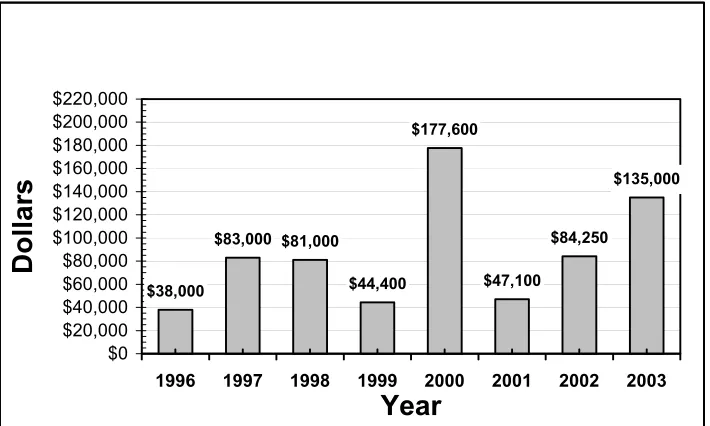
Iowa has utilized extra enforcement in work zones to slow traffic and enforce vehicle regulations for many years, beginning with a pilot project in Scott County in 1993 (11) (as described previously). This initial effort was considered to be successful and local news media supported the campaign. In 1996, funding was allocated to expand the use of extra enforcement in work zones to other areas of the state. Project funds are used in Iowa to support extra enforcement activities (see Figure 3). Additional enforcement is assigned to work zones taking the following major factors into consideration:
• traffic volumes
• enforcement personnel availability • potential work zone congestion • remaining highway capacity • construction work zone type
Although projects in the entire state are technically eligible for these efforts, historically most extra enforcement has been applied in eastern and central Iowa. Projects are
[image:28.612.130.485.461.674.2]recommended by field offices and selected for the program by central construction office staff. Actual Iowa DOT annual extra enforcement expenditures since 1996 are shown in Figure 3.
$135,000
$84,250 $47,100
$177,600
$44,400 $81,000 $83,000 $38,000
$0 $20,000 $40,000 $60,000 $80,000 $100,000 $120,000 $140,000 $160,000 $180,000 $200,000 $220,000
1996 1997 1998 1999 2000 2001 2002 2003
Year
Dollars
New Hampshire
New Hampshire DOT specifications allow contractors to furnish uniformed officers or commercial security or subcontractors to help direct traffic in work zones. According to New Hampshire’s Standard Specifications for Road and Bridge Construction (25), Section 618 (Uniformed Officers and Flaggers), uniformed officers can be used to direct and control traffic through or around work zones. Uniformed officers are required to use official police vehicles with roof-mounted flashing blue lights visible to oncoming traffic and appropriate police markings. The officers are also required to have completed formal traffic control training, as provided by New Hampshire’s Police Standards and Training Council, and to wear regulation duty uniforms along with headgear, reflective vests, and an exposed badge.
New Jersey
In 1994, New Jersey established a dedicated New Jersey State Police (NJSP)
Construction Unit assigned to New Jersey DOT construction projects. This unit assists the New Jersey DOT in monitoring and enforcing provisions of the approved traffic control plans. All members of this unit must receive specific work zone safety training. The NJSP Construction Unit is deployed on an as-needed basis at the request of the local resident engineer on a variety of projects and work classifications. The agreement
between the NJSP and New Jersey DOT can be found in Appendix B.
New York
New York occasionally employs extra enforcement in work zones; however, possible adverse effects of overuse lessening the otherwise positive impacts of a police presence and the potential impact on program funding are also considered by the state.
New York’s policy for staffing extra enforcement efforts is to initially request State Police assistance. Local agencies may be utilized if State Police are unavailable. A recommendation to use focused law enforcement in New York work zones is normally made during the design process of a specific project. High speed, high volume traffic flow in combination with any of the following factors are considered to guide decisions for inclusion of extra enforcement as part of a project traffic control plan:
• construction activities closely adjacent to an active traffic lane without positive
protection (barrier rail, etc.)
• restrictions to traffic flow based on work zone features; no shoulder, reduced
shoulder width, reduced lane width, and reduced number of travel lanes
• locations where incidents will produce substantial congestion and delays • special operations that require temporary or frequent shifts in traffic patterns • locations where traffic conditions and crash history indicate substantial problems
may be encountered during construction
A recommendation to utilize extra enforcement in a work zone may also be made after a project is underway if there is an unusual occurrence of traffic crashes, objectionable delays and congestion, and/or widespread driver disregard for speed limits and other regulations.
The New York program has included parking a police car between traffic and work crew with a mobile crash cushion positioned behind vehicle. Blue strobe lights on flashing arrow boards have also been added to give the impression that additional officers were on site. However, this tactic has had only limited success.
Extra law enforcement costs are paid through a region's capital program. These costs are eligible for reimbursement on federal aid projects. The project engineer generally
controls the number of hours officers are present in the work zone.
Oklahoma
In Oklahoma, the Oklahoma DOT determines when projects should have state troopers present in work zones. Off-duty officers are used for extra enforcement in work zones. Payment is made directly to the Department of Public Safety. Factors considered when choosing work zones for extra enforcement include night work, high volume areas, and areas of complex geometry with known high speed history.
Oklahoma has utilized law enforcement officers disguised as workers on construction equipment. Disguised officers check motorists’ speeds with radar, laser, or LIDAR, and then radio to uniformed officers outside of the work zone with descriptions of violating vehicles. After offending vehicles are beyond the work zone and in a safe environment, uniformed officers issue tickets to violators. One city in Oklahoma that has used this technique is Broken Arrow. The local police department has received positive publicity in local news media informing the public about this new technique used to slow traffic.
South Dakota
3. SURVEYS AND INTERVIEWS
CTRE conducted two surveys and several interviews with transportation officials and law enforcement officers to obtain information and opinions about the use of extra law
enforcement in work zones. Following are summaries of those surveys and interviews.
State DOT Survey
An electronic survey (see Appendix E) was developed and distributed to all 50 state DOTs and seven turnpike or thruway agencies by e-mail. Twenty-eight state DOTs responded. No surveys were returned from turnpike or thruway agencies. A complete summary of states’ survey responses can be found in Appendix F.
Formal Policy
Survey responses indicated that 21 of 28 responding states (75%) have adopted a formal policy or program to provide extra enforcement in work zones during construction projects and/or maintenance operations. For example, both Virginia and Oregon have adopted policies and guidelines describing criteria to determine when extra enforcement will be used in a work zone as well as responsibilities of cooperating police officers when assigned to work zones (see Appendixes C and D).
Selection Criteria and Work Duration
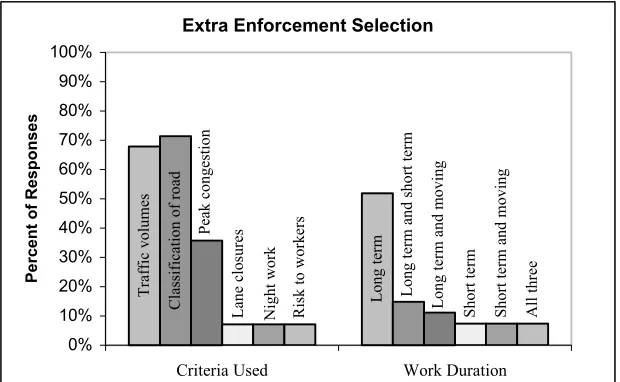
States rely on various criteria to determine if and where extra enforcement will be used (see Figure 4). Traffic volumes and classification of road are used by most responding states to determine what projects have extra law enforcement. Other factors include peak congestion, lane closures, night work, and risk to workers. It was found that responding states mostly use extra law enforcement in long-term work zones.
Extra Enforcement Selection
Traffic volumes Long term
Classification of road Long term and short term
Peak congestion
Long term and moving
Lane closures Short te
rm
Night work Risk to wor Short term and moving
ke
rs
All thre
e
0% 10% 20% 30% 40% 50% 60% 70% 80% 90% 100%
Criteria Used Work Duration
P
e
[image:31.612.152.462.489.680.2]rcent of Responses
Funding Sources
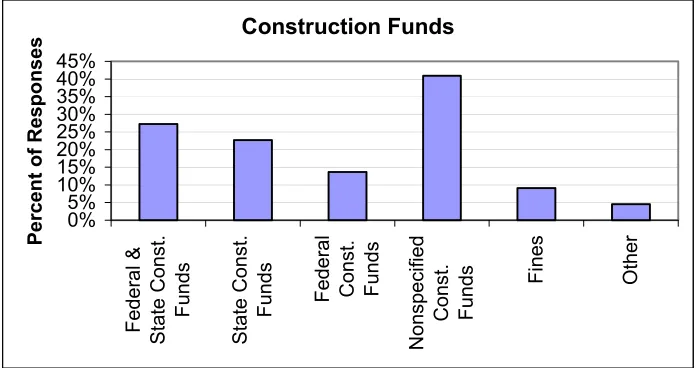
Questions addressing funding sources for extra enforcement and method of reimbursement were included in the survey (see Figure 5).
Construction Funds
0% 5% 10% 15% 20% 25% 30% 35% 40% 45%
Federal & State Const. Funds State Const. Funds
Federal Const. Funds
Nonspecified
Const. Funds
Fines Other
[image:32.612.132.480.151.335.2]Percent of Responses
Figure 5. Survey Response Regarding Extra Enforcement Funding Sources
A majority of responding states fund work zone law enforcement with construction funds. “Construction funds” as described in the responses include project funds, construction funds, project money, highway improvement project funding, and road funds. Of the states that use construction funds for extra enforcement, six states indicated that both state and federal money is utilized. Three states rely only on federal
construction funds to pay for enforcement, and five states rely only on state funds. Nine states using construction funds did not indicate the specific source. Kentucky and Indiana indicated that money generated from “double fines” is designated to pay for extra
enforcement in work zones, although details of funding transfer between agencies was not provided.
A majority of responding states indicated that law agencies are reimbursed for services through the state DOT. In some states, the State Highway Patrol is in the same agency as the DOT, making it easier for funds to be transferred. Five states responded that the contractor is responsible for paying for extra enforcement.
Law Enforcement Details
marked police vehicles when patrolling work zones. Only 10 responding states require warning lights to be operating during work zone patrols. Eight states replied that law enforcement officers are required to wear protective apparel when out of a vehicle in work zones.
Extra Enforcement Details
Yes
Marked
State law enforcement
Volunteer off-duty
No
Officer's normal vehicle
Local law enforcement
On and off-duty
Marked and unmarked
State and Local
On duty
0% 10% 20% 30% 40% 50% 60% 70% 80% 90% 100%
Officer Status Type of Enforcement
Vehicle Type Warning Lights Required to be
On
[image:33.612.156.456.146.321.2]Percent of Responses
Figure 6. Survey Response Regarding Extra Enforcement Details
Training for Law Enforcement Officers in Work Zones
Several states including Maryland, Missouri, South Dakota, and Washington indicated that special training is provided to officers patrolling work zones. In addition, Tennessee is developing a training program for special enforcement officers through a cooperative effort by the Highway Patrol, DOT, FHWA, and University of Tennessee Center for Transportation Research. New Jersey and New Hampshire also require special training for officers patrolling work zones.
Time of Enforcement and Officer Placement
Extra Enforcement Time and Placement
W
ithin
Day and night
Advance
Day only
Day and rush hours
Advance and withi
n
Advance and followin
g
All hours and weekend Advance, within, followin
g
Day (non-rush), night, weekend Roving Following
0% 10% 20% 30% 40% 50% 60% 70% 80% 90% 100% Time Placement P e
[image:34.612.164.452.73.251.2]rcent of Responses
Figure 7. Survey Response Regarding Time and Placement of Extra Enforcement
Effectiveness of Law Enforcement Presence
Perceived effectiveness of extra law enforcement in work zones was requested in the survey (see Figure 8). Eighty-five percent of responding states said that extra
enforcement efforts have been effective in reducing speeds. Similarly, 69 percent of states said they believe that these efforts improve safety. However, only five states indicated that benefits were quantifiable. Six responding states indicated some adverse effects from increased enforcement in work zones primarily due to congestion resulting from lower travel speeds.
Effectiveness 0% 10% 20% 30% 40% 50% 60% 70% 80% 90%
Reduce Speeds Improve Safety
Percent of Responses
Yes No NA
Law Enforcement Survey
Specially designed surveys were also distributed to several law enforcement agencies in Iowa and other states (see Appendix G). Completed surveys were received from the Iowa State Patrol, Iowa City Police Department, Coralville Police Department, Des Moines Police Department, and Missouri Highway Patrol. When asked what criteria are used to select officers for extra enforcement duties, four departments stated that all officers serve strictly on a volunteer basis. The Des Moines Police Department also requires officers to be radar and OWI certified. Iowa City and Des Moines use off-duty officers, and the State Patrol in Iowa and Missouri use both on-duty and off-duty officers. The Coralville Police Department only uses on-duty officers on an overtime basis.
Both the Iowa State Patrol and Coralville provide some special training to officers patrolling in work zones. The Iowa State Patrol discusses side approaches to vehicles in work zones with officers. Discerning a need for directing traffic when trucks are entering and leaving the work zone is also discussed. The Coralville Police Department offers verbal instructions on responsibilities and position placement to officers. Most
responding agencies indicated the primary duties for officers assigned to work zone duty are warning and slowing traffic in addition to actual enforcement of traffic laws.
All responding enforcement agencies were confident that these extra efforts have been effective in reducing speeds and improving safety in work zones and none indicated observing any adverse effects from additional enforcement activities. A complete summary of enforcement survey responses can be found in Appendix H.
Interviews
Several interviews were conducted with Iowa DOT officials and law officers regarding extra enforcement in work zones (contacts are provided in Appendix I). These inquiries were used to gather information and opinions from those most directly involved in enforcement efforts.
A meeting with Kevin Merryman, Iowa DOT resident construction engineer in the Des Moines area, was held on September 6, 2002. In addition to CTRE research staff, Mark Bortle from the Iowa DOT construction office participated in the meeting. The Des Moines area has been popular for extra enforcement primarily due to a heavy construction program on high traffic roadways and participation interest from law enforcement agencies and Iowa DOT office staff. Although the extra enforcement program in Iowa is initiated annually through the central office, administration of