Knowledge Based System Using Fuzzy Logic for
Soybean Crop with Special Reference to Nutrition
Management
Mr. S. J. Yelapure1, Dr. R. V. Kulkarni2, 1
Assistant Professor, Krishna Institute of Computer Application& Management, Wathar, Karad
2
Professor & Head, Department of Computer Studies Research, Kolhapur
Abstract :Knowledge Based System is an application program that makes decisions or solves problem in particular area such as Finance, Medicine, Agriculture etc., by using knowledge and analytical rules defined by experts in that area.[8.2.1] Knowledge Based System is often called as Rule Based Expert System.[8.2.2]This paper deals with research work made to develop prototype Knowledge Based System using Fuzzy Logic which will accept symptoms of nutritional deficiency and identifies nutritional deficiency depending on symptoms and suggest necessary Nutrient application. This system will identify nutritional deficiency depending upon the symptoms observed on leaves. It also suggests necessary Nutrient application to control deficiency which ultimately helps Soyabean growers to increase yield. According to traditional binary logic where variable may take value, either True or False, one can’t depict exact nutrient deficiency. So to depict deficiency, fuzzy logic is used. Basically Fuzzy Logic is multivalve logic that allows intermediate values to be defined between conventional evaluations like true/false, yes/no, high / low, etc. So one can put that symptoms appeared on leaves are in very high or high or medium or low.
Keywords: Knowledge Based System, Fuzzy Logic, Soybean
I. INTRODUCTION
A. Agriculture in India
India is Agricultural country. Today, India ranks second worldwide in the farm output. It was key rise of sedentary human civilization. More than 70% population in our country depends upon agriculture. During 1950s, India relied on imports and aid to meet domestic requirement. After 1966, India reformed its agricultural policies an adapted significant one to focus on a goal of food grain self sufficiency – Green revolution. It began with the decision to adapt superior yielding, in combination with better farming knowledge to improve productivity. As a result, India becomes second, worldwide in farm output and third largest producer of tomatoes, peas and beans.
B. Soybean Crop
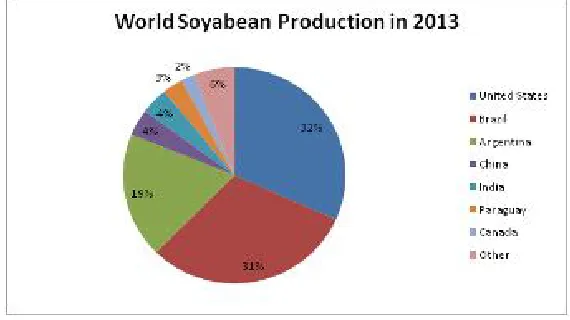
and India. According to world statistics, India contributes 4% of total world production. Soybean production in year 2011 is shown in following Fig.1[8.3.4]
Fig 1 World Soybean production in 2013
C. Problem Faced by Growers
Considering the Soybean growers, in case of profit, maximum yield is only thing that is possible to them but they do not have any control on their product price. Government of India provides SMP or FRP to crops like Cotton, Sugarcane etc, but it is not applicable to crops like Soybean, tomato etc. So their price is depends upon demand and supply position of market. So profit is directly proportional to yield. So maximum yield is only solution to above mentioned problem.
But max yield is depending up on number of factors like water management, weed management, nutrition management, fertilizer management etc. Basically growth and yield is mainly depending upon Nutrition Management. Nutritional deficiency directly affects the yield. So it becomes necessary to provide required nutrition to crop to recover deficiency. One of the sources to identify deficiency is symptoms which are appeared on leaves. But most of the Growers of Maharashtra are unable to identify exact deficiency by observing leaves. So they need an expert advice. But one expert can’t solve problems of number of Growers. So they need virtual expert.
Also in this information age, the available information from various sources is growing at phenomenal rate, and this information is primary requirement and considered as the heart of Precision Agriculture. Numerous researches are being carried out, new results are discovered at the research institutions and they continue to accumulate in the form of Reports and Dissertation. Most of these findings, recommendations do not reach to the farmers at implementation level. That is because there is lack of proper channel between researcher and farmers. The lack of proper decision support system to disseminate timely, relevant farming advice, has been observed as a major road block for adopting precision agriculture (Mc Bratneyetal. 2005).
To address this problem, Knowledge Based Systems can be used. Knowledge Based Systems are one computer program which will guide growers according to expert knowledge. Knowledge based Systems can be used to make decision at different levels in agriculture, Operational Level and Planning Level. On Operation Level, the extension workers in the villages, districts and /or Governorate can use the system to support him in making his decision in giving appropriate advice to Growers. On the Planning level, the decision makers can use expert system who predicates need of water, fertilizers and pesticides. (Rafea, 1996).
II. LITERATURE REVIEW
Peter B Goodell &other (1990) [8.1.1], have focused on integrated Expert system for Cotton production and management, developed in Egypt. CALEX is user friendly computer program that simulates human problem solving behavior. Growers can use this system to help manage crop production or predicts the effects of any one decision on subsequent events. In 1990, more than 100 cotton producers have taken advantage of the CALEX computer program. CALEX contains plant and pest simulation models to diagnose the pest.
FuzzyXPest is proposed to provide information to farmers and researchers through the internet using fuzzy expert system. This system focused on pest activity on rice crop. Fuzzy logic approach is then used to forecast the pest activity level that will determine the damages caused by pests. This system has been verified by Malaysia Agriculture Research & development Institute (MARDI), Malaysia. Azizul Azar bin Ramil & Nur Suhallinbt. Suhaimi (2008) [8.1.4], discussed the development of an expert system for Oil-Palm disease control diagnosis(PEKA-SEWIT). It will perform diagnosis process for assigning an infected disease treatment solution and also the preventive control. Agricultural Officers and planters who involve directly with oil-Palm plantation may use this system as assistance for helping them in managing crop activities especially in disease control. G.N.R. Prasad, Dr. A Vinaya Babu (2006)[8.1.5], discussed various Agricultural expert system. They said that in order to remain competitive, the modern farmers often relies on agricultural specialist and advisor to provide information for decision making. Unfortunately agricultural specialist assistance is not always available when the farmers need it. In order to solve this problem, expert systems were identified as powerful tool with extensive potential in agriculture. In this paper, author discusses some more expert system. POMEE is an expert system for apple orchid management. POMEE advices growers about when and what to spray on their apple to avoid infestation. The system also provide advice regarding to winter injuries, drought control and multiple insects problems. UNU-AES is an expert system in agri forestry management. This system was designed to support land – use officials, research scientist, farmers and other individuals, for maximizing benefits from agri forestry management techniques. In 1991, Egypt started it’s efforts to develop expert systems for different crops. They establish Central Laboratory for Agricultural Expert System (CLAES), by keeping the view that it helps growers for maximize food production. Numbers of expert systems were developed by CLAES. Some are described below. CUPTEX: This expert system is developed for cucumber crop production. It contains five subsystem First one is Disorder diagnosis, provides user with a disorder diagnosis which causes problem on plantation or verifies a user assumption. Second one is disorder treatment provides user with remediation of disorders. Third one is irrigation scheduling which provide an irrigation schedule for a plastic tunnel. An irrigation schedule demonstrates the water quantity related to each time instance. Forth one is Fertilizer scheduling to determine fertilization requirement for cucumber. Fifth one is plant care subsystem to predict from the last crop and plastic tunnel characteristics.
A. Citex: this expert system is developed for orange production. It contains four subsystems.
First one is Assessment of farm which is to evaluate new farm in a given location. Second one is Irrigation scheduling to produce schedule for irrigation of particular farm. Third one is fertilizer scheduling which determine fertilization requirement by considering aspects like fertilizer type, quantity, application method etc. Fourth one is Disorder diagnosis to conclude causes of user complaints. Fifth one is disorder treatments to provide a appropriate treatment for infected plant.
A. J. Castro and Garcia – Torres (1995) [8.1.6], explains an expert system SEMAGI. An interactive microcomputer program named SEMAGI has been developed for sunflower to evaluate the potential yield reduction from multispecies weed infestations and from the parasitic weed broomrape and to determine appropriate selection of herbicide. It combines relational database on herbicides, weed and their interactions. SEMAGI provides an economic study of any herbicide treatment selected or introduced by the user, based on herbicide treatment cost, expected yield increase from the weed control treatment and sunflower selling price.
Harvinder S. Saini, Raj Kamal and A. N. Sharma (2002) [8.1.7], introduces Web based fuzzy expert system for integrated pest management in Soyabean i.e. SOYPEST. Objective of SOYPEST is to provide IPM decision support to the farmers through the internet. This has been used for the crops grown I different regions of India. It provides diagnosis of pest and its preventive and curative measures.
S.J. Yelapure, R.V. Kulkarni, (2012), [8.1.8], studied different expert system in agriculture and concluded that there is not any expert system available for Soyabeanin India which will guide farmers from soil preparation to harvesting. So there is need of such system, where growers get knowledge at one point.
By reviewing above literature, it is observed thatthere is wide scope for Expert Systems and Fuzzy Logic in Agriculture area. So Author hasmade an attempt to develop prototypeKnowledge Based System using Fuzzy Logic for Soybean with special reference to Nutrition Management.
III. METHODS OF DATA COLLECTION
For study the researcher has selected both primary as well as secondary data.
Primary data: This data has been collected by discussing with Agricultural Experts, Academicians, and Growers.
IV. FACTORS CONSIDERED IN THE PROCESS OF NUTRITION MANAGEMENT A. Nutrient required for Soybean and their deficiency symptoms
Nutrient required for Soybean and their deficiency symptoms is shown in Table 1. [8.2.3]
Table 1: Nutrient required for Soybean and their deficiency symptoms Nutri
ent Id
Nutrient Deficie
ncy Id Symptoms Observed on leaves
N1 Nitrogen D11 Younger leaves of plant become light green
D12 Older leaves of plant become yellow and shriveled.
N2 Phosphoru
s D21
Older leaves become darker than normal
D22 Purple color spots appear on older leaves.
N3 Potassium D31 Yellowing at tips and edges in younger leaves
D32 Yellow patches or spots develop on leaves
N4 Zinc D 41 Part of older leaves between two veins turns yellow
D42 Shrinking of leaves
N5 Iron D51
Part of younger leaves between two veins turns yellow and veins remain green.
N6 Magnesiu
m D61
Part of older leaves between two veins turns yellow and veins remain green.
N7 Manganes
e D71
Yellow or whitish spots appears on leaves
D72 Elongated hole between veins
N8 Molybden
um N81
Younger leaves of plant become light green
N82 Older leaves of plant become yellow and shriveled
N9 Boron N91 Brown spots occurs on upper
leaves
N92 Shorten internodes and death of terminal growth
N10 Sulphur N10 1 Younger leaves of plant become light green
N10 2 Older leaves of plant become yellow and shriveled
N10 3 Chlorosys may be more apparent on younger leaves.
N11 Copper D11 1 Green splotches
B. Methods of Nutrient Application
There are number of methods of application depend upon nature of nutrients. Mostly Broadcasting, Placement and foliar spraying mostly used methods of nutrient application. But disadvantage of Broadcasting and Placement is Nutrients are not fully utilized by plant root, since utilization is fully depend upon factors like soil type, moisture available etc.
Foliar spraying is most effective, and the risk of scorch is minimized, if the spray droplets do not dry too rapidly, i.e. on cloudy days and in the early morning or late afternoon.
The advantage of foliar application is the direct uptake of nutrients into the metabolism of the plant tissues. Thus, with a very low consumption of energy for transportation within the plant, the uptake is virtually independent of environmental factors such as soil moisture. The disadvantage is the limited amount that can be applied at one time, due to the risk of leaf burn; but this is of less concern provided proper attention is paid to the relevant limits of concentration, especially when there are a number of split dressings. Another advantage is the opportunity to combine fertilizer application with that of pesticides and growth regulators, in many cases with beneficial synergistic effects. In arid conditions the high concentration of combined sprays reduces evaporation, and so reduces vaporization of the active ingredients, thus permitting a reduction in pesticide usage with resultant benefit to the ecosystem.
By considering advantages of Spraying, Foliar fertilizers become very popular. These fertilizers are in crystal or powder form and can dissolve into water very easily and can be apply using spraying. So in case of Soybean, according to Experts spraying of Foliar Fertilizer is best method to apply nutrient.
C. Growth stages of Soybean crop
[image:6.612.148.465.546.676.2]Growth stages of Soybean crop are shown in Table 2.
Table 2.Growth stages of Soybean Crop
Name Duration in days
Germination 4-6
Vegetative Growth 6-22
Grand Vegetative
Growth 23-40
Flowering 41-60
Pod Formation 50-70
Pod Filling 70-90
Here Flowering stage may continue up to 70 days.[8.2.4] But according to expert, spraying of Nutrient or pesticides are not recommended before stage Flowering, since it is not so beneficial for plant. So according to spraying of Foliar Nutrient, Researcher considers only four stages of crop as shown in Table.3
Table 3.Growth Stages considered for Nutrition management
Stage Id Name Duration in days
S1 Grand Vegetative
Growth 23-40
S2 Flowering 41-60
S3 Pod Formation 50-70
S4 Pod Filling 70-90
D. Primary and other Nutrition requirement of Soybean:
Table 4. Primary Nutrition requirement of Soybean
Nu trie nt Id
Name
Total Nutri
ent requir
ed (gm / Acer)
Stage wise Nutrient required (gm/Acer)
S1 S2 S3 S4
N1 Nitrogen 310 190 120 - -
N2 Phosphor
us 1320 190 610 520 -
N3 Potassium 1030 190 - 340 500
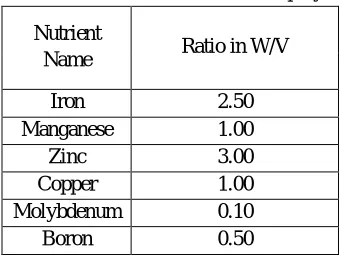
[image:7.612.221.391.365.493.2]Mahatma Phule Krishi Vidhyapeeth, Rahuri recommended only Primary nutrients for Soybean. But according to Expert, for normal growth of Soybean, it also requires Secondary and Micro nutrients. So Growers have to spray Micro nutrients, two times from starting of stage S1 to ending of stage S2 . Government of Maharashtra specifies Micro nutrient mixture for spraying as shown in Table 5.
After spraying above recommended Micro nutrient, even though deficiency symptoms occurs on leaves then Grower have to spray above micro nutrient in additional manner. But for that , Grower must know total requirement of Micronutrient since extra spraying can badly affect the growth.
Table 5. Micro nutrient mixture for spraying
Nutrient
Name Ratio in W/V
Iron 2.50
Manganese 1.00
Zinc 3.00
Copper 1.00
Molybdenum 0.10
Boron 0.50
[image:7.612.181.413.558.728.2]Also this requirement is depend upon number of factors like soil type, availability Nutrients in soil, plant uptake capacity etc. So generally Experts recommend following Micro and Secondary Nutrients with quantity gm per acer as shown in Table 6.
Table 6. Micro and Secondary Nutrients requirement
Nutrient
Id Name
Total Nutrient required (gm /
Acer) W
N4 Zinc 360
N5 Iron 200
N6 Magnesium 200
N7 Boron 24
N8 Manganese 224
N9 Molybdenum 54
N10 Calcium 191
N11 Copper 254
V. DESIGN OF KNOWLEDGE BASED SYSTEM:
In this research, Author adapted fuzzy logic principles to identify exact deficiency of Nutrients depending upon symptoms occur on leaves of Soybean. Here, the Grower can specify exact symptoms, but can’t specify percentage of symptoms like 10% or 20 %. But Growers can specify that, symptoms observed on leaves in very high, high, medium, low, or very low manner.
[image:8.612.89.517.164.371.2]According to Fuzzy Logic, the variables that represents the gradual transition from high to low, true to false, is called Fuzzy variable and set containing these variables is called Fuzzy Set.
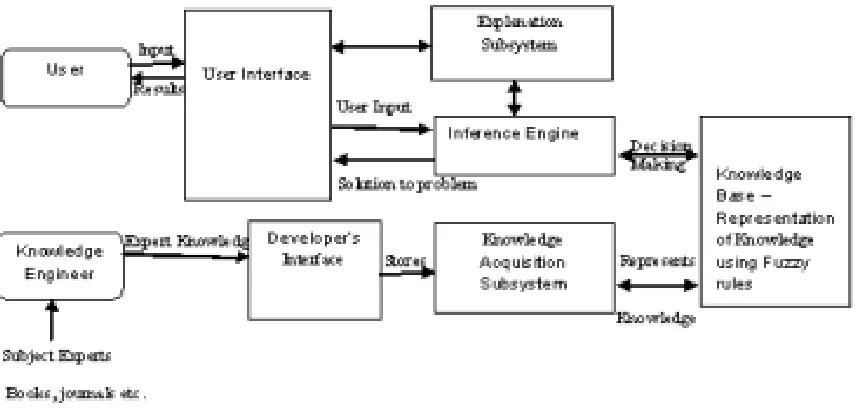
Fig 2 - Knowledge Base System Model
In this research, Author used the concept of Fuzzy set and membership function to map the linguistic characteristics of percentage of symptoms that can be ranked high, medium or low and degree of membership. The degree of membership in Fuzzy set is [1,0], where ‘1’ represents highest membership and ‘0’ represent no membership. A fuzzy variable set and membership values are shown in Table 7.
So by taking advantages of Fuzzy logic, author design a prototype Knowledge Based System to identify Nutrient deficiency depending upon deficiency symptoms, is shown in Fig 2 Here this system will accept values from user like stage of crop, symptoms observed on leaves and their occurrence ratio like very high, high etc. Also if Grower already applied nutrient then he have to specify it’s details. After considering all input parameter, system will give the output in the form of advice.
Table 7 - Fuzzy variable and Membership values
Fuzzy Variable
Id Fuzzy Variable Membership Id
Degree Of Membership
F1 Very High M1 1.0
F2 High M2 0.8
F3 Medium M3 0.6
F4 Low M4 0.4
F5 Very Low M5 0.2
[image:8.612.142.466.524.726.2]VI. RULE BASE DESIGN
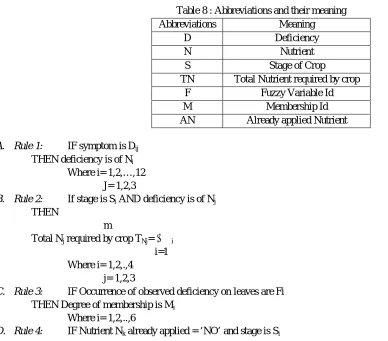
[image:9.612.45.433.122.463.2]In rules, abbreviations are used. So abbreviations and their meaning is given in Table 8
Table 8 : Abbreviations and their meaning
Abbreviations Meaning
D Deficiency
N Nutrient
S Stage of Crop
TN Total Nutrient required by crop
F Fuzzy Variable Id
M Membership Id
AN Already applied Nutrient
A. Rule 1: IF symptom is Dij THEN deficiency is of Ni
Where i= 1,2,…,12 J= 1,2,3
B. Rule 2: If stage is Si AND deficiency is of Nj THEN
m
Total Nj required by crop TNj= ∑ Si i=1 Where i= 1,2,.,4
j= 1,2,3
C. Rule 3: IF Occurrence of observed deficiency on leaves are Fi THEN Degree of membership is Mi
Where i= 1,2,..,6
D. Rule 4: IF Nutrient Nk already applied = ‘NO’ and stage is Si
Then Apply Nk Nutrient to recover deficiency, in the ratio (TNk * Mj) gm / Acer. Also Soybean needs Micro Nutrients for regular growth. So with Nk, also apply Following Nutrient with ratio specified by Maharashtra State Government, during the stage Si
Where i=2,3 j=1,..,6 k = 1,2,3
E. Rule 5: IF Nutrient Nk already applied = ‘NO’ and stage is Si THEN
Apply Nk Nutrient to recover deficiency, in the ratio (TNk * Mj) gm / Acer during The stage Si. Where i=1,4
j=1,..,6 k = 1,2,3
Nutrient Name Ratio / Acer
ron 2.50% w/v
Zinc 3.00% w/v
Manganese 1.00% w/v
Copper 1.00% w/v
F. Rule 6: IF Nutrient Nk already applied = ‘Yes’ and stage is Si THEN
Apply Nk Nutrient to recover deficiency, in the ratio (TNk * Mj) - ANkgm/ Acer. Also Soybean needs Micro Nutrients for regular growth. So with Nk, also apply Following Nutrient with ratio specified by Maharashtra State Government, during the stage Si
Where i=2,3
j=1,..,6 k = 1,2,3
G. Rule 7: IF Nutrient Nk already applied = ‘Yes’ and stage is Si THEN
Apply Nk Nutrient to recover deficiency, in the ratio (TNk * Mj) - ANkgm/ Acer during the stage Si Where i=1,4
j=1,..,6 k = 1,2,3
H. Rule 8: IF Nutrient Nk already applied = ‘No’ and stage is Si THEN
Apply Nk Nutrient to recover deficiency, in the ratio Wkgm/ Acer during the Si Where i=1,2,3
K= 4, ..,12
I. Rule 9: IF Nutrient Nk already applied = ‘Yes’ and stage is Si THEN
Apply Nk Nutrient to recover deficiency, in the ratio Wkgm / Acer during the Si Where i=1,2,3
K= 4, ..,12
J. For Eg.
Case i) Input Parameters Stage of Crop :Flowering
Symptoms :Younger leaves of plant become light green Occurrence :High
Nutrition Already Applied: No
In this case i) Rule 1 will get execute and deficiency found is Nitrogen Rule 2 will get execute and so total nitrogen required = 310 gm/ Acer
3 will get execute and so degree of membership (Occurrence of observed deficiency on leaves) =0.8
Rule 4 will get execute and will get output as - Apply Nitrogen to recover deficiency, in the ratio 248 gm / Acer. Also Soybean needs Micro Nutrients for regular growth. So with Nitrogen, also apply following Nutrient with ratio specified by Maharashtra State Government, during the Flowering stage
Nutrient Name Ratio / Acer
Iron 2.50% w/v
Zinc 3.00% w/v
Manganese 1.00% w/v
Copper 1.00% w/v
VII. CONCLUSION
This paper explores application of Knowledge Based system using Fuzzy Logic in Agriculture sector. This prototype will helpful for Soybean Growers to identify Nutrient deficiency depending upon symptoms observed on leaves of crop. So Grower will take appropriate action which will increase yield. Using this prototype one may go for an advisory system into different domains like Fertilizer Management, Weed Management etc. Also this system can be proved an efficient mean to store Expert knowledge for long time and can be used as training tool for agriculture persons and Growers.
REFERENCES A. Research Papers/ Articles
[1] Peter B Goodell,Richerd E. Plant, Thomos A. Kerby, Joyce F. Strand, L. Ted Wilson, Lowell Zelinski, Julli A. young, Andrew Corbett, R.D. Horrocks, Ronold
N. Vargas, (1990), “CALEX/ Cotton: an integrated expert system for cotton production and management”, California Agriculture, Vol 44, No. 5
[2] PinakiChakraborti, Dr. Dilip Kumar Chakraborti (2008), “An Example of Agricultural Expert Systems Being Used in India”, Georgian Electronic Scientific
Journal : Computer Science & Telecommunication 2008 No.1(5
[3] FadzilahSiraj&NureizeArbaiy, “ Integrated Pest Management System Using Fuzzy Expert System”, www.repo.uum.edu.my/1928/
[4] AzizulAzar bin Ramil&NurSuhallinbt.Suhaimi (2008),”Expert System For Oil – Palm Disease Diagnosis (Peka-Sewit)”,www.eprints.uthm.edu.my/1833/
[5] G.N.R. Prasad, Dr. A VinayaBabu (2006),”A Study of Verious Expert System in Agriculture”, Georgian Electronic Scientific Journal : Computer Science &
Telecommunication 2006 No.4(11
[6] A. J. Castro and Garcia – Torres (1995),”SEMAGI – an expert system for weed control decision making in sunflower”, Crop Protection, Vol. 14, No.7,
543-548,1995,Elsevier Science Ltd
[7] Harvinder S. Saini, Raj Kamal and A. N. Sharma (2002), “Web Based Fuzzy Expert System For Integrated Pest Management in Soyabean”, International
journal Of Information technology, Vol 8, No. 2, 2002
[8] S.J. Yelapure, R.V. Kulkarni (2012), (2012), “Literature Review of Expert System in Agriculture”, international Journal Of Computer Science and Information
Technologies”,Sept 2012.
B. Books
[1] Dan W. Patterson ,”Introduction To Artificial Intelligence & Expert System” , Prentice – Hall of Indi
[2] Dr. R.V. Kulkarni, B.L. Desai, “Knowledge Based System in Banking Sector”, New Century Publication
[3] M.L. Vitosh, D.D. Warnckeand R.E. Lucas, “Secondary and Micro Nutrients for Vegetable and Field Crop”, Department of Crop and Soil Sciences, Michigan
State University Extension, Revised August 1994
[4] D.A. McWilliams,D.R. Berglund,G.J. Endres, “Soybean Growth & Management Quick Guide”, Extension Service , North Dakoa State University, Aug 2004
C. Website References
[1] en.wikipedia.org/wiki/Agriculture_in_India - 23/02/2017 11:30
[2] 8.3.2)www.pnbkrishi.com\soybean.htm ,25/02/2017, 10:30 am
[3] en.wikipedia.org/wiki/Soybean , 27/02/2017, 12:40 pm
[4] http://soystats.com/international-world-soybean-production/, 27/02/2017, 12:30 pm
Nutrient Name Ratio / Acer
Iron 2.50% w/v
Zinc 3.00% w/v
Manganese 1.00% w/v
Copper 1.00% w/v