International Journal of Innovative Technology and Exploring Engineering (IJITEE) ISSN: 2278-3075,Volume-8, Issue-10, July 2019
Abstract: Feature extraction is one of the most essential phase in biometric authentication. It helps in extracting and measuring the biometric image as ideal as possible. These features sets can be used further for image matching, recognition or learning techniques in supervised algorithms. In the proposed work a novel features extraction method for finger knuckle print is explored with comparative analysis. The proposed scheme is based on different mechanical variables and its efficiency also proved by plotting different curves in Matlab R2009a.
Keywords: finger knuckle print, feature extraction, digital image processing, recognition rate.
I. INTRODUCTION
Identity verification is essential and most important feature in numerous of applications e.g. electronic banking, systems access, defense systems and other sophisticated areas. Biometric authentication is preferable and reliable as compare with conventional identification methods such as cards, passwords, keys etc as these conventional identification methods requires something to carry or remember. Whereas in biometric case there is no need to carry or remember anything. Hand based biometrics e.g. fingerprint, palm print, hand geometry has gained the popularity as compared to other biometric traits because of their higher acceptability parameter, therefore finger knuckle print has been used in proposed work. As the surface impression of knuckle print is exterior side, the people have no contact with material on the outside of their hands unlike fingerprints. Therefore no scope of latent FKP also no criminal investigation stigma associated with printing the surface of the knuckles, therefore FKP has a high acceptance rate [1]. Moreover FKP has surface pattern that contains fine crests and texture those are easy to measure with considerable low deformation rate as shown in Figure 1, hence researchers have set their sights on FKP trait [2].
Fig.1: Knuckle surface impression
In image categorization, the local features of image are utilized to differentiate the different images. These features
Revised Manuscript Received on August 05, 2019
Sukhdev Singh, Department of Computer Science & Applications, Kurukshetra University, Kurukshetra, India.
Chander Kant, Department of Computer Science & Applications, Kurukshetra University, Kurukshetra, India.
are classified as diverse key elements of image data like intensity of color, object boundaries present within image, texture, etc. [3]. The efficiency of feature extraction improves the supplementary processing of biometric image to an immense degree. These features can utilized in image matching, pattern identification and repossession. Image examination includes the detection, segmentation, extraction and classification techniques [4]. Feature extraction method is employed to extract the features by maintenance as much information as potential from dataset of image. Various feature extractions methods are classified is shown in Figure 2 below.
Fig.2: Classification of Feature Extraction Methods
II. LITERATUREREVIEW
The literature work is carried out for adequate period in which various methods for feature extraction has been discussed. Jun et al.[5] proposed a new linear feature extraction approach for combining Fisher criterion with manifold criterion called Weighted Linear Embedding(WLE). Gaussian weights are used to combine local and other information.WLE aims to find a mapping vector such that the ratio between weighted class scatter to the weighted within class scatter is maximize. The WLE is applied on right index finger of thousand persons with a recognition rate of 78.2%. Yang et al. [6] also moves on the same track of Gabor wavelets have been applied successfully in image analysis and pattern recognition and used it for feature representation in FKP. The orthogonal linear discriminant analysis (OLDA) transformation in PCA is accomplished and classified using nearest neighbor classifier raising the efficiency as 98%. Jing et al. [7] considered distances and angles simultaneously between image data vectors to measure data similarities in hope of more sufficiently capturing the manifold structure. To remove unnecessary information, OCLPP (orthogonal complex locality preserving projections) method is used. Four images were randomly selected during training process and recognition rate of 88% was achieved for the left index finger. To explore FKP recognition technology Zhu Lei Quing [8] proposed a robust
FKP feature presentation
Novel Method of FKP Feature Extraction Using
Mechanical Variable
and matching method based on Speeded-Up Robust Features (SURF) which is improvement on scale invariant feature transform. A coordinate system is defined based on local convex direction map of FKP to align images and a ROI is cropped for feature extraction. After that the main points are extracted with FH-detector to which an orientation was assigned accordingly to Haar wavelets inside the neighbor circle area of the key point and orientation invariant descriptor get constructed for each key point. During matching process, the relative distance of closest neighbor with second closest neighbor is compared and distance ratio with less than 0.6 unit get retained. It provides accuracy of 90.63% for verification and 96.91% for identification. Lin et al. [9] approach is based on results of neurophysiology studies that show both local and global features are vital for image perception. It is suitable for images containing abundant line like structures and has the advantages like high accuracy, robustness to illumination variations, and fast matching. Rui Zhao et al. [10] proposed a novel approach that reduces the load of large database to train the classifier model. The edges of images are characterized by discrete at gray levels. The experiments proved that the FKP is reliable and suitable traits for recognition rate of 95.68% with 30 threshold value. Z.S. Shariat Madar and Karim Faez [11] in their work used a collection of Gabor filters to extract the orientation information from the FKP images. Five different scales and 8-different orientations were selected to keep the remaining parameters constant and next PCA is applied for their dimension reduction. Combination of PCA and LDA provides effective feature selection, the proposed algorithm was tested for all 4-fingers and derived that right middle finger provides better performance with 75.25% accuracy. Kumar et al. [12] presents a personal authentication system using finger knuckle surface. The feature extraction from the finger knuckle surface was carried out by both texture and geometrical feature (finger length, finger width) analysis methods. The texture information of knuckle surface could be obtained by PCA, ICA and LDA approaches. Scores are generated by computing Euclidean distance obtained from reference and input vectors.
III. PROPOSEDWORK
The proposed work process the digital images obtained from the database from the Polytechnic University of Hong Kong having region of interest as surface of the knuckles. Extensive work has been carried out to prove the efficiency of our work and experimental work is carried with help of Matlab R2013 software. Mechanical concept using sliding window, center of mass and torque has been used for feature extraction. Database from Hong Kong University [15] has been used for feature extraction analysis that contain FKP images of approximately 120 persons with different age groups. Image collection was carried out in two different sessions, first and second session has interval of 25 days and in both sessions, 6 images of each of the left index, middle left, right index and middle right fingers has capture from each participant. Therefore have 48 different images for 4 fingers of each individual whole database have 5,760 images for 480 different fingers.
3.1 Calculating the size of sliding window
The features of FKP will be derived from center of mass
image having reference coordinates (x,y) that move at the same time on window. The size of sliding window is important feature as COM is highly depending on it. The analytical expression for Gaussian weight function to find the centeral area of sliding window is as follow:
L L d g L L
e
e
, ) ( _ ) 2 ( ) 2 2 ( 2 (1)Where σ is approximately L/2 and g (λ) = 0, outside the range of L, which is half of the length of the computational window.
3.2 Center of mass (COM)
The center of mass is a position defined relative to an object. It is average position of all parts of the system, weighted according to their masses [12]. Center of mass for a sliding window of Gaussian type in the segment (-L + L) can be expressed as follow, Assuming the image has a unit of mass per unit length:
d l y g l y d l x g l x L L L L ) ( ) ( ) ( ) ( ) ( ) (
(2) (3)In equation 2 and 3 above, g (λ) is Gaussian function, x (l + λ) is value of x(l) in the disarticulation of λ on the axis x, y (l + λ) is the value of y(l) in the disarticulation of λ on the y axis, (l) is center of mass in the x axis (l) is the center of mass on the y axis. The center of mass varies along the length. The standardized image provides a description of the geometric shape of the image.
3.3 Torque Operator
Torque is mid-level image operator tool to detect closed curve in images, it takes input as raw image and create an image map from the image peak within regions of multiple size. It produce a force tends to produce the rotation [6], Torque exerted by a vector v, which located at position ‘p’ with respect to a point around measured on sliding window as T= v*p. The torque depends on both position and the orientation of the curve and its scale around a point is double the area swept by vector v. The torque changes sign when vector crosses the curve in one direction to another, but its scale is constant. Equation 4 below signifies the torque adapted to FKP image in uniform curve parameterization conditions. )) λ λ)dy(l x(l λ) dx(l λ) g(λ(λ)(y
T(l) (4)
A positive value of T(l) indicates a net sweep of vector v on segment [-L+ L] in counter-clockwise, while a negative value indicates a sweep in clockwise direction. Torque gives a description dependent on the orientation and position in image.
International Journal of Innovative Technology and Exploring Engineering (IJITEE) ISSN: 2278-3075,Volume-8, Issue-10, July 2019
[image:3.595.47.295.78.127.2]figure 3 below shows original FKP image (left) and normalized grey scale FKP image (right):
Fig. 3: Original FKP image normalized FKP image Once the grayscale FKP image has been normalized, the binarization process starts with the help of MatLab.
if pixel value >= threshold value, the pixel will appear as white else it will be black.
Therefore only two colors will be appear in the FKP image that will ease to extract the feature set. Figure 4 below shows the binarized image of normalized FKP image:
Fig.4: Binarized FKP image
In last step of FKP image processing the binarized image get processed with morphological process that produce skeletonization pattern of FKP image. The skeletonized image is extracted from binarized image using successive erosion, the process involves the elimination of points from outer layer in FKP image till thin structure is produced as shown in figure 5 below.
Fig.5: Skeletonized FKP image.
Further the skeletonized image is divided into four quadrants, to analyze separately, the feature extraction techniques has been applied through sliding window with center of mass and torque operators. Figure 6 below shows the four quadrants derived from the skeletonized FKP image :
(i) 1st Quadrant (ii) 2nd Quadrant
(iii) 3rd Quadrant (iv) 4th Quadrant Fig.6: Segmented FKP image in four quadrants. 3.5 FKP Feature Extraction
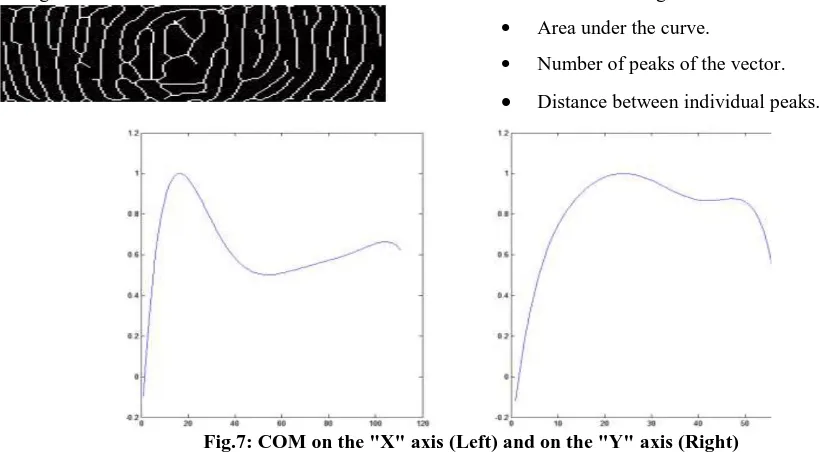
From each quadrant of the skeletonized image, the proposed method extracts information vector in X-Y direction, whose value is between 0 and 1 obtained after normalization process as shown in figure 7. Every feature vectors extracts 1 from each quadrant; unique features with proposed approach for individuals are followings:
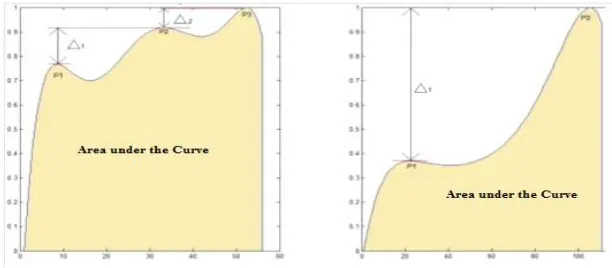
Area under the curve.
[image:3.595.314.539.142.273.2] Number of peaks of the vector.
Distance between individual peaks.Fig.7: COM on the "X" axis (Left) and on the "Y" axis (Right) In the above curves only one peak has been observed and that
is due to the characteristics of minutiae shape for that quadrant. In our approach we consider the distance parameters between the successive peaks. The distance will be marked as zero for single peak present in the curve otherwise it will be a non zero integer have X-value between the peaks as shown in figure 8 below.
The same process applied to four quadrants to concatenate all features into a single vector. The process is as follow V[info] = [abc_comx_c1-c4; abc_comy_c1-c4; np_comx_c1-c4; np_comy_c1-c4; dep_comx_c1-c4; dep_comy_c1-c4]
Where:
abc_comx_c1-c4: are the areas under the curve in COM of X axis of quadrants1 to 4.
abc_comy_c1-c4: are the areas under the curve in COM of Y axis of quadrants1 to 4.
np_cmx_c1-c4: number of peaks in the COM of X axis of quadrants 1 to 4.
np_comy_c1-c4: number of peaks in the COM of Y axis of quadrants 1 to 4.
dep_comx_c1-c4: distance between peaks in COM on the X axis of quadrants 1 to 4.
[image:3.595.72.485.385.611.2]Fig.8: Area Under The Curve, Number Of Peaks And Distance Between Peaks
IV. RESULT
[image:4.595.139.445.52.186.2]The proposed approach has been applied to the same finger knuckle image of person. It is repeated for 148 different persons having 12 samples of same finger i.e. right index thereby having a total of 1776 samples. Each information vector of 1776 samples (kept in matrix) analyzed using 12 sample from database in MatLab with a KNN classifier gives 97.2% recognition rate. The performance of proposed approach is also compared with other FKP recognition methodsin table 1 and found a significant better approach.
Table 1: Comparison Of Proposed Approach With Exiting Approach
Methods Database (Number of Sample)
Classifier Recognition Rate (%)
Principal Component Analysis (PCA)
12 Euclidian Distance
88.25
Linear Discriminant Analysis (LDA)
12 Nearest Neighbor Classifier
95.68
Weighted Linear Embedding
12 Nearest Neighbor Classifier
78.2
Linear Discriminant Embedding (LDE)
12 Nearest Neighbor Classifier
79.2
Gabor Feature and OLDA
12 Nearest Neighbor Classifier
96.06
Speeded-up Robust Features (SURF)
12 Hamming
Distance
95.2
LGIC Technique 12 Euclidian Distance
75.25
Scale Invariant Feature
Transform (SIFT)
12 Nearest Neighbor Classifier
88.4
Empirical Mode 12 Nearest 95.6
(EMD) Classifier
Proposed Method 12 kohonen neural network classifier
97.2
V. CONCLUSION
Feature set are obtained effectively for knuckle surface using different variables and the effectiveness of the approach has also proven in the last section. In future the approach may be used with fused templates rather than individual biometric that of course further increase the efficiency and accuracy parameters of proposed approach.
REFERENCES
1. Mahesh Kumar, K. P. Finger Knuckle-Print identification based on local and global feature extraction using sdost. American Journal of Applied Sciences, 929-938, 2014.
2. Shoichiro Aoyama, K. I.,”A finger-knuckle-print recognition algorithm using phase-based”. Information Sciences, 53-64, 2014.
3. Dong ping Tian, “A Review on Image Feature Extraction and Representation Techniques”, International Journal of Multimedia and Ubiquitous Engineering Vol. 8, No. 4, July, pp 385-396, 2013. 4. Revathi, R., & Hemalatha, M. An Emerging Trend of Feature Extraction
Method In Video Processing. Cs & It-Cscp, 69–80, 2012.
5. Lin Zhang, Lei Zhang and David Zhang, “Monogenic Code: A Novel Fast Feature Coding Algorithm with Applications to FingerKnuckle-Print Recognition “Proceedings of the International Workshop on Emerging Techniques and Challenges for Hand Based Biometrics, 2010.
6. YANG Wanknou, SUN Changyin and SUN Zhongxi, “Finger-Knuckle-Print Recognition Using Gabor Feature and OLDA”, Proceedings of the 30th Chinese Control Conference, pp.2975-2978,July 22-24, 2011.
7. Xiaoyuan Jing, Wenquian Li, Chao Lan, Yongfang, Yao, Xi Cheng and Lu Han, “Orthogonal Complex Locality Preserving Projections based on Image Space Metric for Finger-Knuckle-Print Recognition”, 2011. 8. Goh Kah Ong Michael and Tee Connie and Andrew Teoh Beng Jin, “
Robust Palm Print and Knuckle Print Recognition System Using a Contactless Approach”, 5th IEEE Conference on Industrial Electronics and Applications, pp.323-329, 2010.
9. Shen, Linlin, Li Bai, and Zhen Ji. "Hand-based biometrics fusing palmprint and finger-knuckle-print." 2010 International Workshop on Emerging Techniques and Challenges for Hand-Based Biometrics. IEEE, 2010.
10. Ajay Kumar and Yingbo Zhou, “Personal Identification using Finger Knuckle Orientation Features”, Electronic Letters Vol.45, no 20, pp.1-7, September 2009.
11. Zahara S.Sharaiatmadar, Karim Faez, “A Novel Approach for Finger-Knuckle-Print Recognition Based on Gabor Feature Fusion”, 4th international Congress on
International Journal of Innovative Technology and Exploring Engineering (IJITEE) ISSN: 2278-3075,Volume-8, Issue-10, July 2019
12. A. Kumar, Ch. Ravikanth, “Personal authentication using finger knuckle surface”, IEEE Trans. Inf. Forensics Secur., 4 (1) pp. 98-110, 2009.
13. Nalwa, V. (2002). Automatic on-line signature verification. Proceedings of the IEEE, 215-239.
14. (PolyU) Finger-Knuckle-Print Database. Available at The Hong Kong Polytechnic University (PolyU) Finger-Knuckle-Print Database: http://www4.comp.polyu.edu.hk/~biometrics/FKP.htm
AUTHORS PROFILE
Sukhdev Singh is research scholar in Department of Computer Science and Applications, K.U., Kurukshetra, Haryana, India. He received his post graduate degree in M.Tech. (CSE) from Department of Computer Science & Applications, K.U., Kurukshetra. His research area is biometric. He has also published many paper based on multimodal biometric system.