International Journal of Innovative Technology and Exploring Engineering (IJITEE) ISSN: 2278-3075,Volume-8 Issue-6, April, 2019
Abstract: With the explosion in the population of motor-vehicles using the streets every day, the task of finding parking space is ever more tedious. There simply are not enough public parking spaces to accommodate all the users. We have come up with a platform that integrates auction of the spaces for parking and alleviates the sharing and allocation problem of those. Owners of parking spaces rent out their spaces to drivers who pay a certain fee. The platform is developed through Internet of Things (IoT). It provides services to auction or rent private parking spaces from owners, alleviating the parking trouble. The platform uses the One-sided – Vickrey Clarke Groves (O-VCG) algorithm for allotting parking spaces and keeps the database of available spaces online on the cloud, accessible to users through the web. Users from mobile, vehicle and desktop interfaces can access the service.
Index Terms: Smart Parking, IoT, Cloud database, Efficient Auction, Parking space allocation.
I. INTRODUCTION
The inspiration behind this paper arose from the need to reduce traffic congestions in urban localities caused by vehicles in search for parking spaces. It was found that almost 30% of traffic snarls in urban areas were caused by vehicles cruising for parking space, and it took the driver an average of 7.8 minutes to obtain a parking space on a regular basis. All these problems is expected to worsen as the global crowd of motor vehicle users continue to develop and multiply without a well thought out and convenient plan.
The primary problem that we are trying to solve in this paper is the hassle of drivers having to obtain a parking slot in popular metropolitan neighbourhoods, particularly during rush hour time. Troubles arise from not being able to know where the available spaces are; and at this instance traffic congestions occur. The second problem that is in focus is the valuable time wasted from inconvenient and under-equipped parking lots. A large amount of fuel is consumed while the vehicle idles while the driver looks around for parking lots, paving way to more CO2 emissions. Finally, the last problem is all the potential collisions that may be caused by the sheer number of moving vehicles in disorganized parking lots.
We have researched and developed a system that is competent and cost effective at the same time. There are some systems that has been developed using the same
Revised Manuscript Received on April 08, 2019.
Sujith John, Department of Computer Science Engineering, SRM
Institute of Science and Technology, Chennai, India.
R. Sujeetha, Department of Computer Science Engineering, SRM
Institute of Science and Technology, Chennai, India.
Advait N. Menon, Department of Computer Science Engineering, SRM
Institute of Science and Technology, Chennai, India.
Karthikeyan S., Department of Computer Science Engineering, SRM
Institute of Science and Technology, Chennai, India.
technology, but they are expensive, making it less accessible to the larger part of the society.
The existing system employs an IoT-UPM cloud, based on which, parking slots are distributed among users through a price-compatible top trading cycles and chains (PC-TTCC) system and the parking spaces are re-assigned using the One-sided–Vickrey Clarke Groves (O-VCG) mechanism. The private parking slots available are not taken into account and the interface is available only to people using the mobile app. Factors like transaction charges and the uncertainty of parking are not included into the existing systems.
Also, the different traffic congestion factors are not present which can result in heavy traffic congestion problems when the existing system is used.
The aforementioned drawbacks lead to our comprehensive smart allocation mechanism for urban parking. The newly developed system uses the One-sided–Vickrey Clarke Groves (O-VCG) auction algorithm for allotting parking spaces and keeps the database of available spaces online on the cloud, accessible to users through the web.
The proposed system incorporates an IoT Cloud platform which is responsible for Smart Allocation & Pricing and Slot sharing service. Within the IoT Framework, the Smart Gateway and Cloud data processing modules are present which helps in identifying and differentiating the public, street and private parking spaces. Users from mobile, vehicle and desktop interfaces can access the service, making it easily available to large number of people without restricting them to a single interface.
The different parking arrival and departure scenarios are simulated and tested so that the system works in all the possible scenarios and doesn’t hinder the user.
II. LITERATURESURVEY
This section describes the similar parking solutions that have been probed.
In [1], the system is developed to enhance the network architecture which is based on IoT for cloud–based intelligent parking system. The user using the help of WSN integrated with RFID can find free spaces and pay for it considering the demand at the given point of time.
In [2], the system is mainly designed to review the availability of the guidance systems available to the drivers to find free spaces. Here the existing sensors like RFID, PIR sensor, magnetometer are coupled with the advanced parking technologies like Global Positioning System, Multi-agent systems and Vehicular ad hoc networks.
In [3], it provides a comprehensive approach on how different each smart parking systems work and along with its working principle.
Smart Allocation Mechanism for Urban Parking
Some of the covered technologies are information sensing, sensor connectivity, parking meter and crowd sensing.
In [4], the criteria for the application is to find the parking spaces available in streets with the help of sensing unit deployed with the vehicles and as a result it can communicate with the main server and send information to the user (driver) for a nearby available space for parking and for this system the Supervised Learning Algorithm is used.
In [5], the application is developed for the end users with the option of paying the parking fee directly to the owner with respect to the demand the parking space has at the given point of time. It uses Dynamic Price Engine and Smart Allocation Systems to evaluate the charge of vehicles and find the most suitable parking space available respectively.
In [6], the system is developed to assure the drivers a safe parking space giving the real time location updates including the diversions that are present in the road. It uses Mathematical Model with the objective of Mixed-Integer Linear Programming for reducing the monetary expenses for the users.
In [7], the particular application mainly covers the privacy of the details of the vehicles and drivers thus making it a safe option for the drivers to opt for this application. It uses Parking Spotter, GPS and Map Matching (MM) for the sharing of parking spaces and security models like pseudonymity and un-linkabilty.
In [8], the application uses advanced communication protocols like IEEE 802.15.4, WSN, LEACH, LPWAN and SigFosx to get fast updates of the free spaces and optimize the fee structure in different places using Optimal Resource Allocation.
In [9], the algorithms and techniques used for smart parking systems like Parking Guidance and Information (PGI) Systems, Loop detector, Acoustic sensors are discussed. In [10], with the help of the One-sided–Vickrey Clarke Groves (O-VCG), this system is used for renting the private and public available spaces for parking from the respective owners to other needed vehicles for a given point of time. The payment in this system is carried out using the PC-TTCC mechanism.
III. SYSTEMDESIGN
The proposed system has primarily two layers- the local layer and a cloud layer.
The local layer consists of the system of parking spaces and the gateway that interconnects all these to the cloud data processing module. The real-time information that was collected from smart gateways which included parking timelines, prices charged, locations parked, vehicle associated information, etc.
A public parking space is a parking lot that is owned and operated by a public entity like a mall, government institution, whereas a street parking spaces are those road side parking spaces that are usually operated by the traffic authorities. Private parking spaces are those owned by residential complexes or apartments.
Cloud layer on the other hand comprises of the IoT cloud platform which encompasses the space allocation, pricing and slot sharing mechanism of the system. The user vehicles, mobile devices and desktop class users can access the service through their respective media.
[image:2.595.305.551.123.277.2]Data can be processed in stream (real-time) with great reactiveness and reliability. The server-less approach of the proposed system eliminates the risk of losing the operability of the system owing to server crash or technical malfunctions at the stations.
Fig. 1 System Architecture
A. Processor and Sensor Module
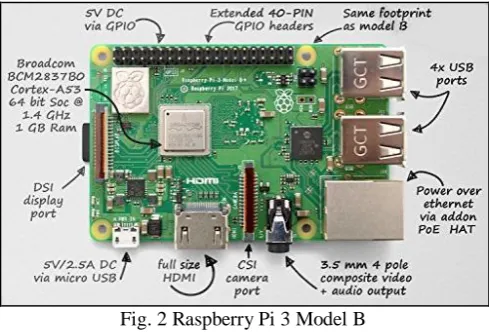
In this particular implementation of the project, the processing work is carried out by a Raspberry Pi 3 Model B. Featuring a 1.4 GHz 64-bit based quad-core ARM Cortex A53 processor, it can blaze through the amount of data to be processed in a network of parking spaces within a 5-8 kilometre radius. For larger and more complex systems, the Compute Engine service of the GCP platform can be employed.
Fig. 2 Raspberry Pi 3 Model B
The sensor array used in the system cosist of the following elements:
Passive Infrared (PIR) sensor: This sensor is used to
identify the changes in the energy or when a parking lot is occupied. When an object such as a car or a lorry passes by, it is first intercepted by one half of the PIR sensor, which triggers a positive change in the differential between the two halves. Moreover, when that object exits the sensing area, the opposite occurs, whereby the sensor produces a negative change in differential. These changes in pulses are what is deduced by the sensor and conveyed to the system.
Parking Guidance Information (PGI) systems: It provides
[image:2.595.305.550.401.567.2]International Journal of Innovative Technology and Exploring Engineering (IJITEE) ISSN: 2278-3075,Volume-8 Issue-6, April, 2019
[image:3.595.46.286.109.281.2]It is integrated with traffic monitoring, communication, processing and variable message signs to make the whole system work better.
Fig. 3 Infrared Sensor
Global Positioning System (GPS): This technology is a
satellite oriented technology integrated along the application to get the accurate real time information of the traffic and availability of parking lots at a given radius of area. In the event that the RFID or IR sensors do not work or malfunction, GPS can be used to track the position of an agent and contact them in the event of overdue of payment or any other issues.
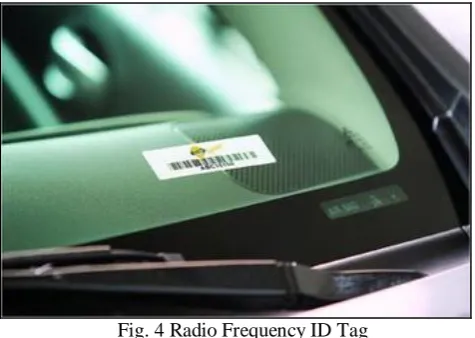
Radio-Frequency Identification (RFID): This system
describes the technology in which digital data is encoded into Radio Frequency ID tags or smart stickers. It draws parallels to barcodes where the data is captured from a tag or label by an instrument that stores the derived data in a database store.
Fig. 4 Radio Frequency ID Tag
These tags are affixed on to motor vehicles, which are read and tagged on the entrance and exit from the parking lot. RFID tag system is employed by the service at big parking spots to keep track of individual vehicles and to create an identity for each individual vehicle.
Vehicular Ad-hoc Networks (VAN): is used to
spontaneously create the connection of a wireless network of vehicle-to-vehicle (V2V) data exchange – to the collection of vehicles. It will use the region of 5.9 GHz to communicate with the systems. This technology helps in creating a web of
intercommunication between the agents subscribed to the system. The sharing of data such as availability of support services, etc. can be shared among agents.
B. Parking space sharing module
The sharing of spaces take place as follows:
1) Each user is allowed to look through necessary information about the share board of spaces for parking in the IoT-cloud platform. Each user is also given the privilege to determine their choices and needs over the parking spaces in the share board.
2) Users looking for spaces for parking spaces, they send requests to platform through their respective mobile devices (smartphones or dashboard mounted computers). A request is coupled with parking space data like location.
3) The space sharing module gathers all the user requests on a real time basis and does an overall slot distribution among users.
4) The users receives one parking space each for free when they have successfully exchanged their parking slot. On the other hand, they can lease their parking slot to the system and receive a certain payment in return.
Fig. 5 Parking space sharing module
The allocation of spaces is done as follows:
a) The cloud system incorporates public spaces for parking and at the same time gets some private parking spaces from users who give it up. All unique bidding user can look through required information on the exchange board containing parking slots in cloud platform.
b) At the time of the auction, all unique interested bidders place a bid that contains at the most three atomic bids. c) The particular space sharing/pricing module gathers all the details on the bidding at a real-time grounds while performing space sharing/pricing between the users who bid over a previously decided time period according to the O-VCG auction system. On top of the “location” details, real-time information of parking timeline, prices charged and the unique parking personalities are also collected as the system inputs.
[image:3.595.304.551.330.464.2] [image:3.595.47.285.472.641.2]C. Algorithm description
The Vickrey Clarke Groves (VCG) auction algorithm describes itself as a kind of closed-bid auction for many items. Bidding users will place bids that note down their valuations for the sale item, without getting to know the bids placed by other bidding users.
The set of possible outcomes is called X. There exists n agents who have different bids for each of the outcomes. The bid of an agent i is shown by a function:
; that describes the value for it, in monetary terms.
The premiere aim is to choose an outcome that projects the grand total of values, that is:
It pays-out each agent i, an amount of money equaling to the total of the values of the all the other bids:
D. Support Module
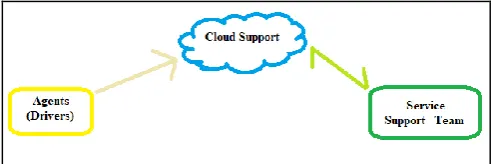
[image:4.595.46.292.432.514.2]The support module primarily offers services for the agent or the user to reach out to the service support team in the case of an anomaly.
Fig. 6 Support module
Users are encouraged to openly discuss any and all difficulties faced during the use of the service. This will help the system to evolve in such a way that it accommodates the evolving needs of the user and tends to the changes in the life and environment of a society.
IV. IMPLEMENTATION
In the lines of parking slot sharing mechanisms, the plethora of available parking spaces are the star items to be distributed and operated on. A slot for parking that is in the ownership of a private individual is called “a private parking space.”
All the users of the service will be addressed as “agents”. The agents can rent a private space especially during the day time, when the owner might be at work and the space is not in use. This will act as an auxiliary source of income for the owner. For agents, reliable travel plans can be made by reserving a parking space at their destination and for motorists running for parking at the last minute can make use
of the service to find a parking space.
As in the case of parking space owners, it serves as an additional source of income. A network of IR sensors and RFID readers keeps tab on the different spaces, checking whether the space is occupied or not. The inter-networking cloud platform effectively eases the unequal problem of the supply and demand issue using the inclusion of private parking space sharing into the proposed system.
For the task of making decisions, by using smartphones, it revolutionizes the way for motor-vehicle users to obtain real-time parking data, communicate with each other, and to make proactive decisions during the act of driving a motor vehicle.
V. CONCLUSION
Smart parking simplifies the problems of urban livability, transportation mobility and environment sustainability. Smart parking technology further improves the productivity level and the service levels in operations.
With this research, we focused on addressing the issues of the existing parking space sharing systems and present a revolutionary smart allocation mechanism for urban parking systems. The idea proposed provides real-time data regarding the availability of parking spaces in an area for parking. This is achieved by using the One-sided–Vickrey Clarke Groves (O-VCG) mechanism for auction, which allocates parking spaces and keeps the database of available spaces online on the cloud. Owners lend their parking spaces to drivers requesting them and in turn make an auxiliary source of income. This reward attracted many individuals to participating in the program. Over a course of 2 weeks, it was observed that drivers were alleviated on the confusion on where to park and saw a significant drop in the number of traffic jams and hold ups that occurred in the area that was surveyed. Users from all types of interfaces i.e. mobile, desktop and vehicle interfaces can access this service over a common cloud service platform.
REFERENCES
1. T.N. Pham, M.-F. Tsai, D.B. Nguyen, C.-R. Dow, and D.-J. Deng, “A Cloud-Based Smart-Parking System Based on Internet-of-Things Technologies”, IEEE Access, vol. 3, pp. 1581-1591, 2014.
2. V. Paidi, H. Fleyeh, J. Håkansson, and R.G. Nyberg,
3. “Smart parking sensors, technologies and applications for open parking lots: a review”, IET Intelligent Transport Systems, vol. 12, no. 8, pp. 735-741, 2018.
4. T. Lin, H. Rivano, and F. Le Mouel, “A Survey of Smart Parking Solutions”, IEEE Transactions on Intelligent Transportation Systems, vol. 18, no. 12, pp. 3229-3253, 2017.
5. C. Roman, R. Liao, P. Ball, S. Ou, and M. de Heaver,
6. “Detecting On-Street Parking Spaces in Smart Cities: Performance Evaluation of Fixed and Mobile Sensing Systems”, IEEE Transactions on Intelligent Transportation Systems, vol. 19, no. 7, pp. 2234-2245, 2018.
7. E. Akhavan-Rezai, M.F. Shabaan, E.F. El-Saadany, and F. Karray, “New EMS to Incorporate Smart Parking Lots Into Demand Response”, IEEE Transactions on Smart Grid, vol. 9, no. 2, pp. 1376-1386, 2018. 8. A.O. Kotb, Y.-C. Shen, X. Zhu, and Y. Huang,
International Journal of Innovative Technology and Exploring Engineering (IJITEE) ISSN: 2278-3075,Volume-8 Issue-6, April, 2019
10. C. Huang, R. Lu, X. Lin, and X. Shen,
11.“Secure Automated Valet Parking: A Privacy-Preserving Reservation Scheme for Autonomous Vehicles”, IEEE Transactions on Vehicular Technology, vol. 67, no. 11, pp. 11169-11180, 2018.
12.A.S.A. Awad, M.F. Shaaban, T.H.M. EL-Fouly, E.F. El-Saadany, and M.M.A. Salama, “Optimal Resource Allocation and Charging Prices for Benefit Maximization in Smart PEV-Parking Lots”, IEEE Transactions on Sustainable Energy, vol. 8, no. 3, pp. 906-915, 2017.
13.A.O. Kotb, Y.-C. Shen, X. Zhu, and Y. Huang,
14.“Smart Parking Guidance, Monitoring and Reservations: A Review”, IEEE Intelligent Transportation Systems Magazine, vol. 9, no. 2, pp. 6-16, 2017.
15.[10] R. Lu, X. Lin, H. Zhu, and X. Shen, “An Intelligent Secure and
Privacy-Preserving Parking Scheme Through Vehicular
Communications”, IEEE Transactions on Vehicular Technology, vol. 59, no. 6, pp. 2772-2785, 2010.
AUTHORSPROFILE
Sujith John, 3rd year B.Tech Computer Science Student at SRM Institute of Science and Technology, Chennai. Previously published research papers in the field of medicine and healthcare technology and developing security systems.
R. Sujeetha, Assistant Professor (O.G.) at
Department of Computer Science Engineering, SRM Institute of Science and Technology, Chennai. Areas of interest include Software Engineering, Object Oriented Analysis and Design
Advait N. Menon, 3rd year B.Tech Computer
Science Student at SRM Institute of Science and Technology, Chennai. Has previously worked in development teams for web apps and security system research.
Karthikeyan S., 3rd year B.Tech Computer