College of Arts and Social Sciences Research School of Humanities and the Arts
School of Art & Design
Visual Arts Graduate Program Doctor of Philosophy
Rebecca Mayo
Labours of care: Art practice and
urban ecological restoration
A thesis submitted for the degree of the Doctor of Philosophy
of The Australian National University
April, 2018
Declaration of Originality
I, ……….. [sign and date] hereby declare that the thesis here presented is the outcome of the research project undertaken during my candidacy, that I am the sole author unless otherwise indicated, and that I have fully documented the source of ideas, references, quotations and paraphrases attributable to other authors.
Acknowledgements
This research is dedicated to those who have and continue to care for and advocate on behalf of Merri Creek. I acknowledge the Wurundjeri people, the traditional custodians of the land through which Merri Creek flows, and I acknowledge the important ways their elders and community continue to attend to country. I am indebted to the many human and non-human collaborators who make up the creek’s environment and who have supported me during this project.
I am particularly grateful to my supervisory panel who have provided critical feedback and support over the course of my candidature: Patsy Payne and John Pratt, whose retirements truncated their immediate involvement in my project, but not their interest; Anne Brennan’s steadfast support through the writing phase, and for laughing at my jokes; Raquel Ormella’s incisive responses to my studio practice and for pushing me forward; Alison Alder, for keeping my eye on the big picture.
I thank art writer, curator and publisher Merryn Gates for copyediting.
I extend my gratitude to Anne Masters, who deals tirelessly with the minutiae of HDR administration. I thank the ANU Printmedia team for welcoming me into the fold during the last year of my candidature: Alison Alder, Nicci Haynes, Millan Pintos-Lopez, Caren Florance and Anna Raupach (Madeleine). The support and conversations with colleagues at RMIT University, who I worked with for fifteen years were invaluable, in particular the collegiality of Clare Humphries, Richard Harding and Ruth Johnstone.
I appreciate the generosity of Freya Mathews, who took time for coffee and email conversations, and whose book Journey to the Source of the Merri inspired my walk. I am grateful to all the land owners who allowed us to walk through their properties, especially those who invited us to stay overnight: Helen and Gil Berry, Kate Looker, Hannah Marriot (Burgess Rural/Stockland) and Margaret Walker.
6
how they each helped shape their day at the creek. Most especially I am indebted to Lesley Harding, for making time in her busy life for a seven day walk down our local creek, for her extended engagement with this work and most importantly, for her friendship.
I am grateful to my fellow Friends of Merri Creek, not only for their participation in this research, but also for the countless Sunday mornings we spent working side by side. I single out Ray Radford and Paul Prentice, whose long-term commitment and care for the creek serve as inspiration and resolve to my own endeavours. In addition, I would like to thank Merri Creek Management staff, in particular Tony Faithfull for his early advice on the walk and Brian Bainbridge for his generosity and encyclopaedic knowledge of the creek and all who live there.
Many people have helped me in the studio, including Sam Popescu, Jethro Harcourt, Kirsty Argyle and the Papermakers of Victoria. I especially thank Anna Topalidou for her design skills which capture my sensibility every time. Isabel Young continues to provide love and support to my family, across the studio and our home. Her unflappable kindness is an immeasurable antidote to the frenetic pace of our lives.
Abstract
This research reveals how an art practice built around ethics of care offers a means of enacting an ecological responsibility. As cities and their human populations continue to grow, urban creeks and green spaces are becoming increasingly important and
contested. Habitat loss for non-human species increases the need to care for these places. My volunteer work as a ‘Friend of Merri Creek’ in Melbourne’s northern suburbs, prompted this practice-based research which has explored practices of care as both subject matter and method. I argue that the processual, repetitive and labour-intense nature of my practice are qualities shared by environmental restoration work. This led me to ask: What could my art practice, based in print and textiles, reveal about practices of ecological restoration and degradation at an urban creek? I have set out to explore this question by bringing Merri Creek and my art practice closer together, using the meditative and repetitive acts of walking, weeding, planting, sewing and printing with locally collected plant dye.
Contents
Declaration of Originality 3
Acknowledgements 5 Abstract 7
List of Figures 13
Introduction 31
Chapter One: Walking the Merri—Care as Attention 49
Preambulation 49
Preparation and permission: Beginning to care 50
Wayfaring and Boundaries 55
Garments 62
Time and Space for Care 67
Conclusion 71
Chapter Two: Tending the Merri 73
Introduction 73
Cycles of transformation and reverie 76
Material networks and sited practice 82
Visible restoration 89
Contemplating material time 94
Framing repetitive practices 96
Conclusion 98
Chapter Three: The Limits to Representation—
Action, Process, Materiality 101
Introduction 101
The Performativity of Matter 105
Re-siting the Merri 112
10
Chapter Four: Bricks and Prickles—Mutable Edges and Fixed
Boundaries 119
Introduction 119
Gorse in Australia: History and Work 121
Physical encounters with Gorse 124
Brick work and the work of bricks 126
Situating Gorse 130
A wall inside the gallery 132
Conclusion 137
Chapter Five: Habitus 139
Introduction 139
Local practices and elsewhere 139
Walking/Wayfaring 144 Sandbags 147
Yingabeal and Heide’s locale 153
Dyeing and printing 157
Installation 162 Conclusion 166
Chapter Six: Installation at Wagga Wagga Art Gallery 167
Introduction 167 Context 169
Installation and negotiation 170
Flow, Matter and Repetition 171
Conclusion 173
Appendices 183
Appendix i) 183
Appendix ii) 184
Appendix iv) 186
Appendix v) 188
List of Figures
Unless otherwise stated, all artworks and photography are the author’s. All artists retain copyright of reproduced artworks.
Map 1 Merri Creek Catchment – Waterway and Drainage Assets,
© Melbourne Water Annotations added by the author. 28 Map 2 Walking from (home) Merri Creek to Heide Museum of Modern Art,
8 April 2016
© OpenStreetMap contributors (openstreetmap.org CC BY-SA)
Annotations added by the author. 29
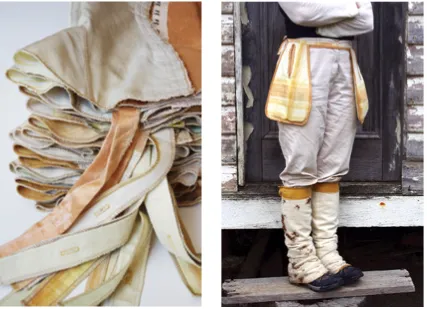
Fig. 1 Seven pairs of gaiters ready for Walking the Merri, 2013
cotton, linen, wool, hemp, screenprinting and dyeing with natural
dyes collected at the Merri Creek 39
Fig. 2 Day Three: Walking the Merri—gaiters and Walking the Merri—pockets after a day of walking between Merri Park and Lockerbie.
Photography: Lesley Harding 39
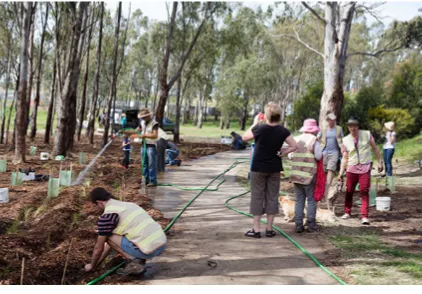
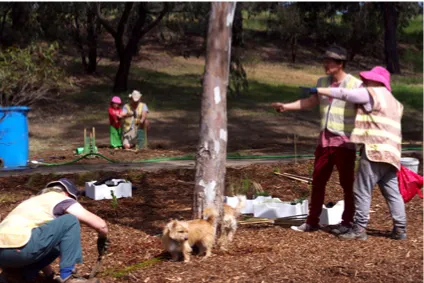
Fig. 3 Edgar’s Creek community planting, September 2013
high-vis-style jackets
calico dyed and screenprinted with weeds and indigenous plants from the Merri Creek catchment
each jacket 55 x 78 cm approx.
Photography: Kirsty Argyle 41
Fig. 4 Walking the Merri, 2014
RMIT Project Space, Melbourne, VIC
Installation view showing Walking the Merri—gaiters and Walking the Merri—pockets
Photography: Andrew Barcham 41
Fig. 5 Bound by Gorse (Ulex europaeus), 2017 gorse
variable dimensions (90 x 250 cm approx.) digital print 57 x 42 cm
Water+Wisdom Australia: India, 2018 RMIT Gallery, Melbourne, VIC
14
Fig. 6 Habitus, 2017 (Quiet Witness)
cotton damask tablecloth, natural dyes 175 x 300 cm
(Porous Borders, Impermeable Boundaries) hemp, wool, natural dyes, sand 360 x 130 x 38 cm
Installation view
Heide III: Kerry Gardner & Andrew Myer Project Gallery Heide Museum of Modern Art, Melbourne, VIC
Photography: Matthew Stanton 45
Fig. 7 Day Two: Wallan to Merri Park Map
Walking the Merri artists’ book/catalogue, page 13
Our passage is marked in green and circumnavigates Camoola
(formerly Springvale Station). The creek flows through the centre of the
property (marked as a white broken line). 52
Fig. 8 Day Two: Gate and fence blocking the creek at the northern
boundary of Camoola. 54 Fig. 9 Fred Kruger, 1831–1888
Sheep, cattle: Springvale Station, Merriang [Victoria], ca. 1880 photograph: albumen silver; 13.3 x 20.2 cm
National Library of Australia, PIC/8760/72 LOC Album 19
http://nla.gov.au/nla.obj-140533421 54 Fig. 10 Day Four: Lockerbie to Craigieburn Map
Walking the Merri artists’ book /catalogue, page 21
Our passage along the creek is marked in green and shifts to red
where we divert around Austral Bricks near Curly Sedge Creek. 57 Fig. 11 Day Four: New growth sprouting through the charred branches of
Melaleuca, Curly Sedge Creek. (see Map 1) 61
Fig. 12 Day Four: Water ribbons (Triglochin procera); Wathaurong name: Polango. An important indigenous food source: the tubers were eaten raw
or cooked. 61
Fig. 13 In 2014 I visited the Museum of London to view their pocket collection. The following two examples are housed in their collection: Embroidered pair of pockets, late 1770
linen, coloured wool
© Museum of London
https://vads.ac.uk/large.php?uid=94227&sos=12
Embroidered pair of pockets, early – mid 1700s linen, yellow silk thread, linen and silk tape each pocket approximately 41 x 25.8 cm Collection: Museum of London, UK Museum number MOL 49.23.2 © Museum of London
https://vads.ac.uk/large.php?uid=94231&sos=14 63 Fig. 14 Walking the Merri—gaiters, 2013
Day Six (showing worn, external and internal surfaces)
ash, bidgee widgee seeds, hemp, wool, buttons, hook and eye tape, screenprinted and dyed with gorse, willow bark, periwinkle, oxalis, artichoke thistle dye, red gum
each 48 x 40 cm 63
Fig. 15 Day Three: Merri Park to Lockerbie
Gaiters with Bidgee Widgee, Acaena novae-zelandiae (syn. Acaena anserinifolia)
Photography: Lesley Harding 64
Fig. 16 Helen Mirra
Hourly directional field recordings, Gravagna, 11 May 2011 oil on linen
155 x 155 cm
http://www.nordenhake.com/php/artist.php?RefID=93 66 Fig. 17 John Wolseley
Murray Sunset Refugia with Ventifacts, 2010
carbonized wood, watercolour and graphite on 15 sheets of paper 210 x 110 cm and 14 satellite ventifacts
National Gallery of Victoria, Melbourne, VIC
https://www.ngv.vic.gov.au/explore/collection/work/113828/ 68 Fig. 18 Fences, roads and railways crisscross the landscape. We walked
under, over and around these boundaries during Walking the Merri.
Photography: Lesley Harding and the author 70
Fig. 19 Clockwise: Pink inner bark from Willow, Coburg, 2012; Collecting pink inner bark from a Willow about to be removed, Coburg, 2017; Gorse flowers ready for they dye pot, 2013; Harvesting gorse at
16
Fig. 20 Screenprinting alum mordant onto calico for the shelter tents and
high-vis-style jackets at Megalo Print Studio, Canberra, ACT. 77 Fig. 21 Water ribbon pattern derived from Day Four of Walking the Merri
(see Fig 12), printed with melaleuca bark, sewn into sandbags for Tending the Merri, 2016
Photography: Matthew Stanton 77
Fig. 22 Filling dye pot with rainwater via the garden hose. (The size of the dye pot diminished the size of the pan where dinner is cooking as
I work.) 78
Fig. 23 The dye bath is ready for the mordanted cloth when steam is gently
rising and it is very hot to touch. 78
Fig. 24 Strettle Wetland community weeding, Merri Creek, Thornbury, April 2014 high-vis-style jackets, dyed and screenprinted with weeds and indigenous plants from the Merri Creek
each jacket 55 x 78 cm
Photography: David Burrows 80
Fig. 25 Strettle Wetland community weeding, Merri Creek, Thornbury, April 2014
high-vis-style jackets, shelter tents (just visible in the background) calico dyed and screenprinted with weeds and indigenous plants from the Merri Creek, zinc buttons, eyelets, tope, tent poles each jacket 55 x 78 cm
each tent quarter 200 x 200 x 280 cm
Photography: David Burrows 80
Fig. 26 India Flint Gather, 2016
silk, wool, eucalyptus dye
detail from the exhibition Shibusa dimensions variable
http:/www.indiaflint.com/page29.htm 81 Fig. 27 Ilka White
Billabong Sash, 2012–2013 hand woven, double-faced cloth
combining irregular sateen and 3/1 twill hemp, silk and woollen yarns
plant dyed weft 8.5 x 275 cm
Fig. 28 Ilka White
Days of Grass, 2013
wild oats, hemp thread, time
40 strands, 75–100 cm circumference
A collection of garlands representing the rhythm of time spent at the Merri Creek Billabong, Royal Park, Tarnuk, Dookie, Violet Town, Lot 19, Castlemaine road sides and the Avenel truck stop.
Photography: Kristian Laemmle-Ruff 83
Fig. 29 Ruth Johnstone
Common Garden: house to studio, Fitzroy, 2014–2016
unbound book: relief print, plant pigment and letterpress Installation view
Photography: Tobias Titz © RMIT 85
Fig. 30 Ellie Irons
Left: Urban Meadow Transect (May–October, Bushwick, Brooklyn), 2015 pencil and plant pigments from nineteen spontaneous plant species on paper
17.3 x 12.5 cm
Right: Feral Hues and Herbicides (Bushwick, Brooklyn), 2015
pencil and plant pigments from 23 spontaneous plants on paper 17.3 x 12.5 cm
https://ellieirons.com/projects/two-meadows/ 85 Fig. 31 Tending the Merri—quarter tent worn as a poncho; studio tests, 2013.
calico dyed and screen printed with indigenous and exotic plants of the Merri Creek, zinc buttons, eyelets
Left: Melaleuca Bark dye
Right: Gorse flower dye 87
Fig. 32 Lucy and Jorg Orta (Studio Orta) Connector Mobile Village I, 2000–2001
aluminium coated polyester, reversible Solden Lycra, open cell polyurethane, silkscreen print, zips
570 x 700 cm (variable dimensions)
Catalogued: p6, Lucy Orta Body Architecture, Verlag Silke Schreiber, 2003; p60 Lucy Orta, Phaidon Press UK, 2003
Exhibition history: 2013 Hangzhou Fibre Triennial, China; 2010 Jam Factory, Adelaide Festival, Australia; 2007 Sao Paolo, Brazil; 2006 Galleria Continua Beijing, China; 2005 Museum Boijmans Van Beuningen, Rotterdam, Holland; 2004 The Fabric Workshop, Philadelphia, USA.
Courtesy: Gallery Continua, San Gimignano, Beijing, Les Moulins & Habana
18
Fig. 33 L–R Romy preparing Oxalis flowers for dye; dye pot; oxalis test
samples on cotton, hemp, linen and silk, 2012. 90
Fig. 34 Edgar’s Creek community planting, September 2013 showing Tending the Merri—high-vis-style jackets, 2013
calico dyed and screenprinted with weeds and indigenous plants from the Merri Creek catchment
each jacket 55 x 78 cm
Photography: Kirsty Argyle 93
Fig. 35 Galgi Ngarrk (Cooper St Grassland) gorse mop-up, November 2013 showing Tending the Merri—high-vis-style jackets, 2013 and Tending the Merri— quarter tents, 2013
calico dyed and screenprinted with weeds and indigenous plants from the Merri Creek catchment, zinc buttons, eyelets, rope, tent poles
each jacket 55 x 78 cm
each tent quarter 200 x 200 x 280 cm
Photography: David Burrows 97
Fig. 36 Galgi Ngarrk (Cooper St Grassland) gorse mop-up, November 2013 showing Tending the Merri—high-vis-style jackets, 2013 and Tending the Merri— quarter tents, 2013
calico dyed and screenprinted with weeds and indigenous plants from the Merri Creek catchment, zinc buttons, eyelets, rope, tent poles
each jacket 55 x 78 cm
each tent quarter 200 x 200 x 280 cm
Photography: David Burrows 97
Fig. 37 Walking the Merri, 2014
RMIT Project Space, Melbourne, VIC
Rebecca Mayo with Roseanne Bartley, Tony Birch (Writer), Caroline Henbest (Musician/ Composer), Anna Topalidou and Ilka White; curated by Lesley Harding
Installation view
Photography: Andrew Barcham 102
Fig. 38 Walking the Merri, 2014
RMIT Project Space, Melbourne, VIC
Rebecca Mayo with Roseanne Bartley, Tony Birch (Writer), Caroline Henbest (Musician/ Composer), Anna Topalidou and Ilka White; curated by Lesley Harding
Installation view
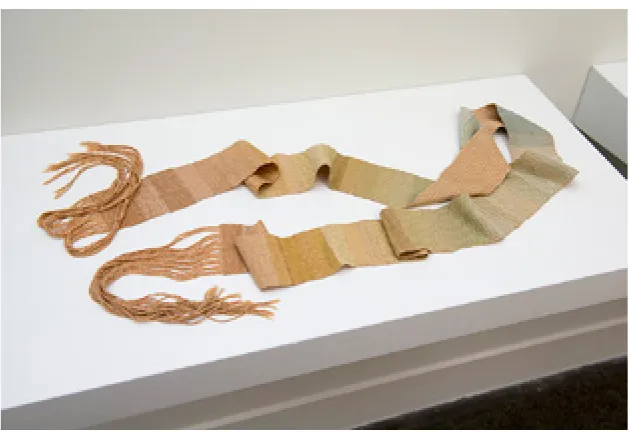
Fig. 39 Ilka White
Billabong Sash, 2012–13
hand woven, double-faced cloth
combining irregular sateen and 3/1 twill, hemp, silk and woollen yarns plant dyed weft
8.5 x 275 cm
Walking the Merri, 2014
RMIT Project Space, Melbourne, VIC
Photography: Andrew Barcham 103
Fig. 40 Anna Topalidou
Trickle, Stream, Creek: Water from Three Merri Creek Sites, 2014 lithograph
52.5 x 83.5 cm
Walking the Merri, 2014
RMIT Project Space, Melbourne, VIC
Photography: Andrew Barcham 103
Fig. 41 Roseanne Bartley
My Shadow Wears—Newspaper (Merri Creek), 2013 My Shadow Wears—Paint (Merri Creek), 2013
My Shadow Wears—Painted Snake (Merri Creek), 2013 digital print, wooden support
59.4 x 42 cm (each) Walking the Merri, 2014
RMIT Project Space, Melbourne, VIC
Photography: Andrew Barcham 103
Fig. 42 Walking the Merri—gaiters, 2013
cotton, linen, wool, hemp, screenprinting and dyeing with natural dyes collected at the Merri Creek
Walking the Merri, 2014
RMIT Project Space, Melbourne, VIC Installation view
Photography: Andrew Barcham 104
Fig. 43 Walking the Merri—pockets, 2013, Walking the Merri—gaiters, 2013 and artists’ book/catalogue
cotton, linen, wool, hemp, screenprinting and dyeing with natural dyes collected at the Merri Creek
Walking the Merri, 2014
RMIT Project Space, Melbourne, VIC Installation view
20
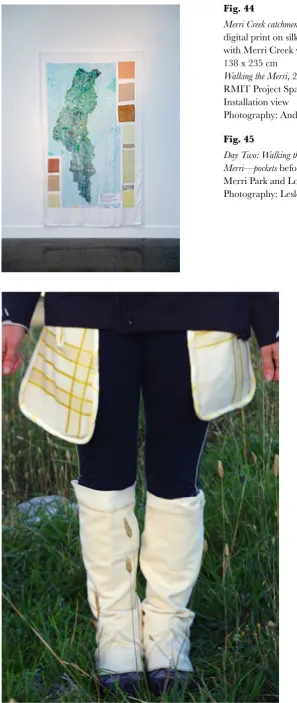
Fig. 44 Merri Creek catchment map, 2014
digital print on silk, silk samples and thread, dyed with Merri Creek weeds
138 x 235 cm
Walking the Merri, 2014
RMIT Project Space, Melbourne, VIC Installation view
Photography: Andrew Barcham 106
Fig. 45 Day Two: Walking the Merri—gaiters and Walking the Merri—pockets before a day of walking between Merri Park and Lockerbie.
Photography: Lesley Harding 106
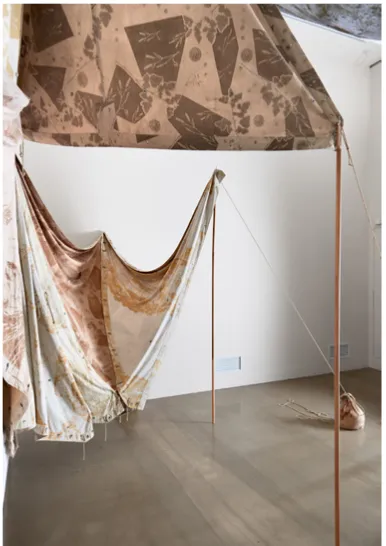
Fig. 46 Tending the Merri—quarter tents, 2013–2016
calico dyed and screen printed with indigenous and exotic plants of the Merri Creek, zinc buttons, eyelets, hemp rope, tent poles
variable dimensions Out of the Matrix, 2016
RMIT Gallery, Melbourne, VIC Installation view
Photography: Matthew Stanton 110
Fig. 47 Robert Smithson
A Non-site (Franklin, New Jersey), 1968
painted wooden bins, limestone, gelatin silver prints and typescript on paper with graphite and transfer letters, and mounted on mat board
Bins installed: 41.9 × 208.9 × 261.6 cm; framed: 103.5 × 78.1 × 2.5 cm; sheet: 101.3 × 75.9 cm
Photography© MCA Chicago
https://mcachicago.org/Collection/Items/1968/Robert-Smithson-
A-Nonsite-Franklin-New-Jersey-1968 111 Fig. 48 Francesco Clemente
Encampment, 2012–2014 Carriageworks, Sydney, NSW 30 July – 9 October 2016 Installation view
Photography: Rebecca Mayo 111
Fig. 49 Bound by Gorse (Ulex europaeus), 2017 gorse
variable dimensions (90 x 250 cm approx.) digital print 57 x 42 cm
Installation view
Photography: Garth Henderson 117
Fig. 50 Site of cleared gorse, Kalkallo, October 2016 digital print
57 x 42 cm 118
Fig. 51 The first herbarium record of Ulex europaeus L. (Gorse) in Australia; collected at Studley Park, Melbourne in 1884 by Felix Reader Royal Botanic Gardens, VIC
catalogue number: MEL 1527666A
https://images.ala.org.au/store/a/9/6/0/3bf8cd7d-9463-408c- a420-07b92f06069a/original Atlas of Living Australia (Accessed
March 18, 2018) 120
Fig. 52 Day Four: Lesley Harding heading downstream, just before the gorse
became impenetrable and we had to backtrack. 123
Fig. 53 Ray Radford directs volunteers into position for the ‘after’
photograph at the end of our working bee at Galgi Ngarrk (Cooper
St Grassland), 24 November 2013. 123
Fig. 54 Gorse brick press
Aphra making bricks from gorse pulp, January 2017. 125 Fig. 55 Brick moulds used to create indentations on each brick, known as
frogs. These frogs imprinted postcodes on the top surface of each brick. 127 Fig. 56 Robbie Rowlands operating the chipper at Kalkallo, October 2016. 127 Fig. 57 Gorse bricks drying in our garage, January 2017. 128 Fig. 58 Dominic Redfern
Weeding, 2015
3 screen video installation, dimensions variable
Video stills 135
Fig. 59 Porous Borders, Impermeable Boundaries, 2017 hemp, wool, natural dyes, sand
360 x 130 x 38 cm
Heide Museum of Modern Art, Bulleen, VIC
Photography: Matthew Stanton 138
Fig. 60 Quiet Witness, 2017
cotton damask tablecloth, natural dyes 175 x 300 cm
22
Fig. 61 Clockwise:
Heide kitchen garden, July 2016
Preparing acorns for the dye bath, February 2017
Sandbags prior to filling, January 2017 140
Fig. 62 Clockwise: Photos taken between Merri Creek and Bulleen, 8 April 2016
Dundas St, Thornbury
Stormwater draining into Darebin Creek Indigofera australis near Darebin Creek
Drains and fences, Heidelberg 143
Fig. 63 The view from each direction looking through the window between
my studio and home. 146
Fig. 64 Nobuho Nagasawa
Where Are You Going? Where Are You From?, 1993 sandbags, barbed wire, hourglass
457.2 x 2500 x 457.2 cm
Royal Garden of the Prague Castle, Prague, The Czech Republic © the artist and Asian American Arts Centre
http://artasiamerica.org/works/3342/178 146 Fig. 65 Dan Peterman
Civilian Defense, 2007
1000 sandbags, domestic fabrics, sand Van Abbe Museum, The Netherlands
https://vanabbemuseum.nl/en/collection/detailscollection/?lookup
%5B1673%5D%5Bfilter%5D%5B0%5D=id%3AC6916 148 Fig. 66 Kangaroo fillets cooking on the gas burner beside the pot preparing
gorse fibre for bricks. 154
Fig. 67 Paul Coldwell
Passing Thoughts – Shoes, 2014 etching
edition: 5
30 x 40 cm 154
Fig. 68 Quiet Witness, 2017
detail of work in progress
acorn dye, iron post mordant, cotton damask tablecloth 156 Fig. 69 Yingabeal, June 2016
Fig. 70 Habitus, 2017
Heide III: Kerry Gardner & Andrew Myer Project Gallery Heide Museum of Modern Art, Bulleen, VIC
Installation view showing unprinted face of sandbags
Photography: Matthew Stanton 156
Fig. 71 Quiet Witness, 2017
Detail showing damask pattern merging with the printed halftone. 159 Fig. 72 My mother and me pinning the Velcro seal into the sandbags,
January 2017. 159
Fig. 73 Filling the sandbags at Artery studio, Northcote (when our living
room got too small), February 2017. 160
Fig. 74 Printing Quiet Witness at my neighbour’s PACK & SEND business,
December 2016. 160
Fig. 75 Sean Connelly
A Small Area of Land (Kaka‘ako Earth Room), 2013 32,000 pounds of volcanic soil and coral sand
ii Gallery, Honolulu, USA 163
Fig. 76 Sean Connelly
A Small Area of Land (Kaka‘ako Earth Room), 2013 32,000 pounds of volcanic soil and coral sand
ii Gallery, Honolulu, USA 163
Fig. 77 Ann Hamilton tropos, 1993–1994
translucent industrial glass windows, gravel topped with concrete, horsehair, table, chair, electric buren, books, recorded voice, audiotape, audiotape player, speakers
Photography: Thibault Jeanson
http://www.annhamiltonstudio.com/projects/tropos.html 168 Fig. 78 Walking the Merri—pockets, 2014
seven collecting pockets for seven days
cotton, linen, wool, hemp, screenprinting and dyeing with natural dyes collected at the Merri Creek (oxalis, willow, gorse, periwinkle, broom)
each single pocket 33 x 20 cm approx.
Photography: Matthew Stanton 184
Fig. 79 Walking the Merri, 2014
24
Installation view
Photography: Andrew Barcham 184
Fig. 80 Walking the Merri, 2014
RMIT Gallery, Melbourne, VIC Installation view
Photography: Andrew Barcham 185
Fig. 81 Walking the Merri, 2014
RMIT Gallery, Melbourne, VIC Installation view
Photography: Andrew Barcham 185
Fig. 82 Tending the Merri—quarter tents, 2013–2016
calico dyed and screen printed with indigenous and exotic plants of the Merri Creek, zinc buttons, eyelets, hemp rope, tent poles
variable dimensions
Installation view
Photography: Matthew Stanton 186
Fig. 83 Tending the Merri—quarter tents, 2013–2016
calico dyed and screen printed with indigenous and exotic plants of the Merri Creek, zinc buttons, eyelets, hemp rope, tent poles
variable dimensions
Installation view
Photography: Matthew Stanton 186
Fig. 84 Bound by Gorse (Ulex europaeus), 2017 (detail) gorse
variable dimensions (90 x 250 cm approx.)
Photography: Matthew Stanton 187
Fig. 85 Bound by Gorse (Ulex europaeus), 2017 (detail) gorse
variable dimensions (90 x 250 cm approx.)
Photography: Garth Henderson 187
Fig. 86 Bound by Gorse (Ulex europaeus), 2017 (detail) gorse
variable dimensions (90 x 250 cm approx.)
Photography: Garth Henderson 187
Fig. 87 Bound by Gorse (Ulex europaeus), 2017 (detail) gorse
variable dimensions (90 x 250 cm approx.)
(Clara Brack’s photographs installed on facing wall)
Photography: Garth Henderson 188
Fig. 88 Bound by Gorse (Ulex europaeus), 2017 (detail) gorse
variable dimensions (90 x 250 cm approx.)
digital print 57 x 42 cm
Photography: Garth Henderson 188
Fig. 89 Bound by Gorse (Ulex europaeus), 2017 (detail) gorse
variable dimensions (90 x 250 cm approx.)
Photography: Mark Ashkanasy © RMIT 189
Fig. 90 Bound by Gorse (Ulex europaeus), 2017 (detail) gorse
variable dimensions (90 x 250 cm approx.)
Photography: Mark Ashkanasy © RMIT 189
Fig. 91 Bound by Gorse (Ulex europaeus), 2017 gorse
variable dimensions (90 x 250 cm approx.) digital print 57 x 42 cm
Installation view
Photography: Mark Ashkanasy © RMIT 189
Fig. 92 Bound by Gorse (Ulex europaeus), 2017 gorse
variable dimensions (90 x 250 cm approx.) digital print 57 x 42 cm
Photography: Mark Ashkanasy © RMIT 190
Fig. 93 Habitus, 2017 Installation view
Photography: Matthew Stanton 190
Fig. 94 Porous Borders, Impermeable Boundaries, 2017 hemp, wool, natural dyes, sand
360 x 130 x 38 cm Installation view
Photography: Matthew Stanton 191
Fig. 95 Habitus, 2017 Installation view
26
Fig. 96 Porous Borders, Impermeable Boundaries, 2017 (detail) hemp, wool, natural dyes, sand
360 x 130 x 38 cm
Photography: Matthew Stanton 191
Fig. 97 Porous Borders, Impermeable Boundaries, 2017 (detail) hemp, wool, natural dyes, sand
360 x 130 x 38 cm
Photography: Matthew Stanton 192
Fig. 98 Porous Borders, Impermeable Boundaries, 2017 (detail) hemp, wool, natural dyes, sand
360 x 130 x 38 cm
28
Map 1
Merri Creek Catchment – Waterway and Drainage Assets, © Melbourne Water Annotations added by the author.
HEATHCOTE JUNCTION DAY 1 DAY 2 DAY 3 DAY 4 DAY 5 DAY 6 DAY 7 Wallan scout hall Camoola (formerly Springvale Station)
Gorse collected for Bound by Gorse at Kalkallo
Bald Hill
Day 4: Gorse so thick we had to cross the creek to find a way through.
Austral Bricks
DETOUR
CURLY SEDGE CREEK
Galgi Ngarrk (Craigieburn Grassland)
Heide Museum of Art
Our House
Ilka’s Billabong
MERRI YARRA CONFLUENCE EDGAR’S CREEK Cooper Street Grassland Cloverton (Formerly Lockerbie) YARRA RIVER Galada Tamboore
(Campbellfield Retarding Basin)
Map 2
Walking from (home) Merri Creek to Heide Museum of Modern Art, 8 April 2016 © OpenStreetMap
Annotations added by the author. DAREBIN CREEK
YARRA RIVER MERRI CREEK
Introduction
Like many Australians of my generation, I grew up a stone’s throw from a suburban creek. The unimaginatively named Second Creek in Adelaide trickles from the foothills, traversing backyards before it is forced underground into concrete pipes, finally spilling into the Torrens River in St Peters. The section I knew ran through a park, across the bottom of my grandmother’s garden and under a road, before traversing more gardens in what amounted to a secret passage taking me directly to my best friend’s house. I recall much of my childhood via memories at the creek: in flood or a summer trickle, collecting tadpoles and yabbies, building dams and playing house, rubber boots in winter and bare feet in summer. The creek weaves through my childhood; snapshot memories of family, friends and imaginary games are held together through the flow of water downstream.
As a result, urban creeks have a continuing significance in my daily life; as places in which to relax and to be with plant and animal life in the city. Moving to Melbourne as an adult, I first encountered Merri Creek along cycle routes to the city. A new place— where plastic bags decorated the trees at high water mark and dog owners ignored instructions to pick-up after their pets—I saw it first as little more than a car-free passage to work. It took me ten years to join the Friends of Merri Creek, a volunteer group who assist in its care and restoration. On reflection, this decade is a measure of the time it takes to connect with a place. It is also the time needed for restoration plantings to take hold and flourish, enabling me to witness how this important work bears fruit.
My experience of suburban creeks and their deep and quotidian significance to human and environmental wellbeing, both within and beyond their catchments, underpins this research, which emerged from the confluence of my art practice and my work with the Friends of Merri Creek. Volunteer restoration labour includes activities such as weeding, planting and litter removal. In common with my printmaking and textile studio practices, these jobs are repetitive, labour-intensive, temporal, seasonal and ongoing.
32
activity affected the creek. This led me to ask: What can my interdisciplinary art practice, based in print and textiles, reveal about the labour and practices of ecological restoration and degradation in an urban creek? I set out to explore how textiles, printed with natural dye made with creek plants, could contribute meaning and context to human practices at the creek. What would be communicated if the plant dye were a bridge between plants, site(s) and labour? Could plant colour perform and add meaning to my practice beyond being a visual marker of a species? How could a studio practice, intent on scrutinising the materials and traits shared with volunteer restoration work, contribute to contemporary dialogues around the pressing need to care for urban ecologies?
In answering these questions, care emerged as the central theme in my practice-led research. Its implicit presence in both restoration and studio labour practice-led me to identify care as a vital element of ecological relations that could be made visible and deepened through my art practice. Simultaneously I wanted to investigate through my practice how labours of care might articulate the human and non-human relations at the creek. Care (or its absence) became a thread along which to navigate the complex and at times contested sites of urban ecological space. The practice-led methodology I developed in studio and field positioned care as both subject and mode of enquiry. The issue of care, referring to both its presence and its absence, became pivotal to understanding the history of the creek and its contemporary challenges.
This understanding informed my studio approaches, shifting my focus from representational frameworks to develop and observe how, by foregrounding the care already present in my studio practices, I opened the work to navigate the complexities of urban creeks. At first care emerged as an intention; to take care and pay attention to the creek, to my work and to the interactions between the two. This enabled me to link the creek’s history and its contemporary materiality. In this exegesis I will explain how I developed this approach through my research, eventually conceptualising my art practice and volunteer restoration work through theories of labours of care.
proposes that care, as a practice, should underpin and inform all our actions.1 By turning this proposition to my practice-led research, I am positioning care as central to how I work, make, engage with and interpret art in and beyond the studio. This framework informs and makes sense of my own research and in doing so offers new ways of reading art practices and works which engage with environmental and social concerns.
Engaging with the problem of how care manifests itself, a focus on its
materialisation in everyday practice emerged as a crucial component of this research. Repetitive, labour-intense and sequential processes are ways of paying attention and taking care. From my printmaking training, my practice is deeply connected to repetitive processes and methodologies which produce reflective or contemplative states. These practices comprise sequences of actions and/or the production of multiples. In this research I use the repetitive and meditative act of walking and iterative studio labour to activate time and space in which to think through action and to produce a sense of the duration of these methods. To contextualise my interdisciplinary practice, I draw on artists who use repetitive walking and printmaking practices, and in doing so acknowledge the strong influence this training has had on my thinking. Beyond this it is most useful to position my practice in the context of artists working with or amongst urban ecologies, under the broad discipline of environmental art, and in so doing extending my reach beyond print.
Being focussed on pre-existing labours of care, this research provides a new optic through which to understand and inform art practices concerned with urban ecological sites. There are many artists working with waterways, pollution, urban plants and walking, yet, to my knowledge, none who specifically address pre-existing labours of care in urban ecological sites. Latent elements of care can be found in most urban ecological art practices. It is my intention to reframe my own practice by positioning care at its centre.
Care is implicit in the work of many artists. Lucas Ihlein, Kim Williams and Brogan Bunt’s Walking Upstream: Waterways of the Illawarra (2014– ) make visible degraded
1 Maria Puig de la Bellacasa, Matters of Care: Speculative Ethics in More Than Human Worlds, ed. Cary Wolfe,
34
and neglected waterways around Wollongong, NSW. This work can be read as a
performance of care. Janet Lawrence’s public artwork In the Shadow (1999) aims to bring attention to a polluted waterway while also putting in place mechanisms to remediate the site through plantings and pollution filters. Both these practices ask audiences to pay attention and look at something marginal with fresh eyes, yet in their work I suggest care is assumed rather than elevated.
Other artists seek to reveal the role of ruderal plants in urban settings, typically focussing on introduced species as food plants. Two examples are Diego Bonetto’s urban foraging and Artist as Family’s permaculture lifestyle. They each merge daily practices in art and life in order to offer more sustainable ways of being. Here the care is focussed around practices which give back to humans by way of food or shelter. Ruth Johnstone’s Weed Census Project (2015) documents locally growing ruderal plants in Fremantle, in doing so she provides an important register of maligned and ignored weedy species. Kate Gorringe-Smith’s Overwintering Project (2017– ) calls on artists to share visual interpretations of their environments to bring attention to the importance of local sites to globally migrating birds. 2
Whilst my practice holds elements in common with each of these projects, this exegesis demonstrates how labours and ethics of care offer, or even insist on, a connection between action, labour, material, history and site. Feminist theorists Joan Tronto and Berenice Fisher’s definition of care reminds us that care is a measure of exchange applicable to most situations:
On the most general level, we suggest that caring be viewed as a species activity that includes everything that we do to maintain, continue, and repair our ‘world’ so that we can live in it as well as possible. The world includes our bodies,
ourselves, and our environment, all of which we seek to interweave in a complex, life-sustaining web.3
Tronto and Fischer’s definition prompts me to reflect on the possibility of care cultivating relations between things. For an artist firmly grounded in making and the
2 Kate Gorringe-Smith, http://www.kategorringesmith.com.au/the-overwintering-project.html.
(Accessed Friday 30th March, 2018).
physical encounter between materials and maker, the way in which the history of Merri Creek is inextricably tied to and revealed in contemporary encounters with the materiality of the site is intrinsic to this research. The Merri’s history has much in common with those of many creeks; originally providing sustenance and life to the local people, the Wurundjeri, the creek was devastated by colonisation. The introduction of tanneries, brickworks, quarries and farming marked significant shifts in land care; these practices damaged water quality and species diversity. The building of suburbs, and subsequent flood mitigation measures, further shaped and controlled the creek and its environs. It was not until the 1970s that deliberate restoration and rehabilitation work began.
In addressing the role of care within these ecological relations, and how my art practice extends these relations, I focus on materiality. As well as describing the qualities of matter in the studio, I use the term materiality, in context to the creek and its environs, to refer to the complicated interactions and intra-actions of matter which make up the creek today.4 The Oxford English Dictionary defines materiality as, “that which constitutes the ‘matter’ of something: opposed to formality; the quality of being material; material aspect or character; mere outwardness or externality.”5 The creek’s materiality carries residual and physical evidence of its history and treatment. Ancient scarred trees are material evidence of pre-colonial human presence. Introduced plant species suggest interventions in the indigenous ecosystems, as do fences, roads, and quarrying.
Walking, working and being at the creek constitute a way of paying attention to this material history through a corporeal and hybrid experience. The materiality of the creek is more than matter and objects; it is the intermingling of history and the present through material intra-actions. Translated to artworks, materials bring their histories with them. If, as Tronto suggests, ‘Care is both a practice and a disposition’, then it is vital that the materials used in my practice, and found at the creek, are subjected to the same careful attention and scrutiny as human-led acts.6 The complexity of the creek
4 Karen Barad describes objects as emerging through intra-actions and conditions. I will return to this
idea in discussion of my work during the exegesis.
5 materiality, in Oxford English Dictionary.http://www.oed.com.virtual.anu.edu.au/view/
36
site—where practices of care, materials, politics and history play out—is impossible to represent as a series of equally weighted concerns or as a singular narrative.
By turning to an approach where the materiality and actions of the human and more-than-human are attended to, my research can catch materials, actions and histories to distil details which speak to broader concerns at the creek. Thus, by framing this research in labours and processes of taking care, I steer away from modes of
representational art making, turning instead to conflate the field of New Materialism with labours of care. New Materialism calls attention to non-human agency where the relations between and through matter are of primary importance. This shift is useful to artists pursuing global, political and environmental concerns and has enriched my investigation of labours of care in art practice.
The work of theorists Karen Barad and Jane Bennett has informed my methodology. I put into practice the importance of following materials and Bennett’s sensorial and attentive approach to understanding the ‘encounters between ontologically diverse actants’ which connect and blur my studio and field practices.7 At the same time, this material approach elevates the agency of the nonhuman, forcing me to take notice of stuff. Further to this, Barad suggests that knowledge and agency both emerge in the context of ‘phenomena’ which form the relational conditions of their possibility. Both, in this respect, are positioned as historical and processual, rather than matter being positioned as a given state that is well represented by knowledge and culture. Indeed, Barad suggests that rather than materiality and culture operating on different planes of existence, matter forms the conditions of producing knowledge, while knowledge reciprocally produces material outcomes. Coining the term ‘intra-action’ to underline this inextricable reciprocity, Barad states that ‘agency is not an attribute but the
ongoing reconfigurings of the world’ that occurs in the context of these intra-relations.8 Barad’s explanation of the entanglement of the discursive and the material facilitates
7 Jane Bennett, Vibrant Matter: A Political Ecology of Things (Durham and London: Duke University,
2010), xiv.
8 Karen Barad, “Posthumanist Performativity: Towards an Understanding of How Matter Comes to
participation in practice-led research while also taking into account the materiality of the creek itself.
In framing my art practice and restoration work through an ethics and labour of care, I ask the question of how art might articulate the complex sites of urban ecologies and their significance to human and non-human life and activity. I respond to this question by employing and combining traditions of repetitive process-based practices with site-specific materials. I am enacting and revealing practices of care in the studio and in the field. In doing so, I show how new ways to interpret and produce artworks engaging with altered urban spaces are made possible. My research shows how the burgeoning field of art engaged with urban ecologies, if read and/or created through a framework of labours or ethics of care, has the potential to open audiences to new ways of navigating and engaging with this important field. I propose that artworks which bind site to process and matter through practices of care connect and engage people in ways that are beyond the scope of representational models of art practice.
The questions of how to use and reveal care through my art practice are
examined through four projects and artworks that comprise my practice-based research. The works can be broadly divided into two groups: field-based art projects discussed in Chapters One and Two; and gallery-based projects discussed in Chapters Four and Five. Chapter Three details a pivotal point in my research where I return to making works for the gallery and Chapter Six discusses the final exhibition at Wagga Wagga Art Gallery.
In Chapter One, I discuss how care emerged in the first field-based work, Walking the Merri (2013) as a process of paying ‘attention’. This seven-day, durational and
38
phases in the process of caring for others.9 Described as ‘caring about’, this initial step identifies the need for care, as well as the decision that this need be met.
As well as documenting my deepening sense of ‘caring about’ Merri Creek this chapter also examines how care and its ties to the creek’s materiality became apparent during the planning and preparation of this work. Prior to Walking the Merri I sought permission to cross the properties of private landowners. This process determined our route, while simultaneously revealing legal and material relationships that constitute Merri Creek today and which began to indicate how individual owners cared for their land.
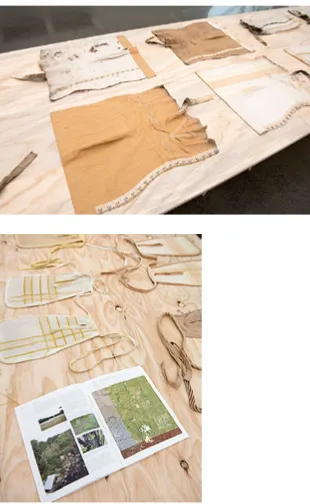
In the studio I employed iterative process of printing, dyeing and sewing. The production of a series of pockets and gaiters dyed and printed with creek plants provided props for the walk. The textiles functioned as protection and vessel. Each day I wore a fresh pair of gaiters; they traced the movement between my body and site through the accrual of creek matter and sweat. I argue the use of iterative printing processes, where creek plants colour the textiles, which are further overlaid with matter collected between my moving body and the site, and the production of multiple
garments, is a manifestation of care through studio and field practices. [Figs. 1 & 2] I discuss how the contemporary turn of walking as an art practice builds on the rich tradition of walking. This return to slower, more attentive ways of being, fosters dialogue across disciplines including cultural geography, environmental science and history. These disciplines inform contemporary walking practices to produce embodied and often site-specific knowledges which I demonstrate employ and reveal practices of care.
9 Tronto, Moral Boundaries: A Political Argument for an Ethic of Care, 105.
Fig. 2
Day Three: Walking the Merri—gaiters and Walking
the Merri—pockets after a day of walking between
Merri Park and Lockerbie. Photography: Lesley Harding
Fig. 1
Seven pairs of gaiters ready for Walking the
Merri, 2013
40
Through this wayfaring method of building knowledge, I learnt about and observed how these histories, boundaries and practices shaped the materiality of the creek, and in turn my experience of walking its length.10 I demonstrate how the corporeal experience of walking, working and being at the creek are ways of paying attention to this material history. Importantly, the route of our walk, directed by permissions and exclusions, mapped in real time a series of individual and collective relations inscribed in this place, while the act of walking itself brought these to my attention. Reflecting on my decision to walk downstream, I draw on Gaston Bachelard’s discussion of water as carrier, a concept I return to through my exegesis to examine the material role of water in my studio practice.11 Water is core to the creek’s materiality and carries physical evidence of its history and treatment.
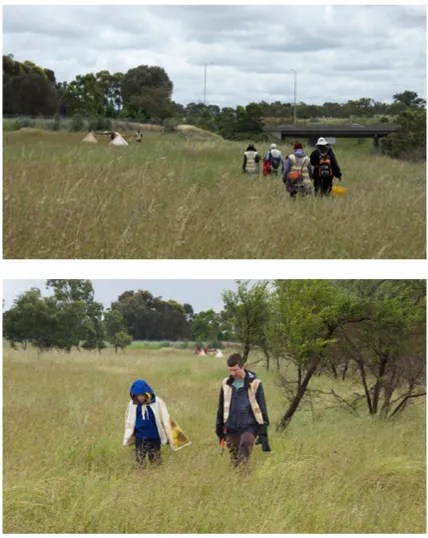
Chapter Two discusses Tending the Merri (2013), a work which engages directly with restoration volunteers, their labour and the sites of their care. A discussion of this work demonstrates how I use the materiality of the creek to bring attention to the labours of care present in restoration work. I created a series of garments and tents in the studio, these plant-dyed textiles were returned to the creek and worn or used by volunteers during a series of Friends of Merri Creek restoration events. [Fig. 3]
The work of volunteers enacts Tronto’s second and third phases of care where she identifies ‘taking care of ’ as individuals assuming some responsibility for an identified need to care, and ‘care giving’ as the direct meeting of this need. She specifies the care giving as involving physical work where there is an encounter between the object and giver of care. I argue, by returning plants to the creek site via garments worn by workers, attention is focussed on the relationship between the site of restoration and the volunteers’ role in performing this care. My studio labour fixed plant colour in the garments’ fibres, reinforcing connections between workers, site and restoration labour through this common material. By creating garments specifically for these events, I brought attention to the often-invisible labour of volunteers.
10 Tim Ingold, “Footprints through the Weather-World: Walking, Breathing, Knowing,” Journal of the Royal Anthropological Institute 16 (2010).
11 Gaston Bachelard, Water and Dreams: An Essay on the Imagination of Matter (Dallas: Pegasus
Fig. 3
Edgar’s Creek community planting, September 2013
high-vis-style jackets
calico dyed and screenprinted with weeds and indigenous plants from the Merri Creek catchment
each jacket 55 x 78 cm approx. Photography: Kirsty Argyle
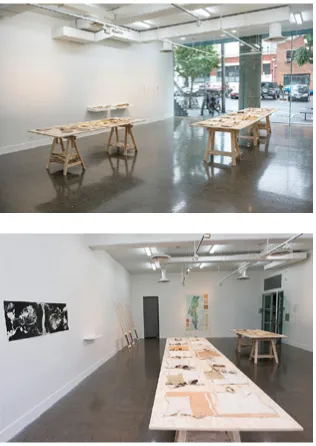
Fig. 4
Walking the Merri, 2014
RMIT Project Space, Melbourne, VIC
Installation view showing Walking the Merri—gaiters
and Walking the Merri—pockets
42
Chapter Three responds to the problem of how art might contribute to extending relations and practices of care in a gallery setting. It does this by tracing a turning point in this research, prompted by an examination of how readings of Walking the Merri and Tending the Merri shifted when installed in a gallery. In different ways, each project has employed and enacted elements of care as a studio methodology to reveal practices of care on site at the creek. What happened then, when the textiles and other residues or artefacts of these works were displayed inside a gallery? Could they still enact labours of care away from the site?
Thus, a logical next step was to exhibit iterations of Walking the Merri and Tending the Merri in a gallery setting where there was the potential of a wider audience than at the creek. However, installed in a gallery, the work ceased activating the sites of human and more-than-human activity at the creek, working instead as documentary evidence of a past event (Walking the Merri) or as a representation of a place (Tending the Merri). In other words, they represented the works in the field without effecting relations of care. This realisation constituted a pivotal phase of my research, and in this chapter, I discuss how, away from the creek, operating as indexical records of past events, these works did not successfully reveal practices of care. In the process of developing these works in response to my research problem, I had found a purely representational model of interpreting and making art was insufficient as a basis for engaging with the complicated site of urban ecological restoration and degradation. Regardless, this work, once
installed in the gallery, had reverted to being read in this way. [Fig. 4]
Reflecting on this problem, I propose in this chapter that it is possible to produce works for a gallery audience which enact and reflect on ethics and practices of care through an engagement with matter and site. To address this issue, I returned to
destabilising human privilege increasingly turn our attention to the agency of matter.12 Barad, a leading theorist in this field, brings the findings of quantum physics into philosophical, feminist and ecological discussions. These theories, a natural fit for artists working in dialogue with materials, allowed me to conceive of how plant matter, and my methodologies of processing it, can translate and communicate practices of care to audiences in the gallery. In paying attention to matter, an artist can reveal and implicate political and environmental relations and practices. Diana Coole and Samantha Frost support my shift towards paying attention to materiality as a way of apprehending and making sense of the complexity of the world where multiple agencies are in a constant state of becoming. 13
The decision to return to conventions of making work specifically for the gallery re-framed Walking the Merri as fieldwork and research (while performing the act of ‘caring about’). The shift between research as artwork and fieldwork articulates one of the complexities of practice-led research, where the separation between research and findings cannot be clearly prised apart. Barbara Bolt differentiates between the artwork and the ‘work of art’ (that is, the work art does). She explains that the work that art does in a research context occurs across all phases of making as well as in its public presentation.14 In the case of Walking the Merri the gallery installation provoked interpretations of the work which did not answer my research questions. However, as research this exhibition ‘worked’ to provide important insights into relations between performativity and representation. That is, the experience of translating Walking the Merri to a gallery, and the knowledge gained whilst walking, served to inform the next direction of my studio practice. This resulted in the production of two more works, created
specifically for the gallery, which I will discuss in the final two chapters of this exegesis.
12 Barbara Bolt, “Introduction,” in Carnal Knowledge: Towards a ‘New Materialism’ through the Arts, ed. Estelle
Barrett and Barbara Bolt (London, New York: I.B.Tauris, 2013), 3.
13 D. Coole and S. Frost, “Introducing the New Materialisms,” in New Materialisms: Ontology, Agency, and Politics, eds. Coole, D. & Frost, S. (Durham & London: Duke University Press, 2010), 7.
14 Barbara Bolt, “Beyond Solipsism in Artistic Research: The Artwork and the Work of Art,” in Material Interventions: Applying Creative Arts Research, ed. Estelle Barrett and Barbara Bolt (London, New York:
44
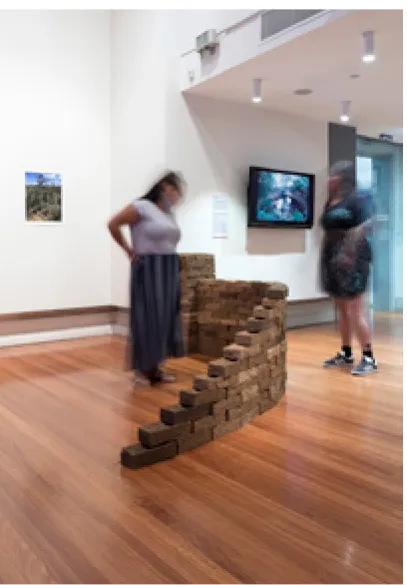
Chapter Four addresses how, considering the experience discussed above, I sought to solve the problem of how to create works for a gallery which combined the creek’s materiality with labours of care. Bound by Gorse (Ulex europaeus) (2017) [Fig. 5] was the first of the works in which I sought to do this. I used papermaking methods to produce about 100 bricks made of the invasive woody weed, gorse (Ulex europaeus). In this work I use the materiality of gorse to explore relations between care and land use. Walking and restoring the creek provided tangible experiences of the lack of care practised by some landowners. The historic roots of ill-conceived care are visible in the landscape and, to understand this, I draw on feminist ecologist Val Plumwood’s critique of the instrumentalisation of nature, which views it simply as a ‘resource’ to provide for humans, without reciprocity.15
Such instrumentalisation was deeply felt and present during Walking the Merri and was therefore a significant idea to revisit in the gallery. By working wholeheartedly with the gorse, I engage with the historic and contemporary ramifications of land practices, firstly in its planting and more recently with efforts to remove and contain this species. Bellacasa identifies ‘“matters of care” [as] a proposition to think with . . . to generate more caring relationalities.’16 I demonstrate that creek material, reconstituted through art making practices and used as an art material, can comprise care and the presence of care practices at urban ecological sites.
Bound by Gorse, and my final installation Habitus (2017) contemplate the temporal and material nature of labours of care and how these manifest in the finished works. To explain how practices of care and time sit together and emerge across urban ecologies, and in the shorter timeframe in my studio practice I borrow Sharon Blakey and Liz Mitchell’s term ‘material time’ in which they describe the ‘intimate interplay’ between time, matter and relationships of care.17 This dialectic between time and care is helpful when examining and understanding the ontological material experience of my studio practice and gallery installations. The depth of my interaction with materials will be
15 Val Plumwood, Feminism and the Mastery of Nature (London: Routledge, 1992), 111. 16 Bellacasa, Matters of Care: Speculative Ethics in More Than Human Worlds, 41, 66.
Fig. 6
Habitus, 2017 (Quiet Witness)
cotton damask tablecloth, natural dyes 175 x 300 cm
(Porous Borders, Impermeable Boundaries)
hemp, wool, natural dyes, sand 360 x 130 x 38 cm
Installation view
Heide III: Kerry Gardner & Andrew Myer Project Gallery
Heide Museum of Modern Art, Melbourne, VIC Photography: Matthew Stanton
Fig. 5
Bound by Gorse (Ulex europaeus), 2017
gorse
variable dimensions (90 x 250 cm approx.) digital print 57 x 42 cm
Water+Wisdom Australia: India, 2018
[image:45.595.114.318.52.345.2]46
discussed in detail in the final chapters where the production of the bricks (Bound by Gorse) and sandbags (Habitus) made these relations most visible.
In Chapter Five I further address how to reveal practices of care, present as subject and method, to gallery audiences. I discuss how my installation Habitus, created for Heide Museum of Modern Art and the 2017 Art + Climate = Change Festival, tackled this problem by framing care at locally connected sites of Merri Creek and Heide in relation to global warming. To do this, I returned to methods used in my first two projects, adapting them specifically to the gallery. [Fig. 6]
For example, I walked between Heide and Merri Creek, using the method of wayfaring to spend time in and learn about the new terrain. In doing so I enacted Tronto’s initial phase of ‘caring about’ this expanded site. I reflected on quotidian practices and how local actions connect with the overarching problem of global warming. In addition, I returned to using locally gathered plants as textile dye. The resulting work was a wall of sandbags, dyed and printed with plant colour collected during my walks. Installed with the sandbags was a printed and dyed damask tablecloth depicting Yingabeal, the Wurundjeri scarred tree, estimated to be over 500 years old, still growing in the Museum’s grounds. As with Bound by Gorse, I took advantage of the repetitive labour, in this case of printing and dyeing, to produce multiple sandbags, which collectively revealed labours of care.
consideration of hybridity and corporeality, in doing so progressing to a more complex account of the world away from dualisms such as nature/culture.18
Chapter Six explains the rationale behind the installation of my final works at Wagga Wagga Art Gallery, which will be presented in a three-person exhibition, Walking Matters, in June 2018. I use this speculative chapter to discuss exhibiting Tending the Merri, Bound by Gorse and Habitus together for the first time. I explain how I propose to rework Tending the Merri, to connect it more closely to labours of care.
I conclude my exegesis by reflecting on the implications of the findings of my research. This research began at the confluence of my art practice and my participation in volunteer ecological restoration work. My exegesis thereafter demonstrates how my art practice drew upon and revealed practices of care found in urban ecological restoration, walking and making. I argue that framing art practice through frameworks of care produces experiences of being in and with the work that are particularly suited to the dynamic and conflicted topic of urban ecological restoration, but that could equally translate to practices engaged with other themes. Shifting away from a solely representational method of interpreting art, I focus instead on the materiality and processes of my practice. By attending to how care plays out as subject and methodology in this material- and process-led investigation, I propose that I have formulated new ways of realising and communicating care in an art practice concerned with the restoration and degradation of urban ecological sites. I propose that this research indicates how art practices which build around ethics and practices of care offer a means of enacting an ecological responsibility. If, as I have argued, care is a way of seeing and acting in the world in which interdependency and relationships are foregrounded and the potential to take responsibility is raised, then my examination of care as a practice and method of art, and its interpretation, offers a path through which to navigate an increasingly precarious world.
18 Sarah Whatmore, Hybrid Geographies: Natures Cultures Spaces (London, Thousand Oaks, Spaces: SAGE
Chapter One: Walking the Merri—Care as Attention
Preambulation
In this chapter I discuss my performative artwork, Walking the Merri (2013), and the ways in which it revealed and performed practices of care. Conceived as an artwork, this seven-day walk from Heathcote Junction to Abbotsford, was also important fieldwork informing my subsequent research direction.19 [Map 1] Walking, as a process of paying attention, offers ways of engaging with complex sites that are at once speculative and material, as Bellacasa argues ‘thinking with care’ is a practice not a theory.20 Translated to art, practicing with care produces new ways of thinking through materials and processes.
Using experiences from the planning and performance of Walking the Merri, I will demonstrate the complexity of the creek in terms of its uses, the modes of care practised and how, in most instances, economic potential of land overrides all other values. As we walked we observed the potential wealth procured through housing, the cost and responsibility of ecological restoration and the mix of uses imposed on the land. The history of these places was apprehended through our moving bodies; the intermingling of introduced and indigenous species, the livestock and crops juxtaposed by kangaroos and wallabies, and—except for one day’s respite—the incessant hum of the Hume Freeway.
My understanding of the creek’s need for care was deepened during each stage of this project. Tronto’s phase of ‘caring about’, where the need for care is identified, and the decision to act is decided, enabled other practices of care at the creek to be observed. I show how walking is an embodied and mobile means of paying attention; as anthropologist Tim Ingold argues it is ‘a process of thinking and knowing’.21 The slowed pace of walking is a performance of care—of paying attention—enhanced by the pace
19 Lesley Harding and I walked from the source of Merri Creek in Heathcote Junction, downstream to its
confluence with the Yarra River (Birraung) in the inner-city suburb of Abbotsford. We were joined each day by a third walker who heightened the relations between creek fragment and whole by punctuating the seven-day walk with their presence.
20 Maria Puig de la Bellacasa, “‘Nothing Comes without Its World’: Thinking with Care,” The Sociological Review 60, no. 2 (2012): 199.
50
and proximity of body and ground. In turn this ambulant pace enabled an encounter with the creek’s materiality which revealed past and present interventions at the creek. I will explain how the walk became a performance of the presence or absence of care, made visible through negotiations with owners during the planning stages. This provided a corporeal experience of the caring and instrumental relations and interventions at the creek, which informed my later works.
Paying attention to boundaries and care practices, I will discuss three aspects Walking the Merri: the planning and negotiation of the walk; the sewing, dyeing and printing of textile pockets and gaiters to wear as I walked; and the performative and durational act of walking and how it embodied and revealed care. In doing so I contextualise the place walking holds in my practice.
Preparation and permission: Beginning to care
The Merri Creek runs for approximately 70 kilometres, much of its northern reaches privately owned. This reflects the rapid and early uptake of land by white colonists and set me the task of asking permission to cross settler-constructed boundaries.The 1881 law where riparian land ‘to some 280 rivers and lakes was reserved’ as Crown Land, did not apply retrospectively; land already in freehold possession remained in private hands.22 By the 1880s there was significant freehold ownership throughout Victoria. The Merri Creek bears this history and Walking the Merri performed its legacy. There are some Crown (Parks Victoria) owned sections, but most of the creek north of Craigieburn is freehold, breaking up the beds, banks and frontages to this day.
Requesting permission to walk on private property set up an ethical framework through which walking as an act of care was made possible. By asking permission from each landowner, I was adhering to colonially introduced laws prohibiting trespass and I was seeking to observe links between permission, ownership and the individual owners’ care practices. These laws reflect the rationale legitimising private property, outlined by eco-feminist Val Plumwood, in which nature is viewed as ‘terra nullius available for
22 Maddocks and The Public Land Consultancy, “Waterways—a Cadastral Taxonomy,” Terra Publica 7,