Direction Oriented Block based Inpainting using
Morphological Operations
Shyni Shajahan, R.Mathusoothana S Kumar, Jacob Vetha Raj
Abstract— Inpainting is one of the wide growing area of image processing. Image inpainting is a technique to reconstruct the restored region using some background information and obtain the results very efficiently and effectively. The basic concept of image inpainting is to replace the unwanted object from the original image and to recover the image using some neighborhood pixels in an undetectable way. In this paper, we introduce an efficient algorithm for image inpainting i.e., Direction Oriented Block-Based using Morphological Operations approach. This algorithm gives better efficiency than the previously proposed algorithm. By this approach, we can inpaint large regions as well as recover small portions in an undetectable way. A more accurate patch will be found out by this proposed approach. The experimental results proved that our proposed work is more computationally efficient and effective compared to previous work.
Index Terms- inpainting; enhanced; neighborhood; priority; object removal
I. I.INTRODUCTION
Image inpainting is an important part of image restoration research. It is a technique of repair and reconstruction of damaged parts of images. It has been noticed that the approach which is available requires expertise or experience to use the current tools. In the current scenario digital world, inpainting refers to the application of refined algorithms to replace lost or damaged parts of the image data. Digital Image Inpainting allows making the changes automatically. This is the main factor inpainting differ from some other graphic design software available in the market. For example, Photoshop is a world‟s best imaging and graphic design software, using this software only the skilled programmer would give a better result. But using our inpainting software this work would be carried out by the normal person give the visually pleasable result. The below figure shows an example of the proposed technique where image (person manually selected as the target region) is replaced from the background in an unnoticeable way. When capturing a picture, extra elements may be disturbing in the picture powerful and sophisticated algorithms are necessary for removing those parts. With the help of an algorithm, the changes can be made wherein it looks “sensible” to the human eye. The objective of the inpainting technique is to create an inpainted image that has a close similarity with the original image.
Revised Manuscript Received on October 05, 2019.
Ms. Shyni Shajahan, Assistant Professor, K R Gouriamma College of Engineering, Kerala.
R.Mathusoothana S Kumar,
Jacob Vetha Raj,
(a) (b)
Figure1. Removing person using Image Inpainting. (a) The original image (b) Image with the person removed
from background.
Such software has various applications in different areas. It is used for removing the stamped date or logos from photographs. They are also used in Medical Imaging, Multimedia industry, film restoration, e.g., removing cracks or scratches from photographs and adding special effects to old photos. One of the other uses of image inpainting is to add special effects such as to creative effect Remove objects, Fill holes, Replicate pattern, Transfer texture, etc. During the broadcast of images over a network, there may be some parts of an image that are lost. These parts can then be restored using image inpainting [6]. This technique can also be used in statical and dynamical videos. To replace the lost blocks in the coding and transmission of images, ie, in a streaming video. It can also be used to replace logos in videos.
Section of this paper is structured as below. Section 2 describes the related work of the proposed algorithm. Section 3 presents the key observation and drawback of the earlier inpainting techniques. After this, we emphasize on the proposed methodology on how we can improve the inpainting process. Sections 4 and 5 describes Experimental results and Conclusion & Future enhancement respectively.
II. RELATED WORK
Traditionally, the inpainting techniques are done by professionals who have a good experience and technically sound in the area. The fundamental method and idea behind the inpainting techniques of their work are: the individual selects the region to be inpainted from the original image. This can be done automatically. Fill the target region with the background information in an undetectable way. The most suitable patch can be seen in the boundary always.
Based on the output requirement of the image which is to be developed the inpainting algorithms are generally categorized into two categories like texture based and structure-based methods. The first category of these algorithms deals with the reconstruction of textures from the image [7], by using this technique we can restore the missing texture of the object. The second class of algorithms is for the reconstruction of structures from the image. It is an iterative method that shrinks the missing area towards the center. These algorithms exploit samples from the source region to rebuild the image.
There have been very few algorithms that exploit the advantages of both structure restoration and texture synthesis image inpainting methods. One image inpainting based work was proposed in the paper by Criminisi et al.[2]. In this paper, they propose an innovative approach that combined both approaches in one algorithm.
Video Inpainting is another most important area in inpainting. It is a step-by-step process; this software is useful for both statical and dynamical videos. It eradicates the fast-moving or slow-moving objects in the frame and then it replaces vacant space with data from the nearby frames [13]. This is a very challenging task as the requirements are two-fold:(1) the generated content in the missing regions must be semantically correct given their surrounding content; and (2)the missing regions need to be filled in a seamless way so that the original holes are visually unnoticeable. There are several approaches for video inpainting, some of its categorizations are below:
1. PDE based Inpainting.
2. Texture Synthesis based Inpainting. 3. Exemplar based Inpainting. 4. Semi-automatic and Fast Inpainting 5. Hybrid Inpainting.
Video Inpainting is a very challenging task in the area of research and inpainting methods have been developed for a wide range of applications. Video inpainting using Partial Differential Equation (PDE) technique [12],[15] works in an iterative manner. This algorithm specifies the boundary of the region must be inpainted similar to the inner region. If the target region consists of a large area then there is a chance of blurring in of the outcome It produces visually plausible results if missed regions are a small one and the target region is non-textured. If the target region size is large, it takes a long time than a small one and some blurring effect is produced in the resultant video sequence.
Generally, video inpainting methods are categorized into two basic methods. They are basically patch and object-based methods. In Patch-based methods [10] block-based sampling, as well as simultaneous propagation of texture and structure information, are used. As a result, the computationally efficient output is achieved using this approach. So the researchers in these areas. The other approach in the video is to get the patches and perform inpainting is that has developed similar ideas in video inpainting Hence, the researchers have followed a similar concept in video inpainting also. Another approach for video inpainting employs information from the nearest frames and performs the insertion of nearest areas to a different image based on those frames to achieve inpainting [14].
Exemplar based inpainting techniques are fast and enhanced the widespread application in the area of inpainting. This approach combines the advantages of both texture and structure-based methods in one algorithm. The basic methodology of this technique is the use of a set of real image blocks, extracted either from the image being restored. Here patch replacement can be done automatically by minimum squared error.
In this paper, we propose an efficient algorithm which is an extension to earlier inpainting algorithms with an enhancement on improving the computational complexity of the approaches along with some other improvement measures such as speed and accuracy.
III. METHODOLOGY
i. Identify the target region. This is the initial stage of our proposed work. It is generally executed separately from the inpainting process. Select the target region from the source region and mark it with some special color. Let us consider that the target region is coloring with red color in the RGB color model, then it becomes R=255, G=0, B=0.Find the boundary of the target region.
ii. Find the nearest boundary points. After the marking of the target region, find the nearest boundary points. The patch size should be larger than the largest texture element in the image. In the proposed work we have used a default patch size of 11 x 11.
iii. Find a patch from outside the boundary that best matches the selected patch from the boundary, ψp.
This matching can be done using the most appropriate distance measures. We use the Sum of Squared Difference (please refer eq. 1) to find the best matching patch.
SSD (d1, d2) = 𝑛2 [𝑓 𝑥 + 𝑖, 𝑦 + 𝑗 −
𝑗 =−𝑛2 𝑛1
𝑖=−𝑛1
𝑔𝑥+𝑖− 𝑑1,𝑦+𝑗−𝑑2]2 (1)
Where the summation extends over the region of size (2n1+1)x(2n2+1).
v. Update the boundary values. According to the pixel value of the center point q of the best matching block obtained in the above step is assigned to the target pixel point p to be repaired and the image is updated. As stated previously, the outcome does completely depends upon the third step where an area is identified for the selection for replacement. In this actual preparation, as the repair process continues, the confidence of the repaired pixel needs to be updated which consults the confidence of the subsequently repaired pixel decreasing, resulting in the value being too low to lose credibility and reducing the image restoration effect. Moreover, when the best pixel P to be repaired during the repair process, the confidence of the neighboring pixels is increased and the priority of the neighboring pixels is increased so that the pixel becomes the next most accurate pixel to be repaired so that the expected output is improved as compared to normal procedure.
Criminisi‟s algorithm is actually an image restoration algorithm based on both structure and texture based methods and its working principle is shown in Figure 1. Ω represents the target area to be inpainted. ɸ represents the source region. δΩ represents a boundary between the target and source region. P is the target pixel to be repaired on the boundary. ΔIp is the tangential direction of the iso-illuminance line of the pixel point P. np is the normal vector of the tangent of the P point on the boundary between the sample area and the target area to be repaired. Ψp is the target region to be inpainted centered on point P.
The important calculation formula of Criminisi algorithm is as follows:
P (p) =C (P)* D (P) (2)
The above formula, C(p) is a confidence term and D(p) is a data term. They are defined by the following formulas:
C (p) =
𝑞∈𝛹𝑝 ∩𝜑𝐶(𝑞)
(3)
D (p) =
𝛻𝐼𝑝. 𝑛𝑝
(4)
α
In the above formula, 𝛷𝑝 is the area of Φp. np is the normalization factor, and is the normal vector of point P. When the image is initialized, C(p) is defined as:
C(p) =
0, ∀𝑝 ∈ Ω
1, ∀𝑝 ∈ 𝛷
(5)
The above formula represents that if the point P is within the target area to be inpainted, the confidence term C (p) is zero. If the point P is in the source region Φ , the confidence C(p) is 1.
First, the image matching block size is determined, and after that the area of the inpainted target region is positioned, that is, the area indicated in the above figure is found and the confidence calculation of all points on the boundary is performed as shown in Equation 3 and 4. The calculation of the gradient data item is performed to obtain the priority value of each pixel as shown in Equation 2. Find the pixel P with the highest priority value and the target block Ψp to be repaired with the P point as the center. Thus the new term can be now expressed as
P (p) =
α
x R
c(p) +β x D (p) 0≤α, β≤1
(6)
Where α and β are the component weights for the confidence and data terms respectively. Also α + β = 1 and Rc (p) is the regularized confidence term
R
c(p)=(1-ω)xC(p)+ω 0≤ω≤1 (7)
The solution to the problem that we propose our algorithm involves the lowest sum of squared difference value is taken from the current list.
I
n the item, according to the known sample area and the boundary of the area to be repaired, the other pixel points in the target block to be repaired with the repair point are different to the central pixel point due to the influence of the surrounding condition distribution and the Manhattan distance in order to get the best pixel to be repaired. At the same time, for the problem that the best matching block is deviated due to the pixel difference of the corresponding pixel of the target block and the search matching block in the original Criminisi algorithm, the Euclidean distance is combined with the matching block pixel variance to find the best matching block. Therefore, the search is performed in a range adjacent to the feature as much as possible within a range acceptable to the pixel difference, and the accuracy of the matching block is improved to some extent. In the proposed calculation the algorithm will look for a area and will not compromise of the performance as in this technique the calculations allow the technique to ignore a large number of patches.IV.EXPERIMENTAL RESULTS
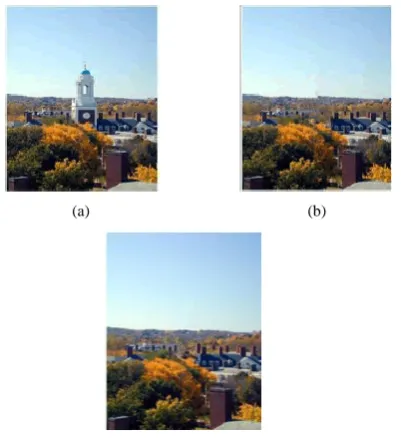
To evaluate the strength of our technique and computational enhancements on the terms of speed and accuracy, we have done tests on multiple images symmetric and asymmetric images and obtained the results compared with the conventional inpainting approaches. The experiment uses Python 3.7 as the simulation platform and is implemented in language Python. The hardware environment is 2.6 GHz Intel Core i7 processor and 12G memory. For the [3], [11] and the algorithm mentioned below , has several different scene images are selected for simulation experiments. Figure 3 and Figure 5 are experiments for repairing target removal. The objective evaluation criteria were also used in the experiment.
A. Comparison with SSD based Inpaintingapproach [1]
Now we present the comparison of our proposed work with the one presented by SSD based Inpainting Algorithm in [1]. The image in Figure 2(a) was given as input to the inpainting process that used our approach as well as to implementation of previously proposed SSD based Inpainting approach. Our proposed Direction oriented block based algorithm achieved better results
compared to SSD based algorithm. The difference in the results occurred during the best exemplar patch selection. At that situation SSD based technique gives a guaranteed solution to overcome that problem. But our proposed work give better result than SSD based inpainting algorithm in terms of better clarity. Therefore the best exemplar patch can be selected for replacement as shown in Figure 2(b).
(a) (b) (c)
Figure 2. Comparison with SSD based Inpainting approach. (a) Image to be inpainted, (b) Result using our
algorithm, (c) Result using SSD based Inpainting approach.
B.Comparison with SSD based Inpainting on the basis of time
Using the proposed Direction Oriented Block Based Inpainting using Morphological Operations approach, the time which it takes to inpaint the image is very much reduced when compared to SSD based algorithm.
[image:4.595.317.537.333.483.2](a) (b) (c)
Figure 3. Comparison with SSD based Inpainting approach (a) Image to be inpainted [3]. (b) Output using
the proposed algorithm. (c) Result using SSD based Inpainting approach.
Following (Table 1) shows short comparison between implementation of our proposed Direction oriented block based approach and SSD based Inpainting approach in terms of computational time.
SL No
Total image size (in pixels)
Removed area size (in pixels)
Time taken in seconds SSD based
algorithm
Our proposed algorithm
1 24381 288 0.1600 0.1440
2 50600 3407 1.7560 0.5239
3 38000 5381 2.6706 0.6574
4 95892 6115 2.7662 0.9477
[image:4.595.310.544.588.731.2]5 196608 26608 10.2598 3.5373
The time taken in the proposed algorithm is depended on the area which is takes for inpainting. In addition to this, the time would be less if the user selects small but spatially disconnected regions rather than if he selects the same percentage of target region continuously. This is so because we have taken into consideration the number of continuous red (color of the target region) pixels to remove the possibility of finding regions with no available patches.
C. Quality of Inpaint object Restoration Software [10]
We are now going to check the quality of our proposed algorithm with the current software for the same activity (Inpaint Photo Restoration Software). Figure 4 exhibits the results as shown below, this concludes that our algorithm gives better results.
(a) (b)
[image:5.595.52.253.272.494.2]
(c)
Figure 4. Comparison with Inpaint Photo Restoration Software (a) Original image (b) result obtained from Inpaint Photo Restoration Software (c) Implementation
of our proposed algorithm.
D. Real Life Examples
Now we present an example that shows removing a person from the seashore photograph (See Figure 5).
(a) (b)
Figure 5. Example of removing a person from original image. (a) Seashore with a person. (b) Image with the
person removed from the original image.
V.CONCLUSION AND FUTURE WORK
Through the research of the Criminisi algorithm and Exemplar based inpainting algorithm, this paper analyzes its shortcomings both in the clarity and speed accuracy. By studying the impact of the boundary update on the repair order, the patch replacement method is improved, and the repair error is also solved. By considering the locality of image restoration, the Euclidean distance is introduced to correct the matching strategy, which makes the matching block search more in line with the visual effect and improves the quality of image restoration. The experimental results show that the proposed algorithm can effectively guarantee the edge structure and texture information of the image, and make the repair effect more natural. The shortcoming of the algorithm in this paper is that because the algorithm still adopts the global repair strategy, the time complexity of the original algorithm is not optimized, resulting in long repair time. In the matching strategy, the determination of the weight lacks adaptability. The next step is to mine the image information, so that the weights in the matching strategy are more accurate, so as to further improve the repair effect. At the same time, for the global search strategy, the local search strategy can be used to improve the time complexity of the algorithm. How to accurately determine the scope of the search is still the focus of the next step. We are developing enhanced methods to add more value to this algorithm and to make it more efficient to apply in both statical and dynamical videos.
ACKNOWLEDGMENT
Firstly, I would like to express my sincere gratitude to my guide Prof.Dr.R.Mathusoothana S Kumar for the continuous support of my PhD study and related research, for his patience, motivation, and immense knowledge. His guidance helped me in all the time of research and writing of this thesis.
REFERENCES
1. Anupam,Pulkit Goyal and Sapan Diwakar, „„Fast and Enhanced Algorithm for Exemplar Based Image Inpainting,‟‟ Fourth Pacific-Rim Symposium on Image and Video Technology, 325-330 , 2010. 2. A. Criminisi, P. Perez, and K. Toyama, “Region Filling and Object
Removal by Exemplar- Based Image Inpainting,” IEEE Transactions on Image Processing, 13(9), 1200-1212, 2004.
3. A Vijayalakshmi and Pethuru Raj, “Modified Exemplar based Image Inpainting Algorithm”, International Journal of Computer Applications (IJCA), Vol. 135, No. 6, February 2016
4. Dai L, Jiang D H, Ding B, et al. Improved digital image restoration algorithm based on Criminisi[J]. Journal of Digital Information Management, 2016.
5. Jaspreet Kaur Chhabra and Vijay Birchha, “An Enhanced Technique for Exemplar based Image Inpainting”, International Journal of Computer Applications (IJCA), Vol. 115, No. 17, April 2015. 6. Liu, Yunqiang, and Vicent Caselles, “Exemplar-based image
inpainting using multiscale graph cuts", IEEE transactions on image processing, Vol. 22, No. 5, pp. 1699-1711, 2013.
7. Qing Zhang and Jiajun Lin, “Exemplar-Based Image Inpainting Using Color Distribution Analysis”, Journal Of Information Science and Engineering, Vol. 28, pp. 641-654, 2012. [16]
[image:5.595.55.280.600.750.2]9. Deng L J, Huang T Z, Zhao X L. Exemplar-Based Image Inpainting Using a Modified Priority Definition.[J]. Plos One, 2015, 10(10):e0141199.
10. Restore Inpaint, http://restoreinpaint.sourceforge.net/
11. T. Shih, et al., “Video inpainting and implant via diversified temporal continuations,” Proceedings of the 14th annual ACM international conference on Multimedia, 133-136, 2006.
12. T.F. Chan, J. Shen, L. Vese, "Variational PDE Models in Image Processing", UCLA Computational and Applied Mathematics, pp. 02-61, Dec. 2002.
13. Video Inpainting on Digitized Vintage Films via Maintaining Spatiotemporal Continuity Nick C. Tang, Chiou-Ting Hsu, Member, IEEE, Chih-Wen Su, Timothy K. Shih, Senior Member, IEEE, and Hong-Yuan Mark Liao, Senior Member, IEEE.
14. Koochari Abbas, Soryani Mohsen, "Exemplar-based video inpainting with large patches", Journal of Zhejiang University: Science C, vol. 11, pp. 270-277, 2010.
15. Kedar A. Patwardhan, Sapiro Guillermo, Bertalmío Marcelo, "Video inpainting under constrained camera motion", IEEE Transactions on Image Processing, vol. 16, pp. 545-553, 2007..
AUTHORSPROFILE
![Figure 3. Comparison with SSD based Inpainting (a) (b) (c) approach (a) Image to be inpainted [3]](https://thumb-us.123doks.com/thumbv2/123dok_us/8166533.251103/4.595.317.537.333.483/figure-comparison-ssd-based-inpainting-approach-image-inpainted.webp)