International Journal of Innovative Technology and Exploring Engineering (IJITEE) ISSN: 2278-3075,Volume-8 Issue-12, October, 2019
Abstract: With the advancement of technology and desire of
Digitalization the sensitive data that are transmitted over the internet has to be secured. Since leakage of Information can lead to security theft, which happens in cybercrime. Hence securing the data which we share over the internet is almost as important in fulfilling the desire of digitalization. With this aim visual cryptography techniques are proposed. In the encryption phase of visual cryptography shares of secret data are created to transmit over the channel. And the shares are combined at the decryption phase to regain the original data. Considering one the existing method called RGB based multiple share creation with aid of Elliptical curve cryptography. The drawback of low PSNR value of retrieved image is boosted by adopting RSA in the second stage of encryption and proposed a Novel Visual cryptography Method that results in ∞ PSNR value along with retaining maximum information with PSNR in the retrieved data after attack.
Keywords : Correlation Coefficient (CC), Mean-Squared error
(MSE), Peak Signal to Noise Ratio (PSNR), Structural Similarity (SSIM).
I. INTRODUCTION
[image:1.595.49.283.489.631.2]Providing Security plays a salient role in order to work sensitive data handling application in a efficient way without leakage of information and transferring the data from one end to other end. With this aim cryptography techniques are used that encrypt the data to securely transfer over the internet [5].
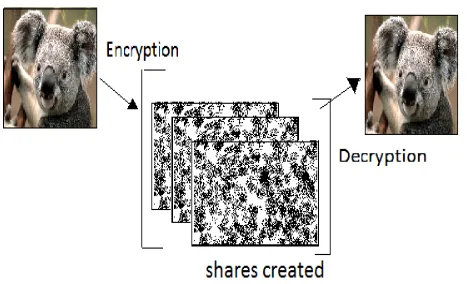
Fig 1:Share creation using Visual Cryptography
Revised Manuscript Received on July 22, 2019.
Jahnavi S, Computer Science and Engineering, DayanandaSagar Academy of Technology & Management, Bangalore, India. Email: [email protected].
C.Nandini, Computer Science & Engineering, DayanandaSagar Academy of Technology & Management, Bangalore, India, Email: [email protected]
A Visual Cryptography Technique is a cryptography technique used to encrypt visual information i.e text, image etc. In visual cryptography data is divided into two or more pieces. These pieces of information are called shares. The process of creating shares is called encryption. The secret data is retrieved by combining all or subset of collection of shares. The process of stacking the shares on one another to retrieve back the secret data is called decryption as shown in Fig 1. Few measuring Parameters considered are considered to evaluate the Visual Cryptography Technique [6]:
PSNR Peak Signal to Noise Ratio: it abbreviated as PSNR, is an expression or an engineering term for the ratio between the maximum possible value (power) of a signal and the power of corrupting noise that affects the quality of its representation.
Structural Similarity (SSIM): is an image quality metric that assess the visual impact of three characteristics of an image i.e Luminance, Contrast, Structure.
Mean-Squared error (MSE): measures the average squared difference between actual and ideal pixel values. Correlation Coefficient (CC): is used to match up to two images of the same object (or scene) value indicates whether the object has been altered or moved.
In the existing methods of visual cryptography the shares are creates are black and white. The color information is not retained and the retrieved image is decrypted image would remain black and white image. To overcome this problem RGB color shares created by K Shankar and P Eshawaran by proposing an method called RGB based multiple share creation in visual cryptography with aid of Elliptical curve cryptography technique[4].
In this technique the Peak Signal to Noise Ratio value of the decrypted image is less than 60% of the original image. Without Elliptical curve cryptography method the RGB based visual cryptography technique lacks in providing an efficient security to the data. With the aim of providing better Peak Signal to Noise Ratio value than existing RGB based visual cryptography techniques which is very much required for authentication system. the shares generated using RGB based visual cryptography is encrypted using RSA method. In section III Novel Visual Cryptography Technique is proposed yielding ∞ PSNR value, which means in the decryption phase the data is retrieved without any distortion. In section IV results of existing system and proposed system is evaluated. In section V conclusion of the work carried out is discussed.
A Naive based share generation using Random
Visual Crypto Technique
II. RGBBASEDMULTIPLESHARECREATIONIN
VISUALCRYPTOGRAPHYWITHAIDOFRSA
TECHNIQUE
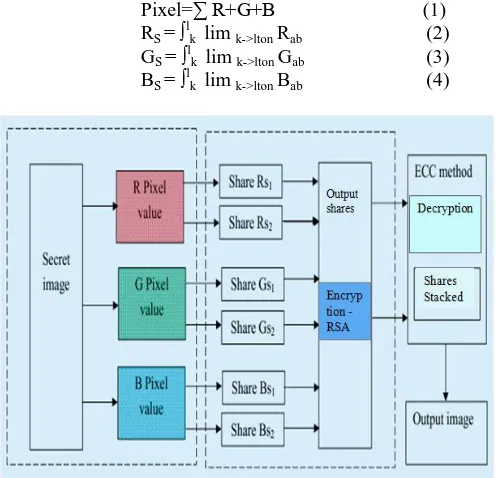
Considering the RGB based multiple share creation colorful meaningless shares are created. Each R, G, B channels of an image are separated. Based on the pixel value, the shares are created. Each share is collection of sub pixels of the secret RGB image considered. The shares are indicated as Rs, Gs and Bs. Where a and b are the position in the share matrix, Ras, Gab, Bab are indicated as components of an image pixel. The R, G, B channels of an image are separated first and considered as an matrix.
Based on the number of basic matrix value, Key matrix Km meaningless shares are created. The information cannot be leaked until and unless are shares are obtained. Number of basic matrix value is indicated as S then XOR operation in used to create shares. Based on basic matrix value the shares are created as shown in below equations.
Pixel=∑ R+G+B (1)
RS = ∫lk lim k->lton Rab (2)
GS = ∫lk lim k->lton Gab (3)
[image:2.595.47.295.281.520.2]BS = ∫lk lim k->lton Bab (4)
Fig 2: Block diagram of Modified Existing method. The following operations are carried out before share creation with Rb1 and Rb2 matrices. BR1=128-Rb1 (5)
BR2= Rb2 (6) Shares of Red channel is created with the below equation
RS1=BR1 Km (5) RS2=BR1 BR2 (6) RS3=BK2 RS1 (7) RS4=RS1R (8)
Repeat the same procedure for G (GS1, GS2, GS3, GS4, Km) and B (BS1, BS2, BS3, BS4, Km) channel for creating color shares.
The shares created in the above process are encrypted using RSA and transmitted over the internet to the other end as shown in Fig 2. One receiving the encrypted shares, it is decrypted and actual shares are drawn. These shares are stacked using an XOR operation to get the R G B channels of an secret image using the below equation.
R= RS1 RS RS3RS4Km
G= GS1 GS GS3GS4Km B= BS1 BS BS3BS4Km
On reconstructing the shares the color channels are stacked together to create an original secret image as shown in Fig 1. The Altered process of exiting method yields ∞ PSNR value of Value of Improvised Existing Method using RSA.
Table I: PSNR, SSIM, MSE, Execution time and CC.
Ima
g
es
Size PSNR SSIM MSE
E
x
e
T
ime
in Seco
nd
s
CC
L
enna
60KB
(5
1
2
*
5
1
2
)
∞ 1 0.0 298.3 1
B
a
bo
o
n
635KB
(5
1
2
*
5
1
2
)
∞ 1 0.0 315.3 1
P
epper
5
26KB (51
2
*
5
1
2
)
∞ 1 0.0 290.4 1
H
o
us
e
509KB
(5
1
2
*
5
1
2
)
∞ 1 0.0 294.21 1
The structural similarity parameter value is reachable 1 only in the case when 2 identical sets of data and therefore SSIM value 1. indicates perfect similarity structure. Value 0 indicates no structural similarity between two data and SSIm can generate a map of quality over the image i.e
SSIM(x,y)=[L(x,y)]α . [C(x,y)]β .[ S(x,y)]γ
International Journal of Innovative Technology and Exploring Engineering (IJITEE) ISSN: 2278-3075,Volume-8 Issue-12, October, 2019
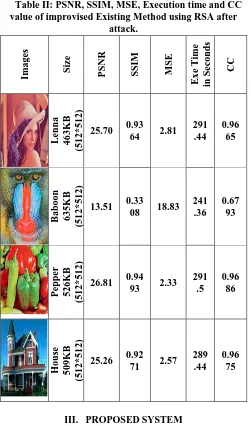
Table II: PSNR, SSIM, MSE, Execution time and CC value of improvised Existing Method using RSA after
attack.
Ima
g
es
Size PSNR
SS IM M SE E x e T ime in Seco nd s CC L enna 463 KB (5 1 2 * 5 1 2 )
25.70 0.93
64 2.81 291 .44 0.96 65 B a bo o n 635KB (5 1 2 * 5 1 2 )
13.51 0.33
08 18.83 241 .36 0.67 93 P epper 526KB (5 1 2 * 5 1 2 )
26.81 0.94
93 2.33 291 .5 0.96 86 H o us e 509KB (5 1 2 * 5 1 2 )
25.26 0.92
71 2.57 289 .44
0.96 75
III. PROPOSEDSYSTEM
The New visual cryptography system for color images will overcome the drawbacks of existing system, the color information is retained in decrypted image and the size of it is retained as of original image using Novel Random matrix pixel shuffling technique. So the decrypted image and shares contains color property without pixel expansion.
During encryption process the Random matrix is generated based on the size of the image. Before creation of the random matrix the image is divided in to four divisions UL, UR, LL and LR and to each sub image random matrix is generated. The random matrix generated will be different of the all 4 sub images and even during every subimage generation process random matrix is generated. Value of the random matrix can be varied of different range. For each subimage color shares are created and the pixel values of the color shares are shuffled during encryption.
During decryption phase the reverse process are carried out by reshuffling the pixel values. For each subimage color shares, pixels are reshuffled first and those reshuffled color shares are used to retrieve the subimage of the original image. On retrieving the subimage UL, UR, LL and LR the original image is obtained by considering the subimages.
Database used: Database used The IMM Frontal Face Database This note describes a data set consisting of 120
[image:3.595.308.549.109.838.2]annotated monocular images of 12 different frontal human faces. Points of correspondence are placed on each image so the data set can be readily used for building statistical models of shape as shown in Table III.
Table III: Proposed, PSNR, MSE, CC, SSIM and execution time of an system
O rig ina l Ima g e Size P SNR M SE CC SS IM E x e T ime in s ec L enna 463 KB (5 1 2 * 5 1 2 )
∞ 0 1 1 4.7
B a bo o n 635KB (5 1 2 * 5 1 2 )
∞ 0 1 1 4.9
P
epper
526KB (51
2 * 5 1 2 )
∞ 0 1 1 4.9
H o us e 509KB (5 1 2 * 5 1 2 )
∞ 0 1 1 4.9
Andrea s 3 2 .4 K B (8 0 0 * 6 0 0 )
∞ 0 1 1 8.65
J eppe 2 6 .7 K B (8 0 0 * 6 0 0 )
Shih -Fu 2 6 .7 K B (8 0 0 * 6 0 0 )
∞ 0 1 1 8.81
Ra smu s 1 .8 M B (2 5 6 0 * 1 9 2 0 )
∞ 0 1 1 8.95
J a nu s 1 .7 7 M B (2 5 6 0 * 1 9 2 0 )
[image:4.595.311.549.48.232.2]∞ 0 1 1 8.73
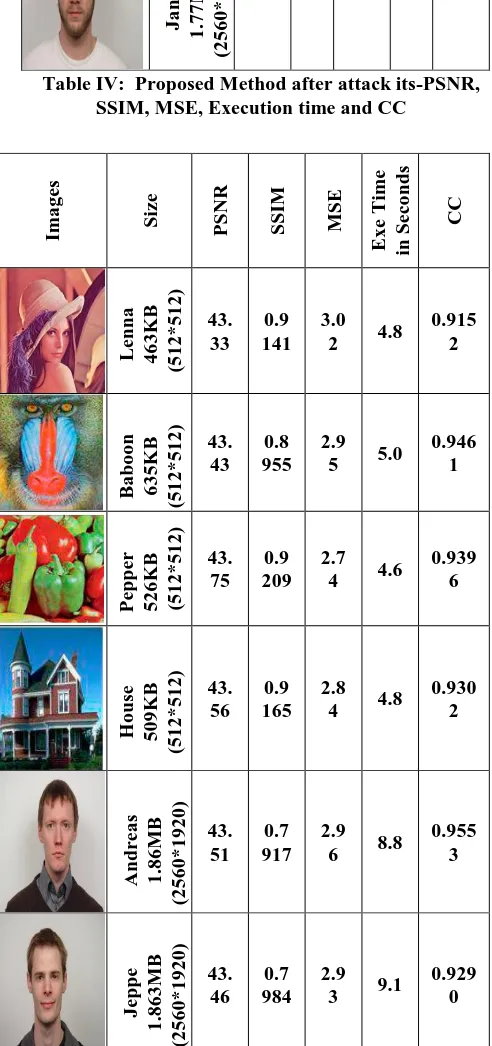
Table IV: Proposed Method after attack its-PSNR, SSIM, MSE, Execution time and CC
To the same images after an attack the resultant retrieved image PSNR, MSE, CC, SSIM and execution time is shown in Table IV.
IV. RESULTSWITHDISCUSSION
In the experiment lenna, babbon, house and pepper images are fed as input to the improvised existing system, PSNR, MSE and CC are recorded. Along with this new few parameters are considered i.e SSIM (structural similarity) and execution time taken by the complete encryption and decryption process. The system with checked with the quality of an retrieved image after attack on the shares assuming if an attackf happens on the shares over the internet, to check the information retain ability Salt and pepper noise is added with noise density that effects the pixel.
SSIM ia an image quality metric that assess the visual impact of three characteristics of an image i.e Luminance, Contrast, Structure. The structural similarity parameter value is reachable 1 only in the case when 2 identical sets of data and therefore SSIM value 1 indicates perfect similarity structure. Value 0 indicates no structural similarity between two data and SSIm can generate a map of quality over the image i.e SSIM(x,y)=[L(x,y)]α . [C(x,y)]β .[ S(x,y)]γ
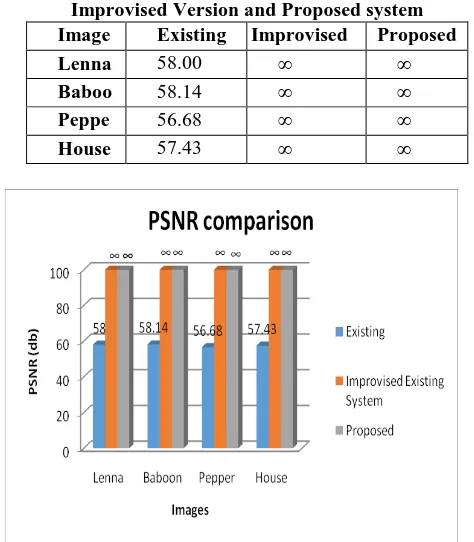
[image:4.595.50.290.49.342.2]Table V shows an existing system PSNR and MSE with respect to different images. In the Table III the propose system is checked with new images of different size but the system performance is not distorted. From Table VI we can notice that PSNR value of existing system and proposed is almost same as shown in Fig 3. But after the attack evaluated against existing and improvised system, the proposed system retains the information with good PSNR value relatively, minimum MSE and Correlation Coefficient value as shown in Fig 4, Fig 5 and Fig 6 respectively.
Ima
g
es
Size PSNR SSIM MSE
E x e T ime in Seco nd s CC L enna 463 KB (5 1 2 * 5 1 2 ) 43. 33 0.9 141 3.0 2 4.8
0.915 2 B a bo o n 635KB (5 1 2 * 5 1 2 ) 43. 43 0.8 955 2.9 5 5.0
0.946 1
P
epper
526KB (51
2 * 5 1 2 ) 43. 75 0.9 209 2.7 4 4.6
0.939 6 H o us e 509KB (5 1 2 * 5 1 2 ) 43. 56 0.9 165 2.8 4 4.8
0.930 2 Andrea s 1 .8 6 M B ( 2560*1920) 43. 51 0.7 917 2.9 6 8.8
0.955 3 J eppe 1 .8 6 3 M B ( 2560*1920) 43. 46 0.7 984 2.9 3 9.1
[image:4.595.43.289.246.769.2]International Journal of Innovative Technology and Exploring Engineering (IJITEE) ISSN: 2278-3075,Volume-8 Issue-12, October, 2019
Table V: Existing Method PSNR and MSE
Ima
g
es
Size PSNR M
SE
L
en
n
a
463
KB
(5
1
2
*
5
1
2
)
58.00 0.103
B
ab
o
o
n
6
3
5
KB
(5
1
2
*
5
1
2
)
58.14 0.0997
Pep
p
er
5
2
6
KB
(5
1
2
*
5
1
2
)
56.68 0.145
Ho
u
se
5
0
9
KB
(5
1
2
*
5
1
2
)
[image:5.595.304.548.48.431.2]57.43 0.118
Table VI: PNSR evaluated value of Existing System, Improvised Version and Proposed system Image Existing Improvised
Existing System
Proposed
Lenna 58.00 ∞ ∞
Baboo n
58.14 ∞ ∞
Peppe r
56.68 ∞ ∞
House 57.43 ∞ ∞
Fig 3: PNSR of Existing System, Improvised Version and Proposed system
Fig 4: PSNR of Existing System, Improvised and proposed system after attack
Fig 5: MSE of Existing System, Improvised and proposed system after attack
Fig 6: CC of Existing System, Improvised and proposed system after attack
Table VII: SSIM of proposed system before and after attack
Image Be
fore Attac k
After Attack Lenna,463KB
(512*512) 1 0.9141
Baboon, 635KB (512*512)
1
[image:5.595.45.282.447.718.2]Pepper, 526KB (512*512)
1
0.9209
House, 509KB (512*512)
1
0.9165
Andreas, 32.4KB (800*600)
1
0.7917
Jeppe, 26.7KB (800*600)
1
0.7984
Shih-Fu, 26.7KB (800*600)
1
0.8357
Rasmus, 1.8MB (2560*1920)
1
0.8234
Janus, 1.77MB (2560*1920)
1
[image:6.595.48.284.49.439.2]0.7925
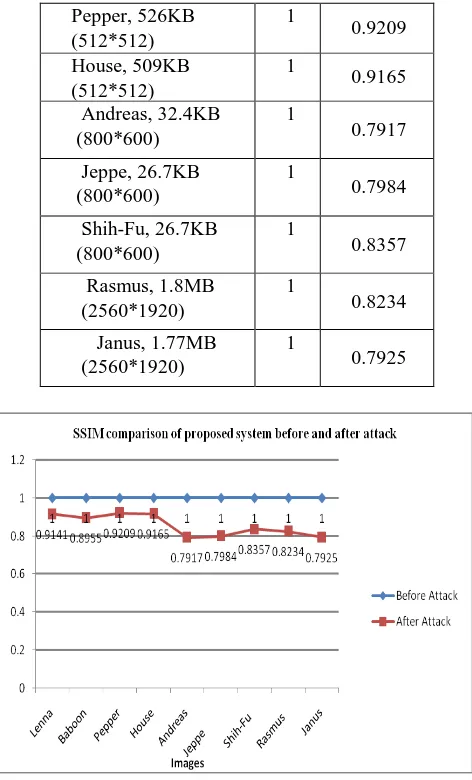
Fig 7: SSIM of proposed system before and after attack The SSIM value of proposed system before and after attack are examined as shown in Table VII and the system yields better SSIM value even after attack as shown in Fig 7.
V. CONCLUSION
With the aim of generating a colorful, clueless shares The Existing system is improvised by implementing with RSA and Novel Visual Cryptography System is implemented with random matrix generation for each sub images. During encryption the image is subdivided in to 4 sub bands/ sub mages and for each sub image 6 colorful meaningless and clueless shares are created, with random matrix for each share. After share generation each share’s pixels are shuffled. During decryption process with the meaningless clueless color shares sub band/ sub-Images are generated and finally original image is retrieved. The experimental result shows that the decrypted image PSNR, SSIM of both original and decrypted images are same, the image is retrieved without any loss or distortion. Even on attack the quality of the decrypted image evaluated against existing system is better.
REFERENCES
1. Deepesh Rawat and Vijaya Bhandari ,“A Steganography Technique for Hiding Image in an Image using LSB Method for 24 Bit Color Image”, International Journal of Computer Applications by IJCA Journal Volume 64 - Number 20 on 2013.
2. Naoki Kita and Kazunori Miyata,“ Magic sheets: Visual cryptography with common shares”, Computational Visual Media springer link Volume 4, Issue 2, pp 185–195, June 2018.
3. Yamini Ravella ; Pallavi Chavan, “Secret encryption using (2, 2) visual cryptography scheme with DCT compression”, IEEE International Conference on Intelligent Computing and Control Systems (ICICCS) June 2017.
4. K. Shankar and P. Eswaran, “RGB based multiple share creation in visual cryptography with aid of elliptic curve cryptography”, IEEE
China Communications journal, Volume: 14, Issue 2, February 2017. 5. Trupti Patel and Rohit Srivastava, “A new technique for color share
generation using visual cryptography”, IEEE International Conference on Inventive Computation Technologies (ICICT), Aug. 2016.
6. R. M. Shiny, P. Jayalakshmi, A. Rajakrishnammal , T. Sivaprabha and R Abirami “An efficient tagged visual cryptography for color images”, IEEE International Conference on Computational Intelligence and Computing Research (ICCIC) 2016.
7. Trupti Patel and Rohit Srivastava, “Hierarchical visual cryptography for grayscale image”, IEEE Online International Conference on Green Engineering and Technologies (IC-GET) 2016.
8. Shubhangi Khairnar and Reena Kharat , “Online fraud transaction prevention system using extended visual cryptography and QR code”, IEEE International Conference on Computing Communication Control and automation (ICCUBEA) 2016.
9. Fersna S and, Athira V, “Progressive visual cryptography scheme without pixel expansion for color images”, International Journal of Advanced Research in Computer and Communication Engineering ,Vol. 4, Issue 6, June 2015.
10. Nadeem Akhtar , Vasim Ahamad and Hira Javed, “A compressed LSB steganography method”, IEEE 3rd International Conference on Computational Intelligence & Communication Technology (CICT) Feb. 2017.
11. Zaid Y. Al-Omari and Ahmad T. Al-Taani, “Secure LSB steganography for colored images using character-color mapping”, IEEE 8th International Conference on Information and Communication Systems (ICICS) April 2017.
12. Samaher Al-Janabi and Ibrahim Al-Shourbaji, “A Hybrid Image steganography method based on genetic algorithm”, IEEE 7th International Conference on Sciences of Electronics, Technologies of Information and Telecommunications (SETIT) December 2017. 13. G. L. Smitha and E. Baburaj, “Asurvey on image steganography based
on Least Significant bit Matched Revisited (LSBMR) algorithm”, IEEE International Conference on Emerging Technological Trends (ICETT) Oct. 2016.
14. P.V. Sabeen Govind , M.K.Sajila and Bindiya M.V arghesea, “A Two Stage Data Hiding Scheme with High Capacity Based on Interpolation and Difference Expansion”, International Conference on Emerging Trends in Engineering, Science and Technology (ICETEST- 2015), Science Direct Procedia Technology journal, Volume 24, Pages 1311-1316, 2016.
15. Masoud Nosrati, Ali Hanani and Ronak Karimi, “Steganography in Image Segments Using Genetic Algorithm”, IEEE Fifth International Conference on Advanced Computing & Communication Technologies Feb. 2015.
16. Fangjun Huang, Yane Zhong, and Jiwu Huang, “Improved Algorithm of Edge Adaptive Image Steganography Based on LSB Matching Revisited Algorithm”, 12th International Workshop on Digital Watermarking , LNCS 8389 , pp. 19–31, 2014.
17. M. Khodaei and K. Faez, “New adaptive steganographic method using least significant- bit substitution and pixel-value differencing”, IEEE IET Image Processing journal , Volume: 6, Issue: 6, pages 677 - 686 , August 2012.
18. Wen-JanChen, Chin-ChenChang and T. Hoang NganLe, “High payload steganography mechanism using hybrid edge detector”, Science Direct Expert Systems with Applications Journal, Volume 37, Issue 4, Pages 3292-3301, April 2010.
19. Rengarajan Amirtharajan, Sumaiya Sulthana and J.B.B. Rayappan, “Seeing and Believing is a Threat: A Visual Cryptography Schemes:, Research Journal of Information Technology, 5: 435-441, 2013 20. Nadeem Akhtar; Pragati Johri; Shahbaaz Khan, “Enhancing the Security
International Journal of Innovative Technology and Exploring Engineering (IJITEE) ISSN: 2278-3075,Volume-8 Issue-12, October, 2019
21. Deepesh RawatVijaya Bhandari ,“A Steganography Technique for Hiding Image in an Image using LSB Method for 24 Bit Color Image”, International Journal of Computer Applications by IJCA Journal Volume 64 - Number 20 on 2013.
AUTHORSPROFILE
Jahnavi S: Is presently working as Assistant Professor in the Department of Computer Science and Engineering at Dayananda Sagar Academy of Technology & Management, Bangalore, India. She received her Bachelor of Engineering (B.E) Mater of Technology (M.Tech.) from Visvesvaraya Technological University. Currently she is perusing Ph.D., in Visvesvaraya Technological University, Belagavi, India. Her research interest include Image Processing, Pattern Recognition and crypto biometrics .