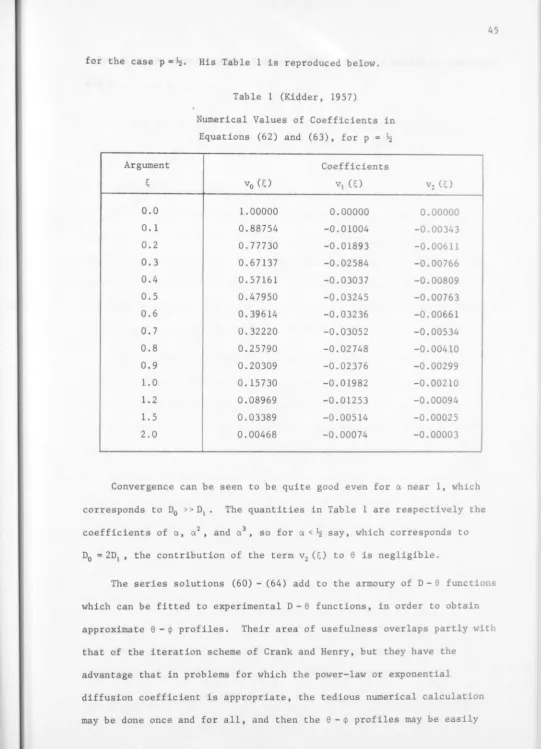
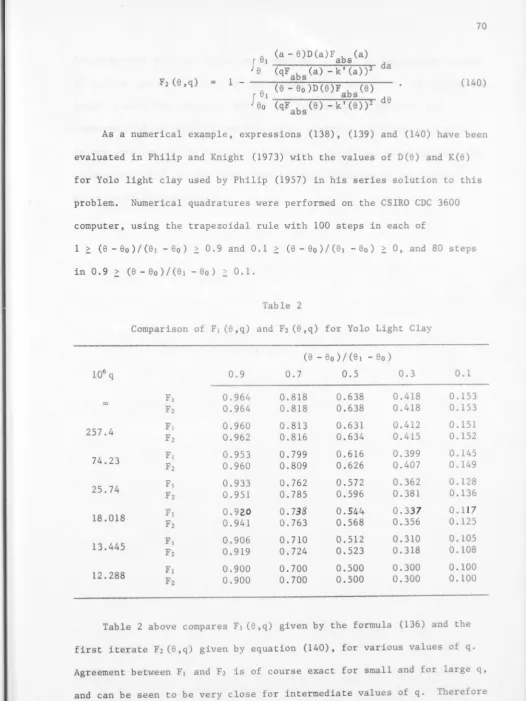
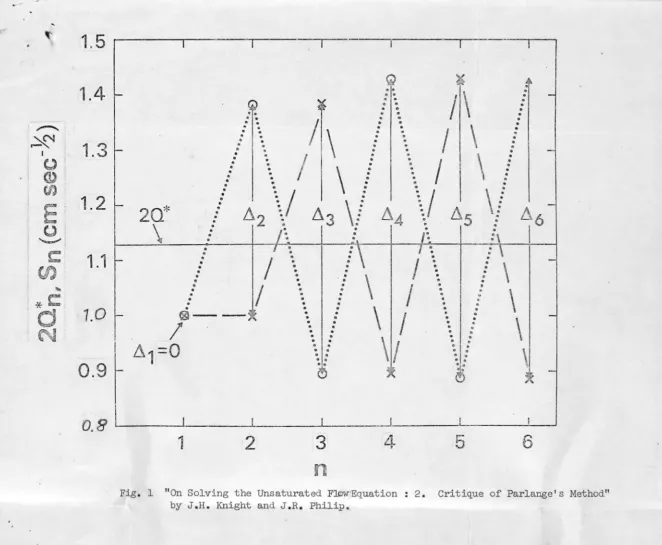
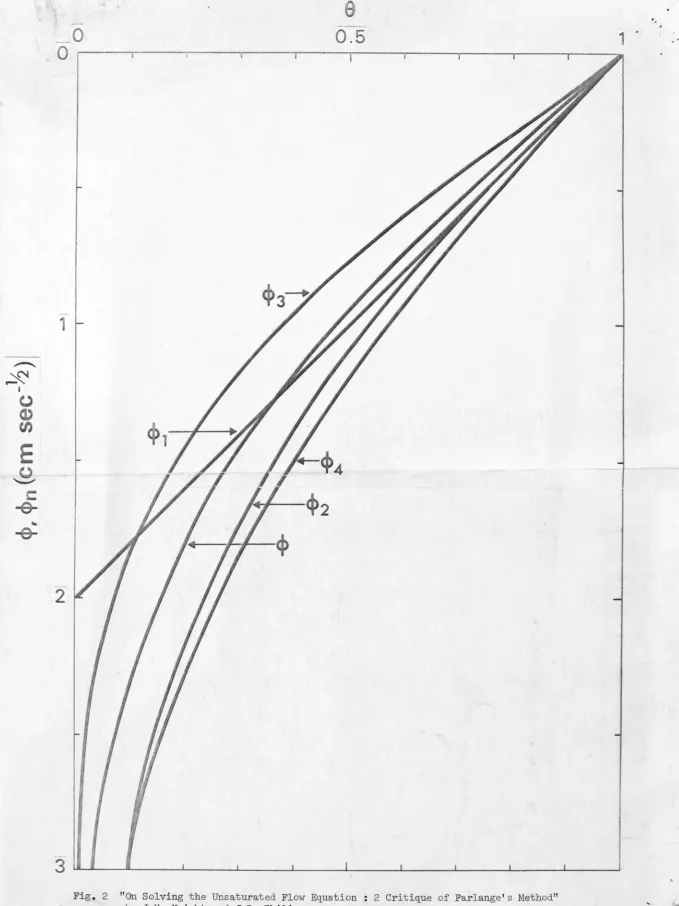
;...s
A
,
~L-V-t'lf.\hljII
SOLUTIONS OF THE NONLINEAR DIFFUSION EQUATION: EXISTENCE, UNIQUENESS, AND ESTIMATION
by
John Howard Knight
A thesis submitted for the degree of Doctor of Philosophy
at the Australian National University
STATEMENT
Unless it is stated in the text to the contrary, the material contained in this thesis is the product of my own research.
ACKNOWLEDGEMENTS
I would like to thank the Australian National University for the award of a research scholarship, and Dr John Philip and Mrs Masako Izumi for their supervision. In particular I thank Dr Philip for many informative discussions, and constant
ABSTRACT
In the first part of the thesis a problem for the nonlinear
diffusion equation with diffusion coefficient a function of concentration, which is reduced by a similarity substitution to a boundary value
problem for a nonlinear ordinary differential equation, is considered. Existence of a solution with certain upper and lower bounds is
demonstrated for diffusion coefficient satisfying a local Lipschitz condition, and uniqueness is proved for non-increasing diffusion coefficient. An iterative method of Crank and Henry for solving this problem is investigated and is proved to converge for non-decreasing diffusion coefficient, thus extending the existence result in this case. A perturbation method is used to derive a general series solution to the problem for a class of diffusion coefficients of power-law and
exponential form.
More general problems are considered in the last two chapters of the thesis. It is shown that a particular nonlinear diffusion equation with flux boundary conditions can be transformed to a linear equation, and new exact solutions are given to various problems of practical interest involving this nonlinear diffusion equation. An iterative method proposed by Parlange to solve various problems for the nonlinear
diffusion equation and related equations is investigated, and it is shown that the method of Parlange fails to converge. The problems are
TABLE OF CONTENTS
STATEMENT
ACKNOWLEDGEMENTS ABSTRACT
CHAPTER 1 INTRODUCTION
1.0 The equations to be solved 1.1 Exact solutions
1.2 Approximate solutions
CHAPTER 2 EXISTENCE, UNIQUENESS AND PROPERTIES OF SOLUTIONS FOR A TWO POINT BOUNDARY VALUE PROBLEM
2.0 Preliminary results 2.1 Uniqueness results
2.2 Existence and properties of solutions
CHAPTER 3 THE METHOD OF CRANK AND HENRY 3.0 The method
3.1 Preliminaries
3.2 Convergence proof for non-decreasing D
CHAPTER 4 AN ANALYTICAL SOLUTION BY PERTURBATION METHOD 4.0 Application of the Kirchhoff transformation 4.1 The perturbation expansion
CHAPTER 5 A NEW EXACT SOLUTION FOR A NONLINEAR DIFFUSION EQUATION WITH CONSTANT-FLUX BOUNDARY CONDITION
5.0 The method of Storm
5.1 Application of the method to more general problems 5.2 An exact solution corresponding to an instantaneous
plane source
5.3 The solution to the general problem, and extensions to variable flux
ii i i i iv
1 4 5
10 15 19
28 29 32
38 41
47
5154
CHAPTER 6 CRITIQUE AND IMPROVEMENT OF PARLANGE'S ITERATIVE
METHOD
6.0 The work of Parlange6.1 The problem as an integral equation 6.2 Improvement of the Parlange method
REFERENCES
58 60 63
INTRODUCTION
1.0 THE EQUATIONS TO BE SOLVED
The
mathematical theory of diffusion
may be described as the study of solutions of the parabolic partial differential equationae
at
'i/• (D'i/8) , (1)where the dependent variable 8 is the concentration of diffusing
substance, and Dis the diffusion coefficient, which may be a function of the independent variables and of the dependent variable 8. When D varies with 8, we have the nonlinear diffusion equation.
The
diffusion equation
(1) is a special case of theheat equation
CB:_at
'il. (k'i/T) (2)where Tis the temperature, and C and k are respectively the heat
capacity and thermal conductivity of the material, which may be functions of the independent variables and of the temperature.
In particular the nonlinear diffusion equation may be applied to the movement of water in soils, when the influence of gravity may be
neglected. When gravity must be taken into account, the process is described by the nonlinear Fokker-Planck equation
ae
at
dK
ae
'i/•(D'i/8)+-•-d
e az
,
(3)D may vary through two or three decades, and dK/d6 through several more (Philip, 1969).
In most problems considered here it will be required to find a solution of equation (1) in a semi-infinite one-dimensional region, with certain initial conditions, and subject to boundary conditions of either the concentration type, in which the concentration is specified on the boundary, or of the flux type, in which the flux -D a6/an is specified on the boundary, where Dis the diffusion coefficient, and a6/an denotes differentiation in a direction normal to the boundary. The thermal parameters C and k will be functions of temperature only, and the diffusion coefficient will be a function only of concentration 6.
In this case where the coefficients are independent of time and position, equations (1) and (2) may be reduced to the same form by a transformation of Kirchhoff (1894). Putting
s (6) - - -1
f
6 D(a)da, D (60)60
where 60 is a datum value of 6, transforms (1) to the form as
at
(4)
(S)
where the diffusion coefficient has been expressed as a function of the new variables. Similarly the transformation
s(T)
reduces (2) to the similar form as at
1
k(T0)
J
T k(a)da To(6)
thermal diffusivity is constant, and equation (6) is a linear equation. Even when the thermal diffusivity may be taken to be constant in this manner, if the thermal conductivity k(T) is not constant we must apply the inverse of the transformation to the solution of the linear equation
(6), in order to obtain the true temperature distribution. This was pointed out in a particular case by Awbery (1936). Where 8 has upper and lower limits 80 and 81 respectively, we may conveniently put
0 (8)
J
88D (a)da 0
which allows the non-dimensional variable 0 to range between O and 1. The Kirchhoff transformation has the added advantage that it reduces a nonlinear flux-type boundary condition of the form
n(0) a0 = - f
ax
to a linear boundary condition
where f and g are constants.
ae
ax
-gwhen x = a
when x
=
a ,When D(8) is positive for all 8, then 0 is a monotone function of 8. This means that when D(8) is a monotone function of 8, and Dis positive
as required in the physical context, D (0) also has a monotonicity property. The one-dimensional form of the diffusion equation is
a0
at
and the Kirchhoff transformation reduces this to
as
at
(7)
(8)
When the initial and boundary conditions are functions of xt-½, the substitution of Boltzmann (1894)
reduces equations (7) and (8) respectively to
d
(n(S)
d8)
+f
~
d~ d~ 2 d~
and
d2s _ L ds d~2 + 2D (s) d~
0
0 •
One set of initial and boundary conditions enabling the Boltzmann substitution to be used consists of the initial condition
S(x,t) when t = 0, x ~ 0 and the constant-concentration boundary condition
8 (x, t) when t ~ 0, x = 0 . These conditions become the boundary conditions
when ~
=
08 as
for the ordinary differential equation (10).
1.1 EXACT SOLUTIONS
(10)
(11)
(12)
(13)
(14)
Most of the monograph of Carslaw and Jaeger (1959) is concerned with the wide variety of methods of solution of the linear equation obtained from (1) or (2) when the diffusion coefficient or thermal parameters are constant. Very few exact solutions are known for equations with
non-constant diffusivity.
'
one-dimensional diffusion equation with constant-flux boundary conditions
and given initial concentration distribution, when the diffusion
coefficient has the form D(S) = a/(l-b8)2 •
Fujita (1952a, 1952b, 1954) found exact solutions to the problem
described by equation (10) and conditions (14), when the diffusion
coefficient is of the form a/(1-bS), a/(l-b8)2 , or a/(1+2b8+c82) . Fujita's solution to this problem with D(S)
=
a/(1-b8)2 may in fact bededuced by the method of Storm applied to the flux-type boundary
condition problem with flux specified on the boundary to be proportional -k
to t 2
Philip (1960a, 1960b) found a very general method for finding D(S)
functions which yield exact solutions to equation (10) with condition
(14).
1.2 APPROXIMATE SOLUTIONS
The lack of exact solutions to the above problem, when D(S) has
simple exponential or polynomial forms, led to a search for approximate
methods of solution. These may be divided into several classes.
Various analytical solutions can be obtained by perturbation methods,
as power series in a "small" parameter. They are approximate because
computational difficulties usually mean that only the first few terms of
the series can be easily calculated, although in theory all terms can be
calculated explicitly with sufficient labour, and each such series has a
certain region of convergence. Kirchhoff and Hansemann (1880) were
apparently the first to apply such a method to this problem. Hopkins
(1938) calculates the first few terms of the solution of the
correspond-ing heat flow problem, for the case where the conductivity and the heat
calculated a series solution to the diffusion problem, equation (10) with
conditions (14), when D{8) = D0exp(a8). Kidder (1957) applied the
Kirchhoff transformation, and then calculated a series solution to the
problem with D(8)
=
a(l+b8). In Chapter 4 a general perturbationexpansion is obtained which covers the cases D (8) = a ( 1 + b8 / with k > 0,
and D(8)
=
D0exp(c8). Kidder's series can be written down as aparticular case of our more general expansion. Yampol'skii and Aizen
(1968) considered the heat conduction problem with thermal conductivity
and heat capacity
ko
(1 + aT) and C0 ( 1 - aT) respectively. All the aboveanalytical methods involve perturbation about the case of constant D, and
so may be expected to be most accurate when D(8) does not vary too widely
with 8, and to be less useful for strongly nonlinear equations.
Solutions may also be obtained by quasi-analytical iterative methods,
such as the method of successive approximations, in which an estimate of
the solution is used to give another, hopefully better, estimate of the
solution. The process often uses a Green's function and an integral
operator to give an expression in closed form for the new estimate in
terms of the old estimate. In practice the quadratures involved must
often be performed using a suitable scheme for numerical integration,
when a numerical answer is required.
Crank and Henry (1949a, 1949b) developed a method of successive
approximations for solving (10) or (11) with boundary conditions (14).
In Chapter 2, various properties such as existence, uniqueness and bounds
for solutions are investigated for this problem, using mainly the
techniques of Bailey, Shampine, and Waltman (1968). This work is
extended in Chapter 3 to show that the iteration scheme of Crank and
Henry converges when D(8) satisfies certain monotonicity and continuity
conditions, and gives a unique solution when D(8) has in addition a
of the method of Crank and Henry may be increased by careful choice of
the starting function.
Klute (1952a, 1952b) used the method of Crank and Henry under
conditions of very rapid variation of D withe, and found that
convergence was slow under these conditions. Philip (1955b) developed a much more rapid and accurate numerical method which used an inverted form
of equation (10), with an analytical approximation near the point 6
=
60 •Philip (1957) made this method the basis of a series solution to an
inverted form of equation (3). Recently, Parlange (1971a, 1971b, 1971c)
has proposed a new iterative method of solving equations (1) and (3)
subject to concentration-type boundary conditions. Parlange's method is investigated in Chapter 6, where it is shown that for the problem
described by equation (7) subject to conditions (12) and (13), it is
equivalent to the application of the method of successive approximations
of Picard (1893) to a two-point boundary value problem for a particular
nonlinear ordinary differential equation. In fact the iterates do not
converge in the conventional sense, but merely oscillate about the true
solution (Knight and Philip, 1973). Philip and Knight (1973) developed
an improved iteration scheme for which each iterate satisfies a
constraint of "integral continuity", and the characteristic oscillation
of Parlange's method is eliminated. A more general choice of first
approximation is made to suit the particular problem. An improved
iteration scheme is developed for the infiltration equation (3) with
conditions (12) and (13), which avoids the serious defects of Parlange's
method. A good first approximation makes iteration unnecessary.
Also in the class of iterative solutions is the work of Mann and
Wolf (1951) who showed that for a linear heat equation in a
one-dimensional semi-infinite region, with certain nonlinear mixed boundary
8
to derive a nonlinear integral equation involving the surface temperature. They gave conditions under which this integral equation could be solved by the method of successive approximations, thus eliminating the need to
calculate the temperature distribution in the whole region in order to know the surface temperature and flux. Abarbanel (1960) extended their work to the sphere and to the finite region.
A further class of approximate solutions includes the rest of those which do not exactly satisfy the equation and boundary conditions, but are "near" the true solution in some sense. They may be improved by correct choice of parameters, but there is no general systematic procedure for using a first approximation to construct a "better" approximation to the solution. Some examples can be given.
Landahl (1953) gave an approximation method for transient diffusion with constant D, and applied it to various boundary value problems. Macey (1959) generalized this approach to non-constant diffusion coefficients, using a "moving steady-state" solution, and found quite good agreement with existing exact solutions. Goodman (1958)
approximated temperature profiles by polynomials, whose coefficients were chosen to satisfy certain constraints, chief of which being one of
overall conservation, referred to by Goodman as the "heat-balance integral". In Goodman (1961) he extended the method to variable diffusion coefficients, and compared the approximations to solutions obtained by the method of Crank and Henry, as rediscovered by Yang (1958).
The conclusion we are forced to draw from a study of all the above approximate methods of solution of the diffusion equation is that a general quasi-analytic approximate method of solution still awaits discovery. With many of the above authors, the first or only problem considered for solution is one which is reduced by the Boltzmann
9
differential equation. Consequently the limitations of all the above
methods when applied to more general problems are not clearly brought out.
Although analytical methods must be used wherever possible to explore the
fundamental structure of solutions, it seems that for many problems of
interest the only hope of obcaining reasonably accurate numerical answers
lies in the use of purely numerical finite-difference methods on
high-speed computers.
CHAPTER 2
EXISTENCE, UNIQUENESS, AND PROPERTIES OF SOLUTIONS
FOR A TWO-POINT BOUNDARY VALUE PROBLEM
2.0 PRELIMINARY RESULTS
In this chapter we consider the one-dimensional diffusion equation
as
at
(15)in the semi-infinite region defined by the condition x ~ 0, with initial
and boundary conditions
when t
=
0, x > 0 ; when x = 0, t ~ 0 (16)The function D(S) is defined and positive when 8 lies between 80 and 81 • For physical reasons we require that the solution S(x,t) of (15) be
bounded by 80 and 81 •
The following uniqueness theorem is a particular case of a result of
Seyferth (1962).
Theorem 1 (Seyferth) When D(S) is continuous and positive and has a continuous derivative dD/dS in (80 ,81 ] , the above problem has at most one
bounded solution.
We apply the Kirchhoff transformation in the form
s (8)
The equation satisfied bys is
a
s
a
t
subject to conditions
j
88 D(a)da 0(17)
--11
s
=
0 when t = 0, x > 0 s=
1 when x=
0 , t ~ 0 • (19)The Boltzmann substitution cp = xt
-½
reduces this to the ordinarydifferential equation
d2s _ j _ ds dcj>2
+
2D (s)~
subject to the boundary conditions
s = 1 when cp
=
0 s -+ 0 0as cp + 00
(20)
(21)
Now that we have reduced our problem to a two-point boundary value
problem for an ordinary differential equation, we may consider questions
of existence and uniqueness, and examine the properties of solutions,
using the simpler techniques of ordinary differential equations, such as
those of Bailey, Shampine, and Waltman (1968).
We need some well-known results about solutions of initial-value
problems for ordinary differential equations, found for example in
Birkhoff and Rota (1969), or in Bailey, Shampine, and Waltman (1968).
Definition A function f(cp,y,y') satisfies a
Lipschitz condition
in adomain G if and only if there exist two non-negative constants Kand L
such that whenever (cj>,y1 ,y;) and (cp,y2 ,yd) are in G, the inequality
holds.
Theorem 2 (Bailey
et al.,
p.10)Initial Value Problems.
Local Existence
of Solutions of
If f(cp,y,y') is continuous in a domain G which contains the point (cp0 ,y0 ,yd), then there exists at least one twice continuously
differentiable function y(t), defined on some interval I containing cj>0 ,
which satisfies
Yo , y' <<l>o) y~ , (23) and has (<1>,y(<j>),y'(<1>)) in G for all <j> in I.
Theorem 3 (Bailey et al., p.10) Uniqueness and Continuability of Solutions of Initial Value Problems.
If f(<j>,y,y') is continuous and satisfies a Lipschitz condition in a
domain G which contains the point (<j>0 ,y0 ,y~), then there is only solution of (22) and (23), and this solution can be uniquely continued arbitrarily close to the boundary of G.
Theorem 4 (Bailey et al., p.11)
Initial Conditions and Parameter.
Continuous Dependence of Solution on
Let G be a domain contain'ng the point (<j>0 ,Yo ,y
0),
let Ebe an openinterval containing s0 , and suppose that f(<j>,y,y',s) is a continuous
function on D x E, bounded by a constant there. Let I be a compact interval containing <Po on which there exists a unique solution y0 (q>) of
(22), (23) when s
=
s0 • Then there exists ao
> 0 such that for any (a,A,m,s) EDxE satisfying ia-<1>0 1+
IA-y0 I+
lm-y~ I+
ls-s0 I <o
,
all solutions of (22), (23) exist on I. If y(t,a,A,m,s) is any solution of (22), (23) on I, then as (a,A,m,s) -+ (<l>0 ,y0 ,y~,s0 ) ,y(<j>,a,A,m,s) -+ y(<l>,<l>o ,Yo ,Yo ,so) = Yo (q>) and
y' (<j>,a,A,m,E) + y' (q>,q>o ,Yo ,Yo ,so) = Yo (<j>) uniformly on the interval I.
We also need the following comparison theorems from Bailey, Shampine and Waltman (1968).
13
U11
+
g U I ?: QV11 + g V 1 _5 Q
on (a,b) with u(¢0 ) v ( ¢0 ) and u ' ( ¢0 ) v' (¢0 ) > 0 for some ¢0 in [a,b] .
Then v'(¢) has a zero between ¢0 and any zero of u'(¢) to the right
of ¢0 •
Theorem 6 (Bailey
et al.,
p.81) Corrparison Theorem.Let h(¢,u,u') be continuous on [a,b] x (-00,00) x (-00,00) and such that the
differential equation
u"(¢)
+
h(¢,u(¢),u'(¢)) = 0 (24)has the properties that all initial value problems have unique solutions
on [a,b], and that two different solutions of (24) cannot agree in value
at more than one point of [a,b].
Let v(¢) be a twice continuously differentiable function on [a,b]
satisfying
v"(¢)
+
h(¢,v(¢) ,v' (¢)) ?: 0 .If u(¢) is a solution of (24) which agrees with v(¢) in both value and
slope at some point ¢0 in [a,b], then
v(¢) ?: u(¢) for ¢ in [a,b].
The inequality signs may be reversed throughout.
We are now in a position to prove a theorem about the properties of
the derivative of the solution of our equation (20) subject to conditions
(21).
Theorem 7 Let D(S) be defined and continuous for all 8 in [80 ,81 ] ,
and such that there exists D0 > 0 such that for all 8 in [80 ,81 ] ,
D0 ~ D (8).
2
~
+
_j__ dsdq/ 2D(s) d<f>
for <f> in [0,00) , with boundary conditions
s(0) = 1
with s(<f>) in [0,l] for all <f> ~0.
ds
Then d<f> is non-zero for all <f> ~ 0.
Proof
S ( 00)
0 (20)
0 (21) ,
The hypotheses on D(8) mean that after the application of the
Kirchhoff transformation, 1/D(s) is continuous as a function of s, for s
in [O, 1] •
Consider the function u(<f>) defined by
u(<f>) 1-s(<f>)
The function u(<f>) satisfies u(0)
= 0, and
ti
+
<I> u'u 2D(l - u(<f>)) 0 . (25)
The unique1 solution of (25) with u(0)
=
0, u' (0)=
0 satisfies u(<f>)=
0for all <f>?. 0. Therefore the solution of (25) with u(0) = 0, u(00 )
= 1
satisfies u' (0) = m, for some m > 0.
Suppose that the conclusion of the theorem is not true. Then there
is a smallest <f>1 such that u' (<1>1)
=
0, and u' (<f>) ?. 0 when 0 ,:: <I>~ <1>1 •Since D(l - u(<f>)) ?. D0 > 0 and u' (<f>) ::_ 0,
Therefore
cp '
2D ( 1 - u (<I>)) u .:: _j_ 2D0 u'
0 u"
+
<I> u'2D(l - u(<f>))
Let v(<f>) be the function satisfying
when 0 5 <I> 5 <1>1 •
u"
+
_<I>_ u' 2D015
v(O) = 0 , v' (O) m .
Explicitly,
v' (¢)
which is never zero for any finite ¢.
By Theorem 5 on position of maxima of solutions, since u' (¢1 ) = 0 by hypothesis, and on [0,¢1]
u"
+
_j_ 2D u' ~ 0,
0v"
+
_j_ v' = 0 2D0then v' (¢) must have a zero on [0,¢1 ] , which is a contradiction.
Therefore u' (¢) does not have a zero on [0,00) and so ds/d¢ is never
zero for any finite ¢, and the theorem is proved. //
The hypotheses on D(S) in Theorem 7 ensure as a corollary that d8/d¢ is non-zero, and that 8(¢) is a strictly monotonic function of¢.
2.1 UNIQUENESS RESULTS
For Chapter 3 we need to know how to solve certain boundary-value problems for linear equations. Uniqueness of these solutions follows from the theorem on positions of maxima of solutions.
Theorem 8
Uniquene
ss
fo
r
Linear Bound
ar
y Value
Pr
oblems.
Let g(¢) be a piecewise continuous function of ¢ such that
D1 ~ g(¢) ~ D0 > 0, for all ¢ ~ 0. Then the problem
YI ! + _ j _ y'
2g (¢)
y(O) 1 ,
has one and only one solution.
0
Y (oo) 0
(26)
u
Proof
It may easily be verified that the function y(¢) defined by
y (¢)
J
¢00
exp [-
J
0\l
z"gTaJ
da) dµJ
000exp(-J/ 2g(a) da)dµ
is a solution to (26) and (27).
Suppose that u(¢) and v(¢) are two different solutions. Then their
difference w(¢)
=
u(¢) - v(¢) satisfiesII + ¢ I
w 2g(¢) w = 0 ; w(0) = 0 w(00 )
=
0 •If w' (0)
=
0, then w(¢)=
0 for all ¢, and u and v are identical.Suppose that w'(¢) is non-zero. Without loss of generality, we may
take w ' ( 0)
=
m > 0 .An argument similar to that used in the proof of Theorem 7 shows
that w'(¢) is non-zero for all finite¢, and sow is a strictly
increasing function, and cannot satisfy both of the conditions w(0) 0, w(oo)
=
0.This contradiction shows that we must have w'(0)
=
0, hence w(¢) = 0 for all¢, and u and v are identical. this establishes theuniqueness of the above solution. //
We do not expect to have uniqueness for the more general nonlinear equation (20) without some conditions on the function D(6). The
following uniqueness theorem requires D(s) to be a non-increasing
function of son [0,1). For positive D this condition holds when 60 6, and D(6) is a non-increasing function of 6 on [60 ,61] , or when 61 < 60 and
Theorem 9 Uniqueness Theorem for monotonic D.
Let D(s) be a continuous function of s defined on [0,1), such that
D(s1):;: D(s2 ) whenever s1 .S s2 , and such that there exists D0 > 0 with
D(s) ~ D0 on [0, 1).
Then the equation
<P
s" + 2D(s) s' 0 (20)
with conditions
s (0) 1 , s(oo) = 0 (21)
has at most one solution such that s(</>) E [0, 1) for all <I>~ 0.
Proof
Let y1 ,y2 be two solutions of (20) satisfying (21). Then
u(</>) = y (</>) - y2 (</>) satisfies
u" + -<I> [ u'
2 D(u+y2) + Y2 D(u+y2) ' ( 1 - D (~2 )) ] 0
and
u(0) 0 , U (oo) 0 .
This has the trivial sol tion which is identically zero.
Suppose that there is another solution u which is not identically
zero. Without loss of generality we may take u' (0)
=
m > 0. In orderthat we may have u(oo) = 0, i t is necessary that u' (<j>) = 0 for some
<PE [0,00) . Let <j>1 be the smallest such <j>.
Then for <PE [0,</>
1] , u(<P) 2: 0, and u' (</>) ~ 0. This means that
and
The monotonicity property means that
Therefore
so
- <P
Yd
- <PYd
2D (y1-)~ 2D (y
2-) Therefore
(yl - Y2) II
+
<P (y1 - Y2) '¢Yi' <Py;
2D (y1 ) ?. y;'
+
2D (y 1 )- y;'
-2D (y2 )
or
u"
+
<P u' ?. 0 2D (y1)Since D(y1)
-
> Do' and ul ?. 0,u"
+
.J_ 2D u' ::'.. 00
As usual let v(<jl) be the function satisfying v(0) = 0, v'(0) m,
v"
+
2D<P 0 v' O •
Then v'(<P) is non-zero for all finite qi. This is a contradiction to the
theorem on position of maxima of solutions, and so there is no finite <P such that u' (¢1)
=
0, and u is in fact identically zero, whichestablishes the uniqueness property.
JI
It is interesting to note that no conditions such as Lipschitz or
smoothness conditions are necessary to establish uniqueness when D(s) is
a monotonically decreasing function of s. For more general D, we
impose additional conditions. The following theorem follows from the
more general Theorem 1.
Theorem 10 (Seyferth)
Let D be a continuous function of 6 on [60 ,61 ] , with a continuous
derivative dD/d6 there, and such that there is a D0 > 0 with D(6) 2 D0 for
all 6 in [60 ,61 ] . Then the equation
s " + ~ s ' 0
with conditions s(0)
=
1, s +0 as <jl-+00, has at most one solution•
2.2 EXISTENCE AND PROPERTIES OF SOLUTIONS
In order to prove the existence of a solution to equation (20) which satisfies conditions (21) by "shooting" from the end <I> = 0, we need to use
Theorems 2, 3 and 4. For these we need a Lipschitz condition to ensure uniqueness of solutions of initial value problems.
Let D(s) be such that D is continuous on [O, l], and D(s) ~ D0 , O.
The function
f(q,,y,y') q> I
2D(y) y
is defined and continuous on [O,oo) x [O, l] x [-00,00] , but does not satisfy a
Lipschitz condition there. To obtain a Lipschitz condition we must
impose conditions on D(6), and restrict the domain off. The requirement that D(6) be continuous and non-zero on [60 ,61 ] , which implies the
existence of D0 , D, > 0 such that O < D0 :S. D(6) .:S D1 for all 6 in [60 ,61 ] , ensures that if D(6) satisfies a Lipschitz condition as a function of 6, then D(s) satisfies a Lipschitz condition as a function of s. The above conditions on D mean in particular that if D(6) satisfies a Lipschitz condition on a closed interval [62,61] not including 60, then D(s)
satisfies a Lipschitz condition on a subinterval [a,l] of [0,1], where a > 0.
If D(s) satisfies a Lipschitz condition on a subinterval [a,l] of [0,1], and <I> is restricted to a finite interval [O,b], and s' to a finite
interval [-n,O], then
f(q,,s,s') ~ 2D (s)
satisfies a Lipschitz condition on [O,b] x [a, l] x [-n,O], and we know that the solution of the initial value problem
y(O)
=
1 , YI (0)=
m > -n < m < 0YII
+
<I> y' 0exist and are unique on the restricted domain, and depend continuously on the parameter m there, by Theorems 2, 3, and 4. We are now in a position to prove the existence theorem for our boundary value problem. Without loss of generality we can assume that 80 < 81 •
Theorem 11 Existence Theorem.
Let D(S) be defined and continuous on [80 ,81 ] , and non-zero there. Let D(S) satisfy a Lipschitz condition in eon any closed subinterval of
[80 ,81 ) not including 80 • Put min[D(S)]
e
D nun . > 0, max [De
( e)]Put
s (e)
f
88D (a)da
0
f
8~1D(a)da Then the boundary value problem
d [nee) de)
+
f
~
= 0 d¢ d¢ 2 d¢e
(O) 8(¢) -+80 as ¢ +oohas at least one solution 8(¢) such that
erfc(¢/2D½i )
m n !: s(8(¢))
½
erfc(¢/2D max )for all ¢ in [0,00) .
Proof
D < oo. max
D(s) satisfies a Lipschitz condition ins on any closed subinterval of [O, l] not including the point s
=
0, and in terms of s the boundary value problem isS " + _ j _ s' 0
2D(s)
s(O) 1 , s(¢)-+O as ¢-+oo .
We are required to show that this problem has at least one solution such that
Let D1 ,D2 be numbers such that 0 < DI < D . ,
min D max < D2 < oo
Put u1 (¢) = erfc ( ¢/2D~) , lli (¢) = erfc ( ¢/2n?) . Then u1 and lli satisfy the
linear differential equations
with conditions
u. (O) l
U '.'
+
_j_ u'1 2Di i
1 ,
0 i
= 1,2
U, (oo)
l 0 ,
Also u1 (¢) < Ui (¢) for finite positive ¢. Put
i
= 1,
2 .U
=
{
(
¢ , y) : 0 ~ ¢ < 00 and u1 ( ¢) ~ y ~ u2 ( ¢) } . For b < 00, put
Ub { ( ¢ , y) : 0 .::: ¢ .::: b and u1 ( ¢) .'.:: y .'.:: lli ( ¢) } .
If n is a positive real number, f(¢,y,y') is Lipschitzian in the region Ub x [-n,0], since Ub is a subset of [0,b] x [u1 (b) ,l], and f is
Lipschitzian in [0,b] x [u1 (b) ,1] x [-n,0].
For r a real number, put
v(¢) = ru1 (¢)
+
(1-r) .If we chooser such that v' (0) is sufficiently close to u; (0), for instance if
then v(¢) satisfies
v' (O)
v" + _j_ v' 0
2D1
v(0)
½
-r/(nD1 )1 v(oo) = 1 - r ,
IDi <
ud
(0)Also v(¢) > u1 (¢) for all ¢> 0, and there is exactly one ¢1 > 0 such
v' (0) = ffi:i < u' (0), and v(<j)) lies below u2 (¢) for ¢ near but not equal to
zero, and v crosses u2 without meeting u1 •
Let y2 be the solution of
y" + __j_ I 0
2D(y) y
y(O) 1 y I (O)
By the theorem on position of maxima of solutions, we know that y2 has
the property
Therefore y satisfies the inequality
11 +
_
cp
_
IYi 2D Y2
l
for all ¢ .2: 0 .
S O .
We know that y7 satisfies the same initial conditions as v, and v
satisfies
v" + _¢_ v'
2D1 0
(28)
(29)
Therefore by the comparison theorem, Theorem 6, y2 (¢) lies above v(¢) for
all finite ¢. Since v crosses u2 from below, so must y1 cross u1 without
meeting u1 • In addition y2 satisfies
y" +_j_y' > 0
2Dz 2 for ¢ > 0 ,
so the strict inequality together with the relations
Ui (0) 1 '
y;
(0) < Ui (0) ,u"
+
_
<P
_
u' 02 2D2 z
ensures that y2 (¢) lies strictly below lli (¢) for ¢ near but not equal to zero, and that y2 (¢) properly crosses lli (¢) when they meet.
0 (30)
1 '
and y1 properly crosses u1 without meeting u2 .
The topological boundary of the closed set Ub is the union of the two sets
and
{(¢,y): (y = u1 (¢) or y = u2 (¢)) and (OS <I> S b)}
{ (b , y) : u, (b) ~ y ~ u2 (b) }
Let y satisfy (30) with y(O) = 1, y' (O) = m, with m contained in the interval [m ,m2] . By the theorem on position of maxima of solutions, m ~ y'(<j>) ~ 0 for all ¢. Since f satisfies a Lipschitz condition in Ub x [m1 ,O], every solution of (30) with y(O)
=
1, y'(O)=
m, m1 ~ m ~ 0,exists at least as far as the boundary of Ub.
Since y satisfies the inequalities
y" + _<I>_ y' < 0
2D1
y" +_p__y' > 0 2D2
when ¢ '> 0 ,
when ¢ > 0 ,
the strict inequality ensures that y necessarily crosses the boundary of Ub at the first point of contact. The strict inequality u1' (O) <-m u; (0)
ensures that y(<j>) does not touch the boundary of Ub when <I> is near but not equal to zero, and for each such m there is a point of the boundary of Ub different from (0,1), at which y first touches the boundary of Ub, and properly crosses the boundary. The Lipschitz conditions ensure that this first point of contact of y with the boundary of Ub depends
continuously on the parameter m.
In order to prove the existence of a solution to our boundary-value problem we must demonstrate the existence of m contained in [m ,m2] such
y (0) = 1 , y' (0) = m (31)
U (¢) .S. y(¢) .!, U2 (¢) for all <P ~ 0 , (32)
limit [y(¢)] = 0 (33)
¢-+«>
Suppose that no such m exists. Then for each m in [m1 ,m,], we have a solution y(<P) of (30) and (31) which exists as far as the boundary of Ub for all b < 00
• Hence each such y exists as far as the boundary of U,
and must cross the boundary of U at the first point of contact. The supposition that no m exists satisfying all of (31), (32) and (33) implies the existence of such a point of contact of y with the boundary of U. This point of contact is on the boundary of a Ub, for some b < 00 •
Accordingly we can define a continuous mapping from [m1 ,!!½] into that part of the boundary of U which does not contain the point (0,1). This mapping T is well-defined for all m in [m1 ,mi], if we let T(m) be the first point of contact of y(<P) with .the boundary of U, in the sense of the previous paragraph.
We have T mapping the interval [m1 ,m,] into the set G1 U G2 , where
{ ( <P , y) : <P > 0 and u . ( <P) = y} ,
l. i = 1, 2 •
Hence T maps the closed interval [m1 ,m,] into the set G U G2 , such that T(mi) is in Gi which is an open subset of G1 U G2 , for i=l,2. G and G2 are disjoint. In other words, we have a continuous mapping of the connected set [m1 ,m,] into the two components of the set G1 U G1 , which
is a contradiction.
Therefore there exists m E [m1 ,m2] such that s (<P) sati&fies
s(O) 1 ' s' (O) m, S (oo) 0 , and
erfc(¢/2D?)
~
s(<P) < erfc(¢/2D~) (34)0 < DI < D . ,
min D < D2 < 00 •
max (35)
The strict inequality in (35) can be relaxed as follows. For all¢ ~ O,
k: erfc(¢/2D 2 • ) = min and k: erfc (¢12D 2
) =
max
Therefore
l
erfc (¢/2D~min . ) .:::
as required.
sup D1 <D . min
inf D2>D
max
s (¢)
:::
k: [erfc (¢12D/)]
k: [erfc (¢/2D/)]
k: erfc (¢12D 2
)
max (36)
II
When the function D(8) is discontinuous, so is D(e(s)}, or D(s). At
a point of discontinuity in D(s) .we do not in general have a solution of
S II
+
~
S I 0s (0) = 1 , s(oo) = 0
where by a "solution" we mean a function which is a twice continuously
differentiable function of ¢. However we can obtain a physically
meaningful answer if we allow s1
' to be discontinuous (and undefined) at a
value of¢ which corresponds to a discontinuity of D(s(¢)J. We require
both the functions and its derivatives' to be continuous for all ¢. In
terms of the variable 8, this is continuity of 8 and of D(8) ~:. The
latter "matching condition" corresponds to continuity of flux, which is
necessary on physical grounds.
If D(8) is a piecewise continuous function on [80 ,81 ] , then D(8) has
a finite number of points of jump discontinuity 82 ,83 , ••• ,en. At each
such ek the two limits
lim [D (8)] 8-+8
-k
and lim [D (8)]
8-+8 + k
exist and are different, and D(8) is continuous and bounded on each open
continuous function on each of the closed intervals [0
0 ,02) , [02 ,03] , • • •
If in addition D(0) satisfies a Lipschitz condition on each interval
(00 ,02 ) , (02 ,03 ) , ••• and D(0) is bounded away from zero on [00 ,e, ], then
we may extend our existence theorem to solutions of this type. We again
Theorem 11 Existence for Piecewise Continuous D(0).
Let D(0) be defined and piecewise continuous on [00 ,01 ] , and such that
inf[D(e)] =
e
D . > 0, and sup [D ( e) ]=
D <00
min 0 max Let the finite set of
points of jump discontinuity of D be 02,03 , ••• ,en' with
00 < 02 < 03 ••• <en < 01 • Let D(0) satisfy a Lipschitz condition on each
interval [00 , 02) , (02 , 03) , • • • (en, 01] . Then there exist points
_j_
[
n (
e
) ~
)
+
1-
~
=o
dcj> dcj> 2 dcj>
for all cj> ~ 0 except ¢2 ,¢3 , • • • ,cj>n'
e
co)
=
1 ,e (cp
k)
limit 0(¢)
=
0cj>-t<>o
k
=
2, ..• ,nand
limi: [ D(0) ::]
=
cj>-+cj>klimit[D(0) ::] cj>+cj>k
k
=
2, ... ,n .Put
f
0
6
D(a)da
0
s(0)
Then for all cj> ~ 0,
.5
s
(e
(
cp
)
)
1
erfc (¢/2D~ ) . max
Proof
Without loss of generality we may consider that D(0) has only one
point of jump discontinuity, 02• On applying the Kirchhoff transformation
we find that the function D(s) has a jump discontinuity at s2, and
(s2 ,1]. If we divide the s - </> plane at the line s = s2, and define the
function f(</>,s,s') by
f(</>,s,s') __ <I>_ s' 2D(s)
then f can be extended to a function f1 which is continuous and
Lipschitzian in the region H1
=
[0,b] x [0,s2] x [-n,0], and can beextended to a function f2 which is continuous and Lipschitzian in the region ~ = [0,b] x [s2, 1) x [-n,0]. If y is a solution of
y" + f2 (</>,y,y') 0
y(0) 1 ' y I (0) m -n s m ~ 0,
then y can be uniquely continued as far as the boundary of~. If y meets the line y
=
s1 , then we have c such that 0 <cs b, y (c)=
s2 , andy' (c) = h, m < h < 0. The point (c,h) depends continuously on the parameter m. In H1 we can define a new initial value problem by
y" + fl (cp,y,y') 0
y(c) y I (C) h .
The solution y can be uniquely continued as far as the boundary of H1 , and it depends continuously on the quantities c and h by Theorem
4.
Therefore the solution y depends continuously on the parameter min the region H1 • We have shown how to construct a function y satisfyingy(0) = 1 , y'(0) = m
Y''+__j__y' 2D(y) 0
for all
cp?.
0 except for (possibly) one <Pi such thats, '
limit [y(cp)] </>-+-</>,limit [y (</>)) </>-+-</>2 ...
Also y depends continuously on tne parameter min the region H1 U Hz·
The rest of the proof follows the same lines as that of Theorem 10.
CHAPTER 3
THE METHOD OF CRANK AND HENRY
3.0 THE METHOD
-It may be easily verified that for a suitable well-behaved function
D(s) the differential equation
S II + __ <P_ S I :; 0
2D (s) (37)
with conditions s (0) = 1, s (co)= 0 is equivalent to an integral equation
s (</>)
ada
J
2D(s(a)) dnada )
2D(s(a)) dn
( 38)
Crank and Henry (1949a, 1949b) constructed an iterative scheme co
solve (38) by the method of successive approximations. In (38) they put
ada ) 2D(s (a)) dn
n ada
l
2D(s (a))J dn
n
(39)
If sn(<P) is an estimate of the solution of (38), then hopefully sn+l (</>) is a "better" estimate. In order to start the iteration scheme, a
suitable starting function s, (</>) must be guessed.
Determining the successive functions sn+l from (39) is equivalent to solving a succession of linear problems
2
dsn+l d sn+l
+ 0 (40)
d</>2 2D(s (n </>)) d</>
sn+l (0)
=
l,
sn+l (co) 0Consequently it will prove fruitful to study the properties of such
would like to show that this monotone property of D results in certain monotone properties of successive solutions of (39).
3.1 PRELIMINARIES
We would like to be able to compare solutions of two different equations (39), when the coefficient of s' in one equation is greater than that in the other. Statements about strict inequality can be proved, and then relaxed to inequality. The following theorem extends results of Bailey, Shampine and Waltman (1968), Chapter 5, about boundary value
problems on the finite interval, to the semi-infinite interval for our particular problem.
Theorem 12 Comparison Lemma for Solutions to Linear Boundary Value Problems.
Let g1 ,g2 be functions of ¢ continuous on [0,00) , with two constants h,k > 0, such that
h ~ gi(¢) ~ k for all ¢ ~ 0
,
i=
1, 2Let Y1 ,Y2 be defined and continuous with continuous derivatives
first and second order on [0,oo), such that II
+ ~ y'.
=
0 Yi 2gi(¢) l.and
y. (0) 1
,
Y • (oo) 0,
for i= l,2l. l.
When
gl (¢) < g2 (¢) for all ¢ > 0
'
then
Y1 (¢) < Y2 (¢) for all ¢ > 0 And when
gl (¢) ~ g2 (¢) for all ¢~0
,
then
Y1 (¢)
::
Y2 (¢) for all ¢~ 0Proof
The strict inequality will be proved first.
Assume that g1 (q,) < g2 (q>) for all q> > 0. From the proof of Theorem 8,
we have explicit expressions for y '., i
=
1, 2.l
y'.(O)
=
l
f
00 [Jn
adaJ
o exp - o 2gi (a) dn1
i = 1, 2 .
Therefore y1' (0) < y~ (0), so y1 (q>) < y2 (4>) for q> near but not equal to zero.
Suppose that the conclusion of the theorem that y1 (4>) <y2 (q,) for all
q> > 0 is not true. Then there is at least one 4> > 0 such that y1
(q,)
= y
2 (4>).The set of all such q> > 0 is a closed subset of (O ,00) , whose
complement in (0 ,00) contains a neighbourhood of zero. Therefore there is a
smallest q,1 such that
0 ' and q,1 > 0 •
We now prove that y properly crosses y2 at q,1 • For q> near
q,
1 butless than 4>1 ,
Therefore for such q>,
y/
(4>) -y;
(4>) > 0 •Now
Suppose that
Then
We know that
Y11 < 0 , and 1
Therefore
We now have the situation that (y1 - y 2 ) "(4> 1) > 0, (y1 - y 2 )' (4>1) = 0, and
(y1 - y
This contradiction means that in fact (y1 - y
2) '(<j>1) = m > 0. In
other words, y1 and y2 cannot agree in both value and slope at <P, , and so
y properly crosses y7 at <P •
Let v(<j>) be the function which satisfies the same initial conditions
as y, at¢ , namely
v' (¢, ) y'(<P) '
and the same equation as y 2 , namely
v"
+
<I> v' 0 .2g2 (<I>)
Then the function (v - y2) satisfies
(v - y2) 1 (¢1 ) = m O •
Explicitly,
(v-y7)(¢) m
I
r <P expr l- 1 rn ZgadaI
2
(a) dr, when <P _ <P, •
J¢1 J¢,
This shows that for all ¢ > </>, , v(q>) y2 (¢), and also that v(00 ) Yi (ex:).
Now we can compare y1 and v, which satisfy respectively
y:'
+
¢ y/ 02g, (<j>)
and
v" + ~ v' 0
2g2 (cp) Therefore
v" + ~ v' .5 0 for all <P ~ q> I
2gl (<j>)
Also v and y satisfy the same initial conditions at <I>= <P, • The
Comparison Theorem, Theorem 6, shows that
y, (</>) ~ v(¢)
Therefore
limit y (<j>) ~ limit v(q>)
<P -+<X) </> 4-0:>
for all ¢ ~ ¢,
limit Yi ( q>) .
<1>~
This is a contradiction to the hypothesis that
limit y1 (<P) = limit y2 (</>) = 0 .
Therefore no such ¢1 exists, and so for all ¢ >O, y (¢) y
2 (¢).
The first statement of the theorem is now proved, and can be used to
prove the second statement.
Let g1 ,g2 be such that g1 (¢) !:. g2 (¢) for all ¢ ..! 0. Put
g3 (¢)
=
g2 (¢)+e:, where e: is a small positive number.Let Y1 ,Y2 ,y3 be twice continuously differentiable functions
satisfying
y'.' +
p
y'i 2gi(¢) i 0 '
1 ' y,(oo) i = 0 for i
=
1, 2, 3 .Then g1 (¢) < g3 (</>), and g2 (¢) < g3 (</>), for all ¢ > 0. This strict
inequality ensures that
Y, (</>) < Y3 (¢) , and Y2 (</>) <. Y3 (¢) , for all ¢ > 0 .
The existence of h,k such that h 1 g3 (¢) ~ k means that as e: .... 0 and
Y1 (¢) ~ y2 (</>), for all ¢ 1 0, and so the second statement of the theorem is
proved. I I
3.2 CONVERGENCE PROOF FOR NON-DECREASING D
The comparison lemma, Theorem 12, will enable us to prove the
convergence of the method of Crank and Henry for non-decreasing D(s) when
Dis sufficiently well behaved, and a suitable starting function is used.
The convergence of the iteration procedure to a solution of (37) for a continuous, positive, non-decreasing D(s) gives an improvement of the existence theorem, Theorem 11, for such D(s) functions, In terms of 6,
the non-decreasing property for positive continuous D(s) is equivalent to
D(S) being a non-decreasing function of 8 on (80 ,81 ] , when 80 8, . This
When D also has properties sufficient co ensure the uniqueness of
such a solution to the problem, it will be shown that the iteration
procedure converges co the unique solution with any suitable starting
function. By Seyferth's uniqueness theorem, the continuity and
positivity of D(8) on [80 ,8,] and the existence of a continuous
derivative dD/d8 is sufficient to ensure uniqueness.
Theorem 14 Convergence for Non-decreasing D(s).
Let D(s) be a continuous function of s defined on [0,1], such that D(s)
is non-decreasing ins and D . =D(O) 0. Then the sequence of functions
min
defined by
1 for all <P ~ 0
r co
f
rr. adaI
;<P exp -;o 2D(s (a)),dn
n
converges to a functions(¢) satisfying
s" + 2D ts) s' =- 0
and
s (0) = l ,
for all <P !. 0
S (co) 0
( 41)
(42)
(43)
If in addition D(s) satisfies conditions sufficient for uniqueness of a
solution of (42) then the sequence of functions (41) converges with any
continuous starting function s0 (<P) satisfying O:: s0 (<P) _ 1 for all <P ~ 0,
to the unique solution of (42) and (43).
Proof
Let s0 be defined by s0 (<P)
=
1 for all <P 2 0. Suppose we havecontinuous functions u1 (¢), u7 (¢), such that
for all ¢ ~ 0 .
Then
We define the operator Ton the function u by
(Tu) (cp)
J
co
f
rn
adaI
cp exp -.o 2D(u(a)) dn
J
00
(
JTl
ada ] o exp - o 2D(u(a)) dn The function (Tu)(cp) satisfies the linear equation(T ) II
p
u
+
2D(u(cp)) (Tu)' 0 (45)and
(Tu) (O)
=
1 , (Tu) (00) 0 •Application of the comparison lemma, Theorem 13, to (45) using (44) shows that for all cp ~ 0,
erfc [ cp ]
~
2 [D (0)]
½
'
.s_ erfc
I
cp I =,. 2 [D (1) ]½
I
(Tu1 ) (cp) S (Tt1i) (cp) (Ts0 ) (cp). (46)
We can write 2
s1
=
Ts0 , s2 = Ts = T s0 , etc. Then we have for all <I> _ 0r
erfc
I
1 II <2 [D (0) ]' \
-(
s2 (cp)
~
s1 (cp)=
erfcI
¢_ 1I
2 [D (1)] ~
Induction on n shows that for all n > 0 and all cp ~ 0,
erfc [
P
I
<2 [D (0) ]½
I
Therefore the sequence {s } is a decreasing sequence of continuous
n
functions, bounded below. For each n,
for all cp ~ 0 •
For all n ~ 0,
- 00 < -1 / [ 11 D ( 0) ]
½
< s ' ( 0) < -1 / [ rr D ( 1) /~ .- n
-Therefore for all n ~ 0 and for all cp, , cp ~ 0,
I
cp - <t>,I
Is
<tP) -
s
(cp1)I
< - - - (47)n n [D(O)]½
The right hand side of inequality (47) is independent of n. Therefore
{s } is n an equicontinuous sequence of functions. On any interval [O,b]
the sequence {s n } is a bounded sequence of equicontinuous functions. By the theorem of Arzela-Ascoli (see for example Rudin, 1964, p.144), the sequence {s } has a subsequence {sn} which s uniformly convergent on
the interval [O,b] to a continuous function.
Because the sequence {s } is a n decreasing sequence, all such
subsequences of {s }, and {s } itself, converge to the same continuous
n n
limit functions(¢) on [O,b]. This is true for any b , so {s l
n
converges to a continuous limit functions on [0,00 ) , the convergence
being uniform on finite intervals.
Continuity of D(s) means that for all finite¢,
limit
-=-,---'----:---c--n-+<>o 2D(sn(<P)) 2D (s ( <P))
We know that for all finite ¢ and all n ~ 0,
2D(s (<p))
n
_ L _
2D(O)
By the Lebesgue Dominated Convergence Theorem (see for example Williamson,
1962, p.60), for all finite¢
By continuity limit
n
[
r ¢ ada
J
limit
I
2D(s (a)) =n-+<>o 1 0 n
[ expl-1 ' ¢ 2D(s (a))I ada ] =
JO n
For all n ~ 0 and all <P _ 0,
r <P ada
,o 2D(s(a))
r ¢ ada
exp!-
----1
0 2D(s(a))
r
r
<P ada___t2__
exp I -
I
2D ( s (a) ) I - exp I - 4D (1 ) I• o n
By the Lebesgue D?minated ConveY'genae Theorem, for all <P _ 0
Therefore for all ¢ ~ 0,
s (¢) = limit [s (¢)] n
n+oo
l
f¢00
exp[-:;
2D(::~a)) ldnj limit---~,---a-d-a--~,-r 00
rn
I
n-+<x> expj-J 2D(s (a)) dn
o o n
00
I
<P
expj-l
JO
ada
I
2D(s (a)) dn
r oo
I
,n adaI
<P exp -J o 2D ( s ( a ) ) d n r"" tT' ada Id
We have shown thats satisfies the integral equation (38). Two applications of the Fundamental Theorem of Calculus show thats satisfies equation (42) and conditions (43) as required, and the first part of the theorem is proved.
We may similarly prove that with starting function v0 such that v0 (<j>)
=
0 for all </> ?. 0, an increasing sequence { v } of equicontinuousn
functions is obtained, bounded above. The sequence {v} converges to a n
continuous function v which is a solution of (42) and (43). Repeated application of (46) shows that if w is another solution to (42) and (43),
then for all </> ?. 0 and all n ~ 0
V (</>)
n ~ w(<j>)
s
s n (</>) • Thereforev(<j>) ~ w(<j>) ~ s(<j>) ,
and so v ands are respectively minimal and maximal solutions to (42) and (43).
If D also satisfies conditions sufficient to ensure uniqueness of a solution of (42) and (43), such as the existence of a continuous
derivative
dD d8
dD . ~ ds d8 then v(<j>) = s(<j>) for all 4>.?. 0.
dD • _ _ D__,(_8 '-) _ ds
In the case that uniqueness applies, let w0 be defined and continuous on [0,00 ) , such that
0
s
Wo (</>)s
l for all </> 2 0 . That is,for all 4> ~ 0 . Therefore all </> ~ 0,
Therefore w(¢)
=
limit [w n (¢)] exists for all ¢ ::_ 0, andn~
limit [vn(¢)] s limit [wn(~)]
n-+oo n~
v(q,) = w(¢) s(qi) •
Therefore if D(s) satisfies conditions sufficient to ensure
uniqueness, then the iteration procedure of Crank and Henry converges to
the solution of (42) and (43) for any such w0 •
In practice the quadratures in (41) must be performed by numerical
integration. Crank and Henry (1949a, 1949b) used the iteration scheme
for several D(0) functions, and found convergence to be quite good for
If D . and D
II
diffusion coefficients not depending too strongly on 0.
nun max
are fairly close together, then the lower and upper bounds
1 1
v1 (¢)
=
erfc(¢/2(D . )~min 1 and s1 (¢)=
erfc1¢;2(D max )~ are quite closetogether, and we may use a solution of the problem with constant "average" Das a starting point. When the bounds are further apart,
speed of convergence is greatly increased by careful choice of starting function. It may be seen from (41) chat in fact we are trying to guess the function D1s(¢); , so in general when dD/ds is large, accurate choice of s0 becomes important. Klute (1952a, 1952b) used the method for the absorption of water into soil, where D . and D may vary by several
min max
CHAPTER 4
AN ANALYTICAL SOLUTION BY PERTURBATION METHOD
4.0
APPLICATION OF THE KIRCHHOFF TRANSFORMATIONIn this chapter we use perturbation methods to derive a general
analytical solution to the simple one-dimensional diffusion equation in a
semi-infinite region with constant initial concentration and
constant-concentration boundary conditions when the diffusion coefficient has a
simple power-law or exponential variation with concentration. Because we
apply the Kirchhoff transformation before expanding in a series of powers of a small parameter a, the zero-order solution with a-= 0 when transformed transformed back to a function 60 (cp) is not the ordinary constant-D
-k
solution 6(cp)
=
60+
(61 -60 ) erfc(cp/2D2
) , but is an improvement on it.
The forms of D - 6 relation we shall examine here are the power-law and exponential relationships, namely
D(6) a6k
and
D(6) b exp(c 6)
where a, k, band care positive constants. We assume throughout that 6 > 0 are in the range of consideration.
Kidder (1957) developed a perturbation method, carried out to
include terms of the second order, for calculating the solution to the desorption problem (60 > 61 ) , in the particular case D (6) = a6. We shall
show how the perturbation method can be generalized to provide solutions
to both the absorption and desorption problems, for the more general D - 6
relations given above.
D(6)
and
D (6)
respectively, where D0 =D(60 ) , D, =D(6 1 ) .
For the absorption case, 61 >60 > 0, apply the Kirchhoff transformation in the form
u(6)
r 61 D (a)da
; e
r 6· D(a)da 60
For the power-law diffusivity, this gives
u(6)
e
k+l l - 60 k+l Puta
=
The relation between D and u becomes
D(u)
With exponential diffusivity, this becomes DI - D(6) u(6) =
Di -Do
Put
D - Do a =
D1
In this case the relation between D and u becomes
D(u) = D (1-au) .
(48)
(49)
We notice that the D - u relation for exponential diffusivity may be
obtained from that for power-law diffusivity by symbolically "letting k
approach infinity" in the power-law relationship. In this sense, then,
the exponential diffusivity function is the "limiting case" of the
power-law function.
If we write the one-dimensional diffusion equation ( 0) in terms of