Perceptions of A levels, GCSEs and
Other Qualifications – Wave 11
Summary Report
May 2013
Contents
Introduction ... 2
Objectives of the research ... 3
Key messages from across the research ... 3
Perceptions of A levels... 3
Perceptions of GCSEs ... 3
Perceptions of vocational qualifications ... 4
Perceptions of Ofqual as a regulator ... 4
Key findings from across the research ... 7
Perceptions of A levels... 7
Perceptions of GCSEs ... 14
Perceptions of vocational qualifications ... 21
Perceptions of Ofqual as a regulator ... 24
Methodology ... 38
Introduction
Ofqual regulates general and vocational qualifications in England, and vocational qualifications in Northern Ireland. Our aim is to secure the standards of, and public confidence in, qualifications and to raise awareness of the range and benefits of regulated qualifications. Therefore, it is important for us to monitor attitudes to qualifications.
The Ofqual perceptions survey 2012 is the eleventh wave of a longitudinal research study commissioned by us since 2008, and before that, by our predecessor the Qualifications and Curriculum Authority since 2003. Historically, this project has measured the perceptions of qualifications taken by young people such as A levels and GCSEs among teachers, parents and students in England. Since 2008, the study has also tracked perceptions of how well we are carrying out our regulatory duties.
In 2012, we commissioned Ipsos MORI and Opinion Leader Research to conduct the eleventh wave of this study. This year the existing scope and methodology of the research was extended to gather the views of a wider range of stakeholders including headteachers, employers and representatives from higher education institutions. Opinions about other academic1 and vocational qualifications were also explored to get a better understanding of the qualifications market in England.
It is important to highlight that all surveys took place at a time when we were the subject of a Judicial Review brought in relation to the awarding of GCSE English qualifications in August 2012.2 Therefore, it is entirely reasonable that these events will be reflected in the findings.
This summary of findings draws together all the research undertaken by Ipsos MORI and Opinion Leader; greater detail can be found in the main research reports.3
1 For the purpose of this survey, “other academic qualifications” were defined as: iGCSEs, the
International Baccalaureate, the Pre-U and Freestanding Maths.
2
www.ofqual.gov.uk/files/2012-08-31-gcse-english-awards-2012-a-regulatory-report.pdf
3
Ipsos MORI was commissioned to measure perceptions of A level and GCSE qualifications among
teachers and headteachers; Opinion Leader conducted the study with employers and representatives
from higher education institutions. The full reports for the surveys of teachers and the general public
conducted by Ipsos MORI and employers and higher education institutions conducted by Opinion
Leader Research (OLR) are published separately and can be found at:
Objectives of the research
The objectives of the research were to investigate:
overall perceptions of, and confidence in, qualifications taken by young people, particularly A levels, GCSEs and other academic and vocational qualifications;
confidence in qualification standards and the exams system – both in implementation and regulation; and
awareness and perceptions of Ofqual.
For employers and higher education institutions, the research was designed to also investigate the way in which A levels and GCSE are used to recruit school leavers.
Key messages from across the research
Perceptions of A levels
Confidence in the A level system was high among all respondents. Those with direct access to and/or experience of the qualification, such as teachers,
headteachers, students and higher education institutions, had more confidence in the qualification than other respondents.
Most respondents - with the exception of teachers and headteachers - had no concerns with A levels; if mentioned by respondents, incorrect marking and/or grading of A levels was the greatest area of concern for teachers, headteachers and students, employers and the general public. For higher education
institutions, the top concern was too many resits.
Perceptions of A level marking affected overall confidence in the system for higher education institutions and the teaching profession but had no impact on levels of confidence reported by employers.
Most respondents agreed that the purpose of the A* grade was to help universities to select the top students; however, only 65 per cent of higher education institutions found the A* grade useful when making decisions about offering a place to prospective candidates at their institution.
For employers and higher education institutions, levels of motivation and attitude (for the role or place for which they are being recruited) are more important than the qualifications attained by prospective candidates.
Perceptions of GCSEs
cent). Despite this, most respondents still consider the GCSE a good qualification for students to obtain for their future.
When prompted, a large proportion of teachers (77 per cent), headteachers (89 per cent) and higher education institutions (61 per cent) expressed at least one concern about the GCSE system. Incorrect marking and grading were the main reasons for concern among headteachers, teachers, general public, parents and students.
Confidence in the quality and accuracy of GCSE marking is perceived to have declined since last year; lower confidence was prevalent among teachers and headteachers and is consistent with the decline in their confidence in A level marking. Confidence in GCSE marking was particularly low among English teachers; this finding suggests that the summer 2012 concerns around the grading of GCSE English had some impact on perceptions of this qualification.
Results suggest that, to some extent, confidence in GCSEs has been affected by the concerns arising from the grading of GCSE English summer 2012. However, the impact of these concerns was higher among the teaching profession than for any other group.
Perceptions of vocational qualifications
Over half of the general public considered that other academic qualifications, vocational qualifications and mixed qualifications are of equal value to
traditional academic qualifications, such as A levels and GCSEs, although this was not the case among headteachers and teachers.
Overall, there seems to be a good understanding of what the “level” of vocational qualifications means across all groups.
Perceptions of Ofqual as a regulator
Awareness of the regulator is growing slowly among respondents; however, familiarity among the general public and employers is low.
trust organisations if they have experience of them4. The exception to this finding were teachers and headteachers, who reported to know more about Ofqual but were less inclined to rate the regulator as “effective” or “very effective”.
When asked whether Ofqual was effective at maintaining the standard of qualifications, higher education institutions were the most positive followed by teachers and headteachers. Fifty two per cent of teachers believed Ofqual is effective whereas only 36 per cent of headteachers thought so. Only 32 per cent of English teachers interviewed believed Ofqual is effective at maintaining standards.
The top reasons, provided by each respondent group, for thinking Ofqual is effective at maintaining standards were actions taken by Ofqual to:
Remove some modules and move to a linear structure (teachers and
headteachers)
Change the exams system (teachers and headteachers)
Make sure standards are comparable (employers and higher education
institutions)
Make sure grading and grade boundaries are accurate (employers)
Ensure marking is consistent and reliable (higher education institutions)
When respondents mentioned they believed Ofqual to be “fairly” or “not at all effective” the top reasons why respondents think Ofqual is not effective at maintaining qualification standards are:
Problems surrounding the awarding of GCSE English in Summer 2012
(teachers, especially headteachers, employers, and higher education institutions)
4
Findings from a study on Public Perceptions of Reliability in Examination Results in England found that over 88 per cent of students, teachers and employers either “‘Agree strongly’ or ‘Agree somewhat’ to the statement ‘I trust organisations if I have personal experience of them’, and over 84 per cent of the respondents endorsed the statement ‘I trust professionals with whom I come into personal contact’, while less than 40 per cent of the respondents trusted organisations they heard about through the media” Source: He, Q, Opposs, D. and Boyle, A. (2010) A Quantitative Investigation into Public Perceptions of Reliability in Examination Results in England. Ofqual: Coventry, UK. Available
Inconsistent grading (teachers and headteachers)
Inconsistent marking (teachers and higher education institutions)
Changes to GCSE (teachers and headteachers)
Grade inflation (employers)
Large scale of Ofqual’s remit – (employers)
Key findings from across the research
Perceptions of A levels
All respondents were asked a range of questions to explore their perceptions of the A level system, including: confidence in the system; perceived value of the A level qualification; and their views of specific aspects of the system, such as accuracy of marking and grading. For employers and higher education institutions questions were also asked to investigate how A levels and GCSEs are used when recruiting school leavers. The following section summarises the key findings on perceptions of A levels.
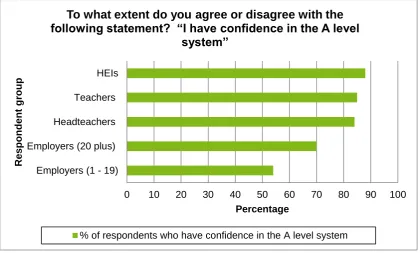
Confidence in the A level system was high among all respondents. Those with direct access to and/or experience of the qualification, such as teachers, headteachers, students and higher education institutions, had more confidence in the qualification than other respondents.
Teachers, headteachers, respondents from higher education institutions and
Figure 1: Confidence in the A level system by respondent group
Note 1: The above figures do not include data collected from the general public, parents and students who were asked about their confidence in a different way.
Note 2: The above data was drawn from three separate surveys and illustrates the percentages of responses obtained by using different sampling strategies and research methods.
Effective base: 170 headteachers and 498 teachers, in England (Nov 2012 – Jan 2013); 32 smaller employers; 217 larger employers; and 170 higher education institutions in England (Nov 2012- Feb 2013).
Respondents’ perception of the A level system compared to last year were explored to track any changes in their perceptions over time.5 Results suggest that self-reported confidence in the A level system has remained high and relatively static among teachers, headteachers, higher education institutions and parents. By contrast, levels of confidence have increased among students and decreased
among employers.
5
Responses from teachers, headteachers, employers, and higher education institutions were obtained by asking the following question: “Compared to last year, would you say that currently you have more confidence in the GCSE system, less confidence in the GCSE system or about the same level of confidence?” Data from the general public, parents and students was collected by asking: “To what extent do you agree or disagree with the statement: ‘I have more confidence in the A level system now than I did a few years ago.’?”
0 10 20 30 40 50 60 70 80 90 100
Employers (1 - 19) Employers (20 plus)
Headteachers Teachers HEIs
Percentage
Respo
n
d
ent
g
ro
u
p
To what extent do you agree or disagree with the following statement? “I have confidence in the A level
system”
From 2003, when this programme of research began, to 2011, there was a steady increase in A level teachers’ confidence in the A level system. This year, most teachers (79 per cent) said that their confidence was the same as a year earlier. Similarly, 77 per cent of headteachers said they had about the same level of confidence in the A level system than they had in the previous year6. However, 19 per cent of headteachers and 15 per cent of teachers had less confidence than last year and only a few felt more confident (1 per cent and 3 per cent respectively).
The majority of respondents from the general public, higher education institutions and parents reported having the same confidence in the A level system as last year. Confidence was higher only among students who reported an increase in their confidence in the A level system (43 per cent) compared to 11 per cent who felt less confident.
On the other hand, the biggest loss of confidence was among smaller employers: 30 per cent of respondents mentioned having less confidence and 66 per cent felt the same as last year. This loss of confidence was not shared to the same degree by larger employers; only 12 per cent stated having less confidence. Still, neither of these groups reported an increase in trust in the qualification.
For teachers, headteachers and students, employers and the general public, the greatest area of concern was incorrect marking and/or grading of A levels. For higher education institutions, the top concern was too many resits.
Most respondents -with the exception of teachers and headteachers-had more confidence in the A level system and had no concerns about it. Despite this, the results showed that respondents with direct access to and experience of the A level qualification, namely teachers, headteachers and representatives from higher education institutions, had more concerns than other groups7.
6
Headteachers were included in this study in 2012 for the first time; therefore, comparisons with
previous waves of research are not possible.
7
Of respondents from higher education institutions, headteachers and teachers, 37 per cent, 40 per
cent and 47 per cent respectively, reported having no concerns about the system. Half of the general
public and smaller employers (50 per cent) had no concerns, followed by parents, students and larger
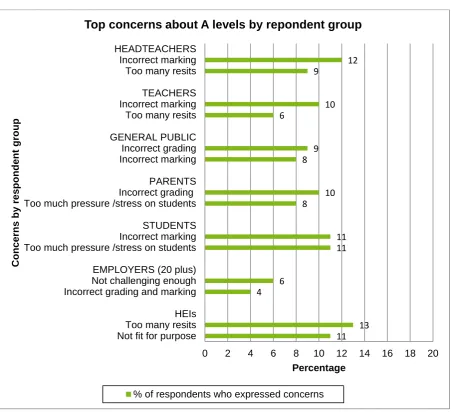
By contrast, about 36 per cent of the general public, parents and students and more than half of headteachers and teachers expressed some concerns8. No single concern was pre-eminent among respondents, although “incorrect grading” or “incorrect marking of exam papers” were the most-reported concerns by all respondent groups (see Figure 2).
For teachers and headteachers, their greatest areas of concern were “incorrect marking” and “too many resits” (identified by at least 10 per cent). The general public mentioned “incorrect grading” (9 per cent) and “incorrect marking” (8 per cent) as their top areas of concern. Parents cited “incorrect grading” (10 per cent) and “too much pressure/stress on students” (8 per cent); similarly students cited “incorrect marking” (11 per cent) and “too much pressure/stress” (11 per cent). For larger employers, the top concerns were “A levels not being challenging enough” (6 per cent) and “incorrect grading and marking” (4 per cent). For higher education
institutions, the top concerns cited were “too many resits” (13 per cent) and “A levels not being appropriate preparation for students for either university or working life” (11 per cent). Figure 2 below, illustrates the main concerns around A levels, raised by respondents at the time of the interviews.
8
Percentage of respondents who mentioned concerns about A levels were: 34 per cent of students,
35 per cent of large employers, 36 per cent general public, 39 per cent of parents, 58 per cent of
Figure 2: Top concerns about A levels by respondent group (unprompted)
Note 1: This chart has been prepared to indicate the top issues of concern to all respondents; all other issues have been excluded.
Note 2: The above data was drawn from four surveys and illustrates the percentages of responses obtained by using different sampling strategies and research methods.
Note 3: Data for smaller employers has not been included given low base sizes.
Effective base: 170 headteachers and 498 teachers; 2,563 members of the general public; 221
students taking or intending to take A levels, GCSEs or other academic qualifications; and 367 parents of students taking or intending to take A levels, GCSEs or other academic qualifications in England (Nov 2012 – Jan 2013); 217 larger employers; 170 higher education institutions in England (Nov 2012-Feb 2013). 11 13 4 6 11 11 8 10 8 9 6 10 9 12
0 2 4 6 8 10 12 14 16 18 20
Not fit for purpose Too many resits HEIs Incorrect grading and marking Not challenging enough EMPLOYERS (20 plus) Too much pressure /stress on students Incorrect marking STUDENTS Too much pressure /stress on students Incorrect grading
PARENTS Incorrect marking Incorrect grading GENERAL PUBLIC Too many resits Incorrect marking TEACHERS Too many resits Incorrect marking HEADTEACHERS Percentage Co n ce rn s b y r es p o n d ent g ro u p
Top concerns about A levels by repondent group
Despite these concerns, the proportion of respondents who thought that A levels are an important qualification for people to obtain remained high9. Most respondents agreed that it is more important now than ever to obtain a high-level qualification such as an A level, with teachers and headteachers reporting the highest levels of agreement (85 and 91 per cent, respectively).
By contrast, 72 per cent of the general public felt the A level is an important
qualification and 64 per cent agreed with the statement that it is now more important than ever for students to obtain such a qualification. Respondents from the Russell Group of higher education institutions reported the highest levels of agreement with these propositions (92 per cent – 25 respondents).
Views on the importance of obtaining a high-level qualification varied between
employers of different sizes. Among those employers with fewer than 20 employees, 22 per cent (14 respondents) disagreed with the statement “it is more important now than ever to obtain a high-level qualification such as an A level”. These figures decreased as the size of employer increased.
Perceptions of A level marking affect overall confidence in the system for the teaching profession but have no impact on levels of confidence
reported by employers.
Findings suggest a relationship between perceptions of accuracy of marking and confidence in the A level system. Headteachers or teachers who reported lower levels of confidence in the accuracy of A level marking were less likely to have confidence in the A level system.
Unlike teachers and headteachers, perceptions of the accuracy of marking were not indicators of confidence for employers. Eighty seven per cent of larger employers tended to have confidence in the qualification despite incorrect marking being the highest reason why they felt students do not obtain the right grade (22 per cent). Smaller employers reported less confidence than larger employers (57 per cent) and also, interestingly, mentioned “individual student behaviour” as the main reason why students do not obtain the right grade (26 per cent). It is worth noting that between 20 to 30 per cent of employers did not feel able to give a view when asked questions regarding the accuracy of marking of A levels.
9 All respondents were asked to specify if they thought the “
Most respondents agreed that the A* grade should help universities to select the top students; however, only 66 per cent of higher education institutions found the A* grade useful when making decisions about particular students.
Respondents to the survey were asked the extent to which they agreed with the statement “The A* grade at A level should help universities identify top students.”
The majority of teachers and headteachers and higher education institutions
considered this to be the case (86, 83 and 82 per cent, respectively). For members of the general public, parents and students, 66 per cent, 69 per cent and 76 per cent respectively agreed with the statement that the A* grade in A levels should help universities to identify the top students.
Overall 82 per cent of respondents from higher education institutions agreed with this statement. A higher percentage of respondents from institutions that would be
expected to make greater use of the A* grade, namely the Russell Group and Old Institutions, reported the highest rates of agreement (96 and 95 per cent -26 and 31-respondents, respectively). This figure decreased to 75 per cent of “New” and “Other Higher Education Institutions” (52 and 39 respondents respectively)10
.
However, despite 80 per cent of respondents from higher education institutions stating that A levels are a good indicator of the overall ability of a student, only 63 per cent found the A* grade useful in making decisions about particular students11.
Employers were not asked to comment on their perceptions of the A* grade.
10
For the purposes of banding Higher Education Institutions together at sampling and analysis
stages, these have been segmented under the traditional headings of:
Russell Group: an association of 24 British public research universities established in 1994 to
represent its members' interests, which include collaborative working amongst its members;
leading in academic research; and attracting the most able staff and students. Other Old (pre-1992): institutions that were classified as universities before 1992.
New (1992 onwards): institutions offering higher education courses, which were given
university status in 1992 (formerly known as polytechnics).
Other Higher Education Institutions: institutions offering higher education courses that are
not formally recognised as universities. 11
For employers and higher education institutions, levels of motivation and the attitude (for the role or place for which they are being recruited) are more important than the qualifications attained by prospective
candidates.
Forty per cent of respondents from larger employers and 47 per cent from smaller employers reported that candidates’ general attitude to work and overall enthusiasm are the most important factors when recruiting for a particular role. For businesses with more than 20 employees, the next most important factors were: the previous experience of the candidate (35 per cent), candidates’ non-specified academic qualifications (26 per cent) and personality (25 per cent). GCSEs were specifically mentioned by 18 per cent of respondents from larger companies, and A levels were mentioned by just 7 per cent.
For businesses with fewer than 20 employees the most important factors after
general attitude to work and overall enthusiasm included: the candidates’ personality (40 per cent, 24 respondents), their technical skills (28 per cent – 17 respondents) and appearance (23 per cent – 14 respondents). GCSEs and A levels were not included in the top ten factors considered by smaller employers when recruiting a school leaver. (GCSEs were specifically mentioned by 10 per cent of respondents (6) from smaller companies, and A levels were mentioned by just 2 per cent – 1
respondent.)
For higher education institutions, the top three responses were: their personal statement, their general attitude and motivation for studying and their academic attainment (39, 31 and 26 per cent, respectively). A levels and GCSEs were ranked in fourth and sixth place of importance below the above mentioned factors. Higher education institutions tended to be more interested in the candidates’ overall performance at GCSE and A level rather than having studied a particular subject.
Perceptions of GCSEs
As was the case with A levels, all respondents were asked a range of questions about their perceptions of the GCSE system including: confidence in the system and their views on specific aspects such as accuracy of marking.
As mentioned before, when interpreting these it is important to bear in mind the context in which the research took place. All surveys were completed at a time when Ofqual was the subject of a Judicial Review brought in relation to the awarding of GCSE English qualifications in August 2012. Therefore, Ofqual anticipated the findings might reflect these events.
per cent). Despite this, most respondents still consider GCSE a good qualification for students to obtain for their future.
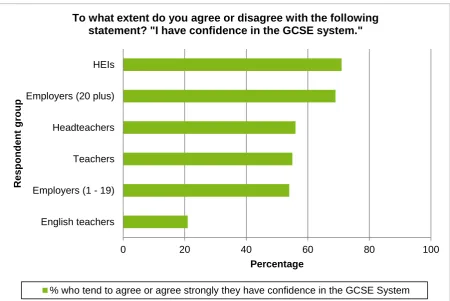
[image:16.595.72.523.218.519.2]Overall, levels of confidence in GCSEs were greater among larger employers and higher education institutions, than for smaller employers, teachers and headteachers. Levels of confidence were particularly low among English teachers. Differences in reported levels of confidence by group of respondents are illustrated in Figure 3.
Figure 3: Confidence in the GCSE system by respondent group
Note 1: The above figure does not include the general public, parents and students who were asked about their confidence in a different way.
Note 2 The above data was drawn from three surveys and illustrates the percentages of responses obtained by using different sampling strategies and research methods.
Effective base: 170 headteachers and 498 teachers in England (Nov 2012 – Jan 2013); 32 smaller employers; 217 larger employers; 170 higher education institutions in England (Nov 2012-Feb 2013).
Low levels of confidence in GCSEs were associated with several factors. For example, teachers who perceived Ofqual as ineffective at regulating the exam system and in maintaining the standards of qualifications were less likely to be confident in the GCSE system, as were those who did not have confidence in the accuracy of GCSE marking. Those who teach English or modern foreign languages were also less confident in GCSEs. These lower levels of confidence among the
0 20 40 60 80 100
English teachers Employers (1 - 19) Teachers Headteachers Employers (20 plus) HEIs
Percentage
Respo
n
d
ent
g
ro
u
p
To what extent do you agree or disagree with the following statement? "I have confidence in the GCSE system."
teaching profession were likely to be influenced by the summer 2012 concerns around the grading of GCSE English; these findings will be discussed later in this summary.
All respondents were asked to express their opinions about changes in levels of trust in GCSE qualifications during the past year. Most respondents mentioned that their confidence in the GCSE system has declined, with the exception of members of the public who reported an increase in confidence.
Sixty per cent of teachers and 80 per cent of headteachers felt less confident
compared to last year. This decline in trust was shared by students and parents (49 and 30 per cent, respectively, reported being confident in the GCSE system in 2012 compared to last year)12. Levels of confidence among the general public were similar to the year before (25 per cent in 2011 compared with 27 per cent in 2012); 74 and 62 per cent of larger and smaller employers, respectively, felt the same as last year.
Despite this apparent decline in confidence, most respondents believe the GCSE is an important qualification. Around 77 per cent of the public, smaller employers and parents consider the GCSE to be an important qualification for people to obtain for their future (75, 77 and 83 per cent, respectively). Agreement among GCSE
students, higher education institutions and larger employers was even higher: 90 per cent of students and 94 per cent of employers and higher education institutions believed this to be the case.
12
Levels of confidence for students and parents were 52 and 35 per cent, respectively, in 2011. As explained in the methodology section of this report, there is no data for 2011 for employers and higher
When prompted, a large proportion of teachers (77 per cent),
headteachers (89 per cent) and higher education institutions (61 per cent) expressed at least one concern about the GCSE system. Incorrect
marking and grading were the main reasons for concern among headteachers, teachers, general public, parents and students.
All respondents were asked if they had any concerns about GCSEs. Eighty nine per cent of headteachers, 77 per cent of teachers and 61 per cent of higher education institutions expressed more reasons for concern about the GCSE system than other groups. By contrast, the majority of employers (59 per cent of larger and 57 per cent of smaller employers), students (68 per cent), parents (46 per cent) and members of the public (51 per cent) had no concerns or could not think of any issues in
connection with GCSE qualifications.
Main reasons for concern varied and reflected the importance that the dissatisfaction around the grading of GCSE English had on this year’s perceptions of the GCSE system among respondents. Incorrect marking, incorrect grading and grade
Figure 4: Top concerns about the GCSE exams system per respondent group (unprompted)
Note 1: This chart has been prepared to indicate the top issues of concern to all respondents; all other issues have been excluded.
Note 2: The above data was drawn from four surveys and illustrates the percentages of responses obtained by using different sampling strategies and research methods.
Note 3: Data for smaller employers has not been included given low base sizes.
10 10 11 13 12 10 16 17 11 12 15 15 16 21
0 5 10 15 20 25
Summer 2012 GCSE issue Individual subject issues HEIs Declining standards Too many changes EMPLOYERS (20 plus) Incorrect marking Incorrect grading STUDENTS Incorrect marking Incorrect grading PARENTS Incorrect marking Incorrect grading GENERAL PUBLIC Grade boundary issues Incorrect grading TEACHERS Grade boundary issues Incorrect marking HEADTEACHERS Percentage Co n ce rn s b y r es p o n d ent g ro u p
Top concerns about GCSE system
Effective base: 170 headteachers and 498 teachers; 2,563 members of the general public; 221
students taking or intending to take A levels, GCSEs or other academic qualifications; and 367 parents of students taking or intending to take A levels, GCSEs or other academic qualifications, in England (Nov 2012 – Jan 2013); 217 larger employers and 170 higher education institutions in England (Nov 2012-Feb 2013).
Respondents were asked to give their opinion on the main factors they believed contribute to students not getting the grades they deserve; a variety of different factors were revealed.
As mentioned before, incorrect marking and grading were the main reasons why most respondents believed GCSE students do not get the grades they deserve. Following in order of importance, the next most mentioned reasons for students not getting the grades they deserve were:
grade boundaries not being properly set (headteachers and teachers);
students inadequately prepared for the exams (general public, parents and
students);
students performing better or worse than expected (for parents);
students inadequately prepared by schools or colleges (all employers);
and
inconsistent teaching quality (higher education institutions).
Confidence in the quality and accuracy of marking of GCSEs is perceived to have declined since last year; lower confidence was prevalent among teachers and headteachers and is consistent with their decline in
confidence in the marking of A level papers.
Teachers, headteachers and respondents from higher education institutions were asked to express their levels of confidence in the marking of GCSE exams. Overall, confidence in the quality and accuracy of marking of GCSEs was greater among higher education institutions (79 per cent). These high levels of confidence were not shared by teachers or headteachers who were significantly less confident in the accuracy of marking of GCSE papers: just 34 per cent of headteachers were confident about the issue compared with 59 per cent of GCSE teachers.
declined over the last year (64 per cent of headteachers, 40 per cent of GCSE teachers and 30 per cent of higher education institutions felt this to be the case). As mentioned above, this pattern of lower (and declining) confidence on the part of headteachers was consistent with their perception of the accuracy of the marking of A level papers. These findings suggest that the lack of trust in the marking of
examinations is widespread among the teaching profession and not only confined to the GCSE exams system.
Teachers who claimed Ofqual is not effective at regulating the exams system, or at maintaining the standards of qualifications, were less likely than teachers generally, to have confidence in the marking of GCSE papers (41 and 40 per cent, respectively, compared with 58 per cent for teachers overall), as were teachers of English and modern foreign languages (37 and 36 per cent, respectively)13. Similarly, teachers of English and languages were more likely to feel that the accuracy of marking of GCSE papers had declined over the past two years (56 and 65 per cent, respectively
compared with 38 per cent of teachers overall). These results suggest that, to an extent, the concerns around the grading of GCSE English last summer had an impact on respondents’ confidence in GCSEs. These findings will be discussed in the last section of this summary.
In the case of higher education institutions, it seems that the concerns around the grading of GCSE English may not have been the sole contributing factor for
respondents to believe that the quality and accuracy of marking had declined in the past couple of years; half of those who said that the concerns over the summer of 2012 had not had any impact on their confidence at all, still felt that the quality and accuracy of the marking of GCSEs had declined since last year.
13
The bases of teachers who teach English and modern foreign languages are 116 and 45
Perceptions of vocational qualifications
Given our role in monitoring qualification standards, it was important for Ofqual to explore public perceptions of vocational, other academic and mixed qualifications14. To this end respondents were asked whether they perceived these qualifications to have the same value as traditional qualifications such as GCSEs and A levels15.
Over half of the general public considered that other academic
qualifications, vocational qualifications and mixed qualifications are of equal value to traditional academic qualifications, such as A levels and GCSEs, although this was not the case among headteachers and
teachers.
A higher proportion of headteachers than teachers believed that other academic qualifications (such as iGCSEs, Pre-U and the International Baccalaureate) are of equal value to traditional qualifications like A levels and GCSEs (54 per cent
compared with 43 per cent). Half of the general public agreed with this (50 per cent) as did rather more parents (57 per cent) and students (64 per cent).
The views of headteachers and teachers were similar regarding whether vocational qualifications are of equal value to traditional qualifications (40 per cent and 38 per cent respectively). This was also the case for mixed qualifications (42 per cent of headteachers and 37 per cent of teachers agreed).
14
Vocational qualifications were defined as qualifications taught in schools and colleges that
prepare students for a particular type of job.
Other academic qualifications include iGCSEs, the International Baccalaureate, the Pre-U and
freestanding maths and are defined as those which are taught in schools and colleges to young people aged 14-19 which are not GCSEs or A levels and include a mainly academic content.
Mixed qualifications include BTECs, OCR Nationals and Principal Learning. They are regarded as
mixed qualifications as they provide a mix of vocational and academic components. Available across a
range of levels they are designed to provide the same degree of difficulty (depending upon level) as,
for example, GCSEs and A levels.
15
It is important to mention that in 2012 the eligibility criteria for parents, students and teachers was
extended to allow students and/or parents of students taking other academic qualifications to
participate in the survey; however, teachers, students or parents of those students teaching or taking
only vocational qualifications have not been included in the survey. Excluding these respondents could
Over half of the general public agreed with this view of vocational and mixed
qualifications (54 per cent and 52 per cent) as did rather more parents (58 per cent and 59 per cent) and students (61 per cent and 62 per cent).
Overall, there seems to be a good understanding of what the “level” of
vocational qualifications means across all groups.
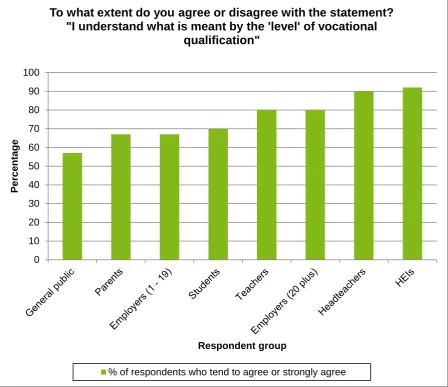
[image:23.595.75.524.300.687.2]Most respondents believed they understood what is meant by “level” of vocational qualification. Ninety per cent of headteachers reported understanding this definition, followed by 92 per cent of higher education institutions. The general public were the least knowledgeable among all respondents (57 per cent). Figure 5 illustrates the differences between all respondent groups.
Figure 5: Respondents’ understanding of the “level” of vocational qualifications
Note 1: The above data was drawn from four surveys and illustrates the percentages of responses obtained by using different sampling strategies and research methods.
0 10 20 30 40 50 60 70 80 90 100
P
er
ce
n
tage
Respondent group
To what extent do you agree or disagree with the statement? "I understand what is meant by the 'level' of vocational
qualification"
Effective base: 170 headteachers and 498 teachers; 2,563 members of the general public; 221
students taking or intending to take A levels, GCSEs or other academic qualifications; and 367 parents of students taking or intending to take A levels, GCSEs or other academic qualifications in England (Nov 2012 – Jan 2013); 32 smaller employers; 217 larger employers; 170 higher education institutions in England (Nov 2012-Feb 2013).
[image:24.595.71.524.284.672.2]Similarly, there was a very good understanding of how the different levels of vocational qualifications relate to GCSEs and A levels, especially with people working in education as illustrated in Figure 6. Smaller employers understood the least about this topic.
Figure 6: Respondents’ understanding of how the different levels of vocational
qualifications relate to GCSEs and A levels
Note 1: The above data was drawn from four surveys and illustrates the percentages of responses obtained by using different sampling strategies and research methods.
Effective base: 170 headteachers and 498 teachers; 2,563 members of the general public; 221 students taking or intending to take A levels, GCSEs or other academic qualifications; and 367 parents
0 10 20 30 40 50 60 70 80 90 100
P
er
ce
n
tage
Respondent group
To what extent do you agree or disagree with the statement? "I understand how the different levels of vocational
qualifications relate to GCSEs and A levels"
of students taking or intending to take A levels, GCSEs or other academic qualifications in England, (Nov 2012 – Jan 2013); 32 smaller employers; 217 larger employers; 170 higher education institutions in England (Nov 2012-Feb 2013).
Perceptions of Ofqual as a regulator
Ofqual wanted to find out whether people were aware of the organisation and their opinion about Ofqual’s performance as the regulator of qualifications. To this end, respondents were asked an unprompted question of what they knew about Ofqual. Then they were given a short explanation of Ofqual and its role, and asked again what they knew about it16. Overall, results showed that awareness of Ofqual is growing slowly. In addition, the impact, if any, of the GCSE English concerns in respondents’ opinions of the regulator was explored; these findings are discussed later in this section.
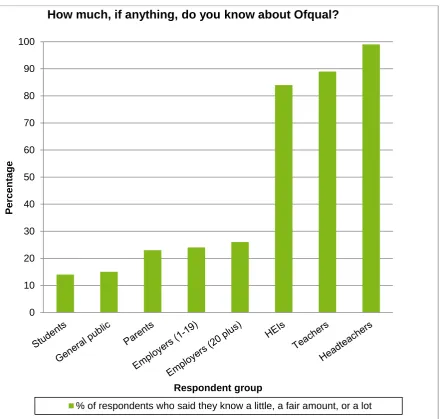
Awareness of the regulator is growing slowly among respondents in general; however, familiarity is lower among the general public and employers.
There was a high level of unprompted awareness of Ofqual among teachers, headteachers and admission tutors at higher education institutions. These
respondents arguably need a higher degree of knowledge of qualifications and the exams system in order to perform their job and, therefore, were more aware of our function and more likely to have an opinion of our performance.
Unprompted awareness of Ofqual among teachers improved steadily from 2008 to 2011. In 2012, almost half of all teachers knew “a lot” or “a fair amount” about Ofqual (46 per cent); 8 per cent knew “a lot”. Headteachers’ unprompted awareness of Ofqual was significantly greater than teachers’: 76 per cent of headteachers knew “a lot” or “a fair amount” about it (24 per cent knew “a lot”). Just 10 per cent of teachers had either not heard of Ofqual or had heard of it but knew nothing about it. English teachers were more aware of Ofqual than teachers as a whole (62 per cent knew “a lot” or “a fair amount”).
16
Encouragingly, 99 per cent of respondents from higher education institutions said they had at least heard of us with over 33 per cent saying they knew “a fair amount” or “a lot”. Once prompted, the proportion of respondents saying they were aware of Ofqual’s role was 95 per cent.
Unprompted awareness of Ofqual among parents, students and the general public was lower than teachers and headteachers. Seventy two per cent of students, 69 per cent of the public and 59 per cent of parents reported not knowing about Ofqual. On the other hand, there was a significant increase in prompted awareness of Ofqual. After being read a description of Ofqual’s role, 24 per cent of the general public said that they were aware that Ofqual is the independent regulator of qualifications, examinations and assessments in England, compared with 14 per cent in 2011.
Awareness particularly rose among parents (35 per cent) and students (22 per cent).
Figure 7: Unprompted awareness of Ofqual by respondent group
Note 1: The above data was drawn from four separate surveys and illustrates the percentages of responses obtained by using different sampling strategies and research methods.
Effective base: 170 headteachers and 498 teachers; 2,563 members of the general public; 221
students taking or intending to take A levels, GCSEs or other academic qualifications; and 367 parents of students taking or intending to take A levels, GCSEs or other academic qualifications in England, (Nov 2012 – Jan 2013); 32 smaller employers; 217 larger employers; 170 higher education institutions in England (Nov 2012-Feb 2013).
Employers and higher education institutions were asked specific questions to find out whether they thought that Ofqual’s role is necessary. Overall, there was agreement between these respondents about the importance of having an organisation like Ofqual regulating the exams and qualifications system (at least 90 per cent of larger employers, 74 per cent of smaller employers and 98 per cent of higher education institutions described the role of Ofqual as “very” or “fairly important”).
0 10 20 30 40 50 60 70 80 90 100
P
er
ce
n
tage
Respondent group
How much, if anything, do you know about Ofqual?
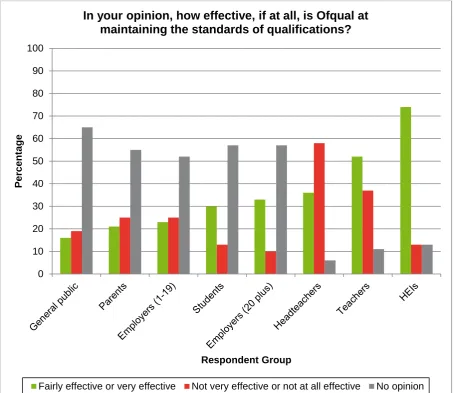
Generally, there was a positive relationship between awareness of Ofqual and perceived effectiveness of the regulator.
Generally, there was a positive relationship between awareness of and perceived effectiveness of the regulator. Respondents who said they knew “a lot” or “a fair amount” about Ofqual were more likely to believe Ofqual is effective at maintaining qualification standards. This finding is consistent with previous results obtained by studies around perceptions of trust conducted by Ofqual, which suggest that
students, teachers and employers are more likely to trust organisations if they have previous experience of them17. The exception to this finding were teachers and
headteachers, who reported to know more about Ofqual but were less inclined to rate the regulator as “effective” or “very effective”.
As illustrated in Figure 8, when asked whether Ofqual is effective at maintaining the standards of qualifications, higher education institutions were the most positive followed by teachers and headteachers. Fifty per cent of the teachers believed Ofqual is effective, whereas only 42 per cent of headteachers thought so. Only 32 per cent of English teachers interviewed believed Ofqual is effective at maintaining standards.
17
He, Q, Opposs, D. and Boyle, A. (2010) A Quantitative Investigation into Public Perceptions of Reliability in Examination Results in England. Ofqual: Coventry, UK. Available online at:
Figure 8: Perceptions of effectiveness of Ofqual at maintaining the standards of qualifications by respondent group
Note 1: The above data was drawn from four separate surveys and illustrates the percentages of responses obtained by using different sampling strategies and research methods.
Effective base: 170 headteachers and 498 teachers; 2,563 members of the general public; 221
students taking or intending to take A levels, GCSEs or other academic qualifications; and 367 parents of students taking or intending to take A levels, GCSEs or other academic qualifications, in England, (Nov 2012 – Jan 2013); 32 smaller employers; 217 larger employers; 170 higher education institutions in England (Nov 2012-Feb 2013).
0 10 20 30 40 50 60 70 80 90 100
P
er
ce
n
tage
Respondent Group
In your opinion, how effective, if at all, is Ofqual at maintaining the standards of qualifications?
The general public, parents, students and small employers, who reported the least awareness of Ofqual, were the least positive about our role with only 16 per cent of the general public, 20 per cent of parents, 30 per cent of students, and 23 per cent of small employers thinking Ofqual is
effective at maintaining standards.
The top reasons, provided by each respondent group, for thinking Ofqual is effective at maintaining standards were actions taken by Ofqual in the past to:
remove some modules and move to a linear structure (teachers and
headteachers);
change the exams system (teachers and headteachers);
make sure standards are comparable (employers and higher education
institutions);
make sure grading and grade boundaries are accurate (employers); and
make sure marking is consistent and reliable (higher education
institutions).
When respondents mentioned they believed Ofqual to be “fairly” or “not at all” effective they were then asked to explain their answer. The top reasons why respondents thought Ofqual is not effective at maintaining qualification standards were:
problems surrounding the awarding of GCSE English in summer 2012
(teachers, especially headteachers, employers, and higher education institutions);
inconsistent grading (teachers);
inconsistent marking (teachers and higher education institutions);
changes to GCSE (teachers);
grade inflation (employers); and
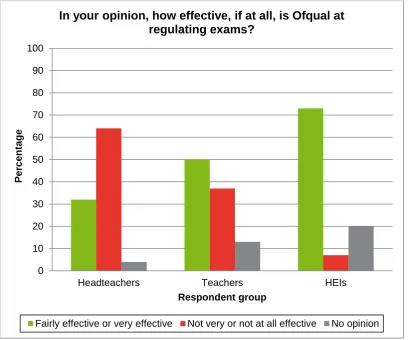
In this survey, teachers’, headteachers’ and higher education institutions’ perceptions of Ofqual’s effectiveness at regulating the exams system were also explored18
. There were mixed views about this topic, with higher education institutions and teachers being more positive than headteachers. Half of the teachers felt Ofqual is effective at regulating the exams system, but more than 50 per cent of headteachers thought Ofqual is not effective.
[image:31.595.71.480.301.641.2]As shown in Figure 9, below, almost 75 per cent of higher education institutions felt that Ofqual is effective at regulating the exams system. Of those higher education institutions that were aware of the GCSE concerns last summer only 7 per cent (13 respondents) thought Ofqual is not effective.
Figure 9: Perceptions of Ofqual’s effectiveness in regulating the exams system by
respondent group
18
The general public, parents, students and employers were not asked to comment on their perceptions of how effective Ofqual is at regulating the exams system; instead they were asked to comment on how effective Ofqual is at maintaining standards, they
0 10 20 30 40 50 60 70 80 90 100
Headteachers Teachers HEIs
P
er
ce
n
tage
Respondent group
In your opinion, how effective, if at all, is Ofqual at regulating exams?
Note 1: The above data was drawn from two separate surveys and illustrates the percentages of responses obtained by using different sampling strategies and research methods.
Effective base: 170 headteachers and 498 teachers, in England, from Ipsos MORI for Ofqual (Nov 2012 – Jan 2013); 170 higher education institutions in England (Nov 2012 -- Feb 2013).
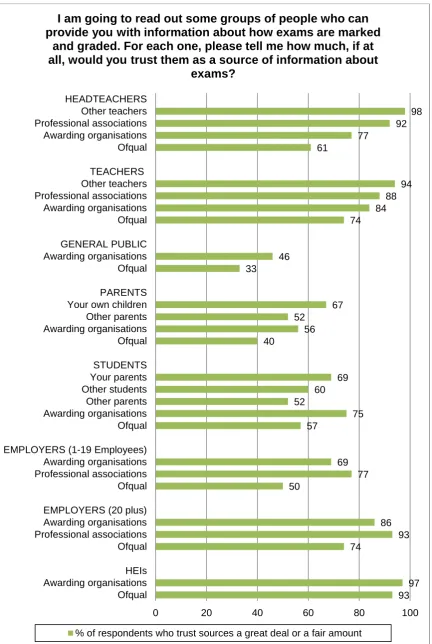
Generally, peer groups and awarding organisation are the most trusted sources of information about exams.
People were asked who they would trust as a source of information about how exams are marked and graded. Respondents were given a list of groups or
institutions that could provide this information such as awarding organisations, the media and so on. Figure 10 illustrates how Ofqual lags behind peer groups19 and awarding organisations when it comes to being a trusted source of information about exams. This seems to suggest that, when it comes to trust, respondents tend to rely more on their immediate circle of acquaintances rather than
organisations/institutions. This finding is supported by existing evidence, which suggests that students, teachers and employers are likely to trust organisations if they had previous experience of them, as discussed previously. On the other hand, the media was the least trusted source of information about exams for all groups.
Teachers and headteachers who did not trust Ofqual as a source of information about exams gave the same three main reasons why they felt Ofqual is not a trusted source of information in their view:
the summer 2012 concerns around grades on English GCSE;
Ofqual is not independent from the Government, and
general issues concerning grading or grade boundaries.
19 “
Peer group” means that teachers trusted other teachers as well as professional associations; students trusted their parents and other students; parents trusted other parents and their children;
Figure 10: Trusted sources of information about exams by respondent group 93 97 74 93 86 50 77 69 57 75 52 60 69 40 56 52 67 33 46 74 84 88 94 61 77 92 98
0 20 40 60 80 100
Ofqual Awarding organisations HEIs Ofqual Professional associations Awarding organisations EMPLOYERS (20 plus) Ofqual Professional associations Awarding organisations EMPLOYERS (1-19 Employees) Ofqual Awarding organisations Other parents Other students Your parents STUDENTS Ofqual Awarding organisations Other parents Your own children PARENTS Ofqual Awarding organisations GENERAL PUBLIC Ofqual Awarding organisations Professional associations Other teachers TEACHERS Ofqual Awarding organisations Professional associations Other teachers HEADTEACHERS
I am going to read out some groups of people who can provide you with information about how exams are marked
and graded. For each one, please tell me how much, if at all, would you trust them as a source of information about
exams?
Note 1: The above data was drawn from four separate surveys and illustrates the percentages of responses obtained by using different sampling strategies and research methods.
Effective base: 170 headteachers and 498 teachers, 2,563 members of the general public, 221 students taking or intending to take A levels, GCSEs or other academic qualifications; and 367 parents of students taking or intending to take A levels, GCSEs or other academic qualifications in England, (Nov 2012 – Jan 2013), 32 smaller employers, 217 larger employers, 170 higher education institutions in England (Nov 2012-Feb 2013).
Students and parents were also asked, unprompted, which organisations they would contact if they had concerns about their/their children’s exam grades. These results are summarised in Figure 11. Students and parents are most likely to contact their schools/teachers and awarding organisations. Forty one per cent of parents and 44 per cent of students would contact Ofqual.
Around 33 per cent of people would try to contact the now closed Qualifications and Curriculum Development Agency (QCDA). The Government and MPs are the least likely to be contacted. The fact that awareness rose across all four groups when prompted and that a significant number of parents and students listed QCDA as an organisation they would contact indicates that the ever-changing roles and
Figure 11: Organisations students/parents would be likely to contact with concerns about the exam system by respondent group
Effective base: 221 students taking or intending to take A levels, GCSEs or other academic qualifications; and 367 parents of students taking or intending to take A levels, GCSEs or other academic qualifications, in England (Nov 2012 – Jan 2013)
Results suggest that, at least to some extent, confidence in GCSEs has been affected by the concerns raised around the summer 2012 grading of GCSE English. However, the impact of these concerns was higher among the teaching profession than for any other group.
Ofqual’s objectives include maintaining the standards of, and confidence in, the qualifications system. To this end, it was important to determine and isolate the impact of the concerns around the grading of summer 2012 GCSE English on the overall perceptions of and confidence in GCSEs. At the end of the survey, to avoid any effect on respondents’ perceptions of other issues, two questions were asked as follows:
The GCSE results were published in August 2012. Ofqual carried out an initial inquiry after receiving complaints from some schools and colleges about their students not getting the GCSE English grades they expected. The initial inquiry
0 10 20 30 40 50 60 70 80 90 100
Your MP The government Qualifications and Curriculum Development Agency (QCDA) Ofqual Awarding organisations Schools /teachers
If you had a concern about examination grades you [your son/daughter] had received, how likely would you be to contact each of the following? (%very/fairly likely)
found the exams students took in June were properly graded. However, students are able to take their GCSE English exam again if they want to in November this year.
Before today, had you heard about this incident around GCSE results? (yes, no); If yes, then:
To what extent, if at all, has your confidence in GCSE exams been affected by this incident? (a lot, a fair amount, not at all, don’t know)
Awareness of these concerns around the grading of GCSE English was high among all respondents. Unsurprisingly, knowledge was widespread among headteachers, teachers and higher education institutions but lower among the general public. All headteachers and teachers and 98 per cent of higher education institutions were aware of these concerns, followed by employers (80 per cent) parents (79 per cent) students (67 per cent) and members of the public (64 per cent).
Results suggest the concerns around the grading of GCSE English had some impact on respondents’ overall perceptions of, and confidence in, the GCSE system.
Figure 12: Impact of the concerns around grading of GCSE English in respondents’
confidence in the GCSE exams system by respondent group
Note 1: The above data was drawn from four separate surveys and illustrates the percentages of responses obtained by using different sampling strategies and research methods.
Note 2: The difference between the total shown and 100 is made up of people who either “neither agreed nor disagreed” with the statements or “did not know”.
Effective base: 170 headteachers and 498 teachers; 2,563 members of the general public; 221 students taking or intending to take A levels, GCSEs or other academic qualifications; and 367 parents of students taking or intending to take A levels, GCSEs or other academic qualifications in England, (Nov 2012 – Jan 2013); 32 smaller employers; 217 larger employers; 170 higher education institutions in England (Nov 2012 - Feb 2013).
All headteachers and teachers were aware of the controversy and it had a
significant impact on their confidence in GCSE exams; as illustrated in Figure 12, 92 per cent of headteachers and 86 per cent of teachers reported that their confidence had been affected by at least “a little”. Those who taught GCSEs were more likely to say that their confidence in the GCSE system had been affected “a lot” or a “fair amount” (67 per cent compared with 52 per cent of non-GCSE teachers). English
60 42 20 15 13 13 12 9 21 22 24 25 15 16 26 20 11 22 32 32 32 30 39 42 7 14 22 23 36 41 23 27
0 20 40 60 80 100
Headteachers Teachers Parents General public Employers (1-19) Employers (20 plus) HEIs Students
Percentage of respondents
Respo n d ent g ro u p
To what extent, if at all, has your confidence in GCSE exams been affected by concerns around the grading of GCSE English?
teachers’ confidence was particularly affected: 94 per cent reported being affected “a lot” or “a fair amount” by the controversy.
Overall, the public’s, parents’ and students’ confidence in GCSE exams was influenced by the concerns around the grading of GCSE English, but much less than teachers’ confidence. The findings from this survey suggest a relationship between reported levels of confidence in the GCSE system and the perceived impact of the GCSE controversy, although it cannot be said there is a causal relationship. For example, those members of the public, parents and students who were more confident in the GCSE system than they had been a year ago were less likely to be affected by these concerns: 34 per cent reported that they had been affected “a lot” or “a fair amount” by the controversy (compared with 56 per cent of people who had less confidence in the system).
On the other hand, awareness of the concerns around the grading of GCSE English seemed to have had an impact on some employers’ and higher education
institutions’ perceptions generally. Larger employers’ confidence in GCSEs, for example, was lower amongst those who were aware of the controversy (65 per cent) than those who were not (81 per cent). Higher education institution respondents whose confidence was most strongly affected, reported lower levels of confidence in the way in which GCSE exams were marked (66 per cent) and in the system overall (52 per cent).
Moreover, for employers, the findings suggest the controversy had a negative impact on the perceived reliability of GCSE exams as tools by which candidates can be fairly compared against each other. Those employers who were aware of the concerns around the grading of GCSE English were less likely to agree that GCSEs provide a reliable measure by which candidates can be fairly compared, than those who were not aware of these concerns (in the case of larger employers, 64 per cent versus 76 per cent). However, results indicate that the controversy did not appear to affect the percentage of employers agreeing that “GCSEs provide a reliable measure about a candidate’s suitability for employment”, or employers’ perceptions of the accuracy and quality of marking of GCSEs.
Finally, in the case of higher education institutions, results suggest that the
concerns around the grading of GCSE English had an impact on respondents’ overall confidence in GCSEs. For example, those respondents who said that their
grading of GCSE English did not appear to have any effect on higher education institutions’ use of GCSE qualifications to scrutinise candidates.
Methodology
Wave 11 of the Ofqual perception survey was conducted as four different research projects, each one corresponding to different audiences of interest to Ofqual:
Teachers and headteachers survey: As in previous years, Ipsos MORI completed the general public element of the research. They also conducted telephone interviews with 600 teachers of GCSE, A level and other academic qualifications for 14-19 year olds. These respondents were selected from a sample of schools and colleges across England and included 402 A level teachers and 506 GCSE teachers. In addition, 203 headteachers were interviewed for the first time as part of this survey. The sample was
representative by school type, school size and geographical location; fieldwork was conducted in November and December 2012.
Members of the public, parents and students omnibus survey: Face-to-face interviews were conducted by Ipsos MORI in England with 3,213 members of the general public, including 254 GCSE, A level or other academic
qualifications students, and 416 parents of such students20. As in previous waves, a face-to-face omnibus survey (known as ‘Capibus’) was used to interview all three audiences, with “booster” waves used for parents and students. These interviews were completed between November 2012 and January 2013.
Employers survey: 500 telephone interviews were conducted by Opinion Leader with businesses in England. Specifically, we interviewed members of
20 As part of this study, “Students” were defined as: “those aged 15 to 19 who are studying/have
studied/will study A levels and/or GCSEs and/or another academic qualification”. Those studying vocational qualifications, including mixed qualifications such as OCR Nationals and BTECs, were not
eligible to take part unless they are also studying one of the eligible academic qualifications, since we
wanted respondents to be able to express their opinions and compare academic and vocational
qualifications based on their experiences. This is different from past waves of the survey when
students were only eligible if they studied GCSEs and/or A levels at the time of the interviews.
Similarly, we considered “Parents/carers” those respondents who were legally responsible for students who are taking or have just taken A levels, GCSEs and/or other academic qualifications (as outlined
above) at the time of the interviews. As with students, this represents a change from the approach
taken in previous waves where only parents of students taking A levels and/or GCSEs were eligible to
staff who were able to answer questions about recruitment at their organisation. In smaller organisations (1-19 employees) this person was often the managing director or owner of the company, while in larger businesses (20 employees or more) the person undertaking the interview tended to be someone working in the Human Resources Department. Interviews were completed between November 2012 and February 2013.
Higher Education Institutions survey: 182 telephone interviews were
completed by Opinion Leader with the members of staff responsible for making decisions on which school leavers were offered a place at their institution. This sample was representative of the population in terms of “type of institution” and “department subject area”21
. At the time of designing the approach to the survey the interviews were exclusively due to be undertaken with departmental heads of admission. However, due to difficulties with contacting these individuals, many interviews were conducted with members of staff working in centralised admission offices. As for the employers’ survey, fieldwork for this project was completed between November 2012 and February 2013 and included higher education institutions in England only.
Details on the different methodologies applied in each survey have been included in the Methodology and Technical Appendices prepared by Ipsos MORI and Opinion Leader.
21 First, the “type” of higher education institution was considered in terms of four classifications:
“Russell Group institutions”, “Other old (pre 1992) institutions”, “New (post 1992) institutions”, “Other higher education institutions”. Second to be considered was the “general subject area” of the
interviewees’ department, with subject areas being divided into five general areas: life sciences and medicine; natural sciences; engineering and technology; social sciences; and arts and humanities.
For the purposes of banding Higher Education Institutions together at sampling and analysis stages,
these have been segmented under the traditional headings of:
Russell Group: an association of 24 British public research universities established in 1994 to represent its members' interests, which include collaborative working amongst its members;
leading in academic research; and attracting the most able staff and students. Other Old (pre-1992): institutions that were classified as universities before 1992. New (1992 onwards): institutions offering higher education courses, which were given
university status in 1992 (formerly known as polytechnics).
Interpretation of the data
The emphasis in previous waves has been to maintain consistency with previous years’ surveys to allow trends to be considered. However, in Wave 11 we updated the sampling behind the survey to provide an appropriate level of confidence in the results. This means that results from this year are not comparable with earlier surveys. Wave 11 was also designed to expand the scope of this project to capture the views of headteachers, employers and higher education institutions. Several new questions were included to explore perceptions of other academic and vocational qualifications. Hence, when interpreting this year’s results, it is important to bear in mind the following caveats:
Comparability between different waves – the general public, parents,
students and teachers surveys: For this wave of research changes were made to the existing questions and sampling methodologies to increase the reliability of the findings.
For example, for the teacher survey, data from previous years has not been included in our reports as the datasets are not comparable because of different sampling approaches taken in 2011 and 2012. In 2011, teachers had to teach A levels or GCSEs to be eligible. However, in 2012, the eligibility criteria were extended to allow teachers of other academic qualifications to participate in the survey, regardless of whether they also taught A levels or GCSEs.
Similarly, in the case of the students and parents samples, this year’s results are not directly comparable with those from previous surveys. In 2011, to be eligible to participate in the survey, parents needed to have children who have studied or were studying A levels or GCSEs; students were only considered if taking those particular qualifications at the time of the interviews. However, in 2012, the eligibility criteria were extended to allow students and/or parents of students taking other academic qualifications to participate in the survey, regardless of whether they also studied A levels or GCSEs. For these reasons, comparisons with previous years’ data have not been included in any report published as part of Wave 11 research of the perceptions survey.