Capability for Infrastructure Asset Capacity Management
1Dr Eric G. Too
Abstract
Infrastructure capacity management is the process of ensuring optimal provision of infrastructure assets to support business operations. Effectiveness in this process will enable infrastructure asset owners and its stakeholders to receive full value on their investment. Management research has shown that an organisation can only achieve business value when it has the right capabilities. This paradigm can also be applied to infrastructure capacity management. With competing needs for limited organisation resources, the challenge for infrastructure organisations is to identify and invest their limited resources to develop the right capabilities in the management of their infrastructure capacity. Using a multiple case study approach, the challenges faced in the management of infrastructure asset capacity and the approaches that can be adopted to overcome these challenges were explored. Conceptualising the approaches adopted by the case participants, the findings suggest that infrastructure organisations must strengthen their stakeholder connectivity capability in order to effectively manage the capacity of their infrastructure assets.
Keywords:
Infrastructure, asset management, capacity management, capability, supply chain
1
This is the Author’s final accepted pre-publication version of Too, Eric G. (2011) Capability for infrastructure asset capacity management. International Journal of Strategic Property Management, 15 (2). pp. 139-151. ISSN
1. Introduction
World-class infrastructure plays a vital role in encouraging a more productive and competitive national economy (Hardwicke, 2005). However, building and operating infrastructure assets consume a large amount of resources (van der Mandele et al., 2006). The provision and development of infrastructure assets typically require long lead times, significant planning and the involvement of many stakeholders to ensure that needs are prioritised within funding constraints. Under these circumstances, the management of infrastructure assets become a great challenge.
The role of infrastructure asset management is to achieve organisational long term goals and effectiveness through dynamic alignment of the required infrastructure assets to meet changing customer needs (Too et al., 2006). This represents the optimum balance of stakeholders’ aspirations, needs and requirements, and the costs over the life of the asset (Bourke et al., 2005). The first step in infrastructure asset management is to identify opportunities to increase both the effectiveness and value of an infrastructure asset. This process takes on the corporate strategies developed by the asset owner and considers what assets are needed to deliver these outcomes for the business. The impact of business trends and goals are evaluated and translated into a need to increase and/or decrease infrastructure assets.
It is therefore necessary for asset managers to consider the gap between the performance and capacity of the existing assets and those required for delivering the minimum services needed by the business in the area of growth. Wherever possible, the ultimate aim should be a high utilisation of assets. It is also necessary to manage and negate the possibility of capacity failure (i.e., when demand for infrastructure assets exceeds capacity) or the underutilisation of any infrastructure asset (i.e., when there is a lack of demand for the service the infrastructure asset provides) (Maunsell & Opus, 2004). Infrastructure capacity management is the process of identifying the direction that will contribute to the best utilisation of assets in the delivery of services to the customers. Through this process, compatibility between current asset portfolios and the changing operational environment surrounding the organisation can be ensured.
2. Supply Chain Capabilities for infrastructure organisations
All organisations including infrastructure organisations must create value to justify their existence. They need to create value better than rivals can; and to contribute to the society in ways that are unique and indispensable. In other words, an organisation has to create, exploit, and sustain its competitive advantages vis-a-vis rivals and it has to do so consistently if it wants to sustain this advantage. This can only be realised either when an organisation gains an advantageous position in an industry or when it mobilises and deploys core capabilities (Prahalad & Hamel, 1990; Wernerfelt, 1984) that enable it to offer superior products to customers relative to its competitors (Lado et al., 1997).
Deregulation and privatisation of infrastructure provision in recent years has no doubt brought new challenges to infrastructure organisations. For example, the Queensland Government (2009) in their latest budget 2009-2010 will undertake a staged program of strategic infrastructure asset sales to restructure the State’s infrastructure asset portfolio. This program will change the structure and environment of the business dynamic. In times of rapid change and high uncertainty such as those experienced by these infrastructure organisations, Ma (2000) suggests that kinetic advantages, whichare often knowledge-based and capability-based (Juga, 1999; Kay, 1999), will more likely to produce sustainable superior performance. The reason being that competitive advantage is not and will not be static. Over time its competitors will endanger the organisation’s position by either imitating its products or developing substitute products. The organisation has to develop kinetic advantages through the building up of capabilities to sustain its competitive position (Dierickx & Cool, 1989).
of appropriate infrastructure asset to support business direction can influence the competitive success, adaptation, and renewal of organisations.
The need to adopt heterogeneous advantage is supported by literature on new product development where it has argued for the need to constantly developing new products and services to meet changing needs (e.g. Brown & Eisenhardt, 1995). In fact, it has become the nexus of competition to many organisations where it is critical for organisations to diversify, adapt, and even reinvent their organisations to match evolving market and technical conditions (Schoohoven et al., 1990). In markets with ageing infrastructure assets, the need to continuously provide and deliver high-quality infrastructure assets in a timely manner has become paramount. However, rapid advances in technology and global information infrastructure mean that infrastructure organisation and their supply chain partners must possess appropriate, competitive inter-organisational knowledge and information if they are to maintain the ability to respond quickly and effectively to changing customer needs and expectations. Consequently, the business community has recognised the need to manage the supply chain as part of broader business strategies. In fact, many organisations are using strategic collaboration as a means to, for instance enter new markets, share development costs, increase their marketing reach, and provide complete solutions to the customer (Heimeriks & Duysters, 2007).
Hsu et. al (2008) defines supply chain management as the integration of key business processes, from original supplier to end-user, to provide products, services and information. Hence, supply chain strategies focus on improvement and innovation of end-to-end processes between organisation and their customers and suppliers (Lee, 2000; Tyndall et al., 1998). An upstream supply chain member that provides greater knowledge transfer to its downstream supply chain will develop downstream capabilities such that the downstream operations will be more productive.
3. Research Method
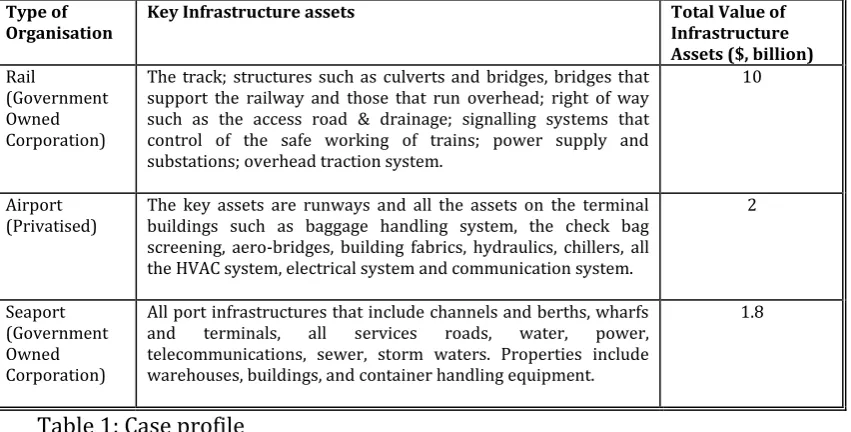
This study used a multiple case design that allows a replication logic i.e., a numbers of cases is treated as a series of experiments, each case serving to confirm or disconfirm the inferences drawn from the others (Yin, 2003). To build a better theory through multiple cases, the choice of cases used in this study are based less on uniqueness of a given case, and more on the contribution to theory development within the set of cases (Eisenhardt, 2007). For this reason, theoretical sampling approach based on a typology of cases is used. For organisations that manage infrastructure assets, the typology are (1) Infrastructure types (namely, airport, seaport, rail) (2) Level of privatisation (government owned corporation, government owned department, full privatisation) (3) Spread of infrastructure (co-located or spread over large geographical areas). Three cases based on this typology were selected and they are summarised in Table 1.
Type of
Organisation Key Infrastructure assets Total Value of Infrastructure Assets ($, billion)
Rail
(Government Owned Corporation)
The track; structures such as culverts and bridges, bridges that support the railway and those that run overhead; right of way such as the access road & drainage; signalling systems that control of the safe working of trains; power supply and substations; overhead traction system.
10
Airport
(Privatised) The key assets are runways and all the assets on the terminal buildings such as baggage handling system, the check bag screening, aero-bridges, building fabrics, hydraulics, chillers, all the HVAC system, electrical system and communication system.
2
Seaport (Government Owned Corporation)
All port infrastructures that include channels and berths, wharfs and terminals, all services roads, water, power, telecommunications, sewer, storm waters. Properties include warehouses, buildings, and container handling equipment.
[image:5.595.75.501.278.494.2]1.8
Table 1: Case profile
The interview data was supported, cross checked and compared with data from a broad range of sources. Many of these documents are available in the case organisations’ website. In addition, some of these organisations have provided access to their internal library that contained collections of many internal documents and reports. All these documents were reviewed to corroborate and augment the evidence gathered from interviews.
A two-stage analysis suggested by Eisendhardt (2002) is adopted for this study; namely (1) Within-Case Analysis and (2) Cross-Case Analysis. Within-Case analysis is conducted initially by coding, to sort answers according to different components such as importance of the process, the challenges faced, and approaches adopted in the management of capacity. From the broad-based nodes, further coding involved recording the repeating ideas by grouping together related passages. These repeating ideas were organised into some initial themes such as the need for updated information, be connected with stakeholders, working with each other, etc. This further coding gave rise to preliminary themes associated with capability for the capacity management process.
After the within case analysis for each case is done, the cross case analysis is next performed. The emerging ideas and concepts from each case were compared to identify common themes and initial propositions. The preliminary findings from the data analysis were compiled into a preliminary report to seek further validation. The report was sent to senior managers of the case organisation for feedbacks and comments. Further meetings were arranged to discuss the findings face-to-face. This feedback was incorporated to refine the findings.
4. Case Study Findings
For the case organisations, capacity management is the process to establish the quality and quantity of infrastructure assets in order to meet the service needs of their organisation. It involves the forecasting of the service delivery needs and developing the capacity to meet them on a short and long-term basis. The key outcome is the provision of infrastructure services responsive to the customer’s needs using available resources (LGV, 2004).
To have proper operational control to support business operations, the evidence from the case studies suggest that capacity management processes must be able to predict capacity under various circumstances and provide a clear picture of the risk of failure. This view is shared by the managers interviewed:
“we do capacity planning to get an idea of (what) the potential (for) failure of our infrastructure asset might be.” (Airport)
Additionally, providing the right infrastructure is critical as it takes a long time to build and the asset is designed to last even longer. For example, in providing a wharf for the case of a seaport, which has a designed life of 50 years, they have to ensure that it is suitable for the ship and trades expected in that kind of lifetime. Similarly, getting the timing right is just as important as shown by the following comments from managers interviewed:
“the fundamental problem I see in the industry is to get the timing right … especially when we deal with such large assets it is all about the timing … building infrastructure too early and not getting the return needs to be balanced with building infrastructure too late and missing the opportunity.” (Port)
“we only build if the demand is there but when the demand is there it is generally too late because we take 3 to 4 years to build.” (Rail)
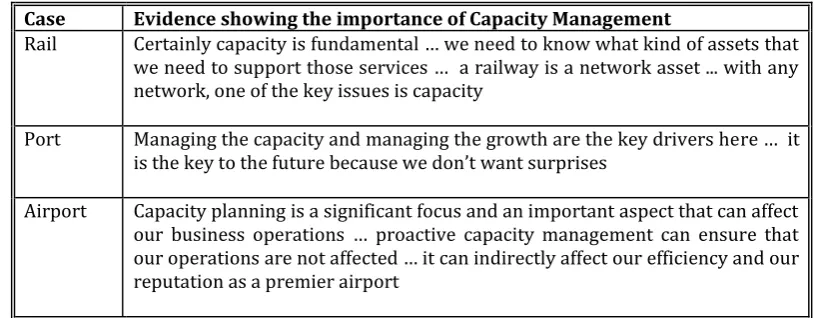
Capacity management is therefore essential to ensure that the goal of capacity matching is achieved and the right infrastructure can be planned and optimally provided to support business needs. All case participants echoed the importance of the capacity management process. This is summarised in Table 1 below.
Case Evidence showing the importance of Capacity Management
Rail Certainly capacity is fundamental … we need to know what kind of assets that we need to support those services … a railway is a network asset ... with any network, one of the key issues is capacity
Port Managing the capacity and managing the growth are the key drivers here … it is the key to the future because we don’t want surprises
[image:7.595.80.488.378.537.2]Airport Capacity planning is a significant focus and an important aspect that can affect our business operations … proactive capacity management can ensure that our operations are not affected … it can indirectly affect our efficiency and our reputation as a premier airport
Table 1 Importance of the Capacity Management Process
4.1 Challenges in Capacity Management
The Institute of Public Works Engineering of Australia (IPWEA, 2006) has suggested that in order to provide the maximum return, infrastructure assets must be utilised effectively and deliver the required level of service. This suggests that in infrastructure capacity management, organisations must ensure (1) the high utilisation of assets and (2) that the assets support their business operation.
productivity. For example, a manager from the port case noted, “when this (trade) information comes to me, we look at what current infrastructure that we have and how we can accommodate the new requirements”. This is important because to support business operations, there are many ways to increase capacity. Data from the case studies suggest that enhanced capacity can be achieved through operational efficiencies and/or improved maintenance efficiencies and not just through new capital investment. This is shared by comments from the managers interviewed:
“you can keep adding capital to a certain amount … the other one is knowledge of the industry such that when you are designing the port layout that is integrated with a proper and logical flow you can make the operation more efficient … this can saves us from building more assets” (Port)
“capacity increases can come from investment in physical assets such as additional trains, port expansions, stockpiling equipment, or from increased operational efficiencies by rail and port operators.” (Rail)
Capacity can also be increased through more efficient use of existing infrastructures via design, reconfiguration and integration of infrastructure assets. This is further echoed by other managers who noted:
“port operation is basically materials handling and what you don’t want to have is inefficient traffic loads and directions … it is all design to make the whole operation for everyone more efficient. That saves us building more assets… it saves us from putting in a lot more capital.” (Port)
“You can invest in signalling system so that trains can run closer together rather than more rolling stock.” (Rail)
Therefore, to effectively manage capacity, cases from this study suggest that some challenges that must be overcome. First is the challenge to provide the right infrastructure assets at the right time that would meet service requirement level. This includes suitable adjustment of the infrastructure asset portfolio in response to change. Part of the difficulty is the possible time-lag between demand and actual supply. The long lead-time for supplying built infrastructure can derail the forecasted demand. This is aptly summed up by some of the managers interviewed:
“demand analysis is a tricky one.” (Rail)
“forecasting growth is very much crystal ball gazing.” (Port)
“identification of what is the right time and what is the right increase in capacity is difficult.” (Airport)
only part of the system. To ensure the capacity of the whole supply chain is increased in tandem, there is a need for a collaborative relationship between all the members of the whole supply chain. Table 2 summarises the cross-case evidence on the challenges faced within the capacity management process.
Challenges Rail Port Airport
Ability to adjust infrastructure assets in respond to changing demand due to time lag
“because of the long lead time to build our infrastructure we are generally being accused of missing the boat and not having the infrastructure … it is a catch 22 because the reality is even the coal companies didn’t see this massive demand coming.”
“the fundamental problem … is getting the timing right … some infrastructure are excellent but they went into the market too early and the market was not ready for them and they failed … alternatively they hit the market too late.”
“if you are just behind then you will be running behind all the time … if you are just in front, you are spending too much and have excess capacity … so the great challenge is getting close to just right or just in time.”
Part of a
complicated supply chain
The railway
infrastructure is part of the supply chain … so we are managing its performance as it is relevant to the performance of that supply chain
“we have one main bridge access to the port and if this bridge is crowded and causes a bottleneck and queue, this is bad for our business because the ships are loading and unloading but the trucks cannot get through to transport goods … it is very important for us to manage the access to the port facilities.”
“… because we are tied to the other parts of the system which we do have no control over, we look at capacity at a much more frequent intervals … for example, passenger numbers and aircraft movements have a direct relationship with ground traffic but capacity can be
[image:9.595.72.488.158.448.2]constrained by land-side traffic.”
Table 2 Summary of Challenges in the Capacity Management Process
4.2 Approaches adopted in Capacity Management
However, setting the right benchmark for these indicators depends on the input and analyses of trend and industry information. In a constantly changing environment, infrastructure organisations must ensure that they always work with the most recent and updated information to accurately forecast the demand for infrastructure. In all cases, infrastructure organisations are observed to gather trend information to enhance their knowledge of the industry. For example, Rail’s intelligence generation is through several sources such as commitment and request from their customers, independent expert opinions, as well as the intentions of other ports to expand their unloading capacity. Similarly, a Port manager noted, “we have 4 studies to model our infrastructure requirements … these studies include trade forecasts, traffic provisional growth studies, economic studies and resource studies”.
A similar approach is observed at the airport where they constantly review the Airbus and Boeing forecasts and orders so that they can have the appropriate infrastructure to serve customers using the bigger and newer aircraft such as A380. The airport case engages specialist consultants to prepare aviation forecasts that include parameters such as income of travellers, prices of air transport, airline service characteristics, tourism needs, population projections, gross domestic product, and national aviation policy. In short, by having the most updated information on the growth and trends of the industry and the current capacity of infrastructure assets, infrastructure organisations are more likely to develop the infrastructure assets that are timely and appropriate to support business needs for the future. A manager at the Port summed up the importance of information gathering as follows,
“it is important to synthesise as much information as you can gather from variety of sources … what we do is minimise the guessing by collecting as much information as possible.”
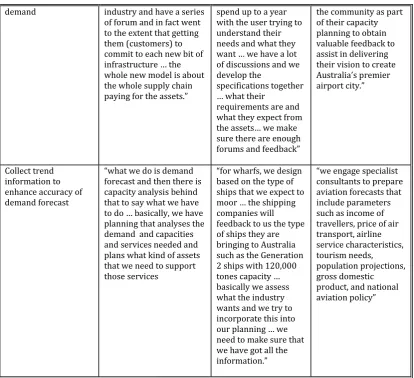
The case study organisations were also noted to constantly enhance the knowledge of their industry such as the best practices through collaborative efforts with their stakeholders. Having the knowledge of industry practice, infrastructure organisations can respond to changing external demands by adjusting the capacity with minimal infrastructure investment. For example, Rail was noted to work with the members of their supply chain to identify and plan specific expansion paths to achieve the optimal system capacity and provide the overall best return. Similarly, Port uses the Landside Logistic Forum to identify projects that can improve port efficiency. This is evidenced from the new initiative introduced by one of their customers through such a forum. Efficiency is improved by avoiding unnecessary container moves in the terminal and thus reducing truck turn times. Table 3 summarises the cross-case evidence of the approaches adopted to overcome the challenges in the capacity management process.
Approaches Rail Port Airport
Collaborate with stakeholders to explore ways to respond to changing
“there are different scenarios for capacity expansion to the various ports … we go to the
“we don’t build anything unless we know what the users want … sometime we
demand industry and have a series of forum and in fact went to the extent that getting them (customers) to commit to each new bit of infrastructure … the whole new model is about the whole supply chain paying for the assets.”
spend up to a year with the user trying to understand their needs and what they want … we have a lot of discussions and we develop the
specifications together … what their
requirements are and what they expect from the assets… we make sure there are enough forums and feedback”
the community as part of their capacity planning to obtain valuable feedback to assist in delivering their vision to create Australia’s premier airport city.”
Collect trend information to enhance accuracy of demand forecast
“what we do is demand forecast and then there is capacity analysis behind that to say what we have to do … basically, we have planning that analyses the demand and capacities and services needed and plans what kind of assets that we need to support those services
“for wharfs, we design based on the type of ships that we expect to moor … the shipping companies will feedback to us the type of ships they are bringing to Australia such as the Generation 2 ships with 120,000 tones capacity … basically we assess what the industry wants and we try to incorporate this into our planning … we need to make sure that we have got all the information.”
[image:11.595.73.488.68.446.2]“we engage specialist consultants to prepare aviation forecasts that include parameters such as income of travellers, price of air transport, airline service characteristics, tourism needs, population projections, gross domestic product, and national aviation policy”
Table 3 Summary of Approaches adopted for the Capacity Management Process
5. Discussion: Capability for the Capacity Management Process
Discussion in the preceding paragraph provided evidence that the key challenge faced by infrastructure organisations in the capacity management process is timely response to changing demand. This is further complicated by first, a time-lag between demand and supply of infrastructure assets and second, capacity management forms part of a complicated supply chain.
information sharing among trading partners which enhances the visibility of project risks and reduces uncertainty in infrastructure provision (Brennan & Turnbull, 1999; Handfield & Betchel, 2002). The partners of the supply chain can then negotiate and work towards a mutually acceptable solution.
An example is the management of capital investment risk within the case study organisations. Data from this research suggests that collaborative relationships with members of the supply chain and stakeholders can provide greater certainty for capital expenditure and investment since it considers the needs of all stakeholders. For example, some managers noted:
“through some consultative process with the industry (stakeholders), we can get them to sign off on their willingness to support our investment in the coal system.”
“we will not want to invest millions of dollars if there is no guarantee that it can generate a good steady income.”
The integration of knowledge within the supply chain requires a good collaborative relationship among the stakeholders. A collaborative relationship is defined as the complex bundling of skills and accumulated knowledge, exercised through organisational processes, enabling organisations to coordinate their activities and make use of their assets (Day, 1994). Evidence from this study also indicates that infrastructure organisations are working closely with the supply chain members to explore the best ways to respond to changing demand. For example, the rail case develops a collaborative relationship with its stakeholders by articulating the importance of a supply-chain focus in its Master Plan. This document then guides the actions and decisions of the organisation and internalises the symbiotic relationship between Rail and its stakeholders. This is acknowledged by the rail case in its Infrastructure Master Plan which states that:
“we believe that a focus on the overall supply chain in the Master Plan will allow all parties to gain a greater understanding of the dynamics of the systems and highlight where action should be directed to improve the overall throughput of the systems.”
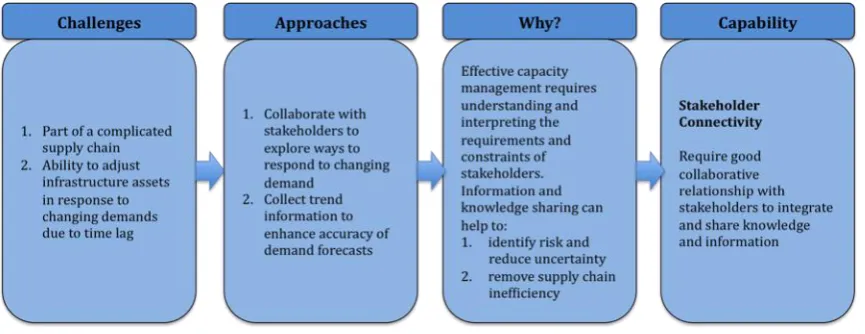
The approaches adopted suggest that effective capacity management requires a good connectivity with stakeholders in order to understand and interpret the requirements and constraints of various stakeholders (e.g. customers, suppliers, regulators, etc.). This is to ensure that all infrastructure decisions are capable of delivering the greatest stakeholder value from the money invested. Additionally, Dangayach and Deshmukh (2001) asserted that organisations that can manage their capabilities and resources related to supply chain management are likely to gain superior performance. Hence through systematic supply chain integration, organisations can share special resources and technological knowledge that are necessary to improve performance and to deliver value to their stakeholders (Hyvonen & Tuominen, 2007).
[image:13.595.67.500.433.600.2]In summary, infrastructure organisations need to increase the accuracy of their demand forecasts by working collaboratively with their stakeholders and regulators. Only through a better understanding of the relationship between stakeholder requirements and asset performance, can asset managers overcome the many challenges outlined above in order to improve performance and service to customers. To achieve this, infrastructure organisations need to develop their stakeholder connectivity capability, which will allow them to have knowledge of stakeholder needs, access to stakeholders’ specialised knowledge, and exchanging of information between organisation and stakeholders. Figure 1 summarises the discussion in relation to the capability needed for the capacity management process.
Figure 1 Capability for the Capacity Management Process
6. Conclusion & Implications
challenges, infrastructure organisations need to integrate and share knowledge with their supply chain stakeholders so that the most up-to-date information is available.
While the results of this study might have shown that stakeholder connectivity capability is important for effective infrastructure capacity management, a first step towards the development of this capability may be to radically amend many practitioners’ mental models of what stakeholder connectivity capability is. This study proposes that stakeholder connectivity is made up of two key constructs i.e. good collaborative relationship and knowledge sharing. This provides an opportunity for asset manager to begin cataloguing this capability. This can involve dialogue across organisational boundaries about collaborative relationship and knowledge sharing; and its impact on organization performance. An appreciation of stakeholder connectivity capability and more importantly the linkages in contributing value to an organization could lead to how asset managers understand the scope and content of infrastructure capacity management.
Infrastructure organisations must therefore make an assessment about their current strength of the stakeholder connectivity capability they currently possess and their relationship with strategic partners. They also need to leverage this capability in developing new solutions to exploit existing opportunities better. At a minimum, assessing how this capability can be leveraged give infrastructure organisations a greater appreciation of its role and importance in executing capacity management strategies. Infrastructure organisations thus need to purposefully build the stakeholder connectivity capability by focussing on resources that are interconnected, deeply rooted within the organisation’s relationship and knowledge base, and span the organisation’s business functions and hierarchy. A strong stakeholder connectivity capability will ensure an effective capacity management process that can contribute value by supporting the business operations.
REFERENCES
Bourke, K., Ramdas, V., Singh, S., Green, A., Crudgington, A., Mootanah, D. (2005). Achieving Whole Life Value in Infrastructure and Buildings. Garston, Watford: Building Research Establishment.
Brennan, R., & Turnbull, P. W. (1999). Adaptive behaviour in buyer-supplier relationships.
Industrial Marketing Management, 28(5), 481-495.
Brown, S. L., & Eisenhardt, K. M. (1995). Product development: Past research, present findings, and fu. Academy of Management. The Academy of Management Review, 20(2), 343.
Dangayach, G. S., & Deshmukh, S. G. (2001). Manufacturing strategy: Literature review and sime issues. International Journal of Operations & Production Management, 21(7), 884-932.
Dierickx, I., & Cool, K. (1989). Asset stock accumulation and the sustainability of
competitive advantage. In N. Foss (Ed.), Resources, Firms and Strategies: A Reader in the Resource-Based Perspective. New York: Oxford University Press Inc.
Eisenhardt, K. M. (2002). Building theories from case study research. In A. M. Huberman & M. B. Miles (Eds.), The Qualitative Researcher's Companion. CA: Sage Publications.
Eisenhardt, K. M. (2007). Theory building from cases: Opportunities and challenges.
Academy of Management Journal, 50(1), 25-32.
Handfield, R. B., & Betchel, C. (2002). The role of trust and relationship structure in improving supply chain responsiveness. Industrial Marketing Management, 31(4), 367-382.
Hardwicke, L. (2005). Australian Infrastructure Report Card. Barton, ACT: Engineers Australia.
Heimeriks, K. H., & Duysters, G. (2007). Alliance capability as a mediator between experience and alliance performance: An empirical investigation into the alliance capability development process. Journal of Management Studies, 44(1), 25-49.
Hsu, C. C., Kannan, V. R., Tan, K. C., & Leong, G. K. (2008). Information sharing, buyer-supplier relationships, and firm performance: A multi-region analysis. International Journal of Physical Distribution & Logistics Management, 38(4), 296-310.
Hyvonen, S., & Tuominen, M. (2007). Channel collaboration, market orientation and performance advantages: Discovering developed and emerging markets. International Review of Retail, Distribution & Consumer Research, 17(5), 423-445.
IPWEA (2006). International Infrastructure Management Manual: Institute of Public Works Engineering of Australia.
Juga, J. (1999). Generic capabilities: combining positional and resource-based views for strategic advantage. Journal of Strategic Marketing, 7, 3-18.
Kay, N. M. (1999). The boundaries of the firm: critiques, strategies and policies. New York: St. Martin's Press Inc.
Lado, A. A., Boyd, N., & Hanlon, S. C. (1997). Competition, cooperation, and the search for economic rents: A Syncretic Model. Academy of Management Review, 22(1), 110-141.
Lee, H. L. (2000). Creating value through supply chain integration. Supply Chain
Management Review, 4(5), 30-36.
Ma, H. (2000). Competitive advantage & firm performance. Competitiveness Review, 10(2), 16-32.
Maunsell, & Opus, I. C. (2004). Optimised decision making guidelines: A sustainable
approach to managing infrastructure Thames, NZ: NZ National Asset Management Steering
Group, 2004.
Prahalad, C. K., & Hamel, G. (1990). The core competence of the corporation. Harvard Business Review, 68(3), 79.
Queensland Government (2009). Queensland State Budget 2009/2010. In Q. Treasury (Ed.). Brisbane: Queensland Government.
Schoohoven, C. B., Eisenhardt, K. M., & Lyman, K. (1990). Speeding products to market: Waiting time to first productintroduction in new firms. Administrative Science Quarterly, 35, 177-207.
Too, E., Betts, M., & Kumar, A. (2006). A strategic approach to infrastructure asset
managementBEE Postgraduate Research Conference, Infrastructure 2006: Sustainability & Innovation Queensland University of Technology, Brisbane.
Tyndall, G. P., Gopal, C., Partsch, W., & Kamauff, J. W. (1998). Supercharging supply chains: New ways to increase value through global operational excellence New York: John Wiley & Sons.
van der Mandele, M., Walker, W., & Bexelius, S. (2006). Policy development for
infrastructure networks: Concepts and ideas. Journal of Infrastructure Systems, 12(2), 69-76.
Wernerfelt, B. (1984). A resource-based view of the firm. Strategic Management Journal, 5(2), 171.
Yin, R. K. (2003). Case study research: Design and method (5th ed.). London: SAGE Publications.
Zhao, M., Droge, C., & Stank, T. (2001). The effects of logistic capabilities on firm performance: customer focused versus information-focused capabilities. Journal of Business Logistics, 22(2), 91-107.
Zhou, H., & Benton, W. C. (2007). Supply chain practice and information sharing. Journal of