Graham Peeke
continuing
Issues in
professional
development
Published by FEDA
Feedback and orders should be sent to FEDA publications, Citadel Place Tinwor th Street, London SE11 5EH
Tel: 020 7840 5302/4 Fax: 020 7840 5401 e-mail: [email protected]
Registered with the Charity Commissioners
Editor: Huw Jones Designer: Dave Shaw
ISBN 1 85338 536 0
© 2000 FEDA
You are welcome to copy this publication for internal use within your organisation. Other wise, no par t of this publication may be reproduced, stored in a retrieval system, or transmitted in any form or by any means, electronic, electrical, chemical, optical, photocopying, recording or other wise, without the prior written permission of the copyright owner.
Introduction 1
1. Defining CPD 2
2. Personal and organisational development 3
3. Encouragement of CPD 4
4. The role of standards and qualifications 5
References 5
Introduction
programmes or research, within their own college or with their local HE institution. However, this development is taking place against the backdrop of declining levels of finance allocated to staff development and calls for more specific attention to be paid to training in pedagogic skills and good quality management training.
Whilst acknowledging much good practice,
Learning to succeed, DfEE (1999), is specific in its criticisms of management and teaching in fur ther education, stating that significant curricula and management weaknesses exist, and that there are providers where quality is not up to scratch. In the wake of recent announcements on failing colleges, the Government has called for a qualification for principals that will be a prerequisite for appointment, and for governor training on financial and other key responsibilities that should occur within six months of appointment. The White Paper also states the intention to require initial teacher training qualifications.
All of this places the continuous professional development (CPD) of governors, principals, managers and teachers centre stage in the drive to improve standards within the sector, ensure the best learning experience for students, and make colleges account-able to those who fund them and the learning commu-nities that use them. This paper examines some of the issues surrounding CPD including its definition, the link between personal and organisational devel-opment, the encouragement of CPD, the development of a systematic framework for CPD in the sector, and the role of standards and qualifications.
Issues in continuing professional development 1
T
he second repor t of the National Advisor y Group for Continuing Education and Lifelong Learning (1999) makes the point that lifelong learning is regarded by many as unnecessary, unappealing or unavailable. It recommends a concer ted effor t to instil a craving for learning in ever y adult and child. A crucial group in a position to help instil this craving are the staff working in FE colleges.1.Defining CPD
and academic awards, but also learning from other people and from the work itself.
If we accept this broad definition, then CPD in the college setting can be considered to include study for fur ther qualifications, in-college development programmes of a formal or more informal nature such as mentoring, coaching, and networking, and learning from experience. Such a definition is helpful because of its inclusiveness: it can embrace all the fur ther learning that is carried out by the different groups of staff who work in colleges. It also suggests a weakness that exists in the breadth of activity that counts as CPD. There are a plethora of qualifications available for those wishing to develop their skills and knowledge, and in-college development programmes are growing fast, par ticularly in the area of manage-ment developmanage-ment. Much learning from experience, however, could benefit from more structured reflection on the issues and problems faced by college staff. Oppor tunities for such reflection and discussion are limited in the ‘hurly-burly’ of ever yday college life.
Perhaps a more sector-specific definition of CPD would be useful, one that attempts to distinguish CPD from what is often referred to as ‘staff development’ or ‘staff training’. CPD can be characterised as follows: usually individually driven and organised, pursued over an extended period of time, usually standards-based or leading to a formal qualification, focused on promoting improvement or change in practice thereby leading to eventual impact on the quality of student learning, and adopting a broad approach rather than a ‘narrow skills development approach’ (Mar tinez, 1999).
2. Personal and
organisational
development
contributions of individuals to the achievement of depar tmental plans and also to identify the development needs they may have in order to suppor t their effective contribution. It is not always possible to see this system in operation in colleges. There has been a tradition of teachers determining their own development, with a par ticular emphasis upon subject development. CPD linked to the needs of the college has not taken precedence. Developments like Investors in People (IiP) have drawn attention to this shor tcoming.
One of the main reasons for this lack of systematic linking of individual development to the needs of the college (as identified in its strategic plan) is the lack of effective models for evaluating the impact of development upon the individual’s ability to do their job, and upon the effectiveness of the college itself. Whilst basic cost benefit models may be available, these are not sophisticated enough to link professional development activity directly to the per formance of the college. In the absence of any proven link, it is difficult to argue that development related to the needs of the college should take precedence over those needs identified by individuals. A statement such as this contains an assumption that individuals under take development activity that may be of little benefit to the college. This is unlikely to be true: as stated above, there is an argument that any kind of development can be beneficial because it is the process of learning that is more impor tant than what is learnt. Putting this claim to one side, however, it is clear that the development activity that teachers and managers engage in, as identified by the FEFC (1999) and Mar tinez (1999), is highly relevant to their organisations.
The key issues here are scarcity and priority. Limited resources imply selectivity, and pressing needs to address specific requirements necessitate some activities taking precedence over others. Colleges need to become more effective at identifying their specific development needs and signalling these to their staff. Individuals will respond positively to the prioritising of some needs at cer tain times, in a culture where all development is valued.
Issues in continuing professional development 3
A
distinction is often made between professional development that is determined by the individual and that which is determined by the needs of the college. It is the latter form of development which is the subject of most discussion today, although clearly both are impor tant. The concept of the learning organisation stresses the impor tance of learning by individuals and the way in which this can accrue for the benefit of the organisation. In shor t, an organisation which is composed of individuals who are themselves constantly learning and reflecting on their learning, will be an organisation which is flexible and capable of adapting readily to its environment. Some companies have sought to promote individual learning through the allocation of funding which employees can use to purchase learning of any type. The point is not that the learning has to be relevant to the business of the organisation, but that individuals who are disposed towards learning and developing, in whatever situation or subject, are an asset to the company.3. Encouragement
of CPD
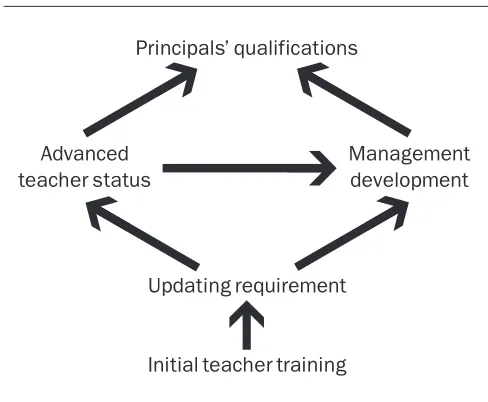
managers in fur ther education. With attention currently being paid to the top and bottom of such a framework, that is the qualification for principals and initial teacher training qualifications, there is a clear need to address the gap in between. The framework needs to take into account such considerations as:
●The need for teachers to develop in their teaching role in addition to their subject or vocational knowledge and skill
●The desire of some teachers to stay working in the classroom rather than move into management as their career progresses
●The desire of some teachers to develop themselves as managers
●The need for managers, both academic and suppor t, to undergo management development
●Those for whom the facilitation of learning is only a par t of a broader role such as technician or librarian.
Following initial training, the first stage of a CPD framework could be required updating in areas covered by initial qualifications where knowledge and practice moves on, and acquisition of skills and knowledge for those who have changed roles or taken on additional roles. After this, the framework splits into two, providing development routes for those who wish to continue developing their teaching role either through specialisation, or as an ‘exper t’ or ‘super teacher’. The other arm of the structure is for
[image:6.596.282.526.541.742.2]those who wish to develop as managers. The two arms need not be exclusive: individuals can select development oppor tunities from either arm as best suits their own needs. The framework is reunited at the apex through the requirement for the training or qualification of principals. Figure 1 below represents this framework diagrammatically.
Figure 1. A framework for CPD
Principals’ qualifications
Advanced Management
I
n a paper to the APC annual conference, Silver (1999) makes the case that the FE sector has been duped into believing that ‘change, modernisation and futurisation of colleges can be brought about either by declared desire or decree’. She cites the way college managers were stewarded, almost by corre-spondence, into coping with incorporation, and how teachers are constantly asked to introduce new or changed products without ‘due and diligent preparation’. In arguing for the sector to make clear to Government what it needs in order to deliver its new educational agenda, and suggesting that the sector asks for ‘something for something’ in return she states:The something that we must ask for, from Government, in return for the many new things that we are involved in, is the replenishment of teachers in their exper t roles and in their love of their subject.
Silver summarises this task as breeding a new profes-sionalism. Some of the key features of professionalism are formal initial training, a requirement to continue to develop, and an ethical code, which determines ever yday practice. The building blocks for the creation of these requirements are beginning to be put in place. FENTO has produced standards for teaching and suppor ting learning, and standards for managers are currently under preparation. The DfEE is working on proposals for an initial teacher training requirement and for a qualification for principals. There have been broad discussions within the sector about the value of a professional body for FE staff. All of this ser ves
➔
4.The role of
standards and
qualifications
References
Issues in continuing professional development 5
I
t is difficult to talk about any framework of CPD without considering the role of qualifications. In addition, where occupational standards exist it is appropriate to consider their role, both in terms of qualifications, and in setting expectations with regard to CPD functions.Qualifications can play an impor tant par t in CPD where there are procedures for approving courses for this purpose. In the absence of any professional body in fur ther education which requires members to remain in good standing through, for example, the accumula-tion of a set number of hours, points or credits, there is no clear or agreed set of qualifications which form a CPD por tfolio. Custom and practice within the sector, however, have established qualifications such as advanced cer tificates and diplomas, MAs, MEds, and research degrees as CPD awards for teachers; and cer tificates and diplomas in management, NVQs in management, and MBAs, as CPD awards in management.
The role of standards, now that they exist, is in informing the development of qualifications and in setting expectations with regard to the design of CPD activities, and the construction of individual development plans. Standards can also play a par t in assisting informal learning. As Eraut (1998) argues in relation to NVQs,
[standards] might help people draw together some of their informal learning, reflect on it and bring it more under the control of their self-evaluative capability.
In some par ts of the UK, for example in Nor thern Ireland and Scotland, the place of qualifications in initial training and CPD has been formalised to some extent, with a clear link between specific qualifications and the professional development of practitioners. With a consensus on a systematic framework for professional development in the rest of the UK, it should be easy to link qualifications to various elements of the framework, resulting in a clear ladder of qualifications or standards related activities to guide the professional develop-ment of FE staff.
DfEE. Learning to succeed: a new framework for post-16 learning.HMSO, 1999.
DfEE/Open Agenda. Lifelong learning and continuous professional development: moving for ward.DfEE/ Open Agenda Brainstorming Event repor t, April 1999.
Eraut M et al. Standards and vocational qualifications in continuing professional development (CPD).
QCA discussion paper, number one, July 1998. FEFC. Professional development in fur ther education.
National repor t from the Inspectorate. FEFC, 1999.
Mar tinez P. Learning from continuing professional development.FEDA, 1999.
National advisor y group for continuing education and lifelong learning. Second repor t.1999.