SUSTAINED RELEASE MATRIX TABLETS OF NATEGLINIDE BY USING NATURAL POLYMERS
A Dissertation submitted to
THE TAMIL NADU DR. M.G.R. MEDICAL UNIVERSITY, CHENNAI- 600 032
In partial fulfilment of the award of the degree of MASTER OF PHARMACY
IN
Branch-I -- PHARMACEUTICS
Submitted by
Name: SATHYASEELAN. V REG.No.261310264
Under the Guidance of
Dr. R. SAMBATHKUMAR, M.Pharm., PhD, DEPARTMENT OF PHARMACEUTICS
J.K.K. NATTARAJA COLLEGE OF PHARMACY KUMARAPALAYAM – 638183
SUSTAINED RELEASE MATRIX TABLETS OF NATEGLINIDE BY
USING NATURAL POLYMERS
A Dissertation submitted to
THE TAMIL NADU DR. M.G.R. MEDICAL UNIVERSITY, CHENNAI - 600 032
In partial fulfilment of the award of the degree of
MASTER OF PHARMACY
IN
Branch-I -- PHARMACEUTICS
Submitted by
Name: SATHYASEELAN. V REG.No. 261310264
Under the Guidance of
Dr. R. SAMBATHKUMAR, M.Pharm., PhD,
DEPARTMENT OF PHARMACEUTICS
J.K.K. NATTARAJA COLLEGE OF PHARMACY
KUMARAPALAYAM – 638183
TAMILNADU.
This is to certify that the dissertation work entitled
“FORMULATION DEVELOPMENT AND INVITRO EVALUATION OF
SUSTAINED RELEASE MATRIX TABLETS OF NATEGLINIDE BY
USING NATURAL POLYMERS”, submitted by the student bearing
Reg. No: 261310264 to “The Tamil Nadu Dr. M.G.R. Medical
University – Chennai”, in partial fulfilment for the award of Degree
of Master of Pharmacy in Pharmaceutics was evaluated by us
during the examination held on………..……….
Internal Examiner External Examiner
This is to certify that the work embodied in this dissertation
entitled “FORMULATION DEVELOPMENT AND INVITRO EVALUATION
OF SUSTAINED RELEASE MATRIX TABLETS OF NATEGLINIDE BY
USING NATURAL POLYMERS”, submitted to “The Tamil Nadu Dr.
M.G.R. Medical University- Chennai”, in partial fulfilment and
requirement of university rules and regulation for the award of Degree of
Master of Pharmacy in Pharmaceutics, is a bonafide work carried out
by the student bearing Reg.No. 261310264 during the academic year
2016-2017, under the guidance and supervision of Dr. R.
Sambathkumar, M. Pharm., PhD., Professor & Head, Department of
Pharmaceutics, J.K.K. Nattraja College of Pharmacy, Kumarapalayam.
CERTIFICATE
Dr. R. Sambathkumar, M. Pharm., PhD.,
Professor & Principal,
J.K.K. Nattraja College of Pharmacy.
This is to certify that the work embodied in this dissertation
entitled “FORMULATION DEVELOPMENT AND INVITRO EVALUATION
OF SUSTAINED RELEASE MATRIX TABLETS OF NATEGLINIDE BY
USING NATURAL POLYMERS”, submitted to “The Tamil Nadu Dr.
M.G.R. Medical University- Chennai”, in partial fulfilment and
requirement of university rules and regulation for the award of Degree of
Master of Pharmacy in Pharmaceutics, is a bonafide work carried out
by the student bearing Reg.No. 261310264 during the academic year
2016-2017, under the guidance and supervision of
Dr. R. Sambathkumar, M. Pharm., PhD., Professor & Head,
Department of Pharmaceutics, J.K.K. Nattraja College of Pharmacy,
Kumarapalayam.
Place: Kumarapalayam
Date:
Dr. R. Sambathkumar, M. Pharm., PhD.,
Professor & Head,
Department of Pharmaceutics
J.K.K. Nattraja College of Pharmacy.
Kumarapalayam - 638 183.
DECLARATON
I do hereby declared that the dissertation “FORMULATION
DEVELOPMENT AND INVITRO EVALUATION OF SUSTAINED
RELEASE MATRIX TABLETS OF NATEGLINIDE BY USING NATURAL
POLYMERS” submitted to “The Tamil Nadu Dr. M.G.R Medical
University - Chennai”, for the partial fulfilment of the degree of Master
of Pharmacy in Pharmaceutics, is a bonafide research work has been
carried out by me during the academic year 2016-2017, under the
guidance and supervision of Dr. R. Sambathkumar, M. Pharm., PhD.,
Professor & Head, Department of Pharmaceutics, J.K.K. Nattraja College
of Pharmacy, Kumarapalayam.
I further declare that this work is original and this dissertation has
not been submitted previously for the award of any other degree,
diploma, associate ship and fellowship or any other similar title. The
information furnished in this dissertation is genuine to the best of my
knowledge.
Place: Kumarapalayam Mr. SATHYASEELAN. V
Dedicated to
Parents,
Teachers &
I am proud to dedicate my deep sense of gratitude to the founder,
(Late) Thiru J.K.K. Nattaraja Chettiar, providing the historical
institution to study.
My sincere thanks and respectful regards to our reverent
Chairperson Smt. N. Sendamaraai, B.Com., and Director
Mr. S. Omm Sharravana, B.Com., LLB., J.K.K. Nattraja Educational
Institutions, Kumarapalayam for their blessings, encouragement and
support at all times.
It is my most pleasant duty to thank our beloved Principal and
Professor Dr. R. Sambathkumar, M. Pharm., PhD., of J.K.K.Nattraja
College of Pharmacy, Kumarapalayam for ensuring all the facilities were
made available to me for the smooth running of this project.
It is most pleasant duty to thank my beloved guide
Mr. K. JAGANATHAN, M.Pharm., Assistant Professor, Department of
Pharmaceutics, J.K.K. Nattraja College of Pharmacy, Kumarapalayam,
for suggesting solution to problems faced by me and providing in
dispensable guidance, tremendous encouragement at each and every step
of this dissertation work. Without his critical advice and deep-rooted
knowledge, this work would not have been a reality.
Our glorious acknowledgement to our administrative officer
Dr. K. Sengodan, M.B.B.S., for encouraging using kind and generous
manner to complete this work.
My sincere thanks to Dr. S. Bhama, M. Pharm., Associate
Professor Department of Pharmaceutics, Mr. R. Kanagasabai, B.Pharm,
M.Tech., Assistant Professor, Mr. K. Jaganathan, M.Pharm., Assistant
Professor, Mr. V. Kamalakannan M.Pharm., Assistant Professor,
Lecturer, Department of pharmaceutics for the in valuable help during
my project.
My sincere thanks to Mr. N. Venkateswaramurthy, M.Pharm.,
Professor and Head, Department of Pharmacy Practice, Mrs. K. Krishna
Veni, M.Pharm., Assistant Professor, Mrs. P. Kavitha M.Pharm,
Assistant Professor, Mr. R. Kameswaran M.Pharm, Assistant Professor,,
Dr. Taniya Jacob, Pharm.D., Lecturer, Dr. V. Viji Queen, Pharm.D.,
Lecturer, Mr. C. Sampushparaj, Lecturer, Mr. T. Thiyagarajan
M.Pharm Lecturer, and Ms. C. Sahana, M.Pharm., Lecturer,
Department of Pharmacy Practice, for their help during my project.
It is my privilege to express deepest sense of gratitude toward
Dr. M. Vijayabaskaran, M.Pharm., Professor & Head, Department of
Pharmaceutical chemistry, Dr. S. P. Vinoth Kumar M.Pharm.,
Assistant professor, Mrs. S. Gomathi M.Pharm., Lecturer, Mrs. B.
Vasuki, M.Pharm., Lecturer and Mrs. P. Devi, M.Pharm., Lecturer,
for their valuable suggestions and inspiration.
My sincere thanks to Dr. V. Sekar, M.Pharm., Ph.D., Professor
and Head, Department of Analysis, Dr. I. Caolin Nimila, M.Pharm.,
Ph.D., Assistant Professor, and Ms. V. Devi, M.Pharm., Lecturer,
Department of Pharmaceutical Analysis for their valuable suggestions.
My sincere thanks to Dr. Senthilraja, M.Pharm., Ph.D., Associate
Professor and Head, Department of Pharmacognosy,
Dr. M. Rajkumar, M.Pharm., Ph.D., Associate Professor,
Mrs. Meena Prabha M.Pharm., Lecturer, Department of Pharmacognosy
and Mrs. P. Seema, M.Pharm., Lecturer, Department of Pharmacognosy
for their valuable suggestions during my project work.
Mr. V. Venkateswaran, M.Pharm., Assistant Professor,
Mrs. M. Sudha M.Pharm., Lecturer, Mrs. R. Elavarasi, M.Pharm.,
Lecturer, Mrs. M. Babykala, M.Pharm., Lecturer, Department of
Pharmacology for their valuable suggestions during my project work.
I greatly acknowledge the help rendered by Mrs. K. Rani, Office
Superintendent, Mr. E. Vasanthakumar, MCA, Assistant Professor,
Miss. M. Venkateswari, M.C.A., typist, Mrs. V. Gandhimathi, M.A.,
M.L.I.S., Librarian, Mrs. S. Jayakala B.A., B.L.I.S., and Asst. Librarian
for their co-operation. I owe my thanks to all the technical and
non-technical staff members of the institute for their precious assistance and
help.
Last, but nevertheless, I am thankful to my lovable parents and all
my friends for their co-operation, encouragement and help extended to
me throughout my project work.
Mr. SATHYASEELAN. V
CONTENTS
S.NO
.
CHAPTER
PAGE NO
1
INTRODUCTION
1
2
LITERATURE REVIEW
35
3
AIM AND OBJECTIVES
38
4
PLAN OF WORK
40
5
DISEASE PROFILE
41
6
DRUG PROFILE
50
7
EXCIPIENTS PROFILE
53
8
MATERIALS AND EQUIPMENTS
57
9
PREFORMULATION
59
10
FORMULATION
66
11
EVALUATION
72
12
RESULTS AND DISCUSION
77
13
SUMMARY
106
14
CONCLUSION
108
SYMBOL INDEX
Symbols Explanation
Rpm : Revolutions per minute
°C : Degree celsius
Fig : Figure E.g. : Example Mg : Milligram
Min : Minutes
Ml : Milliliter
µg (mcg) : Microgram
µ g/ml : Microgram per milliliter
% : Percentage
SDN : Standard deviation
FORMULATION DEVELOPMENT AND
FORMULATION DEVELOPMENT AND
FORMULATION DEVELOPMENT AND
FORMULATION DEVELOPMENT AND
INVITRO
INVITRO
INVITRO
INVITRO
EVALUATION OF
EVALUATION OF
EVALUATION OF
EVALUATION OF
SUSTAINED RELEASE MATRIX
SUSTAINED RELEASE MATRIX
SUSTAINED RELEASE MATRIX
SUSTAINED RELEASE MATRIX
TABLETS OF NATEGLINIDE BY
TABLETS OF NATEGLINIDE BY
TABLETS OF NATEGLINIDE BY
TABLETS OF NATEGLINIDE BY
CHAPTER 1
CHAPTER 1
CHAPTER 1
CHAPTER 1
CHAPTER 2
CHAPTER 2
CHAPTER 2
CHAPTER 2
CHAPTER 3
CHAPTER 3
CHAPTER 3
CHAPTER 3
CHAPTER 4
CHAPTER 4
CHAPTER 4
CHAPTER 4
CHAPTER 5
CHAPTER 5
CHAPTER 5
CHAPTER 5
CHAPTER 6
CHAPTER 6
CHAPTER 6
CHAPTER 6
CHAPTER 7
CHAPTER 7
CHAPTER 7
CHAPTER 7
CHAPTER 8
CHAPTER 8
CHAPTER 8
CHAPTER 8
MATERIALS AND
MATERIALS AND
MATERIALS AND
MATERIALS AND
CHAPTER 9
CHAPTER 9
CHAPTER 9
CHAPTER 9
CHAPTER 10
CHAPTER 10
CHAPTER 10
CHAPTER 10
FORMULATION
CHAPTER 11
CHAPTER 11
CHAPTER 11
CHAPTER 11
CHAPTER 12
CHAPTER 12
CHAPTER 12
CHAPTER 12
CHAPTER 13
CHAPTER 13
CHAPTER 13
CHAPTER 13
CHAPER 14
CHAPER 14
CHAPER 14
CHAPER 14
CHAPER 15
CHAPER 15
CHAPER 15
CHAPER 15
Dept. of Pharmaceutics J.K.K.Nattraja College of Pharmacy 1
1. INTRODUCTION
Oral administration of drugs has been the most common and preferred route for delivery of most therapeutic agents. It remains the preferred route of administration investigated in the discovery and development of new drug candidates and formulations. The popularity of oral route is attributed to patient acceptance, ease of administration, accurate dosing, cost effective manufacturing methods and generally improved shelf life of the product. In recent years, considerable attention has been focused on development of sustained release drug delivery systems. The rationale for the development of sustain release drug delivery system of a drug is to enhance its therapeutic benefits, minimizing its side effects while improving the management of the diseased condition.1
An ideal drug delivery system should deliver the drug at the rate dictated by the needs of the body over the period of treatment i.e. it should provide the desired therapeutic concentration of drug in the plasma and maintain it constant for the entire duration of treatment.
Sustained release (SR) dosage forms continue to draw attention in the search for improved compliance and decrease the incidence of adverse drug reactions2. A sustained release system includes any delivery system that achieves slow release of the drug over an extended period of time.3
In recent years, in association with progress and innovation in the field of pharmaceutical technology, there has been an increasing effort to develop sustained release dosage forms for many drugs. The primary objective of this system is to ensure safety and to improve efficacy of the drugs as well as patient compliance. This is achieved by better control of plasma drug levels and less frequent dosing. Pharmacokinetic theory suggests that the ultimate method for reducing the plasma maximum concentration (Cmax) to plasma minimum concentration (Cmin) ratio is to have
Dept. of Pharmaceutics J.K.K.Nattraja College of Pharmacy 2 The United States Pharmacopoeia (USP) defines the modified-release (MR) dosage form as “the one for which the drug release characteristics of time course and/or location are chosen to accomplish therapeutic or convenience objectives not offered by conventional dosage forms such as solutions, ointments, or promptly dissolving dosage forms”4. One class of MR dosage form is an extended-release (ER) dosage form and is defined as the one that allows at least a 2-fold reduction in dosing frequency or significant increase in patient or therapeutic performance when compared with that presented as a conventional dosage form (a solution or a prompt drug-releasing dosage form). The terms “controlled release (CR)”, “prolonged release”, “sustained or slow release (SR)” and “long-acting (LA)” have been used synonymously with “extended release”. The commercial branded products in this category are often designated by suffixes such as CR, CD (controlled delivery), ER, LA, PD (programmed or prolonged delivery), Retard, SA (slow-acting), SR, TD (timed delivery), TR (timed release), XL and XR (extended release).
1.1. Advantages and limitations of a sustained release (SR) dosage form
Clinical advantages5
Reduction in frequency of drug administration. Improved patient compliance.
Reduction in drug level fluctuation in blood.
Reduction in total drug usage when compared with conventional therapy. Reduction in drug accumulation with chronic therapy.
Reduction in drug toxicity (local/systemic).
Stabilization of medical condition (because of more uniform drug levels). Improvement in bioavailability of some drugs because of spatial control. Economical to the health care providers and the patient.
1.1.1. Commercial/industrial advantages
Illustration of innovative/technological leadership. Product life-cycle extension.
Dept. of Pharmaceutics J.K.K.Nattraja College of Pharmacy 3
1.1.2. Potential limitations
Delay in onset of drug action.
Possibility of dose dumping in the case of a poor formulation strategy. Increased potential for first pass metabolism.
Greater dependence on GI residence time of dosage form. Possibility of less accurate dose adjustment in some cases.
Cost per unit dose is higher when compared with conventional doses. Not all drugs are suitable for formulating into ER dosage form.
1.2. Criteria for the selection of drug for sustained release dosage form6 : -
A number of drug characteristics need to be considered in evaluating drug molecules for sustained release dosage form. Some of these characteristics are as follows
Biopharmaceutical Characteristics of the drug:
1.2.1. Dose:
The formulation of sustained release drug products may not be practical for drugs with large conventional dose (>500mg). Because, the size of the SR drug product would have to be quite large for the patient to swallow easily.
1.2.2. Aqueous solubility:
The rate of dissolution is directly proportional to aqueous solubility. Therefore the aqueous solubility of a drug is the limiting factor in its dissolution. In general, too high or too less aqueous solubility of a drug is undesirable for formulation of sustained release dosage form. A drug with very low solubility and slow dissolution rate will exhibit dissolution-limited absorption and yield inherently sustained blood level. High solubility drugs release at faster rates because of their diffusion driving force would be highest are also great challenge for sustain release dosage form.
1.2.3. Partition Coefficient:
Dept. of Pharmaceutics J.K.K.Nattraja College of Pharmacy 4
1.2.4. Drug stability:
Drugs unstable in Gastro-intestinal environment cannot be administered as oral sustained release formulation because of bioavailability problems.
1.2.5. Mechanism and Site of absorption:
Drugs absorbed by carrier-mediated transport process and those absorbed through a window are poor candidates for controlled release system e.g. several B vitamins
1.2.6. Molecular size and Diffusivity:
The lower the molecular weight, the faster and more complete the absorption. In addition to biological membrane the molecule has to diffuse through a polymeric matrix in most of sustained release dosage forms. This diffusion is function of diffusivity of the drug. Diffusivity is defined as the ability of drug to diffuse through the membranes and it is inversely proportional to molecular size.
1.3. Pharmacokinetic Characteristics of the drug:
1.3. 1. Absorption:
For a drug to be administered as controlled release formulation, its absorption rate (Ka) must be efficient since the desired rate – limiting step is rate of drug release Kr. i.e. Kr<<Ka. A drug with slow absorption is a poor candidate for such dosage forms since continuous release will result in a pool of unabsorbed drug.
1.3.2. Elimination Half Life:
Smaller the t1/2, larger the amount of drug to be incorporated in the sustained
release dosage form. Drugs with half life in the range of 2 to 8 hours make good candidates for such a system.
1.3. Rate of Metabolism: A drug, which is extensively metabolized, is suitable for controlled release system as long as the rate of metabolism is not too rapid. A drug capable of inducing or inhibiting metabolism is a poor candidate for such a product since steady-state blood level would be difficult to maintain.
1.3.4. Dosage form index:
It is defined as the ratio of max steady state conc.(Css.max) to min. steady state
Dept. of Pharmaceutics J.K.K.Nattraja College of Pharmacy 5 reducing the dosage form index while maintaining the plasma drug levels within the therapeutic window, ideally its value should be as close to one as possible.
1.4. Pharmacodynamic Characteristics of the Drug
1.4.1 Plasma concentration-Response Relationship:-
Drugs whose pharmacological activity is independent of its concentration are poor candidates for sustained release systems.
1.4.2. Therapeutic index:
The release rate of the drug with narrow therapeutic index should be such that the plasma concentration attended is within the therapeutically safe and effective range. 1.5. Various Technologies of sustained release dosage form3:
Technologies for designing of sustained release oral dosage forms can be classified according to two characteristics i.e. delivery mechanism and structure of the system. The “Delivery Mechanism” refers to physical and chemical principles involved i.e. dissolution, diffusion, erosion, ion exchange and osmosis. An ideal structure of a controlled release oral dosage form is that which allows the mechanism to yield the desired drug delivery rate.
Depending upon the manner of drug release from the oral sustained release systems, these are classified as,
1. Continuous release systems 2. Delayed release system 1.5.1. Continuous release systems 3
These systems release the drug for a prolonged period of time along the entire length of gastro- intestinal tract with normal transit of the dosage form. It includes dissolution-controlled release, diffusion-controlled release, ion exchange, pH dependent and osmotic pressure controlled system.
1.5 1.1. Dissolution controlled extended-release systems3
Dept. of Pharmaceutics J.K.K.Nattraja College of Pharmacy 6 with a slow dissolving material (encapsulation), or incorporating the drug into a tablet with a slowly dissolving carrier constituent present throughout matrix. The dissolution process can be considered diffusion-layer-controlled, when the rate of diffusion from a solid surface to the bulk solution through an unstirred liquid film is the rate-determining step. Once at steady state, the dissolution process is mathematically described by the Noyes-Whitney equation:
Where:
dC/dt = dissolution rate, A = surface area,
KD = the dissolution rate constant (equivalent to the diffusion coefficient divided
by the thickness of the diffusion layer D/h), D = diffusion coefficient,
Cs = saturation solubility of the solid,
C = concentration of solute in the bulk solution
Equation (1) predicts that the rate of release will be constant only if the physiochemical characteristics are held constant: surface area, diffusion layer thickness, diffusion coefficient, and concentration difference.
1.5 1.2. Diffusion controlled systems3
Diffusion systems are characterized by the release rate of a drug being dependent on its diffusion through an inert membrane barrier, which is usually a water-insoluble polymer. Two different types of diffusion release systems are categorized: reservoir devices and matrix devices.
1.5 1. 3. Reservoir Devices:
Dept. of Pharmaceutics J.K.K.Nattraja College of Pharmacy 7 1.5 1. 4. Matrix extended-release systems 3
In this system, drug in the outside layer exposed to the bathing solution first dissolves and then diffuses out of the matrix. The process continues with the interface between the bulk solution and the undissolved drug moving toward the interior. In order for the system to be diffusion controlled, the rate of dissolution of drug particles within the matrix must be much faster than the diffusion rate of dissolved drug leaving the matrix. Release from a monolithic matrix system can be graphically depicted as in fig. 1
Fig.1: Graphic representation of matrix, extended-release system
The release behavior for the system depicted in figure 1 can be mathematically described by the following equation:
Where,
dM = Change in the amount of drug released per unit area dh = Change in the thickness of the zone of drug-depleted matrix C0 = Total amount of drug in a unit volume of matrix
Cs = Saturated concentration of the drug within the matrix
Dept. of Pharmaceutics J.K.K.Nattraja College of Pharmacy 8 1.5 1. 5. Anomalous release (diffusion and erosion)
In certain systems there is bimodal or anomalous release of the active Pharmaceutical ingredient. In these systems there is diffusion as described previously. Additionally, the extended-release polymer may become hydrated and begin to dissolve leading to release upon erosion. These systems are complex and difficult to mathematically model since the diffusion path length undergoes changes due to polymer dissolution. A series of transport phenomena are involved in the release of a drug from a swellable, diffusion/erodible matrix2. Initially, there are steep water concentration gradients at the polymer/water interface, resulting in water imbibition into the matrix.6 Due to the imbibition of water, the polymer swells, resulting in dramatic change of drug and polymer concentrations, increasing the dimensions of the system and increasing macromolecular mobility8. Upon contact with water the drug dissolves and diffuses out of the device. With increasing water content, the diffusion coefficient of the drug increases substantially3. Finally, the polymer itself dissolves.
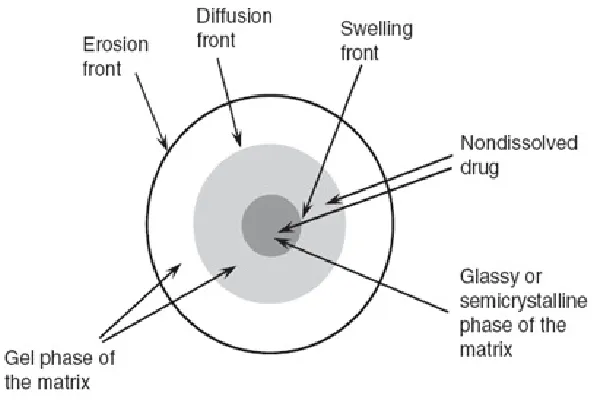
These systems are described in terms of fronts. The following fronts have been defined, with regard to anomalous release systems: the swelling front, the erosion front, and the diffusion front (Figure 3). The swelling front separates the rubbery region (swelling polymer area) which has enough water absorbed within the polymer to lower the glass transition temperature (Tg) of the polymer below the respective environmental temperature allowing for macromolecular mobility and swelling, from the non-swelling polymer region (where the polymer exhibits a Tg that is above the respective environmental temperature). The erosion front separates the matrix from the bulk solution and is the interface between the unstirred layer with polymer-concentration-gradient and the well stirred medium9 .
Dept. of Pharmaceutics J.K.K.Nattraja College of Pharmacy 9
Fig. 2: Fronts in an anomalous release system
In 1985, Peppas introduced a semi-empirical equation describing the drug release behavior from anomalous-release (hydrophilic) matrix systems:
Where,
Q = Fraction of drug release in time (t) t = Time
k = Rate constant (incorporates characteristics of polymer system and drug) n = Diffusional exponent.
Dept. of Pharmaceutics J.K.K.Nattraja College of Pharmacy 10 polymer dissolution. The model also accounts for drug solubility and non-homogenous swelling through the extended release device.
Other extended/ sustained release systems include: 1.5 1.6. Osmotically controlled systems:
These are reservoir systems into which osmotically active agents are incorporated. The dosage form is coated with a semi permeable membrane. The orifice is made in the membrane layer, often with a laser. Bulk solution diffuses through the membrane and dissolves the osmotic agent(s) creating a high osmotic pressure within the reservoir which will push drug solution out of the orifice. In this type of device, drug release follows zero order kinetics and is pH independent.
1.5 1.7. Ion-exchange systems:
Ion exchange resins are water insoluble, cross-linked polymers that have appended ionic groups along the polymer chain. Drugs are bound to these resins and release depends on the ionic environment and electrolyte concentration of the dissolution medium, as well as on the respective properties of a given ion-exchange resin. Drug is released through an exchange process with an appropriately charged molecule from the dissolution medium exchanging location with the appended drug, followed by diffusion of the drug out of the resin and into the bulk medium.
1.5.2. Delayed release systems:
The design of such system involves release of drug only at a specific site in the gastro intestinal tract. The two types of delayed release systems are intestinal release system and colonic release systems.
1.5.2.1. Intestinal release system:
A drug can be enteric coated for intestinal release for several reasons such as to prevent gastric irritation, prevent destabilization in gastric pH.
1.5.2.2. Colonic release system:
Dept. of Pharmaceutics J.K.K.Nattraja College of Pharmacy 11 1.6. Matrix systems 5
A matrix tablet is the simplest and the most cost-effective method to fabricate an sustained-release dosage form. The majority of commercially available matrix formulations are in the form of tablets and their manufacture is similar to conventional tablet formulations consisting of granulation, blending, compression and coating steps. In its simplest form, a typical ER matrix formulation consists of a drug, release retardant polymer (hydrophilic or hydrophobic or both), one or more excipients (as filler or binder), flow aid (glidant) and a lubricant.
1.6.1. Advantages:
It is by far the most commonly used Oral CR technology and the popularity of matrix
systems can be attributed to several factors.
Unlike reservoir and osmotic systems, products based on matrix design can be
manufactured using conventional processing and equipment.
Development time and cost associated with a matrix system generally are viewed
as favorable, and no additional capital investment is required.
Matrix technologies have often proven popular among the oral controlled drug delivery technologies because of their simplicity, ease in manufacturing, high level reproducibility, stability of the raw materials and dosage form, and ease of scale-up and process validation.
In recent years, considerable attention has been focused on hydrophilic polymers in the design of oral controlled drug delivery systems because of their flexibility to obtain a desirable drug release profile, cost-effectiveness, and broad regulatory acceptance.
A matrix system is capable of accommodating both low and high drug load and
active ingredients with a wide range of physical and chemical properties.
1.6.2. Limitations:
As with any technology, matrix systems come with certain limitations.
Matrix systems lack flexibility in adjusting to constantly changing dosage levels,
as required by clinical study outcome. When new dosage strength is deemed
necessary, more often than not a new formulation and thus additional resources
Dept. of Pharmaceutics J.K.K.Nattraja College of Pharmacy 12
Furthermore, for some products that require unique release profiles (e.g., dual
release or delayed plus extended release), more complex matrix-based
technologies such as layered tablets (e.g., Allegra D) will be required.
Nevertheless, we expect continued popularity of matrix systems because they
have demonstrated success across a wide range of product profiles.
1.6.3. Types of matrix system11:
1.6.3.1. Solid matrix (no disintegration, no swelling)
For the first matrix system, only the drug at the surface is released. The release
profile, often expressed as the amount released versus time, isa function of the change of
surface geometry and surface area of the matrix. Therefore, the surface geometry and
surface area play a significant role in dissolution. In addition, where water-soluble
polymers such as polyethylene glycols are used, the viscosity in the diffusion layer
adjacent to the dissolution surface also can contribute to the release profile and release
rate. If the dissolution/erosion surface and the viscosity in the diffusion layer can be
maintained constant during dissolution, a zero-order release profile is obtained. Unless
the drug loading is very high (>50 percent), the dissolution rate of the matrix often is
determined by the properties of excipients, mainly the solubility and viscosity. The more
soluble the excipients and the less viscosity generated in the diffusion layer, the faster is
the matrix dissolution. Since only dissolved drug molecules can be absorbed by the body,
one should understand the fate of drug solid particles after they are released from the
erosion surface of a delivery system. The drug solid particles will start to dissolve in the
dissolution medium once they are released.
The dissolution rate of the drug particles is a function of the solubility of the drug
and their particle size. For drugs with solubilities 10mg/ml or higher, the dissolution rate
of drug particles is usually much faster than the dissolution/erosion rate of matrix
systems. Therefore, the release rate of dissolved drug molecules is almost the same as the
erosion rate of the matrix. On the other hand, for drugs with solubilities of 0.1 mg/ml or
less, the dissolution rate of drug solid particles can be very slow (unless the particles are
Dept. of Pharmaceutics J.K.K.Nattraja College of Pharmacy 13 1.6 3.2. Porous matrix (insoluble, no disintegration, no swelling)
For the second type of matrix system, water penetrates the matrix and dissolves
the drug particles. This is the only system where use of a polymer is not essential to
provide controlled drug release, although insoluble polymers have been used. As the term
suggests, the primary rate-controlling components of a hydrophobic matrix are water
insoluble in nature. These ingredients include waxes, glycerides,fatty acids, and
polymeric materials such as ethyl cellulose and methacrylate copolymers. To modulate
drug release, it may be necessary to incorporate soluble ingredients such as lactose into
the formulation. The presence of insoluble ingredients in the formulations helps to
maintain the physical dimension of a hydrophobic matrix during drug release. As such,
diffusion of the active form from the system is the release mechanism, and the
corresponding release characteristic can be described by the Higuchi equation.
Very often, pores form within a hydrophobic matrix as a result of the release of
the active ingredient. For a porous monolithic system,
--- [4]
Where t is the tortuosity of the matrix.Tortuosity is introduced to account for an increase in diffusion path length owing to branching and bending of the pores. The square
root of time release profile is expected with a porous monolith, whereas the release from
such system is proportional to drug loading. In addition, hydrophobic matrix systems
generally are not suitable for insoluble drugs because the concentration gradient is too
low to render adequate drug release. As such, depending on actual ingredients properties
or formulation design, incomplete drug release within the gastrointestinal (GI) transit
time is a potential risk and needs to be delineated during development [6]. With the
growing need for optimization of therapy, matrix systems providing programmable rates
of delivery become more important7.
In this case, both dissolution and diffusion contribute to the release profile according to
Eq. (5)
--- [5]
Where, C = concentration of dissolved drug inside the matrix
Dept. of Pharmaceutics J.K.K.Nattraja College of Pharmacy 14
D = diffusivity inside the matrix
K = dissolution parameter of the active drug inside the matrix
The first term on the right-hand side of the equation represents diffusion inside a
matrix, and the second term corresponds to the particle dissolution. The dissolved drug
molecules diffuse out of the matrix and are released into the dissolution medium. At
pseudo-steady state (i.e., dC/dt ≈ 0), the drug concentration inside the matrix will be relatively constant or change slowly with time. This pseudo-steady state concentration
inside the matrix will depend on the balance of the dissolution rate of particles and the
diffusion rate of dissolved drug substance. If the dissolution rate is much faster than the
diffusion rate, the pseudo-steady state concentration inside the matrix will be close to the
solubility of the compound. This situation often happens if the solid particles are small or
drug loading is high. On the other hand, if solid particles are large and drug loading is
low, the pseudo-steady state concentration inside the matrix will be lower than the
solubility of the drug substance. Chandrasekaran and Paul have found that for such
systems where dissolution is the rate-limiting step, the release is linear with time, and the
release rate is a zero order, as shown by
--- [6]
where Mt and M∞ = amounts of drug released at time t and infinity
C0 = drug loading
Cs = solubility
D = diffusion constant of drug molecules in the matrix
K = dissolution constant (a function of A/V)
l = thickness of the slab matrix
On the other hand, for systems where diffusion is the rate-limiting step, the release is a
function of the square root of time, as indicated by the Higuchi equation.
--- [7]
At the later stage of drug release, the system is always dissolution controlled
because of the low drug loading encountered. Higuchi developed a model to describe the
release profile of drug solids dispersed in a matrix. This model ignores the dissolution of
Dept. of Pharmaceutics J.K.K.Nattraja College of Pharmacy 15
matrix is the solubility of the compound. This assumption is only true if a delivery system
has high drug loading and is at the early stage of release, where the release is purely
diffusion controlled.
Another study also suggested that in dissolution controlled systems (i.e. systems
with low drug loading, large drug particle size and at the later stage of dissolution), the
drug release from mono dispersed spherical micro particles is a linear function of time, or
the release rate is zero order.
1.6.3.3. Water-soluble hydrophilic swellable matrix
The third matrix system is based on hydrophilic polymers that are soluble in
water. These are drug delivery systems in which therapeutic agent is dispersed in a
compressed matrix made of water swellable polymers which when exposed to aqueous
medium , the surface of polymer hydrates to form a viscous gel layer.
The primary rate-controlling ingredients of a hydrophilic matrix are polymers that
would swell on contact with the aqueous solution and form a gel layer on the surface of
the system. Robust swelling/gelling properties and straightforward manufacturing
processes are to a large degree responsible for the versatility and performance of the
system. Hydroxypropyl methylcellulose (HPMC) is the most commonly used hydrophilic
polymer.
1.7. Dissolution of matrix systems11:
The delivery from these systems often follows a certain time course determined
by the selection of the polymer and the geometry of the matrix. This type of delivery
systems is suitable for reducing the frequency of drug administration, reducing toxicity
for drugs with a small therapeutic window, and correcting poor pharmacokinetic behavior
such as a short half-life. When solid drug particles are embedded in matrix systems, the
release mechanism is more complicated than that of solid-powder systems and largely
depends on the design of the matrix systems. There are many types of matrix systems
where the release can be expressed using different mathematical models. In this section,
Dept. of Pharmaceutics J.K.K.Nattraja College of Pharmacy 16 1.7.1. Surface erodible matrix systems11
The first system is a solid matrix that does not disintegrate nor swell during
dissolution but dissolves from the surface that is exposed to a dissolution medium. In this
case, the drug is released from the eroding surface, and the dissolution profile simply
follows Eq. (8) by the Noyes and Whitney equation,
Written as,
--- [8]
Where,
M = mass
t = time
A = dissolving surface area
D = diffusion coefficient
h = thickness of diffusion layer
Cs = solubility
Cb = concentration in bulk solution
1.7.2. Non erodible systems11
In the second matrix system, the matrix does not change during dissolution
(insoluble, no disintegration, and no swelling). Polymers that are hydrophobic or
cross-linked polymers often are used for the matrix. The drug solid is dissolved inside the
matrix and is released by diffusing out of the matrix. Both dissolution and diffusion
contribute to the release profile of this type of matrix systems. The mathematical
expression for this system can be derived from the following equation:
--- [9]
Where,
C = concentration of dissolved drug inside the matrix
Cs = solubility of the drug inside the matrix
D = diffusivity inside the matrix
Dept. of Pharmaceutics J.K.K.Nattraja College of Pharmacy 17
The first term on the right-hand side of the equation represents diffusion inside a
matrix, and the second term corresponds to the particle dissolution.
1.7.3. Soluble matrix systems
The third matrix system is based on hydrophilic polymers that are soluble in
water. For these types of matrix systems, water-soluble hydrophilic polymers are mixed
with drugs and other excipients and compressed into tablets. On contact with aqueous
solutions, water will penetrate toward the inside of the matrix, converting the hydrated
polymer from a glassy state (or crystalline phase) to a rubbery state. The hydrated layer
will swell and form a gel, and the drug in the gel layer will dissolve and diffuse out of the
matrix. At the same time, the polymer matrix also will dissolve by slow disentanglement
of the polymer chains. This occurs only for un-cross-linked hydrophilic polymer
matrices13-15. When such a system is in contact with an aqueous solution, at the early
stage of release, the swelling of the matrix causes the erosion front to move outward and
the swelling front inward. At the same time, the diffusion front is also receding owing to
dissolution of the drug solid in the gel phase and diffusion of the dissolved drug out of
the matrix.
During the progress of dissolution, the polymer chains at the erosion front begin
to disentangle and dissolve away into the dissolution medium. This surface erosion slows
down the swelling (outward movement of the erosion front) and causes the erosion front
to recede (inward movement of the erosion front) at the later stages of release.
Their release profile and rate are based on the movements of different fronts (erosion
front, diffusion front, and swelling front) during dissolution, as modeled by Eq. (10)
--- [10]
where Mt and M∞ are the amounts of drug released at time t and infinity, and A
and B are constants that are functions of the properties of the polymers, drugs, and
solvents. The solubility, hydration time, and viscosity of the matrix polymers are the
parameters that can be manipulated to change the constants A and B in Eq. (10) and to modify the release profile and rate of a matrix system. Since the properties of a drug to be
Dept. of Pharmaceutics J.K.K.Nattraja College of Pharmacy 18
rate should be considered together with the properties of the embedded drug. Selection of
polymers with low water solubility, high viscosity, and slow hydration times results in a
slow moving erosion front. This makes the constant A in Eq. (10) much larger than
constant B, leading to a slow release rate and Fickian release profile. Similarly, for highly
water-soluble drugs and low drug loading, the diffusion front can move as fast as the
swelling front. The thickness of the gel layer (distance between the erosion front and the
swelling front) controls the release of a drug, and the drug release profile follows Fickian
behavior. For systems with highly water soluble polymers that hydrate quickly and/or
low viscosity, the erosion front moves fast, resulting in a faster drug release rate. In this
case, the constant A,in Eq. (10) is much less than B, leading to a linear time release. This
situation also can happen for high drug loading systems or not very soluble compounds,
where the movement of the diffusion front of these systems may not be as fast as the
swelling front. For these systems, the distance between the diffusion and erosion fronts
controls drug release instead of the thickness of the whole gel layer (distance between the
erosion and swelling fronts). Synchronization of the movement of the diffusion and
erosion fronts leads to a zero-order drug release16,17& 18 . In this case, polymer dissolution
is the release controlling factor.
In summary, polymer dissolution (erosion) and diffusion of drug molecules across
the gel layer have been identified as the rate-controlling mechanisms. Unlike a pure
diffusion-controlled system, the dual release processes make hydrophilic matrices more
suitable for insoluble molecules than other diffusion-controlled systems. That is, through
formulation design, polymer erosion can be modulated to further aid release control of
insoluble compounds12.
1.8. Hydrophilic matrix system
1.8.1. Classification of hydrophilic polymers5:
1. Cellulosic :
Methyl cellulose
Hydroxy ethyl cellulose
Hydroxy propyl methyl cellulose
Dept. of Pharmaceutics J.K.K.Nattraja College of Pharmacy 19
2. Non – cellulosic :
A. Natural gums/Polysaccharides -
Guar gum
Xanthan gum
Karaya gum
Carrageenans
Locust bean gum
Chitosan
Konjac glucomannan etc.
B. Others
Polyethylene oxide
Homopolymers and copolymers of acrylic acid etc.
1. Cellulosic5
Chemically, HPMC is mixed-alkyl hydroxyalkyl cellulose ether containing
methoxyl and hydroxypropoxyl groups. A general structure of cellulose ether polymers. Type and distribution of the substituent groups affect the physicochemical properties such as rate and extent of hydration, surface activity, biodegradation and mechanical plasticity of the polymer.
2. Polysaccharides20
Dept. of Pharmaceutics J.K.K.Nattraja College of Pharmacy 20
Table No. 1. Gums and their sources
Natural gum Source
Xanthan gum Xanthomonas campestris
Guar gum Cyamposis tetragonolobus
Carrageenan Chondrus crispus and Gigartina stellata
Locust bean gum Ceratonia siliqua
Scleroglucan Sclerotium rolfsii
Gellan gum Pseudomonas clodea
3. Others5:
Polymers of acrylic acid are synthetic high molecular weight polymers that are cross-linked with either allyl sucrose or allyl ethers of pentaerythritol. Because these polymers are cross-linked, they are not water soluble but they swell on hydration and form a gel layer. In case of acrylic acid polymers, surface gel formation is not because of the entanglement of the polymer chains (as the polymers are already cross-linked) but because of the formation of the discrete microgels made up of many polymer particles. Polyethylene oxide (PEO) is also a non-ionic water-soluble resin, available in a variety of molecular weight grades ranging from 100,000 to 7,000,000 Daltons. They are the fastest hydrating water-soluble polymers amongst the hydrophilic polymers, which makes PEO products
A suitable choice for applications where slower initial drug release is required.
1.8.2. Drug Release Mechanism:
1.8.2.1 Glassy to rubbery polymer transition
Dept. of Pharmaceutics J.K.K.Nattraja College of Pharmacy 21 could occur even without polymer transition. After a short time, the glassy–rubbery transition of the polymer creates a gel layer that acts as a barrier opposing water and drug transport. An exhaustive treatment of this phenomenon has been given elsewhere21.
When a matrix that contains a swellable glassy polymer comes in contact with a solvent or swelling agent, there is an abrupt change from the glassy to the rubbery state, which is associated with the swelling process. The individual chains, originally in the unperturbed state22, absorb water so that their end-to-end distance and radius of gyration expand to a new solvated state. This is because of the lowering of the transition temperature of the polymer (Tg), which is controlled by the characteristic concentration of the swelling agent and depends on temperature and thermodynamic interactions of the polymer–water system. A sharp distinction between the glassy and rubbery regions is observed and the matrix increases in volume because of swelling. On a molecular basis, this phenomenon can activate a convective drug transport, thus increasing the reproducibility of the drug release. The result is an anomalous non-Fickian transport of the drug, owing to the polymer chain relaxation behind the swelling position. This, turn, creates osmotic stresses and convective transport effects23.
1.8.2.2 The gel layer
Dept. of Pharmaceutics J.K.K.Nattraja College of Pharmacy 22 solution or gastrointestinal fluids, the surface of the tablet is wetted and the polymer hydrates to form a gelly-like structure around the matrix, which is referred to as the “gel layer”. This process is also termed as the glassy to rubbery state transition of the (surface layer) polymer. This leads to relaxation and swelling of the matrix which also contributes to the mechanism of drug release. The core of the tablet remains essentially dry at this stage. In the case of a highly soluble drug, this phenomenon may lead to an initial burst release due to the presence of the drug on the surface of the matrix tablet. The gel layer (rubbery state) grows with time as more water permeates into the core of the matrix, thereby increasing the thickness of the gel layer and providing a diffusion barrier to drug release24 . Simultaneously, as the outer layer becomes fully hydrated, the polymer chains become completely relaxed and can no longer maintain the integrity of the gel layer, thereby leading to disentanglement and erosion of surface of the matrix. Water continues to penetrate towards the core of the tablet, through the gel layer, until it has been completely eroded. Soluble drugs can be released by a combination of diffusion and erosion mechanisms whereas erosion is the predominant mechanism for insoluble drugs25.
Dept. of Pharmaceutics J.K.K.Nattraja College of Pharmacy 23 polymer and polymer–solvent interactions are controlling factors for the gel network structure and erosion.
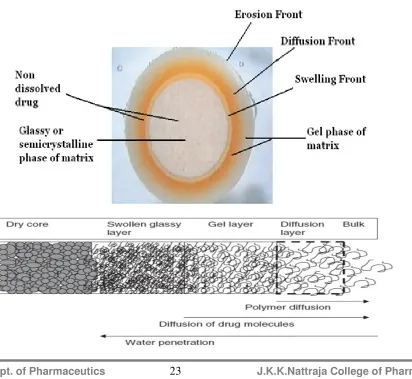
1.8.2.3. Relevant front Description
• The erosion front between the dissolution medium and the erosion (or
dissolving) surface.
• The diffusion front between the dissolved and undissolved drug in the gel (or
swelled) phase.
• The swelling front between the gel phase and the glassy (or semi crystalline)
phase of the matrix.
When such a system is in contact with an aqueous solution, at the early stage of release,
the swelling of the matrix causes the erosion front to move outward and the swelling
[image:53.595.119.531.381.760.2]front inward.
Dept. of Pharmaceutics J.K.K.Nattraja College of Pharmacy 24
At the same time, the diffusion front is also receding owing to dissolution of the
drug solid in the gel phase and diffusion of the dissolved drug out of the matrix. During
the progress of dissolution, the polymer chains at the erosion front begin to disentangle
and dissolve away into the dissolution medium. This surface erosion slows down the
swelling (outward movement of the erosion front) and causes the erosion front to recede
(inward movement of the erosion front) at the later stages of release36. 1.8.2.4. Release Mechanism:
From the previous discussion, it is evident that swellable matrix tablets are activated by water, and drug release is controlled by the interaction between water, polymer and drug. The delivery kinetics depends on the drug gradient in the gel layer. Therefore, drug concentration and thickness of the gel layer governs the drug flux.Drug concentration in the gel depends on drug loading and solubility. Gel-layer thickness depends on the relative contributions of solvent penetration, chain disentanglement and mass (polymer and drug) transfer in the solvent. At the beginning, solvent penetration is more rapid than chain disentanglement, and a rapid build-up of gel layer thickness occurs. However, when the solvent penetrates slowly, owing to an increase in the diffusional distance, little change in gel thickness is obtained, because penetration and disentanglement rates are similar. Thus, the gel-layer thickness dynamics in swellable matrix tablets exhibit three distinct regimes. The thickness increases when solvent penetration is the fastest mechanism, and remains constant when the disentanglement and water penetration occur at a similar rate. Finally, the gel-layer thickness decreases when the entire polymer has undergone the glassy–rubbery transition36. Drug release kinetics are associated with these gel-layer dynamics, ranging initially from Fickian to anomalous (nonFickian), and subsequently from quasi-constant to constant, becoming first-order kinetics in the end. Matrices prepared using swellable polymers of high molecular weight rarely show all of the three regimes during the release time of the drug, because of a low chain disentanglement rate and insufficient external polymeric mass transfer.
Dept. of Pharmaceutics J.K.K.Nattraja College of Pharmacy 25 obtained by drug diffusion through the gel layer, which can dissolve or erode. Recently, a convective contribution to drug transport in the gel layer, owing to the extension of polymer chains, was noted. This supports the anomalous behaviour observed in release kinetics37.
Harland et al. developed a model for drug release based on mass balances of the
drug and the solvent at the swelling front and the erosion front. The release profile was
found to be a combination of Fickian and zero order, as shown by following equation
---[11]
where Mt and M∞ are the amounts of drug released at time t and infinity, and A
and B are constants that are functions of the properties of the polymers, drugs, and solvents. The model suggests that at the early stage of dissolution, the diffusion of
dissolved drug molecules through the gel layer limits the dissolution, and the release
profile is Fickian.
At the later stage of dissolution, when the erosion front starts to recede, dissolution (or
erosion) of the polymer matrix controls the release profile. Therefore, the drug release
approaches zero order, especially when the movements of erosion and swelling fronts are
synchronized. In general, the release profiles from water-soluble polymer matrix systems
often are modeled simply as
Mt/M∞ = ktn --- [12]
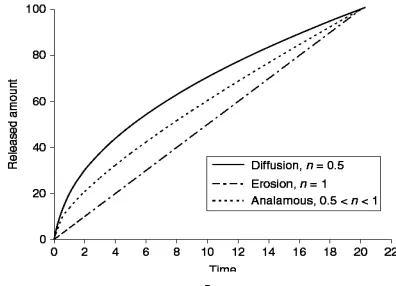
Where k is the kinetic constant that measures the rate of drug release, and n is the release exponent indicative of the release mechanism. If diffusion dominates polymer
erosion, the value of n would approach 0.5. This often happens at the early stage of release when the polymer matrix is swelling. On the other hand, for erosion-controlled
Dept. of Pharmaceutics J.K.K.Nattraja College of Pharmacy 26
Fig.4. Released amount Qt versus time t plots. Three characteristic drug release
profiles from hydrophilic matrices, diffusion, erosional, and anomalous
1.9. Formulation of Hydrophilic Matrices5:
Typical formulation of a hydrophilic matrix consists of drug, polymer and excipients. These components can be compressed into tablets directly or after granulation by dry, wet or hot melt method depending on the nature of the drug, excipients and the preference for process in a particular pharmaceutical company. The various formulation and manufacturing considerations in the design of hydrophilic matrices are listed in following table. The development of hydrophilic matrices has largely been empirical. There is no universal recipe/methodology for designing an ER matrix formulation. One can formulate an ER matrix product with different hydrophilic and/or hydrophobic polymers using various manufacturing principles and processes.
A metformin hydrochloride (HCl) extended-release tablet (Glucophage® XR, Bristol Myers Squibb) is a good example of a use of polymer combinations to achieve a desired release profile. The formulation consists of a dual hydrophilic polymer matrix system where the drug is combined with an ionic release-controlling polymer (sodium carboxy methyl cellulose) to form an “inner” phase, which is then incorporated as discrete particles into an “external” phase of a second non- ionic polymer, HPMC39,40.
Dept. of Pharmaceutics J.K.K.Nattraja College of Pharmacy 27 following sections, some selected fundamental formulation parameters and manufacturing considerations for HPMC matrices are discussed as a general guideline
Key Formulation Considerations:
Table 2: Formulation & manufacturing considerations in the design of hydrophilic
matrices for sustained release of drugs
Material/Process Parameters for considerations
I. Formulation components
a. Drug Solubility & permeability, pka , dose ,
stability, particle size b. Polymer Particle size, type, level c. Excipients
Filler Level/type(solubility) d. Other excipients
1. Lubricants 2. Others
Level/type(Stearates, non-stearates & fatty acids/oils)
Release rate modifiers, stabilizers,
solubilizers, surfactants, buffering agents II. Manufacturing aspects
Manufacturing method
a. Direct compression Particle size of polymer/drug, flow aid b. Dry granulation Slugging/ roller compaction
c. Wet granulation 1. Solvents 2. Binders 3. Process
Aqueous/non- aqueous
Water-soluble/insoluble, enteric polymers, fatty acids/waxes
Low shear High shear
Fluidized bed/foamed granulation 1.9.1. Formulation components
a. Drug Properties
Dept. of Pharmaceutics J.K.K.Nattraja College of Pharmacy 28 free water) and diffuses out into the media. Therefore, it is important to control the factors that affect drug diffusivity (e.g. pH, gel strength and availability of free water) within the gel layer and parameters that ensure integrity of the gel layer after the drug has been dissolved and released from the gel layer. Drug solubility, therefore, is an important factor determining the mechanism of drug release from HPMC hydrophilic matrices, influencing the choice of polymer viscosity, chemistry and choice of excipients. Use of an appropriate viscosity grade will enable a formulation scientist to design matrices based on diffusion, diffusion and erosion or erosion only mechanisms. For water-soluble drugs, high viscosity grades of HPMC (Methocel K4M CR, K15M CR or K100M CR) tend to generate consistent diffusion controlled systems (n approaching, 0.45) . For drugs with poor water solubility, low viscosity grades HPMC (Methocel K100LV CR and E50LV) are recommended where erosion is the predominant release mechanism (n, 0.9). Depending on drug solubility, it may be necessary to blend polymers of different viscosities to obtain an intermediate viscosity grade of HPMC and achieve desired release kinetics. It should be noted that as drug diffusion is dependent on its molecular weight, chemistry and other excipients within the gel layer, drug release too is dependant on these properties [44].
Fig.5. Influence of drug solubility on their release profiles from a Methocel K4M CR
hydrophilic matrix formulation consisting of 30% (w/w) polymer and
Dept. of Pharmaceutics J.K.K.Nattraja College of Pharmacy 29 Above figure shows the influence of drug solubility on release profiles for chlorpheniramine maleate, diclofenac sodium and theophylline from a Methocel K4M CR matrix formulation, keeping all other matrix composition and properties constant45. As aqueous solubility of the drug is decreased, drug release rate also decreases.
For poorly soluble drugs, particle size of the drug has a major influence on its release profile46-48. A decrease in particle size of the drug causes increase in solubility and hence faster drug release rate. Hydrophilic matrix formulation of high-dose drugs (approximating ∼∼∼∼1.0 g) is challenging because of the overall dosage weight limitations versus the quantity of the polymer required to achieve desired release profiles. It has been reported that very large tablets that are formulated to be swallowed whole (e.g. ER and delayed release formulations) lead to poor patient compliance and therefore reduced market acceptability49.
b. Polymer Considerations
Dept. of Pharmaceutics J.K.K.Nattraja College of Pharmacy 30 HPMC form gel layers with higher gel strengths56, which results in slower diffusion and erosion rates and hence slower drug release.
c. Presence of Other Excipients
Fillers:
Soluble (e.g. lactose), insoluble (e.g. microcrystalline cellulose, dicalcium phosphate) and/or partially soluble (e.g. partially pregelatinzed starch) fillers are generally used in hydrophilic matrices to enhance pharmacotechnical properties of tablets (improve compressibility, flow and mechanical strength) or to modify the drug release profile. The inclusion of fillers affects the dissolution performance of a matrix by a “dilution effect” on the polymer. The magnitude of the effect on the performance of matrices is dependant on the drug, the polymer level and the level of excipient itself. The presence of water-soluble fillers in high concentrations in