"H.WWlWftfl Tf*
COMMISSION OF THE EUROPEAN COMMUNITIES
Brussels, 25.06.1996 COM(96) 296 final
96/0160 (CNS )
Proposal for a
COUNCIL REGULATION (EC)
laying down certain technical measures for the conservation of fishery resources
EXPLANATORY MEMORANDUM
At the Council of Ministers of 21-22 December 1995, the Commission presented the "Report of the application of technical measures in the Common Fisheries Policy" (COM(95) 669 final). The report concluded that the technical regulations currently in force (for the Atlantic, Baltic and Mediterranean respectively) have not been effective enough in reducing the catch of juvenile fish, and suggested a series of ways in which their effectiveness could be improved.
On the basis of this document, the Commission committed itself to present, by 1 June 1996, proposals for a modification of existing technical measures that would improve their effectiveness to avoid the catch of juvenile fish. This new regulation, when adopted, will replace Council regulation (EEC) No. 3094/86 laying down technical conservation measures for fisheries in the Atlantic.
The two fundamental aspects to consider in relation with this proposal are the following:
Firstly, two types of measure are proposed to reduce the catch of juvenile fish: to improve the selectivity of towed gear with respect to the existing legislation and to limit the fishing activity in certain areas and seasons where and when juvenile fish are abundant.
Secondly, the experience of the application of the current regulations shows that the existing rules are complex, difficult to understand (to both managers and fishermen) and difficult to enforce. These difficulties contribute to make the regulation less effective. Therefore the current proposal includes provisions that intend to be simple, understandable and enforceable.
The selectivity of towed gear.
The selectivity of towed gear is influenced by a number of factors: mesh size, twine diameter, the use of certain devices (separator trawls, square mesh panels), etc. These possibilities are not mutually exclusive; on the contrary they can be combined in some cases. However, it is understood that the single most effective way to improve the selectivity of towed gear is the increase in mesh size. The proposal therefore concentrates on a general increase in mesh sizes, with respect to the current situation, but also includes provisions on other characteristics of fishing gear. At the same time, the use of square mesh panels to increase species separation or improve selectivity is made mandatory for the larger mesh sizes.
Skagerrak and Kattegat are treated separately. The reason for this is that technical measures in this area are a part of the Agreed Minute signed with Norway in 1982. Although there seems to be little biological reason to justify provisions for Skagerrak and Kattegat different to those for the North Sea, and while the Commission will try to bring the measures in this area in line with those applicable to the rest of the Atlantic, any modification of these measures should be agreed with Norway in the first place. Because of time constraints, consultations with Norway on this issue will be held after the present proposal is adopted by the Commission.
The proposal does not consider authorized or unauthorized mesh sizes. In principle all mesh sizes can be used (except for a certain gap) provided that the species composition retained on board correspond to the percentages established. To the extent possible, the groups of target species corresponding to a given mesh size range are species usually caught together. Moreover, the proposal considers that the number of nets of different mesh size carried on board of different mesh sizes should be minimized, in order to allow an adequate enforcement.
The proposal includes a general increase in the reference mesh sizes. Scientific data show that there are significant long-term gains in yield for some stocks to be expected from this increase. Smaller mesh sizes are also authorized for particular fisheries, and are associated with a percentage of target species retained on board.
Other measures to reduce the catch of juveniles: closed areas/seasons
The catch of juveniles can be reduced by closing certain areas during certain periods of the year where and when juveniles of important species tend to accumulate. For these measures to be effective, the conditions applying to these areas should be as stringent as possible.
Particular attention has been given to the conservation of hake. To this end, the number of areas for protecting hake has been increased, with regard to the legislation currently in place, and the conditions applying to some of them have been made more stringent.
In other cases, however, closed areas/seasons are also established with the aim of protecting spawning adults from fishing. This is the case of herring and demersal species in some areas.
Minimum landing sizes.
Since minimum mesh sizes for towed gear are harmonized, minimum landing sizes are also harmonized. In addition, minimum landing sizes are considered for those species that constitute the most important part of the catch and therefore determine the behaviour of the skippers. These minimum landing sizes correspond, to the extent possible, to the selectivity of the towed gear: for the large demersal species the minimum landing size has been calculated as.the L^ for the mesh size corresponding to each of the species, where selectivity
data exist. L25 for a given mesh size corresponds to the length of the fish for which 25% of
the individuals are retained by the net in question.
That is, these minimum landing sizes are established so that the mesh size appropriate for a particular species or groups of species will tend to catch sized fish.
Structure and presentation.
To make the regulation simple, easy to understand and easy to enforce, the proposal considers two aspects:
(a) substantial aspects. Derogations to the general rules have been kept to a minimum.
(b) formal aspects. The language has been made as direct and clear as possible.
To make the regulation simple:
Some derogations existing in the current regulation only add complexity to the regulation and are no longer justified or necessary. These are not included in the present proposal.
Some administrative requirements related to specific derogations are taken out of the text, to be dealt with by Commission Regulations.
To make the text understandable:
a new, more user-friendly presentation and structure is proposed. Articles are made short and titles are provided to chapters and articles to clarify their content.
Where a derogation or a special provision is introduced, a "whereas" is also provided to explain the reasons justifying such cases. The idea is that all provisions in the regulation are adequately explained.
As to the presentation, the tables on mesh sizes for towed and fixed gear indicate the different ranges of mesh sizes against the target species for them and establish minimum percentages for these target species. The reference in existing regulation to "protected species" is not necessary in this context.
To make the regulation enforceable:
Some ambiguous expressions are improved. An example is that of the term "fishing for...", which is replaced by "retaining on board...". While it is not possible for an inspector to determine what a fisherman is trying to "fish for", the use of the term "retained on board" provides an objective criterion to enforce the provisions in question.
Overall, this proposal represents a significant improvement in the technical measures, in comparison with the existing legislation. In some aspects the present proposal appears as more lenient than the existing regulation (for example, the removal of the "protected species" concept) but these provisions are intended to provide more flexibility to fishermen and to promote a reduction of discards.
Another case in this context is the proposed flexibility for the discarding of species retained on board in excess of the authorized percentages for the mesh size used. While current regulation requires that these excess catches must be discarded immediately, the present proposal provides a flexibility allowing the discard to be done at the end of the fishing trip. This flexibility is intended to reduce by-catches, by allowing fishermen to compensate excess percentages in some hauls with possible lower percentages of target species in subsequent hauls. And, in any case, these elements are largely out weighted by the overall increase in selectivity of the gear introduced in the present proposal.
The Council is requested to adopt this proposal.
Proposal for a
COUNCIL REGULATION (EC) No. .../... laying down certain technical measures for the conservation of fishery resources.
THE COUNCIL OF THE EUROPEAN UNION,
Having regard to the Treaty establishing the European Community and, in particular, Article 43 thereof,
Having regard to the proposal from the Commission,
Having regard to the opinion from the European parliament,1
Having regard to the opinion from the Economic and Social Committee,2
Whereas Council Regulation (EEC) ... constitutes the consolidated version of Council regulation (EEC) 3094/86 of 7 October 1986 laying down certain technical measures for the conservation of fishery resources, which regulation has been frequently and substantially amended;
Whereas experience in the application of Regulation (EEC) No 3094/86, has brought to light certain deficiencies which result in problems of application and enforcement and which should be rectified, notably by reducing the number of different specifications concerning mesh-sizes, by deleting the concept of protected species and by restricting the number of different mesh-sizes that may be kept on board. (Art. 5, 9, Ann. tow. gears); whereas it is therefore appropriate to replace Regulation (EC)... with a new text with the exception of Art. 11 and part of Art.9;
Whereas it is necessary to define principles and certain procedures for establishing technical conservation measures at Community level, so that each Member State can manage fishing activities in the maritime waters under its jurisdiction or sovereignty;
Whereas a balance needs to be established between adapting technical conservation measures to the diversity of the fisheries and the need for homogeneous rules which are easy to apply;
Whereas Article 130r(2) of the Treaty establishes the principle that all Community measures must integrate environmental protection requirements notably in the light of the precautionary principle;
Whereas Council Directive 92/43/EEC of 21.5.1992 lays down measures for conservation of natural habitats and of wild life and fauna; whereas the list of marine organisms contains names of species protected by the requirements of that directive;
O.J. No. C
Whereas to ensure the protection of marine biological resources and the balanced exploitation of fishery resources in the interests of both fishermen and consumers, technical conservation measures should be laid down, specifying inter alia the minimum mesh-sizes appropriate for the capture of certain species and other characteristics of fishing gear, and the minimum landing sizes of marine organisms, as well as limitations of fishing within certain areas and time-periods and with certain gears and equipment;
Whereas in the light of scientific advice, provisions should be made for increases in mesh-sizes of towed gears when fishing for certain species of marine organisms, and provisions should be made for the mandatory use of square-meshed netting, as this can play a significant role in reducing the capture of juveniles of marine organisms;
Whereas to avoid the possibility of using ever smaller mesh sizes for fixed gears, which is resulting in increasing mortality rates for juveniles of the target species of the fisheries concerned, minimum mesh sizes for fixed gears need to be established;
Whereas the species composition of catches and the associated fishing practices in the case of fisheries with fixed gears differ between geographical areas; whereas these differences justify the application of different measures in those areas;
Whereas the catching of certain species to be transformed into fish-meal or fish-oil may be carried out with small mesh sizes, provided that such catching operations do not have a negative influence on other species;
Whereas the practice of discarding should be reduced as much as possible;
Whereas minimum landing sizes need to be applied with respect to species that constitute a major proportion of the landings by Community fleets;
Whereas the minimum landing size of a species should be in accordance with selectivity of the mesh size applicable to that species;
Whereas the manner in which the size of marine organisms is to be measured should be defined;
Whereas protection of nursery areas should be provided for, taking into account the specific biological conditions in the various zones concerned;
Whereas to protect juvenile herring, specific provisions regarding the catching and retaining on board of sprat should be adopted;
Whereas to take into account traditional fishing practice in certain areas, specific provisions regarding the catching and retaining on board of anchovy and tuna should be adopted;
Whereas in order not to hinder scientific research, artificial restocking or transplantation, this Regulation should not apply to operations which may be necessitated by the conduct of such activities;
Whereas certain measures, necessary in the context of conservation, are contained in Council Regulations (EEC) Nos 2930/86, 3760/92 and 2847/93, and therefore need not be reiterated;
Whereas where conservation is seriously threatened, the Commission and the Member States should be authorised to take appropriate provisional measures;
Whereas additional national measures of a strictly local character may be maintained or adopted, subject to examination by the Commission of their compatibility with Community law and conformity with the Common Fisheries Policy;
Whereas where detailed rules on the implementation of this Regulation may be necessary, such measures and rules should be adopted in accordance with the procedure laid down in Article 18 of Regulation (EEC) No 3760/92;
HAS ADOPTED THIS REGULATION :
Article 1
This regulation, laying down technical conservation measures, shall apply to the taking and landing of fishery resources occurring in the maritime waters under the sovereignty or jurisdiction of the Member States and situated in one of the regions specified in Article 2,
except as otherwise provided in Articles 29 and 38.
TITLE I: DEFINITIONS
Article 2
1. For the purposes of this Regulation, the following definitions of maritime waters shall apply :
Region 1:
All waters which lie to the north and west of a line running from a point at latitude 48° N, longitude 18° W, thence due north to latitude 60° N, thence due east to longitude 5° W, thence due north to latitude 60°30' N, thence due east to longitude 4° W. thence due north to latitude 64° N, thence due east to the coast of Norway.
. Region 2:
All waters situated north of latitude 48° N, but excluding the waters in Region 1 and ICES Divisions Illb, IIIc and Hid.
Region 3:
All waters corresponding to ICES Sub-areas VIII and IX.
Region 4:
Region 5:
All waters situated in that part of the east central Atlantic comprising divisions 34.1.1, 34.1.2 and 34.1.3 and subarea 34.2.0 of fishing zone 34 of the CECAF region.
Region 6:
All waters off the coasts of the French department of Guyana that come under the sovereignty or jurisdiction of said department.
Region 7:
All waters off the coasts of the French departments of Martinique and Guadeloupe that come under the sovereignty or jurisdiction of said departments.
Region 8:
All waters off the coasts of the French department of Réunion- that come under the sovereignty or jurisdiction of said department.
2. The geographical areas designated in this regulation by the letters "ICES" and "CECAF" shall be those defined by the International Council for the Exploration of the Sea, and the Fishery Committee for Eastern Central Atlantic, respectively. They are described, subject to any subsequent amendments, in Commission Communications No 85/C 335/02 and No 85/C 347/05.
3. The regions referred to in paragraph 1 may be divided into geographical areas, in particular on the basis of the definitions referred to in paragraph 2, in accordance with the procedure referred to in Article 52.
4. Notwithstanding paragraph 2, for the purposes of this regulation:
- the Kattegat is limited in the north by a line drawn from Skagen Lighthouse to the lighthouse in Tistlarna, and from there to the nearest point on the Swedish coast, and in the south by a line drawn from Hasenore Head to Gniben Point, from Korshage to Spodsbjerg, and from Gilbjerg Head to the Kullen,
- the Skagerrak is limited in the west by a line drawn from the lighthouse of Hanstholm to the lighthouse of Lindesnes, and in the south by a line drawn from Skagen Lighthouse to the lighthouse of Tistlarna, and from there to the nearest point on the Swedish coast,
- the North Sea shall comprise ICES Sub-area IV, the adjacent part of ICES Division Ha lying south of latitude 64° N, and that part of ICES Division Ilia which is not covered by the definition of the Skagerrak given in the second indent of this paragraph.
Article 3
Article 4
For the purposes of this regulation:
a) the "minimum mesh size" of a net is the mesh size in that part of the net having the smallest meshes,
b) "square-meshed netting" shall mean a section of netting mounted so that of the two sets of parallel lines fonned by the mesh bars, one set is parallel to, and the other at right angles to, the long axis of the net,
c) "bottom set gill nets" or "entangling nets" are any fixed gear made up of a single piece of net, fixed by any means to the bottom of the sea,
TITLE II: NETS AND CONDITIONS FOR THEIR USE
CHAPTER I: PROVISIONS FOR TOWED NETS
Article 5
1. For each of the regions or geographical areas mentioned in Annexes II, III and IV, and depending where applicable on the time-period, it is prohibited to use any trawl, Danish seine or similar towed net unless:
its minimum mesh size corresponds to one of the categories set out in that annex, and
the catch taken with that net and retained on board includes a percentage of target species equal to or greater than that specified for the mesh size category set out in that annex.
2. The minimum percentage of target species may be obtained by aggregating the quantities of all the target species caught.
Article 6
1. The percentages referred to in Annexes II, III and IV shall be calculated as the proportion by weight of all marine organisms on board after sorting or on landing.
2. The percentages may be calculated on the basis of one or more representative samples.
3. Notwithstanding paragraph 1, catches of sandeel retained on board and caught with nets having mesh sizes smaller than 16 millimetres, the percentage may be measured before sorting.
4. For the purpose of this article, the equivalent weight of whole Norway lobster shall be obtained by multiplying the weight of Norway lobster tails by three.
Article 7
i
It is prohibited to have on board or to use any trawl, Danish seine or similar towed net havina more than 100 meshes in the circumference of the cod-end, excluding the joinings and selvedges.
Paragraph 1 shall apply to nets of which the minimum mesh size is equal to or greater than 70 mm.
Article 8
The following conditions shall apply to any section of square-meshed netting as referred to in paragraph 1 :
(a) it shall be at least 3 metres in length,
(b) it shall be attached along each lengthwise edge to the net in such a way that the stretched length of that part of the net to which the section of square-meshed netting is attached, is the same as the stretched length of the section of square-meshed netting along that lengthwise edge,
(c) it shall cover at least 90% of the width of that part of the net into which it is inserted.
It is prohibited to retain on board any quantity of prawns caught with towed net having any mesh size between 32 and 54 millimetres, unless the upper part of the net is equipped with a section of square-meshed netting having a minimum mesh-size which is double that of the cod-end.
(a) It is prohibited to retain on board any quantity of deepwater rose shrimp caught with demersal towed net having any mesh size between 55 and 60 millimetres, unless the upper part of the net is equipped with a section of square-meshed netting having a minimum mesh-size which is double that of the cod-end.
(b) However, it shall be permitted to retain on board quantities of deepwater rose shrimp caught with the net described in subparagraph (a), provided they do not exceed 5% of the total weight of the marine organisms on board which have been caught with said net.
Article 9
It is prohibited for vessels which carry on board or use any towed net with a minimum mesh size equal to or greater than 110 millimetres simultaneously to carry on board or to use any other towed net with a minimum mesh size less than 110 millimetres.
Vessels may carry on board or use towed nets of two different minimum mesh sizes, provided that one of these minimum mesh sizes falls within the range of 0 through 60 millimetres, and the other of these minimum mesh sizes falls within the range of 70 through 109 millimetres.
In this case, and derogating from the provisions of Article 5, the minimum percentage of target species that must be retained on board shall be 85%. This percentage shall apply to thetarget species as defined for the net or nets with the larger of the two mesh sizes that are being kept on board.
Article 10
1. It is prohibited to carry on board or to use any towed nets constructed wholly or in part of netting materials having a twine diameter of more than 8 millimetres.
2. It is prohibited to carry on board or to use any towed nets constructed wholly or in part of netting materials consisting of multiple twine.
Article 11
1. It is prohibited to carry on board or to use any towed net constructed wholly or in part of any type of mesh other than square mesh or diamond mesh.
2. Paragraph 1 shall not apply to towed net with a minimum mesh size of 31 millimetres or less.
Article 12
Dredges are exempted from the provisions of Article 5, provided that the quantities of marine organisms retained on board and caught with these nets, other than bivalve molluscs, do not exceed 10% of the total weight of the marine organisms on board.
CHAPTER II: PROVISIONS FOR FIXED GEARS
Article 13
1. For each of the regions or geographical areas mentioned in Annexes V and VI, and depending where applicable on the time-period, it is prohibited to use or to keep on board any bottom set gillnet, entangling net or trammel net unless:
the catch taken with that net and retained on board includes a percentage of target species no less than 70%, and
in the case of bottom set gillnets and entangling nets: its mesh size corresponds to one of the categories set out in the relevant annex,
in the case of trammel nets: its mesh size in that part of the net having the smallest meshes corresponds to one of the categories set out in the relevant annex.
2. The minimum percentage of target species may be obtained by aggregating the quantities of all the target species caught.
Article 14
1. The percentage referred to in Article 13 paragraph 1 shall be calculated as the proportion by weight of all marine organisms on board after sorting or on landing.
Article 15
Articles 13 and 14 shall not apply to catches of salmonids, lampreys or hagfish.
CHAPTER III: GENERAL PROVISIONS ON NETS AND CONDITIONS FOR THEIR USE
Article 16
Sorting shall be carried out immediately after hauling.
Article 17
1. Quantities of marine organisms retained on board in excess of permitted percentages according to Annexes II through VI shall be discarded into the sea at any time prior to return to port.
2. Paragraph 1 shall apply to marine organisms other than those defined as target species for any one of the mesh size categories set out in Annexes II through VI.
Article 18
No device shall be used by means of which the mesh in any part of the fishing net is obstructed or otherwise effectively diminished.
TITLE III: MINIMUM SIZE OF MARINE ORGANISMS
Article 19
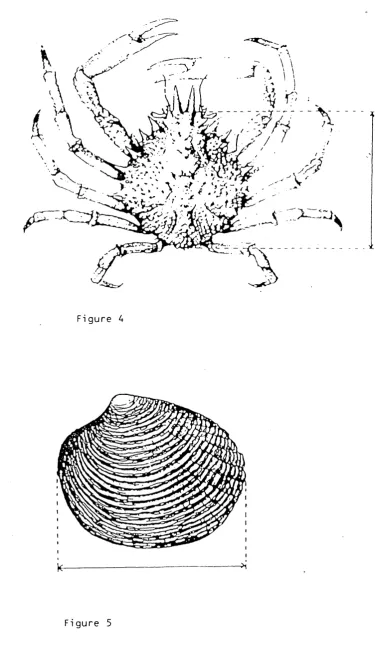
A marine organism is undersized if its dimensions are smaller than the minimum dimensions specified in Annex VII for the relevant species and the relevant geographical area.
Article 20
1. The measurement of the size of a marine organism shall take place in accordance with the provisions laid down in Annex VIII.
2. Where more than one method of measuring the size of a marine organism is provided for, the organism is considered to be of the minimum size if the application of any one of these methods results in a size equal to or greater than the corresponding minimum size.
3. Bivalve molluscs, edible crabs and lobsters may only be landed whole.
Article 21
1. Undersized marine organisms must not be retained on board or be transhipped, landed, transported, stored, sold, displayed or offered for sale, but must be discarded immediately into the sea.
2. Paragraph 1 shall not apply to :
a) herring, horse mackerel and mackerel, within a limit of 10% by weight of the total catches retained on board of these species,
b) marine organisms other than those defined in Annexes II, III and IV as target species for the mesh size categories 0-15 or 16-31, and caught with towed gear of a mesh size less than 32 millimetres, provided that said organisms are not sorted and are not sold, displayed or offered for sale for human consumption.
3. However, undersized anchovy, horse mackerel or mackerel caught for use as live bait may be retained on board, provided they are retained alive.
Article 22
1. The percentage of undersized marine organisms shall be calculated as the proportion by weight of all marine organisms on board after sorting or on landing.
2. The percentage may be calculated on the basis of one or more representative samples.
TITLE IV: SPECIAL PROVISIONS RELATING TO FISHING FOR CERTAIN MARINE ORGANISMS
Article 23
Restrictions on fishing for herring
1. It is prohibited to retain on board herring which are caught within the geographical areas and during the periods mentioned below :
a) from 1 January through 50 April, within the geographical area situated to the north-east of a line drawn between Mull of Kintyre and Corsewall Point.
b) from 1 July through 31 October, within the geographical area bounded by the following coordinates:
the west coast of Denmark at latitude 55°30'N, latitude 55°30'N, longitude 07°00'E,
latitude 57°00'N, longitude 07°00'E,
the west coast of Denmark at latitude 57°00'N.
c) from 15 August through 15 September, within the zone extending from six to twelve miles off the east coast of the United Kingdom as measured from the baselines between latitudes 55°30'N and 55°45'N.
d) from 15 August through 30 September, within the geographical area bounded by a line joining the following points:
- the Butt of Lewis, - Cape Wrath,
- latitude 58°55'N, longitude 05°00'W, - latitude 58°55'N, longitude 07°10'W, - latitude 58°20'N, longitude 08°20'W, - latitude 57°40'N, longitude 08°20'W,
- the west coast of North Uist at latitude 57°40'N, then along the north coast of the island as far as latitude 57°40'36"N, longitude 07°20'39"W,
- latitude 57°50'3"N, longitude 07°8'6"W,
- north-east along the west coast of Lewis as far as the point of departure (Butt of Lewis).
e) • from 15 August through 30 September, within the zone extending from six to twelve miles off the east coast of the United Kingdom as measured from the baselines between latitudes 54°10'N and 54°45'N.
f) from 21 September through 31 December, within the parts of ICES Division Vila bounded by the following coordinates:
- the east coast of the Isle of Man at latitude 54°20'N, - latitude 54°20'N, longitude 3°40'W,
- latitude 53°50'N, longitude 3°50'W, - latitude 53°50'N, longitude 4°50'W,
- the south-west coast of the Isle of Man at longitude 4°50'W.
and
- the east coast of Northern Ireland at latitude 54°15'N, - latitude 54°15'N, longitude 5°15'W,
- latitude 53°50'N, longitude 5°50'W,
- the east coast of Ireland at latitude 53°50'N.
g) throughout the year within ICES Division Vila, in the geographical area between the west coasts of Scotland, England and Wales, and a line drawn twelve miles from the baselines of the coasts bounded to the south by latitude 53°20'N and the north-west by a line drawn between the Mull of Galloway (Scotland) and the Point of Ayre (Isle of Man).
h) throughout the year within Logan Bay, defined as being the waters east of a line drawn from the Mull of Logan situated at latitude 54°44'N and longitude 4°59'W, to Laggantalluch Head, situated at latitude 54°41'N and longitude 4°58'W.
i) In 1998 and every third year afterwards, and throughout the year , within the area bounded by the following coordinates:
- the south coast of Ireland at longitude 9°00'W, - latitude 51 ° 15'N, longitude 9°00'W,
- latitude 51°15'N, longitude 7°30'W, - latitude 52°00'N, longitude 7°30'W,
- the south-east coast of Ireland at latitude 52°00'N.
j) In 1999 and every third year afterwards, within the areas bounded by the following
coordinates :
• i) from 15 January through 31 January:
the south-east coast of Ireland at latitude 52°00'N, latitude 52°00'N, longitude 6°00'W,
latitude 52°30'N, Longitude 6°00'W,
the south-east coast of Ireland at latitude 52°30'N.
ii) from 1 November through 15 November:
- the south coast of Ireland at longitude 9°00'W, - latitude 51°15TSI, longitude 9°00'W,
- latitude 51 ° 15*N, longitude 11 °00*W, - latitude 52°30*N, longitude 11°00'W,
- the east coast of Ireland at latitude 52°30'N.
2.. However, it is permitted to retain on board quantities of herring from any of the areas described, provided they do not exceed 5% of the total weight of the marine organisms on board which have been caught in each separate area during one of the periods specified.
Article 24
Restrictions on fishing for sprat to protect herring
1. It is prohibited to retain on board sprat which are caught within the geographical areas and during the periods mentioned below :
a) from 1 January through 31 March, and from 1 October through 31 December, within ICES statistical area 39E8. For the purpose of this regulation, this ICES area shall be the area bounded by a line due east from the United Kingdom east coast along latitude 55°00'N to a point at longitude 1°00'W, from there due north to a point at latitude 55°30'N and from there due west to the United Kingdom coast.
b) from 1 January through 31 March, and from 1 October through 31 December, within the inner waters of the Moray Firth west of longitude 3°30'W, and in the inner waters of the Firth of Forth west of longitude 3°00'W.
c) from 1 July through 31 October, within the geographical area bounded by the following coordinates:
the west coast of Denmark at latitude 55°30'N, - latitude 55°30'N, longitude 07°00'E,
- latitude 57°00'N, longitude 07°00'E,
the west coast of Denmark at latitude 57°00'N.
2. However, it is permitted to retain on board quantities of sprat from any of the areas described, provided they do not exceed 5% of the total weight of the marine organisms on board which have been caught in each separate area during one of the periods specified.
Article 25
Restrictions on fishing for mackerel
1. It is prohibited to retain on board mackerel which are caught within the geographical area bounded by the following coordinates:
- a point on the south coast of the United Kingdom at longitude 02°00' W, - latitude 49°30" N, longitude 02°00' W,
- latitude 49°30* N, longitude 07°00' W,
- a point on the west coast of the United Kingdom at latitude 52°00' N,
unless the weight of the mackerel does not exceed 15% by weight of the total quantities of mackerel and other species on board which have been caught in this area.
2. Paragraph 1 shall not apply:
(a) to vessels fishing exclusively with gill nets and/or hand lines;
(b) to vessels fishing with bottom trawls, Danish seines or other similar towed nets, provided that they have on board a minimum of 75% by weight of marine organisms with the exception of anchovy, herring, horse mackerel, mackerel, pelagic cephalopods and sardine, calculated as a percentage of the total weight of all the species on board;
(c) to vessels in transit through this area, provided that all fishing gear is stowed in accordance with the provisions laid down in Article 20 paragraph 1 of Council Regulation (EEC) No 2847/93;
(d) to vessels which are not equipped for fishing and to which mackerel are being transhipped.
Article 26
Restrictions on fishing for anchovy
1. It is prohibited to retain on board anchovy which are caught using pelagic trawls in ICES Division VIIIc.
2. Within that Division, it is prohibited simultaneously to carry on board pelagic trawls and purse seines.
Article 27
Restrictions on fishing for tuna
1. It is prohibited to retain on board any quantity of skipjack, bigeye or longfin tuna which are caught using purse seines in waters under the sovereignty or jurisdiction of Portugal in ICES sub-area X north of 36°30'N, or in CECAF areas north of 31°N and east of 17°30'W.
2. It is prohibited to retain on board tuna which are caught using drift nets in waters under the sovereignty or jurisdiction of Spain or Portugal in ICES sub-areas VIII, IX or X, or, in CECAF areas around the Canary Islands.
Article 28
Restrictions on fishing for shrimps to protect flatfish
1. It is prohibited to retain on board any quantity of common shrimps and Aesop shrimps caught with demersal towed gear having any mesh size between 16 and 31 millimetres unless:
- the vessel has permanently installed on board a functioning sieve designed to separate juvenile flatfish from common shrimps and Aesop shrimps, and,
- a separator trawl or a net with a sorting grid is being used for catching said species.
2. However, it is permitted to retain quantities of common shrimp or Aesop shrimp on board of fishing vessels that do not comply with the provisions laid down in paragraph 1, provided these quantities do not exceed 5% of the total weight of the marine organisms on board.
Article 29
Restrictions on fishing for salmon and sea trout
1. Salmon and sea trout must not be retained on board or be transhipped, landed, transported, stored, sold, displayed or offered for sale, but must be returned immediately to the sea, when taken:
- within the waters situated outside the 12-mile limit measured from Member States' baselines in regions 1,2,3 and 4,
- by way of derogation from Article 2 paragraph 1, outside the waters under the sovereignty or jurisdiction of the Member States in regions 1, 2, 3 and 4, except in the waters under the jurisdiction of Greenland and the Faroe Islands,
- when fishing with any towed net.
2. This article shall not apply to salmon and sea trout taken within the Skagerrak and Kattegat.
Article 30
Restrictions on fishing for Norway pout to protect other roundfish
1. It is prohibited to retain on board Norway pout which are caught with any towed gear in the area which is bounded by a line joining the following points:
- a point at 56°N on the east coast of the United Kingdom as far as 2°E,
- then running north to 58°N, west to 0°30'W, north to 59°15'N, east to 1°E, north to 60°N, west to longitude 0°00*,
- from there north to 60°30'N, west to the coast of the Shetland Isles, then west from 60°N on the west coast of the Shetlands to 3°W, south to 58°30'N,
- and finally west to the coast of the United Kingdom.
2. However, it is permitted to retain on board quantities of Norway pout from the area and caught with the gear described in paragraph 1, provided they do not exceed 5% of the total weight of the marine organisms on board which have been caught in said area with said gear.
Article 31
Restrictions on fishing for hake
1. It is prohibited to fish with any trawl, Danish seine or similar towed net in the geographical areas and during the periods mentioned below :
a) from 1 April to 31 July, within the geographical areas bounded by a line joining the following coordinates:
- latitude 51°35'N, longitude 11°40'W, - latitude 51°35'N, longitude 11°25'W, - latitude 51 °25'N, longitude 11 °25'W, - latitude 51 °25'N, longitude 11 °40'W.
b) from 1 May to 31 July, within the geographical areas bounded by a line joining the following coordinates:
- latitude 51 °00'N, longitude 11 °35'W, - latitude 51°00'N, longitude H°25'W, - latitude 49°40'N, longitude H°25'W, - latitude 49°40'N, longitude 11°35'W.
and
latitude 50°30'R longitude 10°30'W, latitude 50°30'N, longitude 09°20'W, latitude 50°45'N, longitude 09°20'W, latitude 50°45'N, longitude 10°30'W.
and
latitude 51°45'N, longitude 14°30'W, latitude 51°45'N, longitude 13°00' W, latitude 52°30'N, longitude 13°00'W, latitude 52°30'N, longitude 14°30'W.
and
- latitude 48°10*N, longitude 09°40*W, - latitude 48°10'N, longitude 09°10'W, - latitude 48°40'N, longitude, 09°10'W, - latitude 48°40'N, longitude 09°40'W.
c) from 1 September to 31 December, within the geographical area bounded by a line joining the following coordinates :
- the point on the north coast of Spain called Cabo Prior (latitude 43°34'N, longitude 8°19'W),
- latitude 43°50'N, longitude 8°19'W, - latitude 43°25'N, longitude 9°12'W,
- the point on the west coast of Spain called Cabo Villano (latitude 43°10'N, longitude 9°12'W).
d) from 1 October to 31 December, within the geographical area bounded by a line joining the following coordinates :
- the point on the west coast of Spain called Cabo Corrubedo (latitude 42°35'N, longitude 9°05'W),
- latitude 42°35'N, longitude 9°25'W, - latitude 43°00'N, longitude 9°30'W,
- the point on the west coast of Spain at latitude 43°00'N.
e) from 1 December to the last day of February in the following year, within the geographical area bounded by a line joining the following coordinates :
- a point on the west coast of Portugal at latitude 37°50'N, - latitude 37°50'N, longitude 9°03'W,
- latitude 37°00*N, longitude 9°06'W,
- a point on the west coast of Portugal at latitude 37°00'N.
1) from 1 December to the last day of February in the following year, within the geographical area bounded by a line joining the following coordinates:
- latitude 41°32T'N, longitude 09°07'3"W, - latitude 41°20'7"N, longitude 09°05T"W, - latitude 41 ° 12'0"N, longitude 09°02'7"W, • - latitude 41°02'8"N, longitude 08°59'0"W,
- latitude 40°38'5"N, longitude 09°04'6"W, - latitude 40°27'5"N, longitude 09°08'2"W, - latitude 40° 11T"N, longitude 09°13'8"W, - latitude 40°11T"N, longitude 09°33'5"W, - latitude 40°27'5"N, longitude 09°32,0"W,
- latitude 40°38*5"N, longitude 09°19'5"W, - latitude 41°02'8"N, longitude 09°19*0"W,
- latitude 4ri2'0"N, longitude 09° 16' 1 "W, - latitude 41°207"N, longitude 09°07'8"W, - latitude 41°32'1"N, longitude 09°14T'W.
Additionally, is prohibited to fish with demersal fixed gears in the are^ and during the period mentioned above.
g) Throughout the year, within the geographical areas bounded by a line joining the following coordinates:
- latitude 47°40'N, longitude 4°40'W, - latitude 47°28'N, longitude 4°40'W, - latitude 47°23'N, longitude 3°45'W, - latitude 47°35'N, longitude 3°45'W.
and
- latitude 46°50'N, longitude 3°31'W, - latitude 45°55'N, longitude 2°45'W, - latitude 46°15'N, longitude 2°35'W, - latitude 46°50'N, longitude 3°20'W.
and
- latitude 45°55'N, longitude 2°40'W, - latitude 45°45'N, longitude 2°40'W, - latitude 45°45'N, longitude 1°55'W, - latitude 45°55'N, longitude 2°00'W.
2. Within the zones and during the periods referred to in paragraph 1, it is prohibited to carry on board any towed net, unless such a net is stowed in accordance with the provisions laid down in Article 20 paragraph 1 of Council Regulation (EEC) No 2847/93.
3. Within the zones, and outside of the periods referred to in paragraph 1, it is prohibited to carry on board or to use any towed net with a minimum mesh size of less than 80 millimetres.
Article 32
Restrictions on fishing for plaice
1. It is prohibited for any vessel exceeding 8 metres length overall to use any beam trawl, otter trawl or bottom pair trawl inside the following geographical areas:
(b) the area bounded by a line joining the following coordinates:
- a point on the west coast of Denmark at latitude 57°00'N, - latitude 57°00*N, longitude 7°15'E,
- latitude 55°00'N, longitude 7°15'E, - latitude 55°00'N, longitude 7°00'E, - latitude 54°30'N, longitude 7°00'E, - latitude 54°30'N, longitude 7°30*E, - latitude 54°00'N, longitude 7°30'E, - latitude 54°00'N, longitude 6°00'E, - latitude 53°50'N, longitude 6°00'E, - latitude 53°50*N, longitude 5°00*E, - latitude 53°30'N, longitude 5°00'E, - latitude 53°30'N, longitude 4°15'E, - latitude 53°00'N, longitude 4°15'E,
- a point on the coast of the Netherlands at latitude 53°00'N.
(c) the area within 12 miles of the west coast of Denmark from latitude 57°00' N as far north as the Hirtshals Lighthouse, measured from the baselines.
(a) However, vessels
- whose names and technical characteristics are contained on a list which shall be drawn up in accordance with the procedure laid down in Article 52,
- and to which a special fishing permit has been issued in accordance with Article 7 paragraph 3 of Council Regulation (EEC) No 1627/94 of 27 June 1994,
are authorized to fish in said areas using beam trawls.
(b) Vessels which may appear on the list referred to in subparagraph (a) must comply with the following criteria:
- be listed on the nominative list of vessels contained in Commission Regulation (1-1-1996),
- their engine power does not exceed 221 kW and, in the case of derated engines did not exceed 300 kW before derating.
(c) Any individual vessel on the list may be replaced by another vessel, provided that
- the engine power of the replacement vessel does not exceed that of the vessel replaced and
- the length overall of the replacement vessel does not exceed 24 metres.
(d)The engine of any individual vessel on the list may be replaced, provided that
- the replacement engine is not derated and
- the power of the replacement engine does not exceed that of the engine replaced.
3. Notwithstanding paragraph 2 subparagraph (a), it is prohibited to use any beam trawl of which the beam length or beam trawls of which the aggregate beam length is greater than 9 metres, or can be extended to a length greater than 9 metres, except when operating with gear having a mesh size between 16 and 31 millimetres.
4. a) By way of derogation from paragraph 1:
- vessels whose engine power does not exceed 221 kW and, in the case of derated engines did not exceed 300 kW before derating, are authorized to fish in said areas using otter trawls.
- paired vessels whose combined engine power does not exceed 221 kW and, in the case of derated engines did not exceed 300 kW before derating, are authorized to fish in said areas using bottom pair trawls.
b) However, vessels whose engine power exceeds 221 kW shall be permitted to use otter trawls, or paired vessels whose combined engine power exceeds 221 kW shall be permitted to use bottom pair trawls, provided that:
(i) the catch retained on board consists of sand-eel and/or sprat, and constitutes at least 90% of the total weight of the marine organisms on board, and,
(ii) the quantities of plaice and/or sole retained on board do not exceed 2% of the total weight of the marine organisms on board,
or
(iii) the mesh size used is at least 110 millimetres, and
(iv) the quantities of plaice and/or sole retained on board do not exceed 5% of the total weight of the marine organisms on board.
5. Fishing vessels which do not comply with the criteria specified in paragraphs 2 through 4. shall not be allowed to engage in the fishing activities referred to in those paragraphs.
6.. Detailed rules for the implementation of this article shall be drawn up in accordance with the procedure laid down in Article 52.
7. Within areas where beam trawls, otter trawls or bottom pair trawls may not be used, it is prohibited to carry on board such nets, unless they are stowed in accordance with the provisions laid down in Article 20 paragraph 1 of Council Regulation (EEC) No 2847/93.
Article 33
Restrictions on fishing for sole and plaice
From 1 February to 31 May it is prohibited to fish with any demersal towed gear in the geographical area bounded by a line joining the following coordinates:
a point on the west coast of the United Kingdom at longitude 03°40'W, - latitude 53°40'N, longitude 03°40'W,
a point on the west coast of the United Kingdom at latitude 53°40'N.
Article 34
Restrictions on fishing for demersal fish
From 1 March to 30 April it is prohibited to fish with any demersal towed gear in the geographical area bounded by a line joining the following coordinates:
a point on the west coast of the United Kingdom at latitude 50°15'N, - latitude 50°15'N, longitude 06°00'W,
- latitude 51°00'N, longitude 06°00'W, - latitude 51°00'N, longitude 04°40*W,
a point on the west coast of the United Kingdom at longitude 04°40W.
TITLE V: RESTRICTIONS ON CERTAIN TYPES OF FISHING AND ASSOCIATED ACTIVITIES
Article 35
Restrictions on the use of beam trawls
1. It is prohibited for a vessel to have on board or to use any beam trawl of which the beam length, or beam trawls of which the aggregate beam length measured as the sum of the length of each beam, is greater than 24 metres or can be extended to a length greater than 24 metres. The length of a beam shall be measured between its extremities including all attachments thereto.
2. It is prohibited for a vessel to have on board or to use any beam trawl of which the minimum mesh size lies between 32 and 109 millimetres within either of the following geographical areas:
(a) the North Sea north of a line joined by the following points:
- a point on the east coast of the United Kingdom at latitude 55°N, - then east to latitude 55°N, longitude 05°E,
- then north to latitude 56°N,
- and finally east to a point on the west coast of Denmark at latitude 56°N;
(b) the area west of Scotland north of latitude 56°N.
Article 36
Unconventional fishing methods
It is prohibited fish with methods incorporating the use of explosives, poisonous or stupefying substances, electric current, or guns.
Article 37
Restrictions on the use of automatic sorting equipment
1. It is prohibited for vessels carrying or using either towed gear with a mesh size smaller than 55 mm or purse seines to carry automatic sorting equipment on board.
2. However, freezer vessels shall be authorized to carry automatic sorting equipment on board, provided that its sole function is commercial grading of all the fish caught and intended for freezing. Automatic sorting equipment must be installed in such a way, that following grading the catch is immediately frozen for marketing and cannot easily be discarded into the sea.
Article 38
Restrictions on the use of purse seines
1. It is prohibited to undertake any encirclement with purse seines of any school or group of marine mammals.
2. Notwithstanding Article 1, paragraph 1 of the current article shall apply to all vessels flying the flag of, or registered in a Member State, in all waters.
Article 39
Restrictions on fishing activities in the 12-mile-zones around the United Kingdom and Ireland
1. It is prohibited for any vessel to use any beam trawl inside the areas within 12 miles of the coasts of the United Kingdom and Ireland, measured from the baselines from which the territorial waters are measured.
2. However, vessels in any of the following categories are authorized to fish in said areas using beam trawls: "•b
(a) a vessel which entered into service before 1 January 1987, and whose engine power does not exceed 221 kW, and in the case of derated engines did not exceed 300 kW before derating;
(b) a vessel which entered into service after 31 December 1986 whose engine is not derated, whose engine power does not exceed 221 kW, and whose length overall does not exceed 24 metres;
(c) a vessel which had its engine replaced after 31 December 1986 with an engine which is not derated and whose power does not exceed 221 kW.
3. Notwithstanding paragraph 2, it is prohibited to use any beam trawl of which the beam length or beam trawls of which the aggregate beam length is greater than 9 metres, or can be extended to a length greater than 9 metres, except when operating with gear having a mesh size between 16 and 31 millimetres.
4. Fishing vessels which do not comply with the criteria specified in paragraphs 2 and 3, shall not be allowed to engage in the fishing activities referred to in those paragraphs.
5. Detailed rules for the implementation of this article shall be drawn up in accordance with the procedure laid down in Article 52.
6. The vessels which may not use beam trawls are prohibited to carry on board such nets within the areas referred to in this article, unless they are stowed in accordance with the provisions laid down in Article 20 paragraph 1 of Council Regulation (EEC) No 2847/93.
TITLE VI: SPECIFIC PROVISIONS FOR THE SKAGERRAK AND KATTEGAT
Article 40
Notwithstanding Article 21 paragraph 1, undersized marine organisms caught in the Skagerrak or Kattegat may be retained on board, or be transhipped, landed, transported, stored, sold, dispayed or offered for sale within a limit of 10% by weight of the total catches retained on board.
Article 41
Salmon and sea trout must not be retained on board or be transhipped, landed, transported, stored, sold, displayed or offered for sale, but must returned immediately to the sea, when taken within any part of the Skagerrak and Kattegat situated outside the 4-mile-limit measured from Member States' baselines.
Article 42
1. It is prohibited to use trawls having a mesh size of less than 32 mm from 1 July through 15 September in the waters situated within three miles of the baselines in the Skagerrak and Kattegat.
2. However, when trawling within said waters and during said period:
- for northern shrimp, nets with a minimum mesh size of 30 millimetres may be used,
- for eelpout (Zoarces viviparus), gobies (Gobiidae) or scorpion fish {Cottus spp.) to be used as bait, nets with any mesh size may be used.
Article 43
It is prohibited to retain on board any quantity of herring, mackerel or sprat caught using trawls or purse seines between Saturday midnight and Sunday midnight in the Skagerrak, and between Friday midnight and Sunday midnight in the Kattegat.
Article 44
It is prohibited to use any beam trawl in the Kattegat.
Article 45
During the periods and within the areas referred to in articles 42, 43 and 44, where trawls or beam trawls may not be used, it is prohibited to carry on board such nets, unless they are stowed in accordance with the provisions laid down in Article 20 paragraph 1 of Council Regulation (EEC) No 2847/93.
Article 46
Notwithstanding Article 36, it shall be permitted to use electric current or harpoon guns to catch tuna and basking shark (Cetorhinus maximus) in the Skagerrak and Kattegat.
TITLE VII: TECHNICAL PROVISIONS
Article 47
Processing operations
It is prohibited to carry out on board a fishing vessel any physical or chemical processing of fish to produce fish-meal, fish-oil, or similar products, or to tranship catches of fish for such purposes. This prohibition shall not apply to the processing of offal.
Article 48
Scientific research
1. This regulation shall not apply to fishing operations conducted solely for the purpose of scientific investigations, which are carried out with the permission and under the authority of the Member State or Member States concerned, and of which the Commission and the Member State or Member States in whose water the research is carried out have been informed in advance.
2. Marine organisms caught for the purposes specified in paragraph 1 may be sold, stored, displayed or offered for sale, provided that:
- they meet the standards laid down in Annex VII of the present regulation and the marketing standards adopted pursuant to Article 2 of Council Regulation (EEC) No 3759/92 of 17 December 1992 on the common organization of the market in fishery and aquaculture products, or
- they are sold directly for purposes other than human consumption.
Article 49
Artificial restocking and transplantation
1. This regulation shall not apply to fishing operations carried out during the course of artificial restocking or transplantation of marine organisms.
2. Marine organisms caught for the purposes set out in paragraph 1 may not be used for any other purposes.
TITLE VIII: FINAL PROVISIONS
Article 50
1. Where the conservation of stocks of marine organisms calls for immediate action, the Commission may, in addition to or by way of derogation to this Regulation, adopt any measures necessary in accordance with the procedure referred to in Article 52.
2. Where the conservation of certain species or fishing grounds is seriously threatened, and where any delay would result in damage which would be difficult to repair, the coastal State may take appropriate non-discriminatory conservation measures in respect of the waters under its jurisdiction.
3. The measures referred to in paragraph 2, together with an explanatory memorandum, shall be communicated to the Commission and the other Member States as soon as they are adopted.
Within 10 working days of receipt of such notification, the Commission shall confirm such measures, or require their cancellation or amendment. The Commission's decision shall be immediately notified to the Member States.
Member States may refer the Commission's decision to the Council within 10 working days of receiving this notification.
The Council, acting by a qualified majority, may adopt a different decision within one month.
Article 51
1. Member States may take measures for the conservation and management of stocks :
(a) in the case of strictly local stocks which are of interest solely to the fishermen of the Member State concerned, or
(b) in the form of conditions or detailed arrangements designed to limit catches by technical measures :
(i) supplementing those laid down in the Community legislation on fisheries, or
(ii) going beyond the minimum requirements laid down in the said legislation,
provided that such measures apply solely to the fishermen of the Member State concerned, are compatible with Community law, and are in conformity with the common fisheries policy.
2. The Commission shall be informed, in time for it to present its observations, of any plans to introduce or amend national technical measures.
If the Commission so requests within one month of such notification, the Member State concerned shall suspend the entry into force of the measures planned until three months have elapsed from the date of the said notification, so that the Commission can decide within that period whether the measures in question comply with the provisions of paragraph 1.
Where the Commission finds, by a decision which it shall communicate to all Member States, that a planned measure does not comply with the provisions of paragraph 1, the Member State concerned may not bring it into force without making the necessary amendments thereto.
The Member State concerned shall immediately inform the other Member States and the Commission of the measures adopted, having made any amendments which may be necessary.
3. Member States shall provide the Commission, on request, with all particulars necessary for an assessment of whether their national technical measures comply with the provisions of paragraph 1.
4. At the instigation of the Commission, or at the request of any Member State, the question of whether a national technical measure applied by a Member State complies with paragraph 1 may be subject of a decision taken in accordance with the procedure laid down in Article 52. Should such a decision be taken, the third and fourth subparagraphs of paragraph 2 shall apply.
5. Measures relating to fishing from the shore shall be communicated by the Member State concerned to the Commission for information purposes only.
Article 52
Detailed rules for the implementation of this regulation may be adopted, in accordance with the procedure laid down in Article 18 of Council Regulation (EEC) 3760/92 of 20 December
1992. These rules may include, inter alia:
technical rules for the determination of twine diameter,
technical rules for the determination of mesh size,
rules for sampling,
lists and- technical descriptions of devices that may be attached to nets.
Article 53
The following articles, paragraphs and annexes of Regulation ... are hereby repealed :
Articles 1 through 8,
Article 9, paragraphs 1 and 2, and the final subparagraph of paragraph 3,
Article 10,
Articles 12 through 18,
annexes I through IV.
References to said regulation shall be construed as references to this regulation and shall be read in accordance with the correlation table set out in Annex IX.
Article 54
This regulation shall enter into force on the seventh day after its publication in the Official
Journal of the European Communities.
It shall be applicable from ...
This regulation shall be binding in its entirety and directly applicable in all Member States.
ANNEX 1
CHECKLIST OF MARINE ORGANISMS
CODE Scientific Name Vernacular Name
AES Pandalus montagui ALB Thunnus alalunga ANE Engraulis encrasicolus
Lophius spp. ARG Argentina spp.
Palaemon adspersus BIB Trisopterus luscus BET Thunnus obesus CLX Bivalvia ARA Aristeus antennatus
BLI Molva dypterygia
WHB Micromesistius poutassou BOG Boops boops
BLL , Scophthalmus rhombus Venus verrucosa COD Gadus morhua CNZ Crangon spp. COE Conger conger CTC Sepia officinalis DAB Limanda limanda
DPS Parapenaeus longirostris ELE Anguilla anguilla
Microc.hirus azevia FLE Platichthys flesus PLZ Pleuronectidae FOX Phycis spp.
Belone spp.
Aristaeomorpha foliacea GUG Eutrigla gumardus MUL Mugilidae GUX Triglidae
HAD Melanogrammus aeglefinus Myxinidae
HKE Merluccius merluccius HER Clupea harengus JAX Trachurus spp.
LAS Petromyzonidae LIN Molva molva
LBE Homarus gammarus LUM Cyclopterus lumpus MAZ Scomber spp. LEZ Lepidorhombus spp. PRA Pandalus borealis NEP Nephrops norvegicus NOP Trisopterus esmarkii OCC Octopus vulgaris
Loligo spp.
PIC Centracanthidae DGS Squalus acanthias PIL Sardina pilchardus PLE Pleuronectes platessa
Aesop shrimp
Albacore, longfin tuna Anchovy
Anglerfish
Argentine, silver smelt Baltic shrimp
Bib
Bigeye tuna Bivalve molluscs Blue and red shrimp Blue ling
Blue whiting Bogue Brill
Clam or warty venus Cod
Common shrimp Conger
Cuttlefish Dab
Deepwater rose shrimp Eel Eyed sole Flounder Flounders Forkbeards Garfish
Giant red shrimp Grey gurnard
Grey mullets, Mullets nei Gurnards Haddock Hagfish Hake Herring Horse mackerel Lampreys Ling Lobster Lumpsucker Mackerel Megrim Northern shrimp Norway lobster Norway pout Octopus Pelagic cephalopods Picarels Picked dogfish Pilchard or sardine Plaice
CODE
ANNEX 1
CHECKLIST OF MARINE ORGANISMS
Scientific Name Vernacular Name
POL Pollachius pollachius PAN Pandalus spp.
Coris julis MUM Mullidae SCO Scorpaenidae POK Pollachius virens SAL Salmo salar
Salmonidae SAN Ammodytes spp. SCE Pecten maximus BSS Dicentrarchus labrax SBX Sparidae TRS Salmo trutta
OMZ Ommastrephidae SKJ Katsuwonus pelamis SOL Solea vulgaris SCR Maja squinado SCL Scyliorhinus spp. SPR Sprattus sprattus
LTA Auxis spp., Euthynnus spp. TUS Katsuwonus spp., Thunnus spp. TUR Psetta maxima
CET Dicologoglossa cuneata TRA Trachinidae WHG Merlangius merlangus -WRA Labridae Pollack Prawns Rainbow wrass Red mullets Rockfish Saithe Salmon Salmonids Sand eel Scallop Sea bass Sea breams Sea trout Shortfinned squids Skipjack tuna Sole
ANNEX II. Kattegat)
Minimum mesh sizes and target species in Regions 1, 2, 3 and 4(except Skagerrak and
Target species
Sand eel (Ammodytidae)a)
Sand eel (Ammodytidaef^
Norway pout (Trisopterus esmarkii)(>)
Shrimps (Pandalus montagui, Crangon spp.) Sprat (Sprattus sprattus)
Eel (Anguilla anguilla)
Anchovy (Engraulis encrasicholus)
Prawns (Pandalus spp.)0)
Mackerel (Scomber spp.) Horse mackerel (Trachurus spp.) Herring (Clupea harengus)
Blue Whiting (Micromesistius poutassou) Sardine (Sardina pilchardus)
Pelagic cephalopods (Loligo spp.)
Shrimp (Parapenaeus longirostris)m
Sea breams (Sparidae) Rockfish (Scorpaenidae) Fyed sole (Microchirus acexia) Short-finned squids (Ommastrephidae) Conger (Conger conger)
Forkbeard (Phycis spp.) Weevers (Irachinidae) Gurnards (Triglidae) Picarels (Centracanthidae) Red mullets (Mullidae) Octopus (Octopus vulgaris)
Norway lobster (Nephrops norvegicus) Shrimps (Aristeus antennatus and
Arislaeomorpha foliacea)
Sole (Solea vulgaris)
Plaice (Pleuroncctes platessa) Hake (Merluccius merluccius) Megrim (iepidorhombus spp.) Whiting (Merlangius merlangus) Brill (Scophthalmus rhombus) Pollack (Pollachius pollachius) Dab (Limanda limanda) Cuttlefish (Sepia officinalis) Sea bass (Dicentrarchus labrax) Flounder (Platichtys flesus)
/Ml other marine organisms
Mesh size range (mm)
0-15 16-31 32-54(4) 5 5 - 6 0w 70-79(l><4> 8 0.10 9<1)(4)(6) >110( 1 )
Minimum percentage of target species
95 * 90 * * * * * * * 30 * * * * * * * * 90 * * * * * * * * * * * * 70 * * * * * * * * * * * * * * * * * * * * * * * * * * 40 * * * * * * * * * * * * * * * * * * * * * * * * * * 70 * * * * * * * * * * * * * * * * * * * * * * * * * * * * * * * * * * * * * * * none * * * * * * * * * * * * * * * * * * * * * * * * * * * * * * * * * * * * *
(1) Mandatory use of square mesh panels, in accordance with article 7. (2) In areas and times of the year other than those specified in footnote (3). (3) In the North Sea. from 1 November to the last day of February. In Region 3. (4) See Article 35.2.
(5) See Article 30. (6) See Article 3 1 . (7) See Article 8.3. (S) See Article S.4.
ANNEX III. Minimum mesh sizes and target species in Skagerrak and Kattegat
Species
Sand eel (Ammndyiidae)'"
Sand eel (Ammodylidae)'*' Norway pout (Trisap/enisesmarkii) Eel (Anguillaanguilla)
Blue whiting (Micromcsisiiuspouiassou) Greater weever fl'nicliinusdraco)'" Molluscs (except Sepia)"* Garfish (Reloue belone/"
Gray gurnard (liiilri^la^urnardus)'" Argentine (Argentinaspp. )
Common shrimp/Baltic shrimp (Crangonxpp. I'alaemon
iidspersus)'1'
Mackerel (Scomberspp.) Horse mackerel (Trachurusspp i Herring (( 'lupea harengus) Sprat (Sprollussprallus)
Northern shrimp (I'andalusborealis)
Common shrimp/Baltic shrimp il'rcingtmspp, I'alaemon
udspersusf
Whiting (Merlangiusnierlanpis i Norway lobster (Xephropsnorvcgiais)
All other marine organisms
Mesh size range (mm)
0-15 16 - 31 3 2 - 6 9 70-89 >90
Minimum percentage of target species
50%
•
8 0 %
*
2 0 %
*
*
6 0 %
* * * * 4 * * * * * * * 20% * • * 50 % * * * ; * * none * * * * * * *
(1) Only within 4 miles from the baselines. (2) Outside 4 miles from the baselines. (3) From 1 March to 31 July.
(4) In Skagerrak, from 1 November to the last day of February. In Kattegat, from 1 August to the last day of February.
ANNEX IV. Minimum mesh sizes and target species in regions 5 and 6.
A. Region 5
Species
Bogue {Boops boops) Sardine {Sardina pilchardus)
Mackerel {Scomber spp.) Horse mackerel {Trachurus spp.)
All other marine organisms
Mesh size range (mm)
20-39 40-64 >65
Minimum percentage of target species
5 0 % * *
80% * *
* *
None * *
* *
*
B. Region 6
Species
Shrimps {Penaeus subtilis, Penaeus brasiliensis, Xiphopenaeus kroyeri)
All species
Mesh size range (mm)
45-50 >100
Minimum percentage of target species
30%
*
None
*
*
V-ANNEX V
FIXED GEARS
Regions 1 and 2
Species / mesh
Sardine (Sardina pilch ardus) Eel (Anguilla anguilla) Sprat (Sprattus sprattus)
Horse mackerel (Trachurus spp.) Herring (Clupea harengus) Mackerel (Scomber spp.) Red mullets (Mullidae) Garfish (Belone spp.)
Sea bass (Dieentrarchus labrax) Grey mullets (Mugilidae)
Dab (Limanda limanda)'
Haddock (Melanogramus aeglefinus) Whiting (Merlangius merlangus)(2)
Flounder (Platichthys flesus) Sole (Solea vulgaris)
Plaice (Pleuronectes platessa) Cuttlefish (Sepia officinalis)
Cod (Gadus morrhua)
Pollack (Pollachius pollachius)(3)
Ling (Molva molva) Saithe (Pollachius virens) Hake (Merluccius merluccius)^ Picked dogfish (Squalus acanthias) Spotted dogfish (Scyliorhinus spp.) Megrim (Lepidorhombus spp. ) Lumpsucker (Cyclopterus lumpus)
Others 10-30 mm * * * 50-70 mm * * * * * * * * 90-99 mm * * * * * * * * * * 100-119 mm * * * * * * * * * * * * * * * * 120-220 mm * * * * * * * * * * * * * * * * * * * * * * * >220 mm * * * * * * * * * * * * * * * * * * * * * * * * *m
(1) Catches of anglerfish {Lophius spp.) taken from ICES divisions [VI and VII] and retained on board in excess of 30 " n of the total catch on board from those areas must be taken with a minimum mesh size of 250 mm or greater.
(2) In ICES divisions Vile and Vlld, for a period of [2] years following the entry into force of this regulation, the minimum size will be 90 mm.
(3) In ICES divisions Vile and Vlld, for a period of [2] years following the entry into force of this regulation, the minimum size will be 110 mm.
ANNEX VI: FIXED GEARS
Region 3
Species / mesh size
Sardine (Sardina pilchardus) Shrimps (Palaemon spp.) Rainbow wrasse (Coris julis) Bogue (Boops boops)
Shrimps (Penaeus spp.)
Mantis shrimp (Squilla mantis) Red mullets (Mullidae)
Wedge sole (Dicologoglossa cuneata) Wrasses (Labridae)
Horse mackerel (Trachurus spp.) Mackerel (Scomber spp.)
Bib (Trisopterus luscus) Cuttlefish (Sepia officinalis) Gurnards (Triglidae)
Sea breams (Sparidae) Rockfish (Scorpaenidae)
Eyed sole (Microchirus acevia)
Shortfinned squid (Ommatostrephidae) Conger (Conger conger)
Forkbeard (Phycis spp.) Brill (Scophtalmus rhombus) Wee ver s (Trachinidae) Picarels (Centracanthidae)
Sea bass (Dicentrai'chus labrax) Whiting (Merlangius merlangus) Turbot (Psetta maxima)
Pollack (Pollachius pollachius) Flounders (Pleuronectidae)
SoleOSo/ea vulgaris)(])
Hake ( Merluccius merluccius){])
Others(2)
< 4 0 mm * * * * 40-49 mm * * * * * * * * * 50-59 mm * * * * * * * * * * * * * 60-79 mm * * * * * * * * * * * * * * * * * * * * * * * 80-99 mm * * * * * * * * * * * * * * * * * * * * * * * * * * * * > 100 mm * * * * * * * * * * * * * * * * * * * * * * * * * * * * * *
(1) In ICES divisions VII.Ic and IX the minimum mesh size will be 80-99 mm. However, for a period of [2] years following the entry into force of this regulation, the minimum mesh size will be 60 mm.
(2) Catches of anglerfish {Lophius spp.) and retained on board in excess of 30 % of the total catch on board must be taken with a minimum mesh size of 280 mm or greater.