UNIVERSITI TEKNIKAL MALAYSIA MELAKA
OPTIMISATION OF THE MECHANICAL PROPERTIES OF
THE ENGINEERING PLASTICS VIA OPTIMAL
PROCESSING PARAMETERS USING TAGUCHI METHOD
This report is submitted in accordance with the requirement of the Universiti Teknikal Malaysia Melaka (UTeM) for the Bachelor of Manufacturing Engineering
Technology (Process and Technology) with Honours.
by
CHENG NGEE SIONG
B071410214
940308-02-5803
FACULTY OF ENGINEERING TECHNOLOGY
UNIVERSITI TEKNIKAL MALAYSIA MELAKA
BORANG PENGESAHAN STATUS LAPORAN PROJEK SARJANA MUDA
TAJUK: OPTIMISATION OF THE MECHANICAL PROPERTIES OF THE
ENGINEERING PLASTICS VIA OPTIMAL PROCESSING PARAMETERS USING TAGUCHI METHOD
SESI PENGAJIAN: 2017/18 Semester 1
Saya CHENG NGEE SIONG
mengaku membenarkan Laporan PSM ini disimpan di Perpustakaan Universiti Teknikal Malaysia Melaka (UTeM) dengan syarat-syarat kegunaan seperti berikut:
1. Laporan PSM adalah hak milik Universiti Teknikal Malaysia Melaka dan penulis. 2. Perpustakaan Universiti Teknikal Malaysia Melaka dibenarkan membuat salinan
untuk tujuan pengajian sahaja dengan izin penulis.
3. Perpustakaan dibenarkan membuat salinan laporan PSM ini sebagai bahan pertukaran antara institusi pengajian tinggi.
4. **Sila tandakan ( )
SULIT
TERHAD
TIDAK TERHAD
(Mengandungi maklumat yang berdarjah keselamatan atau kepentingan Malaysia sebagaimana yang termaktub dalam AKTA RAHSIA RASMI 1972)
(Mengandungi maklumat TERHAD yang telah ditentukan oleh organisasi/badan di mana penyelidikan dijalankan)
Alamat Tetap:
NO. 132, KAMPUNG BARU,
08100, BEDONG,
KEDAH DARUL AMAN.
Tarikh: 07 DISEMBER 2017
Disahkan oleh:
Cop Rasmi:
Tarikh: _______________________
FAKULTI TEKNOLOGI KEJURUTERAAN
Tel : +606 234 6623 | Faks : +606 23406526
Rujukan Kami (Our Ref) : Rujukan Tuan (Your Ref) :
28 JAN XXXX - Cth
Pustakawan
Perpustakaan UTeM
Universiti Teknikal Malaysia Melaka Hang Tuah Jaya,
76100 Durian Tunggal, Melaka.
Tuan/Puan,
PENGKELASAN LAPORAN PSM SEBAGAI SULIT/TERHAD LAPORAN PROJEK SARJANA MUDA TEKNOLOGI KEJURUTERAAN PEMBUATAN (COURSE NAME): AAA BIN BBB
Sukacita dimaklumkan bahawa Laporan PSM yang tersebut di atas bertajuk “Quality and Performance Investigation of TiAlN Coated Drill Tools”
mohon dikelaskan sebagai *SULIT / TERHAD untuk tempoh LIMA (5) tahun dari tarikh surat ini.
2. Hal ini adalah kerana IANYA MERUPAKAN PROJEK YANG DITAJA OLEH SYARIKAT LUAR DAN HASIL KAJIANNYA ADALAH SULIT.
Sekian dimaklumkan. Terima kasih.
Yang benar,
________________
Tandatangan dan Cop Penyelia
* Potong yang tidak berkenaan
NOTA: BORANG INI HANYA DIISI JIKA DIKLASIFIKASIKAN SEBAGAI
SULIT DAN TERHAD. JIKA LAPORAN DIKELASKAN SEBAGAI TIDAK
iv
DECLARATION
I hereby, declared this report entitled “OPTIMISATION OF THE MECHANICAL PROPERTIES OF THE ENGINEERING PLASTICS VIA OPTIMAL PROCESSING PARAMETERS USING TAGUCHI METHOD” is the results of
my own research except as cited in references.
Signature : ……….
Author’s Name : ……….
v
APPROVAL
This report is submitted to the Faculty of Engineering Technology of UTeM as a partial fulfilment of the requirements for the degree of Bachelor of Manufacturing Engineering Technology (Process and Technology) with Honours. The member of the supervisory is as follow:
vi
ABSTRAK
Proses pengacuan suntikan plastik ialah satu proses pembuatan polimer di mana
bahagian dengan geometri yang rumit dan kompleks boleh direka dengan ketepatan
tinggi sambil mengekalkan kekemasan permukaan yang baik. Kelebihan utama
acuan suntikan plastik ialah skala ekonomi yang dibawa dalam pengeluaran
besar-besaran.Aplikasi plastik yang luas dalam pelbagai bidang membuktikan kelayakan
sebagai bahan pilihan kerana sifat yang ringan dan mudah dibentuk. Plastik secara
umumnya dikategorikan kepada dua (2) kumpulan utama, iaitu termoplastik dan
plastik termoset. Proses pengacuan suntikan plastik menggunakan mesin pengacuan
suntikan plastik Zhafir Venus II Siri 900 II / 210 dengan empat (4) parameter
pemprosesan dalam projek penyelidikan ini, iaitu tekanan suntikan, tekanan
pemegangan,kelajuan suntikan, dan masa pemegangan. Teknik Taguchi digunakan
untuk menjalankan pengoptimuman kepada empat (4) parameter pemprosesan
tersebut. Spesimen plastik kemudian diuji untuk kekuatan tegangan menggunakan
mesin pengujian universal Instron 3360 Dual Column Jenis 50kN. Kekuatan
tegangan seterusnya disahkan dengan analisis Taguchi dan Analisis Varians
(ANOVA). Keputusan dari analisis Taguchi adalah sepadan dengan hasil dari
Analisis Varians (ANOVA). Tekanan puncak suntikan ialah faktor terpenting dalam
menentukan kekuatan tegangan spesimen yang dibuat daripada acrylonitrile
butadiene styrene (ABS). Masa pemegangan, kelajuan suntikan, dan tekanan
pemegangan mempunyai pengaruh yang kecil kepada kekuatan tegangan spesimen.
Kombinasi parameter pemprosesan yang dioptimumkan dalam menentukan kekuatan
vii
suntikan 110MPa; tekanan pemegangan 17.5MPa; kelajuan suntikan 115mm/s; dan
14 saat masa pemegangan.
ABSTRACT
viii determining the tensile strength of the specimen is A2, B3, C1, D4, which is reflective to 110MPa injection peak pressure; 17.5MPa holding pressure; 115mm/s injection speed; and 14 seconds holding time.
DEDICATION
ix
ACKNOWLEDGEMENT
I would like to thank Mr Salleh bin Aboo Hassan, my project supervisor for his help and guidance throughout the project. The completion of project would not have been possible without his guidance. I have learned a lot from him not only the way to writea thesis in a more organised but also the way he taught me to think about a problem from different perspectives. This does not only allow me to complete the project but also benefit me in future life with a new mind set he taught.
Besides, I would like to thank my friends who help me along the way in completing my project. Their presence by my sides do provide me assistance and aid whenever I need them, both in the verbal way as well as in the physical way.
Last but not least, I would like to offer my sincere gratitude to my family members for mentally supporting me throughout the project. They are my motivation to complete the project.
x
TABLE OF CONTENT
DECLARATION iv
APPROVAL v
ABSTRAK vi
ABSTRACT vii
DEDICATION viii
ACKNOWLEDGEMENT ix
TABLE OF CONTENT x
LIST OF TABLES xiii
LIST OF FIGURES xiv
LIST OF ABBREVIATIONS, SYMBOLS AND NOMENCLATURE xvi
CHAPTER 1: INTRODUCTION 1
1.0 Introduction 1
1.1 Overview 1
1.2 Problem Statement 5
1.3 Objectives 5
1.4 Scopes 6
xi
CHAPTER 2: LITERATURE REVIEW 8
2.0 Introduction 8
2.1 Injection Moulding 8
2.2 Plastics 12
2.2.1 Structure of Plastics 13
2.2.2 Mechanical Properties of Plastics 15
2.2.3 Thermoplastics 16
2.2.4 Thermosetting Plastics 19
2.2.5 Engineering Plastics 21
2.2.6 Commodity Plastics 24
2.3 Processing Parameters 27
2.4 Taguchi Technique 28
CHAPTER 3: METHODOLOGY 33
3.0 Introduction 33
3.1 Overview 33
3.2 Planning of Study 34
3.3 Gantt Chart 39
3.3.1 Bachelor Degree Project (BDP) Gantt Chart 40
3.4 Experimental/Study Design 41
3.4.1 Selection of Test Material 41
3.4.2 Selection of Processing Parameters in Plastic Injection Moulding 43 3.4.3 Identification of Factor Levels and Orthogonal Array 43
3.5 Parameter Studies 50
3.5.1 Analysis of Signal-to-Noise (S/N) Ratio 50
3.5.2 Analysis of Variance (ANOVA) 51
CHAPTER 4: RESULTS AND DISCUSSIONS 52
4.0 Introduction 52
4.1 Plastic Injection Moulding 52
4.2 Tensile Testing 54
4.3 Results of Tensile Testing 55
4.4 Taguchi Analysis 56
xii CHAPTER 5: CONCLUSION AND RECOMMENDATIONS 60
5.0 Introduction 60
5.1 Conclusion 60
5.2Recommendations 61
REFERENCES 63
APPENDIX 67
xiii
LIST OF TABLES
Table 1.1: Structure of the Bachelor Degree Project. 7
Table 2. 1 Table of Comparison between Thermoplastics and Thermosetting Plastics. 20
Flow Chart 2. 1 P-Diagram for Plastic Injection Moulding Process. 30
Flow Chart 2. 2 Steps in Taguchi Parameter Design. 31
Table 3. 1 Table of Physical Properties of Acrylonitrile Butadiene Styrene (ABS). 41 Table 3. 2 Table of Injection Moulding Parameters and Their Respective Levels. 43 Table 3. 3 Table of L16 Orthogonal Array with the Processing Parameters and Their
Respective Levels. 44
Table 3. 4 Constant Processing Parameter Settings in Injection Moulding. 46 Table 3. 5 Specifications and Dimensions of ASTM D-638 Type IV. 48
Flow Chart 3. 1 Bachelor Degree Project Phase 1. 35
Flow Chart 3. 2 Bachelor Degree Project Phase 2. 36
Table 4. 1 Experimental Results of Tensile Testing for ABS. 55
Table 4. 2 Response Table of S/N Ratio for ABS. 56
xiv
LIST OF FIGURES
Figure 2. 1: Graphical Illustration of the Complete Cycle of Plastic Injection Moulding
Process……… 11
Figure 2. 2: Structure of Plastics………. 12
Figure 2. 3 Linear Structure. ………...13
Figure 2. 4 Branched Structure……… ...13
Figure 2. 5 Cross-Linked Structure……….14
Figure 2. 6 Network Structure. ………...14
Figure 2. 7 Stress- Strain Behaviour of Plastic………... 15
Figure 2. 8 Molecular Structure of Thermoplastics……… 17
Figure 2. 9 Applications of Thermoplastics………18
Figure 2. 10 Molecular Structure of Thermosetting Plastics……….. 19
Figure 2. 11 Applications of Thermosetting Plastics……….. 20
Figure 2. 12 Forecast of the Compound Annual Growth Rate (CAGR) of the Engineering Plastics Market by Region from 2016 to 2026………... 23
Figure 2. 13 Cause-and-Effect Diagram Illustrated Using Fishbone Diagram……...28
Figure 3. 1 Dog-Bone Specimen ... 34
Figure 3. 2 Bachelor Degree Project (BDP) Gantt Chart. ... 40
Figure 3. 3 Table of Typical Properties of Toray Plastics Toyolac® 700 Type 314 General-Purposed Acrylonitrile Butadiene Styrene (ABS) Resins. ... 42
Figure 3. 4 Zhafir Venus II Series 900 II /210 Plastic Injection Moulding Machine. 45 Figure 3. 5 Barrel Heating in Injection Moulding. ... 46
Figure 3. 6 Charge Settings in Injection Moulding. ... 47
Figure 3. 7 Instron 3360 Dual Column 50kN Universal Testing Machine (UTM). .. 47
Figure 3. 8 ASTM D-638 Type IV Specifications and Dimensions. ... 48
Figure 3. 9 Geometry and Default Dimensions in Tensile Testing. ... 49
xv
Figure 4. 1 Dog-Bone Specimens Produced. ... 53
Figure 4. 2 Dog-Bone Specimens Produced. ... 53
Figure 4. 3 Resultant Specimens after the Tensile Testing. ... 54
Figure 4. 4 Plot of Main Effects for S/N Ratio. ... 57
Figure 6. 1 Processing Parameter Settings for Run No.1. ... 68
Figure 6. 2 Processing Parameter Settings for Run No.2. ... 68
Figure 6. 3 Processing Parameter Settings for Run No.3. ... 69
Figure 6. 4 Processing Parameter Settings for Run No.4. ... 69
Figure 6. 5 Processing Parameter Settings for Run No.5. ... 70
Figure 6. 6 Processing Parameter Settings for Run No.6. ... 70
Figure 6. 7 Processing Parameter Settings for Run No.7. ... 71
Figure 6. 8 Processing Parameter Settings for Run No.8. ... 71
Figure 6. 9 Processing Parameter Settings for Run No.9. ... 72
Figure 6. 10 Processing Parameter Settings for Run No.10. ... 72
Figure 6. 11 Processing Parameter Settings for Run No.11. ... 73
Figure 6. 12 Processing Parameter Settings for Run No.12. ... 73
Figure 6. 13 Processing Parameter Settings for Run No.13. ... 74
Figure 6. 14 Processing Parameter Settings for Run No.14. ... 74
Figure 6. 15 Processing Parameter Settings for Run No.15. ... 75
xvi
LIST OF ABBREVIATIONS, SYMBOLS AND
NOMENCLATURE
% - percent/percentage
∑ - Sigma/Sum of
°C - degree Celcius
°F - degree Fahrenheit
ABS - Acrylonitrile Butadiene Btyrene ANOVA - Analysis of Variance
ASTM - American Society for Testing and Materials BASF - Badische Anilin- und Soda-Fabrik
BDP - Bachelor Degree Project BHN - Brinell Hardness Number CAGR - Compound Annual Growth Rate CF - Correction Factor
cm3 - centimetre cube
g/cm3 - gram per centimetre cube
g/cm3 - gram per centimetre cube
g/min - gram per minute
HDPE - High Density Polyethylene
i - Variable (s)
ICI - Imperial Chemical Industries IMM - Injection Moulding Machine
kN - kiloNewton
LCP - Liquid-Crystal Polymer LDPE - Low Density Polyethylene
LLDPE - Linear Low-Density Polyethylene m/s - metre per second
MDPE - Medium Density Polyethylene
MPa - MegaPascal
xvii MYR - Malaysian Ringgit
n - Number of variable (s) N/mm2 - Newton per millimetre cube
OA - Orthogonal Array
PBT - Polybutylene Terephthalate
PC - Polycarbonate
PE - Polyethylene
PEEK - Polyether Ether Ketone PEK - Polyetherketone
PET - Polyethylene Terephthalate
PF - Phenol Formaldehyde
POM - Polyoxymethylene
PP - Polypropylene
PPS - Polyphenylene Sulfide
PS - Polystyrene
PUR - Polyurethane PVC - Polyvinyl Chloride S/N - Signal-to-Noise ratio
ST - Total sum of square deviation Tg - Glass Transition Temperature
US $ - United States Dollar USA - United States of America USD - United States dollar
UTM - Universal Testing Machine
1
CHAPTER 1
INTRODUCTION
1.0 Introduction
Chapter 1 provides general insight to the readers on the topic which will be done in the Bachelor Degree Project, which is about altering the processing parameters of the plastic injection moulding process in order to optimise the tensile strength of the dog bone specimen fabricated using acrylonitrile butadiene styrene (ABS) plastic resins via Taguchi methodology. This chapter includes problem statement, objective as well as structure of the project to give a basic idea about the project to the readers. In this chapter, the scope is also set to limit a certain extent of study which is uncontrollable. Moreover, Chapter 1 comprises the structure of project as well in order to clarify how the project goes.
1.1 Overview
2 A vast range of materials are feasible to perform injection moulding, in the forms of grains or powder, which include metals, elastomers and glasses, with the most commonly utilised materials being thermoplastic and thermosetting polymers (Kumar et al., 2013).
The mould is designed, fabricated and precisely machined to build up the required and desirable specifications by a mould maker, usually using metal such as steel and aluminium (Kumar et al., 2013). Among the common manufacturing processes utilised today, such as casting, joining, forming, machining and additive manufacturing, injection moulding possesses the largest efficiency with largest amount of yield and most precise dimensional accuracy of the parts produced (Ng, Nik and Shahrul, 2013).
Engineering plastics refer to thermoplastics having the higher strength per unit weight than the usual metallic materials, yet having low material cost. Some examplers of engineering plastics include acrylonitrile butadiene styrene (ABS), polyetheretherketone (PEEK), polyetherketone (PEK), polyethylene terephthalate (PET) and polycarbonates (PC). The mechanical and thermal properties are better in comparison with the vastly and extensively utilised commodity plastics such as polystyrene (PS), polypropylene (PP), polyethylene (PE) and polyvinyl chloride (PVC) (Hiroki and Etsuo, 2004).
Engineering plastics are commonly devoted for objects smaller in sizes or applications of small quantities such as the mechanical parts rather than for large aggregate and massive utilisations such as containers and packaging. Today, the advancement attainable in engineering plastics have resulted in the gradual substitute of the conventional engineering materials, for instance wood or metal in various purposes. This is due to the reason that the engineering plastics are much easier and effortless to manufacture and fabricate a part, especially in complicated geometries besides possessing equal or surpassed credentials in terms of weight, strength and other mechanical and thermal properties (Crompton, 2014).
3 Hence, injection moulding carries the responsibility of large volume production of plastic components to meet the ever demanding and increasing market demands globally as an array of consumer products in various fields such as medical, electronics and automobile consist of injection-moulded plastic parts (Ng et al., 2013).
The plastic injection moulding process is a broad manufacturing process where the resultant structural shape of the plastic product can be greatly influenced by the possible defects occurred during the injection process. There are a number of processing parameters affecting the plastic injection moulding process, such as the mould temperature, melt temperature, holding pressure, holding time, cooling time, injection velocity, injection time, injection peak pressure, location of the injection gate and the type of the runner of the mould (Guido and Manuel, 2013).
Due to the adverse processing parameters available, the accurate, desirable design and optimisation of the whole injection moulding process is a challenge to be solved before the plastic injection moulding process can take place. The complexity in the interactions among the processing parameters is high and has to be investigated prior to the injection moulding process in order to fine tune the industrial process which will result in fabricating the most number of plastic parts possessing the demanding qualities in tolerance, hence minimising scraps (Guido et al., 2013).
4 The real challenge lies in the optimisation procedures due to the complicated thermos-viscoelastic property of the plastic. Hence, the optimisation of the processing parameters is always referenced from hand books before adjusting the processing parameters subsequently using trial-and-error method. The main drawbacks of the trial-and-error method are high expenditure and lengthy time spent in order to get to the optimum processing parameters (Dang, 2013).
The Taguchi technique, also known as the Robust design, has been applied extensively in enhancing the engineering productivity. The Taguchi technique is a simple and competent method utilised especially in off-line quality control to construct products of high quality and decide the ideal setting of the manipulated parameters. The best spectrum of designs for quality, performance and enumerated cost can be determined systematically using Taguchi technique (Nik and Shahrul, 2012). The Taguchi technique uses the orthogonal array experiments to optimise the performance characteristics within the integration of design parameters (Kumar et al., 2013).
In the product or process design of Taguchi technique, three (3) steps are concerned, namely the System Design, Parameter Design and Tolerance Design (Kumar et al., 2013). The System Design refers to the utilisation of scientific and engineering proficiencies desired for in producing a product while the Parameter Design is involved in finding ideal process values in order to enhance the quality characteristics. The Tolerance Design is employed in deciding and analysing the tolerances in the ideal settings proposed by the Parameter Design (Wang, Kim and Song, 2014).
5 1.2 Problem Statement
The tensile strength of an acrylonitrile butadiene styrene (ABS - engineering plastic) specimen depends upon the processing parameters such as the injection peak pressure, injection speed, holding pressure and holding time. However, the most significant processing parameter to affect the mechanical properties of the dog bone specimen during tensile testing has to be determined. Moreover, the optimum processing parameters in injection moulding to produce the dog bone specimen with the best tensile strength are to be recognised.
1.3 Objectives
This research project is conducted with the following objectives to be achieved.
a. To determine the most significant processing parameter possessing an effect in the tensile strength ofacrylonitrile butadiene styrene (ABS).
6 1.4 Scopes
7 1.5 Structure of the Research Project
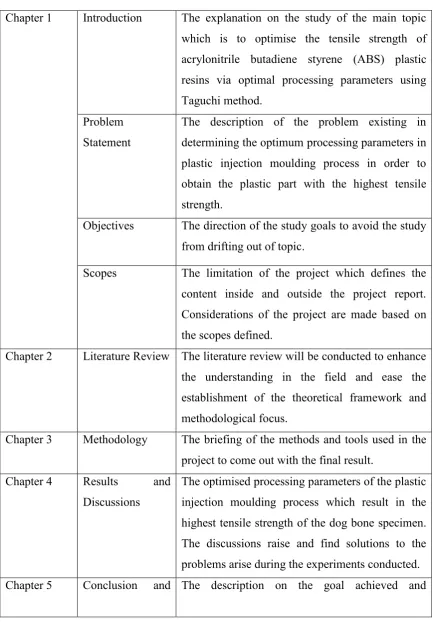
Table 1.1: Structure of the Bachelor Degree Project.
Chapter 1 Introduction The explanation on the study of the main topic which is to optimise the tensile strength of acrylonitrile butadiene styrene (ABS) plastic resins via optimal processing parameters using Taguchi method.
Problem Statement
The description of the problem existing in determining the optimum processing parameters in plastic injection moulding process in order to obtain the plastic part with the highest tensile strength.
Objectives The direction of the study goals to avoid the study from drifting out of topic.
Scopes The limitation of the project which defines the content inside and outside the project report. Considerations of the project are made based on the scopes defined.
Chapter 2 Literature Review The literature review will be conducted to enhance the understanding in the field and ease the establishment of the theoretical framework and methodological focus.
Chapter 3 Methodology The briefing of the methods and tools used in the project to come out with the final result.
Chapter 4 Results and Discussions