SPECTRAL TUNING
AND ITS APPLICATION
TO INSTRUMENTAL
AND
VOCAL COMPOSITION
by
Marciano Telese
A thesis submitted for the degree of
Doctor of Philosophy
of The Australian National University
DECLARATION
I certifY that this thesis does not incorporate without acknowledgement any material previously submitted for a degree or diploma in any university; and that to the best of my knowledge and belief it does not contain any material previously published or written by another person where due reference is not made in the text.
ACKNOWLEDGEMENTS
I firstly would like to thank Professor Larry Sitsky for his many years of encouragement, perseverance and belief in me and the musical ideals that have matured in this thesis. The many discussions about composition and orchestral performance with regards to tuning and intonation were a very important part of the continued motivation in this research. I would also like to thank Professor William Sethares for sharing his innovative tuning perspectives and his publications on the topic are leading the way. His assistance with microtuning the software sampler was critical in producing the right tuning for the composition Revelation. I must also acknowledge the enormous benefit the text component of this thesis has received by working with the most learned Professor Neville Fletcher. His involvement in this thesis reflects his generous and supportive attitude and an extensive understanding of tuning and spectral analysis. Lastly thanks go to Dr Greg Schiemer whose commitment to microtuning has kept this thesis in the realm of the "doable". This research was supported by an Australian National University Graduate School Scholarship and its financial assistance was greatly appreciated.
More than thanks are owed to my family and extended family. Their love and patience, support and criticism were an essential part of this enlightening period of my life. These words can only attempt to express the emotion of gratitude to all, especially to my mother and father and my loving partner Karen and her parents, and our beautiful children; Rohan, Kaylee and Michael. Thank you.
PREFACE
In the years of my musical learning and exploration two things, that I was aware of, have had a major influence on my direction. Firstly, a spiritual intuition which happens when I have prayed, meditated or in dreams and secondly a continued fascination with musical tuning.
My interest in tuning started with listening to the sounds of objects and the reverberant qualities of music halls and rooms. Why did that metal hand-rail have a pitched tone when my hand tapped on it? Why did the room I was playing my electric bass in seem to amplify a particular pitch? Later I became interested in the resonant quality of acoustic guitar bodies. I would sing various notes in a glissando fashion into the sound hole until I noticed the loudest pitch being amplified by the guitar body. This pitch would then become a prominent note in an open tuning for that specific guitar. All these acoustic behaviours were scientifically explained when, many years later, I studied the physics and psychophysics of sound. The explanation for these broad ranging behaviours can be found in a study of sympathetic vibration or acoustic resonance. The term I use is sympathetic resonance, resonance due to sympathetic vibration. Although, before my academic studies I was unaware of the term and meaning of sympathetic resonance, it was ultimately the doorway to what became a quest for tuning knowledge and understanding. In my previous masters degree I developed computer software tools to create compositions based on tunings resulting from discrete Fourier analysis of digital audio. One result of that study was a tuning process that I now call "spectral tuning".
ABSTRACT
This thesis demonstrates the use of spectral tuning in musical compOSItIon. Spectral tuning is the use of spectral analysis, most often a fast Fourier transform (FFT) of audio, to provide frequencies that correlate to musical pitches. These pitches then defme a spectral tuning. The fITst chapter outlines a thread of historical and conceptual influences on spectral tuning techniques. Several tuning systems are presented to place spectral tuning in context with other tuning systems. The field of psychoacoustics is also presented to show how certain musical perceptions influence the notion of tuning and intonation. The second chapter briefly describes current spectral tuning practice and looks at the tuning of the compositions in my research folio. The major work of this thesis Reveiafion uses the spectral tuning defmed by the spectral analysis of Nyai Widya Laras (The Venerable Lady Melody of Knowledge) Javanese gamelan gongs and bonangs. The last chapter concludes with a discussion of microtonal perception and deals with the practical issues raised by microtonal outcomes of spectral tuning. Reference pitch from accurately tuned instruments or audio samples are suggested for performers to rehearse until they "hear" the new tuning. Microtonal score notation is also briefly discussed and it is recommended, where possible, cents be used to defme tunings supplied with digital audio examples so that there is no doubt what is required by the composer.
, " "
TABLE OF CONTENTS
Page
DECLARATION ... .ii
ACKNOWLEDGEMENTS ... iii
ABSTRACT ... iv
PREFACE ... v
LIST OF TABLES ... '" ... viii
LIST OF FIGURES ... ix
CHAPTER 1... I INTRODUCTION ... 1
1.1 Overview ... 1
1.2 History ... 4
1.3 Timbre ... 9
1.4 Tunings ... 12
1.4. I Harmonic Series ... 13
1.4.2 Spectral Tuning ... 15
1.4.3 Chinese ... 16
1.4.4 Indian ... 17
1.4.5 Pythagorean ... 20
1.4.6 Just Intonation ... 21
1.4.7 Meantone ... 22
1.4.8 Werckmeister III ... 23
1.4.9 Equal Temperament. ... 24
1.4.10 Setharean ... 25
1.4.] 1 Gamelan Tuning ... 26
1.5 Perceptions ... 28
1.5.1 Masking ... 28
1.5.2 Critical Band ... 29
1.5.3 Pitch Perception ... 30
1.6 Summation ... 32
CHAPTER 2 ... 33
APPLICATION ... 33
2.1 Spectral Tuning Practice ... 33
2.1.1 William Sethares ... 34
2.1.2 Gerard Grisey ... 36
2.1.3 Tristan Murail ... 38
2.2 Spectral Tuning Procedures ... 40
2.2. I Source Material ... 40
2.2.2 Spectral Analysis ... 41
2.2.3 Spectral Interpretation ... 42
2.2.4 Spectral Tuning ... 42
2.2.5 Applied Tuning ... 44
VI
2.3 Thesis Compositions ... 47
2.3.1 Revelation ... 48
2.3.1.1 Gamelan analysis ... 50
2.3.1.2 Tuning applied ... 53
2.3.1.3 Digital audio processing ... 56
2.3.1.4 Performance practicalities ... 61
2.3.1.5 Microtonal notation ... 62
2.3.1.6 Compositional process ... 63
2.3.1.6.1 Overall structure ... 63
2.3.1.6.2 Modes and themes ... 65
2.3.1.6.3 Correspondences ... 68
2.3.1.6.4 Biblical representation in the score ... 71
2.3.2 Poesie Calabrese ... 82
2.3.2.1 Voice and guitar analysis ... 83
2.3.2.2 Tuning applied ... 86
2.3.2.3 Performance practicalities ... 87
2.3.3 Seagull 's Flight. ... 88
2.3.3.1 String quartet analysis ... 88
2.3.3.2 Tuning applied ... 89
2.4 Summation ... 91
CHAPTER 3 ... 93
CONCLUSION ... 93
3.1 Microtonal Perception ... 93
3.1.1 Intonation Analysis and Perception ... 94
3.2 Microtonal Notation ... 99
3.3 Performance Practicalities ... 100
3.4 Summation ... 101
BIBLIOGRAPHY ... 103
APPENDIX A ... 114
APPENDIX B ... 116
APPENDIX C ... 123
APPENDIX D ... 137
APPENDIX E ... 151
APPENDIX F ... 156
LIST OF TABLES
Table 1.1 Gong partials ... II
Table 1.2 Harmonics and equal temperament.. ... 14
Table 1.3 Chinese Lil fifths tuning ... 16
Table 1.4 Chinese pentatonic tuning ... 16
Table 1.5 Seven tetrachords ... 18
Table 1.6 22 srutis ... 19
Table 1.7 Pythagorean ascending and descending from 111 ... 20
Table 1.8 Table Pythagorean chromatic ... 21
Table 1.9 Just C major ... 22
Table 1.10 Quarter-comma meantone ... 23
Table 1.11 Werckmeister III ... 23
Table 1.12 Equal temperament.. ... 25
Table 1.13 Tingshaw tuning ... 26
Table 1.14 Bonang barung pelog tuning ... 27
Table 1.15 Slendro correspondences ... 28
Table 2.1 Gong fundamentals ... 51
Table 2.2 Bonang barung fundamentals ... 51
Table 2.3 Bonang panerus fundamentals ... 52
Table 2.4 Guitar fifth string parials ... 83
Table 2.5 Vocal sample "i" ... 85
Table 3.1 Modulations p 5, mm 33 intonation analysis ... 96
Table 3.2 Modulations p 6, mm 45 intonation analysis ... 97
Vlll
LIST OF FIGURES
Figure 1.1 Guitar partials ... 10
Figure 1.2 Gong sonogram ... 11
Figure 1.3 A-I Harmonic series score representation ... 13
Figure 1.4 A-I Harmonic series chord representation ... 14
Figure 1.5 Tingshaw dissonance curve (Sethares 1999, p 129) ... 26
Figure 1.6 Critical band and JND (Sethares 1999, p 42) ... 30
Figure 2.1 Plomp and Levelt curves (Sethares 1999, p 86) ... 35
Figure 2.2 Spectral pitch sets of brass mutes (Rose 1996, p 19) ... 37
Figure 2.3 Desintegrations score (Murail 1990) ... 39
Figure 2.4 Gongs of "Nyai Widya Laras" ... 50
Figure 2.5 Bonang barung ... 51
Figure 2.6 Bonang panerus ... 52
Figure 2.7 Voice spectrum ... 57
Figure 2.8 Trombone spectrum ... 57
Figure 2.9 Convolution/cross-synthesis spectrum ... 57
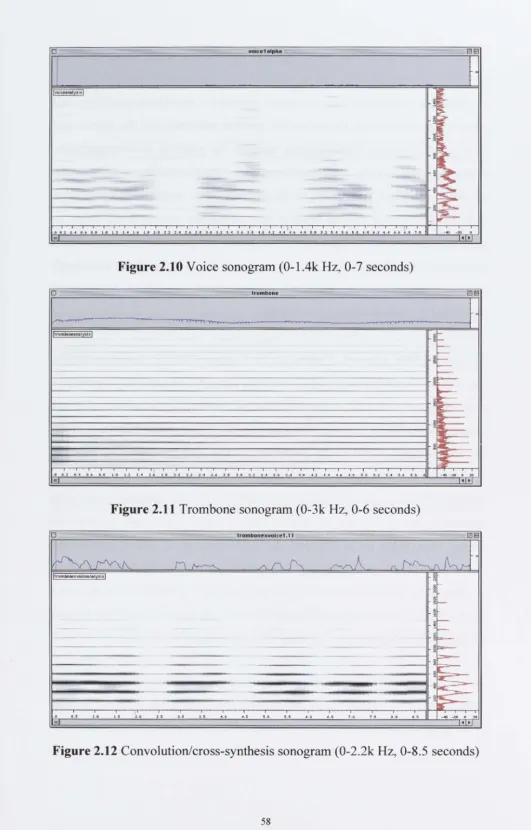
Figure 2.10 Voice sonogram ... 58
Figure 2.11 Trombone sonogram ... 58
Figure 2.12 Convolution/cross-synthesis sonogram ... 58
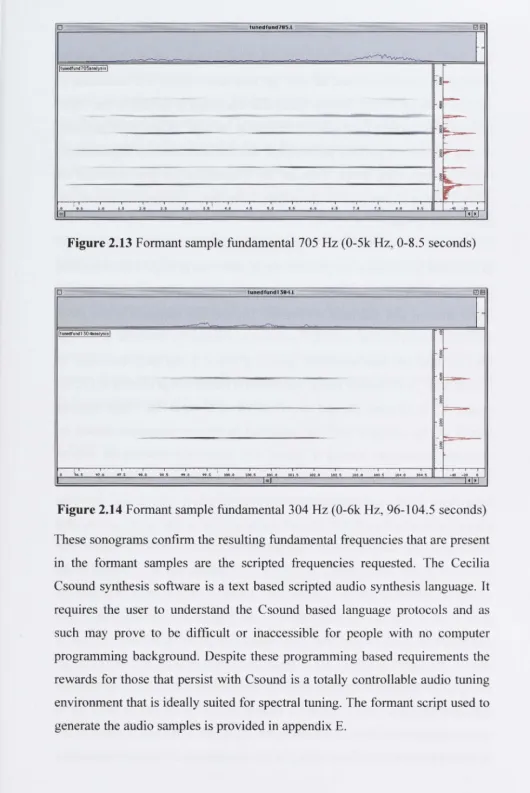
Figure 2.13 Formant sample fundamental 705 Hz ... 60
Figure 2.14 Formant sample fundamental 304 Hz ... 60
Figure 2.15 Ephesus mm 101 ... 66
Figure 2.16 Smyrna mm 134 ... 66
Figure 2.17 Pergamos mm 150 ... 66
Figure 2.18 Thyatira mm 196 ... 67
Figure 2.19 Sardis mm 245 ... 67
Figure 2.20 Philadelphia mm 300 ... 68
Figure 2.21 Laodicea mm 344 ... 68
Figure 2.22 Guitar fifth string pitch and overtones ... 83
Figure 2.23 Guitar fifth string sonogram ... 84
Figure 2.24 Vocal "i" pitch and overtones ... 85
Figure 2.25 Vocal "i" sonogram ... 85
Figure 2.26 Guitar scordatura tuning adjustments ... 87
Figure 2.27 Score comparison ... 89
Figure 2.28 Chord 1 mm 3 ... 90
Figure 2.29 Chord 2 mm 3 ... 90
Figure 2.30 Chord 3 mm 3 ... 90
Figure 2.31 Chord 4 mm 7-8 ... 91
Figure 2.32 Chord 6 mm 12-17 ... 91
Figure 3.1 Modulations p 5, mm 33 ... 95
Figure 3.2 Modulations p 6, mm 45 ... 97
r
CHAPTER!
INTRODUCTION
1.1 Overview
Spectral tuning can be defmed as the process where a fast Fourier transform
(FFT), a mathematically efficient high speed discrete Fourier analysis, is
performed on digital audio samples for the purpose of spectral analysis. The
spectral analysis results are then interpreted and the prominent frequency
components are correlated to musical pitch. These resultant pitches provide
notes for the tuning. The spectral tuning in this thesis is used as a model for
composition with mostly orchestral instruments and does not endeavour to
explicitly resynthesise audio timbres to maximise consonance or dissonance as
in the tuning systems of Sethares (Sethares 1999). It must also be recognised that using orchestral instruments and voices with predominantly harmonic
overtones and complex transitory behaviour, will not recreate the sound source
from which a spectral tuning is based. But what is certainly recognisable is the
perceived "in tuneness" of the sound of an object and an instrument that is
tuned to the corresponding object's spectrum. This feature provides a defIning
pitch for musicians to perform or cents I displacement values for audio sample
pitch shifting, as in the case of the gamelan analysis and resulting spectral
tuning for my composition Revelation, which is detailed in chapter two section
2.3.1. Although my research only analyses audio material, FFT spectral
analysis is not limited to the audio domain. Other non audio samples such as
crystalline structures have been used in the work of Sethares 1994. A detailed
explanation of the spectral tuning process is provided in chapter two of this
thesis. My motivation for this PhD was to use the process of spectral tuning to
compose for instrumental and vocal composition. The change from the
studio-controlled environment where pitch can be manipulated beyond perceptible
1 See chapter two section 2.2.4 for an explanation of cents interval measures.
differences in computer synthesis, to working with mUSiCians and acoustic
instruments/samples, was the next challenge.
Due to the possibly unusual and sometimes inhannonic nature of spectral
tuning, certain practical performance and composition difficulties would have
to be considered. How can a composer notate microtonal pitch such as those
that result from spectral tuning? Will the current range of microtonal symbols
provide an accurate outcome? The symbolic nature of the standard western
music score does not accurately represent pitch beyond certain microtonal
limits. Addressing these limitations and considering a definitive pitch notation
should be evaluated. The term microtonal is used in this thesis to signify pitch
deviations smaller than a semitone. In performance, pitch is contextual and
correct pitch intonation depends on this relationship. It is common practice in
classical instrumental performance to vary the pitch intonation in order to play
"in tune". This musical technique is required to fit the context but the score
does not reveal this practice. It is handed down from master to student in the
tradition of the guilds of the renaissance. Just as some orchestral string players
will be instructed to play in the "style of' and learn to hear the intervallic
quality of the performance from a master rather than be told to play that note on
descent an 1/Sth of tone flat or approach this tonic 1/6th of a tone sharp.
However, when the musical context and tuning is no longer familiar or the
master is no longer living, correct pitch would be difficult to achieve. In dealing
with these pitch performance difficulties I will consider what practical aids can
make the performer become accustomed to unfamiliar tunings and more
specifically can musical context be learned from a reference audio CD or from
instruments such as an alternatively or microtonally tuned piano or synthesiser.
The success or failure in resolving these practical tuning related issues are part
of the research that follows.
In this thesis I outline the basic conceptual and technical foundations upon
which spectral tuning has evolved. This will start with some early philosophical
beliefs and trace a thread through important contributions from the fields of
mathematics, psychoacoustics and mUSiC. A brief review of pertinent
-publications about spectral music techniques will be presented. These include works by, Gerard Grisey, and William Sethares. In this review I look at theoretical and practical aspects of their work and how it is related to spectral tuning. In the main body section I will describe the spectral tuning techniques used for instrumental and vocal composition in my works:
1 Poesie Calabrese for classical guitar and mezzo soprano 2 Seagull's Flight for string quartet
3 Revelation for gamelan, piano, chorus, orchestra and digital audio
In this section the general technique of recording sound source material, analysing and interpreting spectral data and deriving a tuning is demonstrated for each piece. I also show the process of spectral convolution also known as cross-synthesis in the digital audio processing section 2.3.1.3 of chapter 2. Spectral convolution takes the spectrum of each sound source and multiplies them together, a technique where two sound sources are combined to create a hybrid sound with similar spectral qualities as the sound sources. The specific sources of tuning for each piece are presented. Poesie Calabrese uses the sympathetic vibration of a classical guitar body to determine an open string tuning (scordatura). It also corresponds to a vocal gesture by Judith Crispin which had an aural appeal to me and consequently after analysis was found to be close to the same pitch in a different octave. Seagull's Flight uses a recording of a string quartet (Seagull across Lake Eyre) I had composed in 1993 to determine a spectral tuning that could be used in a new string quartet. This analysis reveals the pitches used to compose the work but also provides overtones/partials that could be used in the new work that weren't previously considered. In Revelation I have used the bonangs and gongs of the Javanese Indonesian gamelan, known as ''Nyai Widya Laras" which translates to The Venerable Lady Melody of Knowledge. This gamelan resides at the Australian National University, School of Music. I have recorded and analysed these instruments to derive the tuning for the major work of my folio. I have used the corresponding spiritual heritage of the gamelan with the inspiration of the Judeo-Christian book of Revelation to create a work that uses aspects of
3
numerology mapped to tuning. The work also uses a piano tuned to specific
gamelan pitches. This process of tuning the piano is also detailed and reveals
the practical assistance it can provide with regard to pitch intonation. The
conclusion outlines the difficulty in composing works for instrumental and
vocal performance in spectral tunings. It also provides an account of what
successful outcomes were achieved throughout the research period involved.
There are also attitudinal concerns with some performers about changing the
tuning on precious instruments outside of the range of what they were designed
to play. Score notation issues are raised when the requirement of any
composition has precise pitch. Cents are proposed as an accurate measure to
defme pitches of unusual tunings and where possible a composer should
provide an audio reference tuning CD to leave no doubt. Cents are a
logarithmic measure that enables the ratio of two frequencies to be converted
into a pitch-measure. 100 cents is the equivalent of a semitone and 1200 cents
represents the octave. See section 2.2.4 for the mathematical equation. Perceptual microtonal recognition in high-density chord structures reveals that
as the number of simultaneously voiced notes increases during performance, the subtle distinction between microtonal inflexions are not audible. The possible paradox arises that composers demanding microtonal subtlety may never end
up hearing such a performance because of the perceptual threshold that blurs
the audible outcome that occurs. Further research into this area could provide
another helpful map of psychoacoustic perceptual limitations for composers.
1.2 History
The conceptual ongms of spectral tuning appear to be ancient. Joscelyn
Godwin, a noted musicologist, draws a conclusion from ancient speculative music that has literal meaning in the spectral tuning domain.
"One possible conclusion is that the universe is harmonic by nature, but that its harmony is of an unimaginable and incalculable complexity. Each seeker finds only one aspect, as it were a few chords of the whole work, and satisfied by them, believing himself to have found the master-key."
(Godwin 1995, p. 220).
In tenns of ancient speculative correspondences, mUSIC has a profound
connection with the universe of knowledge and experience.
"Music was therefore justly considered by the ancients as the key to all sciences and arts - the link between metaphysics and physics through which the universal laws and their multiple applications could be understood." (Danielou 1995, p. 1).
References to esoteric ideas in the form of primordial vibrations have been
described by composers Comeliu Cezar and further developed by Octavian
Nemescu.
"Spectral ism as an archetypal approach is an attempt to retrieve the magic dimension of music and its lost signification. It proposes a consciousness of cosmic integration, music being a vehicle that connects us to the primordial vibrations of the universe. Consequently it also refers to those religious aspects related to cosmogony."
(Teodorescu-Ciocanea 2003, p. 90).
Tenns such as primordial vibrations have been used to relate how philosophers
(Danielou 1995) believed the world and all things were created. These ideas
were interpreted from Hindu Vedic text.
"The affinnation of the perpetuity of the Vedas is directly connected with the cosmological theory of the primordial nature of sound among sensible qualities (sound being the particular quality of ether, akasa, which is the first element). And this theory is in reality nothing other than that which is expressed in other traditions when 'creation by the Word' is spoken of. The primordial sound is the divine Word, through which, according to the first chapter of the Hebrew Genesis, all things were made. This is why it is said that the Rishis or sages ofthe first ages 'heard' the Vedas. Revelation, being a work of the Word like creation itself, is actually a hearing for those who
receive it."
(Danielou 1995, p. 3).
These historical references to vibration express the idea that would later
correspond to the acoustic phenomenon that we currently use to describe sound.
Composer Horatio Radulescu also relates the spectral technique to a past where
intuition and number were deeply entwined.
"His revolutionary approach introduced in 1968-69 - historically for the first time -the spectral language, which is, two thousand years later, a conceptual
reply to Pythagoras, and a realization of the intuitions of both the Hindu and
Byzantine music, which, the composer says, ' were the closest to natural
resonance'." (Gilmore 1998, p. 9).
Natural resonance or vibration and the correspondence to number are associated
with music practice of ancient Vedic Indian, Chinese and Greek culture (Danielou 1995). Further developments in numerical correspondences saw the
field of Harmonics become academically established. The students of the
"quadrivium" (arithmetic, geometry, music and astronomy) also undertook the study of harmonics.
"Harmonical analysis exploits the ancient world's fascination with number and with those correlations between tone and number which we call acoustic theory, but which a former age of innocence considered to be Cosmology. By studying the most ancient forms of numerology in a tonal context we revive a rationality that was lost."
(McClain 1976, p. 195).
Past studies in harmonics set the foundations for what later developed into
Fourier based spectral analysis, the core process that defines spectral tuning and many other scientific analyses. This technique of numeric analysis (Fourier analysis), developed by French mathematician Jean Baptiste Joseph Fourier (1768-1830), had evolved during a period of great fascination in esotericism and it was a topic of discussion and revived interest during this period in France.
"It witnessed the burgeoning of a popular interest in occultism, at the same time as more serious efforts to fmd a place for the occult within modem science."
(Godwin 1995, p. 7).
Fourier was in the circles of the esoterically aware. His teachers at the Ecole
Normale in Paris, Lagrange and Laplace, were recognised for their work on planetary orbits. Laplace's description of planets as children born from the sun
certainly implies the understanding of ancient harmonics as proposed by
scholars such as Ptolemy. Fourier's position in French scientific society must have been highly regarded. During the French invasion and occupation of
Egypt, he was a scientific adviser and member, along with Napoleon Bonaparte, of the Cairo Institute. There, unti I 1801, Fourier supervised the collating of scientific, archaeological and literary discoveries made during the
time in Egypt. Several years following his return to Paris, Fourier submitted his paper titled On the Propagation of Heat in Solid Bodies. The important
mathematical development was the expansion of functions as a trigonometrical
series. For a mathematical explanation of Fourier analysis, refer to Bracewell's
The Fourier Transform And Its Applications (Bracewell 1986). The intention of
Fourier's research was focused on vibrations in solid bodies and no direct association to music, acoustics or tuning was specified. It was not until 1843 physicist Georg Ohm and later Herman von Helmholtz who conducted experiments in acoustic resonance that we find the bridge from Fourier's mathematics to the world of sound. According to Helmholtz, Fourier's theorem shows how any periodic magnitude, whatever its nature, can be expressed by the sum of the series of periodic magnitudes. He also proposed that Fourier analysis should be seen as a theory of harmony, a concept fundamental to spectral tuning. He further postulates that Pythagorean numerical relations are found in Fourier's math.
" ... Ultimately, then, the reason of the rational numerical relations of Pythagoras is to be found in the theorem of Fourier, and in one sense this theorem may be considered as the prime source of the theory of harmony." (Helmholtz 1954, p. 229).
The transdisciplinary approach that Helmholtz applied is rather unique ill
scientific methodology. Not only did he recognise Fourier's work and its application to sound, he also then applies the same relations to the physiology of the ear. Helmholtz believed that the ear resolves all sounds into simple oscillations, that is, sinusoidal tones.
"Why is consonance determined by the ratios of small whole number? ... the ear resolves all complex sounds into pendular oscillations."
(Helmholtz 1954, p. 229).
This view of the behaviour of the ear laid the platform for later studies (Plomp and Levelt 1965) on consonance and dissonance known as the critical band.
These experimental measures now provide a great resource for composers,
scholars of psychoacoustics and those willing to explore various perspectives on consonance and dissonance. The importance of Helmholtz's contributions
should not be underestimated. His ability to bring quantifiable measures into a
previously untested sonic world and recognise Fourier's theorem as a "prime
source" of the theory of harmony was innovative and a precursor to further
developments in spectral tuning.
Spectral tuning has evolved out of the spiritual past or at least been influenced
by the practice of correspondences. Some of these practices may have been
forgotten due to their esoteric nature or because it was no longer supported by
established institutions. In Godwin's publication on French musical
philosophies, he concludes that by the 1940s speculative music was no longer
in a nurtured environment.
"... all the elements that once nourished speCUlative music have now died.
The general public, having at last digested scientific materialism, has rejected
the occultism with which it flirted at the tum of the century. At a higher level,
the efforts to reconcile modem science with occultism have failed: psychical
research is no longer a respectable field for Polytechnicians and Fellows of the Royal Society."
(Godwin 1995, p. 215).
The influence of the esoteric for the most part diminished by the 18th century as
science became more focused on quantifiable testing. Modem science had
turned away from the somewhat eclectic philosophies of the past to establish an
independent world where the occult played no part in the unfolding mysteries
of science. The study of science with mystic or cosmic correspondences, such
as Newton's ability to make connections between Pythagoras' string tensions
and the law of gravitational planetary attraction, gave way to the study of
science with rationale and number. One aspect of the harmony of the universe,
as Godwin previously mentions, is revealed by audio spectral analysis. The
master-key in spectral tuning terms would certainly have the name Jean
Baptiste Joseph Fourier on it. His mathematical law would become one of the
most popular applications of audio analysis in the digital form known as the
Fast Fourier Transform (FFT). Today in spectral tuning terms, number is the
common denominator. Whether a tuning is defined by ratio, frequency or by
mode, scale or harmony, number is the language by which common
understanding can be defined.
"
1.3 Timbre
Many terms have been used to describe musical timbre, most of them a subjective metaphor; brightness, colour, tone-quality are several that highlight the difficulty in providing a quantifiable and musically useful description. William Sethares suggests that, unlike many over simplified definitions, timbre and its description is still evolving.
"Timbre is thus a multidimensional attribute of sound, though exactly how many 'dimensions' are required is a point of significant debate."
(Sethares 1999, p. 28).
While there are definite perceptual notions of how to describe timbre, my concern is with the musically functional ones related to pitch and tuning. Two aspects of timbre that are physically measurable are temporal effects and spectral effects (Sethares 1999). Testing over the last four decades show how important temporal/spectral aspects of timbre are in the perceptual recognition of instruments and have provided many important outcomes. One in particular, is the correlation between timbre and spectrum. This research has "opened the sound", that is, provided a means to understanding the structure and behaviour of sound with psychoacoustic models which reveal a relationship to pitch. Although not exclusive, the frequencies described by spectral analysis do provide a pitch-based window from which a composer can arrange and create scales or various tuning schemes. This ability to define timbre with numeric frequencies is another essential spectral technique. The spectral analysis results can represent timbre in the form of sinusoidal peaks. These peaks are also known as overtones or partials. Generally the lowest frequency peak is perceived as the fundamental of the tone. This analytical approach can provide us with a reference model to guide us in recognising the overtonal fusion that takes place when a complex sound is vibrating. Although the terms partial and overtone can be freely exchanged in the discourse of instrumental or vocal spectra, sometimes they are mistakenly called "harmonics2", technically, exact
spectral harmonics do not occur in musical tones, unless they are electronically
2 Not to be confused with the lightly touched harmonic of stringed instruments or overblown brass and woodwind instruments.
9
synthesised. But the close approximation to the harmonjc series in the spectra
of musical tones has found the term "harmonic" being used to describe
overtones or partials. A good example of "harmonic" overtones is found in
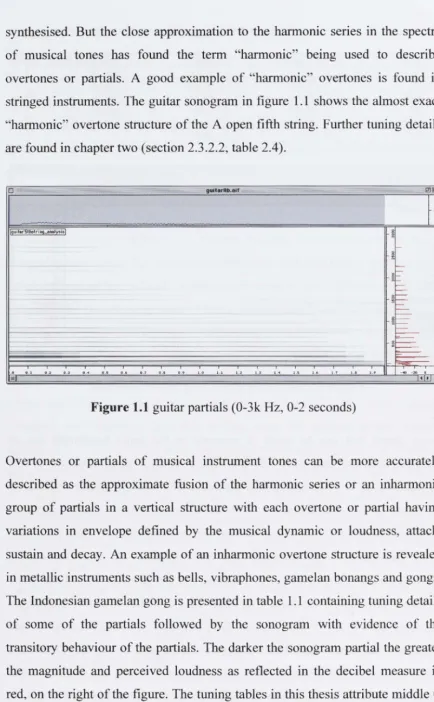
stringed instruments. The guitar sonogram in figure 1.1 shows the almost exact
"harmonic" overtone structure of the A open fifth string. Further tuning details
are found in chapter two (section 2.3.2.2, table 2.4).
o gui'arAb.ait
.0 0.1 0.2 D.~ o.~ 0.1 0.. 0.7 0.. 0., 10 J.l 1.2 I , I ~ 1.5 16 1'J I.. 1.,
[image:19.607.53.487.42.744.2]•
Figure 1.1 guitar partials (0-3k Hz, 0-2 seconds)
I
013
_40 -10 0
.,
/.Overtones or partials of musical instrument tones can be more accurately
described as the approximate fusion of the harmonic series or an inharmonic
group of partials in a vertical structure with each overtone or partial having
variations in envelope defined by the musical dynamic or loudness, attack,
sustain and decay. An example of an inharmonic overtone structure is revealed
in metallic instruments such as bells, vibraphones, gamelan bonangs and gongs.
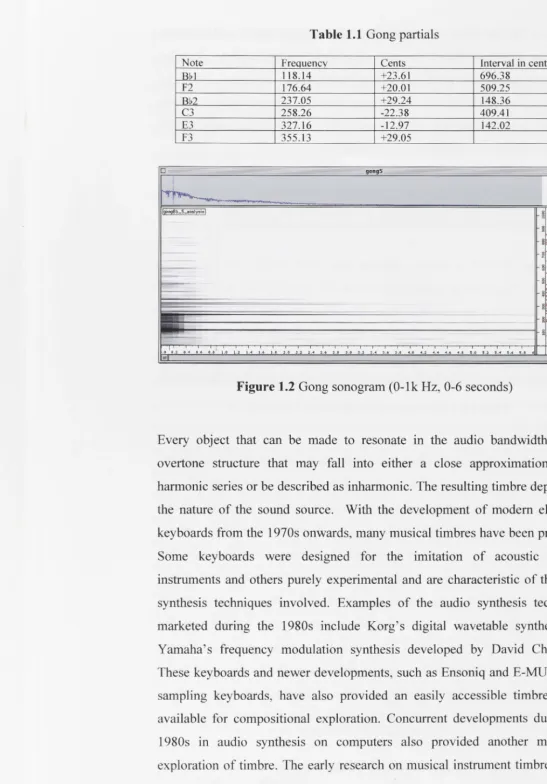
The Indonesian gamelan gong is presented in table 1.1 containing tuning details
of some of the partials followed by the sonogram with evidence of the
transitory behaviour of the partials. The darker the sonogram partial the greater
the magnitude and perceived loudness as reflected in the decibel measure in
red, on the right of the figure. The tuning tables in this thesis attribute riddle C
as C3. This is to conform with the audio software tools that have been used in
this thesis.
Table 1.1 Gong partials
Note Frequency Cents Interval in cents
Bi>1 118.14 +23.61 696.38
F2 176.64 +20.01 509.25
BJ>2 237.05 +29.24 148.36
C3 258.26 -22.38 409.41
E3 327.16 -12.97 142.02
F3 355.13 +29.05
o 90n95 rns
t
looIl98LS-'I'IIIY!isl
. ,
.0 0.2 0 <I 06 0.' 1.0 1.2 1. ... 1.6 Lf 2.0 2.2 2 .... 2.' 2 .• 3.0 3.2 3 .... 3.6 3.' "'.0 ".2 ... . ... 5.0 '1.2 'I." 'I.' S.' 6 -«) -20 0 20
• •
•
Figure 1.2 Gong sonogram (O-lk Hz, 0-6 seconds)
Every object that can be made to resonate in the audio bandwidth has an
overtone structure that may fall into either a close approximation of the
harmonic series or be described as inharmonic. The resulting timbre depends on
the nature of the sound source. With the development of modem electronic
keyboards from the 1970s onwards, many musical timbres have been produced.
Some keyboards were designed for the imitation of acoustic musical
instruments and others purely experimental and are characteristic of the audio
synthesis techniques involved. Examples of the audio synthesis techniques
marketed during the 1980s include Korg's digital wavetable synthesis and
Yamaha's frequency modulation synthesis developed by David Chowning.
These keyboards and newer developments, such as Ensoniq and E-MU's audio
sampling keyboards, have also provided an easily accessible timbre palette
available for compositional exploration. Concurrent developments during the
1980s in audio synthesis on computers also provided another means of
exploration of timbre. The early research on musical instrument timbre by use
of computer spectral analysis (Grey and Moorer 1977, Risset and Wessel 1982)
became a forerunner to some of the spectral music techniques that followed.
However those experimental developments remained accessible to those
affiliated with larger academic institutions. Practically, computers were too
slow and a long way from the processing speed currently available. Further
discussion on music technology and its spectral applications is found in Chapter
two.
1.4 Tunings
In this section an overvIew of various tunings IS presented. It is not a
comprehensive survey but it serves to reflect the fact that tuning systems have
developed out of the cultural expression of societies from diverse geographic
backgrounds. The origin of some of these diverse tunings could be explained by
acoustic and perceptual theories (Plomp and Levelt 1965) but this is largely
speculative and best left for a thorough investigation (Parncutt 2001). The
tunings described are limited to scale definitions by intervallic measures and,
where pertinent, philosophical symbolic correspondences. The tunings
presented are theoretical and this section does not address actual musical
performance and the deviations from the theoretical scales that occur. Some of
these scales are derived from the work of Danielou titled Music and the Power
of Sound, The influence of Tuning and Interval on Consciousness and refer to
ancient Indian music. His publication also looks at various other tuning systems
such as the Chinese and Greek. It also harshly repudiates the laziness of
musicians who can not imagine music beyond Western equal temperament.
Another reference used is the Jorgensen book on historical tunings, Tuning:
Containing the Perfection of Eighteenth-Century Temperament, the Lost Art of
Nineteenth-Century Temperament, and the Science of Equal Temperament, for
its extensive study on the topic.
1. 4.1
Harmonic Series
In musical form, the harmonic series can be described as the integer number
multiple of the frequency of the fundamental. By defining 440 Hz as A33 and
the lowest note on the piano as A-I, 27.5 Hz, the following musical score
approximation for the first sixteen notes of the harmonic series are presented
below, beginning with the pitch A-I.
fl
tJ ~ . .. H ~
I
I1
J
-
•
.
.
l •I
- ::;
...
--
..
=
1III
Figure 1.3 A-I Harmonic series score representation
What is not revealed by this score, is the significant variation in pitch of certain
notes from the harmonic series compared to twelve-tone equal-temperament.
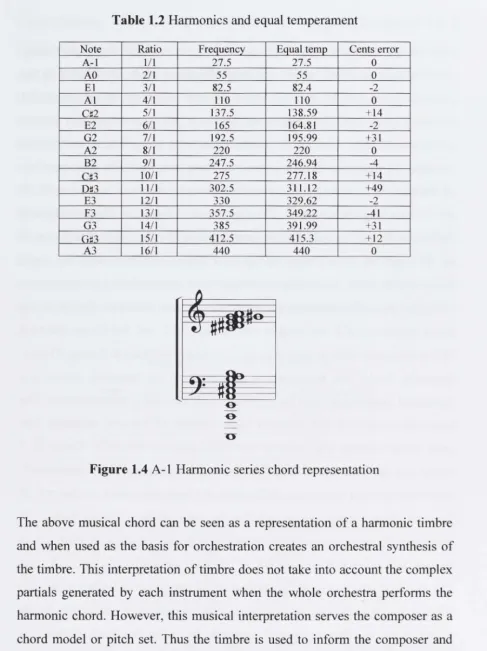
For example the D#3, 11th harmonic derived from the A-I harmonic series
above, has a frequency of 302.5 Hz, where the D#3 pitch in equal-temperament
has a fundamental frequency of 311 . ] 2 Hz, a difference of 49 cents or almost a
quarter-tone. Table 1.2 provides a comparison of the frequencies of the fust
sixteen harmonics of the A-I harmonic series frequencies and the twelve-tone
equal-tempered notes closest to the harmonic series. The error in cents is
relative to the harmonic series. Contemporary mUSIC score notation only
currently describes pitches within twelve-tone equal temperament. Many
microtonal hieroglyphs have been suggested to address the inconsistencies of
pitch in the variety of tunings but a standard is yet to be agreed on (Read 1990).
More detail about accurate microtonal score notation is discussed in chapter
three of this thesis.
3 This is the assigned MIDI note pitch which is commonly used in music software.
Note A-I AO EI Al ClI2 E2 G2 A2 B2
cn
DlI3 E3 F3 G3 GlI3 A3Table 1.2 Harmonics and equal temperament
Ratio 1/1 2/1 3/1 4/1 5/1 6/1 7/1 8/1 9/1
1011
1111 12/1 13/1 14/1 15/1 16/1 Frequency
.
.
27.5 55 82.5 110 137.5 165 192.5 220 247.5 275 302.5 330 357.5 385 412.5 440Equal temp Cents error
27.5 0
55 0
82.4 -2
110 0
138.59 +14
164.81 -2
195.99 +31
220 0
246.94 -4
277.18 +14
311.l2 +49
329.62 -2
349.22 -41
391.99 +31
415.3 +12
440 0
Figure 1.4 A-I Hannonic series chord representation
The above musical chord can be seen as a representation of a hannonic timbre
and when used as the basis for orchestration creates an orchestral synthesis of
the timbre. This interpretation of timbre does not take into account the complex
partials generated by each instrument when the whole orchestra performs the
harmonic chord. However, this musical interpretation serves the composer as a
chord model or pitch set. Thus the timbre is used to inform the composer and
by using spectral analysis on audio timbre a spectral tuning scheme can be
defmed.
1.4.2 Spectral Tuning
Even though spectral tuning is dependant on modem digital signal processing (DSP) techniques, it still inherits several qualities that can be identified with the harmonic series. Firstly, spectral analysis results can be viewed as sinusoidal frequency bins, and the frequencies of each bin are related by integer multiplication. The same integer relations are used in the harmonic series to calculate the frequency of each harmonic. Thus, with the initial frequency bin known as F the ascending spectral analysis frequency bins can be seen as 2F 3F 4F .... continuing up to 16384F. The upper limit of the spectral frequency bin is determined by the sample window length divided by two, an inherent part of the FFT process which keeps the spectral analysis results within the audio bandwidth required. The initial bin frequency is determined by the parameters of sample window length and the audio sample rate. For more details on the actual frequency of F see chapter two section 2.2.2 and for further practical FFT explanations refer to Appendix C of Sethares' publication Tuning, Timbre,
Spectrum, Scale. The harmonics as derived from the harmonic series, is a
theoretical construct and has its origins in early numeric correspondences. The harmonic series is a mathematical representation of numeric relations. The exact same relations also exist in the mathematics of the FFT. Therefore it would not be incorrect to call the sinusoidal frequency bins "harmonics". Where the spectral tuning can differ from the harmonic series, is that not all frequency bins contain energy and thus do not contribute to fmal tuning. To exemplify the harmonic series correlation, the gong spectra in table 1.1 is formed with spectral frequency bin or harmonic numbers; 88, 131, 176, 192, 243 and 264. Psychoacoustic modelling of the spectral data further refmes the spectral tuning technique by including auditory perception parameters in the tuning outcome. This perceptual approach to tuning has been pursued by Terhardt, Pamcutt and Sethares and brings an important perspective to tuning.
1.4.3 Chinese
Chinese tuning emanates from the Tao-te Ching. It describes how the number
one produced two, two produced three and three produced all numbers.
Danielou indicates that the ancient text La shi chun qiu details a method to tune
tubes of metal, known as La, into proportional lengths of 4:3 and 2:3 of the
length of the tonic or gong La. The generating, or gong La, is identified by the
number three in the relative proportions. These proportions4 create the intervals
of a fourth below or a fifth above the La as the pentatonic scale is calculated.
The following sequence and table describe how the pentatonic scale is derived
according to Danielou. The gong La is measured to 2/3 its length to create first
fifth or second La. The second fifth is brought down to the next octave by
creating a La 4/3 the length of the second La. The third La is then raised a fifth
by creating a La 2/3 the third. The fifth La is measured at 4/3 length of the 4th
La.
Table 1.3 Chinese La fifths tuning
Note Ratio Interval cents
C 3/3 0
G 3/2 +702
D 9/8 -498
A 27/16 +702
E 81164 -498
Table 1.4 Chinese pentatonic tuning
Note Ratio Cents Correspondence
C 111 0 Saturn
D 9/8 204 Venus
E 81/64 408 Jupiter
G 3/2 702 Mars
A 27/16 906 Mercury
C 2/1 1200 Saturn
Further extension of the pentatonic scale is defined by continuing the series
with the above mentioned process up to the 60th note. This results in a scale that
has sixty intervals per octave. Danielou explains the reason the scale is
extended to sixty notes was to facilitate transpositions within the initial
4 These proportions can only be correct ifthe tube diameter is scaled to length. (N. Fletcher)
pentatonic scale. It also reflects the influence of cyclic number patterns on
Chinese philosophy. The various correspondences of Chinese tuning include
the yang and yin of heaven and earth, the elements and the changing seasons.
1.4.4 Indian
The Indian tuning system is derived from the ancient Sanskrit texts. One in
particular, Natya-sastra, defines the sruti as the difference between the interval
9/8 and 10/9. Which is 81180 also known as one comma diesis. However,
further definitions describe the srutis as varied intervals of 81/80, 25/24 and
256/243. The srutis serve to divide the grarnas, or scale, into corresponding
moods. It is the function of the svaras, or principal notes, to define the scale.
The tuning is based on seven principal notes and is constructed by the use,
combination and differences of these interval ratios;
1019 minor tone
9/8 major tone
16115 major halftone (apotome)
These seven principal tones form an ascending cyclic senes of seven
tetrachords on each principal note as defined in table 1.5
Table 1.5 Seven tetrachords
Note Ratio Interval ratio Intervals cents Ratio in cents
C 111 1/1 0 0
D 9/8 9/8 204 204
E 5/4 10/9 182 386
F 4/3 16115 112 498
F 111 111 0 0
G 9/8 9/8 204 204
A 5/4 10/9 182 386
B 45/32 9/8 204 590
B III 1/1 0 0
C 16115 16115 112 112
D 6/5 9/8 204 316
E 4/3 10/9 182 498
E 111 111 0 0
F 16/15 16/15 112 112
G 6/5 9/8 204 316
A 4/3 10/9 182 498
A 111 111 0 0
B 9/8 9/8 204 204
C 6/5 16/15 112 316
0 27/20 9/8 204 520
D 111 111 0 0
E 10/9 10/9 182 182
F 32/27 16/15 112 294
G 4/3 9/8 204 498
G 111 111 0 0
A 10/9 10/9 182 182
B 5/4 9/8 204 386
C 4/3 16/15 112 498
The resulting additional interval ratios fonned from the above interval
combinations and differences generate, although approximately, the following
nitio intervals which can be defined as sruti;
81/80 comma
25/24 minor halftone
256/243limma
Accorcling to Danielou, a text by Bharata, indicates a practical way to tune two
vinas (string instrument) so that the twenty two srutis are audible. One vina is
tuned to the Sa gram a (scale);
DEFGA+BCD
The E to A+ of this scale has the interval of 27/20, a sharpened 4th or 520 cents.
By tuning the second vina so that the A note forms a perfect fourth with the E
note of the first vina, it has lowered the note by a comma, 81180 or 22 cents.
The procedure then follows with the new A note as the reference for the other
notes on the second vina to be tuned. This provides a simple practical way to
tune the second instrument a comma below the first vina that allows the
twenty-two srutis to be performed. The twenty-twenty-two srutis can be seen as originating
from the harmonic series and partly from the spiral of fifths. Each interval also
corresponds to a Rasa or emotion.
Table 1.6 22 srutis
Note Ratio Step ratio Cents Rasa
C 111 III 0 comic, love
256/243 2561243 90 marvellous, heroic, furious
16/15 81/80 112 comic
10/9 25/24 182 love
D 9/8 81/80 204 comic, love
32/27 256/243 294 compassion
6/5 81/80 316 comic, love
E 5/4 25/24 386 love
81/64 81/80 408 marvellous, heroic, furious
F 4/3 256/243 498 comic
27/20 81/80 520 marvellous, heroic, furious
43/32 25/24 590 comic
729/512 81/80 612 love
G 3/2 256/243 702 comic, love
128/81 256/243 792 love
8/5 81/80 814 comic, love
A 5/3 25/24 884 comic
27116 81/80 906 compassion
16/9 256/243 996 compassion
9/5 81/80 1018 comic
B 15/8 25/24 1088 comic, love
243/128 81180 1110 marvellous, heroic, furious
C 2/1 256/243 1200 comic, love
This is a very simplistic explanation and only provides a brief overview of
Indian music tuning.
1.4.5 Pythagorean
Pythagoras was a philosopher and mathematician, whom we have understood to
believe, that the universe could be explained by numbers. Although all of his
writings are lost, it is to him that this tuning is attributed. The origins of
Pythagorean tuning are sourced from Plato's Timeaus. In the description the
Demiurge used a tetrakyts to divide the World-Soul into seven parts. These
seven parts symbolised the harmony of the spheres and corresponded each note
to the planets. The musical tetraktys uses the numbers 2 and 3. These two
numbers are used to define a series based on mathematical powers. Firstly,
powers of2 then followed by powers of3;
1248 1 3927
In simple terms, these numbers create the intervals of octaves and fifths. From
these intervals the Pythagorean tuning can define many different scales,
however I will just illustrate one chromatic scale. The chromatic scale is
defined by both ascending and descending with an interval of a perfect fifth.
When six steps from an arbitrary fundamental are completed the note ratios
below are produced.
Table 1.7 Pythagorean ascending and descending from 111
G~ D~ A~ E~ B~ F C G D A E B F#
64/729 321243 16/81 8127 4/9 2/3 1/1 3/2 9/4 27/8 81116 243/32 729/64
These intervals, when reduced to one octave result in the scale listed in the table
below. The notes are also mapped to the corresponding planet and day
according to the ancient Greek usage.
Table 1.8 Table Pythagorean chromatic
Note Ratio Cents Correspondence
C 111 0 J upiterfThursday
m
256/243 90D 9/8 204 Marsffuesday
E~ 32/27 294
E 81/64 408 Sun/Sunday
F 4/3 498 VenuslFriday
GP 10241729 588
H 729/512 612
G 3/2 702 Mercury/Wednesday
A~ 128/81 792
A 27/16 906 MoonIMonday
m 16/9 996
B 2431128 1110 Saturn/Saturday
C 211 1200
The Pythagorean chromatic forms intervals of pure or perfect fifths, 3/2, within
the notes of the scale. There are two intervals that are closely positioned at GD,
10241729 and F~, 729/512 which in equal temperament are exactly the same but
in this scale they are not. The same pitch anomaly is found when the perfect
fifth is raised twelve times, 5314411262144. This produces a slightly larger
interval than the equivalent octave and the discrepancy is known as the
Pythagorean comma, approximately 23 cents. Pythagorean tuning does not use
the number ratios including 5 or 7, as it was beyond number 4, and in doing so
the aural quality of the tuning is limited to "fIfthness". Danielou claims, with
some justification, that these principles had been previously espoused in
Chinese and Indian tuning systems. Without going into a debate of what tuning
originated first, it is clearly obvious by viewing the scale tables presented thus
far that the Pythagorean tuning, or the derivative intervals, are common to both
the Chinese and Indian tuning schemes.
1.4
.
6 Just Intonation
Just intonation is a tuning that aims to use exact proportional or ratio based
intervals in order to maintain musical consonance. It is directly related to the
harmonic series in that each musical interval occurs in the series. Just intonation
has been defined by scales incorporating intervals of the third 5/4, fifth 3/2 and
the octave, 211. However, just scales need not be limited to intervals based on
the numbers three, four and five. Just scales using various integer numbers can
be used to form musical intervals that extend the traditional usage of thirds and
fifths into scales of more variety. The term "limit" has been used to identifY
ratio numerator and denominator values that defme scales based on restricted
ratios. For example a thirteen limit just scales uses numbers up to, but not
including, thirteen to create musical intervals. The higher the limit, the more
variety in musical intervals and scales. Composers who have used Just
intonation, include; Harry Partch, Ben Johnston and James Tenney. The
example of a Just major scale in C is listed in the table below.
Table 1.9 Just C major
Note Ratio Cents
C 111 0
16/15 112
D 9/8 204
6/5 316
E 5/4 386
F 4/3 498 27/20 520 43/32 590
G 3/2 702 8/5 814
A 5/3 884
16/9 996
B 15/8 1088
C 2/1 1200
1.4. 7
Meantone
Meantone can describe tunings that adjust or temper certain intervals in a
compromise between just intonation and the equal division of an interval.
Meantone tuning was historically pertinent in European music during the 1500s
through to the early 1900s. The tuning exists with many variants but it is
primarily based on the importance of preserving the consonance of the thirds,
5/4. This is achieved by compensating and adjusting certain intervals, such as
the fifth and second. An example of meantone tuning was the triadic harmony
of composers such as Palestrina and Gibbons. The music of the Renaissance
and Baroque was generally limited to keys close to the tuning tonal center of C.
By keeping the music in the keys of C, F, G, D, B~ or A the resultant harmonies
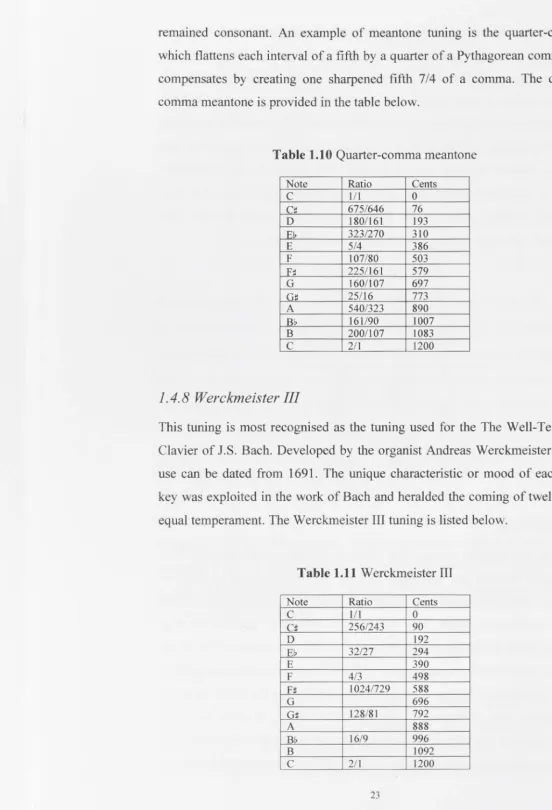
remained consonant. An example of meantone tuning is the quarter-comma, which flattens each interval of a fifth by a quarter of a Pythagorean comma and compensates by creating one sharpened fifth 7/4 of a comma. The quarter-comma meantone is provided in the table below.
Table 1.10 Quarter-comma meantone
Note Ratio Cents
C 1/1 0
0 675/646 76
D 1801161 193
E~ 323/270 310
E 5/4 386
F 107/80 503
B 225/161 579
G 160/107 697
m
25/16 773A 540/323 890
B~ 161/90 1007
B 2001107 1083
C 211 1200
1.4.8 Werckmeister III
This tuning is most recognised as the tuning used for the The Well-Tempered Clavier of 1.S. Bach. Developed by the organist Andreas Werckmeister and its use can be dated from 1691. The unique characteristic or mood of each tonal key was exploited in the work of Bach and heralded the coming of twelve tone equal temperament. The Werckmeister III tuning is listed below.
Table 1.11 Werckmeister III
Note Ratio Cents
C III 0
0 2561243 90
D 192
m
32/27 294E 390
F 4/3 498
Fti 1024/729 588
G 696
m
128/81 792A 888
BI> 16/9 996
B 1092
C 2/1 1200
1.4.9 Equal Temperament
With the tempering of various just intonations, especially on keyboard
instruments, in order to explore the remote music key centers, it was inevitable
that equal temperament would become the practical keyboard tuning. Although
it is easy to say that in hindsight, key modulations are now easily achieved due
to the equal temperament. Until the demand for modulation or remote key
exploration became the focus, equal temperament was not applied. I will not
enter the debate on the qualitative comparisons of the various tuning systems,
as they all are musically useful to the composer. Equal temperaments can be
described by the following mathematical expression.
Where r is the ratio of each step, n is the number of steps between the interval
and I is the interval in ratio between the lowest pitched and highest pitched note
frequencies. For the common 12 tone per octave equal temperament the
equation is;
n = 12
1=211 (the octave ratio)
r =
1
'lJ2
r
=
1.05946With the ratio defined the scale can be built starting with any frequency as the
fundamental. The table for the twelve tone equal temperament in one octave is
listed with ratios and cents.
Table 1.12 Equal temperament
Note Cents Ratio
C 0 1.0
o
orD~ 100 1.059D 200 l.l22
D~ orB 300 1.189
E 400 1.26
F 500 1.335
Horm 600 1.414
G 700 1.498
G~ or A~ 800 1.587
A 900 1.682
A~ orm 1000 1.781
B 1100 1.888
C 1200 2.0
Equal temperaments need not be limited to octaves. In my composition
Revelation I have used an equal temperament between the pitches of the gamelan gongs to define the scale notes for the piano, see section 2.3.1.2 for details.
1.4.10 Setharean
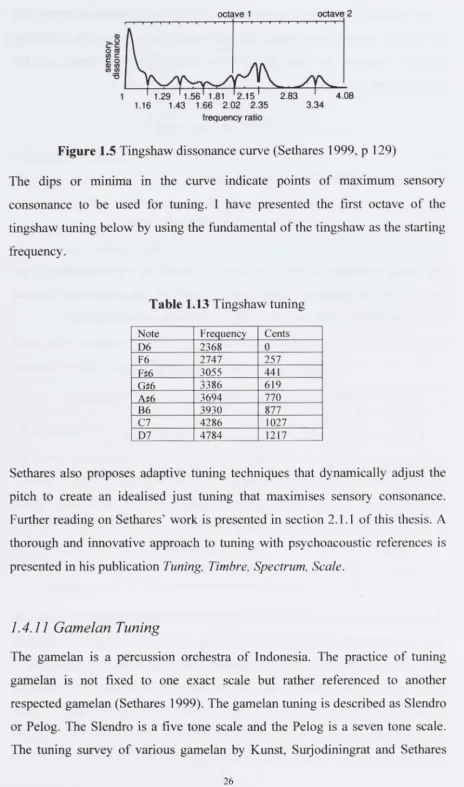
William Sethares has introduced a tuning that parameterises the sensory consonance curves of Plomp and Levelt (1965). It defines a tuning that relates the spectrum of a sound with a scale that produces the most consonant performance of that sound spectrum. With the encoding of psychoacoustic measures in the Sethares technique, a perceptually consonant tuning can be achieved. Even with inharmonic sounds that previously would have sounded discordant. In the composition Tingshaw, Sethares analyses the sound of a bell as the basis for a tuning, effectively a non-just, non-equal temperament and more accurately a type of spectral tuning is the result. After spectral analysis the resulting frequencies were determined to be the most salient.
2368,4784,5553, 7921 and 10] 03
These frequencies and their relative amplitudes are then processed to calculate the dissonance curves, which relate the spectrum of the tingshaw to the recommended tuning for the most consonant performance of the tingshaw.
25
i/'- _ . '
octave 1 octave 2
''I'
,, I
Q)
~g
On!
CIlC
co
Q)CIl alal '5
[image:35.601.45.510.58.847.2]4.08 3.34 frequency ratio
Figure 1.5 Tingshaw dissonance curve (Sethares 1999, p 129)
The dips or minima in the curve indicate points of maximum sensory
consonance to be used for tuning. I have presented the fIrst octave of the
tingshaw tuning below by using the fundamental of the tingshaw as the starting
frequency.
Table 1.13 Tingshaw tuning
Note Frequency Cents
06 2368 0
F6 2747 257
Fl!6 3055 441
GU6 3386 619
M6 3694 770
86 3930 877
C7 4286 1027
D7 4784 1217
Sethares also proposes adaptive tuning techniques that dynamically adjust the
pitch to create an idealised just tuning that maximises sensory consonance.
Further reading on Sethares' work is presented in section 2.1.1 of this thesis. A
thorough and innovative approach to tuning with psychoacoustic references is
presented in his publication Tuning, Timbre, Spectrum, Scale.
1.4.11 Gamelan Tuning
The gamelan is a percussion orchestra of Indonesia. The practice of tuning
gamelan is not fIxed to one exact scale but rather referenced to another
respected gamelan (Sethares 1999). The gamelan tuning is described as Slendro
or Pelog. The Slendro is a fIve tone scale and the Pelog is a seven tone scale.
The tuning survey of various gamelan by Kunst, Surjodiningrat and Sethares
clearly reveal the subtle tuning variations between each gamelan orchestra. We
can broadly classify these scales but each orchestra is unique in its tuning.
Sethares indicates the average slendro tuning in cents based on the
Surjodiningrat work is;
0,231,474,717,955,1208
The average pelog tuning from the same data is;
0,120,258,539,675,785,943,1206
The tuning presented in the table below is based on my recordings of the
bonangs of the gamelan "Nyai Widya Laras" of the Australian National
University, School of Music. It is known as the seven-note pelog scale.
Table 1.14 Bonang barung pelog tuning
Name Pitch and cents Frequency Interval cents Scale cents
Bern 1 03 +28 298.55 0 0
Gulu 2 E3 -35 323.07 136 136
Ohadha 3 F3 +9 351.15 144 281
Pelog 4 A~3 -23 409.93 268 549
Lima5 A3 +25 446.32 147 696
Enem 6 8P3+33 475.26 109 805
Barang 7 C4 +20 529.60 187 992
Bern 1 D4 +38 600.43 217 1209
The gamelan music inherits the ancient practice of correspondences, most likely
from the Indian travellers that brought with them knowledge of the Sanskrit
texts. The interpretation, by Sastrapustaka, maintains correspondences and is
based on the name and meanings of the slendro scale. The table below lists the
five meanings.
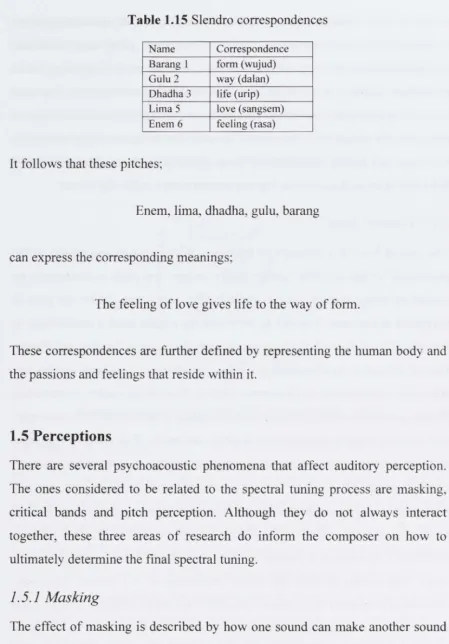
Table 1.15 Slendro correspondences
Name Correspondence Barang 1 form (wujud) Gulu 2 way (dalan) Dhadha 3 life (urip) Lima5 love (sangsem) Enem 6 feeling (rasa)
It follows that these pitches;
Enem, lima, dhadha, gulu, barang
can express the corresponding meanings;
The feeling of love gives life to the way of form.
These correspondences are further defined by representing the human body and
the passions and feelings that reside within it.
1.5
Perceptions
There are several psychoacoustic phenomena that affect auditory perception.
The ones considered to be related to the spectral tuning process are masking,
critical bands and pitch perception. Although they do not always interact
together, these three areas of research do inform the composer on how to
ultimately determine the [mal spectral tuning.
1.5.1 Masking
The effect of masking is described by how one sound can make another sound
inaudible. The amount of masking is determined by the relative loudness in
decibels and frequency proximity of each sound. In the research work of
Terhardt, Stoll and Sweeman (1982) they developed a pitch extraction model
based on these masking behaviours. In the AudioSculpt software these masking
effects are used as a perceptual basis for analysis. The steps outlined describe a
spectral analysis which is then processed by amplitude masking, where only
relatively loud spectral peak components are retained. It also distinguishes
between frequency components. That is, frequency components that are
perceptually too close to sound different are not used. Exploiting these
perceptual features in masking, the telecommunications industry has also
invested in perceptual encoding. The result of this development is the use of
mpeg encoding algorithms that reduce the data size of digital media content for
broadcast and internet distribution. These psychoacoustic masking techniques
have also been implemented in the now common mp3 audio file format.
1.5
.
2 Critical Band
The critical band is a measure of frequency discrimination and relates to the
physiology of the ear. The "place" theory defmes that pitch is determined by
sensations along specific places on the basilar membrane. When the pitch is
perceived as the same it is said to be within the critical band. Contributions to
the critical band theory have been provided by Helmholtz, Zwicker and Plomp.
One of the major developments to evolve out of the critical band studies was
the sensory consonance or dissonance models. From these studies, in particular
Plomp and Levelt 1965, a measure of consonance is developed that relates pure
and complex tones to psychoacoustic pitch perception. This allows a composer
to create a tuning from a perceptual perspective rather than arbitrarily from an
existing tuning. The work of Terhardt, Pamcutt and Sethares all demonstrate a
perceptual or psychoacoustic relationship to pitch, harmony and tuning. Related
to the critical band is the Just Noticeable Difference (JND). The JND limen is
generally a measure of a listener's ability to distinguish sequential sinusoidal
tones. The results of JND are varied depending on the person, frequency,
intensity and duration of the tones. The JND has a direct affect on melodic pitch
recognition. The distinctions between sinusoidal tone frequencies in a melodic
context has been reviewed by Pamcutt and Cohen (1995) and indicate that 2-3
cents is the approximate JND threshold between 100-5000 Hz for the most
sensitive and trained subjects. A JND for orchestral musicians was expressed as
2-8 cents. The results of the Pamcutt and Cohen (1995) microtonal melody
experiments show that tone recognition with visual contour aids was between
10 to 20 cents. The study raises the issue of melodic context and the affect it