Open Access
Research article
Home injuries and built form – methodological issues and
developments in database linkage
Robert G Newcombe
1, Ronan A Lyons*
2, Sarah J Jones
1and
Joanne Patterson
3Address: 1Department of Epidemiology, Statistics and Public Health, Cardiff University, Heath Park, Cardiff CF14 4XN, UK, 2The Clinical School,
University of Wales Swansea, Grove Building, Singleton Park, Swansea SA2 8PP, UK and 3Welsh School of Architecture, Cardiff University, Bute
Building, King Edward VII Avenue, Cardiff, CF10 3NB, UK
Email: Robert G Newcombe - [email protected]; Ronan A Lyons* - [email protected]; Sarah J Jones - [email protected]; Joanne Patterson - [email protected]
* Corresponding author
Abstract
Background: The aim of this body of research is to determine whether injuries in the home are more common in particular types of housing. Previous home injuries research has tended to focus on behaviours or the provision of safety equipment to families with young children. There has been little consideration of the physical environment. This study reports methodological developments in database linkage and analysis to improve researchers abilities to utilise large administrative and clinical databases to carry out health and health services research.
Methods: The study involved linking a database of home injuries obtained from an emergency department surveillance system with an external survey of all homes in an area and population denominators for home types derived from a health service administrative database. Analysis of injury incidence by housing type was adjusted for potential biases due to deprivation and distance to hospital. For non-injured individuals data confidentiality considerations required the deprivation and distance measures be imputed. The process of randomly imputing these variables and the testing of the validity of this approach is detailed.
Results: There were 14,081 first injuries in 112,248 residents living in 54,081 homes over a two-year period. The imputation method worked well with imputed and observed measures in the injured group being very similar. Re-randomisation and a repeated analysis gave identical results to the first analysis. One particular housing type had a substantially elevated odds ratio for injury occurrence, OR = 2.07 (95% CI: 1.87 to 2.30).
Conclusions: The method of data linkage, imputation and statistical analysis used provides a basis for improved analysis of database linkage studies.
Background
Home injuries are frequent and result in greater mortality and morbidity than road traffic injuries[1]. It is evident
that the risks of some types of injuries, such as falls or injuries resulting from fire, could well be related to the built form of the home. Nevertheless the availability of
Published: 02 February 2005
BMC Health Services Research 2005, 5:12 doi:10.1186/1472-6963-5-12
Received: 30 April 2004 Accepted: 02 February 2005
This article is available from: http://www.biomedcentral.com/1472-6963/5/12
© 2005 Newcombe et al; licensee BioMed Central Ltd.
robust evidence based on large numbers of cases is quite limited[2]. Previous home injuries research has tended to focus on behaviours or the provision of safety equipment to families with young children. There has been little con-sideration of the physical environment. Linkage of exist-ing large datasets has the potential to yield substantial evidence.
The present study was designed to utilise three such data-sets relating to all residential properties in a defined geo-graphical area in the United Kingdom, the resident population, and their attendances at local hospital emer-gency departments (EDs). These datasets could not be linked comprehensively at individual level on account of constraints on identifiability of individuals. This article describes the novel challenges that result, and the meth-odology used to obviate them.
Methods
This study was carried out as part of the wider Housing and Neighbourhood and Health (HANAH) project[3]. This is a long-term partnership between academia and local authorities to elucidate the relationship between the social and built environment and health and to develop interventions to improve health. Data from an injury sur-veillance system on injury events in residents of the Neath-Port Talbot County Borough Council area was linked to a register of property types and denominator data. Ethical permission for the study was granted by the Morgannwg Local Research Ethics Committee.
All properties in the study area were viewed externally. Domestic properties were classified into categories based on floor area (four groups), five period groups, and five build types, viz. detached, semi-detached, flat conver-sions, purpose-built flats, and terraced housing. Ninety-four of the 100 combinations of the three housing type variables were found in the study area. Analysis was car-ried out at individual property level: analysis at postcode or zip code level was not possible because very few post-codes (13%) comprised a single property type. Postpost-codes contained an average of 14 properties.
Data on injuries treated at EDs were obtained for the period 1999 – 2000 from the All Wales Injury Surveillance System (AWISS) which routinely obtains individual level data from EDs surrounding the study area and is described in detail elsewhere[4]. Briefly, the data comprises the patient's address, age, sex, date of occurrence, type and anatomical site of injury (up to three diagnoses and three sites can be coded), and includes a code indicating whether the injury occurred at home or not. No informa-tion on precipitating factors such as falls, fires or drug abuse is included.
To obtain denominator data for each property type we used the National Health Service Administrative Register (NHSAR), a list of all people registered with the free-to-use primary care health service in Wales. Data on this sys-tem are highly confidential and denominator population profiles were obtained by providing a list of all properties in the ninety four different groups to the NHSAR staff who then matched these with their system and obtained the number of people in each of the property types, subdi-vided by age and sex. This system has previously been used to obtain small area population data[5].
In analysing data on injury attendance at hospital EDs it is important to take into account the potential confound-ers of deprivation and access, which are known to be strongly related to injury occurrence and ED attendance respectively[6]. For each of the injured individuals it was possible to assign an exact value for the Townsend Index of Material Deprivation and distance to hospital by road as the individual addresses were available[7]. The Townsend Index is a small area based deprivation index, commonly used in epidemiological studies in the UK, and derived from four census variables: home ownership, overcrowding, access to a car, and unemployment. It has been shown to be strongly related to the incidence of spe-cific types of injuries[5,6]. For non-injured individuals this was not possible due to confidentiality constraints described above – only data aggregated at groups of address level was available. Linkage had to be performed in an indirect manner because a small number of proper-ties in a single electoral division meant that data on age/ sex compilation could be considered potentially identifi-able and so could not be released.
During 1999 and 2000, 14,171 out of 112,248 residents made one or more emergency department visits for a home injury. We sought to combine three files comprising individual-level injuries data from an emergency depart-ment surveillance system; an external assessdepart-ment of the built form in all 54,801 homes in the area; and denomi-nator populations for each of ninety-four property types delivered from a health service registration system. Appli-cation of logistic regression to model injury risk on built form, property size and age, subject age, sex, deprivation and distance from emergency department jointly necessi-tates construction of a single linked data file. The objective was to construct an appropriately linked database and hence determine whether injuries occur more commonly in different types of home.
attendances involved 14,171 residents of the study area. Thus the average number of visits during the study period among those who ever visited the ED was 1.15, in other words 15% of the visits were repeat visits. The main anal-yses were constructed to compare the 14,171 first injury records identified as the subject's first attendance at ED for a home injury during the study period with those of the remaining 98,077 subjects. This has the effect of identify-ing all subjects who had one or more ED attendance for home injury during the study period.
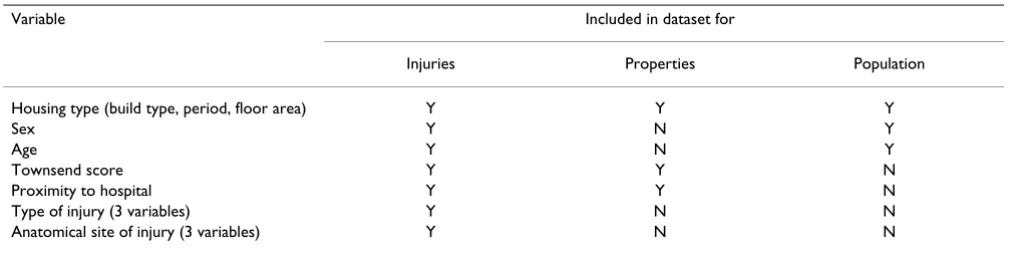
The other datasets to be linked were the population distri-bution by housing group, age and sex (112,248 subjects, no missing data) and a file listing 54,913 properties, of which we restrict attention to the 54,801 with complete data. Table 1 shows how the three sets of data include dif-ferent subsets of the variables. It is not possible to con-struct a comprehensively linked dataset at individual level enabling comparison of 14,171 injured and 98,077 unin-jured subjects, because individuals in the latter group lack deprivation and proximity data.
Following discussion of preliminary results it was decided to use actual deprivation and proximity scores for the injured, and to impute values randomly according to property type for the uninjured. This is appropriate because risk scores for the remaining variables, age and sex taken together as a forty two category categorical able, were uncorrelated with risk scores for all other vari-ables (see later), hence imputing according to property type alone and disregarding age and sex is a reasonable strategy.
The process of randomly imputing property records, and hence Townsend and proximity scores, to the 112,248 population according to housing type is not trivial. Using ordinary stratified sampling does not work, simply because the number of residents is larger than the number of properties. The overall occupancy ratio was 112,248 residents in 54,801 properties, i.e. 2.05 individuals per
property, but this figure varied widely between the 94 property types. For example, for property type 1 there were just under 2 people per property, 114 properties and 226 population. We then choose randomly 114 of the 226 population to match one-to-one to the 114 properties in a random order, leaving the remaining 112 to be matched to a random sample of the 114 properties also in a ran-dom order. This simply achieves a maximal degree of rep-resentativity with an appropriate degree of randomness. A multi-stage randomisation and linkage process (further details available from the authors) successfully linked the vast majority (14,081/14,171) of first attendances with the merged population-properties file. This has the effect of producing a merged data file in which the deprivation and distance scores randomly imputed to the uninjured both incorporate the correct means to produce an appro-priate degree of adjustment for confounding, and also the correct amount of variation to produce appropriate logis-tic regression coefficients to perform the adjustment.
The resulting linked file, comprising reconstructed data for all 112,248 residents, containing elements originating in population, properties and events files, has complete data for demographics, property type and randomly imputed Townsend and proximity measures. Among the 112,248 subjects, 14,081 are identified as having had one or more attendances for injuries following home acci-dents. Actual Townsend and proximity measures and the code for injury type 1 are available for each of the 14,081 injured individuals.
[image:3.612.53.562.99.226.2]The actual and imputed Townsend and proximity values were summarised for the injured and uninjured and com-pared. This was done by t-test, paired or unpaired as appropriate, rather than by non-parametric methods which were associated with a serious loss of power due to the gross discreteness of the small area based, randomly imputed Townsend score. Associations between random and actual Townsend and proximity scores were character-ised by Spearman rank correlations. Examination of these Table 1: Variables included in the 3 datasets to be linked.
Variable Included in dataset for
Injuries Properties Population
Housing type (build type, period, floor area) Y Y Y
Sex Y N Y
Age Y N Y
Townsend score Y Y N
Proximity to hospital Y Y N
Type of injury (3 variables) Y N N
results, together with the low correlations of a risk score for age and sex with those for property type variables, Townsend and proximity, suggested it was appropriate to include in the logistic regression model composite Townsend and proximity scores, defined as the actual value in the injured and the randomly imputed value in the uninjured. Property size, age and build type were entered as categorical variables. Preliminary analyses indi-cated that Townsend score should be included as a contin-uous variable, but distance from hospital discretised into five categories. On account of the known marked sex-age interaction, sex and subject's age were entered together as a 42-group categorical variable, age being discretised into groups under 1, 1–4, 5–9, ..., 90–94 and 95 and over.
The main analysis proceeded as above, using the 14,081 who were ever injured during the study period as the group with the outcome of interest. Both univariate anal-yses for each explanatory variable in turn and a multivar-iate analysis were produced.
Also, the main analysis was repeated after re-running the randomisation parts of the linkage process. This step is more radical than might appear. In particular, due to the small amount of missing data, the randomised matching program does not pick up exactly the same set of 14,081 events records on both occasions. Essentially, the process draws 14,081 out of 14,114 potentially matchable events.
Results
Table 2 shows summary statistics for actual and randomly imputed Townsend score and proximity. The summary statistics for the randomly imputed Townsend and prox-imity scores based on all 112,248 subjects are very similar but not identical to those for the 54,801 properties, from which they have been drawn. The mean randomly imputed Townsend score for the injured is very similar to the mean actual score in the 14,081 injured subjects, 0.85 (p = 0.78). Conversely, the randomly imputed distance measures are similar in injured and uninjured (p = 0.12), but the randomly imputed values are significantly greater than the actual ones in the 14,081 injured (p < 0.001). For the Townsend score, the randomly imputed scores are highly significantly higher (i.e. more deprived) for the injured (mean 0.86) than the uninjured (mean 0.70, p < 0.001). For Townsend score and distance alike, the differ-ence between the actual mean in the injured and the mean of randomly imputed values in those not injured is approximately correct to adjust for in the subsequent mul-tivariate analysis, and the process incorporates the appro-priate degree of variation at individual level.
[image:4.612.55.554.102.181.2]Table 3 gives Spearman rank correlations between ran-dom and actual Townsend and proximity measures. While all of these are statistically significant (p < 0.001), most are quite small. The correlation of nearly 0.2 between random and actual Townsend scores reflects the unsurprising, substantial variation in Townsend score between property types.
Table 2: Summary statistics (mean and SD) for actual and randomly imputed Townsend score and proximity to hospital.
Basis Series n Townsend score Distance (km)
[image:4.612.53.553.240.333.2]All properties 54,801 +0.74 (2.75) 8.33 (5.06) Randomly imputed All 112,248 +0.72 (2.77) 8.36 (5.05) Not injured 98,167 +0.70 (2.77) 8.37 (5.06) Injured 14,081 +0.86 (2.76) 8.30 (5.03) Actual Injured 14,081 +0.85 (2.77) 7.73 (4.87)
Table 3: Spearman rank correlations between random and actual Townsend and proximity measures.
Within groups between variables N Spearman rank correlation 95% confidence interval
Townsend v. distance
Randomly imputed 112,248 0.107 0.101 to 0.113
Actual 14,081 0.051 0.034 to 0.067
Randomly imputed v. actual
Townsend 14,081 0.193 0.177 to 0.209
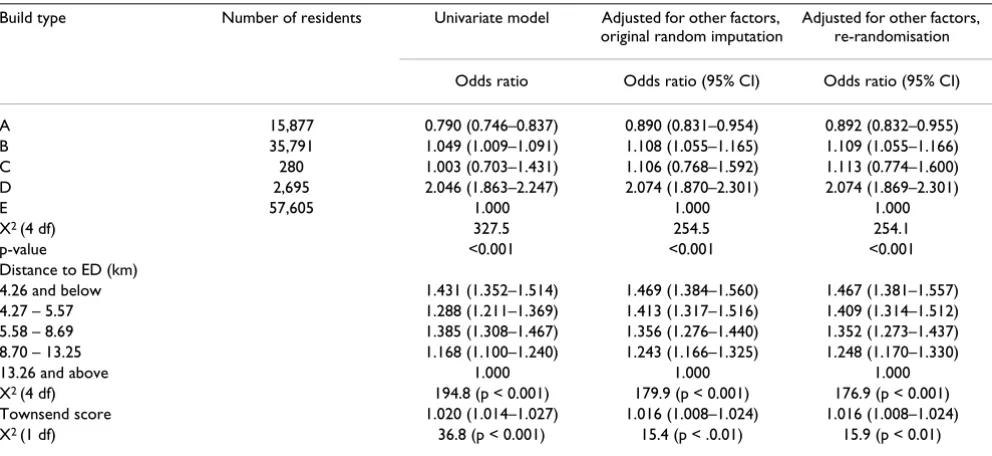
The effect of the random imputation process was explored in the main logistic regression model. In the final model the effect of age and sex jointly was dominant, followed by build type, then distance, property age, Townsend score (all p < 0.001) and floor area (p = 0.007). Table 4 shows the univariate and adjusted results with regard to build type, the housing variable with the clearest associa-tion with the proporassocia-tion of subjects who ever attended for a home injury. Adjustment for the confounding effects of the other variables made some difference to the odds ratios, but the doubled risk of injury in build type D remained essentially unaltered.
The results of the main multiple logistic regression model in table 4 were used to construct risk scores for each indi-vidual representing age and sex, the three property varia-bles, and the composite distance measure. Table 5 shows
parametric correlations of the risk score for sex and age with those for the three property variables and the com-posite distance measure, and the comcom-posite Townsend score. (This is, of course, equivalent to using a risk score based on it as it is entered as a linear factor in the model). Even though all but one of these correlations is highly sig-nificant, all of them are sufficiently small that we can regard the random imputation process as reasonable.
Discussion
[image:5.612.59.555.119.347.2]The main methodological finding of the study is that the random imputation process developed here is a reasona-ble one. This approach enareasona-bled us to base analyses on a very large dataset notwithstanding confidentiality issues precluding comprehensive linkage directly at individual level. It is feasible to incorporate randomisation into the linkage process, even when the target group is larger than Table 4: Main logistic regression model results. All first injuries (14,081 subjects out of 112,248). Odds ratios and X2 tests for effect of
build type on proportion of subjects ever injured (a) unadjusted; (b) adjusted for other factors after random imputation of deprivation and distance scores to the uninjured; and (c) adjusted for other factors after re-randomisation.
Build type Number of residents Univariate model Adjusted for other factors, original random imputation
Adjusted for other factors, re-randomisation
Odds ratio Odds ratio (95% CI) Odds ratio (95% CI)
A 15,877 0.790 (0.746–0.837) 0.890 (0.831–0.954) 0.892 (0.832–0.955) B 35,791 1.049 (1.009–1.091) 1.108 (1.055–1.165) 1.109 (1.055–1.166) C 280 1.003 (0.703–1.431) 1.106 (0.768–1.592) 1.113 (0.774–1.600) D 2,695 2.046 (1.863–2.247) 2.074 (1.870–2.301) 2.074 (1.869–2.301)
E 57,605 1.000 1.000 1.000
X2 (4 df) 327.5 254.5 254.1
p-value <0.001 <0.001 <0.001
Distance to ED (km)
4.26 and below 1.431 (1.352–1.514) 1.469 (1.384–1.560) 1.467 (1.381–1.557) 4.27 – 5.57 1.288 (1.211–1.369) 1.413 (1.317–1.516) 1.409 (1.314–1.512) 5.58 – 8.69 1.385 (1.308–1.467) 1.356 (1.276–1.440) 1.352 (1.273–1.437) 8.70 – 13.25 1.168 (1.100–1.240) 1.243 (1.166–1.325) 1.248 (1.170–1.330)
13.26 and above 1.000 1.000 1.000
X2 (4 df) 194.8 (p < 0.001) 179.9 (p < 0.001) 176.9 (p < 0.001)
Townsend score 1.020 (1.014–1.027) 1.016 (1.008–1.024) 1.016 (1.008–1.024) X2 (1 df) 36.8 (p < 0.001) 15.4 (p < .0.01) 15.9 (p < 0.01)
Table 5: Parametric correlations of risk scores for age and sex with those for other factors.
Parametric correlation of risk score for age and sex with: 95% confidence interval
[image:5.612.56.553.406.488.2]the source. The reasonableness of the imputation process can be judged by comparison of the actual and imputed variables for the injured population. For the Townsend score the actual and imputed scores are essentially identi-cal in distribution, thus showing that the methodology does not produce a biased result. For the distance variable the mean imputed value is 7.4% higher than the actual distance. Whilst this difference is statistically significant the magnitude of the effect on residual confounding can-not be large, given the odds ratios for attendance rates by distance in Table 4, which indicate that a 1% change in distance produces around a 1% change in the odds ratio for attendance.
The low correlation between randomly imputed and actual values, for distance from hospital and Townsend score, could result in attenuated regression coefficients and hence underadjustment for the confounding effect of these variables. For distance, which is by far the more influential of the two variables, a logistic regression in which the entire population of 112,248 is assumed to have the same distribution into the 5 distance groups as applies to the 54,801 properties gives odds ratios 1.469, 1.318, 1.445, 1.200 for the first 4 distance categories rela-tive to the 5th (most distant) one. These figures are similar to those obtained in the univariate logistic regression based on the composite distance measure, and suggest that the latter regression coefficients, and hence also those in the multiple regression, may be attenuated by around 10% only.
Of primary importance to the validity of the methodology set out here, the results obtained after a second randomi-sation were almost identical. The unadjusted analyses for age-sex and housing type were unaltered, as these varia-bles do not come from the random imputation. The anal-yses for deprivation and proximity and the results of multivariate analyses for build type and other variables were altered, but only to a very minor degree. These results provide considerable reassurance that the random ele-ment that was necessary in order to achieve the linkage process introduced very little additional uncertainty into the final analyses.
It appears that injured people tend to live in property types more associated with deprivation than the unin-jured. Their actual Townsend scores are in line with what we would expect from their property types. On the com-posite data, i.e. when we replace random by actual Townsend scores for the injured only, there is a substan-tial difference in mean Townsend score, 0.85 v. 0.70, and all the 0.15 points difference is attributable to a real effect of deprivation on risk.
Conversely, the injured and uninjured tend to live in property types equally distanced from hospital. The actual distance is less for the injured than the randomly imputed distance, which is in line with the known tendency for hospital attendance for less serious types of injury to be related to proximity(6). On the composite data (with means 7.73 v. 8.37 km), nearly the whole of the difference (0.57 out of 0.64 km) is attributable to this self-selection effect.
Conclusions
This process is an important methodological develop-ment to increase the power of linkage studies when all individual data elements are not available for all individ-uals. As a result the analysis was based on 112,248 sub-jects and not on ninety-four groups. Thus, the power to detect important differences is substantially enhanced.
Further work is continuing in the relationship between specific features of built type and injury occurrence, using the methodology described in this paper.
Competing interests
The author(s) declare that they have no competing interests.
Authors' contributions
All authors contributed to the design of the study. RGN devised the conceptual design of the data imputation and carried out the statistical analysis. All authors read and approved the final manuscript.
References
1. Housing and health: building for the future.London: British Med-ical Association 2003.
2. Statistical evidence to support the housing health and safety rating system, Project Report.London: Office of the Deputy Prime Minister 2003, 1:.
3. HANAH – Housing and Neighbourhoods and Health [http:// www.hanahproject.com]
4. Lyons RA, Jones S, Palmer SR, Kemp A, Sibert JR, Shepherd J, Rich-mond P: The development and use of a low-cost injury surveil-lance system: the All Wales Injury Surveilsurveil-lance System (AWISS).Injury Prevention 2002, 8:83-86.
5. Lyons RA, Jones SJ, Deacon T, Heaven M: Socio-economic varia-tion in injury in children and older people: populavaria-tion based study.Injury Prevention 2003, 9:33-37.
6. Lyons RA, Lo SV, Heaven M, Littlepage BNC: Injury surveillance in children – usefulness of a centralised database of accident and emergency attendances.Injury Prevention 1995, 1:173-176. 7. Townsend P, Phillimore P, Beattie A: Health and deprivation:
ine-quality and the north.London: Croom Helm 1998.
Pre-publication history
The pre-publication history for this paper can be accessed here: